Using Web 2.0 tools to enhance the teaching and learning of graduate blended coursesNitza M. Hernández, Ph.D.Graduate School of Information Sciences and TechnologyUniversity of Puerto RicoHETS First Annual Best Practices ShowcaseSan Juan PRJanuary 14, 2010
Purpose of thispresentationTo share how the use of web 2.0 tools have changed the way I have designed and delivered graduate courses.To show the effective use of web 2.0 tools for teaching and learning such as blogs, wikis and collaborative portals to motivate graduate students and engage them actively in their learning experience. To acknowledge the use of blended learning as an innovative approach or strategy that has proven to promote student success.
   “…blended learning is more than fashionable; it is training and educational delivery method of choice. Blended learning is dominating news in higher education, in corporate America, and in governmental training settings. It is now standard part of the education and training lexicon.” (Bonk, Kim & Zeng, 2005)AboutBlended Learning
“In recent experimental and quasi-experimental studies contrasting blends of online and face-to-face instruction with conventional face-to-face classes, blended instruction has been more effective, providing a rationale for the effort required to design and implement blended approaches. Even when used by itself, online learning appears to offer a modest advantage over conventional classroom instruction.”Advantages of blendedlearningIt was the combination of elements in the treatment conditions (which was likely to have included additional learning time and materials as well as additional opportunities for collaboration) that produced the observed learning advantages. At the same time, one should note that online learning is much more conducive to the expansion of learning time than is face-to-face instruction.”Means, B. et al. (2009) in Learning Evaluation of Evidence-Based Practices in Online Learning: A Meta-Analysis and Review of Online Learning Studies. Center for Technology, US Department of Education.
Exciting opportunities for students to debate and discuss scholarly ideas in an asynchronous forum, including blogs.Bring in outside or invited lecturers for a synchronous chat or videoconference. Some course meetings or training events are conducted virtually rather thanface-to-face.Supplement course readings and activities with online articles, simulations, events, videoconferences, and other technological resources.Conditions of blendedlearning
Hybrid modality that combines face-to-face interactions with online learning.Potential to provide more flexibility and accessibility to the course content at anytime from any place (most of the material available online).Provides for discussions in the classroom about the content of course on the Web. Most of the creative work come from the inclusion of Web 2.0 tools. Some studies demonstrate that students using Web resources learn more than using a traditional teaching approach (Rosales et al., 2008). Blended learning (B-learning)
Role of the instructor in BLThe instructor can combine various teaching methods and resources. A combination of technology-based materials and face-to-face sessions to present content. Begin a course with a well-structured introductory lesson in the classroom, and then proceed with follow-up materials online.
Web 2.0 Tools – Opportunitiesforblendedlearning
My coursedesign w/Web 2.0 Tools CINF 6300: IntroductiontoInformation Technologies
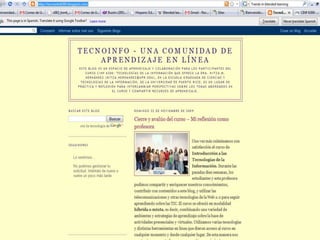
Blending web 2.0 tools and other technologies We used Blogger to develop the course blog TecnoInfoand PBWorks to develop the WIKI for the graduate course on Introduction to Information Technologies.The course blog was open to the community and some people outside the classroom visited the site and became “followers”.We did a video conference (IP) with professor Rene Sainz, from the Texas University in Bronwsville,  to learn more about the technology of videoconferencing and to stimulate inter-institutional collaboration between two HETS members.
Open source applications that facilitate interactive information sharing and collaboration on the Web.Some examples of Web 2.0 applicationsWikisBlogsVideo sharing sites (Youtube)Social networking sites (Facebook)Allow to organize and make information easy and fast to access.Provide for a greater diversity and enhancement of learning strategies and experiences Web 2.0 Tools
TecnoInfo- The Course BlogMy posts serve to introduce, integrate and summarize course topicsSelected and valuable videos from Youtube supplement and enhance learningLinks to other valuable blogs, websites and online resources widen learning perspectivesStudents are authorized as content developers together with me. They post or publish (mostly in Spanish, but some have done it in English as well, as they prefer):Article and news reviews about emerging technologiesBrief summaries of assigned readingsReflections of  their learning experience (brief essays)Executive Summaries of the Group Projects
Quality standards, timeliness and relevance are emphasized as major criteria for content development and publishing.  [I edit at times students entries.]Everyone is required or motivated to make comments to entries, as assigned or on a voluntary basis.Students create their own blogs following the model of the course blog. Autonomous and cooperative learning takes place.TecnoInfo- The Course Blog
Entries and comments in the Blog (Fallsemester 2009)ENTRIES / POSTINGSCOMMENTS toentriesorpostings10 --- Professor26 --- Students  Total --- 36 61 --- Professor38 --- StudentsTotal --- 99TOPICS
Topicsdeveloped in the BlogEmerging and web 2.0 technologiesGoogle Wave, Twitter, Last.fm, Podcasting, Google Earth and museums, wiki, YoutubeOpen sourceOpen accessTechnological paradigmsDigital librariesVirtual educationVideogames in librariesData bases
Usedmainlyfor:Guidelines and rubricsforcourseprojectsMonitoringteamworkfor final projectsWorking virtual spacesforeachgroupStudentcollaborationTheCourse Wiki
Flexible access to online materials and course documents.Development of a cooperative network to exchange information and knowledge on the web.Combination of different strategies in the teaching-learning process to enrich class discussion and blog posting. Outcomes
OutcomesStudents strengthen their research skills using various information and communication technologies.  Students learn to communicate and collaborate through virtual/online learning environments, from anywhere at anytime.As part of their final projects students develop project proposals and value added information products using podcasting,  screencasting and videocasting technologies, as well as other social networking tools.
Feel much more prepared for using Web 2.0 toolsValue theoretical background of the course for internet usage and professional applications of social networking technologies. Changed their technological paradigm. Recognized the “added value” of internet tools for their research and development of professional competencies in librarianship. Learned how to evaluate, classify and choose reliable information available on the Internet. Student course evaluations(What students expressed  (11/09)
Student course evaluations(What students expressed  (11/09)Satisfaction with their group work at a distance (WIKI), the blended strategies and flexible access to the course materials (24/7).Appreciation of content requirements and quality standards for publishing their work in a graduate blog that is public.Value the paperless nature of the course and the digitized resources.Blog allowed and Wiki allowed constant and open communication with the professor and among peers.Recognition of the innovative modality of the course.
On the Seminar we use an open source content management system to create virtual learning environment. Students have access to digitized readings in the Document Library and have posted their work on the content management system.TheSeminaronKnowledge Management
Use of Alfrescoforblendingthecourse in a portal environment – open sourceapplicationforcollaborationDocumentmanagement – capture, share and retaincontent
Web contentmanagement – engagestudentsthroughcontent
Collaboration – CollaborativecontentmanagementUse of SKYPEformost of thevideoconferenceswithinvitedlecturers. (Weretaped and placed in the portal.)TheSeminaronKnowledge Management
Final words – a testimonyThings I havelearned… Use web 2.0 resourcestoinnovateon my teachingstrategies and transformtheway I teach.Focusessentiallyonstudents’ learning and outcomes.Empower my studentswithpublishingcapabilities in a blog thatisbeingmadepublic.Stimulateautonomouslearning and guide collaboration of my studentsthroughtechnology. Managetheknowledge and learningprocesswith social networktechnologies.

Using Web Tools To Enhance Teaching & Learning

  • 1.
    Using Web 2.0tools to enhance the teaching and learning of graduate blended coursesNitza M. Hernández, Ph.D.Graduate School of Information Sciences and TechnologyUniversity of Puerto RicoHETS First Annual Best Practices ShowcaseSan Juan PRJanuary 14, 2010
  • 2.
    Purpose of thispresentationToshare how the use of web 2.0 tools have changed the way I have designed and delivered graduate courses.To show the effective use of web 2.0 tools for teaching and learning such as blogs, wikis and collaborative portals to motivate graduate students and engage them actively in their learning experience. To acknowledge the use of blended learning as an innovative approach or strategy that has proven to promote student success.
  • 3.
    “…blended learning is more than fashionable; it is training and educational delivery method of choice. Blended learning is dominating news in higher education, in corporate America, and in governmental training settings. It is now standard part of the education and training lexicon.” (Bonk, Kim & Zeng, 2005)AboutBlended Learning
  • 4.
    “In recent experimentaland quasi-experimental studies contrasting blends of online and face-to-face instruction with conventional face-to-face classes, blended instruction has been more effective, providing a rationale for the effort required to design and implement blended approaches. Even when used by itself, online learning appears to offer a modest advantage over conventional classroom instruction.”Advantages of blendedlearningIt was the combination of elements in the treatment conditions (which was likely to have included additional learning time and materials as well as additional opportunities for collaboration) that produced the observed learning advantages. At the same time, one should note that online learning is much more conducive to the expansion of learning time than is face-to-face instruction.”Means, B. et al. (2009) in Learning Evaluation of Evidence-Based Practices in Online Learning: A Meta-Analysis and Review of Online Learning Studies. Center for Technology, US Department of Education.
  • 5.
    Exciting opportunities forstudents to debate and discuss scholarly ideas in an asynchronous forum, including blogs.Bring in outside or invited lecturers for a synchronous chat or videoconference. Some course meetings or training events are conducted virtually rather thanface-to-face.Supplement course readings and activities with online articles, simulations, events, videoconferences, and other technological resources.Conditions of blendedlearning
  • 6.
    Hybrid modality thatcombines face-to-face interactions with online learning.Potential to provide more flexibility and accessibility to the course content at anytime from any place (most of the material available online).Provides for discussions in the classroom about the content of course on the Web. Most of the creative work come from the inclusion of Web 2.0 tools. Some studies demonstrate that students using Web resources learn more than using a traditional teaching approach (Rosales et al., 2008). Blended learning (B-learning)
  • 7.
    Role of theinstructor in BLThe instructor can combine various teaching methods and resources. A combination of technology-based materials and face-to-face sessions to present content. Begin a course with a well-structured introductory lesson in the classroom, and then proceed with follow-up materials online.
  • 8.
    Web 2.0 Tools– Opportunitiesforblendedlearning
  • 9.
    My coursedesign w/Web2.0 Tools CINF 6300: IntroductiontoInformation Technologies
  • 10.
    Blending web 2.0tools and other technologies We used Blogger to develop the course blog TecnoInfoand PBWorks to develop the WIKI for the graduate course on Introduction to Information Technologies.The course blog was open to the community and some people outside the classroom visited the site and became “followers”.We did a video conference (IP) with professor Rene Sainz, from the Texas University in Bronwsville, to learn more about the technology of videoconferencing and to stimulate inter-institutional collaboration between two HETS members.
  • 11.
    Open source applicationsthat facilitate interactive information sharing and collaboration on the Web.Some examples of Web 2.0 applicationsWikisBlogsVideo sharing sites (Youtube)Social networking sites (Facebook)Allow to organize and make information easy and fast to access.Provide for a greater diversity and enhancement of learning strategies and experiences Web 2.0 Tools
  • 14.
    TecnoInfo- The CourseBlogMy posts serve to introduce, integrate and summarize course topicsSelected and valuable videos from Youtube supplement and enhance learningLinks to other valuable blogs, websites and online resources widen learning perspectivesStudents are authorized as content developers together with me. They post or publish (mostly in Spanish, but some have done it in English as well, as they prefer):Article and news reviews about emerging technologiesBrief summaries of assigned readingsReflections of their learning experience (brief essays)Executive Summaries of the Group Projects
  • 15.
    Quality standards, timelinessand relevance are emphasized as major criteria for content development and publishing. [I edit at times students entries.]Everyone is required or motivated to make comments to entries, as assigned or on a voluntary basis.Students create their own blogs following the model of the course blog. Autonomous and cooperative learning takes place.TecnoInfo- The Course Blog
  • 16.
    Entries and commentsin the Blog (Fallsemester 2009)ENTRIES / POSTINGSCOMMENTS toentriesorpostings10 --- Professor26 --- Students Total --- 36 61 --- Professor38 --- StudentsTotal --- 99TOPICS
  • 17.
    Topicsdeveloped in theBlogEmerging and web 2.0 technologiesGoogle Wave, Twitter, Last.fm, Podcasting, Google Earth and museums, wiki, YoutubeOpen sourceOpen accessTechnological paradigmsDigital librariesVirtual educationVideogames in librariesData bases
  • 19.
    Usedmainlyfor:Guidelines and rubricsforcourseprojectsMonitoringteamworkforfinal projectsWorking virtual spacesforeachgroupStudentcollaborationTheCourse Wiki
  • 20.
    Flexible access toonline materials and course documents.Development of a cooperative network to exchange information and knowledge on the web.Combination of different strategies in the teaching-learning process to enrich class discussion and blog posting. Outcomes
  • 21.
    OutcomesStudents strengthen theirresearch skills using various information and communication technologies. Students learn to communicate and collaborate through virtual/online learning environments, from anywhere at anytime.As part of their final projects students develop project proposals and value added information products using podcasting, screencasting and videocasting technologies, as well as other social networking tools.
  • 22.
    Feel much moreprepared for using Web 2.0 toolsValue theoretical background of the course for internet usage and professional applications of social networking technologies. Changed their technological paradigm. Recognized the “added value” of internet tools for their research and development of professional competencies in librarianship. Learned how to evaluate, classify and choose reliable information available on the Internet. Student course evaluations(What students expressed (11/09)
  • 23.
    Student course evaluations(Whatstudents expressed (11/09)Satisfaction with their group work at a distance (WIKI), the blended strategies and flexible access to the course materials (24/7).Appreciation of content requirements and quality standards for publishing their work in a graduate blog that is public.Value the paperless nature of the course and the digitized resources.Blog allowed and Wiki allowed constant and open communication with the professor and among peers.Recognition of the innovative modality of the course.
  • 24.
    On the Seminarwe use an open source content management system to create virtual learning environment. Students have access to digitized readings in the Document Library and have posted their work on the content management system.TheSeminaronKnowledge Management
  • 25.
    Use of Alfrescoforblendingthecoursein a portal environment – open sourceapplicationforcollaborationDocumentmanagement – capture, share and retaincontent
  • 26.
    Web contentmanagement –engagestudentsthroughcontent
  • 27.
    Collaboration – CollaborativecontentmanagementUseof SKYPEformost of thevideoconferenceswithinvitedlecturers. (Weretaped and placed in the portal.)TheSeminaronKnowledge Management
  • 28.
    Final words –a testimonyThings I havelearned… Use web 2.0 resourcestoinnovateon my teachingstrategies and transformtheway I teach.Focusessentiallyonstudents’ learning and outcomes.Empower my studentswithpublishingcapabilities in a blog thatisbeingmadepublic.Stimulateautonomouslearning and guide collaboration of my studentsthroughtechnology. Managetheknowledge and learningprocesswith social networktechnologies.