MOOC
PRESENTATION
WHAT IS MOOC ALL
ABOUT?
• A Massive Open Online Course is an online
course aimed at unlimited participation and
open access via the web.
In addition to traditional course materials such as
videos, readings, and problem sets, MOOCs provide
interactive user fora that help build a community for
students, professors, and teaching assistants (TAs).
MOOCs are a recent development in distance
education.
In simple words mooc is a course of study made
available over the Internet without charge to a very
large number of people: anyone who decides to
take a MOOC simply logs on to the website and
signs up.
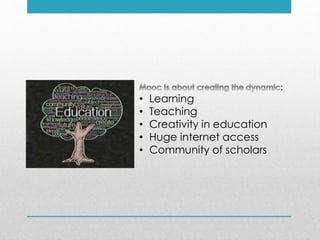
:
• Learning
• Teaching
• Creativity in education
• Huge internet access
• Community of scholars
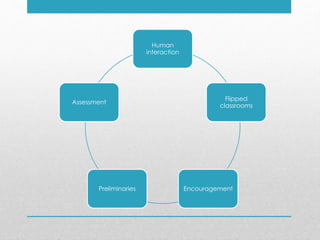
Human
interaction
Flipped
classrooms
EncouragementPreliminaries
Assessment
What is the MOOC’s
history?
Before the Digital Age, distance learning appeared in the form of
correspondence courses, broadcast courses and early forms of e-
learning. By the 1890s correspondence courses on specialized
topics such as civil service tests and shorthand were promoted by
door-to-door salesmen. Broadcast radio was new in the 1920s and
with programs that were free to audiences of any size. By 1922,
New York University operated its own radio station, with plans to
broadcast practically all its courses. Other schools followed,
including Columbia, Harvard, Kansas State, Ohio State, NYU,
Purdue, Wisconsin, Utah and many others. Students read
textbooks and listened to broadcast lectures, while mailing in
answers to test.
At many universities in the 1980s classrooms were linked to a
remote campus to provide closed-circuit video access for some
students.
In 1994, James J. O'Donnell of the University of Pennsylvania
taught a seminar over the Internet, using gopher and email, on
the life and works of St. The short lecture format used by many
MOOCs developed from "Khan free archive of snappy
instructional videos. The course was open to all participants who
could have access to radio and the internet.
Thinking how could the
technology used back
then accommodate all
these social media
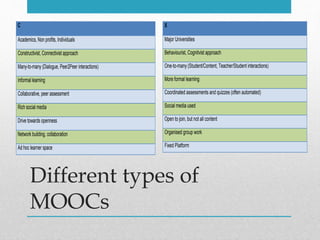
Different types of
MOOCs
C
Academics, Non profits, Individuals
Constructivist, Connectivist approach
Many-to-many (Dialogue, Peer2Peer interactions)
Informal learning
Collaborative, peer assessment
Rich social media
Drive towards openness
Network building, collaboration
Ad hoc learner space
X
Major Universities
Behaviourist, Cognitvist approach
One-to-many (Student/Content, Teacher/Student interactions)
More formal learning
Coordinated assessments and quizzes (often automated)
Social media used
Open to join, but not all content
Organised group work
Fixed Platform
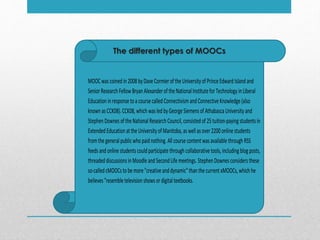
The different types of MOOCs
MOOCwascoinedin2008 byDaveCormieroftheUniversityofPrinceEdward Island and
SeniorResearch FellowBryan AlexanderoftheNationalInstituteforTechnologyinLiberal
Educationinresponsetoacoursecalled ConnectivismandConnectiveKnowledge(also
knownasCCK08).CCK08,which wasled byGeorgeSiemensof AthabascaUniversityand
StephenDownesoftheNationalResearch Council,consistedof25tuition-payingstudentsin
ExtendedEducation attheUniversityofManitoba,aswellasover2200 onlinestudents
fromthegeneralpublicwho paidnothing. Allcoursecontentwasavailablethrough RSS
feedsand onlinestudentscouldparticipatethrough collaborativetools,includingblogposts,
threaded discussionsinMoodleandSecond Lifemeetings. StephenDownesconsidersthese
so-calledcMOOCstobemore"creativeanddynamic"thanthecurrentxMOOCs,which he
believes"resembletelevision showsordigitaltextbooks.
How is MOOC used in
terms of education?
• E-learning is more like face-to-face teaching
and learning; it is an effective distance way of
education to take place. As for MOOC is it a
broad educational tool that motivate teachers
to explore and innovate methods effective
teaching. For learners it create and
environment to explore many learning
opportunities.
How is MOOC important
to me as a student teacher?
• Designing and facilitating online courses with a
diverse student population is a challenge for new,
as well as experienced online teachers. This course
invites your critical reflection on the methods of
online instruction; beliefs and potential bias of the
online learner; policies and rules and how they align
with course objectives; tone and the purpose of
communication. I have collected readings and
experiences of practice from other online teachers
and students to provide a foundation for E-learning
on my teaching field. As a teacher mooc is the tool
to create effective lessons as there is more content
online.
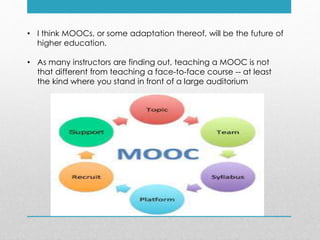
• I think MOOCs, or some adaptation thereof, will be the future of
higher education.
• As many instructors are finding out, teaching a MOOC is not
that different from teaching a face-to-face course -- at least
the kind where you stand in front of a large auditorium
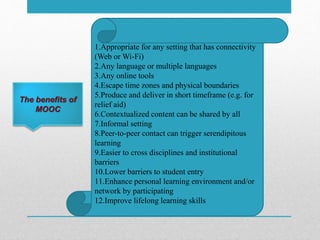
The benefits of
MOOC
1.Appropriate for any setting that has connectivity
(Web or Wi-Fi)
2.Any language or multiple languages
3.Any online tools
4.Escape time zones and physical boundaries
5.Produce and deliver in short timeframe (e.g. for
relief aid)
6.Contextualized content can be shared by all
7.Informal setting
8.Peer-to-peer contact can trigger serendipitous
learning
9.Easier to cross disciplines and institutional
barriers
10.Lower barriers to student entry
11.Enhance personal learning environment and/or
network by participating
12.Improve lifelong learning skills
My interests
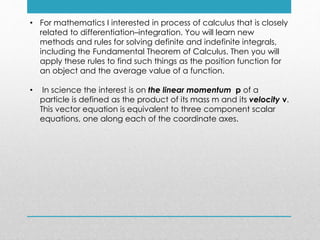
• For mathematics I interested in process of calculus that is closely
related to differentiation–integration. You will learn new
methods and rules for solving definite and indefinite integrals,
including the Fundamental Theorem of Calculus. Then you will
apply these rules to find such things as the position function for
an object and the average value of a function.
• In science the interest is on the linear momentum p of a
particle is defined as the product of its mass m and its velocity v.
This vector equation is equivalent to three component scalar
equations, one along each of the coordinate axes.
List of references
http://www.ed.ac.uk/studying/online-
learning/moocs/moocs
http://www.moocs.co/
http://www.mooc-list.com

Mz mandhlazi 201241723

  • 1.
  • 2.
    WHAT IS MOOCALL ABOUT? • A Massive Open Online Course is an online course aimed at unlimited participation and open access via the web.
  • 3.
    In addition totraditional course materials such as videos, readings, and problem sets, MOOCs provide interactive user fora that help build a community for students, professors, and teaching assistants (TAs). MOOCs are a recent development in distance education. In simple words mooc is a course of study made available over the Internet without charge to a very large number of people: anyone who decides to take a MOOC simply logs on to the website and signs up.
  • 4.
    : • Learning • Teaching •Creativity in education • Huge internet access • Community of scholars
  • 5.
  • 6.
    What is theMOOC’s history?
  • 7.
    Before the DigitalAge, distance learning appeared in the form of correspondence courses, broadcast courses and early forms of e- learning. By the 1890s correspondence courses on specialized topics such as civil service tests and shorthand were promoted by door-to-door salesmen. Broadcast radio was new in the 1920s and with programs that were free to audiences of any size. By 1922, New York University operated its own radio station, with plans to broadcast practically all its courses. Other schools followed, including Columbia, Harvard, Kansas State, Ohio State, NYU, Purdue, Wisconsin, Utah and many others. Students read textbooks and listened to broadcast lectures, while mailing in answers to test.
  • 8.
    At many universitiesin the 1980s classrooms were linked to a remote campus to provide closed-circuit video access for some students. In 1994, James J. O'Donnell of the University of Pennsylvania taught a seminar over the Internet, using gopher and email, on the life and works of St. The short lecture format used by many MOOCs developed from "Khan free archive of snappy instructional videos. The course was open to all participants who could have access to radio and the internet. Thinking how could the technology used back then accommodate all these social media
  • 9.
    Different types of MOOCs C Academics,Non profits, Individuals Constructivist, Connectivist approach Many-to-many (Dialogue, Peer2Peer interactions) Informal learning Collaborative, peer assessment Rich social media Drive towards openness Network building, collaboration Ad hoc learner space X Major Universities Behaviourist, Cognitvist approach One-to-many (Student/Content, Teacher/Student interactions) More formal learning Coordinated assessments and quizzes (often automated) Social media used Open to join, but not all content Organised group work Fixed Platform
  • 10.
    The different typesof MOOCs MOOCwascoinedin2008 byDaveCormieroftheUniversityofPrinceEdward Island and SeniorResearch FellowBryan AlexanderoftheNationalInstituteforTechnologyinLiberal Educationinresponsetoacoursecalled ConnectivismandConnectiveKnowledge(also knownasCCK08).CCK08,which wasled byGeorgeSiemensof AthabascaUniversityand StephenDownesoftheNationalResearch Council,consistedof25tuition-payingstudentsin ExtendedEducation attheUniversityofManitoba,aswellasover2200 onlinestudents fromthegeneralpublicwho paidnothing. Allcoursecontentwasavailablethrough RSS feedsand onlinestudentscouldparticipatethrough collaborativetools,includingblogposts, threaded discussionsinMoodleandSecond Lifemeetings. StephenDownesconsidersthese so-calledcMOOCstobemore"creativeanddynamic"thanthecurrentxMOOCs,which he believes"resembletelevision showsordigitaltextbooks.
  • 11.
    How is MOOCused in terms of education? • E-learning is more like face-to-face teaching and learning; it is an effective distance way of education to take place. As for MOOC is it a broad educational tool that motivate teachers to explore and innovate methods effective teaching. For learners it create and environment to explore many learning opportunities.
  • 15.
    How is MOOCimportant to me as a student teacher? • Designing and facilitating online courses with a diverse student population is a challenge for new, as well as experienced online teachers. This course invites your critical reflection on the methods of online instruction; beliefs and potential bias of the online learner; policies and rules and how they align with course objectives; tone and the purpose of communication. I have collected readings and experiences of practice from other online teachers and students to provide a foundation for E-learning on my teaching field. As a teacher mooc is the tool to create effective lessons as there is more content online.
  • 16.
    • I thinkMOOCs, or some adaptation thereof, will be the future of higher education. • As many instructors are finding out, teaching a MOOC is not that different from teaching a face-to-face course -- at least the kind where you stand in front of a large auditorium
  • 17.
    The benefits of MOOC 1.Appropriatefor any setting that has connectivity (Web or Wi-Fi) 2.Any language or multiple languages 3.Any online tools 4.Escape time zones and physical boundaries 5.Produce and deliver in short timeframe (e.g. for relief aid) 6.Contextualized content can be shared by all 7.Informal setting 8.Peer-to-peer contact can trigger serendipitous learning 9.Easier to cross disciplines and institutional barriers 10.Lower barriers to student entry 11.Enhance personal learning environment and/or network by participating 12.Improve lifelong learning skills
  • 18.
  • 20.
    • For mathematicsI interested in process of calculus that is closely related to differentiation–integration. You will learn new methods and rules for solving definite and indefinite integrals, including the Fundamental Theorem of Calculus. Then you will apply these rules to find such things as the position function for an object and the average value of a function. • In science the interest is on the linear momentum p of a particle is defined as the product of its mass m and its velocity v. This vector equation is equivalent to three component scalar equations, one along each of the coordinate axes.
  • 21.