Using Third Party Components for
Building an Application Might be More
Dangerous Than You Think!
Achim D. Brucker Fabio Massacci Stanislav Dashevskyi
Abstract
2
Today, nearly all developers rely on third party components for building an application. Thus, for most software vendors, third
party components in general and Free/Libre and Open Source Software (FLOSS) in particular, are an integral part of their
software supply chain.
As the security of a software offering, independently of the delivery model, depends on all components, a secure software supply
chain is of utmost importance. While this is true for both proprietary and as well as FLOSS components that are consumed,
FLOSS components impose particular challenges as well as provide unique opportunities. For example, on the one hand,
FLOSS licenses contain usually a very strong “no warranty” clause and no service-level agreement. On the other hand, FLOSS
licenses allow to modify the source code and, thus, to fix issues without depending on an (external) software vendor.
This talk is based on working on integrating securely third-party components in general, and FLOSS components in particular,
into the SAP's Security Development Lifecycle (SSDL). Thus, our experience covers a wide range of products (e.g., from small
mobile applications of a few thousands lines of code to large scale enterprise applications with more than a billion lines of code),
a wide range of software development models (ranging from traditional waterfall to agile software engineering to DevOps), as
well as a multiple deployment models (e.g., on premise products, custom hosting, or software-as-a-service).
About Us
Achim D. Brucker
• Senior Lecturer (Software Security), University of Sheffield, UK
• Software Security Consultant
• Until 12/2015: Security Testing Strategist at SAP SE, Germany
3
Stanislav Dashevskyi
• PhD Student at the University of Trento and SAP SE, France
Part I:
Securing The Software Supply Chain
or
The Security Risk of Third Party Components
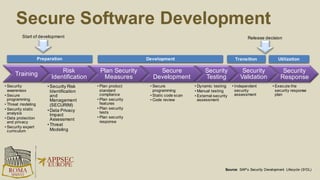
Preparation Development UtilizationTransition
Start of development Release decision
Training
• Security
awareness
• Secure
programming
• Threat modeling
• Security static
analysis
• Data protection
and privacy
• Security expert
curriculum
Risk
Identification
•Security Risk
Identification
and
Management
(SECURIM)
•Data Privacy
Impact
Assessment
•Threat
Modeling
Plan Security
Measures
• Plan product
standard
compliance
• Plan security
features
• Plan security
tests
• Plan security
response
Secure
Development
• Secure
programming
• Static code scan
• Code review
Security
Testing
• Dynamic testing
• Manual testing
• External security
assessment
Security
Validation
• Independent
security
assessment
Security
Response
• Execute the
security response
plan
Secure Software Development
Source: SAP’s Security Development Lifecycle (S2DL)
Preparation Development UtilizationTransition
Start of development Release decision
Training
• Security
awareness
• Secure
programming
• Threat modeling
• Security static
analysis
• Data protection
and privacy
• Security expert
curriculum
Risk
Identification
•Security Risk
Identification
and
Management
(SECURIM)
•Data Privacy
Impact
Assessment
•Threat
Modeling
Plan Security
Measures
• Plan product
standard
compliance
• Plan security
features
• Plan security
tests
• Plan security
response
Secure
Development
• Secure
programming
• Static code scan
• Code review
Security
Testing
• Dynamic testing
• Manual testing
• External security
assessment
Security
Validation
• Independent
security
assessment
Security
Response
• Execute the
security response
plan
Secure Software Development
Source: SAP’s Security Development Lifecycle (S2DL)
Preparation Development UtilizationTransition
Start of development Release decision
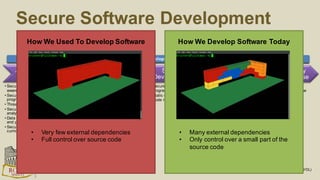
• Many external dependencies
• Only control over a small part of the
source code
How We Develop Software Today
• Very few external dependencies
• Full control over source code
How We Used To Develop Software
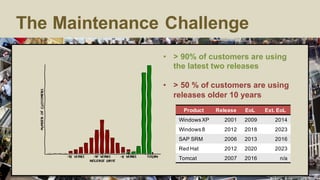
The Maintenance Challenge
• > 90% of customers are using
the latest two releases
• > 50 % of customers are using
releases older 10 years
Product Release EoL Ext. EoL
Windows XP 2001 2009 2014
Windows 8 2012 2018 2023
SAP SRM 2006 2013 2016
Red Hat 2012 2020 2023
Tomcat 2007 2016 n/a
Preparation Development UtilizationTransition
Start of development Release decision
Training
• Security
awareness
• Secure
programming
• Threat modeling
• Security static
analysis
• Data protection
and privacy
• Security expert
curriculum
Risk
Identification
•Security Risk
Identification
and
Management
(SECURIM)
•Data Privacy
Impact
Assessment
•Threat
Modeling
Plan Security
Measures
• Plan product
standard
compliance
• Plan security
features
• Plan security
tests
• Plan security
response
Secure
Development
• Secure
programming
• Static code scan
• Code review
Security
Testing
• Dynamic testing
• Manual testing
• External security
assessment
Security
Validation
• Independent
security
assessment
Security
Response
• Execute the
security response
plan
Secure Software Development
Source: SAP’s Security Development Lifecycle (S2DL)
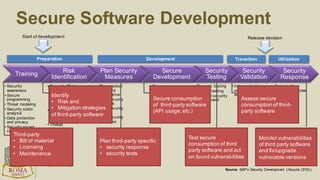
Third-party
• Bill of material
• Licensing
• Maintenance
Identify
• Risk and
• Mitigation strategies
of third-party software
Plan third-party specific
• security response
• security tests
Secure consumption
of third-party software
(API usage, etc.)
Test secure
consumption of third
party software and act
on found vulnerabilities
Assess secure
consumption of third-
party software
Monitor vulnerabilities
of third party software
and fix/upgrade
vulnerable versions
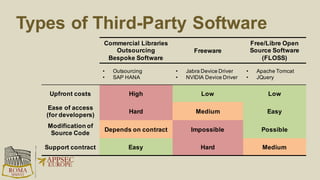
Types of Third-Party Software
Commercial Libraries
Outsourcing
Bespoke Software
Freeware
Free/Libre Open
Source Software
(FLOSS)
• Outsourcing
• SAP HANA
• Jabra Device Driver
• NVIDIA Device Driver
• Apache Tomcat
• JQuery
Upfront costs High Low Low
Ease of access
(for developers)
Hard Medium Easy
Modification of
Source Code
Depends on contract Impossible Possible
Support contract Easy Hard Medium
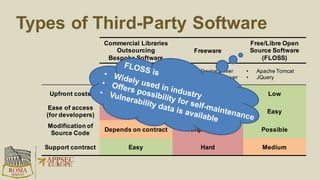
Types of Third-Party Software
Commercial Libraries
Outsourcing
Bespoke Software
Freeware
Free/Libre Open
Source Software
(FLOSS)
• Outsourcing
• SAP HANA
• Jabra Device Driver
• NVIDIA Device Driver
• Apache Tomcat
• JQuery
Upfront costs High Low Low
Ease of access
(for developers)
Hard Medium Easy
Modification of
Source Code
Depends on contract Impossible Possible
Support contract Easy Hard Medium
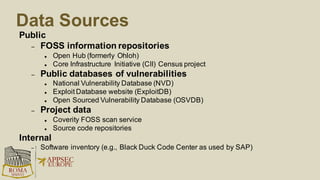
Data Sources
Public
 FOSS information repositories
 Open Hub (formerly Ohloh)
 Core Infrastructure Initiative (CII) Census project
 Public databases of vulnerabilities
 National Vulnerability Database (NVD)
 Exploit Database website (ExploitDB)
 Open Sourced Vulnerability Database (OSVDB)
 Project data
 Coverity FOSS scan service
 Source code repositories
Internal
 Software inventory (e.g., Black Duck Code Center as used by SAP)
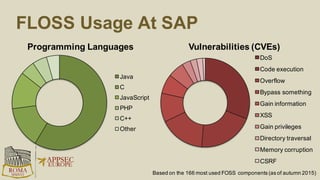
FLOSS Usage At SAP
Based on the 166 most used FOSS components (as of autumn 2015)
Programming Languages
Java
C
JavaScript
PHP
C++
Other
Vulnerabilities (CVEs)
DoS
Code execution
Overflow
Bypass something
Gain information
XSS
Gain privileges
Directory traversal
Memory corruption
CSRF
Part II:
Security of Open Source Enterprise Frameworks
or
Assessing Risks and Planning Efforts of the Secure
Consumption of FLOSS
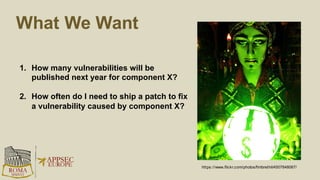
What We Want
https://www.flickr.com/photos/fimbrethil/4507848067/
1. How many vulnerabilities will be
published next year for component X?
2. How often do I need to ship a patch to fix
a vulnerability caused by component X?
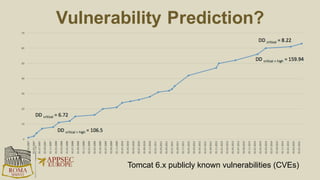
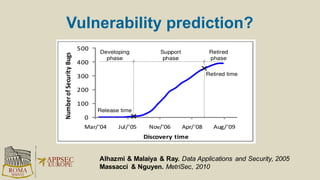
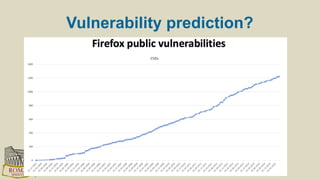
Vulnerability Prediction?
Tomcat 6.x publicly known vulnerabilities (CVEs)
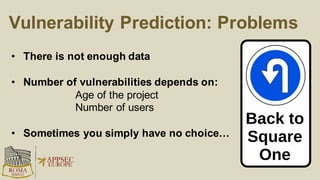
Vulnerability Prediction: Problems
• There is not enough data
• Number of vulnerabilities depends on:
Age of the project
Number of users
• Sometimes you simply have no choice…
Understanding Factors Is More
Critical Than Predictions
 When will a vulnerability appear in a FOSS component?
 We do not know
 Can we distinguish features of projects causing
"problems" for consuming software?
 We use maintenance effort of proprietary consumers to denote “problems”
 Does the ”security culture” of FOSS developers make a difference?
 Does is make a difference which main language/technology is used?
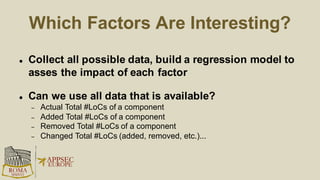
Which Factors Are Interesting?
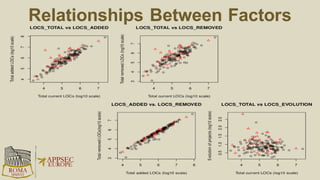
 Collect all possible data, build a regression model to
asses the impact of each factor
 Can we use all data that is available?
 Actual Total #LoCs of a component
 Added Total #LoCs of a component
 Removed Total #LoCs of a component
 Changed Total #LoCs (added, removed, etc.)...
Relationships Between Factors
Different Maintenance Models
 60 products are using Apache Tomcat
 Requires a lot of expertise to resolve security issues
 It makes more sense to have a team of Apache Tomcat experts around
 2 products are using a small JavaScript library
 This does not require any major expertise
 However, if a company ends up using large number of products for which only the
“local” expertise exists, it may be problematic
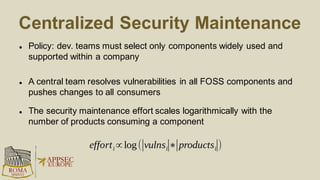
Centralized Security Maintenance
 Policy: dev. teams must select only components widely used and
supported within a company
 A central team resolves vulnerabilities in all FOSS components and
pushes changes to all consumers
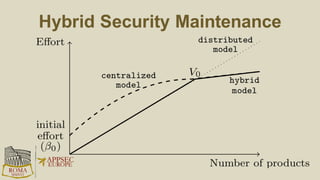
 The security maintenance effort scales logarithmically with the
number of products consuming a component
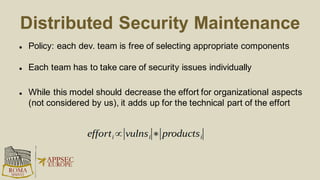
Distributed Security Maintenance
 Policy: each dev. team is free of selecting appropriate components
 Each team has to take care of security issues individually
 While this model should decrease the effort for organizational aspects
(not considered by us), it adds up for the technical part of the effort
Hybrid Security Maintenance
Part III:
Practical Recommendations On
Controling Risk & Effort Of Using Third Party Components
Secure Software Development Life Cycle
 Maintain a detailed software inventory
(Do not forget the dependencies)
 Actively monitor vulnerability databases
 Assess project specific risk of third-party components
Obtaining components (or sources)
 Download from trustworthy sources
(https, check signatures/checksums)
Strategies For Controlling Risks (1/2)
Project Selection
 Prefer projects with private bug trackers
 Evidences of a healthy/working SDLC
 Documented security fixes/patches
(no “secret” security fixes)
 Documented security guidelines
 Use of security testing tools
Strategies For Controlling Risks (2/2)
https://www.coreinfrastructure.org/programs
Secure Software Development Life Cycle
 Update early and often
 Avoid own forks
(collaborate with FLOSS community)
Project selection
 Large user base
 Active development community
 Technologies you are familiar with
 Compatible maintenance strategy/life cycle
 Smaller (in terms of code size) and less complex might be better
Strategies For Controlling Effort
Part IV:
Conclusion
Do not waste time with unimportant questions!
(Is FLOSS more/less secure as proprietary software)
Implement a secure consumption strategy:
• Risk assessment of third party consumption (at least security & licenses)
• Plan for the efforts of secure consumption
• Plan the efforts/costs for response and maintenance
Conclusion
Do not waste time with unimportant questions!
(Is FLOSS more/less secure as proprietary software)
Implement a secure consumption strategy:
• Risk assessment of third party consumption (at least security & licenses)
• Plan for the efforts of secure consumption
• Plan the efforts/costs for response and maintenance
Conclusion
Final advice:
• Accept that you can be hit by a “black swan” (e.g., heartbleed)
• If it happens:
• Concentrate on understanding and fixing the issue
• Understanding why you did not find the swan
earlier should not be your first priority
Achim D. Brucker
Department of Computer Science
University of Sheffield
Regent Court
211 Portobello St.
Sheffield S1 4DP, UK
https://de.linkedin.com/in/adbrucker
https://www.brucker.uk
https://www.logicalhacking.com
a.brucker@sheffield.ac.uk
Stanislav Dashevskyi
University of Trento
Scuola di dottorato in Informatica e Telecomunicazioni
Via Sommarive, 14
38123 Povo, Italy
https://st.fbk.eu/people/profile/dashevskyi
stanislav.dashevskyi@unitn.it
Contact:
Thank you!
Bibliography
 Stanislav Dashevskyi, Achim D. Brucker, and Fabio Massacci. On the Security Cost of Using a Free and Open
Source Component in a Proprietary Product. In International Symposium on Engineering Secure Software and
Systems (ESSoS). Lecture Notes in Computer Science 9639, Springer-Verlag, 2016.
https://www.brucker.ch/bibliography/abstract/dashevskyi.ea-foss-costs-2016.en.html
 Ruediger Bachmann and Achim D. Brucker. Developing Secure Software: A Holistic Approach to Security Testing.
In Datenschutz und Datensicherheit (DuD), 38 (4), pages 257-261, 2014.
https://www.brucker.ch/bibliography/abstract/bachmann.ea-security-testing-2014.en.html
 Achim D. Brucker and Uwe Sodan. Deploying Static Application Security Testing on a Large Scale. In GI
Sicherheit 2014. Lecture Notes in Informatics, 228, pages 91-101, GI, 2014.
https://www.brucker.ch/bibliography/abstract/brucker.ea-sast-expierences-2014.en.html
 Achim D. Brucker. Bringing Security Testing To Development: How To Enable Developers To Act As Security
Experts, OWASP AppSecEU 2015. https://youtu.be/LZoz4cv0MAg
https://www.brucker.ch/bibliography/abstract/talk-brucker.ea-owasp-sectest-2015.en.html
36

Using Third Party Components for Building an Application Might be More Dangerous Than You Think!

  • 1.
    Using Third PartyComponents for Building an Application Might be More Dangerous Than You Think! Achim D. Brucker Fabio Massacci Stanislav Dashevskyi
  • 2.
    Abstract 2 Today, nearly alldevelopers rely on third party components for building an application. Thus, for most software vendors, third party components in general and Free/Libre and Open Source Software (FLOSS) in particular, are an integral part of their software supply chain. As the security of a software offering, independently of the delivery model, depends on all components, a secure software supply chain is of utmost importance. While this is true for both proprietary and as well as FLOSS components that are consumed, FLOSS components impose particular challenges as well as provide unique opportunities. For example, on the one hand, FLOSS licenses contain usually a very strong “no warranty” clause and no service-level agreement. On the other hand, FLOSS licenses allow to modify the source code and, thus, to fix issues without depending on an (external) software vendor. This talk is based on working on integrating securely third-party components in general, and FLOSS components in particular, into the SAP's Security Development Lifecycle (SSDL). Thus, our experience covers a wide range of products (e.g., from small mobile applications of a few thousands lines of code to large scale enterprise applications with more than a billion lines of code), a wide range of software development models (ranging from traditional waterfall to agile software engineering to DevOps), as well as a multiple deployment models (e.g., on premise products, custom hosting, or software-as-a-service).
  • 3.
    About Us Achim D.Brucker • Senior Lecturer (Software Security), University of Sheffield, UK • Software Security Consultant • Until 12/2015: Security Testing Strategist at SAP SE, Germany 3 Stanislav Dashevskyi • PhD Student at the University of Trento and SAP SE, France
  • 4.
    Part I: Securing TheSoftware Supply Chain or The Security Risk of Third Party Components
  • 5.
    Preparation Development UtilizationTransition Startof development Release decision Training • Security awareness • Secure programming • Threat modeling • Security static analysis • Data protection and privacy • Security expert curriculum Risk Identification •Security Risk Identification and Management (SECURIM) •Data Privacy Impact Assessment •Threat Modeling Plan Security Measures • Plan product standard compliance • Plan security features • Plan security tests • Plan security response Secure Development • Secure programming • Static code scan • Code review Security Testing • Dynamic testing • Manual testing • External security assessment Security Validation • Independent security assessment Security Response • Execute the security response plan Secure Software Development Source: SAP’s Security Development Lifecycle (S2DL)
  • 6.
    Preparation Development UtilizationTransition Startof development Release decision Training • Security awareness • Secure programming • Threat modeling • Security static analysis • Data protection and privacy • Security expert curriculum Risk Identification •Security Risk Identification and Management (SECURIM) •Data Privacy Impact Assessment •Threat Modeling Plan Security Measures • Plan product standard compliance • Plan security features • Plan security tests • Plan security response Secure Development • Secure programming • Static code scan • Code review Security Testing • Dynamic testing • Manual testing • External security assessment Security Validation • Independent security assessment Security Response • Execute the security response plan Secure Software Development Source: SAP’s Security Development Lifecycle (S2DL) Preparation Development UtilizationTransition Start of development Release decision • Many external dependencies • Only control over a small part of the source code How We Develop Software Today • Very few external dependencies • Full control over source code How We Used To Develop Software
  • 7.
    The Maintenance Challenge •> 90% of customers are using the latest two releases • > 50 % of customers are using releases older 10 years Product Release EoL Ext. EoL Windows XP 2001 2009 2014 Windows 8 2012 2018 2023 SAP SRM 2006 2013 2016 Red Hat 2012 2020 2023 Tomcat 2007 2016 n/a
  • 8.
    Preparation Development UtilizationTransition Startof development Release decision Training • Security awareness • Secure programming • Threat modeling • Security static analysis • Data protection and privacy • Security expert curriculum Risk Identification •Security Risk Identification and Management (SECURIM) •Data Privacy Impact Assessment •Threat Modeling Plan Security Measures • Plan product standard compliance • Plan security features • Plan security tests • Plan security response Secure Development • Secure programming • Static code scan • Code review Security Testing • Dynamic testing • Manual testing • External security assessment Security Validation • Independent security assessment Security Response • Execute the security response plan Secure Software Development Source: SAP’s Security Development Lifecycle (S2DL) Third-party • Bill of material • Licensing • Maintenance Identify • Risk and • Mitigation strategies of third-party software Plan third-party specific • security response • security tests Secure consumption of third-party software (API usage, etc.) Test secure consumption of third party software and act on found vulnerabilities Assess secure consumption of third- party software Monitor vulnerabilities of third party software and fix/upgrade vulnerable versions
  • 9.
    Types of Third-PartySoftware Commercial Libraries Outsourcing Bespoke Software Freeware Free/Libre Open Source Software (FLOSS) • Outsourcing • SAP HANA • Jabra Device Driver • NVIDIA Device Driver • Apache Tomcat • JQuery Upfront costs High Low Low Ease of access (for developers) Hard Medium Easy Modification of Source Code Depends on contract Impossible Possible Support contract Easy Hard Medium
  • 10.
    Types of Third-PartySoftware Commercial Libraries Outsourcing Bespoke Software Freeware Free/Libre Open Source Software (FLOSS) • Outsourcing • SAP HANA • Jabra Device Driver • NVIDIA Device Driver • Apache Tomcat • JQuery Upfront costs High Low Low Ease of access (for developers) Hard Medium Easy Modification of Source Code Depends on contract Impossible Possible Support contract Easy Hard Medium
  • 11.
    Data Sources Public  FOSSinformation repositories  Open Hub (formerly Ohloh)  Core Infrastructure Initiative (CII) Census project  Public databases of vulnerabilities  National Vulnerability Database (NVD)  Exploit Database website (ExploitDB)  Open Sourced Vulnerability Database (OSVDB)  Project data  Coverity FOSS scan service  Source code repositories Internal  Software inventory (e.g., Black Duck Code Center as used by SAP)
  • 12.
    FLOSS Usage AtSAP Based on the 166 most used FOSS components (as of autumn 2015) Programming Languages Java C JavaScript PHP C++ Other Vulnerabilities (CVEs) DoS Code execution Overflow Bypass something Gain information XSS Gain privileges Directory traversal Memory corruption CSRF
  • 13.
    Part II: Security ofOpen Source Enterprise Frameworks or Assessing Risks and Planning Efforts of the Secure Consumption of FLOSS
  • 14.
    What We Want https://www.flickr.com/photos/fimbrethil/4507848067/ 1.How many vulnerabilities will be published next year for component X? 2. How often do I need to ship a patch to fix a vulnerability caused by component X?
  • 15.
    Vulnerability Prediction? Tomcat 6.xpublicly known vulnerabilities (CVEs)
  • 16.
    Vulnerability Prediction: Problems •There is not enough data • Number of vulnerabilities depends on: Age of the project Number of users • Sometimes you simply have no choice…
  • 17.
    Understanding Factors IsMore Critical Than Predictions  When will a vulnerability appear in a FOSS component?  We do not know  Can we distinguish features of projects causing "problems" for consuming software?  We use maintenance effort of proprietary consumers to denote “problems”  Does the ”security culture” of FOSS developers make a difference?  Does is make a difference which main language/technology is used?
  • 18.
    Which Factors AreInteresting?  Collect all possible data, build a regression model to asses the impact of each factor  Can we use all data that is available?  Actual Total #LoCs of a component  Added Total #LoCs of a component  Removed Total #LoCs of a component  Changed Total #LoCs (added, removed, etc.)...
  • 19.
  • 20.
    Different Maintenance Models 60 products are using Apache Tomcat  Requires a lot of expertise to resolve security issues  It makes more sense to have a team of Apache Tomcat experts around  2 products are using a small JavaScript library  This does not require any major expertise  However, if a company ends up using large number of products for which only the “local” expertise exists, it may be problematic
  • 21.
    Centralized Security Maintenance Policy: dev. teams must select only components widely used and supported within a company  A central team resolves vulnerabilities in all FOSS components and pushes changes to all consumers  The security maintenance effort scales logarithmically with the number of products consuming a component
  • 22.
    Distributed Security Maintenance Policy: each dev. team is free of selecting appropriate components  Each team has to take care of security issues individually  While this model should decrease the effort for organizational aspects (not considered by us), it adds up for the technical part of the effort
  • 23.
  • 24.
    Part III: Practical RecommendationsOn Controling Risk & Effort Of Using Third Party Components
  • 25.
    Secure Software DevelopmentLife Cycle  Maintain a detailed software inventory (Do not forget the dependencies)  Actively monitor vulnerability databases  Assess project specific risk of third-party components Obtaining components (or sources)  Download from trustworthy sources (https, check signatures/checksums) Strategies For Controlling Risks (1/2)
  • 26.
    Project Selection  Preferprojects with private bug trackers  Evidences of a healthy/working SDLC  Documented security fixes/patches (no “secret” security fixes)  Documented security guidelines  Use of security testing tools Strategies For Controlling Risks (2/2) https://www.coreinfrastructure.org/programs
  • 27.
    Secure Software DevelopmentLife Cycle  Update early and often  Avoid own forks (collaborate with FLOSS community) Project selection  Large user base  Active development community  Technologies you are familiar with  Compatible maintenance strategy/life cycle  Smaller (in terms of code size) and less complex might be better Strategies For Controlling Effort
  • 28.
  • 29.
    Do not wastetime with unimportant questions! (Is FLOSS more/less secure as proprietary software) Implement a secure consumption strategy: • Risk assessment of third party consumption (at least security & licenses) • Plan for the efforts of secure consumption • Plan the efforts/costs for response and maintenance Conclusion
  • 30.
    Do not wastetime with unimportant questions! (Is FLOSS more/less secure as proprietary software) Implement a secure consumption strategy: • Risk assessment of third party consumption (at least security & licenses) • Plan for the efforts of secure consumption • Plan the efforts/costs for response and maintenance Conclusion Final advice: • Accept that you can be hit by a “black swan” (e.g., heartbleed) • If it happens: • Concentrate on understanding and fixing the issue • Understanding why you did not find the swan earlier should not be your first priority
  • 31.
    Achim D. Brucker Departmentof Computer Science University of Sheffield Regent Court 211 Portobello St. Sheffield S1 4DP, UK https://de.linkedin.com/in/adbrucker https://www.brucker.uk https://www.logicalhacking.com a.brucker@sheffield.ac.uk Stanislav Dashevskyi University of Trento Scuola di dottorato in Informatica e Telecomunicazioni Via Sommarive, 14 38123 Povo, Italy https://st.fbk.eu/people/profile/dashevskyi stanislav.dashevskyi@unitn.it Contact: Thank you!
  • 32.
    Bibliography  Stanislav Dashevskyi,Achim D. Brucker, and Fabio Massacci. On the Security Cost of Using a Free and Open Source Component in a Proprietary Product. In International Symposium on Engineering Secure Software and Systems (ESSoS). Lecture Notes in Computer Science 9639, Springer-Verlag, 2016. https://www.brucker.ch/bibliography/abstract/dashevskyi.ea-foss-costs-2016.en.html  Ruediger Bachmann and Achim D. Brucker. Developing Secure Software: A Holistic Approach to Security Testing. In Datenschutz und Datensicherheit (DuD), 38 (4), pages 257-261, 2014. https://www.brucker.ch/bibliography/abstract/bachmann.ea-security-testing-2014.en.html  Achim D. Brucker and Uwe Sodan. Deploying Static Application Security Testing on a Large Scale. In GI Sicherheit 2014. Lecture Notes in Informatics, 228, pages 91-101, GI, 2014. https://www.brucker.ch/bibliography/abstract/brucker.ea-sast-expierences-2014.en.html  Achim D. Brucker. Bringing Security Testing To Development: How To Enable Developers To Act As Security Experts, OWASP AppSecEU 2015. https://youtu.be/LZoz4cv0MAg https://www.brucker.ch/bibliography/abstract/talk-brucker.ea-owasp-sectest-2015.en.html 36