



7 Reasons Your Applications are 
Attractive to Adversaries 
2014 Fall Cyber Security Forum and Expo 
Robins Air Force Base 
November 18, 2014 
1
2 3/19/14 
Modern software development 
HAS CHANGED 
Application security 
HASN’T CHANGED 
ENOUGH
3 3/19/14 
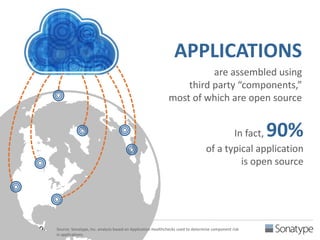
APPLICATIONS 
are assembled using 
third party “components,” 
most of which are open source 
In fact,90% 
of a typical application 
is open source 
Source: Sonatype, Inc. analysis based on Application Healthchecks used to determine component risk 
in applications.
1 
AS OPEN SOURCE USAGE EXPANDS, 
SO DOES OUR SHARED RISK
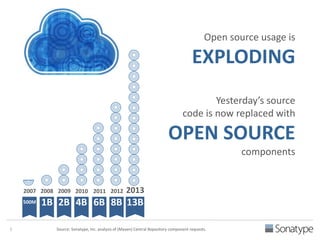
Open source usage is 
EXPLODING 
Yesterday’s source 
code is now replaced with 
OPEN SOURCE 
components 
2007 2008 2009 2010 2011 2012 2013 
500M 1B 2B 4B 6B 8B 13B 
5 Source: Sonatype, Inc. analysis of (Maven) Central Repository component requests.
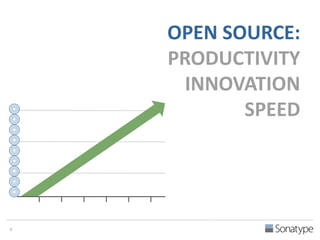
OPEN SOURCE: 
PRODUCTIVITY 
INNOVATION 
SPEED 
6
7 
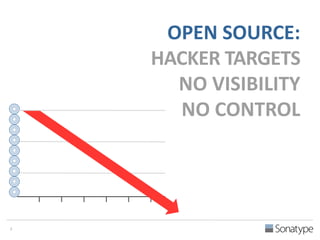
OPEN SOURCE: 
HACKER TARGETS 
NO VISIBILITY 
NO CONTROL
2 
SMALL EFFORT AND BIG GAINS
9 
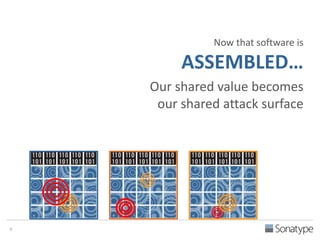
Now that software is 
ASSEMBLED… 
Our shared value becomes 
our shared attack surface
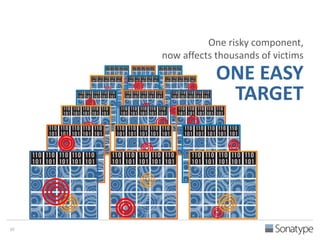
One risky component, 
now affects thousands of victims 
ONE EASY 
TARGET 
10
3 
YOU USE A SOFTWARE SUPPLY CHAIN.
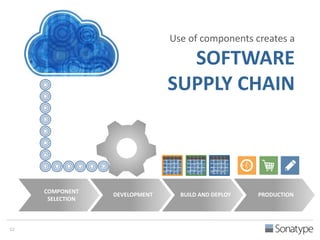
Use of components creates a 
SOFTWARE 
SUPPLY CHAIN 
Component 
Selection 
DEVELOPMENT BUILD AND DEPLOY PRODUCTION 
COMPONENT 
SELECTION 
12
13 
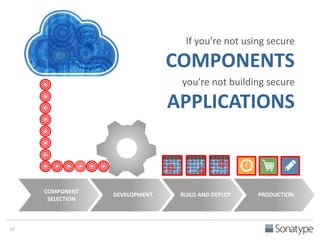
If you’re not using secure 
COMPONENTS 
you’re not building secure 
APPLICATIONS 
Component 
Selection 
DEVELOPMENT BUILD AND DEPLOY PRODUCTION 
COMPONENT 
SELECTION
Component 
Selection 
DEVELOPMENT BUILD AND DEPLOY PRODUCTION 
COMPONENT 
SELECTION 
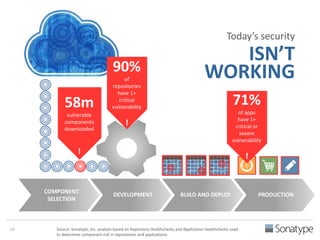
Today’s security 
ISN’T 
WORKING 
58m 
vulnerable 
components 
downloaded 
! 
71% 
of apps 
have 1+ 
critical or 
severe 
vulnerability 
! 
90% 
of 
repositories 
have 1+ 
critical 
vulnerability 
! 
14 Source: Sonatype, Inc. analysis based on Repository Healthchecks and Application Healthchecks used 
to determine component risk in repositories and applications.
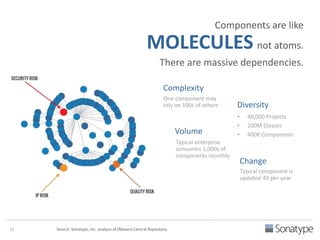
Components are like 
MOLECULES not atoms. 
There are massive dependencies. 
Diversity 
• 40,000 Projects 
• 200M Classes 
• 400K Components 
Complexity 
One component may 
rely on 100s of others 
Volume 
Typical enterprise 
consumes 1,000s of 
components monthly 
Change 
Typical component is 
updated 4X per year 
15 Source: Sonatype, Inc. analysis of (Maven) Central Repository.
4 
SECURITY BUDGETS ARE 
OUT OF SYNC WITH 
RISK AND REALITY
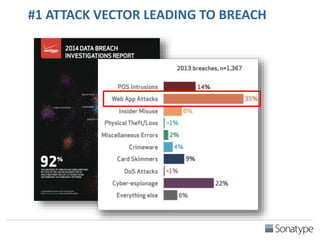
#1 ATTACK VECTOR LEADING TO BREACH
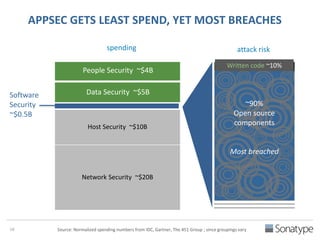
APPSEC GETS LEAST SPEND, YET MOST BREACHES 
spending 
18 
attack risk 
People Security ~$4B 
Data Security ~$5B 
Host Security ~$10B 
Network Security ~$20B 
Written code ~10% 
Source: Normalized spending numbers from IDC, Gartner, The 451 Group ; since groupings vary 
Software 
Security 
~$0.5B 
~90% 
Open source 
components 
Most breached
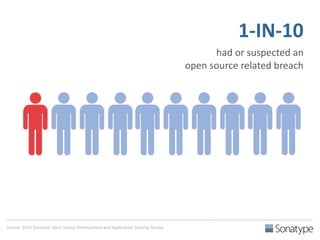
Source: 2014 Sonatype Open Source Development and Application Security Survey 
1-IN-10 
had or suspected an 
open source related breach
5 
MANUAL POLICIES JUST DON’T WORK 
IN A SECURE DEVELOPMENT LIFECYCLE.
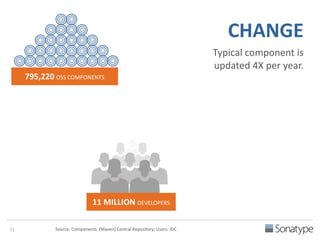
CHANGE 
Typical component is 
updated 4X per year. 
21 
795,220 OSS COMPONENTS 
11 MILLION DEVELOPERS 
Source: Components: (Maven) Central Repository; Users: IDC
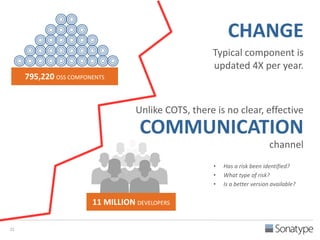
CHANGE 
Typical component is 
updated 4X per year. 
22 
Unlike COTS, there is no clear, effective 
COMMUNICATION 
channel 
795,220 OSS COMPONENTS 
11 MILLION DEVELOPERS 
• Has a risk been identified? 
• What type of risk? 
• Is a better version available?
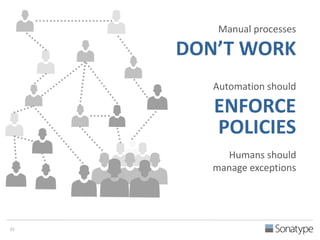
Manual processes 
DON’T WORK 
Automation should 
ENFORCE 
POLICIES 
Humans should 
manage exceptions 
23
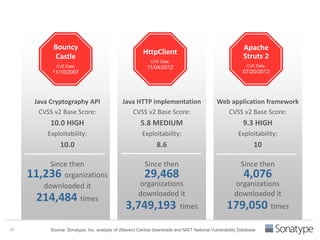
Bouncy 
Castle 
CVE Date: 
11/10/2007 
Java Cryptography API 
CVSS v2 Base Score: 
10.0 HIGH 
Exploitability: 
10.0 
Since then 
11,236 organizations 
downloaded it 
214,484 times 
HttpClient 
CVE Date: 
11/04/2012 
Java HTTP implementation 
CVSS v2 Base Score: 
5.8 MEDIUM 
Exploitability: 
8.6 
Since then 
29,468 
organizations 
downloaded it 
3,749,193 times 
Apache 
Struts 2 
CVE Date: 
07/20/2013 
Web application framework 
CVSS v2 Base Score: 
9.3 HIGH 
Exploitability: 
10 
Since then 
4,076 
organizations 
downloaded it 
179,050 times 
24 Source: Sonatype, Inc. analysis of (Maven) Central downloads and NIST National Vulnerability Database
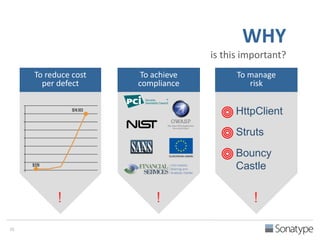
To reduce cost 
per defect 
! 
To achieve 
compliance 
! 
WHY 
is this important? 
To manage 
risk 
HttpClient 
Struts 
Bouncy 
Castle 
! 
25
What are you doing to ADDRESS THIS RISK? 
26
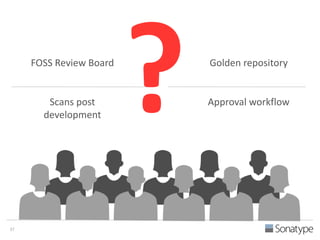
FOSS Review Board 
Scans post 
development 
Golden repository 
Approval workflow 
27
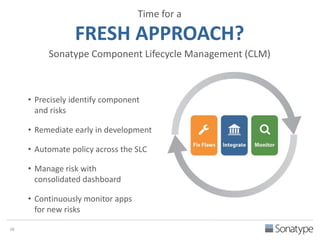
Time for a 
FRESH APPROACH? 
28 
Sonatype Component Lifecycle Management (CLM) 
• Precisely identify component 
and risks 
• Remediate early in development 
• Automate policy across the SLC 
• Manage risk with 
consolidated dashboard 
• Continuously monitor apps 
for new risks
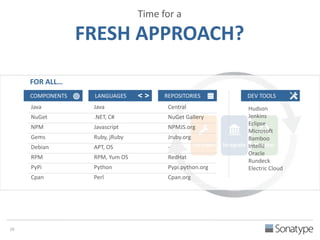
Time for a 
FRESH APPROACH? 
29 
FOR ALL… 
COMPONENTS LANGUAGES < > REPOSITORIES DEV TOOLS 
Java Java Central 
NuGet .NET, C# NuGet Gallery 
NPM Javascript NPMJS.org 
Gems Ruby, jRuby Jruby.org 
Debian APT, OS - 
RPM RPM, Yum OS RedHat 
PyPi Python Pypi.python.org 
Cpan Perl Cpan.org 
Hudson 
Jenkins 
Eclipse 
Microsoft 
Bamboo 
IntelliJ 
Oracle 
Rundeck 
Electric Cloud
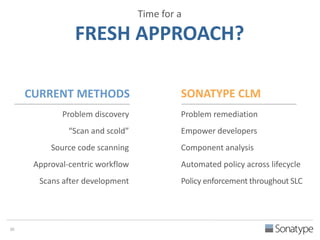
Time for a 
FRESH APPROACH? 
CURRENT METHODS SONATYPE CLM 
Problem discovery Problem remediation 
“Scan and scold” 
Source code scanning 
Approval-centric workflow 
Empower developers 
Component analysis 
Automated policy across lifecycle 
Policy enforcement throughout SLC 
Scans after development 
30
6 
EMPOWER YOUR DEVELOPERS 
ON THE FRONT LINE
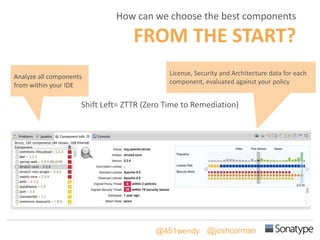
How can we choose the best components 
FROM THE START? 
Analyze all components 
from within your IDE 
License, Security and Architecture data for each 
component, evaluated against your policy 
Shift Left= ZTTR (Zero Time to Remediation) 
@451wendy @joshcorman
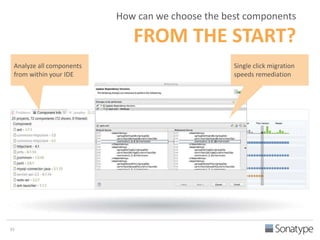
How can we choose the best components 
FROM THE START? 
Analyze all components 
from within your IDE 
Single click migration 
speeds remediation 
33
7 
AGILE DEVELOPMENT REQUIRES 
AGILE SECURITY.
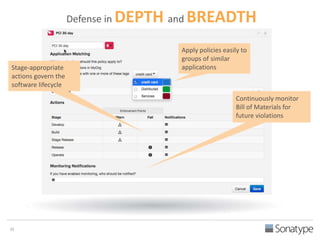
Defense in DEPTH and BREADTH 
Continuously monitor 
Bill of Materials for 
future violations 
Stage-appropriate 
actions govern the 
software lifecycle 
35 
Apply policies easily to 
groups of similar 
applications
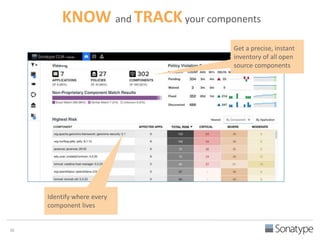
KNOW and TRACK your components 
Get a precise, instant 
inventory of all open 
source components 
36 
Identify where every 
component lives
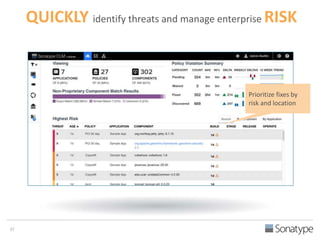
QUICKLY identify threats and manage enterprise RISK 
Prioritize fixes by 
risk and location 
37
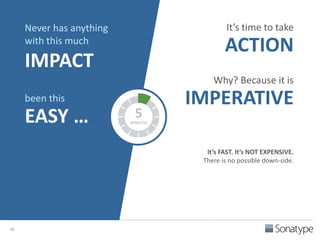
38 
Never has anything 
with this much 
IMPACT 
been this 
EASY … 
It’s time to take 
ACTION 
Why? Because it is 
IMPERATIVE 
It’s FAST. It’s NOT EXPENSIVE. 
There is no possible down-side. 
5 
MINUTES
39 
in 
5 MINUTES 
accomplish these 
3 CRITICAL 
STEPS 
5 
MINUTES
40 
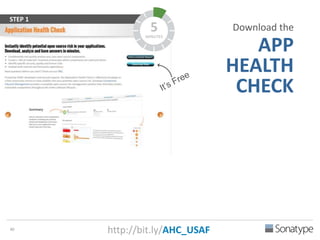
Download the 
APP 
HEALTH 
CHECK 
STEP 1 
5 
MINUTES 
http://bit.ly/AHC_USAF
41 
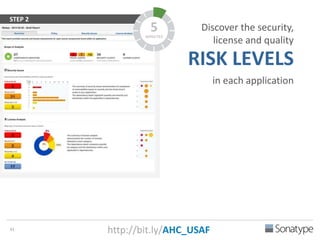
Discover the security, 
license and quality 
RISK LEVELS 
in each application 
STEP 2 
5 
MINUTES 
http://bit.ly/AHC_USAF
42 
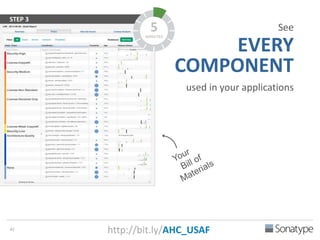
See 
EVERY 
COMPONENT 
used in your applications 
STEP 3 
5 
MINUTES 
http://bit.ly/AHC_USAF
43 
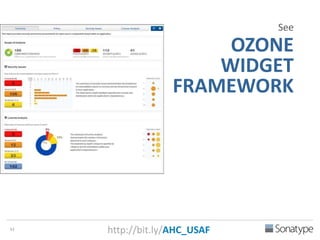
See 
OZONE 
WIDGET 
FRAMEWORK 
http://bit.ly/AHC_USAF
44 
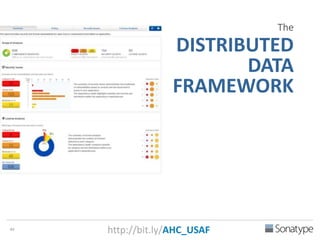
The 
DISTRIBUTED 
DATA 
FRAMEWORK 
http://bit.ly/AHC_USAF
LET’S GET STARTED 
5 
MINUTES 
http://bit.ly/AHC_USAF

7 Reasons Your Applications are Attractive to Adversaries

  • 1.
    7 Reasons YourApplications are Attractive to Adversaries 2014 Fall Cyber Security Forum and Expo Robins Air Force Base November 18, 2014 1
  • 2.
    2 3/19/14 Modernsoftware development HAS CHANGED Application security HASN’T CHANGED ENOUGH
  • 3.
    3 3/19/14 APPLICATIONS are assembled using third party “components,” most of which are open source In fact,90% of a typical application is open source Source: Sonatype, Inc. analysis based on Application Healthchecks used to determine component risk in applications.
  • 4.
    1 AS OPENSOURCE USAGE EXPANDS, SO DOES OUR SHARED RISK
  • 5.
    Open source usageis EXPLODING Yesterday’s source code is now replaced with OPEN SOURCE components 2007 2008 2009 2010 2011 2012 2013 500M 1B 2B 4B 6B 8B 13B 5 Source: Sonatype, Inc. analysis of (Maven) Central Repository component requests.
  • 6.
    OPEN SOURCE: PRODUCTIVITY INNOVATION SPEED 6
  • 7.
    7 OPEN SOURCE: HACKER TARGETS NO VISIBILITY NO CONTROL
  • 8.
    2 SMALL EFFORTAND BIG GAINS
  • 9.
    9 Now thatsoftware is ASSEMBLED… Our shared value becomes our shared attack surface
  • 10.
    One risky component, now affects thousands of victims ONE EASY TARGET 10
  • 11.
    3 YOU USEA SOFTWARE SUPPLY CHAIN.
  • 12.
    Use of componentscreates a SOFTWARE SUPPLY CHAIN Component Selection DEVELOPMENT BUILD AND DEPLOY PRODUCTION COMPONENT SELECTION 12
  • 13.
    13 If you’renot using secure COMPONENTS you’re not building secure APPLICATIONS Component Selection DEVELOPMENT BUILD AND DEPLOY PRODUCTION COMPONENT SELECTION
  • 14.
    Component Selection DEVELOPMENTBUILD AND DEPLOY PRODUCTION COMPONENT SELECTION Today’s security ISN’T WORKING 58m vulnerable components downloaded ! 71% of apps have 1+ critical or severe vulnerability ! 90% of repositories have 1+ critical vulnerability ! 14 Source: Sonatype, Inc. analysis based on Repository Healthchecks and Application Healthchecks used to determine component risk in repositories and applications.
  • 15.
    Components are like MOLECULES not atoms. There are massive dependencies. Diversity • 40,000 Projects • 200M Classes • 400K Components Complexity One component may rely on 100s of others Volume Typical enterprise consumes 1,000s of components monthly Change Typical component is updated 4X per year 15 Source: Sonatype, Inc. analysis of (Maven) Central Repository.
  • 16.
    4 SECURITY BUDGETSARE OUT OF SYNC WITH RISK AND REALITY
  • 17.
    #1 ATTACK VECTORLEADING TO BREACH
  • 18.
    APPSEC GETS LEASTSPEND, YET MOST BREACHES spending 18 attack risk People Security ~$4B Data Security ~$5B Host Security ~$10B Network Security ~$20B Written code ~10% Source: Normalized spending numbers from IDC, Gartner, The 451 Group ; since groupings vary Software Security ~$0.5B ~90% Open source components Most breached
  • 19.
    Source: 2014 SonatypeOpen Source Development and Application Security Survey 1-IN-10 had or suspected an open source related breach
  • 20.
    5 MANUAL POLICIESJUST DON’T WORK IN A SECURE DEVELOPMENT LIFECYCLE.
  • 21.
    CHANGE Typical componentis updated 4X per year. 21 795,220 OSS COMPONENTS 11 MILLION DEVELOPERS Source: Components: (Maven) Central Repository; Users: IDC
  • 22.
    CHANGE Typical componentis updated 4X per year. 22 Unlike COTS, there is no clear, effective COMMUNICATION channel 795,220 OSS COMPONENTS 11 MILLION DEVELOPERS • Has a risk been identified? • What type of risk? • Is a better version available?
  • 23.
    Manual processes DON’TWORK Automation should ENFORCE POLICIES Humans should manage exceptions 23
  • 24.
    Bouncy Castle CVEDate: 11/10/2007 Java Cryptography API CVSS v2 Base Score: 10.0 HIGH Exploitability: 10.0 Since then 11,236 organizations downloaded it 214,484 times HttpClient CVE Date: 11/04/2012 Java HTTP implementation CVSS v2 Base Score: 5.8 MEDIUM Exploitability: 8.6 Since then 29,468 organizations downloaded it 3,749,193 times Apache Struts 2 CVE Date: 07/20/2013 Web application framework CVSS v2 Base Score: 9.3 HIGH Exploitability: 10 Since then 4,076 organizations downloaded it 179,050 times 24 Source: Sonatype, Inc. analysis of (Maven) Central downloads and NIST National Vulnerability Database
  • 25.
    To reduce cost per defect ! To achieve compliance ! WHY is this important? To manage risk HttpClient Struts Bouncy Castle ! 25
  • 26.
    What are youdoing to ADDRESS THIS RISK? 26
  • 27.
    FOSS Review Board Scans post development Golden repository Approval workflow 27
  • 28.
    Time for a FRESH APPROACH? 28 Sonatype Component Lifecycle Management (CLM) • Precisely identify component and risks • Remediate early in development • Automate policy across the SLC • Manage risk with consolidated dashboard • Continuously monitor apps for new risks
  • 29.
    Time for a FRESH APPROACH? 29 FOR ALL… COMPONENTS LANGUAGES < > REPOSITORIES DEV TOOLS Java Java Central NuGet .NET, C# NuGet Gallery NPM Javascript NPMJS.org Gems Ruby, jRuby Jruby.org Debian APT, OS - RPM RPM, Yum OS RedHat PyPi Python Pypi.python.org Cpan Perl Cpan.org Hudson Jenkins Eclipse Microsoft Bamboo IntelliJ Oracle Rundeck Electric Cloud
  • 30.
    Time for a FRESH APPROACH? CURRENT METHODS SONATYPE CLM Problem discovery Problem remediation “Scan and scold” Source code scanning Approval-centric workflow Empower developers Component analysis Automated policy across lifecycle Policy enforcement throughout SLC Scans after development 30
  • 31.
    6 EMPOWER YOURDEVELOPERS ON THE FRONT LINE
  • 32.
    How can wechoose the best components FROM THE START? Analyze all components from within your IDE License, Security and Architecture data for each component, evaluated against your policy Shift Left= ZTTR (Zero Time to Remediation) @451wendy @joshcorman
  • 33.
    How can wechoose the best components FROM THE START? Analyze all components from within your IDE Single click migration speeds remediation 33
  • 34.
    7 AGILE DEVELOPMENTREQUIRES AGILE SECURITY.
  • 35.
    Defense in DEPTHand BREADTH Continuously monitor Bill of Materials for future violations Stage-appropriate actions govern the software lifecycle 35 Apply policies easily to groups of similar applications
  • 36.
    KNOW and TRACKyour components Get a precise, instant inventory of all open source components 36 Identify where every component lives
  • 37.
    QUICKLY identify threatsand manage enterprise RISK Prioritize fixes by risk and location 37
  • 38.
    38 Never hasanything with this much IMPACT been this EASY … It’s time to take ACTION Why? Because it is IMPERATIVE It’s FAST. It’s NOT EXPENSIVE. There is no possible down-side. 5 MINUTES
  • 39.
    39 in 5MINUTES accomplish these 3 CRITICAL STEPS 5 MINUTES
  • 40.
    40 Download the APP HEALTH CHECK STEP 1 5 MINUTES http://bit.ly/AHC_USAF
  • 41.
    41 Discover thesecurity, license and quality RISK LEVELS in each application STEP 2 5 MINUTES http://bit.ly/AHC_USAF
  • 42.
    42 See EVERY COMPONENT used in your applications STEP 3 5 MINUTES http://bit.ly/AHC_USAF
  • 43.
    43 See OZONE WIDGET FRAMEWORK http://bit.ly/AHC_USAF
  • 44.
    44 The DISTRIBUTED DATA FRAMEWORK http://bit.ly/AHC_USAF
  • 45.
    LET’S GET STARTED 5 MINUTES http://bit.ly/AHC_USAF

Editor's Notes

  • #3 Open source risk, Open source security, Open source management, Open source governance, Open source policy, Software supply chain management, Repository management, Component Lifecycle Management, OSS logistics, Software Bill of Materials
  • #4 Open source risk, Open source security, Open source management, Open source governance, Open source policy, Software supply chain management, Repository management, Component Lifecycle Management, OSS logistics, Software Bill of Materials
  • #5 Open source risk, Open source security, Open source management, Open source governance, Open source policy, Software supply chain management, Repository management, Component Lifecycle Management, OSS logistics, Software Bill of Materials
  • #6 Open source risk, Open source security, Open source management, Open source governance, Open source policy, Software supply chain management, Repository management, Component Lifecycle Management, OSS logistics, Software Bill of Materials
  • #7 Open source is absolutely essential There are a lot of huge benefits… and we are huge advocates. Sonatype software is built largely using open source. However one of the myths of open source is that, since it is used by so many organizations, it has been thoroughly tested and is safe. But there is another side of this story…
  • #8 Open source means open access. It is community driven and community supported. Without better open source management and visibility, vulnerable components are used even when newer, safer versions have been released. Worse yet, since components are shared among thousands of organizations, components are attractive to your adversaries. They hack one component and impact thousands of companies at once.
  • #9 Open source risk, Open source security, Open source management, Open source governance, Open source policy, Software supply chain management, Repository management, Component Lifecycle Management, OSS logistics, Software Bill of Materials
  • #10 From an attacker eye view… Source code at Bank XYZ Only that bank Our shared value becomes our shared attack surface
  • #11 …if an attacker finds a flaw in Struts… it can attack EVERY bank who uses it – which is most of them. Same reason Heartbleed was so far reaching … shared dependence == shared risk/attack surface As Dan Geer, CISO at In-Q-Tel, once mentioned, where there is enough prey, there will be predators
  • #12 Think like an attacker ----- Meeting Notes (11/16/14 16:24) ----- 8min
  • #13 Open source risk, Open source security, Open source management, Open source governance, Open source policy, Software supply chain management, Repository management, Component Lifecycle Management, OSS logistics, Software Bill of Materials
  • #16 Open source risk, Open source security, Open source management, Open source governance, Open source policy, Software supply chain management, Repository management, Component Lifecycle Management, OSS logistics, Software Bill of Materials
  • #19 Open source risk, Open source security, Open source management, Open source governance, Open source policy, Software supply chain management, Repository management, Component Lifecycle Management, OSS logistics, Software Bill of Materials
  • #20 Open source risk, Open source security, Open source management, Open source governance, Open source policy, Software supply chain management, Repository management, Component Lifecycle Management, OSS logistics, Software Bill of Materials
  • #23 Open source risk, Open source security, Open source management, Open source governance, Open source policy, Software supply chain management, Repository management, Component Lifecycle Management, OSS logistics, Software Bill of Materials
  • #33 Open source risk, Open source security, Open source management, Open source governance, Open source policy, Software supply chain management, Repository management, Component Lifecycle Management, OSS logistics, Software Bill of Materials
  • #34 Open source risk, Open source security, Open source management, Open source governance, Open source policy, Software supply chain management, Repository management, Component Lifecycle Management, OSS logistics, Software Bill of Materials
  • #46 Open source risk, Open source security, Open source management, Open source governance, Open source policy, Software supply chain management, Repository management, Component Lifecycle Management, OSS logistics, Software Bill of Materials