



How to Enable Developers to Deliver Secure Code
Achim D. Brucker
a.brucker@sheffield.ac.uk https://www.brucker.ch/
Software Assurance & Security Research
Department of Computer Science, The University of Sheffield, Sheffield, UK
https://logicalhacking.com/
March 15, 2017
Outline
1 Motivation
2 Secure Software Development
3 Enabling Developers: From (Mild) Pain to Success
4 Lesson’s Learned
c 2017 LogicalHacking.com. Public (CC BY-NC-ND 4.0) Page 3 of 18
Example (LinkedIn, May 2016)
164 million email addresses and passwords
from an attack in 2012, offered for sale May 2016
Compromised data:
email addresses
passwords
Example (TalkTalk, October 2015)
nearly 157,000 customer records leaked
nearly 16,000 records included bank details
more than 150,000 customers lost
(home services market share fall by 4.4 percent
in terms of new customers)
Costs for TalkTalk: around any £60 million
Example (Ashley Madison, July 2015)
more than 30 million email addresses & much
more
Compromised data:
Dates of birth
Email addresses
Ethnicities, Genders
Sexual preferences
Home addresses, Phone numbers
Payment histories
Passwords, Usernames, Security questions and
answers
Website activity
Similar Leak: Mate1 in February 2016:
27 million records with even more personal details
(e.g., drinking/drug habits, political views)
Outline
1 Motivation
2 Secure Software Development
3 Enabling Developers: From (Mild) Pain to Success
4 Lesson’s Learned
c 2017 LogicalHacking.com. Public (CC BY-NC-ND 4.0) Page 5 of 18
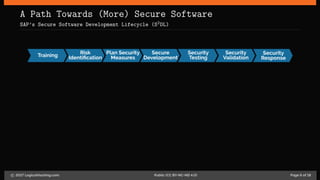
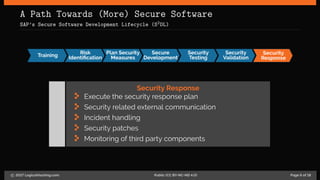
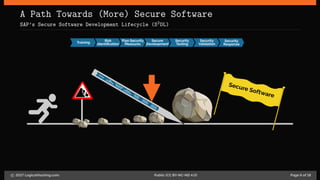
A Path Towards (More) Secure Software
SAP’s Secure Software Development Lifecycle (S2DL)
Training
Risk
Identification
Plan Security
Measures
Secure
Development
Security
Testing
Security
Validation
Security
Response
c 2017 LogicalHacking.com. Public (CC BY-NC-ND 4.0) Page 6 of 18
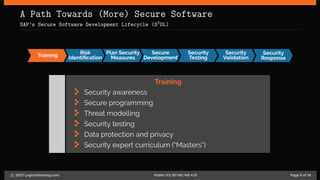
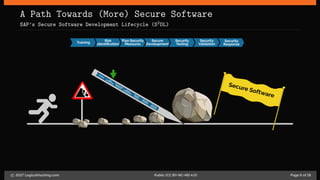
A Path Towards (More) Secure Software
SAP’s Secure Software Development Lifecycle (S2DL)
Training
Risk
Identification
Plan Security
Measures
Secure
Development
Security
Testing
Security
Validation
Security
Response
Training
Security awareness
Secure programming
Threat modelling
Security testing
Data protection and privacy
Security expert curriculum (“Masters”)
c 2017 LogicalHacking.com. Public (CC BY-NC-ND 4.0) Page 6 of 18
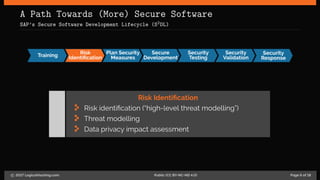
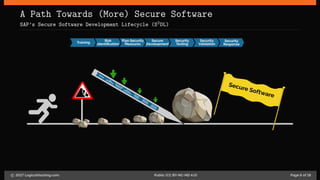
A Path Towards (More) Secure Software
SAP’s Secure Software Development Lifecycle (S2DL)
Training
Risk
Identification
Plan Security
Measures
Secure
Development
Security
Testing
Security
Validation
Security
Response
Risk Identification
Risk identification (“high-level threat modelling”)
Threat modelling
Data privacy impact assessment
c 2017 LogicalHacking.com. Public (CC BY-NC-ND 4.0) Page 6 of 18
A Path Towards (More) Secure Software
SAP’s Secure Software Development Lifecycle (S2DL)
Training
Risk
Identification
Plan Security
Measures
Secure
Development
Security
Testing
Security
Validation
Security
Response
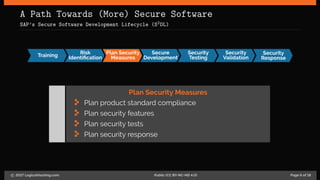
Plan Security Measures
Plan product standard compliance
Plan security features
Plan security tests
Plan security response
c 2017 LogicalHacking.com. Public (CC BY-NC-ND 4.0) Page 6 of 18
A Path Towards (More) Secure Software
SAP’s Secure Software Development Lifecycle (S2DL)
Training
Risk
Identification
Plan Security
Measures
Secure
Development
Security
Testing
Security
Validation
Security
Response
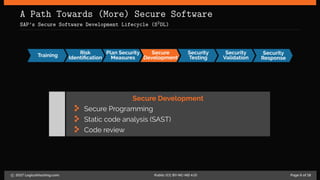
Secure Development
Secure Programming
Static code analysis (SAST)
Code review
c 2017 LogicalHacking.com. Public (CC BY-NC-ND 4.0) Page 6 of 18
A Path Towards (More) Secure Software
SAP’s Secure Software Development Lifecycle (S2DL)
Training
Risk
Identification
Plan Security
Measures
Secure
Development
Security
Testing
Security
Validation
Security
Response
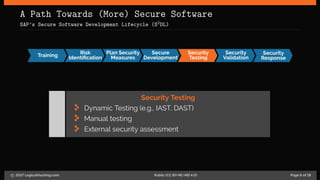
Security Testing
Dynamic Testing (e.g., IAST, DAST)
Manual testing
External security assessment
c 2017 LogicalHacking.com. Public (CC BY-NC-ND 4.0) Page 6 of 18
A Path Towards (More) Secure Software
SAP’s Secure Software Development Lifecycle (S2DL)
Training
Risk
Identification
Plan Security
Measures
Secure
Development
Security
Testing
Security
Validation
Security
Response
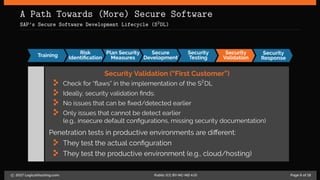
Security Validation (“First Customer”)
Check for “flaws” in the implementation of the S2
DL
Ideally, security validation finds:
No issues that can be fixed/detected earlier
Only issues that cannot be detect earlier
(e.g., insecure default configurations, missing security documentation)
Penetration tests in productive environments are different:
They test the actual configuration
They test the productive environment (e.g., cloud/hosting)
c 2017 LogicalHacking.com. Public (CC BY-NC-ND 4.0) Page 6 of 18
A Path Towards (More) Secure Software
SAP’s Secure Software Development Lifecycle (S2DL)
Training
Risk
Identification
Plan Security
Measures
Secure
Development
Security
Testing
Security
Validation
Security
Response
Security Response
Execute the security response plan
Security related external communication
Incident handling
Security patches
Monitoring of third party components
c 2017 LogicalHacking.com. Public (CC BY-NC-ND 4.0) Page 6 of 18
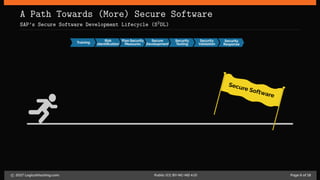
A Path Towards (More) Secure Software
SAP’s Secure Software Development Lifecycle (S2DL)
Training
Risk
Identification
Plan Security
Measures
Secure
Development
Security
Testing
Security
Validation
Security
Response
Secure Software
c 2017 LogicalHacking.com. Public (CC BY-NC-ND 4.0) Page 6 of 18
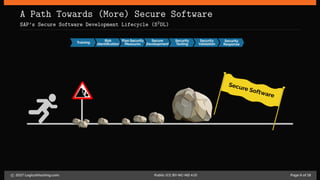
A Path Towards (More) Secure Software
SAP’s Secure Software Development Lifecycle (S2DL)
Training
Risk
Identification
Plan Security
Measures
Secure
Development
Security
Testing
Security
Validation
Security
Response
Secure Software
c 2017 LogicalHacking.com. Public (CC BY-NC-ND 4.0) Page 6 of 18
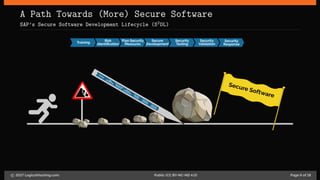
A Path Towards (More) Secure Software
SAP’s Secure Software Development Lifecycle (S2DL)
Training
Risk
Identification
Plan Security
Measures
Secure
Development
Security
Testing
Security
Validation
Security
Response
Secure Software
Security
Validation
Security
Testing
Secure
Development
Plan Security
Measu
res
Risk
Identification
Training
Security
Resp
onse
c 2017 LogicalHacking.com. Public (CC BY-NC-ND 4.0) Page 6 of 18
A Path Towards (More) Secure Software
SAP’s Secure Software Development Lifecycle (S2DL)
Training
Risk
Identification
Plan Security
Measures
Secure
Development
Security
Testing
Security
Validation
Security
Response
Secure Software
Security
Validation
Security
Testing
Secure
Development
Plan Security
Measu
res
Risk
Identification
Training
Security
Resp
onse
c 2017 LogicalHacking.com. Public (CC BY-NC-ND 4.0) Page 6 of 18
A Path Towards (More) Secure Software
SAP’s Secure Software Development Lifecycle (S2DL)
Training
Risk
Identification
Plan Security
Measures
Secure
Development
Security
Testing
Security
Validation
Security
Response
Secure Software
Security
Validation
Security
Testing
Secure
Development
Plan Security
Measu
res
Risk
Identification
Training
Security
Resp
onse
c 2017 LogicalHacking.com. Public (CC BY-NC-ND 4.0) Page 6 of 18
A Path Towards (More) Secure Software
SAP’s Secure Software Development Lifecycle (S2DL)
Training
Risk
Identification
Plan Security
Measures
Secure
Development
Security
Testing
Security
Validation
Security
Response
Secure Software
Security
Validation
Security
Testing
Secure
Development
Plan Security
Measu
res
Risk
Identification
Training
Security
Resp
onse
c 2017 LogicalHacking.com. Public (CC BY-NC-ND 4.0) Page 6 of 18
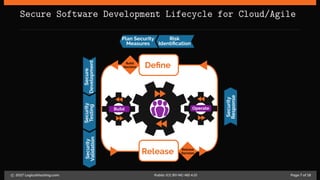
Secure Software Development Lifecycle for Cloud/Agile
Build Operate
Define
Release Release
Decision
Build
Decision
Risk
Identification
Plan Security
Measures
Secure
Development
Security
Testing
Security
Validation
Security
Response
c 2017 LogicalHacking.com. Public (CC BY-NC-ND 4.0) Page 7 of 18
Outline
1 Motivation
2 Secure Software Development
3 Enabling Developers: From (Mild) Pain to Success
4 Lesson’s Learned
c 2017 LogicalHacking.com. Public (CC BY-NC-ND 4.0) Page 8 of 18
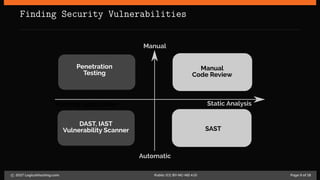
Finding Security Vulnerabilities
Manual
Automatic
Running Application Static Analysis
Penetration
Testing
DAST, IAST
Vulnerability Scanner SAST
Manual
Code Review
c 2017 LogicalHacking.com. Public (CC BY-NC-ND 4.0) Page 9 of 18
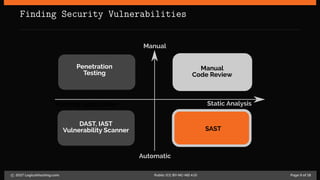
Finding Security Vulnerabilities
Manual
Automatic
Running Application Static Analysis
Penetration
Testing
DAST, IAST
Vulnerability Scanner SAST
Manual
Code Review
c 2017 LogicalHacking.com. Public (CC BY-NC-ND 4.0) Page 9 of 18
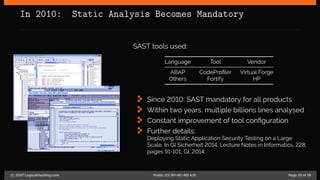
In 2010: Static Analysis Becomes Mandatory
SAST tools used:
Language Tool Vendor
ABAP CodeProfiler Virtual Forge
Others Fortify HP
Since 2010: SAST mandatory for all products
Within two years, multiple billions lines analysed
Constant improvement of tool configuration
Further details:
Deploying Static Application Security Testing on a Large
Scale. In GI Sicherheit 2014. Lecture Notes in Informatics, 228,
pages 91-101, GI, 2014.
c 2017 LogicalHacking.com. Public (CC BY-NC-ND 4.0) Page 10 of 18
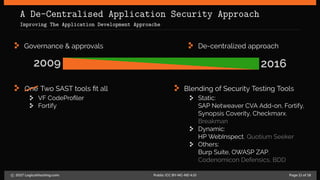
A De-Centralised Application Security Approach
Improving The Application Development Approache
Governance & approvals De-centralized approach
2009 2016
One Two SAST tools fit all
VF CodeProfiler
Fortify
Blending of Security Testing Tools
Static:
SAP Netweaver CVA Add-on, Fortify,
Synopsis Coverity, Checkmarx,
Breakman
Dynamic:
HP WebInspect, Quotium Seeker
Others:
Burp Suite, OWASP ZAP,
Codenomicon Defensics, BDD
c 2017 LogicalHacking.com. Public (CC BY-NC-ND 4.0) Page 11 of 18
A De-Centralised Application Security Approach
Improving The Application Development Approache
Governance & approvals De-centralized approach
2009 2016
Blending of Security Testing Tools
Static:
SAP Netweaver CVA Add-on, Fortify,
Synopsis Coverity, Checkmarx,
Breakman
Dynamic:
HP WebInspect, Quotium Seeker
Others:
Burp Suite, OWASP ZAP,
Codenomicon Defensics, BDD
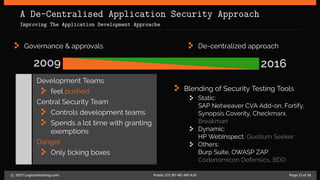
Development Teams
feel pushed
Central Security Team
Controls development teams
Spends a lot time with granting
exemptions
Danger
Only ticking boxes
c 2017 LogicalHacking.com. Public (CC BY-NC-ND 4.0) Page 11 of 18
A De-Centralised Application Security Approach
Improving The Application Development Approache
Governance & approvals De-centralized approach
2009 2016
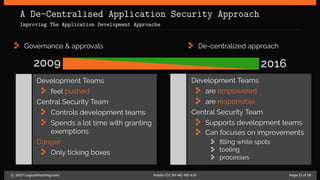
Development Teams
feel pushed
Central Security Team
Controls development teams
Spends a lot time with granting
exemptions
Danger
Only ticking boxes
Development Teams
are empowered
are responsible
Central Security Team
Supports development teams
Can focuses on improvements
filling white spots
tooling
processes
c 2017 LogicalHacking.com. Public (CC BY-NC-ND 4.0) Page 11 of 18
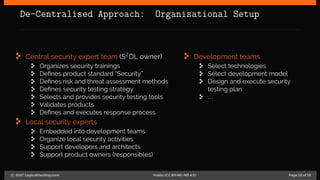
De-Centralised Approach: Organisational Setup
Central security expert team (S2
DL owner)
Organizes security trainings
Defines product standard “Security”
Defines risk and threat assessment methods
Defines security testing strategy
Selects and provides security testing tools
Validates products
Defines and executes response process
Local security experts
Embedded into development teams
Organize local security activities
Support developers and architects
Support product owners (responsibles)
Development teams
Select technologies
Select development model
Design and execute security
testing plan
...
c 2017 LogicalHacking.com. Public (CC BY-NC-ND 4.0) Page 12 of 18
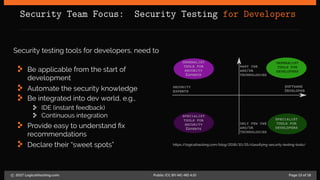
Security Team Focus: Security Testing for Developers
Security testing tools for developers, need to
Be applicable from the start of
development
Automate the security knowledge
Be integrated into dev world, e.g.,
IDE (instant feedback)
Continuous integration
Provide easy to understand fix
recommendations
Declare their “sweet spots”
security
experts
software
Developer
many cwe
and/or
technologies
only few cwe
and/or
technologies
generalist
tools for
security
Experts
specialist
tools for
security
Experts
specialist
tools for
developers
generalist
tools for
developers
https://logicalhacking.com/blog/2016/10/25/classifying-security-testing-tools/
c 2017 LogicalHacking.com. Public (CC BY-NC-ND 4.0) Page 13 of 18
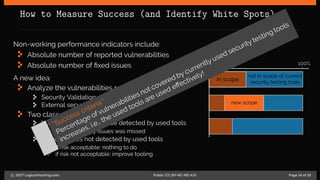
How to Measure Success (and Identify White Spots)
Listen to your developers
c 2017 LogicalHacking.com. Public (CC BY-NC-ND 4.0) Page 14 of 18
How to Measure Success (and Identify White Spots)
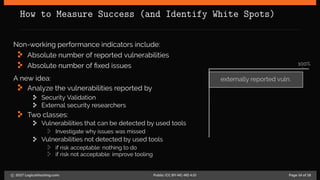
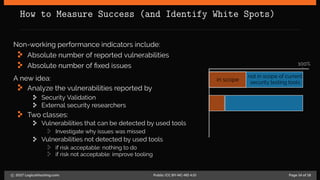
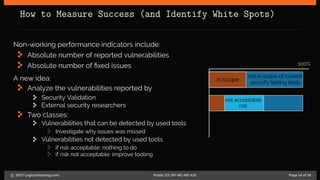
Non-working performance indicators include:
Absolute number of reported vulnerabilities
Absolute number of fixed issues
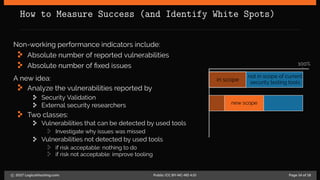
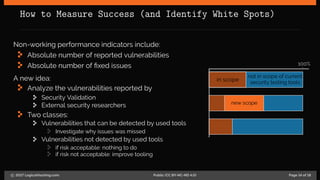
A new idea:
Analyze the vulnerabilities reported by
Security Validation
External security researchers
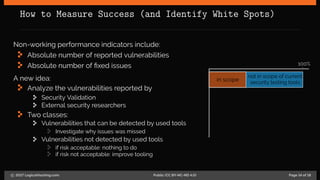
Two classes:
Vulnerabilities that can be detected by used tools
Investigate why issues was missed
Vulnerabilities not detected by used tools
if risk acceptable: nothing to do
if risk not acceptable: improve tooling
externally reported vuln.
100%
c 2017 LogicalHacking.com. Public (CC BY-NC-ND 4.0) Page 14 of 18
How to Measure Success (and Identify White Spots)
Non-working performance indicators include:
Absolute number of reported vulnerabilities
Absolute number of fixed issues
A new idea:
Analyze the vulnerabilities reported by
Security Validation
External security researchers
Two classes:
Vulnerabilities that can be detected by used tools
Investigate why issues was missed
Vulnerabilities not detected by used tools
if risk acceptable: nothing to do
if risk not acceptable: improve tooling
externally reported vuln.in scope
not in scope of current
security testing tools
100%
c 2017 LogicalHacking.com. Public (CC BY-NC-ND 4.0) Page 14 of 18
How to Measure Success (and Identify White Spots)
Non-working performance indicators include:
Absolute number of reported vulnerabilities
Absolute number of fixed issues
A new idea:
Analyze the vulnerabilities reported by
Security Validation
External security researchers
Two classes:
Vulnerabilities that can be detected by used tools
Investigate why issues was missed
Vulnerabilities not detected by used tools
if risk acceptable: nothing to do
if risk not acceptable: improve tooling
externally reported vuln.in scope
not in scope of current
security testing tools
100%
c 2017 LogicalHacking.com. Public (CC BY-NC-ND 4.0) Page 14 of 18
How to Measure Success (and Identify White Spots)
Non-working performance indicators include:
Absolute number of reported vulnerabilities
Absolute number of fixed issues
A new idea:
Analyze the vulnerabilities reported by
Security Validation
External security researchers
Two classes:
Vulnerabilities that can be detected by used tools
Investigate why issues was missed
Vulnerabilities not detected by used tools
if risk acceptable: nothing to do
if risk not acceptable: improve tooling
externally reported vuln.in scope
not in scope of current
security testing tools
not acceptable
risk
100%
c 2017 LogicalHacking.com. Public (CC BY-NC-ND 4.0) Page 14 of 18
How to Measure Success (and Identify White Spots)
Non-working performance indicators include:
Absolute number of reported vulnerabilities
Absolute number of fixed issues
A new idea:
Analyze the vulnerabilities reported by
Security Validation
External security researchers
Two classes:
Vulnerabilities that can be detected by used tools
Investigate why issues was missed
Vulnerabilities not detected by used tools
if risk acceptable: nothing to do
if risk not acceptable: improve tooling
externally reported vuln.in scope
not in scope of current
security testing tools
not acceptable
risk
new scope
100%
c 2017 LogicalHacking.com. Public (CC BY-NC-ND 4.0) Page 14 of 18
How to Measure Success (and Identify White Spots)
Non-working performance indicators include:
Absolute number of reported vulnerabilities
Absolute number of fixed issues
A new idea:
Analyze the vulnerabilities reported by
Security Validation
External security researchers
Two classes:
Vulnerabilities that can be detected by used tools
Investigate why issues was missed
Vulnerabilities not detected by used tools
if risk acceptable: nothing to do
if risk not acceptable: improve tooling
externally reported vuln.in scope
not in scope of current
security testing tools
not acceptable
risk
new scope
100%
c 2017 LogicalHacking.com. Public (CC BY-NC-ND 4.0) Page 14 of 18
How to Measure Success (and Identify White Spots)
Non-working performance indicators include:
Absolute number of reported vulnerabilities
Absolute number of fixed issues
A new idea:
Analyze the vulnerabilities reported by
Security Validation
External security researchers
Two classes:
Vulnerabilities that can be detected by used tools
Investigate why issues was missed
Vulnerabilities not detected by used tools
if risk acceptable: nothing to do
if risk not acceptable: improve tooling
externally reported vuln.in scope
not in scope of current
security testing tools
not acceptable
risk
new scope
100%
“Success criteria:”
Percentage of vulnerabilities not covered by currently used security testing tools
increases, i.e., the used tools are used effectively!
c 2017 LogicalHacking.com. Public (CC BY-NC-ND 4.0) Page 14 of 18
Outline
1 Motivation
2 Secure Software Development
3 Enabling Developers: From (Mild) Pain to Success
4 Lesson’s Learned
c 2017 LogicalHacking.com. Public (CC BY-NC-ND 4.0) Page 15 of 18
Key Success Factors
A holistic security awareness program for
Developers
Managers
c 2017 LogicalHacking.com. Public (CC BY-NC-ND 4.0) Page 16 of 18
Key Success Factors
A holistic security awareness program for
Developers
Managers
Yes, security awareness is important
c 2017 LogicalHacking.com. Public (CC BY-NC-ND 4.0) Page 16 of 18
Key Success Factors
A holistic security awareness program for
Developers
Managers
Yes, security awareness is important but
c 2017 LogicalHacking.com. Public (CC BY-NC-ND 4.0) Page 16 of 18
Key Success Factors
A holistic security awareness program for
Developers
Managers
Yes, security awareness is important but
Developer awareness is even more important!
c 2017 LogicalHacking.com. Public (CC BY-NC-ND 4.0) Page 16 of 18
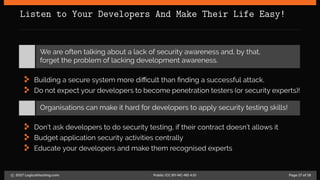
Listen to Your Developers And Make Their Life Easy!
We are often talking about a lack of security awareness and, by that,
forget the problem of lacking development awareness.
Building a secure system more difficult than finding a successful attack.
Do not expect your developers to become penetration testers (or security experts)!
Organisations can make it hard for developers to apply security testing skills!
Don’t ask developers to do security testing, if their contract doesn’t allows it
Budget application security activities centrally
Educate your developers and make them recognised experts
c 2017 LogicalHacking.com. Public (CC BY-NC-ND 4.0) Page 17 of 18
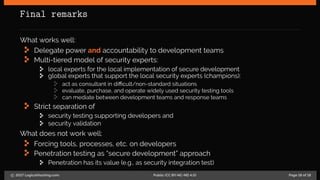
Final remarks
What works well:
Delegate power and accountability to development teams
Multi-tiered model of security experts:
local experts for the local implementation of secure development
global experts that support the local security experts (champions):
act as consultant in difficult/non-standard situations
evaluate, purchase, and operate widely used security testing tools
can mediate between development teams and response teams
Strict separation of
security testing supporting developers and
security validation
What does not work well:
Forcing tools, processes, etc. on developers
Penetration testing as “secure development” approach
Penetration has its value (e.g., as security integration test)
c 2017 LogicalHacking.com. Public (CC BY-NC-ND 4.0) Page 18 of 18
Thank you for your attention!
Any questions or remarks?
Contact: Dr. Achim D. Brucker
Department of Computer Science
University of Sheffield
Regent Court
211 Portobello St.
Sheffield S1 4DP, UK
ƀ a.brucker@sheffield.ac.uk
@adbrucker
https://de.linkedin.com/in/adbrucker/
ĸ https://www.brucker.ch/
į https://logicalhacking.com/blog/
Bibliography
Ruediger Bachmann and Achim D. Brucker.
Developing secure software: A holistic approach to security testing.
Datenschutz und Datensicherheit (DuD), 38(4):257–261, April 2014.
Achim D. Brucker and Uwe Sodan.
Deploying static application security testing on a large scale.
In Stefan Katzenbeisser, Volkmar Lotz, and Edgar Weippl, editors, GI Sicherheit 2014, volume 228 of
Lecture Notes in Informatics, pages 91–101. GI, March 2014.
Michael Felderer, Matthias Büchler, Martin Johns, Achim D. Brucker, Ruth Breu, and Alexander
Pretschner.
Security testing: A survey.
Advances in Computers, 101:1–51, March 2016.
c 2017 LogicalHacking.com. Public (CC BY-NC-ND 4.0) Page 20 of 18
Document Classification and License Information
c 2017 LogicalHacking.com, A.D. Brucker.
This presentation is classified as Public (CC BY-NC-ND 4.0):
Except where otherwise noted, this presentation is licensed under a Creative Commons
Attribution-NonCommercial-NoDerivatives 4.0 International Public License (CC BY-NC-ND 4.0).
c 2017 LogicalHacking.com. Public (CC BY-NC-ND 4.0) Page 21 of 18
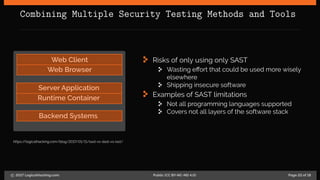
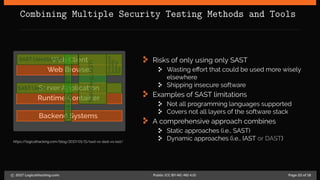
Combining Multiple Security Testing Methods and Tools
Web Client
Web Browser
Server Application
Runtime Container
Backend Systems
https://logicalhacking.com/blog/2017/01/11/sast-vs-dast-vs-iast/
Risks of only using only SAST
Wasting effort that could be used more wisely
elsewhere
Shipping insecure software
Examples of SAST limitations
Not all programming languages supported
Covers not all layers of the software stack
c 2017 LogicalHacking.com. Public (CC BY-NC-ND 4.0) Page 22 of 18
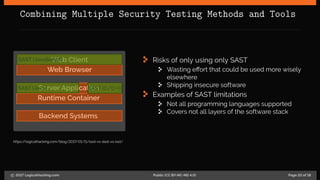
Combining Multiple Security Testing Methods and Tools
Web Client
Web Browser
Server Application
Runtime Container
Backend Systems
SAST (Java)
SAST (JavaScript)
SAST (C/C++)
https://logicalhacking.com/blog/2017/01/11/sast-vs-dast-vs-iast/
Risks of only using only SAST
Wasting effort that could be used more wisely
elsewhere
Shipping insecure software
Examples of SAST limitations
Not all programming languages supported
Covers not all layers of the software stack
c 2017 LogicalHacking.com. Public (CC BY-NC-ND 4.0) Page 22 of 18
Combining Multiple Security Testing Methods and Tools
Web Client
Web Browser
Server Application
Runtime Container
Backend Systems
SAST (Java)
SAST (JavaScript)
SAST (C/C++)
ToolA(e.g.,DAST)
ToolB(e.g.,IAST)
In-Browser
Security
Testing
Tool
https://logicalhacking.com/blog/2017/01/11/sast-vs-dast-vs-iast/
Risks of only using only SAST
Wasting effort that could be used more wisely
elsewhere
Shipping insecure software
Examples of SAST limitations
Not all programming languages supported
Covers not all layers of the software stack
c 2017 LogicalHacking.com. Public (CC BY-NC-ND 4.0) Page 22 of 18
Combining Multiple Security Testing Methods and Tools
Web Client
Web Browser
Server Application
Runtime Container
Backend Systems
ToolA(e.g.,DAST)
ToolB(e.g.,IAST)
In-Browser
Security
Testing
Tool
SAST (Java)
SAST (JavaScript)
https://logicalhacking.com/blog/2017/01/11/sast-vs-dast-vs-iast/
Risks of only using only SAST
Wasting effort that could be used more wisely
elsewhere
Shipping insecure software
Examples of SAST limitations
Not all programming languages supported
Covers not all layers of the software stack
c 2017 LogicalHacking.com. Public (CC BY-NC-ND 4.0) Page 22 of 18
Combining Multiple Security Testing Methods and Tools
Web Client
Web Browser
Server Application
Runtime Container
Backend Systems
ToolA(e.g.,DAST)
ToolB(e.g.,IAST)
In-Browser
Security
Testing
Tool
SAST (Java)
SAST (JavaScript)
https://logicalhacking.com/blog/2017/01/11/sast-vs-dast-vs-iast/
Risks of only using only SAST
Wasting effort that could be used more wisely
elsewhere
Shipping insecure software
Examples of SAST limitations
Not all programming languages supported
Covers not all layers of the software stack
A comprehensive approach combines
Static approaches (i.e., SAST)
Dynamic approaches (i.e., IAST or DAST)
c 2017 LogicalHacking.com. Public (CC BY-NC-ND 4.0) Page 22 of 18

How to Enable Developers to Deliver Secure Code

  • 1.
    How to EnableDevelopers to Deliver Secure Code Achim D. Brucker a.brucker@sheffield.ac.uk https://www.brucker.ch/ Software Assurance & Security Research Department of Computer Science, The University of Sheffield, Sheffield, UK https://logicalhacking.com/ March 15, 2017
  • 2.
    Outline 1 Motivation 2 SecureSoftware Development 3 Enabling Developers: From (Mild) Pain to Success 4 Lesson’s Learned c 2017 LogicalHacking.com. Public (CC BY-NC-ND 4.0) Page 3 of 18
  • 4.
    Example (LinkedIn, May2016) 164 million email addresses and passwords from an attack in 2012, offered for sale May 2016 Compromised data: email addresses passwords
  • 5.
    Example (TalkTalk, October2015) nearly 157,000 customer records leaked nearly 16,000 records included bank details more than 150,000 customers lost (home services market share fall by 4.4 percent in terms of new customers) Costs for TalkTalk: around any £60 million
  • 6.
    Example (Ashley Madison,July 2015) more than 30 million email addresses & much more Compromised data: Dates of birth Email addresses Ethnicities, Genders Sexual preferences Home addresses, Phone numbers Payment histories Passwords, Usernames, Security questions and answers Website activity Similar Leak: Mate1 in February 2016: 27 million records with even more personal details (e.g., drinking/drug habits, political views)
  • 7.
    Outline 1 Motivation 2 SecureSoftware Development 3 Enabling Developers: From (Mild) Pain to Success 4 Lesson’s Learned c 2017 LogicalHacking.com. Public (CC BY-NC-ND 4.0) Page 5 of 18
  • 8.
    A Path Towards(More) Secure Software SAP’s Secure Software Development Lifecycle (S2DL) Training Risk Identification Plan Security Measures Secure Development Security Testing Security Validation Security Response c 2017 LogicalHacking.com. Public (CC BY-NC-ND 4.0) Page 6 of 18
  • 9.
    A Path Towards(More) Secure Software SAP’s Secure Software Development Lifecycle (S2DL) Training Risk Identification Plan Security Measures Secure Development Security Testing Security Validation Security Response Training Security awareness Secure programming Threat modelling Security testing Data protection and privacy Security expert curriculum (“Masters”) c 2017 LogicalHacking.com. Public (CC BY-NC-ND 4.0) Page 6 of 18
  • 10.
    A Path Towards(More) Secure Software SAP’s Secure Software Development Lifecycle (S2DL) Training Risk Identification Plan Security Measures Secure Development Security Testing Security Validation Security Response Risk Identification Risk identification (“high-level threat modelling”) Threat modelling Data privacy impact assessment c 2017 LogicalHacking.com. Public (CC BY-NC-ND 4.0) Page 6 of 18
  • 11.
    A Path Towards(More) Secure Software SAP’s Secure Software Development Lifecycle (S2DL) Training Risk Identification Plan Security Measures Secure Development Security Testing Security Validation Security Response Plan Security Measures Plan product standard compliance Plan security features Plan security tests Plan security response c 2017 LogicalHacking.com. Public (CC BY-NC-ND 4.0) Page 6 of 18
  • 12.
    A Path Towards(More) Secure Software SAP’s Secure Software Development Lifecycle (S2DL) Training Risk Identification Plan Security Measures Secure Development Security Testing Security Validation Security Response Secure Development Secure Programming Static code analysis (SAST) Code review c 2017 LogicalHacking.com. Public (CC BY-NC-ND 4.0) Page 6 of 18
  • 13.
    A Path Towards(More) Secure Software SAP’s Secure Software Development Lifecycle (S2DL) Training Risk Identification Plan Security Measures Secure Development Security Testing Security Validation Security Response Security Testing Dynamic Testing (e.g., IAST, DAST) Manual testing External security assessment c 2017 LogicalHacking.com. Public (CC BY-NC-ND 4.0) Page 6 of 18
  • 14.
    A Path Towards(More) Secure Software SAP’s Secure Software Development Lifecycle (S2DL) Training Risk Identification Plan Security Measures Secure Development Security Testing Security Validation Security Response Security Validation (“First Customer”) Check for “flaws” in the implementation of the S2 DL Ideally, security validation finds: No issues that can be fixed/detected earlier Only issues that cannot be detect earlier (e.g., insecure default configurations, missing security documentation) Penetration tests in productive environments are different: They test the actual configuration They test the productive environment (e.g., cloud/hosting) c 2017 LogicalHacking.com. Public (CC BY-NC-ND 4.0) Page 6 of 18
  • 15.
    A Path Towards(More) Secure Software SAP’s Secure Software Development Lifecycle (S2DL) Training Risk Identification Plan Security Measures Secure Development Security Testing Security Validation Security Response Security Response Execute the security response plan Security related external communication Incident handling Security patches Monitoring of third party components c 2017 LogicalHacking.com. Public (CC BY-NC-ND 4.0) Page 6 of 18
  • 16.
    A Path Towards(More) Secure Software SAP’s Secure Software Development Lifecycle (S2DL) Training Risk Identification Plan Security Measures Secure Development Security Testing Security Validation Security Response Secure Software c 2017 LogicalHacking.com. Public (CC BY-NC-ND 4.0) Page 6 of 18
  • 17.
    A Path Towards(More) Secure Software SAP’s Secure Software Development Lifecycle (S2DL) Training Risk Identification Plan Security Measures Secure Development Security Testing Security Validation Security Response Secure Software c 2017 LogicalHacking.com. Public (CC BY-NC-ND 4.0) Page 6 of 18
  • 18.
    A Path Towards(More) Secure Software SAP’s Secure Software Development Lifecycle (S2DL) Training Risk Identification Plan Security Measures Secure Development Security Testing Security Validation Security Response Secure Software Security Validation Security Testing Secure Development Plan Security Measu res Risk Identification Training Security Resp onse c 2017 LogicalHacking.com. Public (CC BY-NC-ND 4.0) Page 6 of 18
  • 19.
    A Path Towards(More) Secure Software SAP’s Secure Software Development Lifecycle (S2DL) Training Risk Identification Plan Security Measures Secure Development Security Testing Security Validation Security Response Secure Software Security Validation Security Testing Secure Development Plan Security Measu res Risk Identification Training Security Resp onse c 2017 LogicalHacking.com. Public (CC BY-NC-ND 4.0) Page 6 of 18
  • 20.
    A Path Towards(More) Secure Software SAP’s Secure Software Development Lifecycle (S2DL) Training Risk Identification Plan Security Measures Secure Development Security Testing Security Validation Security Response Secure Software Security Validation Security Testing Secure Development Plan Security Measu res Risk Identification Training Security Resp onse c 2017 LogicalHacking.com. Public (CC BY-NC-ND 4.0) Page 6 of 18
  • 21.
    A Path Towards(More) Secure Software SAP’s Secure Software Development Lifecycle (S2DL) Training Risk Identification Plan Security Measures Secure Development Security Testing Security Validation Security Response Secure Software Security Validation Security Testing Secure Development Plan Security Measu res Risk Identification Training Security Resp onse c 2017 LogicalHacking.com. Public (CC BY-NC-ND 4.0) Page 6 of 18
  • 22.
    Secure Software DevelopmentLifecycle for Cloud/Agile Build Operate Define Release Release Decision Build Decision Risk Identification Plan Security Measures Secure Development Security Testing Security Validation Security Response c 2017 LogicalHacking.com. Public (CC BY-NC-ND 4.0) Page 7 of 18
  • 23.
    Outline 1 Motivation 2 SecureSoftware Development 3 Enabling Developers: From (Mild) Pain to Success 4 Lesson’s Learned c 2017 LogicalHacking.com. Public (CC BY-NC-ND 4.0) Page 8 of 18
  • 24.
    Finding Security Vulnerabilities Manual Automatic RunningApplication Static Analysis Penetration Testing DAST, IAST Vulnerability Scanner SAST Manual Code Review c 2017 LogicalHacking.com. Public (CC BY-NC-ND 4.0) Page 9 of 18
  • 25.
    Finding Security Vulnerabilities Manual Automatic RunningApplication Static Analysis Penetration Testing DAST, IAST Vulnerability Scanner SAST Manual Code Review c 2017 LogicalHacking.com. Public (CC BY-NC-ND 4.0) Page 9 of 18
  • 26.
    In 2010: StaticAnalysis Becomes Mandatory SAST tools used: Language Tool Vendor ABAP CodeProfiler Virtual Forge Others Fortify HP Since 2010: SAST mandatory for all products Within two years, multiple billions lines analysed Constant improvement of tool configuration Further details: Deploying Static Application Security Testing on a Large Scale. In GI Sicherheit 2014. Lecture Notes in Informatics, 228, pages 91-101, GI, 2014. c 2017 LogicalHacking.com. Public (CC BY-NC-ND 4.0) Page 10 of 18
  • 27.
    A De-Centralised ApplicationSecurity Approach Improving The Application Development Approache Governance & approvals De-centralized approach 2009 2016 One Two SAST tools fit all VF CodeProfiler Fortify Blending of Security Testing Tools Static: SAP Netweaver CVA Add-on, Fortify, Synopsis Coverity, Checkmarx, Breakman Dynamic: HP WebInspect, Quotium Seeker Others: Burp Suite, OWASP ZAP, Codenomicon Defensics, BDD c 2017 LogicalHacking.com. Public (CC BY-NC-ND 4.0) Page 11 of 18
  • 28.
    A De-Centralised ApplicationSecurity Approach Improving The Application Development Approache Governance & approvals De-centralized approach 2009 2016 Blending of Security Testing Tools Static: SAP Netweaver CVA Add-on, Fortify, Synopsis Coverity, Checkmarx, Breakman Dynamic: HP WebInspect, Quotium Seeker Others: Burp Suite, OWASP ZAP, Codenomicon Defensics, BDD Development Teams feel pushed Central Security Team Controls development teams Spends a lot time with granting exemptions Danger Only ticking boxes c 2017 LogicalHacking.com. Public (CC BY-NC-ND 4.0) Page 11 of 18
  • 29.
    A De-Centralised ApplicationSecurity Approach Improving The Application Development Approache Governance & approvals De-centralized approach 2009 2016 Development Teams feel pushed Central Security Team Controls development teams Spends a lot time with granting exemptions Danger Only ticking boxes Development Teams are empowered are responsible Central Security Team Supports development teams Can focuses on improvements filling white spots tooling processes c 2017 LogicalHacking.com. Public (CC BY-NC-ND 4.0) Page 11 of 18
  • 30.
    De-Centralised Approach: OrganisationalSetup Central security expert team (S2 DL owner) Organizes security trainings Defines product standard “Security” Defines risk and threat assessment methods Defines security testing strategy Selects and provides security testing tools Validates products Defines and executes response process Local security experts Embedded into development teams Organize local security activities Support developers and architects Support product owners (responsibles) Development teams Select technologies Select development model Design and execute security testing plan ... c 2017 LogicalHacking.com. Public (CC BY-NC-ND 4.0) Page 12 of 18
  • 31.
    Security Team Focus:Security Testing for Developers Security testing tools for developers, need to Be applicable from the start of development Automate the security knowledge Be integrated into dev world, e.g., IDE (instant feedback) Continuous integration Provide easy to understand fix recommendations Declare their “sweet spots” security experts software Developer many cwe and/or technologies only few cwe and/or technologies generalist tools for security Experts specialist tools for security Experts specialist tools for developers generalist tools for developers https://logicalhacking.com/blog/2016/10/25/classifying-security-testing-tools/ c 2017 LogicalHacking.com. Public (CC BY-NC-ND 4.0) Page 13 of 18
  • 32.
    How to MeasureSuccess (and Identify White Spots) Listen to your developers c 2017 LogicalHacking.com. Public (CC BY-NC-ND 4.0) Page 14 of 18
  • 33.
    How to MeasureSuccess (and Identify White Spots) Non-working performance indicators include: Absolute number of reported vulnerabilities Absolute number of fixed issues A new idea: Analyze the vulnerabilities reported by Security Validation External security researchers Two classes: Vulnerabilities that can be detected by used tools Investigate why issues was missed Vulnerabilities not detected by used tools if risk acceptable: nothing to do if risk not acceptable: improve tooling externally reported vuln. 100% c 2017 LogicalHacking.com. Public (CC BY-NC-ND 4.0) Page 14 of 18
  • 34.
    How to MeasureSuccess (and Identify White Spots) Non-working performance indicators include: Absolute number of reported vulnerabilities Absolute number of fixed issues A new idea: Analyze the vulnerabilities reported by Security Validation External security researchers Two classes: Vulnerabilities that can be detected by used tools Investigate why issues was missed Vulnerabilities not detected by used tools if risk acceptable: nothing to do if risk not acceptable: improve tooling externally reported vuln.in scope not in scope of current security testing tools 100% c 2017 LogicalHacking.com. Public (CC BY-NC-ND 4.0) Page 14 of 18
  • 35.
    How to MeasureSuccess (and Identify White Spots) Non-working performance indicators include: Absolute number of reported vulnerabilities Absolute number of fixed issues A new idea: Analyze the vulnerabilities reported by Security Validation External security researchers Two classes: Vulnerabilities that can be detected by used tools Investigate why issues was missed Vulnerabilities not detected by used tools if risk acceptable: nothing to do if risk not acceptable: improve tooling externally reported vuln.in scope not in scope of current security testing tools 100% c 2017 LogicalHacking.com. Public (CC BY-NC-ND 4.0) Page 14 of 18
  • 36.
    How to MeasureSuccess (and Identify White Spots) Non-working performance indicators include: Absolute number of reported vulnerabilities Absolute number of fixed issues A new idea: Analyze the vulnerabilities reported by Security Validation External security researchers Two classes: Vulnerabilities that can be detected by used tools Investigate why issues was missed Vulnerabilities not detected by used tools if risk acceptable: nothing to do if risk not acceptable: improve tooling externally reported vuln.in scope not in scope of current security testing tools not acceptable risk 100% c 2017 LogicalHacking.com. Public (CC BY-NC-ND 4.0) Page 14 of 18
  • 37.
    How to MeasureSuccess (and Identify White Spots) Non-working performance indicators include: Absolute number of reported vulnerabilities Absolute number of fixed issues A new idea: Analyze the vulnerabilities reported by Security Validation External security researchers Two classes: Vulnerabilities that can be detected by used tools Investigate why issues was missed Vulnerabilities not detected by used tools if risk acceptable: nothing to do if risk not acceptable: improve tooling externally reported vuln.in scope not in scope of current security testing tools not acceptable risk new scope 100% c 2017 LogicalHacking.com. Public (CC BY-NC-ND 4.0) Page 14 of 18
  • 38.
    How to MeasureSuccess (and Identify White Spots) Non-working performance indicators include: Absolute number of reported vulnerabilities Absolute number of fixed issues A new idea: Analyze the vulnerabilities reported by Security Validation External security researchers Two classes: Vulnerabilities that can be detected by used tools Investigate why issues was missed Vulnerabilities not detected by used tools if risk acceptable: nothing to do if risk not acceptable: improve tooling externally reported vuln.in scope not in scope of current security testing tools not acceptable risk new scope 100% c 2017 LogicalHacking.com. Public (CC BY-NC-ND 4.0) Page 14 of 18
  • 39.
    How to MeasureSuccess (and Identify White Spots) Non-working performance indicators include: Absolute number of reported vulnerabilities Absolute number of fixed issues A new idea: Analyze the vulnerabilities reported by Security Validation External security researchers Two classes: Vulnerabilities that can be detected by used tools Investigate why issues was missed Vulnerabilities not detected by used tools if risk acceptable: nothing to do if risk not acceptable: improve tooling externally reported vuln.in scope not in scope of current security testing tools not acceptable risk new scope 100% “Success criteria:” Percentage of vulnerabilities not covered by currently used security testing tools increases, i.e., the used tools are used effectively! c 2017 LogicalHacking.com. Public (CC BY-NC-ND 4.0) Page 14 of 18
  • 40.
    Outline 1 Motivation 2 SecureSoftware Development 3 Enabling Developers: From (Mild) Pain to Success 4 Lesson’s Learned c 2017 LogicalHacking.com. Public (CC BY-NC-ND 4.0) Page 15 of 18
  • 41.
    Key Success Factors Aholistic security awareness program for Developers Managers c 2017 LogicalHacking.com. Public (CC BY-NC-ND 4.0) Page 16 of 18
  • 42.
    Key Success Factors Aholistic security awareness program for Developers Managers Yes, security awareness is important c 2017 LogicalHacking.com. Public (CC BY-NC-ND 4.0) Page 16 of 18
  • 43.
    Key Success Factors Aholistic security awareness program for Developers Managers Yes, security awareness is important but c 2017 LogicalHacking.com. Public (CC BY-NC-ND 4.0) Page 16 of 18
  • 44.
    Key Success Factors Aholistic security awareness program for Developers Managers Yes, security awareness is important but Developer awareness is even more important! c 2017 LogicalHacking.com. Public (CC BY-NC-ND 4.0) Page 16 of 18
  • 45.
    Listen to YourDevelopers And Make Their Life Easy! We are often talking about a lack of security awareness and, by that, forget the problem of lacking development awareness. Building a secure system more difficult than finding a successful attack. Do not expect your developers to become penetration testers (or security experts)! Organisations can make it hard for developers to apply security testing skills! Don’t ask developers to do security testing, if their contract doesn’t allows it Budget application security activities centrally Educate your developers and make them recognised experts c 2017 LogicalHacking.com. Public (CC BY-NC-ND 4.0) Page 17 of 18
  • 46.
    Final remarks What workswell: Delegate power and accountability to development teams Multi-tiered model of security experts: local experts for the local implementation of secure development global experts that support the local security experts (champions): act as consultant in difficult/non-standard situations evaluate, purchase, and operate widely used security testing tools can mediate between development teams and response teams Strict separation of security testing supporting developers and security validation What does not work well: Forcing tools, processes, etc. on developers Penetration testing as “secure development” approach Penetration has its value (e.g., as security integration test) c 2017 LogicalHacking.com. Public (CC BY-NC-ND 4.0) Page 18 of 18
  • 47.
    Thank you foryour attention! Any questions or remarks? Contact: Dr. Achim D. Brucker Department of Computer Science University of Sheffield Regent Court 211 Portobello St. Sheffield S1 4DP, UK ƀ a.brucker@sheffield.ac.uk @adbrucker https://de.linkedin.com/in/adbrucker/ ĸ https://www.brucker.ch/ į https://logicalhacking.com/blog/
  • 48.
    Bibliography Ruediger Bachmann andAchim D. Brucker. Developing secure software: A holistic approach to security testing. Datenschutz und Datensicherheit (DuD), 38(4):257–261, April 2014. Achim D. Brucker and Uwe Sodan. Deploying static application security testing on a large scale. In Stefan Katzenbeisser, Volkmar Lotz, and Edgar Weippl, editors, GI Sicherheit 2014, volume 228 of Lecture Notes in Informatics, pages 91–101. GI, March 2014. Michael Felderer, Matthias Büchler, Martin Johns, Achim D. Brucker, Ruth Breu, and Alexander Pretschner. Security testing: A survey. Advances in Computers, 101:1–51, March 2016. c 2017 LogicalHacking.com. Public (CC BY-NC-ND 4.0) Page 20 of 18
  • 49.
    Document Classification andLicense Information c 2017 LogicalHacking.com, A.D. Brucker. This presentation is classified as Public (CC BY-NC-ND 4.0): Except where otherwise noted, this presentation is licensed under a Creative Commons Attribution-NonCommercial-NoDerivatives 4.0 International Public License (CC BY-NC-ND 4.0). c 2017 LogicalHacking.com. Public (CC BY-NC-ND 4.0) Page 21 of 18
  • 50.
    Combining Multiple SecurityTesting Methods and Tools Web Client Web Browser Server Application Runtime Container Backend Systems https://logicalhacking.com/blog/2017/01/11/sast-vs-dast-vs-iast/ Risks of only using only SAST Wasting effort that could be used more wisely elsewhere Shipping insecure software Examples of SAST limitations Not all programming languages supported Covers not all layers of the software stack c 2017 LogicalHacking.com. Public (CC BY-NC-ND 4.0) Page 22 of 18
  • 51.
    Combining Multiple SecurityTesting Methods and Tools Web Client Web Browser Server Application Runtime Container Backend Systems SAST (Java) SAST (JavaScript) SAST (C/C++) https://logicalhacking.com/blog/2017/01/11/sast-vs-dast-vs-iast/ Risks of only using only SAST Wasting effort that could be used more wisely elsewhere Shipping insecure software Examples of SAST limitations Not all programming languages supported Covers not all layers of the software stack c 2017 LogicalHacking.com. Public (CC BY-NC-ND 4.0) Page 22 of 18
  • 52.
    Combining Multiple SecurityTesting Methods and Tools Web Client Web Browser Server Application Runtime Container Backend Systems SAST (Java) SAST (JavaScript) SAST (C/C++) ToolA(e.g.,DAST) ToolB(e.g.,IAST) In-Browser Security Testing Tool https://logicalhacking.com/blog/2017/01/11/sast-vs-dast-vs-iast/ Risks of only using only SAST Wasting effort that could be used more wisely elsewhere Shipping insecure software Examples of SAST limitations Not all programming languages supported Covers not all layers of the software stack c 2017 LogicalHacking.com. Public (CC BY-NC-ND 4.0) Page 22 of 18
  • 53.
    Combining Multiple SecurityTesting Methods and Tools Web Client Web Browser Server Application Runtime Container Backend Systems ToolA(e.g.,DAST) ToolB(e.g.,IAST) In-Browser Security Testing Tool SAST (Java) SAST (JavaScript) https://logicalhacking.com/blog/2017/01/11/sast-vs-dast-vs-iast/ Risks of only using only SAST Wasting effort that could be used more wisely elsewhere Shipping insecure software Examples of SAST limitations Not all programming languages supported Covers not all layers of the software stack c 2017 LogicalHacking.com. Public (CC BY-NC-ND 4.0) Page 22 of 18
  • 54.
    Combining Multiple SecurityTesting Methods and Tools Web Client Web Browser Server Application Runtime Container Backend Systems ToolA(e.g.,DAST) ToolB(e.g.,IAST) In-Browser Security Testing Tool SAST (Java) SAST (JavaScript) https://logicalhacking.com/blog/2017/01/11/sast-vs-dast-vs-iast/ Risks of only using only SAST Wasting effort that could be used more wisely elsewhere Shipping insecure software Examples of SAST limitations Not all programming languages supported Covers not all layers of the software stack A comprehensive approach combines Static approaches (i.e., SAST) Dynamic approaches (i.e., IAST or DAST) c 2017 LogicalHacking.com. Public (CC BY-NC-ND 4.0) Page 22 of 18