Learning from Developers:
How to Make Dependency
Management Secure
IVAN PASHCHENKO
Postdoctoral Research Fellow @ University of Trento (IT)
whoami
2
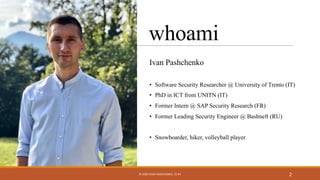
Ivan Pashchenko
• Software Security Researcher @ University of Trento (IT)
• PhD in ICT from UNITN (IT)
• Former Intern @ SAP Security Research (FR)
• Former Leading Security Engineer @ Bashneft (RU)
• Snowboarder, hiker, volleyball player
2© 2020 IVAN PASHCHENKO. CC BY
3
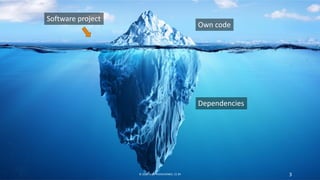
Own code
Dependencies
Software project
© 2020 IVAN PASHCHENKO. CC BY
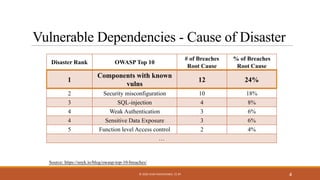
Vulnerable Dependencies - Cause of Disaster
4
Disaster Rank OWASP Top 10
# of Breaches
Root Cause
% of Breaches
Root Cause
1
Components with known
vulns
12 24%
2 Security misconfiguration 10 18%
3 SQL-injection 4 8%
4 Weak Authentication 3 6%
4 Sensitive Data Exposure 3 6%
5 Function level Access control 2 4%
…
Source: https://snyk.io/blog/owasp-top-10-breaches/
© 2020 IVAN PASHCHENKO. CC BY
Developers still keep dependencies outdated.. Why?
5
3. R.G. Kula, D.M. German, A. O. TakashiIshio, and K.Inoue. 2017. Do developers update their library dependencies? Emp. Soft. Eng. Journ., 2017
Derr et al. [1]:
«Many dependencies are vulnerable, but
could be easily updated»
Kula et al. [3]:
«Many Java libraries do not react on
security updates»
Huang et al. [2]:
«Easy update would have broken around
50% of dependent projects»
Pashchenko et al. [4]:
«20% of vulnerabilities are in test/dev
scopes, hence, not exploitable»
1. E. Derr, S. Bugiel, S. Fahl, Y. Acar, and M. Backes. 2017. Keep me updated: An empirical study of third-party library updatability on Android. In Proc. of CCS’17.
2. J. Huang, N. Borges, S. Bugiel, and M. Backes. 2019. Up-To-Crash: Evaluating Third-Party Library Updatability on Android. In Proc. of EuroS&P’19.
4. I. Pashchenko, H. Plate, S.E. Ponta, A. Sabetta, and F. Massacci. 2018. Vulnerable Open Source Dependencies: Counting Those That Matter. In Proc. of ESEM’18.
© 2020 IVAN PASHCHENKO. CC BY
Developers may not be entirely irrational
in not always updating dependencies
6© 2020 IVAN PASHCHENKO. CC BY
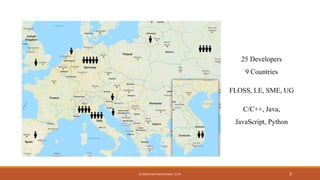
25 Developers
9 Countries
FLOSS, LE, SME, UG
C/C++, Java,
JavaScript, Python
7© 2020 IVAN PASHCHENKO. CC BY
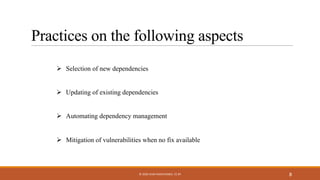
Practices on the following aspects
Ø Selection of new dependencies
Ø Updating of existing dependencies
Ø Automating dependency management
Ø Mitigation of vulnerabilities when no fix available
8© 2020 IVAN PASHCHENKO. CC BY
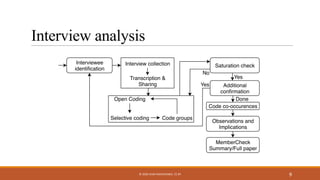
Interview analysis
9
Inter ie ee
identi cation
Inter ie collection
Transcription &
Sharing
Open Coding
Selecti e coding Code gro ps
Sat ration check
Additional
con rmation
Code co-occ rences
MemberCheck
S mmar /F ll paper
Yes
No
Yes
Done
Obser ations and
Implications
© 2020 IVAN PASHCHENKO. CC BY
Implication
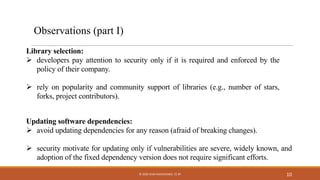
Library selection:
Ø developers pay attention to security only if it is required and enforced by the
policy of their company.
Ø rely on popularity and community support of libraries (e.g., number of stars,
forks, project contributors).
Observations (part I)
Updating software dependencies:
Ø avoid updating dependencies for any reason (afraid of breaking changes).
Ø security motivate for updating only if vulnerabilities are severe, widely known, and
adoption of the fixed dependency version does not require significant efforts.
10© 2020 IVAN PASHCHENKO. CC BY
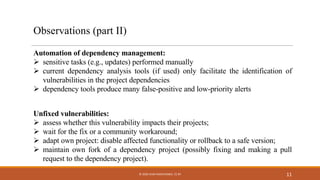
Observations (part II)
Implication
Automation of dependency management:
Ø sensitive tasks (e.g., updates) performed manually
Ø current dependency analysis tools (if used) only facilitate the identification of
vulnerabilities in the project dependencies
Ø dependency tools produce many false-positive and low-priority alerts
Unfixed vulnerabilities:
Ø assess whether this vulnerability impacts their projects;
Ø wait for the fix or a community workaround;
Ø adapt own project: disable affected functionality or rollback to a safe version;
Ø maintain own fork of a dependency project (possibly fixing and making a pull
request to the dependency project).
11© 2020 IVAN PASHCHENKO. CC BY
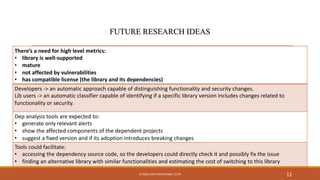
There’s a need for high level metrics:
• library is well-supported
• mature
• not affected by vulnerabilities
• has compatible license (the library and its dependencies)
Developers -> an automatic approach capable of distinguishing functionality and security changes.
Lib users -> an automatic classifier capable of identifying if a specific library version includes changes related to
functionality or security.
Dep analysis tools are expected to:
• generate only relevant alerts
• show the affected components of the dependent projects
• suggest a fixed version and if its adoption introduces breaking changes
Tools could facilitate:
• accessing the dependency source code, so the developers could directly check it and possibly fix the issue
• finding an alternative library with similar functionalities and estimating the cost of switching to this library
12© 2020 IVAN PASHCHENKO. CC BY
13
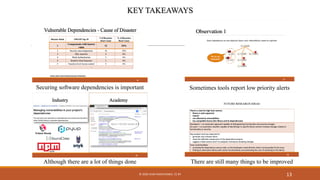
Securing software dependencies is important Sometimes tools report low priority alerts
There are still many things to be improvedAlthough there are a lot of things done
© 2020 IVAN PASHCHENKO. CC BY
The work has been partly funded by the EU under the H2020 Programs
H2020-EU.2.1.1-CyberSec4Europe (Grant No. 830929)
14
ivan.pashchenko@unitn.it
@IvPashenko
http://disi.unitn.it/~pashchenko
Contact me:
Dev perceptions preprint:
© 2020 IVAN PASHCHENKO. CC BY

SFScon 2020 - Ivan Pashchenko - Learning from Developers How to Make Dependency Management Secure

  • 1.
    Learning from Developers: Howto Make Dependency Management Secure IVAN PASHCHENKO Postdoctoral Research Fellow @ University of Trento (IT)
  • 2.
    whoami 2 Ivan Pashchenko • SoftwareSecurity Researcher @ University of Trento (IT) • PhD in ICT from UNITN (IT) • Former Intern @ SAP Security Research (FR) • Former Leading Security Engineer @ Bashneft (RU) • Snowboarder, hiker, volleyball player 2© 2020 IVAN PASHCHENKO. CC BY
  • 3.
  • 4.
    Vulnerable Dependencies -Cause of Disaster 4 Disaster Rank OWASP Top 10 # of Breaches Root Cause % of Breaches Root Cause 1 Components with known vulns 12 24% 2 Security misconfiguration 10 18% 3 SQL-injection 4 8% 4 Weak Authentication 3 6% 4 Sensitive Data Exposure 3 6% 5 Function level Access control 2 4% … Source: https://snyk.io/blog/owasp-top-10-breaches/ © 2020 IVAN PASHCHENKO. CC BY
  • 5.
    Developers still keepdependencies outdated.. Why? 5 3. R.G. Kula, D.M. German, A. O. TakashiIshio, and K.Inoue. 2017. Do developers update their library dependencies? Emp. Soft. Eng. Journ., 2017 Derr et al. [1]: «Many dependencies are vulnerable, but could be easily updated» Kula et al. [3]: «Many Java libraries do not react on security updates» Huang et al. [2]: «Easy update would have broken around 50% of dependent projects» Pashchenko et al. [4]: «20% of vulnerabilities are in test/dev scopes, hence, not exploitable» 1. E. Derr, S. Bugiel, S. Fahl, Y. Acar, and M. Backes. 2017. Keep me updated: An empirical study of third-party library updatability on Android. In Proc. of CCS’17. 2. J. Huang, N. Borges, S. Bugiel, and M. Backes. 2019. Up-To-Crash: Evaluating Third-Party Library Updatability on Android. In Proc. of EuroS&P’19. 4. I. Pashchenko, H. Plate, S.E. Ponta, A. Sabetta, and F. Massacci. 2018. Vulnerable Open Source Dependencies: Counting Those That Matter. In Proc. of ESEM’18. © 2020 IVAN PASHCHENKO. CC BY
  • 6.
    Developers may notbe entirely irrational in not always updating dependencies 6© 2020 IVAN PASHCHENKO. CC BY
  • 7.
    25 Developers 9 Countries FLOSS,LE, SME, UG C/C++, Java, JavaScript, Python 7© 2020 IVAN PASHCHENKO. CC BY
  • 8.
    Practices on thefollowing aspects Ø Selection of new dependencies Ø Updating of existing dependencies Ø Automating dependency management Ø Mitigation of vulnerabilities when no fix available 8© 2020 IVAN PASHCHENKO. CC BY
  • 9.
    Interview analysis 9 Inter ieee identi cation Inter ie collection Transcription & Sharing Open Coding Selecti e coding Code gro ps Sat ration check Additional con rmation Code co-occ rences MemberCheck S mmar /F ll paper Yes No Yes Done Obser ations and Implications © 2020 IVAN PASHCHENKO. CC BY
  • 10.
    Implication Library selection: Ø developerspay attention to security only if it is required and enforced by the policy of their company. Ø rely on popularity and community support of libraries (e.g., number of stars, forks, project contributors). Observations (part I) Updating software dependencies: Ø avoid updating dependencies for any reason (afraid of breaking changes). Ø security motivate for updating only if vulnerabilities are severe, widely known, and adoption of the fixed dependency version does not require significant efforts. 10© 2020 IVAN PASHCHENKO. CC BY
  • 11.
    Observations (part II) Implication Automationof dependency management: Ø sensitive tasks (e.g., updates) performed manually Ø current dependency analysis tools (if used) only facilitate the identification of vulnerabilities in the project dependencies Ø dependency tools produce many false-positive and low-priority alerts Unfixed vulnerabilities: Ø assess whether this vulnerability impacts their projects; Ø wait for the fix or a community workaround; Ø adapt own project: disable affected functionality or rollback to a safe version; Ø maintain own fork of a dependency project (possibly fixing and making a pull request to the dependency project). 11© 2020 IVAN PASHCHENKO. CC BY
  • 12.
    There’s a needfor high level metrics: • library is well-supported • mature • not affected by vulnerabilities • has compatible license (the library and its dependencies) Developers -> an automatic approach capable of distinguishing functionality and security changes. Lib users -> an automatic classifier capable of identifying if a specific library version includes changes related to functionality or security. Dep analysis tools are expected to: • generate only relevant alerts • show the affected components of the dependent projects • suggest a fixed version and if its adoption introduces breaking changes Tools could facilitate: • accessing the dependency source code, so the developers could directly check it and possibly fix the issue • finding an alternative library with similar functionalities and estimating the cost of switching to this library 12© 2020 IVAN PASHCHENKO. CC BY
  • 13.
    13 Securing software dependenciesis important Sometimes tools report low priority alerts There are still many things to be improvedAlthough there are a lot of things done © 2020 IVAN PASHCHENKO. CC BY
  • 14.
    The work hasbeen partly funded by the EU under the H2020 Programs H2020-EU.2.1.1-CyberSec4Europe (Grant No. 830929) 14 ivan.pashchenko@unitn.it @IvPashenko http://disi.unitn.it/~pashchenko Contact me: Dev perceptions preprint: © 2020 IVAN PASHCHENKO. CC BY