The blog as a tool for shaping
a potential connectivist
learning context
Inter institutional Extended Curriculum Symposium
Granger Bay CPUT hotel school
26 th August 2014
Rita Ndagire Kizito (UWC)
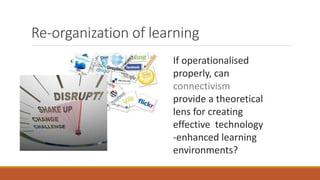
Re-organization of learning
If operationalised
properly, can
connectivism
provide a theoretical
lens for creating
effective technology
-enhanced learning
environments?
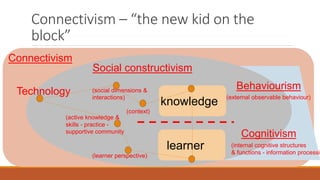
Connectivism – “the new kid on the
block”
knowledge
learner
Behaviourism
(external observable behaviour)
Cognitivism
(internal cognitive structures
& functions - information processin
Social constructivism
(learner perspective)
Connectivism
(active knowledge &
skills - practice -
supportive community
(social dimensions &
interactions)
Technology
(context)
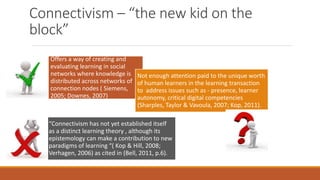
Connectivism – “the new kid on the
block”
Offers a way of creating and
evaluating learning in social
networks where knowledge is
distributed across networks of
connection nodes ( Siemens,
2005; Downes, 2007)
Not enough attention paid to the unique worth
of human learners in the learning transaction
to address issues such as - presence, learner
autonomy, critical digital competencies
(Sharples, Taylor & Vavoula, 2007; Kop, 2011).
“Connectivism has not yet established itself
as a distinct learning theory , although its
epistemology can make a contribution to new
paradigms of learning “( Kop & Hill, 2008;
Verhagen, 2006) as cited in (Bell, 2011, p.6).
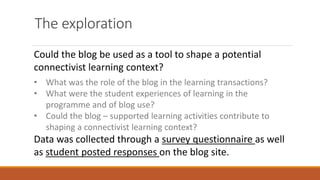
The exploration
Could the blog be used as a tool to shape a potential
connectivist learning context?
• What was the role of the blog in the learning transactions?
• What were the student experiences of learning in the
programme and of blog use?
• Could the blog – supported learning activities contribute to
shaping a connectivist learning context?
Data was collected through a survey questionnaire as well
as student posted responses on the blog site.
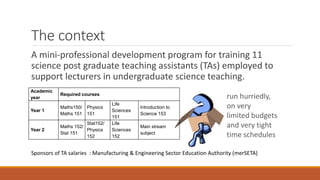
The context
A mini-professional development program for training 11
science post graduate teaching assistants (TAs) employed to
support lecturers in undergraduate science teaching.
.
Academic
year
Required courses
Year 1
Maths150/
Maths 151
Physics
151
Life
Sciences
151
Introduction to
Science 153
Year 2
Maths 152/
Stat 151
Stat152/
Physics
152
Life
Sciences
152
Main stream
subject
run hurriedly,
on very
limited budgets
and very tight
time schedules
Sponsors of TA salaries : Manufacturing & Engineering Sector Education Authority (merSETA)
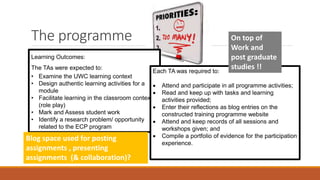
The programme
Learning Outcomes:
The TAs were expected to:
• Examine the UWC learning context
• Design authentic learning activities for a
module
• Facilitate learning in the classroom context
(role play)
• Mark and Assess student work
• Identify a research problem/ opportunity
related to the ECP program
Each TA was required to:
 Attend and participate in all programme activities;
 Read and keep up with tasks and learning
activities provided;
 Enter their reflections as blog entries on the
constructed training programme website
 Attend and keep records of all sessions and
workshops given; and
 Compile a portfolio of evidence for the participation
experience.
On top of
Work and
post graduate
studies !!
Blog space used for posting
assignments , presenting
assignments (& collaboration)?
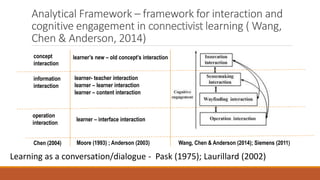
Analytical Framework – framework for interaction and
cognitive engagement in connectivist learning ( Wang,
Chen & Anderson, 2014)
learner – interface interaction
learner- teacher interaction
learner – learner interaction
learner – content interaction
learner’s new – old concept’s interaction
operation
interaction
information
interaction
concept
interaction
Chen (2004) Moore (1993) ; Anderson (2003) Wang, Chen & Anderson (2014); Siemens (2011)
Learning as a conversation/dialogue - Pask (1975); Laurillard (2002)
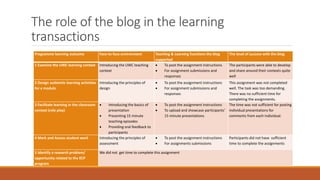
The role of the blog in the learning
transactions
Programme learning outcome Face-to-face environment Teaching & Learning functions the blog
supported
The level of success with the blog
1 Examine the UWC learning context Introducing the UWC teaching
context
 To post the assignment instructions
 For assignment submissions and
responses
The participants were able to develop
and share around their contexts quite
well
2 Design authentic learning activities
for a module
Introducing the principles of
design
 To post the assignment instructions
 For assignment submissions and
responses
This assignment was not completed
well. The task was too demanding.
There was no sufficient time for
completing the assignments.
3 Facilitate learning in the classroom
context (role play)
 Introducing the basics of
presentation
 Presenting 15 minute
teaching episodes
 Providing oral feedback to
participants
 To post the assignment instructions
 To upload and showcase participants’
15 minute presentations
The time was not sufficient for posting
individual presentations for
comments from each individual.
4 Mark and Assess student work Introducing the principles of
assessment
 To post the assignment instructions
 For assignments submissions
Participants did not have sufficient
time to complete the assignments
5 Identify a research problem/
opportunity related to the ECP
program
We did not get time to complete this assignment
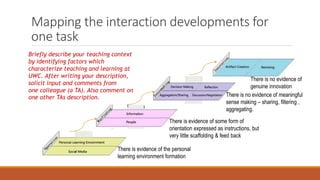
Mapping the interaction developments for
one task
There is evidence of the personal
learning environment formation
There is no evidence of meaningful
sense making – sharing, filtering ,
aggregating.
There is evidence of some form of
orientation expressed as instructions, but
very little scaffolding & feed back
There is no evidence of
genuine innovation
Briefly describe your teaching context
by identifying factors which
characterize teaching and learning at
UWC. After writing your description,
solicit input and comments from
one colleague (a TA). Also comment on
one other TAs description.
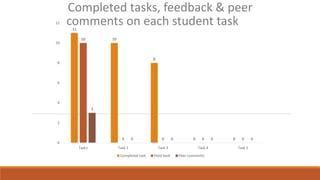
11
10
8
0 0
10
0 0 0 0
3
0 0 0 0
0
2
4
6
8
10
12
Task1 Task 2 Task 3 Task 4 Task 5
Completed task Feed back Peer comments
Completed tasks, feedback & peer
comments on each student task
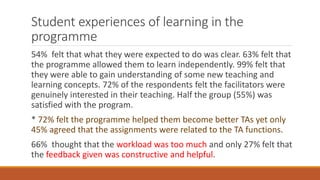
Student experiences of learning in the
programme
54% felt that what they were expected to do was clear. 63% felt that
the programme allowed them to learn independently. 99% felt that
they were able to gain understanding of some new teaching and
learning concepts. 72% of the respondents felt the facilitators were
genuinely interested in their teaching. Half the group (55%) was
satisfied with the program.
* 72% felt the programme helped them become better TAs yet only
45% agreed that the assignments were related to the TA functions.
66% thought that the workload was too much and only 27% felt that
the feedback given was constructive and helpful.
Student experiences of learning in the
programme
“no feedback from coordinators
clearly demonstrates that our
efforts in the assignments were for
nothing”
“not enough contact time with the
facilitators”
“for a science student, who is also
a TA overlooking over 250 students
that was a lot of material to get
through”
The areas of feedback and
workload would have to be
revisited to improve the
quality of the programme.
There was a lack of
congruence between the
assignments and the TA
functions.
Student experiences of blog use
“The blog environment was good but inconsistent, an
updated email notification could have been sent to us
to support the blog”.
“The blog was very useful as I could gain from what
others were doing”
“The blog was an interesting tool”.
“The lack of feedback and support on my blog made
me feel that all my efforts and hard work was for
nothing”.
communication
collaboration
motivation?
feedback
Shortcomings
 Not enough scaffolding & feedback (new roles-
amplifying, curating, wayfinding, modelling, presence) (Siemens,
2010)
 Peer support not encouraged and enabled enough
 Not enough done to build a collaborative and a
learning community
 Too many tasks
 No unifying underlying theory
 Assignments not closely linked to practice
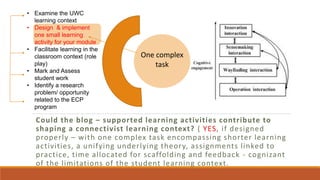
Could the blog – supported learning activities contribute to
shaping a connectivist learning context? ( YES, if designed
properly – with one complex task encompassing shorter learning
activities, a unifying underlying theory, assignments linked to
practice, time allocated for scaffolding and feedback - cognizant
of the limitations of the student learning context.
One complex
task
• Examine the UWC
learning context
• Design & implement
one small learning
activity for your module
• Facilitate learning in the
classroom context (role
play)
• Mark and Assess
student work
• Identify a research
problem/ opportunity
related to the ECP
program
References
Anderson, T. (2003). Getting the mix right again: An updated and theoretical rationale for
interaction. The International Review of Research in Open and Distance Learning, 4(2)
Bell, F. (2011). Connectivism: Its place in theory-informed research and innovation in
technology-enabled learning. The International Review of Research in Open and Distance
Learning, 12(3), 98-118.
Chen, L. (2004). A hierarchical model for student and teacher interaction in distance
learning. Distance Education in China, (05), 24-28+78.
Downes, S. (2007). What connectivism is. Retrieved from
http://halfanhour.blogspot.com/2007/02/what-connectivism-is.html
Kop, R. (2011). The challenges to connectivist learning on open online networks: Learning
experiences during a massive open online course. The International Review of Research in
Open and Distance Learning, 12(3), 19-38.
References
Kop, R., & Hill, A. (2008). Connectivism: Learning theory of the future or vestige of the
past? The International Review of Research in Open and Distance Learning, 9(3). Retrieved
from http://www.irrodl.org/index.php/irrodl/article/view/523/1103.
Laurillard, D. (2002). Rethinking university teaching: A conversational framework for the
effective use of learning technologies (2nd ed.). London: Routledge-Falmer
Moore, M. G. (1993). Theory of transactional distance. In Theoretical principles of distance
education (pp. 22–38). London: Rutledge
Pask, G. (1975). Conversation, cognition and learning. Amsterdam: Elsevier.
Sharples, M., Taylor, J., & Vavoula, G. (2010). A theory of learning for the mobile age. In
Medienbildung in neuen Kulturräumen (pp. 87-99). VS Verlag für Sozialwissenschaften.
References
Siemens, G. (2005). Connectivism: A learning theory for the digital age. International Journal of
Instructional Technology and Distance Learning, 2(1), 3-10.
Siemens, G. (2011). Orientation: Sensemaking and wayfinding in complex distributed online
information environments (Doctoral dissertation). University of Aberdeen.
Verhagen, P. (2006). Connectivism: A new learning theory? Surf e-learning themasite. Retrieved
from http://elearning.surf.nl/e-learning/english/3793
Wang, Z., Chen, L., & Anderson, T. (2014). A framework for interaction and cognitive engagement
in connectivist learning contexts. The International Review of Research in Open and Distance
Learning, 15(2).

The blog as a tool for shaping a potential connectivist learning context

  • 1.
    The blog asa tool for shaping a potential connectivist learning context Inter institutional Extended Curriculum Symposium Granger Bay CPUT hotel school 26 th August 2014 Rita Ndagire Kizito (UWC)
  • 2.
    Re-organization of learning Ifoperationalised properly, can connectivism provide a theoretical lens for creating effective technology -enhanced learning environments?
  • 3.
    Connectivism – “thenew kid on the block” knowledge learner Behaviourism (external observable behaviour) Cognitivism (internal cognitive structures & functions - information processin Social constructivism (learner perspective) Connectivism (active knowledge & skills - practice - supportive community (social dimensions & interactions) Technology (context)
  • 4.
    Connectivism – “thenew kid on the block” Offers a way of creating and evaluating learning in social networks where knowledge is distributed across networks of connection nodes ( Siemens, 2005; Downes, 2007) Not enough attention paid to the unique worth of human learners in the learning transaction to address issues such as - presence, learner autonomy, critical digital competencies (Sharples, Taylor & Vavoula, 2007; Kop, 2011). “Connectivism has not yet established itself as a distinct learning theory , although its epistemology can make a contribution to new paradigms of learning “( Kop & Hill, 2008; Verhagen, 2006) as cited in (Bell, 2011, p.6).
  • 5.
    The exploration Could theblog be used as a tool to shape a potential connectivist learning context? • What was the role of the blog in the learning transactions? • What were the student experiences of learning in the programme and of blog use? • Could the blog – supported learning activities contribute to shaping a connectivist learning context? Data was collected through a survey questionnaire as well as student posted responses on the blog site.
  • 6.
    The context A mini-professionaldevelopment program for training 11 science post graduate teaching assistants (TAs) employed to support lecturers in undergraduate science teaching. . Academic year Required courses Year 1 Maths150/ Maths 151 Physics 151 Life Sciences 151 Introduction to Science 153 Year 2 Maths 152/ Stat 151 Stat152/ Physics 152 Life Sciences 152 Main stream subject run hurriedly, on very limited budgets and very tight time schedules Sponsors of TA salaries : Manufacturing & Engineering Sector Education Authority (merSETA)
  • 7.
    The programme Learning Outcomes: TheTAs were expected to: • Examine the UWC learning context • Design authentic learning activities for a module • Facilitate learning in the classroom context (role play) • Mark and Assess student work • Identify a research problem/ opportunity related to the ECP program Each TA was required to:  Attend and participate in all programme activities;  Read and keep up with tasks and learning activities provided;  Enter their reflections as blog entries on the constructed training programme website  Attend and keep records of all sessions and workshops given; and  Compile a portfolio of evidence for the participation experience. On top of Work and post graduate studies !! Blog space used for posting assignments , presenting assignments (& collaboration)?
  • 8.
    Analytical Framework –framework for interaction and cognitive engagement in connectivist learning ( Wang, Chen & Anderson, 2014) learner – interface interaction learner- teacher interaction learner – learner interaction learner – content interaction learner’s new – old concept’s interaction operation interaction information interaction concept interaction Chen (2004) Moore (1993) ; Anderson (2003) Wang, Chen & Anderson (2014); Siemens (2011) Learning as a conversation/dialogue - Pask (1975); Laurillard (2002)
  • 9.
    The role ofthe blog in the learning transactions Programme learning outcome Face-to-face environment Teaching & Learning functions the blog supported The level of success with the blog 1 Examine the UWC learning context Introducing the UWC teaching context  To post the assignment instructions  For assignment submissions and responses The participants were able to develop and share around their contexts quite well 2 Design authentic learning activities for a module Introducing the principles of design  To post the assignment instructions  For assignment submissions and responses This assignment was not completed well. The task was too demanding. There was no sufficient time for completing the assignments. 3 Facilitate learning in the classroom context (role play)  Introducing the basics of presentation  Presenting 15 minute teaching episodes  Providing oral feedback to participants  To post the assignment instructions  To upload and showcase participants’ 15 minute presentations The time was not sufficient for posting individual presentations for comments from each individual. 4 Mark and Assess student work Introducing the principles of assessment  To post the assignment instructions  For assignments submissions Participants did not have sufficient time to complete the assignments 5 Identify a research problem/ opportunity related to the ECP program We did not get time to complete this assignment
  • 10.
    Mapping the interactiondevelopments for one task There is evidence of the personal learning environment formation There is no evidence of meaningful sense making – sharing, filtering , aggregating. There is evidence of some form of orientation expressed as instructions, but very little scaffolding & feed back There is no evidence of genuine innovation Briefly describe your teaching context by identifying factors which characterize teaching and learning at UWC. After writing your description, solicit input and comments from one colleague (a TA). Also comment on one other TAs description.
  • 11.
    11 10 8 0 0 10 0 00 0 3 0 0 0 0 0 2 4 6 8 10 12 Task1 Task 2 Task 3 Task 4 Task 5 Completed task Feed back Peer comments Completed tasks, feedback & peer comments on each student task
  • 12.
    Student experiences oflearning in the programme 54% felt that what they were expected to do was clear. 63% felt that the programme allowed them to learn independently. 99% felt that they were able to gain understanding of some new teaching and learning concepts. 72% of the respondents felt the facilitators were genuinely interested in their teaching. Half the group (55%) was satisfied with the program. * 72% felt the programme helped them become better TAs yet only 45% agreed that the assignments were related to the TA functions. 66% thought that the workload was too much and only 27% felt that the feedback given was constructive and helpful.
  • 13.
    Student experiences oflearning in the programme “no feedback from coordinators clearly demonstrates that our efforts in the assignments were for nothing” “not enough contact time with the facilitators” “for a science student, who is also a TA overlooking over 250 students that was a lot of material to get through” The areas of feedback and workload would have to be revisited to improve the quality of the programme. There was a lack of congruence between the assignments and the TA functions.
  • 14.
    Student experiences ofblog use “The blog environment was good but inconsistent, an updated email notification could have been sent to us to support the blog”. “The blog was very useful as I could gain from what others were doing” “The blog was an interesting tool”. “The lack of feedback and support on my blog made me feel that all my efforts and hard work was for nothing”. communication collaboration motivation? feedback
  • 15.
    Shortcomings  Not enoughscaffolding & feedback (new roles- amplifying, curating, wayfinding, modelling, presence) (Siemens, 2010)  Peer support not encouraged and enabled enough  Not enough done to build a collaborative and a learning community  Too many tasks  No unifying underlying theory  Assignments not closely linked to practice
  • 16.
    Could the blog– supported learning activities contribute to shaping a connectivist learning context? ( YES, if designed properly – with one complex task encompassing shorter learning activities, a unifying underlying theory, assignments linked to practice, time allocated for scaffolding and feedback - cognizant of the limitations of the student learning context. One complex task • Examine the UWC learning context • Design & implement one small learning activity for your module • Facilitate learning in the classroom context (role play) • Mark and Assess student work • Identify a research problem/ opportunity related to the ECP program
  • 17.
    References Anderson, T. (2003).Getting the mix right again: An updated and theoretical rationale for interaction. The International Review of Research in Open and Distance Learning, 4(2) Bell, F. (2011). Connectivism: Its place in theory-informed research and innovation in technology-enabled learning. The International Review of Research in Open and Distance Learning, 12(3), 98-118. Chen, L. (2004). A hierarchical model for student and teacher interaction in distance learning. Distance Education in China, (05), 24-28+78. Downes, S. (2007). What connectivism is. Retrieved from http://halfanhour.blogspot.com/2007/02/what-connectivism-is.html Kop, R. (2011). The challenges to connectivist learning on open online networks: Learning experiences during a massive open online course. The International Review of Research in Open and Distance Learning, 12(3), 19-38.
  • 18.
    References Kop, R., &Hill, A. (2008). Connectivism: Learning theory of the future or vestige of the past? The International Review of Research in Open and Distance Learning, 9(3). Retrieved from http://www.irrodl.org/index.php/irrodl/article/view/523/1103. Laurillard, D. (2002). Rethinking university teaching: A conversational framework for the effective use of learning technologies (2nd ed.). London: Routledge-Falmer Moore, M. G. (1993). Theory of transactional distance. In Theoretical principles of distance education (pp. 22–38). London: Rutledge Pask, G. (1975). Conversation, cognition and learning. Amsterdam: Elsevier. Sharples, M., Taylor, J., & Vavoula, G. (2010). A theory of learning for the mobile age. In Medienbildung in neuen Kulturräumen (pp. 87-99). VS Verlag für Sozialwissenschaften.
  • 19.
    References Siemens, G. (2005).Connectivism: A learning theory for the digital age. International Journal of Instructional Technology and Distance Learning, 2(1), 3-10. Siemens, G. (2011). Orientation: Sensemaking and wayfinding in complex distributed online information environments (Doctoral dissertation). University of Aberdeen. Verhagen, P. (2006). Connectivism: A new learning theory? Surf e-learning themasite. Retrieved from http://elearning.surf.nl/e-learning/english/3793 Wang, Z., Chen, L., & Anderson, T. (2014). A framework for interaction and cognitive engagement in connectivist learning contexts. The International Review of Research in Open and Distance Learning, 15(2).