The seminar

The aim of this session is to
 enhance your reflection on your evaluations
 make explicit links to theory and research
 clarify the essay and resolve any issues
 BSE 1

 Plans and Evaluations

 Theory (again!)
    Meaningful Learning
    Good ICT

 The Essay
    Structure
    Criteria

 Practicalities
BSE 1

“How have your views about
 learning and teaching ICT
 changed?”
                           Section 3
Plans
 Present your annotated plans to two or three colleagues

 Focus on…
    The intended learning and subject understanding
    The role of the teacher
    What will be assessed and how

 Is there reference to relevant subject texts to support
  the choices made?

 Be a „critical friend‟ to those presenting
Evaluations
 Present your evaluations to two or three colleagues

 Focus on…
    the extent of children‟s learning and evidence for this;
    evidence for the effectiveness of the talk used by you
     and the children;
    what you have learned about how children learn and
     your teaching.

 Are the points made related to relevant reading?

 Be a „critical friend‟ to those presenting
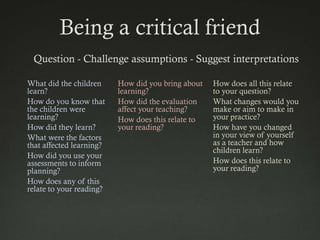
Being a critical friend
 Question - Challenge assumptions - Suggest interpretations

What did the children     How did you bring about   How does all this relate
learn?                    learning?                 to your question?
How do you know that      How did the evaluation    What changes would you
the children were         affect your teaching?     make or aim to make in
learning?                 How does this relate to   your practice?
How did they learn?       your reading?             How have you changed
What were the factors                               in your view of yourself
that affected learning?                             as a teacher and how
                                                    children learn?
How did you use your
assessments to inform                               How does this relate to
planning?                                           your reading?
How does any of this
relate to your reading?
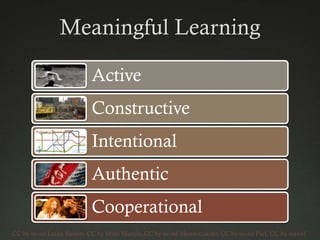
Meaningful Learning

                           Active
                           Constructive
                           Intentional
                           Authentic
                           Cooperational
CC by-nc-nd Laura Burton, CC by Matti Mattila, CC by-nc-nd Mundocuardo, CC by-nc-nd Parl, CC by mawel
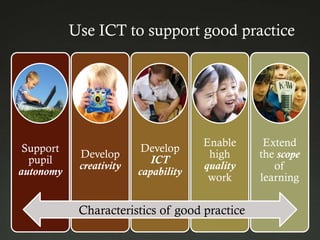
Use ICT to support good practice


                                      Enable     Extend
 Support                  Develop
            Develop                    high     the scope
  pupil                     ICT
            creativity                quality      of
autonomy                 capability
                                       work     learning


            Characteristics of good practice
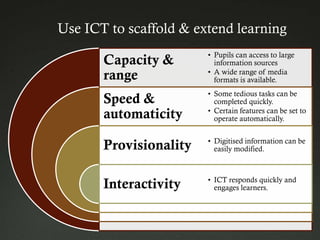
Use ICT to scaffold & extend learning
                        • Pupils can access to large
       Capacity &         information sources
                        • A wide range of media
       range              formats is available.
                        • Some tedious tasks can be
       Speed &            completed quickly.
                        • Certain features can be set to
       automaticity       operate automatically.

                        • Digitised information can be
       Provisionality     easily modified.


                        • ICT responds quickly and
       Interactivity      engages learners.
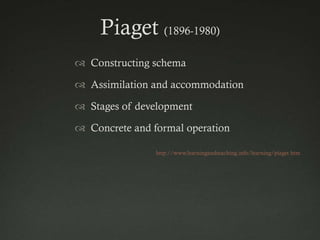
Piaget (1896-1980)
 Constructing schema

 Assimilation and accommodation

 Stages of development

 Concrete and formal operation

                http://www.learningandteaching.info/learning/piaget.htm
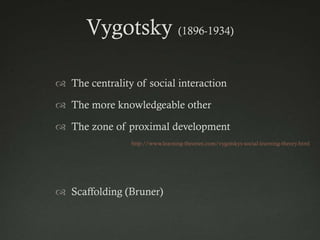
Vygotsky (1896-1934)

 The centrality of social interaction

 The more knowledgeable other

 The zone of proximal development
                http://www.learning-theories.com/vygotskys-social-learning-theory.html


 Scaffolding (Bruner)
Constructionism

 Constructivist learning happens
  best when „constructing a public
  entity‟

 “Concrete” materials rather than
  abstract propositions


         http://www.papert.org/articles/SituatingConstructionism.html
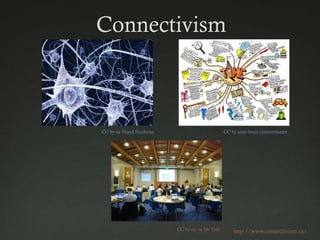
Connectivism


CC by-sa Hijod.Huskona                        CC by jean-louis zimmermann


                         CC by-nc-sa Mr Ush       http://www.connectivism.ca/
The essay…

 … is about evaluating your practice drawing on theory
  and reflecting on your assumptions.

 You are not trying to generate a definitive answer.

 The style of your answer is about discussion and
  analysis.
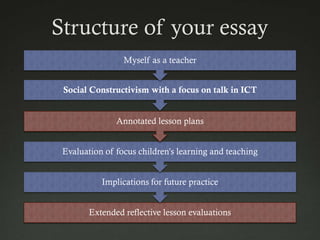
Structure of your essay
                 Myself as a teacher


 Social Constructivism with a focus on talk in ICT


               Annotated lesson plans


 Evaluation of focus children‟s learning and teaching


           Implications for future practice


        Extended reflective lesson evaluations
1. Myself as a teacher: a reflective discussion considering
   your aims for teaching your chosen curriculum area and the
   kind of teacher you would like to be. Discuss how your
   own experiences and your reading may influence your
   views and practice.
                                                      250 words


2. Social Constructivism with a focus on talk in one
   curriculum area: What does a social constructivist view of
   learning imply for teaching approaches? Critically consider
   current issues in your subject area and justify your views,
   related to reading.
                                                      1250 words

  Annotated lesson plans
3. Evaluation of focus children’s learning and your
   teaching:
   Discussion of above considering the children‟s learning
   drawing on their responses and your evaluation.
   Reflections on your teaching including decisions made „in
   action‟.
                                                  1500 words

4. What are the implications for your practice within the
   national context?
   Include ways your views have changed and reflections on
   this process.
                                                1000 words
Towards Section 3
 Drawing on your plans and evaluation discuss what
  you will write in section 3:
 What did you learn about:
    how children learn ICT?
    the role of talk in learning?

 How have your views about learning and teaching
  mathematics changed / developed?
 How does this relate to what you have written
  previously?
 How does this relate to your reading?
Section 4

 What are the implications for your practice?

 What are the possible difficulties and tensions for
  yourself as a teacher of ICT in the current context?

 How does this affect your teaching across the
  curriculum?
The current context
“Disapplying the ICT programme of study is about
freedom. It will mean that, for the first time, teachers will
be allowed to cover truly innovative, specialist and
challenging topics.
And whether they choose a premade curriculum, or
whether they design their own programme of study
specifically for their school, they will have the freedom and
flexibility to decide what is best for their pupils.
Teachers will now be allowed to focus more sharply on the
subjects they think matter – for example, teaching exactly
how computers work, studying the basics of programming
and coding and encouraging pupils to have a go
themselves.”
The current context 2
 The Government has made clear that it considers ICT
  to be an important subject that should be taught to all
  pupils. As a clear statement of the importance that it
  attaches to ICT education, the Government has
  decided that ICT will continue to be a National
  Curriculum subject, with new statutory Programmes
  of Study at all four key stages, from September 2014.
  The Department for Education will look to work with
  experts from industry, IT organisations and the
  teaching profession to develop the new Programmes of
  Study as a national standard for all schools, whilst
  providing sufficient flexibility and scope to meet the
  changing demands of the subject.
 See bcs.org/ictpos for the draft PoS
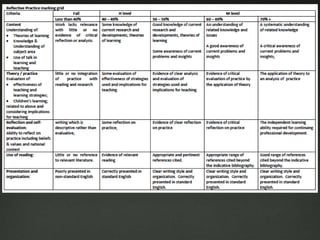
To pass…

evaluation of effectiveness of teaching strategies and the use
of talk, related to theories of learning and demonstrating
awareness of current research and developments;

identification and evaluation of children’s learning with
implications for subsequent teaching;

demonstration of the ability to reflect on practice, including
beliefs and values about teaching and learning in the national
context.
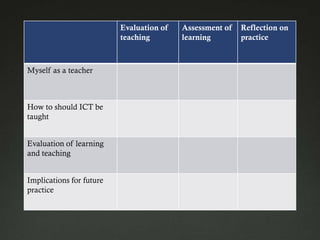
Evaluation of   Assessment of   Reflection on
                          teaching        learning        practice


Myself as a teacher


How to should ICT be
taught


Evaluation of learning
and teaching


Implications for future
practice
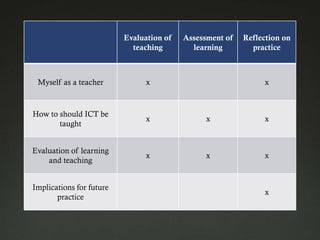
Evaluation of   Assessment of   Reflection on
                            teaching        learning        practice


 Myself as a teacher            x                              x


How to should ICT be
                                x               x              x
       taught


Evaluation of learning
                                x               x              x
    and teaching


Implications for future
                                                               x
       practice
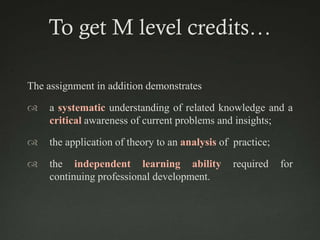
To get M level credits…

The assignment in addition demonstrates

   a systematic understanding of related knowledge and a
    critical awareness of current problems and insights;

   the application of theory to an analysis of practice;

   the independent learning ability            required    for
    continuing professional development.
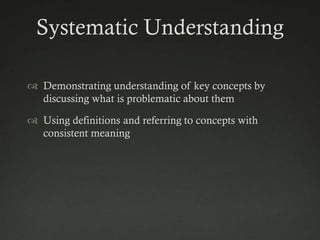
Systematic Understanding

 Demonstrating understanding of key concepts by
  discussing what is problematic about them

 Using definitions and referring to concepts with
  consistent meaning
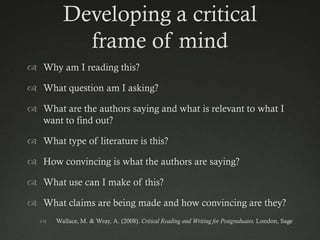
Developing a critical
           frame of mind
 Why am I reading this?

 What question am I asking?

 What are the authors saying and what is relevant to what I
  want to find out?

 What type of literature is this?

 How convincing is what the authors are saying?

 What use can I make of this?

 What claims are being made and how convincing are they?
      Wallace, M. & Wray, A. (2008). Critical Reading and Writing for Postgraduates. London, Sage
Independent learning
       ability

 Thinking things through for yourself

 Researching original sources
Reading
 Google Scholar

 Becta and Futurelab

 Cambridge Primary Review

 Teaching and Learning
Practicalities
 5000 words equivalent,
   made up of 4000 words of substantive text
   two annotated lesson plans,
   bibliography and
   optional appendices

 Section word counts are advisory
 +/- 10% without penalty
  (ie 3600 – 4400 words substantive text)
Referencing

 See the style guide. No, really. You should do this.

 DfEE/QCA, (1999) The National Curriculum, London:
  HMSO

 Chazan, M. & A. F. Laing, (1982) Children with Special
  Needs, Milton Keynes: Open University Press

 Zotero, Mendeley, Refworks
Timescale

 Draft your essay
 E-Mail me a copy when you‟re ready for feedback, but not
  later than 15th February
 Tutorial a few days after I get your draft
 Revise your draft
 Turnitin
 Hand in by 14:00, 15th March – earlier is better
Turnitin
 The Turnitin file is in the RP folder on Studyzone (tutorials
  there if needed)
 You must submit the final version of your essay via
  Turnitin and in hard copy.
 Fill in the electronic cover sheet and make it page 1 of your
  essay.
 You do not need to give us the copy of the originality
  report.
 You can submit your essay at earlier stages to get formative
  feedback. Later submissions overwrite previous versions.
 It could take 24 hours to generate the originality report at
  busy times (but you don‟t need it before handing in).

12 13 PGCE ICT Reflective Practice Seminar 2

  • 2.
    The seminar The aimof this session is to  enhance your reflection on your evaluations  make explicit links to theory and research  clarify the essay and resolve any issues
  • 3.
     BSE 1 Plans and Evaluations  Theory (again!)  Meaningful Learning  Good ICT  The Essay  Structure  Criteria  Practicalities
  • 4.
    BSE 1 “How haveyour views about learning and teaching ICT changed?”  Section 3
  • 5.
    Plans  Present yourannotated plans to two or three colleagues  Focus on…  The intended learning and subject understanding  The role of the teacher  What will be assessed and how  Is there reference to relevant subject texts to support the choices made?  Be a „critical friend‟ to those presenting
  • 6.
    Evaluations  Present yourevaluations to two or three colleagues  Focus on…  the extent of children‟s learning and evidence for this;  evidence for the effectiveness of the talk used by you and the children;  what you have learned about how children learn and your teaching.  Are the points made related to relevant reading?  Be a „critical friend‟ to those presenting
  • 7.
    Being a criticalfriend Question - Challenge assumptions - Suggest interpretations What did the children How did you bring about How does all this relate learn? learning? to your question? How do you know that How did the evaluation What changes would you the children were affect your teaching? make or aim to make in learning? How does this relate to your practice? How did they learn? your reading? How have you changed What were the factors in your view of yourself that affected learning? as a teacher and how children learn? How did you use your assessments to inform How does this relate to planning? your reading? How does any of this relate to your reading?
  • 8.
    Meaningful Learning Active Constructive Intentional Authentic Cooperational CC by-nc-nd Laura Burton, CC by Matti Mattila, CC by-nc-nd Mundocuardo, CC by-nc-nd Parl, CC by mawel
  • 9.
    Use ICT tosupport good practice Enable Extend Support Develop Develop high the scope pupil ICT creativity quality of autonomy capability work learning Characteristics of good practice
  • 10.
    Use ICT toscaffold & extend learning • Pupils can access to large Capacity & information sources • A wide range of media range formats is available. • Some tedious tasks can be Speed & completed quickly. • Certain features can be set to automaticity operate automatically. • Digitised information can be Provisionality easily modified. • ICT responds quickly and Interactivity engages learners.
  • 11.
    Piaget (1896-1980)  Constructingschema  Assimilation and accommodation  Stages of development  Concrete and formal operation http://www.learningandteaching.info/learning/piaget.htm
  • 12.
    Vygotsky (1896-1934)  Thecentrality of social interaction  The more knowledgeable other  The zone of proximal development http://www.learning-theories.com/vygotskys-social-learning-theory.html  Scaffolding (Bruner)
  • 13.
    Constructionism  Constructivist learninghappens best when „constructing a public entity‟  “Concrete” materials rather than abstract propositions http://www.papert.org/articles/SituatingConstructionism.html
  • 14.
    Connectivism CC by-sa Hijod.Huskona CC by jean-louis zimmermann CC by-nc-sa Mr Ush http://www.connectivism.ca/
  • 15.
    The essay…  …is about evaluating your practice drawing on theory and reflecting on your assumptions.  You are not trying to generate a definitive answer.  The style of your answer is about discussion and analysis.
  • 16.
    Structure of youressay Myself as a teacher Social Constructivism with a focus on talk in ICT Annotated lesson plans Evaluation of focus children‟s learning and teaching Implications for future practice Extended reflective lesson evaluations
  • 17.
    1. Myself asa teacher: a reflective discussion considering your aims for teaching your chosen curriculum area and the kind of teacher you would like to be. Discuss how your own experiences and your reading may influence your views and practice. 250 words 2. Social Constructivism with a focus on talk in one curriculum area: What does a social constructivist view of learning imply for teaching approaches? Critically consider current issues in your subject area and justify your views, related to reading. 1250 words Annotated lesson plans
  • 18.
    3. Evaluation offocus children’s learning and your teaching: Discussion of above considering the children‟s learning drawing on their responses and your evaluation. Reflections on your teaching including decisions made „in action‟. 1500 words 4. What are the implications for your practice within the national context? Include ways your views have changed and reflections on this process. 1000 words
  • 19.
    Towards Section 3 Drawing on your plans and evaluation discuss what you will write in section 3:  What did you learn about:  how children learn ICT?  the role of talk in learning?  How have your views about learning and teaching mathematics changed / developed?  How does this relate to what you have written previously?  How does this relate to your reading?
  • 20.
    Section 4  Whatare the implications for your practice?  What are the possible difficulties and tensions for yourself as a teacher of ICT in the current context?  How does this affect your teaching across the curriculum?
  • 21.
    The current context “Disapplyingthe ICT programme of study is about freedom. It will mean that, for the first time, teachers will be allowed to cover truly innovative, specialist and challenging topics. And whether they choose a premade curriculum, or whether they design their own programme of study specifically for their school, they will have the freedom and flexibility to decide what is best for their pupils. Teachers will now be allowed to focus more sharply on the subjects they think matter – for example, teaching exactly how computers work, studying the basics of programming and coding and encouraging pupils to have a go themselves.”
  • 22.
    The current context2  The Government has made clear that it considers ICT to be an important subject that should be taught to all pupils. As a clear statement of the importance that it attaches to ICT education, the Government has decided that ICT will continue to be a National Curriculum subject, with new statutory Programmes of Study at all four key stages, from September 2014. The Department for Education will look to work with experts from industry, IT organisations and the teaching profession to develop the new Programmes of Study as a national standard for all schools, whilst providing sufficient flexibility and scope to meet the changing demands of the subject.  See bcs.org/ictpos for the draft PoS
  • 23.
    To pass… evaluation ofeffectiveness of teaching strategies and the use of talk, related to theories of learning and demonstrating awareness of current research and developments; identification and evaluation of children’s learning with implications for subsequent teaching; demonstration of the ability to reflect on practice, including beliefs and values about teaching and learning in the national context.
  • 24.
    Evaluation of Assessment of Reflection on teaching learning practice Myself as a teacher How to should ICT be taught Evaluation of learning and teaching Implications for future practice
  • 25.
    Evaluation of Assessment of Reflection on teaching learning practice Myself as a teacher x x How to should ICT be x x x taught Evaluation of learning x x x and teaching Implications for future x practice
  • 26.
    To get Mlevel credits… The assignment in addition demonstrates  a systematic understanding of related knowledge and a critical awareness of current problems and insights;  the application of theory to an analysis of practice;  the independent learning ability required for continuing professional development.
  • 27.
    Systematic Understanding  Demonstratingunderstanding of key concepts by discussing what is problematic about them  Using definitions and referring to concepts with consistent meaning
  • 28.
    Developing a critical frame of mind  Why am I reading this?  What question am I asking?  What are the authors saying and what is relevant to what I want to find out?  What type of literature is this?  How convincing is what the authors are saying?  What use can I make of this?  What claims are being made and how convincing are they?  Wallace, M. & Wray, A. (2008). Critical Reading and Writing for Postgraduates. London, Sage
  • 29.
    Independent learning ability  Thinking things through for yourself  Researching original sources
  • 30.
    Reading  Google Scholar Becta and Futurelab  Cambridge Primary Review  Teaching and Learning
  • 32.
    Practicalities  5000 wordsequivalent,  made up of 4000 words of substantive text  two annotated lesson plans,  bibliography and  optional appendices  Section word counts are advisory  +/- 10% without penalty (ie 3600 – 4400 words substantive text)
  • 33.
    Referencing  See thestyle guide. No, really. You should do this.  DfEE/QCA, (1999) The National Curriculum, London: HMSO  Chazan, M. & A. F. Laing, (1982) Children with Special Needs, Milton Keynes: Open University Press  Zotero, Mendeley, Refworks
  • 34.
    Timescale  Draft youressay  E-Mail me a copy when you‟re ready for feedback, but not later than 15th February  Tutorial a few days after I get your draft  Revise your draft  Turnitin  Hand in by 14:00, 15th March – earlier is better
  • 35.
    Turnitin  The Turnitinfile is in the RP folder on Studyzone (tutorials there if needed)  You must submit the final version of your essay via Turnitin and in hard copy.  Fill in the electronic cover sheet and make it page 1 of your essay.  You do not need to give us the copy of the originality report.  You can submit your essay at earlier stages to get formative feedback. Later submissions overwrite previous versions.  It could take 24 hours to generate the originality report at busy times (but you don‟t need it before handing in).