


This PowerPoint is available at
                       www.slideshare.net/dmittleman1
ideas but & learning
      & suggestions
teaching first,
 4 employing social
 with web2.0 tools
   a commercial
       media                  wow!
                               lol!


                              Daniel Mittleman
                              DePaul University CDM
                              danny@cdm.depaul.edu
Problem Seeking

What is teaching with social
          media?

 And why might you care?
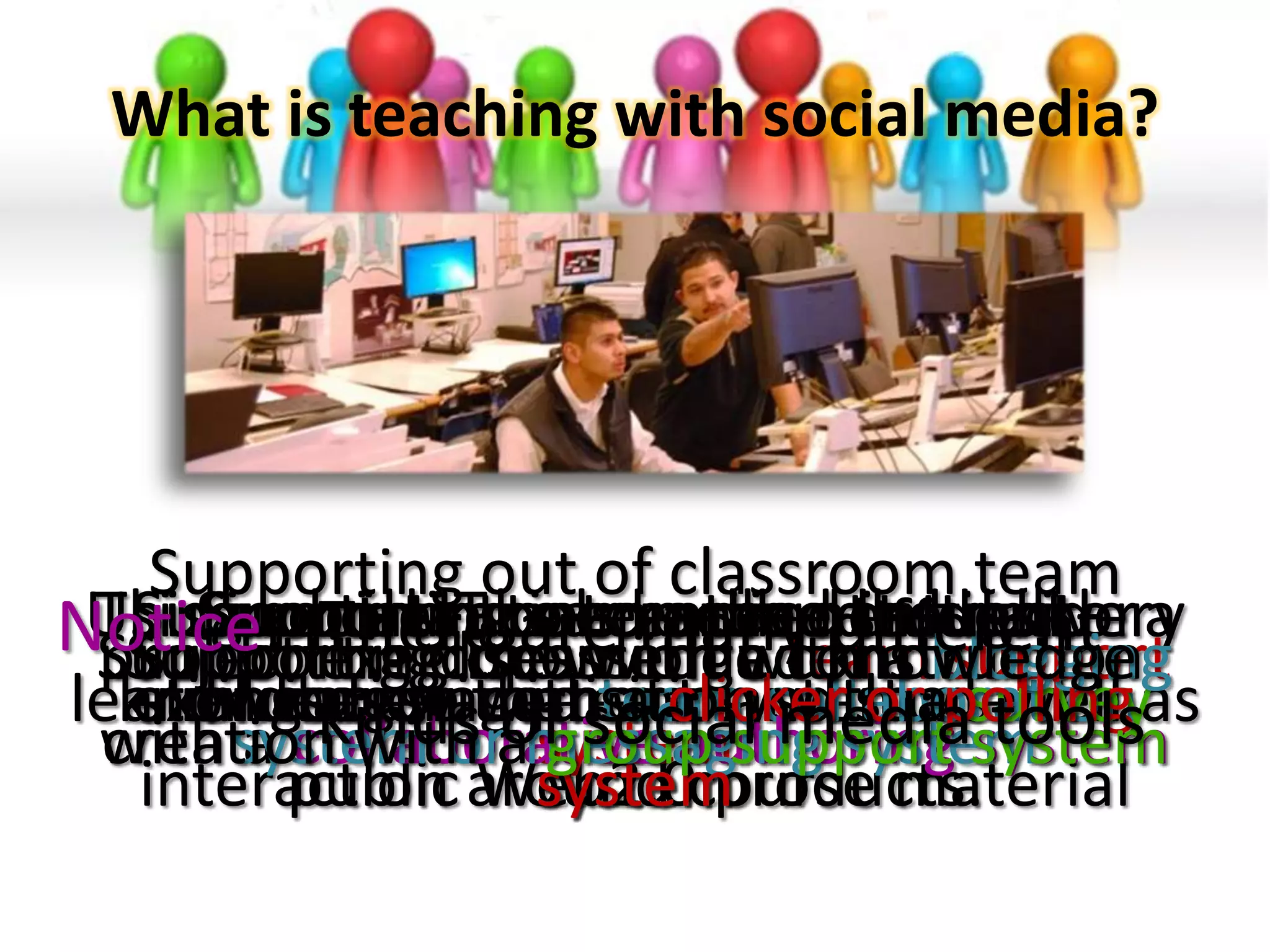
What is teaching with social media?


    Supporting out of classroom team
Notice: exercises complementblogging
 Using social ITtools embedded delivery
 ThisSupportingto many different a
  Supporting closed ended thought
       includes are time student
 project   There interactiveknowledge
                  same        instructor
                                  inside
 Supporting discussion a team support
  Supporting knowledge construction
   Supporting open ended a
                     with with
learning kindswithteam collaborationas
  knowledge acquisition with apolling
  exercises with asocial mediasurvey
   stimulation materialsystem astools
      of course of a clicker student
           management and or well
 with system oramessaging system
 creation with systemsupport system
        a collaborative authoring
                   group
   interaction around course material
          public Web2.0 products.
                  system
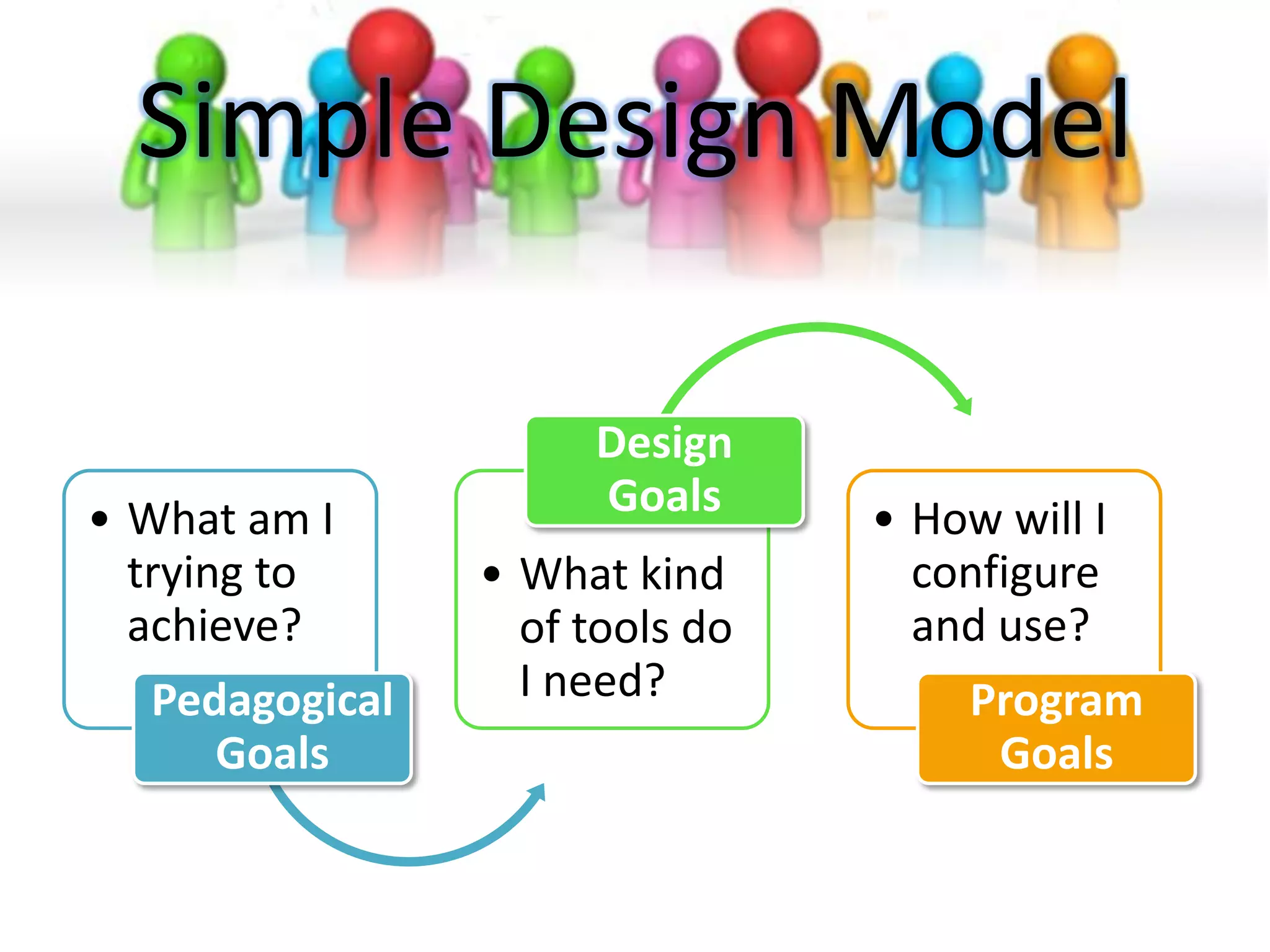
Simple Design Model

                     Design
• What am I          Goals      • How will I
  trying to     • What kind       configure
  achieve?        of tools do     and use?
  Pedagogical     I need?            Program
     Goals                            Goals
My Research Stream
• Within domains of problem solving, knowledge
  acquisition, knowledge creation, and learning

• Collaborative problem analysis (programming)
• Collaborative solution design (using a pattern
  language approach)
• Design of collaboration tools (UX focused)
• Social Media design, use, and implications
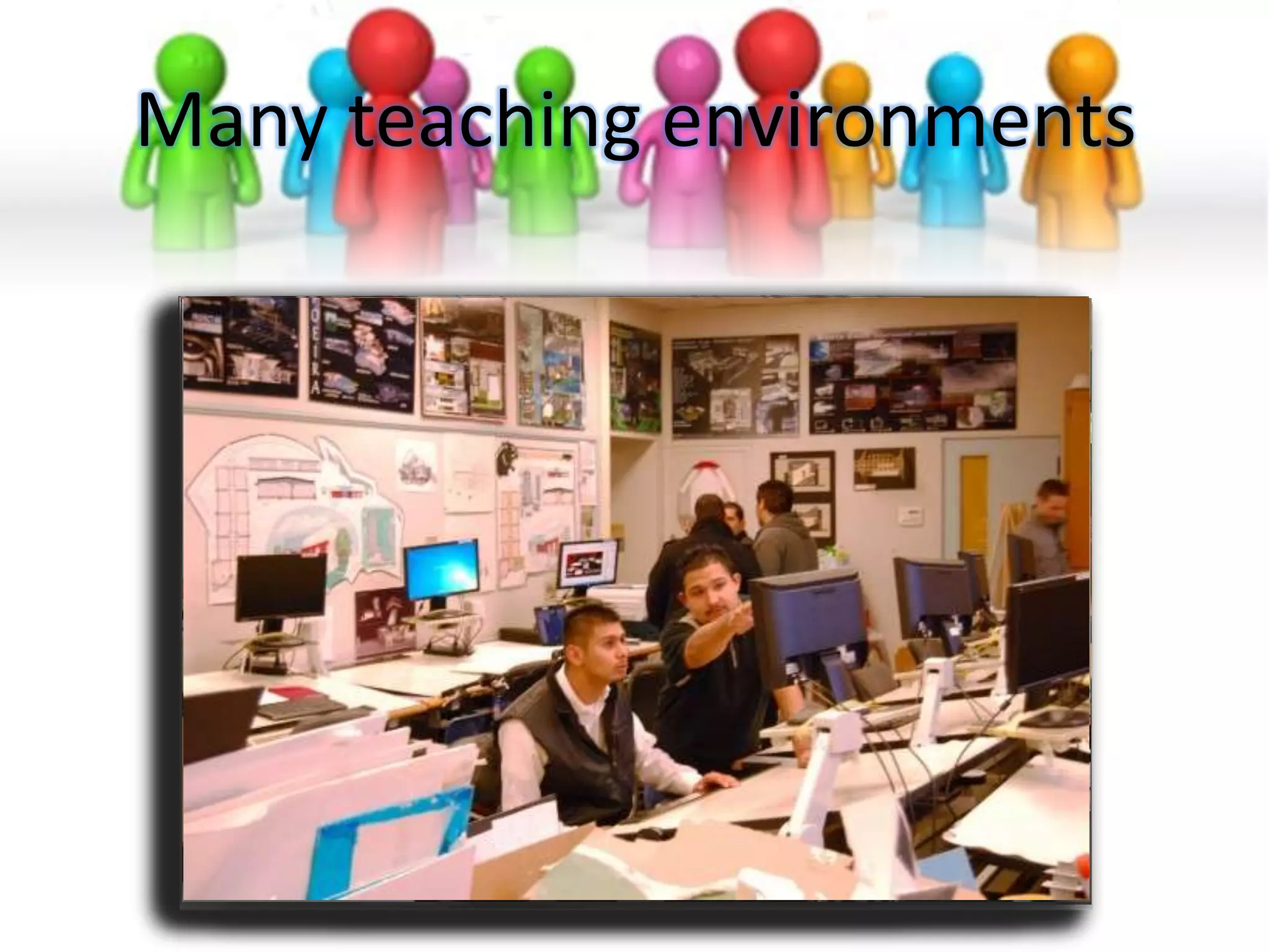
Many teaching environments
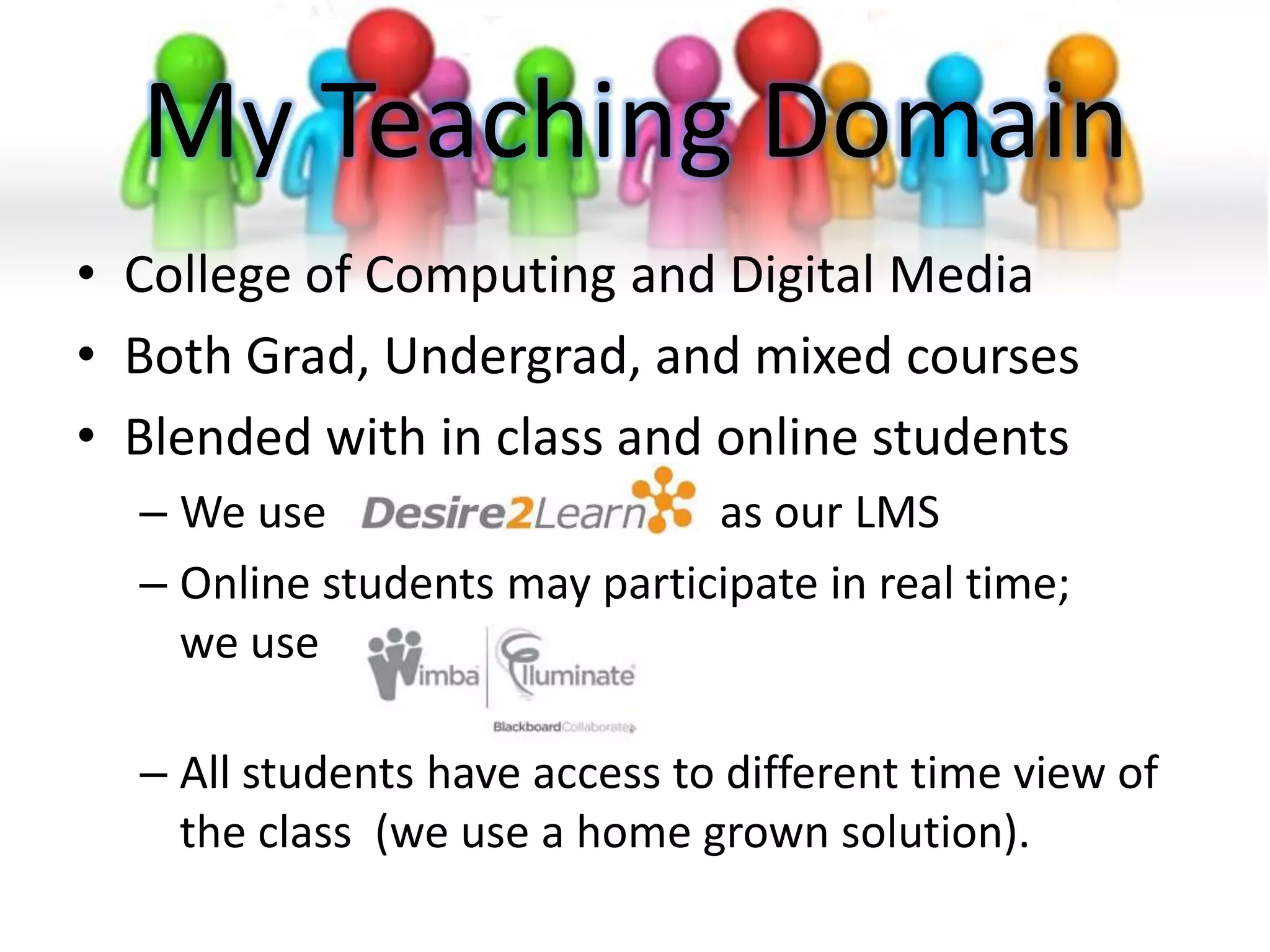
My Teaching Domain
• College of Computing and Digital Media
• Both Grad, Undergrad, and mixed courses
• Blended with in class and online students
  – We use                    as our LMS
  – Online students may participate in real time;
    we use

  – All students have access to different time view of
    the class (we use a home grown solution).
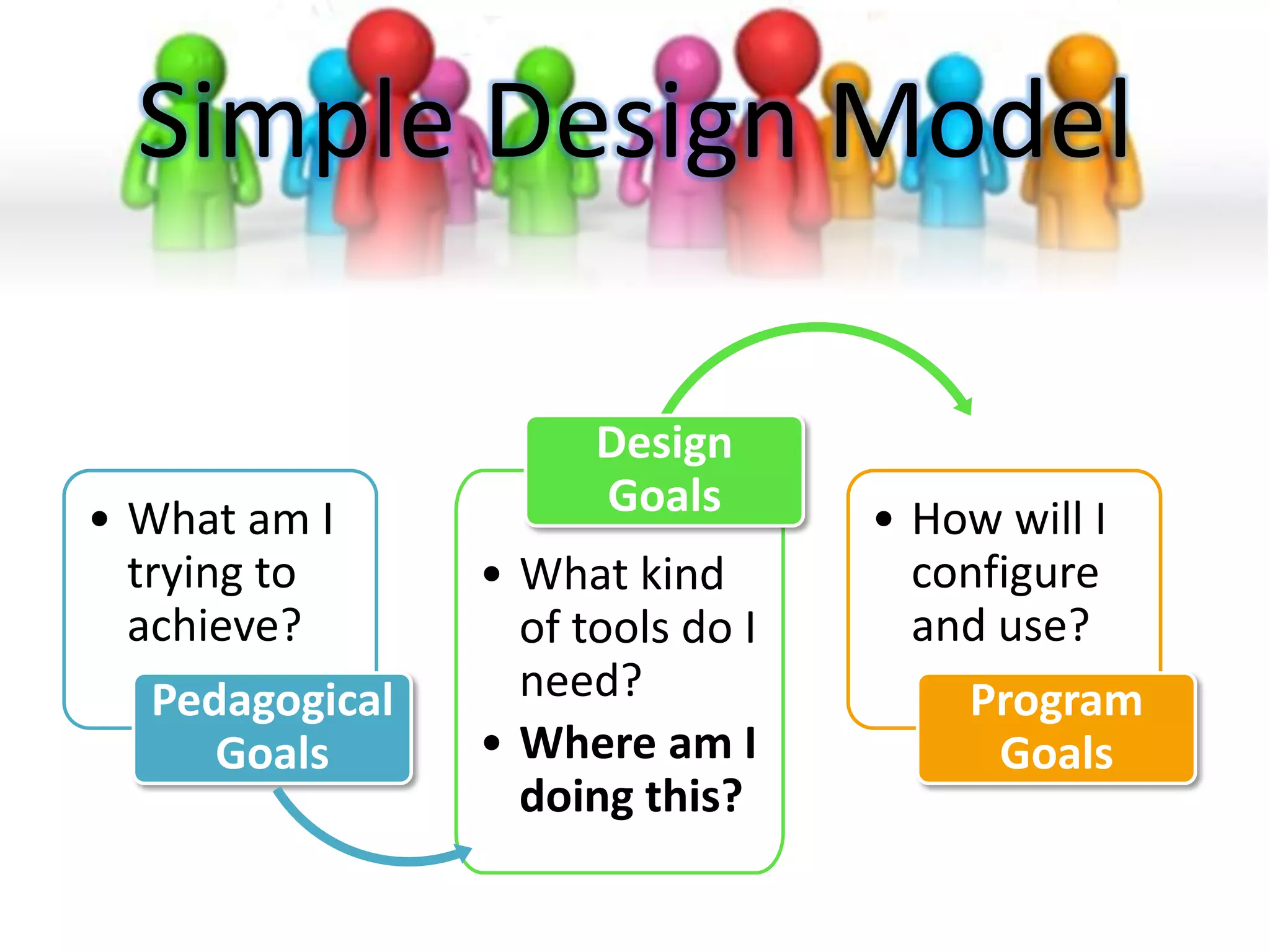
Simple Design Model

                      Design
• What am I           Goals       • How will I
  trying to     • What kind         configure
  achieve?        of tools do I     and use?
  Pedagogical     need?                Program
     Goals      • Where am I            Goals
                  doing this?
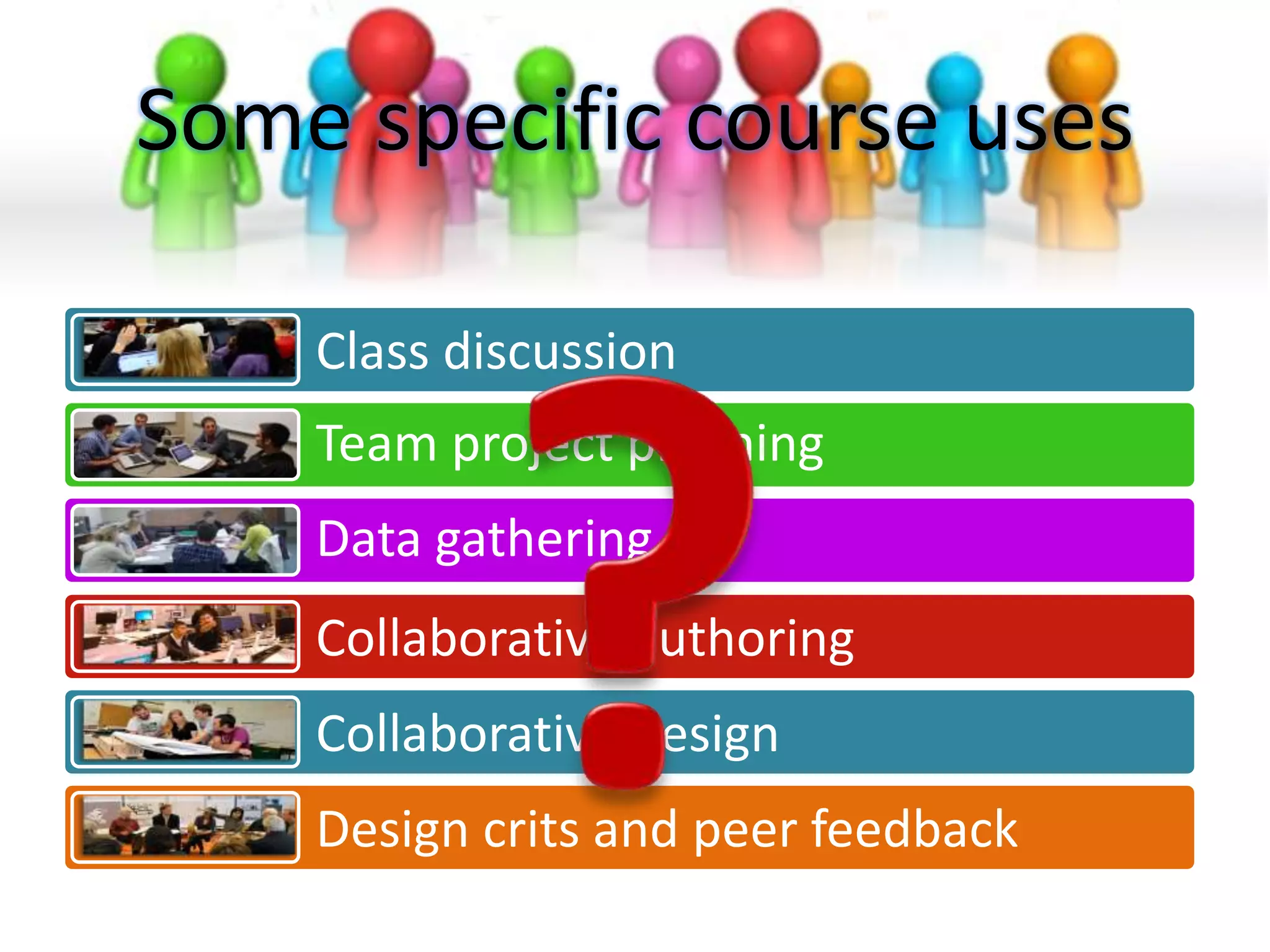
Some specific course uses

    Class discussion
    Team project planning
    Data gathering
    Collaborative authoring
    Collaborative design
    Design crits and peer feedback
Class Discussion
• WordPress blog for online discussion
  – Levels playing field
  – Current events incorporation
  – Grading is a bitch
• Wordpress is easy; TypePad is easier; Blogger
  is easier yet; and Posterous is easiest
• Find partners and mount a single blog across
  several courses/universities.
Web2.0 Team Project Planning
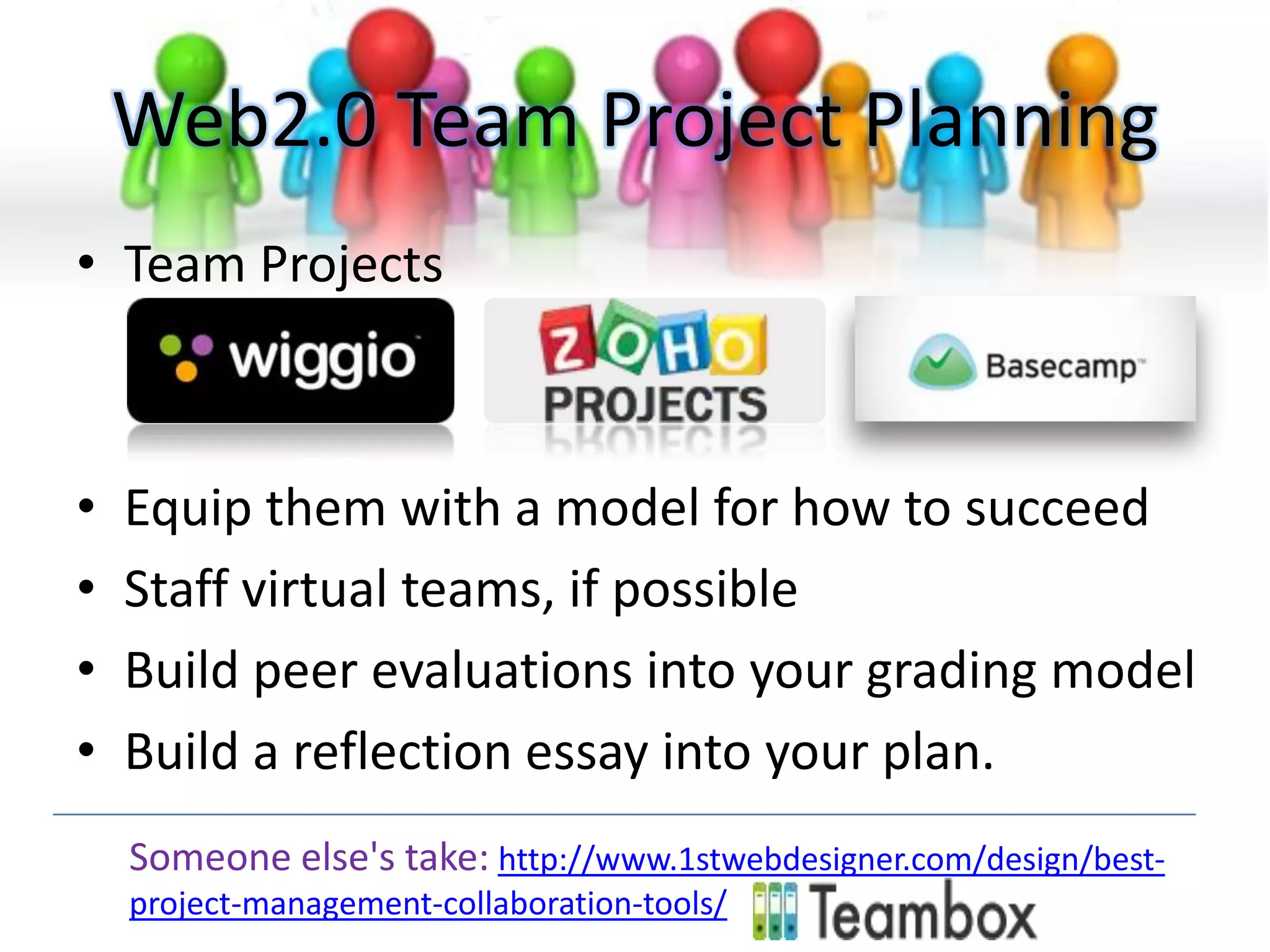
• Team Projects


•   Equip them with a model for how to succeed
•   Staff virtual teams, if possible
•   Build peer evaluations into your grading model
•   Build a reflection essay into your plan.
    Someone else's take: http://www.1stwebdesigner.com/design/best-
    project-management-collaboration-tools/
Data Gathering
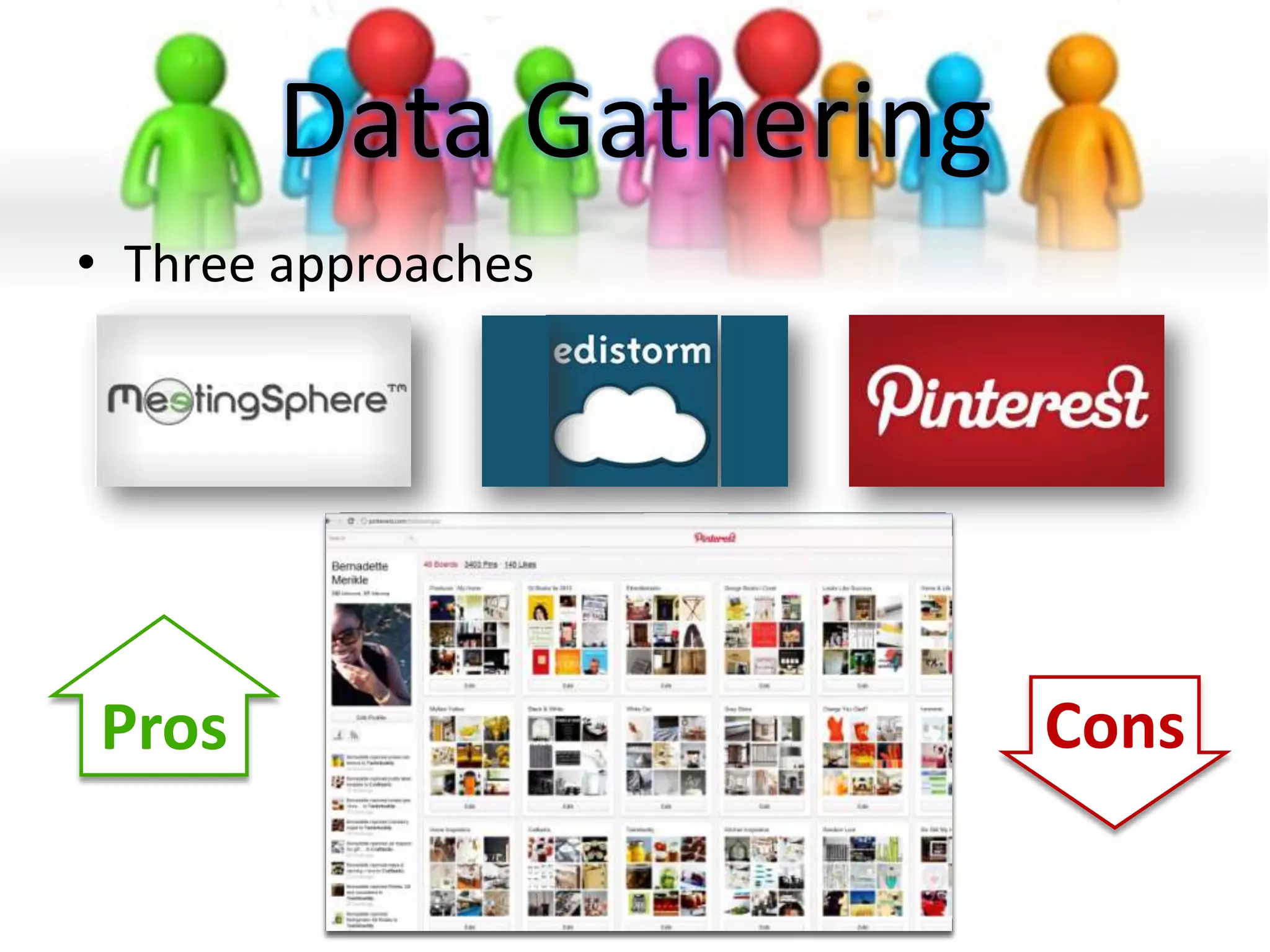
• Three approaches


Pros                    Cons
Social Sharing
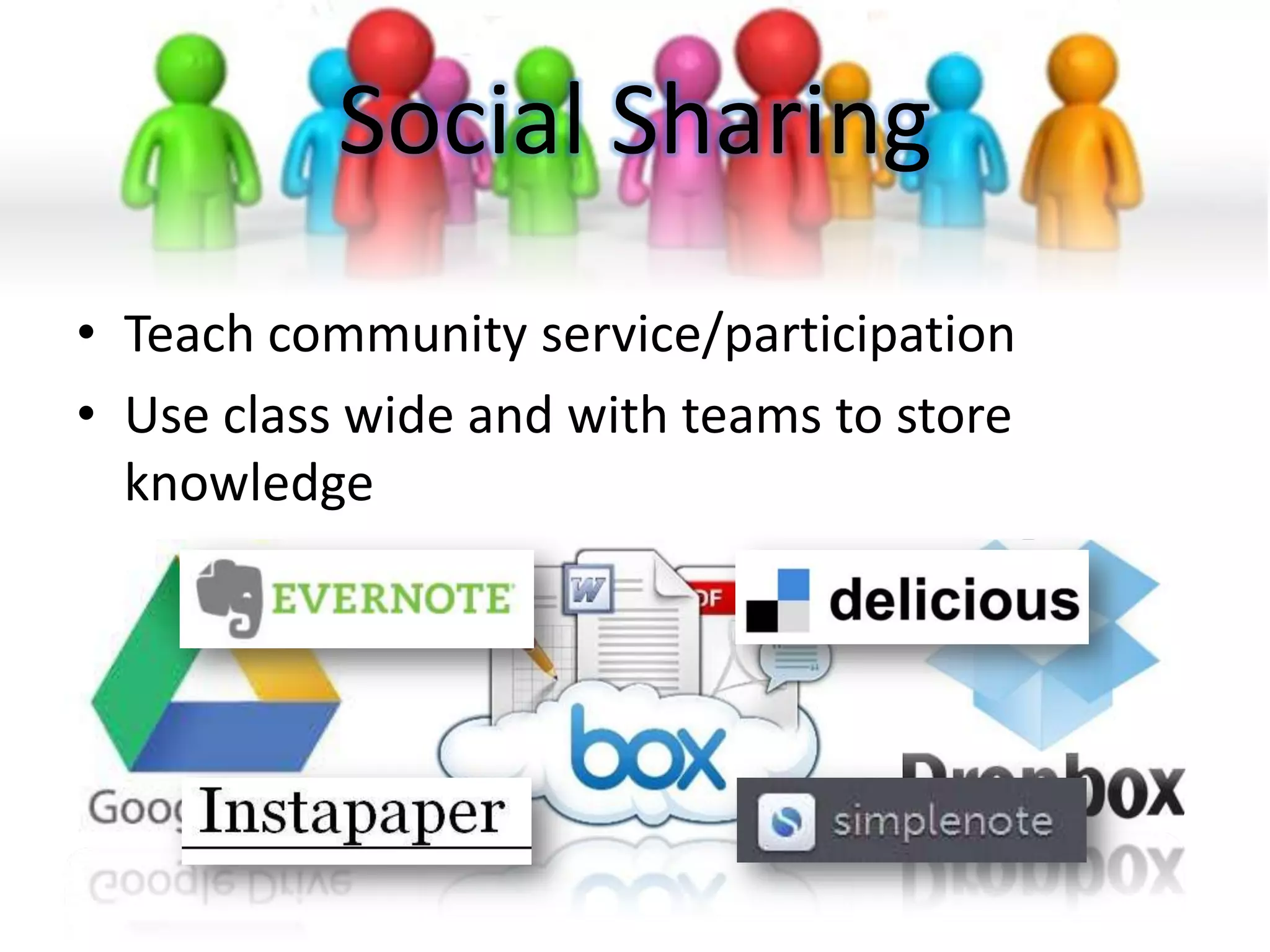
• Teach community service/participation
• Use class wide and with teams to store
  knowledge
Collaborative Authoring
• I use

• I use wikis for team authoring, rather
  than Google Docs or Zoho Writer
• I Teach reciprocal authoring methods
• Wikis can support online debates!
• Treat wiki submissions as public to
  the class
   – Models good writing behaviors.
Collaborative Design
• Depends on what you are design
  processes you teach
• Raster vs. Vector tools
• Teach tool integrated with
  collaborative design process
  stages
• Develop sharing and resolution
  protocols
http://www.webdistortion.com/2011/01/22/best-online-collaborative-drawing-tools/
Crits and Peer Feedback
• Process adjustment, rather than new tools
• Use Pinterest or similar that permits
  object related feedback and discussion
• Model and promote desired work
  behaviors/work product
Same time Video Techniques

•   Place preview monitor in front of you
•   Keep student names on paper in hand
•   Know the cone of your stage
•   Use in-class students as confederates
•   Virtualize your breakout work, if in-class
    students have technology
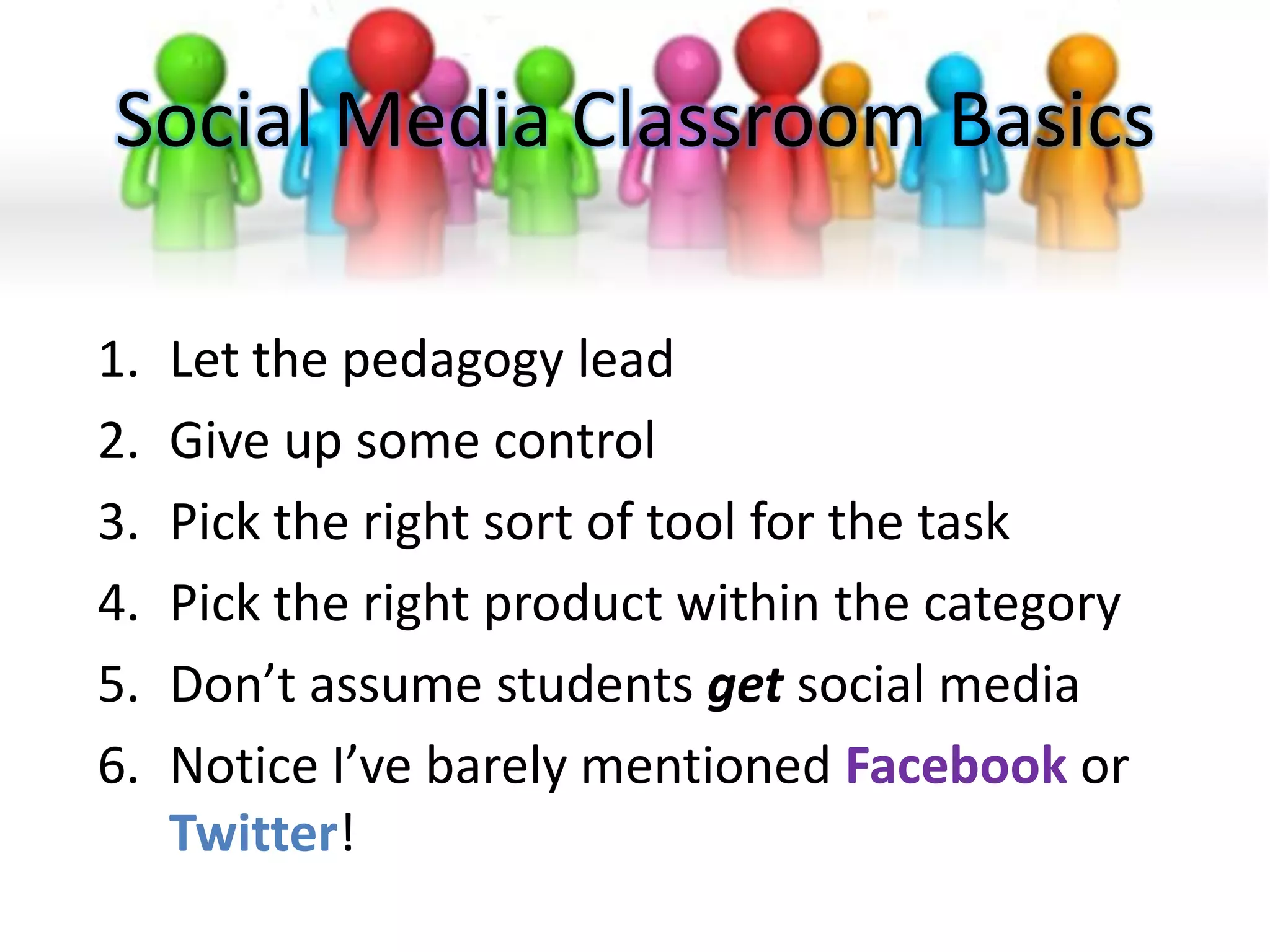
Social Media Classroom Basics

1.   Let the pedagogy lead
2.   Give up some control
3.   Pick the right sort of tool for the task
4.   Pick the right product within the category
5.   Don’t assume students get social media
6.   Notice I’ve barely mentioned Facebook or
     Twitter!
Resources
• Google for Educators
  – http://www.google.com/educators/tools.html
• Zoho Collaboration Apps
  – http://www.zoho.com/collaboration-apps.html
• WetPaint Wikis in Education
  – http://wikisineducation.wetpaint.com/
• CyberSmart Curriculum
  – http://cybersmartcurriculum.org/tools/
This PowerPoint is available at
                      www.slideshare.net/dmittleman1
ideas & suggestions
 4 employing social         EDRA43Seattle
       media                   lol!
                             June 2, 2012


                             Daniel Mittleman
                             DePaul University CDM
                             danny@cdm.depaul.edu

Teaching and learning with Web2

  • 1.
    This PowerPoint isavailable at www.slideshare.net/dmittleman1 ideas but & learning & suggestions teaching first, 4 employing social with web2.0 tools a commercial media wow! lol! Daniel Mittleman DePaul University CDM danny@cdm.depaul.edu
  • 2.
    Problem Seeking What isteaching with social media? And why might you care?
  • 3.
    What is teachingwith social media? Supporting out of classroom team Notice: exercises complementblogging Using social ITtools embedded delivery ThisSupportingto many different a Supporting closed ended thought includes are time student project There interactiveknowledge same instructor inside Supporting discussion a team support Supporting knowledge construction Supporting open ended a with with learning kindswithteam collaborationas knowledge acquisition with apolling exercises with asocial mediasurvey stimulation materialsystem astools of course of a clicker student management and or well with system oramessaging system creation with systemsupport system a collaborative authoring group interaction around course material public Web2.0 products. system
  • 4.
    Simple Design Model Design • What am I Goals • How will I trying to • What kind configure achieve? of tools do and use? Pedagogical I need? Program Goals Goals
  • 5.
    My Research Stream •Within domains of problem solving, knowledge acquisition, knowledge creation, and learning • Collaborative problem analysis (programming) • Collaborative solution design (using a pattern language approach) • Design of collaboration tools (UX focused) • Social Media design, use, and implications
  • 6.
  • 7.
    My Teaching Domain •College of Computing and Digital Media • Both Grad, Undergrad, and mixed courses • Blended with in class and online students – We use as our LMS – Online students may participate in real time; we use – All students have access to different time view of the class (we use a home grown solution).
  • 8.
    Simple Design Model Design • What am I Goals • How will I trying to • What kind configure achieve? of tools do I and use? Pedagogical need? Program Goals • Where am I Goals doing this?
  • 9.
    Some specific courseuses Class discussion Team project planning Data gathering Collaborative authoring Collaborative design Design crits and peer feedback
  • 10.
    Class Discussion • WordPressblog for online discussion – Levels playing field – Current events incorporation – Grading is a bitch • Wordpress is easy; TypePad is easier; Blogger is easier yet; and Posterous is easiest • Find partners and mount a single blog across several courses/universities.
  • 11.
    Web2.0 Team ProjectPlanning • Team Projects • Equip them with a model for how to succeed • Staff virtual teams, if possible • Build peer evaluations into your grading model • Build a reflection essay into your plan. Someone else's take: http://www.1stwebdesigner.com/design/best- project-management-collaboration-tools/
  • 12.
    Data Gathering • Threeapproaches Pros Cons
  • 13.
    Social Sharing • Teachcommunity service/participation • Use class wide and with teams to store knowledge
  • 14.
    Collaborative Authoring • Iuse • I use wikis for team authoring, rather than Google Docs or Zoho Writer • I Teach reciprocal authoring methods • Wikis can support online debates! • Treat wiki submissions as public to the class – Models good writing behaviors.
  • 15.
    Collaborative Design • Dependson what you are design processes you teach • Raster vs. Vector tools • Teach tool integrated with collaborative design process stages • Develop sharing and resolution protocols http://www.webdistortion.com/2011/01/22/best-online-collaborative-drawing-tools/
  • 16.
    Crits and PeerFeedback • Process adjustment, rather than new tools • Use Pinterest or similar that permits object related feedback and discussion • Model and promote desired work behaviors/work product
  • 17.
    Same time VideoTechniques • Place preview monitor in front of you • Keep student names on paper in hand • Know the cone of your stage • Use in-class students as confederates • Virtualize your breakout work, if in-class students have technology
  • 18.
    Social Media ClassroomBasics 1. Let the pedagogy lead 2. Give up some control 3. Pick the right sort of tool for the task 4. Pick the right product within the category 5. Don’t assume students get social media 6. Notice I’ve barely mentioned Facebook or Twitter!
  • 19.
    Resources • Google forEducators – http://www.google.com/educators/tools.html • Zoho Collaboration Apps – http://www.zoho.com/collaboration-apps.html • WetPaint Wikis in Education – http://wikisineducation.wetpaint.com/ • CyberSmart Curriculum – http://cybersmartcurriculum.org/tools/
  • 20.
    This PowerPoint isavailable at www.slideshare.net/dmittleman1 ideas & suggestions 4 employing social EDRA43Seattle media lol! June 2, 2012 Daniel Mittleman DePaul University CDM danny@cdm.depaul.edu

Editor's Notes

  • #6 Using tools in the classroom to supplement or complement delivery of course material and student interaction around course materialThis includes: tools embedded inside a learning management system, web conferencing system, Supporting same time student exercises with team collaboration systemSupporting out of classroom team project exercises with a team support systemSupporting knowledge construction with a collaborative authoring systemSupporting interactive thought stimulation with a clicker or polling systemSupporting closed ended instructor knowledge acquisition with a survey systemSupporting open ended knowledge creation with a group support systemSupporting discussion with a blogging system or bulletin board system
  • #9 Teaching Environments includeTraditional rowed classroomSeminar room or tableTiered fixed seating classroomStudioReconfigurable open spaceIn situ at a domain siteSame time students in one roomTwo+ rooms bridged by video conferencing in real timeSynchronous online learningAsynchronous online learningBlended classroom of two or more of the above situationsInformation Technology support includesNo electronic ITTeacher only IT (of various types)Teacher and student ITThe various types include a wide variety of presentation, attention focusing, communication, and collaboration tool sets. And there are sub-categories for each of these categories. This is a whole world of complex! See:Daniel D. Mittleman, Robert O. Briggs, John Murphy, and Alanah Davis. 2009. Toward a Taxonomy of Groupware Technologies. In Groupware: Design, Implementation, and Use, Robert O. Briggs, Pedro Antunes, Gert-Jan Vreede, and Aaron S. Read (Eds.). Lecture Notes In Computer Science, Vol. 5411. Springer-Verlag, Berlin, Heidelberg 305-317. DOI=10.1007/978-3-540-92831-7_25 http://dx.doi.org/10.1007/978-3-540-92831-7_25Domains for IT tool sets includeDesktop, or tablet, or phone, or task specific handheld (think: clicker)Local application, server application, cloud application
  • #12 Let’s play “Family Feud!”
  • #13 Blogging as the instructor.Online discussion are a vital part of an online or blended learning course. Not only do they engage students not in a physical same time classroom, but they level the playing field for students for whom English is a second language and students from a culture where face to face confrontation is frowned upon.Issues: do you engage in discussion inside a closed environment, or out on the Internet?- Privacy, confidentially vs. functionality (push tech) and community engagement with studentsHow often do you require students to engage?- What is realistic for your student population?How do you evaluate student participation?- Overcoming student apprehension vs. requiring comment qualityHow do you minimize students gaming the system?plagiarism?Dumping comments at end of courseIdea: at end of course ask each student to select five contributions they made to the conversation during the course, put those comments in front of you, and describe how those comments contributed to advancing the conversation. Grade quality ONLY on these comments.
  • #14 Supporting virtual team projectsDon’t assume that students know how to work on virtual teams. In fact, many students do not know how to work effectively on traditional teams. Virtuality adds several degrees of freedom that will be discomforting to students, and contribute to additional dysfunctional behaviors including free riding, inadequate communication feedback loops, cultural misunderstandings.Prep your students for success by modeling good virtual teaming behavior for them. Provide them with candidate agendas, checklists, goals, closed ended deliverables. Give them less rope that you might think you should. Give them lots of feedback on shorter feedback loops. Give them resources for modeling behaviors. Encourage or require regular reflection about what is working, what is not working, and how they might fix what is not working.Use peer evaluations – build this this in to your grading model, presented in your syllabus. My model is 100 points split among team members not including the evaluator.Build a reflection essay into your grading model. Have them submit a reflection at the very end of the course. You might encourage regular contributions toward this essay (Live Journal or Posterous are good tools to consider), but you probably don’t want to read anything until the end. Provide a rubric so they know how this will be evaluated, but evaluation is fairly simply from your point of view: after you read a few of these it will be clear who is simply punching the clock on the requirement and who is actually reflecting and learning. Also, if you encourage reflection about team project experience, these essays will validate the peer grading system. There will be some rich narrative about team interactions.Provide the students with tools to support project teaming work. Think through the functionality they will need, which may vary based on your project requirements. Here are some tool categories to consider:Private discussion environment. They will need a place where they can have private team conversation. Determine up front whether you require being a party to their discussion – and communicate to them whether you are there or they are working in private (I recommend leaving them private). Determine whether your LMS supports discussion in the way that they need. Two specific requirements to explore:Can they initiate their own discussion threads, or is it one single thread that you initiate? Some LMS are limited in this functionality.Will the discussion environment tie to email or RSS? That is, how will they be informed a teammate has contributed to the discussion? If there is no push technology out to a client they regularly use (email or SMS) then the environment will have very limited real world functionality for them. Most LMS will not do this—and for this reason you may wish to move them outside the LMS for team discussion (this point may also be true for full class discussion).The tool I have been using of late is wiggio.com. There are many discussion environments on the market, but this one fits my requirements (and also handles functionality to be mentioned below). Yahoo Groups and Google Groups handle these requirements as well. Shared document storage. They may need a place to store shared work documents. You will prefer an environment no one student owns (what if that student drops or becomes difficult to deal with?); you will prefer an environment have maintains document history in a manner that no student can accidentally or intentionally delete a document; you will prefer an environment that is free and is very easy to use.There are many cloud storage environments available for little or no cost. I use Dropbox, but it is far from the only acceptable cloud storage solution. These environments will be robust, easily accessible, and provide adequate capacity. One student (if not you) will need to be the primary owner. Sharing rights will need to be set up (some environments are more user friendly than others at this task).Wiggio supports document sharing. Several other multi-featured teaming environments do as well.Your LMS may support document sharing. If it does, test how well it manages versioning, history, and document retention.Google Docs and Zoho Docs support document sharing. You may wish to create a gmail account for each team so that you own the space and then invite your students into it.Collaborative authoringStudents may require the ability to co-author text, graphic, or presentation documents. Each of these raise different issues.Text: Google Docs and Zoho Writer are both excellent tools for this purpose. You may also consider guiding your students toward a wiki (I use PBWorks; several free hosted wikis exist). Wikis have a slightly longer learning curve, but do an excellent job of versioning and support division of labor. A collaborative authoring process should be modeled for students. There is a literature about this (outside the scope of this paper).Graphics: First, consider whether your students need to be working in raster (whiteboard-like) or vector (object-based) graphics. If they are creating artistic design, the solution may require a raster tool (I use Pixlr.com). More likely, though, you will be asking students to create models (think: flowcharts) and a vector tool will be a superior solution. There are several free web2.0 collaborative vector modeling tools available (I have used Flowchart.com, but am not current on this particular topic.) You may be asking your students to do ideation – so a collaborative mindmapping tool would be the right object-based solution (check out MindMeister.com). You will need to model for your students a collaborative design process; do not expect them to understand how to step through this task collaboratively.Presentation: Students may be asked to present their project deliverable to the class. If so, they may desire to build a presentation solution. Google Docs and Zoho Office both offer collaborative presentation design tools. Again, this work process should be modeled for them.Wiggio and some other teaming environments offer collaborative text authoring functionality. I am not aware of a teaming environment that offers collaborative graphics or presentation modeling.Same-time team meeting supportVirtual student teams will have to use technology for their team meetings. Here are some considerations:Have the teams hold their initial meeting without you present, but provide them with an agenda guideline and specific deliverable expectations. Provide them with a suggested meeting tool and instructions for how to use that tool.Offer to participate in the second virtual team meeting. In this meeting you should model team meeting behaviors you have communicated to them.Some guidelines for virtual team meeting process:All meetings have a leader and at least one scribe.All team member deliverables are due 24 hours prior to the meeting, not at meeting time – so team members have an opportunity to review prior to the meeting. Teams should be encouraged to establish a culture where it is unacceptable to be late on the deliverable. Not doing this means that team meeting time is taken up by reading the deliverables.Team members should not present deliverable material that can be—and should have been—read. Meeting time should be taken up by Q&A about deliverables, team-based decision making, and assignment for next tasks.All tasks should be assigned at a meeting (not after a meeting) and ONE person should be ultimately responsible for completion of each task, not a sub-team of two or more (even if several will be working on it.)Some toolsFree telephone conferencingSkype (or other VoIP) telephonyWeb Conferencing tools (Oovoo?) Once again, Wiggio has functionality in this area.Some overall guidance:Employ minimal tools. Too many environments are confusing; keep it simple even if it means trading off some functionality. In some cases it will make sense to keep the class inside the LMS for this reason.Understand your school’s expectations about student technology use, accessibility, data privacy. Make sure you are not violating any of your school’s rules.Encourage students who are uncomfortable about putting their identities on the public Internet to acquire an account identity specifically for the course. Encourage students to discuss technology and privacy concerns privately with you week one and work with those students to design a solution that will not push their privacy comfort zone. Do push students, however, on their abilities to use social media.
  • #15 If you pursue MeetingSphere or Pinterest, let the developers know I sent you!Both may have more application for your own research than for classroom work. Both are wonderful in their own way.
  • #16 Cloud Storage: I use and prefer Dropbox, but this market is changing rapidly. Many others have entered it including MS and Apple. Google’s introduction of Google Drive may be the biggest change yet. All are free; Dropbox currently provides the least space but will have to adjust to Google’s entry.Shared Notetaking: Evernote is by far the most full featured of these tools. Nevertheless I use Simplenote (and ResophNote with it on my PC — Simplenote is iOS native) as I prefer the absolute simplicity of this interface. So I give up features for faster performance and better UX. With teams, Evernote may make more sense (Simplenote is really an individual tool); well so is Evernote, but it has more hooks for sharing.Delicious is a great shared bookmarking social network. There are others, but Delicious does a good job of supporting shared work. Instapaper is my choice for archiving web articles; it has a sharing feature, but that is not central to its mission. Instpaper removed their RSS feature, so I doubt they are going in a social direction.
  • #17 For reciprocal authoring process, see: Adkins, M.; Reinig, J.Q.; Kruse, J.; Mittleman, D.; , "GSS collaboration in document development: using GroupWriter to improve the process," System Sciences, 1999. HICSS-32. Proceedings of the 32nd Annual Hawaii International Conference on , vol.Track1, no., pp.11 pp., 1999doi: 10.1109/HICSS.1999.772739URL: http://ieeexplore.ieee.org/stamp/stamp.jsp?tp=&arnumber=772739&isnumber=16781
  • #20 Guidance for lecturing with online students using a web conferencing system.Lecturing may occur with a live audience (live class) or without a live audience (studio)Work with a preview monitor in front of youKeep student names readily available Know your visibility cone for the cameras in useUse in class students as confederatesVurtualize breakout work