Using + social media = fail Participation reveals real ROI for everyone involved David Cushman Ninety10group.com Twitter: @davidcushman FasterFuture.blogspot.com
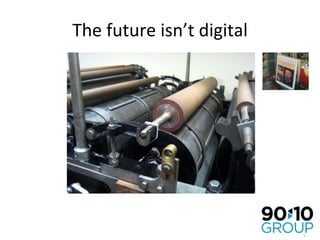
The future isn’t digital
What’s the next tool?
Don’t need to worry about that Worry less about what the tech is Understand what people are doing, with each other, with the tech
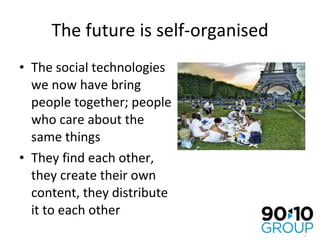
The future is self-organised The social technologies we now have bring people together; people who care about the same things They find each other, they create their own content, they distribute it to each other
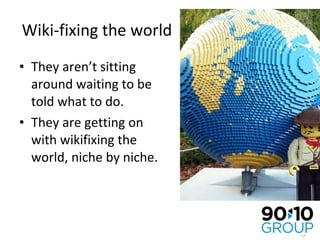
Wiki-fixing the world They aren’t sitting around waiting to be told what to do. They are getting on with wikifixing the world, niche by niche.
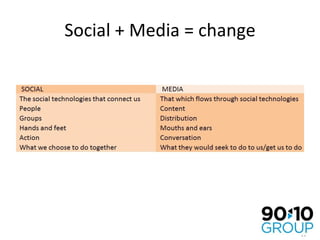
Social + Media = change
No social without media The media side is where we pass on messages from one to another, do the viral thing, create content and publish it - in social networks and on blogs and in tweets. It is where we fulfil those multiple roles that once were the sole domain of the media industry - we publish, we advertise and market (to our peers). We distribute: through peer-to-peer pass on. We do it all in networks rather than channels, Real-time rather than their time  Many-to-many rather than one-to-many.
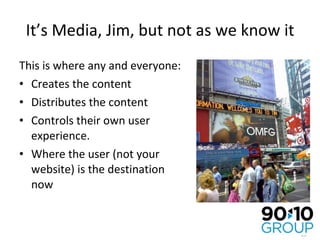
It’s Media, Jim, but not as we know it This is where any and everyone: Creates the content Distributes the content Controls their own user experience. Where the user (not your website) is the destination now
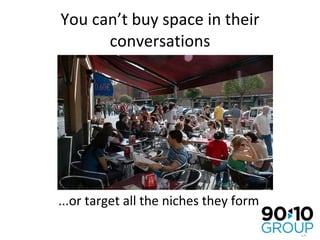
You can’t buy space in their conversations ...or target all the niches they form
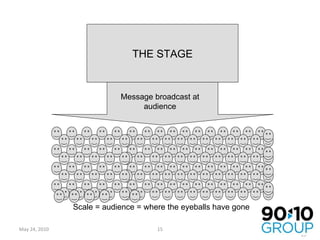
May 24, 2010 THE STAGE Scale = audience = where the eyeballs have gone Message broadcast at audience
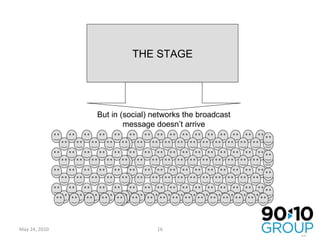
May 24, 2010 THE STAGE But in (social) networks the broadcast message doesn’t arrive
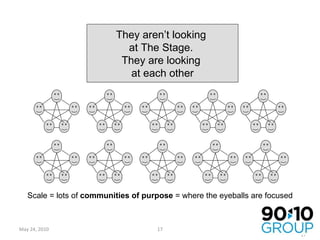
May 24, 2010 They aren’t looking  at The Stage.  They are looking  at each other Scale = lots of  communities of purpose  = where the eyeballs are focused
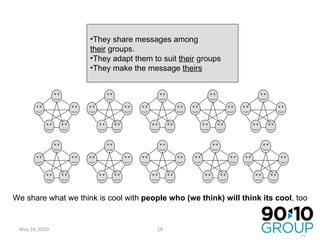
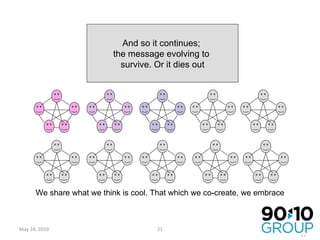
May 24, 2010 They share messages among  their  groups. They adapt them to suit  their  groups  They make the message  theirs We share what we think is cool with  people who (we think) will think its cool , too
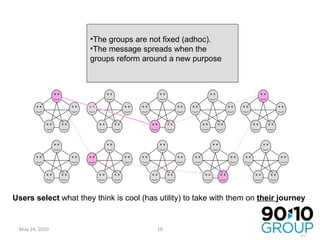
May 24, 2010 The groups are not fixed (adhoc). The message spreads when the  groups reform around a new purpose Users select  what they think is cool (has utility) to take with them on  their  journey
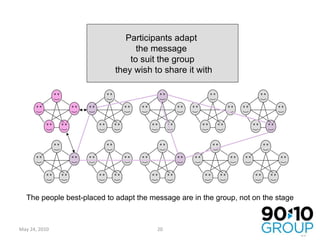
May 24, 2010 Participants adapt  the message  to suit the group they wish to share it with The people best-placed to adapt the message are in the group, not on the stage
May 24, 2010 And so it continues;  the message evolving to  survive. Or it dies out We share what we think is cool. That which we co-create, we embrace
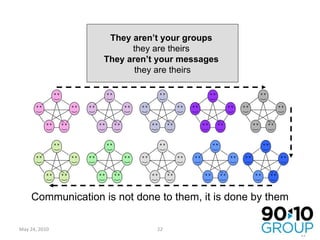
May 24, 2010 They aren’t your groups  they are theirs   They aren’t your messages   they are theirs Communication is not done to them, it is done by them
But where’s the value? It isn’t in the fact that comms happen
But where’s the value? It isn’t in the fact that comms happen It is in what happens as a result of those comms
But where’s the value? It isn’t in the fact that comms happen It is in what happens as a result of those comms It is in what people are doing together with ‘the tech’.
The real ROI is wiki-fixing the world The value of the comms is in what all our expressions of meta-data lead to: New, fast, user-centric, efficiencies through group-forming. Our media-like activity brings us together with people seeking to solve the same problem or improve the same experience that matters to us.  This is where the efficiencies happen. Niche by niche.
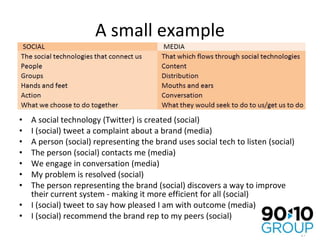
A small example A social technology (Twitter) is created (social) I (social) tweet a complaint about a brand (media) A person (social) representing the brand uses social tech to listen (social) The person (social) contacts me (media) We engage in conversation (media) My problem is resolved (social) The person representing the brand (social) discovers a way to improve their current system - making it more efficient for all (social) I (social) tweet to say how pleased I am with outcome (media) I (social) recommend the brand rep to my peers (social)
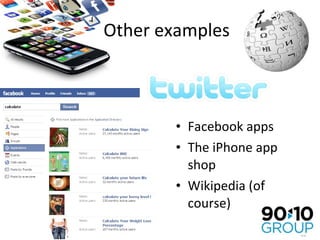
Twitter Facebook apps The iPhone app shop Wikipedia (of course) Other examples
But it’s not just in the valley...
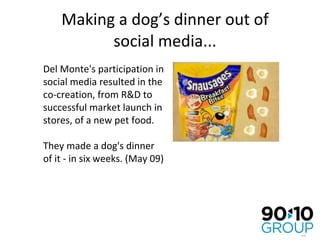
Making a dog’s dinner out of social media... Del Monte's participation in social media resulted in the co-creation, from R&D to successful market launch in stores, of a new pet food. They made a dog's dinner of it - in six weeks. (May 09)
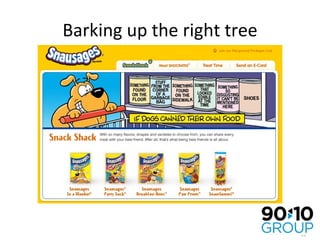
Barking up the right tree
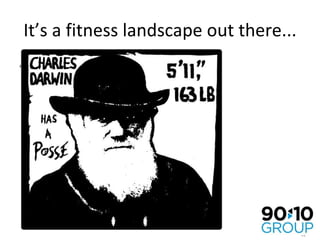
It’s a fitness landscape out there... Only the best adapted survive
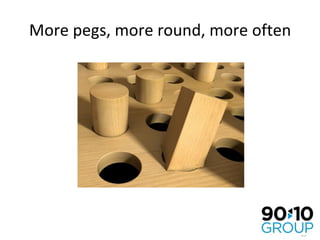
More pegs, more round, more often
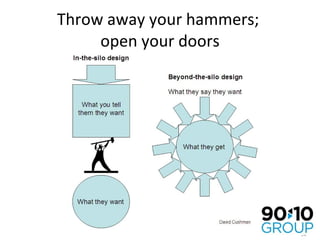
Throw away your hammers;  open your doors
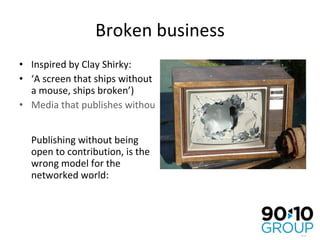
Broken business Inspired by Clay Shirky:  ‘ A screen that ships without a mouse, ships broken’) Media that publishes without a comment box, publishes broken Publishing without being open to contribution, is the wrong model for the networked world:
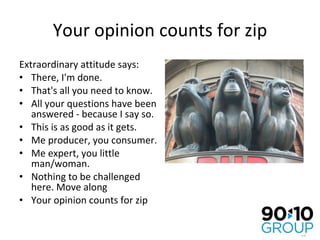
Your opinion counts for zip Extraordinary attitude says: There, I'm done.  That's all you need to know.  All your questions have been answered - because I say so. This is as good as it gets. Me producer, you consumer. Me expert, you little man/woman. Nothing to be challenged here. Move along Your opinion counts for zip
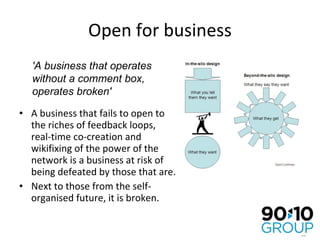
'A business that operates without a comment box, operates broken'
Open for business A business that fails to open to the riches of feedback loops, real-time co-creation and wikifixing of the power of the network is a business at risk of being defeated by those that are. Next to those from the self-organised future, it is broken.  'A business that operates without a comment box, operates broken'
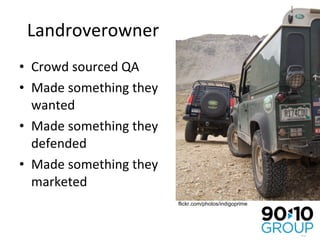
Landroverowner Crowd sourced QA Made something they wanted Made something they defended Made something they marketed flickr.com/photos/indigoprime
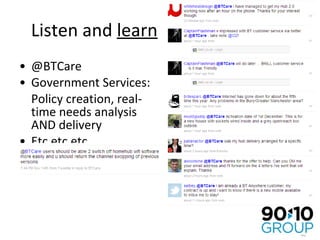
Listen and  learn @BTCare Government Services: Policy creation, real-time needs analysis AND delivery Etc etc etc…
What the money is waiting to follow 500m on Facebook; 106m on Twitter - but where’s the business model? The emerging value of social tech is not in the real-estate, tools or the comms – it is in efficiencies they offer by bringing people together
Social + Media = direct ROI Adapting business to the networked world shows direct return on investment  It streamlines businesses, creates new orders of efficiency in everything from product development, to marketing, to recruitment, to you name it... It delivers business models (and businesses) adapted to the networked world. That enables businesses to thrive in a rapidly transforming world.
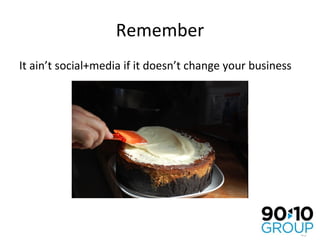
Remember It ain’t social+media if it doesn’t change your business
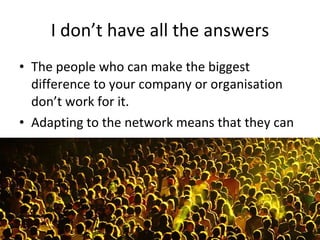
I don’t have all the answers The people who can make the biggest difference to your company or organisation don’t work for it. Adapting to the network means that they can
David Cushman Managing Director Ninety10group.com [email_address] Call or text +44 (0)7736 353590 FasterFuture.blogspot.com twitter.com/davidcushman May 24, 2010
All images  All images in this presentation are available under a creative commons licence on Flickr.com

David Cushman - #smib10 presentation

  • 1.
    Using + socialmedia = fail Participation reveals real ROI for everyone involved David Cushman Ninety10group.com Twitter: @davidcushman FasterFuture.blogspot.com
  • 2.
  • 3.
  • 4.
  • 5.
  • 6.
  • 7.
  • 8.
    Don’t need toworry about that Worry less about what the tech is Understand what people are doing, with each other, with the tech
  • 9.
    The future isself-organised The social technologies we now have bring people together; people who care about the same things They find each other, they create their own content, they distribute it to each other
  • 10.
    Wiki-fixing the worldThey aren’t sitting around waiting to be told what to do. They are getting on with wikifixing the world, niche by niche.
  • 11.
  • 12.
    No social withoutmedia The media side is where we pass on messages from one to another, do the viral thing, create content and publish it - in social networks and on blogs and in tweets. It is where we fulfil those multiple roles that once were the sole domain of the media industry - we publish, we advertise and market (to our peers). We distribute: through peer-to-peer pass on. We do it all in networks rather than channels, Real-time rather than their time Many-to-many rather than one-to-many.
  • 13.
    It’s Media, Jim,but not as we know it This is where any and everyone: Creates the content Distributes the content Controls their own user experience. Where the user (not your website) is the destination now
  • 14.
    You can’t buyspace in their conversations ...or target all the niches they form
  • 15.
    May 24, 2010THE STAGE Scale = audience = where the eyeballs have gone Message broadcast at audience
  • 16.
    May 24, 2010THE STAGE But in (social) networks the broadcast message doesn’t arrive
  • 17.
    May 24, 2010They aren’t looking at The Stage. They are looking at each other Scale = lots of communities of purpose = where the eyeballs are focused
  • 18.
    May 24, 2010They share messages among their groups. They adapt them to suit their groups They make the message theirs We share what we think is cool with people who (we think) will think its cool , too
  • 19.
    May 24, 2010The groups are not fixed (adhoc). The message spreads when the groups reform around a new purpose Users select what they think is cool (has utility) to take with them on their journey
  • 20.
    May 24, 2010Participants adapt the message to suit the group they wish to share it with The people best-placed to adapt the message are in the group, not on the stage
  • 21.
    May 24, 2010And so it continues; the message evolving to survive. Or it dies out We share what we think is cool. That which we co-create, we embrace
  • 22.
    May 24, 2010They aren’t your groups they are theirs They aren’t your messages they are theirs Communication is not done to them, it is done by them
  • 23.
    But where’s thevalue? It isn’t in the fact that comms happen
  • 24.
    But where’s thevalue? It isn’t in the fact that comms happen It is in what happens as a result of those comms
  • 25.
    But where’s thevalue? It isn’t in the fact that comms happen It is in what happens as a result of those comms It is in what people are doing together with ‘the tech’.
  • 26.
    The real ROIis wiki-fixing the world The value of the comms is in what all our expressions of meta-data lead to: New, fast, user-centric, efficiencies through group-forming. Our media-like activity brings us together with people seeking to solve the same problem or improve the same experience that matters to us. This is where the efficiencies happen. Niche by niche.
  • 27.
    A small exampleA social technology (Twitter) is created (social) I (social) tweet a complaint about a brand (media) A person (social) representing the brand uses social tech to listen (social) The person (social) contacts me (media) We engage in conversation (media) My problem is resolved (social) The person representing the brand (social) discovers a way to improve their current system - making it more efficient for all (social) I (social) tweet to say how pleased I am with outcome (media) I (social) recommend the brand rep to my peers (social)
  • 28.
    Twitter Facebook appsThe iPhone app shop Wikipedia (of course) Other examples
  • 29.
    But it’s notjust in the valley...
  • 30.
    Making a dog’sdinner out of social media... Del Monte's participation in social media resulted in the co-creation, from R&D to successful market launch in stores, of a new pet food. They made a dog's dinner of it - in six weeks. (May 09)
  • 31.
    Barking up theright tree
  • 32.
    It’s a fitnesslandscape out there... Only the best adapted survive
  • 33.
    More pegs, moreround, more often
  • 34.
    Throw away yourhammers; open your doors
  • 35.
    Broken business Inspiredby Clay Shirky: ‘ A screen that ships without a mouse, ships broken’) Media that publishes without a comment box, publishes broken Publishing without being open to contribution, is the wrong model for the networked world:
  • 36.
    Your opinion countsfor zip Extraordinary attitude says: There, I'm done. That's all you need to know. All your questions have been answered - because I say so. This is as good as it gets. Me producer, you consumer. Me expert, you little man/woman. Nothing to be challenged here. Move along Your opinion counts for zip
  • 37.
    'A business thatoperates without a comment box, operates broken'
  • 38.
    Open for businessA business that fails to open to the riches of feedback loops, real-time co-creation and wikifixing of the power of the network is a business at risk of being defeated by those that are. Next to those from the self-organised future, it is broken. 'A business that operates without a comment box, operates broken'
  • 39.
    Landroverowner Crowd sourcedQA Made something they wanted Made something they defended Made something they marketed flickr.com/photos/indigoprime
  • 40.
    Listen and learn @BTCare Government Services: Policy creation, real-time needs analysis AND delivery Etc etc etc…
  • 41.
    What the moneyis waiting to follow 500m on Facebook; 106m on Twitter - but where’s the business model? The emerging value of social tech is not in the real-estate, tools or the comms – it is in efficiencies they offer by bringing people together
  • 42.
    Social + Media= direct ROI Adapting business to the networked world shows direct return on investment It streamlines businesses, creates new orders of efficiency in everything from product development, to marketing, to recruitment, to you name it... It delivers business models (and businesses) adapted to the networked world. That enables businesses to thrive in a rapidly transforming world.
  • 43.
    Remember It ain’tsocial+media if it doesn’t change your business
  • 44.
    I don’t haveall the answers The people who can make the biggest difference to your company or organisation don’t work for it. Adapting to the network means that they can
  • 45.
    David Cushman ManagingDirector Ninety10group.com [email_address] Call or text +44 (0)7736 353590 FasterFuture.blogspot.com twitter.com/davidcushman May 24, 2010
  • 46.
    All images All images in this presentation are available under a creative commons licence on Flickr.com

Editor's Notes

  • #3 When the printing press arrived I daresay there were futurists and consultants of every hue (likely called diviners and astrologers back then) who predicted the future was all about paper – and big clanky printing presses. But it wasn’t – it was about the impact of new information flows and how people and society changed in response to this new freer, less church/state controlled flow of information Just as now, the future is not about the tools and the platforms we use to exchange information – it is about what changes as a result of their use – what we discover about ourselves It is self-organising.
  • #33 Only the best adapted survive.