a presentation by
Charlie Gray
prepared for
Prof. Sidneyeve
Matrix
FILM 260
June 3, 2016
CLICKTIVISM
a (flawed) force for good
Image: “Archenhold Oberschule” by Ralf Roletschek. CC 3.0
what is clicktivism?
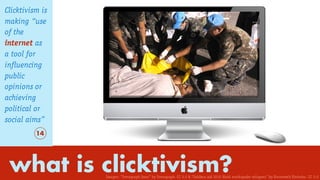
Clicktivism is
making “use
of the
internet as
a tool for
influencing
public
opinions or
achieving
political or
social aims”
14
Images: “Svengraph Imac” by Svengraph. CC 3.0 & “Soldiers aid 2010 Haiti earthquake refugees” by Roosewelt Pinheiro. CC 3.0
clicktivism platforms
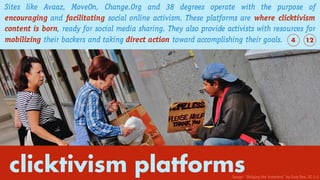
Sites like Avaaz, MoveOn, Change.Org and 38 degrees operate with the purpose of
encouraging and facilitating social online activism. These platforms are where clicktivism
content is born, ready for social media sharing. They also provide activists with resources for
mobilizing their backers and taking direct action toward accomplishing their goals. 124
Image: “Helping the homeless” by Gary Dee. CC 2.0
social media clicktivism
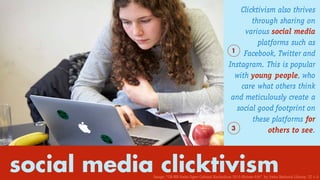
Clicktivism also thrives
through sharing on
various social media
platforms such as
Facebook, Twitter and
Instagram. This is popular
with young people, who
care what others think
and meticulously create a
social good footprint on
these platforms for
others to see.
1
3
Image: “CH-NB-Swiss Open Cultural Hackathon 2015-Picture-039” by Swiss National Library. CC 4.0
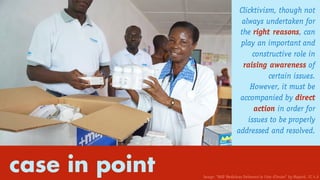
Clicktivism, though not
always undertaken for
the right reasons, can
play an important and
constructive role in
raising awareness of
certain issues.
However, it must be
accompanied by direct
action in order for
issues to be properly
addressed and resolved.
case in point Image: “MAP Medicines Delivered in Cote d’Ivoire” by Mapintl. CC 4.0
curated self-exhibition
Engaging in social forms
of clicktivism like sharing
articles and petitions is
part of how we construct
“our social selves”,
“keystroke by keystroke”.
In doing so, we are
“curating the exhibition
of [a] self” who cares
about important issues,
even if this is not the
case.
2
Image: “Finance Meeting Paris 2012-02-18 n12” by Marie-Lan Nguyen. CC 3.0
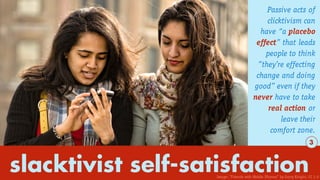
slacktivist self-satisfaction
Passive acts of
clicktivism can
have “a placebo
effect” that leads
people to think
”they’re effecting
change and doing
good” even if they
never have to take
real action or
leave their
comfort zone.
3
Image: “Friends with Mobile Phones” by Garry Knight. CC 2.0
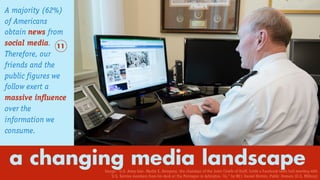
A majority (62%)
of Americans
obtain news from
social media.
Therefore, our
friends and the
public figures we
follow exert a
massive influence
over the
information we
consume.
a changing media landscape
11
Image: “U.S. Army Gen. Martin E. Dempsey, the chairman of the Joint Chiefs of Staff, holds a Facebook town hall meeting with
U.S. Service members from his desk at the Pentagon in Arlington, Va.” by MC1 Daniel Hinton. Public Domain (U.S. Military)
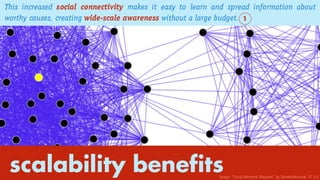
scalability benefits
This increased social connectivity makes it easy to learn and spread information about
worthy causes, creating wide-scale awareness without a large budget. 1
Image: “Social Network Diagram” by DarwinPeacock. CC 3.0
reaching a wider audience
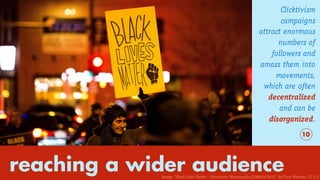
Clicktivism
campaigns
attract enormous
numbers of
followers and
amass them into
movements,
which are often
decentralized
and can be
disorganized.
10
Image: “Black Lives Matter – Downtown Minneapolis (22886247943)” by Tony Webster. CC 2.0
springing to action
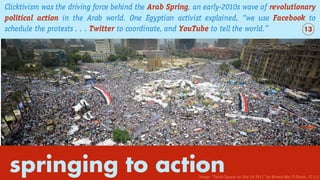
Clicktivism was the driving force behind the Arab Spring, an early-2010s wave of revolutionary
political action in the Arab world. One Egyptian activist explained, “we use Facebook to
schedule the protests . . . Twitter to coordinate, and YouTube to tell the world.” 13
Image: “Tahrir Square on July 29 2011” by Ahmed Abd El-Fatah. CC 2.0
stifling voices
In the wake of the
Arab Spring’s
success, oppressive
governments have
recognized the
information-
dissemination
potential of
clicktivism hubs like
Facebook and
banned their use.
17
Image: “Defense.gov photo essay 110110-F-6655M-017” by U.S. Air Force Master Sgt. Jerry Morrison. Public Domain (U.S. Government)
lack of engagement
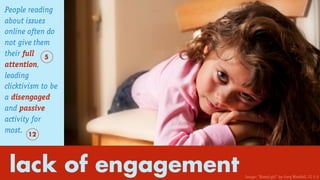
People reading
about issues
online often do
not give them
their full
attention,
leading
clicktivism to be
a disengaged
and passive
activity for
most.
5
12
Image: “Bored girl” by Greg Westfall. CC 2.0
funding imbalances
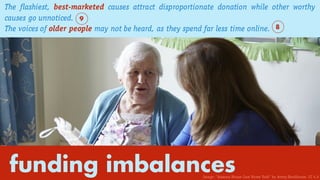
The flashiest, best-marketed causes attract disproportionate donation while other worthy
causes go unnoticed.
The voices of older people may not be heard, as they spend far less time online. 8
9
Image: “Amarna House Care Home York” by Avery Healthcare. CC 4.0
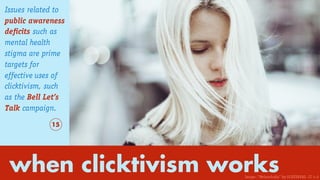
Issues related to
public awareness
deficits such as
mental health
stigma are prime
targets for
effective uses of
clicktivism, such
as the Bell Let’s
Talk campaign.
when clicktivism works
15
Image: “Melancholia” by OLESYAVAS. CC 4.0
awareness can be valuable
Some claim that
merely spreading
awareness is lazy,
but successful
campaigns such as
the ALS Ice Bucket
Challenge prove
that just spreading
awareness can bring
enormous financial
benefits to a cause.
6
Image: “Mission Accomplished – ALS Ice Bucket Challenge (14848289439)” by Anthony Quintano. CC 2.0
when clicktivism fails
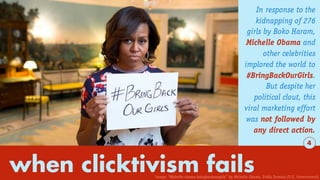
In response to the
kidnapping of 276
girls by Boko Haram,
Michelle Obama and
other celebrities
implored the world to
#BringBackOurGirls.
But despite her
political clout, this
viral marketing effort
was not followed by
any direct action.
4
Image: “Michelle-obama-bringbackourgirls” by Michelle Obama. Public Domain (U.S. Government)
awareness can be insufficient
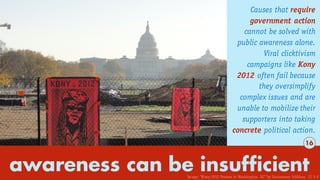
Causes that require
government action
cannot be solved with
public awareness alone.
Viral clicktivism
campaigns like Kony
2012 often fail because
they oversimplify
complex issues and are
unable to mobilize their
supporters into taking
concrete political action.
16
Image: “Kony 2012 Posters in Washington, DC” by Uncommon fritillary. CC 3.0
real-world activism
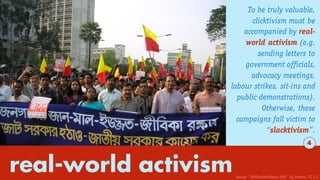
To be truly valuable,
clicktivism must be
accompanied by real-
world activism (e.g.
sending letters to
government officials,
advocacy meetings,
labour strikes, sit-ins and
public demonstrations).
Otherwise, these
campaigns fall victim to
“slacktivism”.
4
Image: “Jsddhakarallyinu (69)” by Soman. CC 2.5
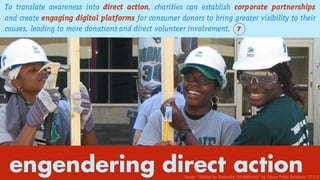
engendering direct action
To translate awareness into direct action, charities can establish corporate partnerships
and create engaging digital platforms for consumer donors to bring greater visibility to their
causes, leading to more donations and direct volunteer involvement. 7
Image: “Habitat for Humanity (3619985406)” by Tulane Public Relations. CC 2.0
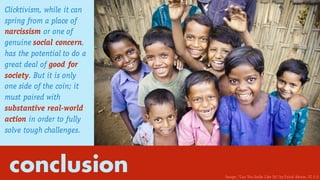
conclusion
Clicktivism, while it can
spring from a place of
narcissism or one of
genuine social concern,
has the potential to do a
great deal of good for
society. But it is only
one side of the coin; it
must paired with
substantive real-world
action in order to fully
solve tough challenges.
Image: “Can You Smile Like Us? by Faisal Akram. CC 2.0
course sources
Bresciani, S. and A. Schmeil (2012). Social media platforms for social good. 2012 6th IEEE International
Conference on Digital Ecosystems and Technologies (DEST), Campione d’Italia. 1-6. Retrieved
June 2, 2016.
Matrix, S. (2016, May). Module 02 slides. Queen’s University: FILM 260. Retrieved June 1, 2016.
Matrix, S. (2016, June). Module 04 slides. Queen’s University: FILM 260. Retrieved June 2, 2016.
Kielburger, C. and M. Kielburger (2015, April 10). A click is not enough to have impact on world.
Canoe. Retrieved May 30, 2016.
Rosenwald, M. S. (2014, April 6). Serious reading takes a hit from online scanning and skimming,
researchers say. The Washington Post. Retrieved June 1, 2016.
Sharma, R. (2014, October 20). Stop pouring ice on clicktivism. The Huffington Post. Retrieved May 30,
2016.
Stern, C. M. (2015, March 31). In praise of clicktivism. The Huffington Post. Retrieved June 2, 2016.
Wu, Y., C. Ware, S. Damnee, H. Kerherve & A. Rigaud (2015). Bridging the technology gap in older
adults: A study from an initiative to inform older adults about technologies. Clinical
Interventions in Aging, 193-200. Retrieved June 1, 2016.
1
2
3
4
5
6
7
8
found sources
Belluz, J. (2014, August 20). The truth about the Ice Bucket Challenge: Viral memes shouldn’t dictate
our charitable giving. Vox. Retrieved June 3, 2016.
Berlatsky, N. (2015, January 7). Hashtag activism isn’t a cop-out. The Atlantic. Retrieved May 31, 2016.
Gottfried, J. and E. Shearer (2016, May 26). News use across social media platforms 2016. Pew Research
Center. Retrieved June 1, 2016.
Howard, E. (2014, September 24). How ‘clicktivism’ has changed the face of political campaigns. The
Guardian. Retrieved June 2, 2016.
Kassim, S. (2012, July 3). Twitter revolution: How the Arab Spring was helped by social media. Mic:
Policy.Mic. Retrieved June 1, 2016.
MacMillan Dictionary (n.d.) Clicktivism. MacMillan Dictionary BuzzWord. Retrieved June 1, 2016.
Quigley, J. (2016, January 27). Bell Let’s Talk Day lifted ‘cloak of secrecy’ around mental illness, say
advocates. CBC News. Retrieved June 2, 2016.
Taylor, A. (2014, December 16). Was #Kony2012 a failure? The Washington Post. Retrieved June 2, 2016.
Williams, C. (2011, January 28). How Egypt shut down the internet. The Telegraph. Retrieved June 2, 2016.
All graphics have Creative Commons licenses or are otherwise in the public domain (as indicated in
the individual image credits), and all graphics were retrieved from Wikimedia Commons.
9
10
11
12
13
14
15
16
17

CLICKTIVISM: A (Flawed) Force for Good

  • 1.
    a presentation by CharlieGray prepared for Prof. Sidneyeve Matrix FILM 260 June 3, 2016 CLICKTIVISM a (flawed) force for good Image: “Archenhold Oberschule” by Ralf Roletschek. CC 3.0
  • 2.
    what is clicktivism? Clicktivismis making “use of the internet as a tool for influencing public opinions or achieving political or social aims” 14 Images: “Svengraph Imac” by Svengraph. CC 3.0 & “Soldiers aid 2010 Haiti earthquake refugees” by Roosewelt Pinheiro. CC 3.0
  • 3.
    clicktivism platforms Sites likeAvaaz, MoveOn, Change.Org and 38 degrees operate with the purpose of encouraging and facilitating social online activism. These platforms are where clicktivism content is born, ready for social media sharing. They also provide activists with resources for mobilizing their backers and taking direct action toward accomplishing their goals. 124 Image: “Helping the homeless” by Gary Dee. CC 2.0
  • 4.
    social media clicktivism Clicktivismalso thrives through sharing on various social media platforms such as Facebook, Twitter and Instagram. This is popular with young people, who care what others think and meticulously create a social good footprint on these platforms for others to see. 1 3 Image: “CH-NB-Swiss Open Cultural Hackathon 2015-Picture-039” by Swiss National Library. CC 4.0
  • 5.
    Clicktivism, though not alwaysundertaken for the right reasons, can play an important and constructive role in raising awareness of certain issues. However, it must be accompanied by direct action in order for issues to be properly addressed and resolved. case in point Image: “MAP Medicines Delivered in Cote d’Ivoire” by Mapintl. CC 4.0
  • 6.
    curated self-exhibition Engaging insocial forms of clicktivism like sharing articles and petitions is part of how we construct “our social selves”, “keystroke by keystroke”. In doing so, we are “curating the exhibition of [a] self” who cares about important issues, even if this is not the case. 2 Image: “Finance Meeting Paris 2012-02-18 n12” by Marie-Lan Nguyen. CC 3.0
  • 7.
    slacktivist self-satisfaction Passive actsof clicktivism can have “a placebo effect” that leads people to think ”they’re effecting change and doing good” even if they never have to take real action or leave their comfort zone. 3 Image: “Friends with Mobile Phones” by Garry Knight. CC 2.0
  • 8.
    A majority (62%) ofAmericans obtain news from social media. Therefore, our friends and the public figures we follow exert a massive influence over the information we consume. a changing media landscape 11 Image: “U.S. Army Gen. Martin E. Dempsey, the chairman of the Joint Chiefs of Staff, holds a Facebook town hall meeting with U.S. Service members from his desk at the Pentagon in Arlington, Va.” by MC1 Daniel Hinton. Public Domain (U.S. Military)
  • 9.
    scalability benefits This increasedsocial connectivity makes it easy to learn and spread information about worthy causes, creating wide-scale awareness without a large budget. 1 Image: “Social Network Diagram” by DarwinPeacock. CC 3.0
  • 10.
    reaching a wideraudience Clicktivism campaigns attract enormous numbers of followers and amass them into movements, which are often decentralized and can be disorganized. 10 Image: “Black Lives Matter – Downtown Minneapolis (22886247943)” by Tony Webster. CC 2.0
  • 11.
    springing to action Clicktivismwas the driving force behind the Arab Spring, an early-2010s wave of revolutionary political action in the Arab world. One Egyptian activist explained, “we use Facebook to schedule the protests . . . Twitter to coordinate, and YouTube to tell the world.” 13 Image: “Tahrir Square on July 29 2011” by Ahmed Abd El-Fatah. CC 2.0
  • 12.
    stifling voices In thewake of the Arab Spring’s success, oppressive governments have recognized the information- dissemination potential of clicktivism hubs like Facebook and banned their use. 17 Image: “Defense.gov photo essay 110110-F-6655M-017” by U.S. Air Force Master Sgt. Jerry Morrison. Public Domain (U.S. Government)
  • 13.
    lack of engagement Peoplereading about issues online often do not give them their full attention, leading clicktivism to be a disengaged and passive activity for most. 5 12 Image: “Bored girl” by Greg Westfall. CC 2.0
  • 14.
    funding imbalances The flashiest,best-marketed causes attract disproportionate donation while other worthy causes go unnoticed. The voices of older people may not be heard, as they spend far less time online. 8 9 Image: “Amarna House Care Home York” by Avery Healthcare. CC 4.0
  • 15.
    Issues related to publicawareness deficits such as mental health stigma are prime targets for effective uses of clicktivism, such as the Bell Let’s Talk campaign. when clicktivism works 15 Image: “Melancholia” by OLESYAVAS. CC 4.0
  • 16.
    awareness can bevaluable Some claim that merely spreading awareness is lazy, but successful campaigns such as the ALS Ice Bucket Challenge prove that just spreading awareness can bring enormous financial benefits to a cause. 6 Image: “Mission Accomplished – ALS Ice Bucket Challenge (14848289439)” by Anthony Quintano. CC 2.0
  • 17.
    when clicktivism fails Inresponse to the kidnapping of 276 girls by Boko Haram, Michelle Obama and other celebrities implored the world to #BringBackOurGirls. But despite her political clout, this viral marketing effort was not followed by any direct action. 4 Image: “Michelle-obama-bringbackourgirls” by Michelle Obama. Public Domain (U.S. Government)
  • 18.
    awareness can beinsufficient Causes that require government action cannot be solved with public awareness alone. Viral clicktivism campaigns like Kony 2012 often fail because they oversimplify complex issues and are unable to mobilize their supporters into taking concrete political action. 16 Image: “Kony 2012 Posters in Washington, DC” by Uncommon fritillary. CC 3.0
  • 19.
    real-world activism To betruly valuable, clicktivism must be accompanied by real- world activism (e.g. sending letters to government officials, advocacy meetings, labour strikes, sit-ins and public demonstrations). Otherwise, these campaigns fall victim to “slacktivism”. 4 Image: “Jsddhakarallyinu (69)” by Soman. CC 2.5
  • 20.
    engendering direct action Totranslate awareness into direct action, charities can establish corporate partnerships and create engaging digital platforms for consumer donors to bring greater visibility to their causes, leading to more donations and direct volunteer involvement. 7 Image: “Habitat for Humanity (3619985406)” by Tulane Public Relations. CC 2.0
  • 21.
    conclusion Clicktivism, while itcan spring from a place of narcissism or one of genuine social concern, has the potential to do a great deal of good for society. But it is only one side of the coin; it must paired with substantive real-world action in order to fully solve tough challenges. Image: “Can You Smile Like Us? by Faisal Akram. CC 2.0
  • 22.
    course sources Bresciani, S.and A. Schmeil (2012). Social media platforms for social good. 2012 6th IEEE International Conference on Digital Ecosystems and Technologies (DEST), Campione d’Italia. 1-6. Retrieved June 2, 2016. Matrix, S. (2016, May). Module 02 slides. Queen’s University: FILM 260. Retrieved June 1, 2016. Matrix, S. (2016, June). Module 04 slides. Queen’s University: FILM 260. Retrieved June 2, 2016. Kielburger, C. and M. Kielburger (2015, April 10). A click is not enough to have impact on world. Canoe. Retrieved May 30, 2016. Rosenwald, M. S. (2014, April 6). Serious reading takes a hit from online scanning and skimming, researchers say. The Washington Post. Retrieved June 1, 2016. Sharma, R. (2014, October 20). Stop pouring ice on clicktivism. The Huffington Post. Retrieved May 30, 2016. Stern, C. M. (2015, March 31). In praise of clicktivism. The Huffington Post. Retrieved June 2, 2016. Wu, Y., C. Ware, S. Damnee, H. Kerherve & A. Rigaud (2015). Bridging the technology gap in older adults: A study from an initiative to inform older adults about technologies. Clinical Interventions in Aging, 193-200. Retrieved June 1, 2016. 1 2 3 4 5 6 7 8
  • 23.
    found sources Belluz, J.(2014, August 20). The truth about the Ice Bucket Challenge: Viral memes shouldn’t dictate our charitable giving. Vox. Retrieved June 3, 2016. Berlatsky, N. (2015, January 7). Hashtag activism isn’t a cop-out. The Atlantic. Retrieved May 31, 2016. Gottfried, J. and E. Shearer (2016, May 26). News use across social media platforms 2016. Pew Research Center. Retrieved June 1, 2016. Howard, E. (2014, September 24). How ‘clicktivism’ has changed the face of political campaigns. The Guardian. Retrieved June 2, 2016. Kassim, S. (2012, July 3). Twitter revolution: How the Arab Spring was helped by social media. Mic: Policy.Mic. Retrieved June 1, 2016. MacMillan Dictionary (n.d.) Clicktivism. MacMillan Dictionary BuzzWord. Retrieved June 1, 2016. Quigley, J. (2016, January 27). Bell Let’s Talk Day lifted ‘cloak of secrecy’ around mental illness, say advocates. CBC News. Retrieved June 2, 2016. Taylor, A. (2014, December 16). Was #Kony2012 a failure? The Washington Post. Retrieved June 2, 2016. Williams, C. (2011, January 28). How Egypt shut down the internet. The Telegraph. Retrieved June 2, 2016. All graphics have Creative Commons licenses or are otherwise in the public domain (as indicated in the individual image credits), and all graphics were retrieved from Wikimedia Commons. 9 10 11 12 13 14 15 16 17