Viral Media: Forward/Embed/Share/PlayMAC309robert.jewitt@sunderland.ac.ukhttp://twitter.com/rob_jewitt
In this module I like to look at some of the emergent trends coming out of the tech space.  This session is going to be considering some of the ways in which brands and companies have tried to engage with users in order to establish themselves.
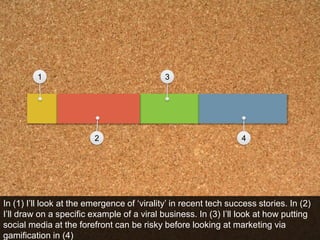
1324In (1) I’ll look at the emergence of ‘virality’ in recent tech success stories. In (2) I’ll draw on a specific example of a viral business. In (3) I’ll look at how putting social media at the forefront can be risky before looking at marketing via gamification in (4)
1324I want to illustrate section (1) by drawing on an idea coined recently by Adam Penenberg, something he calls a viral loop
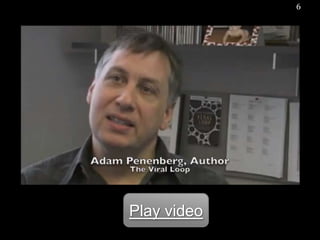
‘Viral expansion loops’Adam L. Penenberg (2009) identified a number of successful organisations who incorporated virality into their functionality so that each user begets another user.5
Click to play videos6Play video
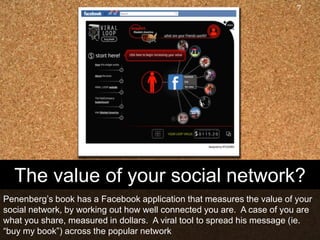
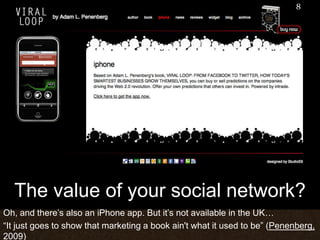
The value of your social network?7Penenberg’s book has a Facebook application that measures the value of your social network, by working out how well connected you are.  A case of you are what you share, measured in dollars.  A viral tool to spread his message (ie. “buy my book”) across the popular network
The value of your social network?Oh, and there’s also an iPhone app. But it’s not available in the UK…  “It just goes to show that marketing a book ain't what it used to be” (Penenberg, 2009)8
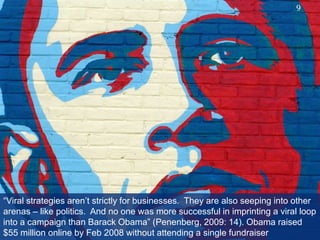
“Viral strategies aren’t strictly for businesses.  They are also seeping into other arenas – like politics.  And no one was more successful in imprinting a viral loop into a campaign than Barack Obama” (Penenberg, 2009: 14). Obama raised $55 million online by Feb 2008 without attending a single fundraiser9
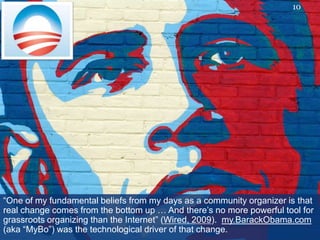
“One of my fundamental beliefs from my days as a community organizer is that real change comes from the bottom up … And there’s no more powerful tool for grassroots organizing than the Internet” (Wired, 2009).  my.BarackObama.com (aka “MyBo”) was the technological driver of that change.10
1324Now in section (2), still drawing on Penenberg, I’ll explain how a viral success story emerged using Am I Hot Or Not? as an example of a organisation which took advantage of a socially orientated growth strategy.
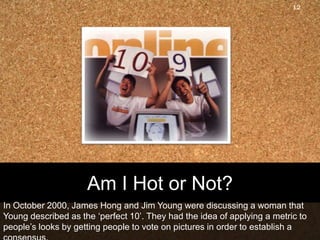
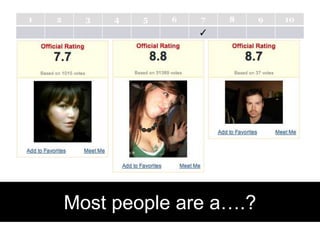
Am I Hot or Not?In October 2000, James Hong and Jim Young were discussing a woman that Young described as the ‘perfect 10’. They had the idea of applying a metric to people’s looks by getting people to vote on pictures in order to establish a consensus.12
Most people are a….?13
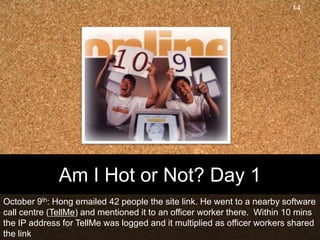
Am I Hot or Not? Day 1October 9th: Hong emailed 42 people the site link. He went to a nearby software call centre (TellMe) and mentioned it to an officer worker there.  Within 10 mins the IP address for TellMe was logged and it multiplied as officer workers shared the link14
Am I Hot or Not? Day 1By the end of the day the site had received 37,000 unique views while 200 photos had been uploaded15
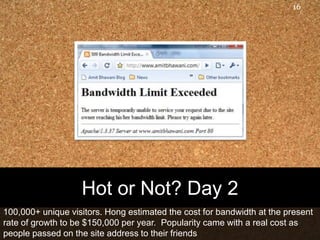
Hot or Not? Day 2100,000+ unique visitors. Hong estimated the cost for bandwidth at the present rate of growth to be $150,000 per year.  Popularity came with a real cost as people passed on the site address to their friends16
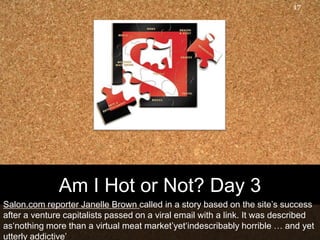
Am I Hot or Not? Day 3Salon.com reporter Janelle Brown called in a story based on the site’s success after a venture capitalists passed on a viral email with a link. It was described as‘nothing more than a virtual meat market’yet‘indescribably horrible … and yet utterly addictive’17
ScalabilityIn order to offset costs decided to host the photos on Yahoo’s Geocities and thesite on a cheap 400-mghz Celeron PC under a desk in Berkeley.  By 5am the server had been down for 2 hours.  The Dean of the engineering department complained the traffic was pulling the entire network down. They were struggling to stay in control of their rapid growth18
ScalabilityLots of media attention, but still no plan for monetisation.  They were getting more notoriety and more traffic. By day 8 the site was getting 1.8 million page views per day. Agreed a deal with Rackspace servers who wanted to boost their presence/reputation 19
Within 6 weeks the site had 3 million page views, was hosting 3000 photos.  However, there was still no clear funding model.  The site predated Google’s AdSense service for automated advertisements.20Scalability
The site faced a number of problems as it grew and funding was being sought. Several users were uploading pornographic content that wouldn’t sit well with potential advertisers.  Initially Hong’s parents moderated images but they soon turned to the community to keep the service free of shocking images21Scalability
Within 2 months the site had counted 7 million page views per day making it one of the top 25 domains online.  They had collected 130,000 photos and had generated $100,000 in ad revenue22Scalability
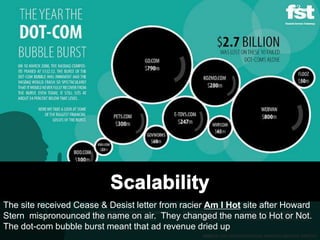
The site received Cease & Desist letter from racier Am I Hot site after Howard Stern  mispronounced the name on air.  They changed the name to Hot or Not. The dot-com bubble burst meant that ad revenue dried up23Scalability
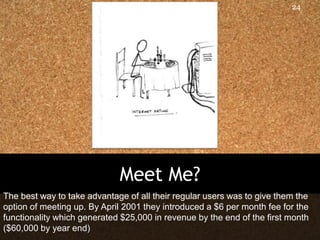
Meet Me?The best way to take advantage of all their regular users was to give them the option of meeting up. By April 2001they introduced a $6 per month fee for the functionality which generated $25,000 in revenue by the end of the first month ($60,000 by year end)24
www.hotornot.com25
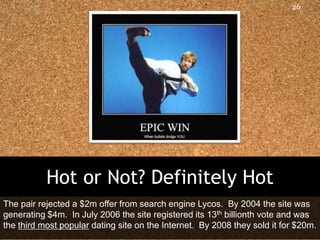
Hot or Not? Definitely HotThe pair rejected a $2m offer from search engine Lycos.  By 2004 the site was generating $4m.  In July 2006 the site registered its 13th billionth vote and was the third most populardating site on the Internet.  By 2008 they sold it for $20m.26
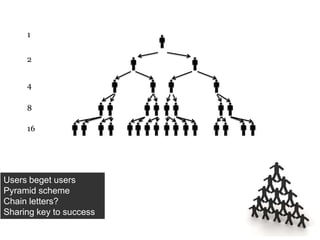
27124816Users beget usersPyramid schemeChain letters?Sharing key to success
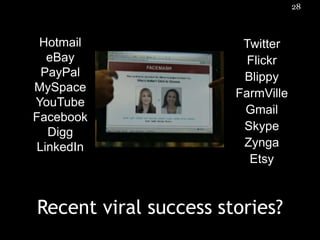
Recent viral success stories?HotmaileBayPayPalMySpaceYouTubeFacebookDiggLinkedInTwitterFlickrBlippyFarmVilleGmailSkypeZyngaEtsy28
‘Viral expansion loops’Recap: Penenberg (2009) identified a number of successful organisations who incorporated virality into their functionality so that each user begets another user.  An effective social strategy in which a brand’s proposition can be easily disseminated is key, but not everyone gets that right.29
1324In section (3) I’ll look at how putting social media at the forefront can be a risky strategy for some organisations, despite the advantages that can come with being well known.
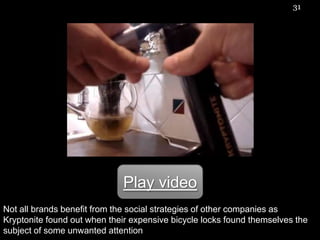
Not all brands benefit from the social strategies of other companies as Kryptonite found out when their expensive bicycle locks found themselves the subject of some unwanted attention 31Play video
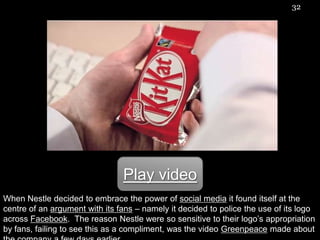
When Nestledecided to embrace the power of social mediait found itself at the centre of an argument with its fans– namely it decided to police the use of its logo across Facebook.  The reason Nestle were so sensitive to their logo’s appropriation by fans, failing to see this as a compliment, was the video Greenpeace made about the company a few days earlier32Play video
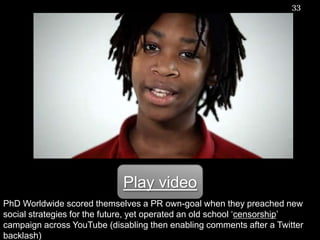
PhD Worldwide scored themselves a PR own-goal when they preached new social strategies for the future, yet operated an old school ‘censorship’ campaign across YouTube (disabling then enabling comments after a Twitter backlash)33Play video
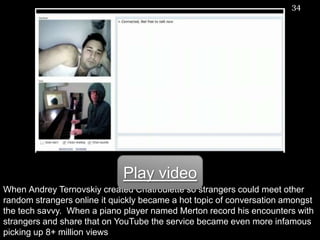
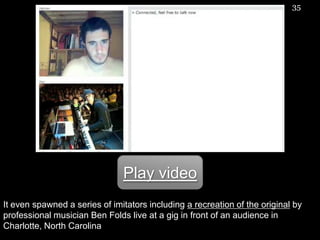
When AndreyTernovskiycreated Chatroulette so strangers could meet other random strangers online it quickly became a hot topic of conversation amongst the tech savvy.  When a piano player named Merton record his encounters with strangers and share that on YouTube the service became even more infamous picking up 8+ million views34Play video
It even spawned a series of imitators including a recreation of the originalby professional musician Ben Folds live at a gig in front of an audience in Charlotte, North Carolina35Play video
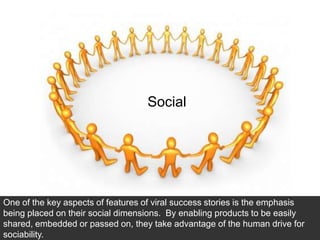
SocialOne of the key aspects of features of viral success stories is the emphasis being placed on their social dimensions.  By enabling products to be easily shared, embedded or passed on, they take advantage of the human drive for sociability.36
1324In this final section (4) I’ll look at the current marketing buzz-word, ‘gamification’, which promises a lot of engagement between a product or service and its user base in order to keep people interested by rewarding their interactions
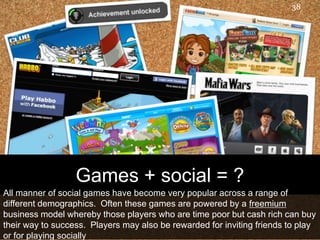
38Games + social = ?All manner of social games have become very popular across a range of different demographics.  Often these games are powered by a freemium business model whereby those players who are time poor but cash rich can buy their way to success.  Players may also be rewarded for inviting friends to play or for playing socially
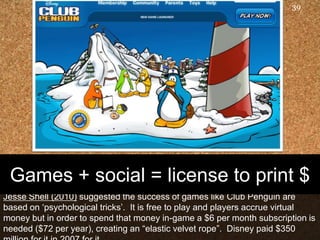
Jesse Shell(2010) suggested the success of games like Club Penguin are based on ‘psychological tricks’.  It is free to play and players accrue virtual money but in order to spend that money in-game a $6 per month subscription is needed ($72 per year), creating an “elastic velvet rope”.  Disney paid $350 million for it in 2007 for it39Games + social = license to print $
There’s a new buzz word in town (although there’s some discontent regarding its significance, or at least its application).  Games are encroaching into reality, breaking outside of the confines of the traditional game space40
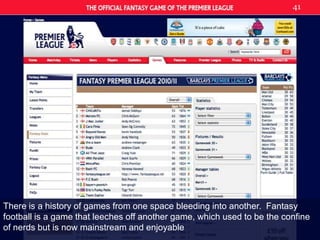
There is a history of games from one space bleeding into another.  Fantasy football is a game that leeches off another game, which used to be the confine of nerds but is now mainstream and enjoyable41
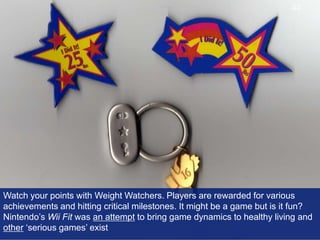
Watch your points with Weight Watchers. Players are rewarded for various achievements and hitting critical milestones. It might be a game but is it fun? Nintendo’s Wii Fit was an attempt to bring game dynamics to healthy living and other ‘serious games’ exist42
Track your progress, beat your score, compare your performance with other users of Nike+!43
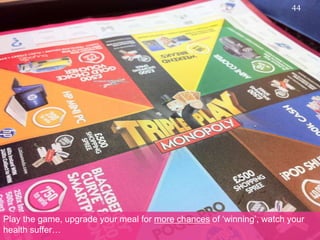
Play the game, upgrade your meal for more chances of ‘winning’, watch your health suffer…44
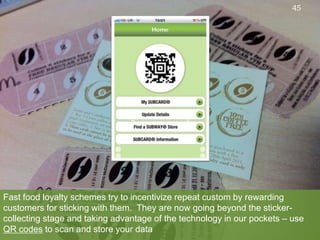
Fast food loyalty schemes try to incentivize repeat custom by rewarding customers for sticking with them.  They are now going beyond the sticker-collecting stage and taking advantage of the technology in our pockets – use QR codes to scan and store your data45
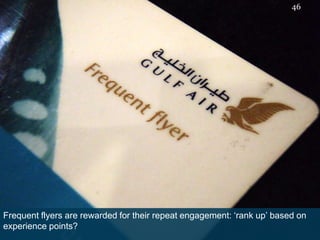
Frequent flyers are rewarded for their repeat engagement: ‘rank up’ based on experience points?46
There is a tendency for car manufacturers to include fuel economy gauges for drivers to maximize their fuel efficiency.  The aim of the game is to ‘score’ your highest MPG.   Play Fuel Challenge™ by ‘hypermiling’ with some unintended consequences, such as refusing to slow down at traffic lights so as not to have to accelerate later47
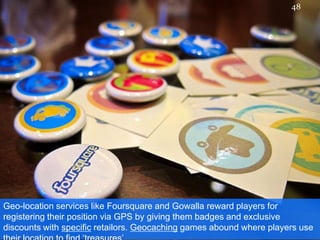
Geo-location services like Foursquare and Gowalla reward players for registering their position via GPS by giving them badges and exclusive discounts with specific retailors. Geocachinggames abound where players use their location to find ‘treasures’48
Gamification = application of game design elements to things that aren’t typically considered a game.  It strives to encourage users in desired behaviours by taking advantage of psychological predispositions to engage in a game format when the task at hand may not be that exciting (wink to Sebastian Deterding for this one…)49
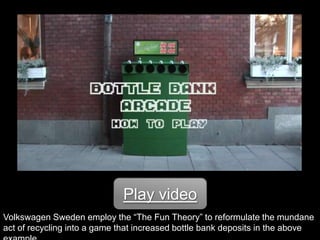
Play videoVolkswagen Sweden employ the “The Fun Theory” to reformulate the mundane act of recycling into a game that increased bottle bank deposits in the above example.
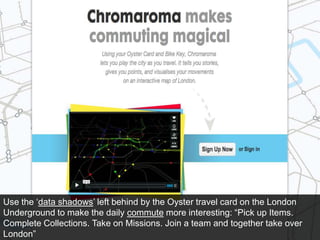
Use the ‘data shadows’ left behind by the Oyster travel card on the London Underground to make the daily commute more interesting: “Pick up Items. Complete Collections. Take on Missions. Join a team and together take over London”
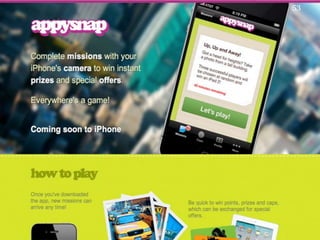
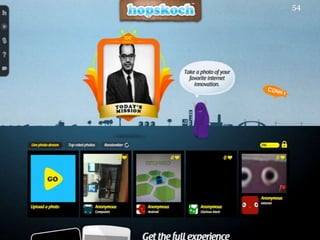
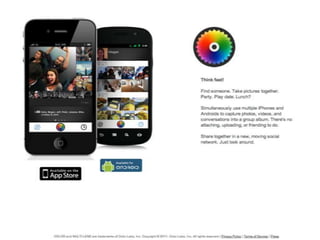
The decreasing costs and increasing sophistication of accelerometers, RFID chips and other sensors is creating a context in which they can be found almost anywhere, and their centrality may engender new possibilities for innovationand engagement.  Even the most mundane objects like a smartphone can be utilized as part of a ‘gamified’ marketing campaign.  This doesn’t mean they’ll always be implemented effectively…52
53
54
55
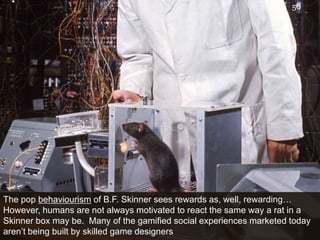
The pop behaviourism of B.F. Skinner sees rewards as, well, rewarding…  However, humans are not always motivated to react the same way a rat in a Skinner box may be.  Many of the gamified social experiences marketed today aren’t being built by skilled game designers56
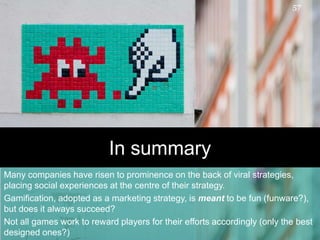
In summaryMany companies have risen to prominence on the back of viral strategies, placing social experiences at the centre of their strategy.  Gamification, adopted as a marketing strategy, is meant to be fun (funware?), but does it always succeed?  Not all games work to reward players for their efforts accordingly (only the best designed ones?)57
# - C!..., 2010, Share# - @Hella, 2008, Obama# - Sergio Vaiani, 2009, Scale Stairs# - Mike Zienowicz, 2007, Joe# - MissNatalie, 2008, Miss Natalie’s Growth Chart#  - GDS Infographics, 2010, The Year the Dot-Com Bubble Burst# - Phil Hatchard, 2010, Sketchbook 2: Internet Dating# - kurtxia, 2008, Space invaders# - bitchcakesny, 2008, Weight Watchers Awards# - Jun Acullador, 2007, Gulf Air# - plien, 2009, Z4 dash# - DORONKO, 2010, NIKE +iPod# – nan palmero, 2010, Foursquare Pins and Tattoos SXSW 2010# - yoyolabellut, 2010, Space Invader @ Paris (France)# - paulszym, 2010, Step 10 – Place the 5mm Sensor for soldering# - Nina Leen (LIFE), 1964, B F Skinner training a rat# - yoyolabellut, 2010, Space Invader @ Paris (France)# - A. DiezHerrero, 2007, creative commons -Franz Patzig-58All attempts made to attribute sources but if I’m missed one, get in touch please

Mac309 viral media and gamification

  • 1.
  • 2.
    In this moduleI like to look at some of the emergent trends coming out of the tech space. This session is going to be considering some of the ways in which brands and companies have tried to engage with users in order to establish themselves.
  • 3.
    1324In (1) I’lllook at the emergence of ‘virality’ in recent tech success stories. In (2) I’ll draw on a specific example of a viral business. In (3) I’ll look at how putting social media at the forefront can be risky before looking at marketing via gamification in (4)
  • 4.
    1324I want toillustrate section (1) by drawing on an idea coined recently by Adam Penenberg, something he calls a viral loop
  • 5.
    ‘Viral expansion loops’AdamL. Penenberg (2009) identified a number of successful organisations who incorporated virality into their functionality so that each user begets another user.5
  • 6.
    Click to playvideos6Play video
  • 7.
    The value ofyour social network?7Penenberg’s book has a Facebook application that measures the value of your social network, by working out how well connected you are. A case of you are what you share, measured in dollars. A viral tool to spread his message (ie. “buy my book”) across the popular network
  • 8.
    The value ofyour social network?Oh, and there’s also an iPhone app. But it’s not available in the UK… “It just goes to show that marketing a book ain't what it used to be” (Penenberg, 2009)8
  • 9.
    “Viral strategies aren’tstrictly for businesses. They are also seeping into other arenas – like politics. And no one was more successful in imprinting a viral loop into a campaign than Barack Obama” (Penenberg, 2009: 14). Obama raised $55 million online by Feb 2008 without attending a single fundraiser9
  • 10.
    “One of myfundamental beliefs from my days as a community organizer is that real change comes from the bottom up … And there’s no more powerful tool for grassroots organizing than the Internet” (Wired, 2009). my.BarackObama.com (aka “MyBo”) was the technological driver of that change.10
  • 11.
    1324Now in section(2), still drawing on Penenberg, I’ll explain how a viral success story emerged using Am I Hot Or Not? as an example of a organisation which took advantage of a socially orientated growth strategy.
  • 12.
    Am I Hotor Not?In October 2000, James Hong and Jim Young were discussing a woman that Young described as the ‘perfect 10’. They had the idea of applying a metric to people’s looks by getting people to vote on pictures in order to establish a consensus.12
  • 13.
  • 14.
    Am I Hotor Not? Day 1October 9th: Hong emailed 42 people the site link. He went to a nearby software call centre (TellMe) and mentioned it to an officer worker there. Within 10 mins the IP address for TellMe was logged and it multiplied as officer workers shared the link14
  • 15.
    Am I Hotor Not? Day 1By the end of the day the site had received 37,000 unique views while 200 photos had been uploaded15
  • 16.
    Hot or Not?Day 2100,000+ unique visitors. Hong estimated the cost for bandwidth at the present rate of growth to be $150,000 per year. Popularity came with a real cost as people passed on the site address to their friends16
  • 17.
    Am I Hotor Not? Day 3Salon.com reporter Janelle Brown called in a story based on the site’s success after a venture capitalists passed on a viral email with a link. It was described as‘nothing more than a virtual meat market’yet‘indescribably horrible … and yet utterly addictive’17
  • 18.
    ScalabilityIn order tooffset costs decided to host the photos on Yahoo’s Geocities and thesite on a cheap 400-mghz Celeron PC under a desk in Berkeley. By 5am the server had been down for 2 hours. The Dean of the engineering department complained the traffic was pulling the entire network down. They were struggling to stay in control of their rapid growth18
  • 19.
    ScalabilityLots of mediaattention, but still no plan for monetisation. They were getting more notoriety and more traffic. By day 8 the site was getting 1.8 million page views per day. Agreed a deal with Rackspace servers who wanted to boost their presence/reputation 19
  • 20.
    Within 6 weeksthe site had 3 million page views, was hosting 3000 photos. However, there was still no clear funding model. The site predated Google’s AdSense service for automated advertisements.20Scalability
  • 21.
    The site faceda number of problems as it grew and funding was being sought. Several users were uploading pornographic content that wouldn’t sit well with potential advertisers. Initially Hong’s parents moderated images but they soon turned to the community to keep the service free of shocking images21Scalability
  • 22.
    Within 2 monthsthe site had counted 7 million page views per day making it one of the top 25 domains online. They had collected 130,000 photos and had generated $100,000 in ad revenue22Scalability
  • 23.
    The site receivedCease & Desist letter from racier Am I Hot site after Howard Stern mispronounced the name on air. They changed the name to Hot or Not. The dot-com bubble burst meant that ad revenue dried up23Scalability
  • 24.
    Meet Me?The bestway to take advantage of all their regular users was to give them the option of meeting up. By April 2001they introduced a $6 per month fee for the functionality which generated $25,000 in revenue by the end of the first month ($60,000 by year end)24
  • 25.
  • 26.
    Hot or Not?Definitely HotThe pair rejected a $2m offer from search engine Lycos. By 2004 the site was generating $4m. In July 2006 the site registered its 13th billionth vote and was the third most populardating site on the Internet. By 2008 they sold it for $20m.26
  • 27.
    27124816Users beget usersPyramidschemeChain letters?Sharing key to success
  • 28.
    Recent viral successstories?HotmaileBayPayPalMySpaceYouTubeFacebookDiggLinkedInTwitterFlickrBlippyFarmVilleGmailSkypeZyngaEtsy28
  • 29.
    ‘Viral expansion loops’Recap:Penenberg (2009) identified a number of successful organisations who incorporated virality into their functionality so that each user begets another user. An effective social strategy in which a brand’s proposition can be easily disseminated is key, but not everyone gets that right.29
  • 30.
    1324In section (3)I’ll look at how putting social media at the forefront can be a risky strategy for some organisations, despite the advantages that can come with being well known.
  • 31.
    Not all brandsbenefit from the social strategies of other companies as Kryptonite found out when their expensive bicycle locks found themselves the subject of some unwanted attention 31Play video
  • 32.
    When Nestledecided toembrace the power of social mediait found itself at the centre of an argument with its fans– namely it decided to police the use of its logo across Facebook. The reason Nestle were so sensitive to their logo’s appropriation by fans, failing to see this as a compliment, was the video Greenpeace made about the company a few days earlier32Play video
  • 33.
    PhD Worldwide scoredthemselves a PR own-goal when they preached new social strategies for the future, yet operated an old school ‘censorship’ campaign across YouTube (disabling then enabling comments after a Twitter backlash)33Play video
  • 34.
    When AndreyTernovskiycreated Chatrouletteso strangers could meet other random strangers online it quickly became a hot topic of conversation amongst the tech savvy. When a piano player named Merton record his encounters with strangers and share that on YouTube the service became even more infamous picking up 8+ million views34Play video
  • 35.
    It even spawneda series of imitators including a recreation of the originalby professional musician Ben Folds live at a gig in front of an audience in Charlotte, North Carolina35Play video
  • 36.
    SocialOne of thekey aspects of features of viral success stories is the emphasis being placed on their social dimensions. By enabling products to be easily shared, embedded or passed on, they take advantage of the human drive for sociability.36
  • 37.
    1324In this finalsection (4) I’ll look at the current marketing buzz-word, ‘gamification’, which promises a lot of engagement between a product or service and its user base in order to keep people interested by rewarding their interactions
  • 38.
    38Games + social= ?All manner of social games have become very popular across a range of different demographics. Often these games are powered by a freemium business model whereby those players who are time poor but cash rich can buy their way to success. Players may also be rewarded for inviting friends to play or for playing socially
  • 39.
    Jesse Shell(2010) suggestedthe success of games like Club Penguin are based on ‘psychological tricks’. It is free to play and players accrue virtual money but in order to spend that money in-game a $6 per month subscription is needed ($72 per year), creating an “elastic velvet rope”. Disney paid $350 million for it in 2007 for it39Games + social = license to print $
  • 40.
    There’s a newbuzz word in town (although there’s some discontent regarding its significance, or at least its application). Games are encroaching into reality, breaking outside of the confines of the traditional game space40
  • 41.
    There is ahistory of games from one space bleeding into another. Fantasy football is a game that leeches off another game, which used to be the confine of nerds but is now mainstream and enjoyable41
  • 42.
    Watch your pointswith Weight Watchers. Players are rewarded for various achievements and hitting critical milestones. It might be a game but is it fun? Nintendo’s Wii Fit was an attempt to bring game dynamics to healthy living and other ‘serious games’ exist42
  • 43.
    Track your progress,beat your score, compare your performance with other users of Nike+!43
  • 44.
    Play the game,upgrade your meal for more chances of ‘winning’, watch your health suffer…44
  • 45.
    Fast food loyaltyschemes try to incentivize repeat custom by rewarding customers for sticking with them. They are now going beyond the sticker-collecting stage and taking advantage of the technology in our pockets – use QR codes to scan and store your data45
  • 46.
    Frequent flyers arerewarded for their repeat engagement: ‘rank up’ based on experience points?46
  • 47.
    There is atendency for car manufacturers to include fuel economy gauges for drivers to maximize their fuel efficiency. The aim of the game is to ‘score’ your highest MPG. Play Fuel Challenge™ by ‘hypermiling’ with some unintended consequences, such as refusing to slow down at traffic lights so as not to have to accelerate later47
  • 48.
    Geo-location services likeFoursquare and Gowalla reward players for registering their position via GPS by giving them badges and exclusive discounts with specific retailors. Geocachinggames abound where players use their location to find ‘treasures’48
  • 49.
    Gamification = applicationof game design elements to things that aren’t typically considered a game. It strives to encourage users in desired behaviours by taking advantage of psychological predispositions to engage in a game format when the task at hand may not be that exciting (wink to Sebastian Deterding for this one…)49
  • 50.
    Play videoVolkswagen Swedenemploy the “The Fun Theory” to reformulate the mundane act of recycling into a game that increased bottle bank deposits in the above example.
  • 51.
    Use the ‘datashadows’ left behind by the Oyster travel card on the London Underground to make the daily commute more interesting: “Pick up Items. Complete Collections. Take on Missions. Join a team and together take over London”
  • 52.
    The decreasing costsand increasing sophistication of accelerometers, RFID chips and other sensors is creating a context in which they can be found almost anywhere, and their centrality may engender new possibilities for innovationand engagement. Even the most mundane objects like a smartphone can be utilized as part of a ‘gamified’ marketing campaign. This doesn’t mean they’ll always be implemented effectively…52
  • 53.
  • 54.
  • 55.
  • 56.
    The pop behaviourismof B.F. Skinner sees rewards as, well, rewarding… However, humans are not always motivated to react the same way a rat in a Skinner box may be. Many of the gamified social experiences marketed today aren’t being built by skilled game designers56
  • 57.
    In summaryMany companieshave risen to prominence on the back of viral strategies, placing social experiences at the centre of their strategy. Gamification, adopted as a marketing strategy, is meant to be fun (funware?), but does it always succeed? Not all games work to reward players for their efforts accordingly (only the best designed ones?)57
  • 58.
    # - C!...,2010, Share# - @Hella, 2008, Obama# - Sergio Vaiani, 2009, Scale Stairs# - Mike Zienowicz, 2007, Joe# - MissNatalie, 2008, Miss Natalie’s Growth Chart# - GDS Infographics, 2010, The Year the Dot-Com Bubble Burst# - Phil Hatchard, 2010, Sketchbook 2: Internet Dating# - kurtxia, 2008, Space invaders# - bitchcakesny, 2008, Weight Watchers Awards# - Jun Acullador, 2007, Gulf Air# - plien, 2009, Z4 dash# - DORONKO, 2010, NIKE +iPod# – nan palmero, 2010, Foursquare Pins and Tattoos SXSW 2010# - yoyolabellut, 2010, Space Invader @ Paris (France)# - paulszym, 2010, Step 10 – Place the 5mm Sensor for soldering# - Nina Leen (LIFE), 1964, B F Skinner training a rat# - yoyolabellut, 2010, Space Invader @ Paris (France)# - A. DiezHerrero, 2007, creative commons -Franz Patzig-58All attempts made to attribute sources but if I’m missed one, get in touch please