
 What is Teacher professional
development?
 Characteristics of Teacher professional
development.
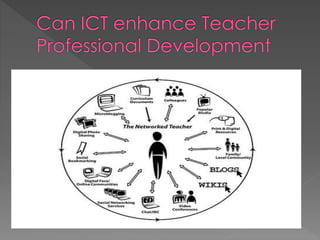
 Can ICT enhance Teacher professional
development?
 « Professional development, in a broad
sense, refers to the development of a
person in his or her professional role » (
Eleanora,2003)
 « Professional development is the
professional growth a teacher achieves
as a result of gaining increased
experience and examining his or her
teaching systematically »
(Glatthorn,1995)
 It is based on constructivism; teachers
are treated as active learners engaged
in concrete tasks .
 It is a long process in which teachers
learn over time.
 It is perceived as a process that takes
place within a particular context.
 It is a process that is intimately linked to
school reform.
 A teacher is conceived of as a reflective
practitioner.
 Professional development is conceived
of a collaborative process
 “ Blogs have given everyone the
opportunity to have a voice, and people
have taken advantage”
 Edublogs.org
 Weblogg-ed by Will Richardson
 2 Cents Worth by David Warlick
 Think:lab by Christian Long
 Ed Tech Journeys by Pete Reilly
 The Thinking Stick by Jeff Utecht
 Cool Cat Teacher by Vicki Davis
 Techlearning.com blog
 “Del.icio.us is a social bookmarking
service that enables users to store and
tag information resources in an online
account that can be accessed by
others.”
 "Links for You" section where other
del.icio.us users can send you links to
resources.
 "Your Network« feature that enables you to
identify a set of del.icio.us users and see
what they bookmark.
 Subscription option that enables a user to
subscribe to a specific tag in del.icio.us,
such as digitalstorytelling, and see all the
resources from all the del.icio.us users on
that topic
 Del.icio.us accounts are available
at http://del.icio.us
 David Jakes del.icio.us feed
 Christopher Sessums del.icio.us feed
 Will Richardson's del.icio.us feed
 Dean Shareskis del.icio.us feed
 John Petersons del.icio.us feed
 “Podcasts are recordings of an individual,
of a discussion, or perhaps of a
presentation, delivered in MP3 format. Like
blogs, they provide a voice, but this time in
audio format that can be listened to on an
MP3 player or a computer while exercising,
walking the dog, or driving the car. Like
blogs and del.icio.us resources, podcasts
can be delivered through an RSS feed to
the listener or learner. “
 EdTechTalk
 Connect Learning
 The Savvy Technologist Podcast
 EdTechCoasttoCoas
 The key is RSS (Really Simple Syndication).
The three tools above all produce RSS feeds
which stream or deliver content. The
aggregator is like a mailbox and captures
the information feeds and presents it to the
user. The aggregator's value is that it
presents feeds from multiple authors and
content types (blogs, wikis, podcasts, Flickr,
and del.icio.us) all in a single location for
ease of processing.
 Bloglines
 Google Reader
 Netvibes
 PageFlakes
 http://www.techlearning.com/tech/me
dia-coordinators/0018/professional-
development-and-web-
20/44270#sthash.EHvfqvru.dpuf

Using ICT in teacher professional development

  • 2.
     What isTeacher professional development?  Characteristics of Teacher professional development.  Can ICT enhance Teacher professional development?
  • 3.
     « Professionaldevelopment, in a broad sense, refers to the development of a person in his or her professional role » ( Eleanora,2003)  « Professional development is the professional growth a teacher achieves as a result of gaining increased experience and examining his or her teaching systematically » (Glatthorn,1995)
  • 4.
     It isbased on constructivism; teachers are treated as active learners engaged in concrete tasks .  It is a long process in which teachers learn over time.  It is perceived as a process that takes place within a particular context.
  • 5.
     It isa process that is intimately linked to school reform.  A teacher is conceived of as a reflective practitioner.  Professional development is conceived of a collaborative process
  • 7.
     “ Blogshave given everyone the opportunity to have a voice, and people have taken advantage”  Edublogs.org  Weblogg-ed by Will Richardson  2 Cents Worth by David Warlick  Think:lab by Christian Long  Ed Tech Journeys by Pete Reilly  The Thinking Stick by Jeff Utecht  Cool Cat Teacher by Vicki Davis  Techlearning.com blog
  • 8.
     “Del.icio.us isa social bookmarking service that enables users to store and tag information resources in an online account that can be accessed by others.”
  • 9.
     "Links forYou" section where other del.icio.us users can send you links to resources.  "Your Network« feature that enables you to identify a set of del.icio.us users and see what they bookmark.  Subscription option that enables a user to subscribe to a specific tag in del.icio.us, such as digitalstorytelling, and see all the resources from all the del.icio.us users on that topic
  • 10.
     Del.icio.us accountsare available at http://del.icio.us  David Jakes del.icio.us feed  Christopher Sessums del.icio.us feed  Will Richardson's del.icio.us feed  Dean Shareskis del.icio.us feed  John Petersons del.icio.us feed
  • 11.
     “Podcasts arerecordings of an individual, of a discussion, or perhaps of a presentation, delivered in MP3 format. Like blogs, they provide a voice, but this time in audio format that can be listened to on an MP3 player or a computer while exercising, walking the dog, or driving the car. Like blogs and del.icio.us resources, podcasts can be delivered through an RSS feed to the listener or learner. “
  • 12.
     EdTechTalk  ConnectLearning  The Savvy Technologist Podcast  EdTechCoasttoCoas
  • 13.
     The keyis RSS (Really Simple Syndication). The three tools above all produce RSS feeds which stream or deliver content. The aggregator is like a mailbox and captures the information feeds and presents it to the user. The aggregator's value is that it presents feeds from multiple authors and content types (blogs, wikis, podcasts, Flickr, and del.icio.us) all in a single location for ease of processing.
  • 14.
     Bloglines  GoogleReader  Netvibes  PageFlakes
  • 15.