How to avoid writing device drivers
for embedded Linux
Embedded World 2016
How to avoid writing device drivers for embedded Linux 1 Copyright © 2011-2016, 2net Ltd
License
These slides are available under a Creative Commons Attribution-ShareAlike 3.0
license. You can read the full text of the license here
http://creativecommons.org/licenses/by-sa/3.0/legalcode
You are free to
• copy, distribute, display, and perform the work
• make derivative works
• make commercial use of the work
Under the following conditions
• Attribution: you must give the original author credit
• Share Alike: if you alter, transform, or build upon this work, you may distribute
the resulting work only under a license identical to this one (i.e. include this
page exactly as it is)
• For any reuse or distribution, you must make clear to others the license terms of
this work
How to avoid writing device drivers for embedded Linux 2 Copyright © 2011-2016, 2net Ltd
About Chris Simmonds
• Consultant and trainer
• Author of Mastering Embedded Linux
Programming
• Working with embedded Linux since 1999
• Android since 2009
• Speaker at many conferences and
workshops
"Looking after the Inner Penguin" blog at http://2net.co.uk/
https://uk.linkedin.com/in/chrisdsimmonds/
https://google.com/+chrissimmonds
How to avoid writing device drivers for embedded Linux 3 Copyright © 2011-2016, 2net Ltd
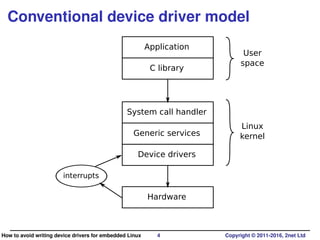
Conventional device driver model
User
space
System call handler
Generic services
Device drivers
Hardware
Application
C library
interrupts
Linux
kernel
How to avoid writing device drivers for embedded Linux 4 Copyright © 2011-2016, 2net Ltd
How applications call device drivers
• In Linux, everything is a file 1
• Applications interact with drivers via POSIX functions
open(2), read(2), write(2), ioctl(2), etc
• There are two types of interface
• 1. Device nodes in /dev
• The serial driver, ttyS is an example
• Device nodes are named /dev/ttyS0, /dev/ttyS1 ...
• 2. Driver attributes, exported via sysfs
• For example /sys/class/gpio
1Except network interfaces, which are sockets
How to avoid writing device drivers for embedded Linux 5 Copyright © 2011-2016, 2net Ltd
Userspace drivers
• Writing kernel device drivers can be difficult
• Luckily, there are generic drivers that that allow you to
write most of the code in userspace
• We will look at three
• GPIO
• PWM
• I2C
• Note: applications will need read/write permissions
for the files. Consequently, they usually have to run
as user root
How to avoid writing device drivers for embedded Linux 6 Copyright © 2011-2016, 2net Ltd
/sys/class/gpio
# ls /sys/class/gpio/
export gpiochip0 gpiochip32 gpiochip64 gpiochip96 unexport
This device has 4 gpio chips
each with 32 pins
Write to this
file to export
a GPIO pin
to user space
Write to this
file to unexport
a GPIO pin
to user space
How to avoid writing device drivers for embedded Linux 7 Copyright © 2011-2016, 2net Ltd
gpiochip
# /sys/class/gpio/gpiochip0
base device label ngpio power subsystem uevent
The number of GPIO pins (32)
A lable to identify the chip
(gpiochip0)
The starting GPIO number (0)
How to avoid writing device drivers for embedded Linux 8 Copyright © 2011-2016, 2net Ltd
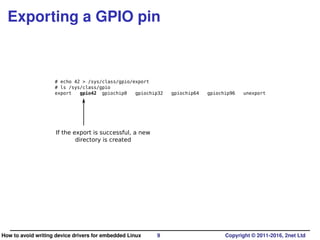
Exporting a GPIO pin
# echo 42 > /sys/class/gpio/export
# ls /sys/class/gpio
export gpio42 gpiochip0 gpiochip32 gpiochip64 gpiochip96 unexport
If the export is successful, a new
directory is created
How to avoid writing device drivers for embedded Linux 9 Copyright © 2011-2016, 2net Ltd
Inputs and outputs
# ls /sys/class/gpio/gpio42
active_low device direction edge power subsystem uevent value
Set to 1 to invert
input and ouput
Set direction by
writing "out" or
"in". Default "in"
The logic level of the
pin. Change the level
of outputs by writing
"0" or "1"
How to avoid writing device drivers for embedded Linux 10 Copyright © 2011-2016, 2net Ltd
Interrupts
• If the GPIO can generate interrupts, the file edge can
be used to control interrupt handling
• edge = ["none", "rising", "falling","both]
• For example, to make GPIO60 interrupt on falling
edge:
• echo falling > /sys/class/gpio/gpio60/edge
• To wait for an interrupt, use the poll(2) function
• Example on next slide
How to avoid writing device drivers for embedded Linux 11 Copyright © 2011-2016, 2net Ltd
GPIO interrupt code example
#include <stdio.h>
#include <unistd.h>
#include <sys/types.h>
#include <sys/stat.h>
#include <fcntl.h>
#include <poll.h>
int main (int argc, char *argv[])
{
int f;
struct pollfd poll_fds [1];
int ret;
char value[4];
f = open("/sys/class/gpio/gpio60/value", O_RDONLY);
poll_fds[0].fd = f;
poll_fds[0].events = POLLPRI | POLLERR;
while (1) {
if (poll(poll_fds, 1, -1) > 0) {
read(f, &value, sizeof(value));
printf("Interrupt! value=%cn", value[0]);
}
}
}
Code: https://github.com/csimmonds/userspace-io-ew2016
How to avoid writing device drivers for embedded Linux 12 Copyright © 2011-2016, 2net Ltd
PWM
# echo 6 > /sys/class/pwm/export
# ls /sys/class/pwm
export pwm6 pwmchip0 pwmchip2 pwmchip3 pwmchip5 pwmchip7 unexport
If the export is successful, a new
directory is created
# ls /sys/class/pwm/pwm6/
device duty_ns period_ns polarity power run subsystem uevent
period_ns
duty_ns
How to avoid writing device drivers for embedded Linux 13 Copyright © 2011-2016, 2net Ltd
I2C
• Device nodes, one per I2C bus controller:
# ls -l /dev/i2c*
crw-rw---T 1 root i2c 89, 0 Jan 1 2000 /dev/i2c-0
crw-rw---T 1 root i2c 89, 1 Jan 1 2000 /dev/i2c-1
• Some functions are implemented using ioctl(2), using
commands and structures defined in
usr/include/linux/i2c-dev.h
How to avoid writing device drivers for embedded Linux 14 Copyright © 2011-2016, 2net Ltd
i2c-utils
• Command-line tools for interacting with I2C devices
• i2cdetect - list I2C adapters and probe bus
• i2cget - read data from an I2C device
• i2cset - write data to an I2C device
How to avoid writing device drivers for embedded Linux 15 Copyright © 2011-2016, 2net Ltd
i2cdetect
• i2cdetect - list i2c adapters and probe bus
• Example: detect devices on bus 1 (/dev/i2c-1)
# i2cdetect -y -r 1
0 1 2 3 4 5 6 7 8 9 a b c d e f
00: -- -- -- -- -- -- -- -- -- -- -- -- --
10: -- -- -- -- -- -- -- -- -- -- -- -- -- -- -- --
20: -- -- -- -- -- -- -- -- -- -- -- -- -- -- -- --
30: -- -- -- -- -- -- -- -- -- 39 -- -- -- -- -- --
40: -- -- -- -- -- -- -- -- -- -- -- -- -- -- -- --
50: -- -- -- -- UU UU UU UU -- -- -- -- -- -- -- --
60: -- -- -- -- -- -- -- -- -- -- -- -- -- -- -- --
70: -- -- -- -- -- -- -- --
UU = device already handled by kernel driver
0x39 = device discovered at address 0x39
How to avoid writing device drivers for embedded Linux 16 Copyright © 2011-2016, 2net Ltd
i2cget/i2cset
• i2cget <bus> <chip> <register>: read data from an I2C
device
• Example: read register 0x8a from device at 0x39
# i2cget -y 1 0x39 0x8a
0x50
• i2cset <bus> <chip> <register>: writedata to an I2C
device
• Example: Write 0x03 to register 0x80:
# i2cset -y 1 0x39 0x80 3
How to avoid writing device drivers for embedded Linux 17 Copyright © 2011-2016, 2net Ltd
I2C code example
#include <stdio.h>
#include <unistd.h>
#include <sys/types.h>
#include <sys/stat.h>
#include <fcntl.h>
#include <sys/ioctl.h>
#include <linux/i2c-dev.h>
int main(int argc, char **argv)
int f;
char buf[4];
f = open("/dev/i2c-1", O_RDWR);
ioctl(f, I2C_SLAVE, 0x39) < 0) {
buf[0] = 0x8a; /* Chip ID register */
write(f, buf, 1);
read(f, buf, 1);
printf("ID 0x%xn", buf [0]);
}
Code: https://github.com/csimmonds/userspace-io-ew2016
How to avoid writing device drivers for embedded Linux 18 Copyright © 2011-2016, 2net Ltd
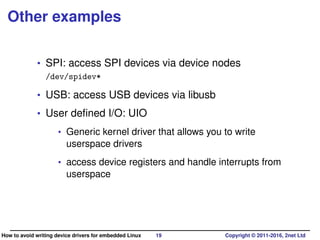
Other examples
• SPI: access SPI devices via device nodes
/dev/spidev*
• USB: access USB devices via libusb
• User defined I/O: UIO
• Generic kernel driver that allows you to write
userspace drivers
• access device registers and handle interrupts from
userspace
How to avoid writing device drivers for embedded Linux 19 Copyright © 2011-2016, 2net Ltd
Delving deeper
• This is an excerpt from my Fast track to embedded
Linux class
• If you would like to discover more about the power of
embedded Linux, visit
http://www.2net.co.uk/training.html and enquire
about training classes for your company
• 2net training is available world-wide
• Also, my book, Mastering Embedded Linux
Programming, covers the topics discused here in
much greater detail
How to avoid writing device drivers for embedded Linux 20 Copyright © 2011-2016, 2net Ltd

Userspace drivers-2016

  • 1.
    How to avoidwriting device drivers for embedded Linux Embedded World 2016 How to avoid writing device drivers for embedded Linux 1 Copyright © 2011-2016, 2net Ltd
  • 2.
    License These slides areavailable under a Creative Commons Attribution-ShareAlike 3.0 license. You can read the full text of the license here http://creativecommons.org/licenses/by-sa/3.0/legalcode You are free to • copy, distribute, display, and perform the work • make derivative works • make commercial use of the work Under the following conditions • Attribution: you must give the original author credit • Share Alike: if you alter, transform, or build upon this work, you may distribute the resulting work only under a license identical to this one (i.e. include this page exactly as it is) • For any reuse or distribution, you must make clear to others the license terms of this work How to avoid writing device drivers for embedded Linux 2 Copyright © 2011-2016, 2net Ltd
  • 3.
    About Chris Simmonds •Consultant and trainer • Author of Mastering Embedded Linux Programming • Working with embedded Linux since 1999 • Android since 2009 • Speaker at many conferences and workshops "Looking after the Inner Penguin" blog at http://2net.co.uk/ https://uk.linkedin.com/in/chrisdsimmonds/ https://google.com/+chrissimmonds How to avoid writing device drivers for embedded Linux 3 Copyright © 2011-2016, 2net Ltd
  • 4.
    Conventional device drivermodel User space System call handler Generic services Device drivers Hardware Application C library interrupts Linux kernel How to avoid writing device drivers for embedded Linux 4 Copyright © 2011-2016, 2net Ltd
  • 5.
    How applications calldevice drivers • In Linux, everything is a file 1 • Applications interact with drivers via POSIX functions open(2), read(2), write(2), ioctl(2), etc • There are two types of interface • 1. Device nodes in /dev • The serial driver, ttyS is an example • Device nodes are named /dev/ttyS0, /dev/ttyS1 ... • 2. Driver attributes, exported via sysfs • For example /sys/class/gpio 1Except network interfaces, which are sockets How to avoid writing device drivers for embedded Linux 5 Copyright © 2011-2016, 2net Ltd
  • 6.
    Userspace drivers • Writingkernel device drivers can be difficult • Luckily, there are generic drivers that that allow you to write most of the code in userspace • We will look at three • GPIO • PWM • I2C • Note: applications will need read/write permissions for the files. Consequently, they usually have to run as user root How to avoid writing device drivers for embedded Linux 6 Copyright © 2011-2016, 2net Ltd
  • 7.
    /sys/class/gpio # ls /sys/class/gpio/ exportgpiochip0 gpiochip32 gpiochip64 gpiochip96 unexport This device has 4 gpio chips each with 32 pins Write to this file to export a GPIO pin to user space Write to this file to unexport a GPIO pin to user space How to avoid writing device drivers for embedded Linux 7 Copyright © 2011-2016, 2net Ltd
  • 8.
    gpiochip # /sys/class/gpio/gpiochip0 base devicelabel ngpio power subsystem uevent The number of GPIO pins (32) A lable to identify the chip (gpiochip0) The starting GPIO number (0) How to avoid writing device drivers for embedded Linux 8 Copyright © 2011-2016, 2net Ltd
  • 9.
    Exporting a GPIOpin # echo 42 > /sys/class/gpio/export # ls /sys/class/gpio export gpio42 gpiochip0 gpiochip32 gpiochip64 gpiochip96 unexport If the export is successful, a new directory is created How to avoid writing device drivers for embedded Linux 9 Copyright © 2011-2016, 2net Ltd
  • 10.
    Inputs and outputs #ls /sys/class/gpio/gpio42 active_low device direction edge power subsystem uevent value Set to 1 to invert input and ouput Set direction by writing "out" or "in". Default "in" The logic level of the pin. Change the level of outputs by writing "0" or "1" How to avoid writing device drivers for embedded Linux 10 Copyright © 2011-2016, 2net Ltd
  • 11.
    Interrupts • If theGPIO can generate interrupts, the file edge can be used to control interrupt handling • edge = ["none", "rising", "falling","both] • For example, to make GPIO60 interrupt on falling edge: • echo falling > /sys/class/gpio/gpio60/edge • To wait for an interrupt, use the poll(2) function • Example on next slide How to avoid writing device drivers for embedded Linux 11 Copyright © 2011-2016, 2net Ltd
  • 12.
    GPIO interrupt codeexample #include <stdio.h> #include <unistd.h> #include <sys/types.h> #include <sys/stat.h> #include <fcntl.h> #include <poll.h> int main (int argc, char *argv[]) { int f; struct pollfd poll_fds [1]; int ret; char value[4]; f = open("/sys/class/gpio/gpio60/value", O_RDONLY); poll_fds[0].fd = f; poll_fds[0].events = POLLPRI | POLLERR; while (1) { if (poll(poll_fds, 1, -1) > 0) { read(f, &value, sizeof(value)); printf("Interrupt! value=%cn", value[0]); } } } Code: https://github.com/csimmonds/userspace-io-ew2016 How to avoid writing device drivers for embedded Linux 12 Copyright © 2011-2016, 2net Ltd
  • 13.
    PWM # echo 6> /sys/class/pwm/export # ls /sys/class/pwm export pwm6 pwmchip0 pwmchip2 pwmchip3 pwmchip5 pwmchip7 unexport If the export is successful, a new directory is created # ls /sys/class/pwm/pwm6/ device duty_ns period_ns polarity power run subsystem uevent period_ns duty_ns How to avoid writing device drivers for embedded Linux 13 Copyright © 2011-2016, 2net Ltd
  • 14.
    I2C • Device nodes,one per I2C bus controller: # ls -l /dev/i2c* crw-rw---T 1 root i2c 89, 0 Jan 1 2000 /dev/i2c-0 crw-rw---T 1 root i2c 89, 1 Jan 1 2000 /dev/i2c-1 • Some functions are implemented using ioctl(2), using commands and structures defined in usr/include/linux/i2c-dev.h How to avoid writing device drivers for embedded Linux 14 Copyright © 2011-2016, 2net Ltd
  • 15.
    i2c-utils • Command-line toolsfor interacting with I2C devices • i2cdetect - list I2C adapters and probe bus • i2cget - read data from an I2C device • i2cset - write data to an I2C device How to avoid writing device drivers for embedded Linux 15 Copyright © 2011-2016, 2net Ltd
  • 16.
    i2cdetect • i2cdetect -list i2c adapters and probe bus • Example: detect devices on bus 1 (/dev/i2c-1) # i2cdetect -y -r 1 0 1 2 3 4 5 6 7 8 9 a b c d e f 00: -- -- -- -- -- -- -- -- -- -- -- -- -- 10: -- -- -- -- -- -- -- -- -- -- -- -- -- -- -- -- 20: -- -- -- -- -- -- -- -- -- -- -- -- -- -- -- -- 30: -- -- -- -- -- -- -- -- -- 39 -- -- -- -- -- -- 40: -- -- -- -- -- -- -- -- -- -- -- -- -- -- -- -- 50: -- -- -- -- UU UU UU UU -- -- -- -- -- -- -- -- 60: -- -- -- -- -- -- -- -- -- -- -- -- -- -- -- -- 70: -- -- -- -- -- -- -- -- UU = device already handled by kernel driver 0x39 = device discovered at address 0x39 How to avoid writing device drivers for embedded Linux 16 Copyright © 2011-2016, 2net Ltd
  • 17.
    i2cget/i2cset • i2cget <bus><chip> <register>: read data from an I2C device • Example: read register 0x8a from device at 0x39 # i2cget -y 1 0x39 0x8a 0x50 • i2cset <bus> <chip> <register>: writedata to an I2C device • Example: Write 0x03 to register 0x80: # i2cset -y 1 0x39 0x80 3 How to avoid writing device drivers for embedded Linux 17 Copyright © 2011-2016, 2net Ltd
  • 18.
    I2C code example #include<stdio.h> #include <unistd.h> #include <sys/types.h> #include <sys/stat.h> #include <fcntl.h> #include <sys/ioctl.h> #include <linux/i2c-dev.h> int main(int argc, char **argv) int f; char buf[4]; f = open("/dev/i2c-1", O_RDWR); ioctl(f, I2C_SLAVE, 0x39) < 0) { buf[0] = 0x8a; /* Chip ID register */ write(f, buf, 1); read(f, buf, 1); printf("ID 0x%xn", buf [0]); } Code: https://github.com/csimmonds/userspace-io-ew2016 How to avoid writing device drivers for embedded Linux 18 Copyright © 2011-2016, 2net Ltd
  • 19.
    Other examples • SPI:access SPI devices via device nodes /dev/spidev* • USB: access USB devices via libusb • User defined I/O: UIO • Generic kernel driver that allows you to write userspace drivers • access device registers and handle interrupts from userspace How to avoid writing device drivers for embedded Linux 19 Copyright © 2011-2016, 2net Ltd
  • 20.
    Delving deeper • Thisis an excerpt from my Fast track to embedded Linux class • If you would like to discover more about the power of embedded Linux, visit http://www.2net.co.uk/training.html and enquire about training classes for your company • 2net training is available world-wide • Also, my book, Mastering Embedded Linux Programming, covers the topics discused here in much greater detail How to avoid writing device drivers for embedded Linux 20 Copyright © 2011-2016, 2net Ltd