Software update for IoT
the current state of play
Chris Simmonds
Embedded World 2017
Software update for IoT 1 Copyright © 2011-2017, 2net Ltd
License
These slides are available under a Creative Commons Attribution-ShareAlike 3.0 license. You can read the full
text of the license here
http://creativecommons.org/licenses/by-sa/3.0/legalcode
You are free to
• copy, distribute, display, and perform the work
• make derivative works
• make commercial use of the work
Under the following conditions
• Attribution: you must give the original author credit
• Share Alike: if you alter, transform, or build upon this work, you may distribute the resulting work only
under a license identical to this one (i.e. include this page exactly as it is)
• For any reuse or distribution, you must make clear to others the license terms of this work
Software update for IoT 2 Copyright © 2011-2017, 2net Ltd
About Chris Simmonds
• Consultant and trainer
• Author of Mastering Embedded Linux Programming
• Working with embedded Linux since 1999
• Android since 2009
• Speaker at many conferences and workshops
"Looking after the Inner Penguin" blog at http://2net.co.uk/
https://uk.linkedin.com/in/chrisdsimmonds/
https://google.com/+chrissimmonds
Software update for IoT 3 Copyright © 2011-2017, 2net Ltd
Overview
• Software update 101
• Software update for embedded Linux
• Over The Air (OTA) update
• Stateless rootfs
Software update for IoT 4 Copyright © 2011-2017, 2net Ltd
What could possibly go wrong?
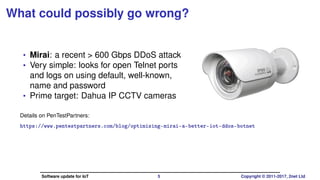
• Mirai: a recent > 600 Gbps DDoS attack
• Very simple: looks for open Telnet ports
and logs on using default, well-known,
name and password
• Prime target: Dahua IP CCTV cameras
Details on PenTestPartners:
https://www.pentestpartners.com/blog/optimising-mirai-a-better-iot-ddos-botnet
Software update for IoT 5 Copyright © 2011-2017, 2net Ltd
Requirements for SW update
• Secure: must not become an attack vector to hijack the device
• Robust: must not render the device unusable
• Atomic: an update must be installed completely or not at all
• Fail-safe: should fall-back to last known working system if there are
errors
Software update for IoT 6 Copyright © 2011-2017, 2net Ltd
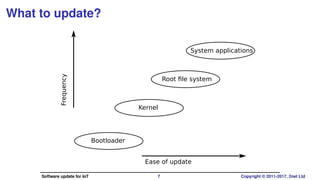
What to update?
Frequency
Ease of update
Bootloader
Kernel
Root file system
System applications
Software update for IoT 7 Copyright © 2011-2017, 2net Ltd
Update granularity
• File:
• not an option: hard to achieve atomicity over a group of file updates
• Package (e.g. RPM, deb):
• apt-get update works fine for servers but not for devices
• Entire filesystem image:
• the most common option: fairy easy to implement and verify
• Atomic differential update
• Uses clever tricks to perform atomic update of groups of files
• Container
• neat idea, so long as you have containerised applications
Software update for IoT 8 Copyright © 2011-2017, 2net Ltd
Device update != server update
• Server
• Secure environment, no power outage, no network outage
• If update fails, human intervention is possible
• Device:
• Intermittent power and network mean update quite likely to be
interrupted
• Failed update may be difficult (and expensive) to resolve
Incremental package updates via RPM/deb are not atomic
Software update for IoT 9 Copyright © 2011-2017, 2net Ltd
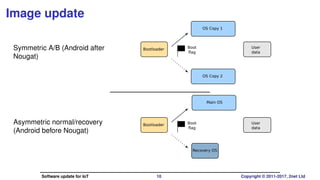
Image update
Symmetric A/B (Android after
Nougat)
Bootloader User
data
Boot
flag
OS Copy 1
OS Copy 2
Asymmetric normal/recovery
(Android before Nougat)
Bootloader
Main OS
Recovery OS
User
data
Boot
flag
Software update for IoT 10 Copyright © 2011-2017, 2net Ltd
Examples of image updaters 1/2
• swupdate: http://sbabic.github.io/swupdate/index.html
• Symmetric and asymmetric image update client
• License: GPLv2
• Mender: https://mender.io
• Symmetric image update client
• Integrates with open source OTA update server
• License: Apache 2
Software update for IoT 11 Copyright © 2011-2017, 2net Ltd
Examples of image updaters 2/2
• RAUC (Robust Auto-Update Controller):
https://rauc.readthedocs.org/
• Symmetric and asymmetric image update client
• License: LGPLv2.1
• Android Things:
https://developer.android.com/things/hardware/index.html
• Symmetric and asymmetric image update client
• Android Things is cut-down Android for IoT
• License: Apache 2
Software update for IoT 12 Copyright © 2011-2017, 2net Ltd
Atomic differential update (OSTree)
• OSTree stores data in a "git-like" object repository
• Actual filesystem created from hard links to objects in the repository
• Checkout is atomic
• Pluses
• Updates are incremental: uses less disk space than A/B image update
• Reduced transfer time: update contains only changed files
• Minuses
• Physically there is only one filesystem: cannot recover from filesystem
corruption
Software update for IoT 13 Copyright © 2011-2017, 2net Ltd
Projects using OSTree
• Automotive Grade Linux (agl)
• Yocto Project meta-updater layer
Software update for IoT 14 Copyright © 2011-2017, 2net Ltd
Atomic differential update (swupd)
• Similar to OSTree
• swupd processes updates in bundles
• Bundle contains file updates
• Updates to bundles are applied atomically
Software update for IoT 15 Copyright © 2011-2017, 2net Ltd
Projects using swupd
• Clear Linux
• Ostro OS
• Yocto Project meta-swupd layer
Software update for IoT 16 Copyright © 2011-2017, 2net Ltd
Containerised updaters
• Consists of
• Immutable base OS
• Applications in containers
• Update client running in base OS is able to update the applications
atomically
• But, note that:
• Updates applications only
• Need another mechanism to update kernel and rootfs (e.g image A/B)
Software update for IoT 17 Copyright © 2011-2017, 2net Ltd
Examples of containerised updaters
• resin.io: https://resin.io
• Applications distributed in Docker containers
• Managed on device by Resin Container Engine
• Integrates with OTA update server (not open source)
• Licenses: Client: Apache2; Server: proprietary
• Snappy: https://snapcraft.io
• Containers are called snaps
• A snap contains a squashfs file system, mounted on /snap/[app]
• License: GPLv3
Software update for IoT 18 Copyright © 2011-2017, 2net Ltd
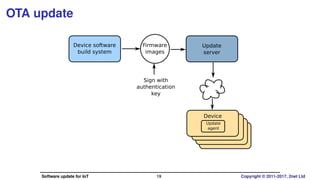
OTA update
Device software
build system
Firmware
images
Sign with
authentication
key
Update
server
Device
Update
agent
Software update for IoT 19 Copyright © 2011-2017, 2net Ltd
Complexities of OTA update
• Authentication (is this update legit?)
• Security (am I receiving what you are sending?)
• Roll-back (if update fails to boot, switch to previous version)
• Scale (roll out to large populations)
• Monitoring (keeping track of status of the population of devices)
Software update for IoT 20 Copyright © 2011-2017, 2net Ltd
Roll-back
• Boot limit count
• Feature of bootloader (e.g U-Boot)
• Increment count in bootloader
• Reset after successful boot
• If reboot with count > 0, bootloader knows boot failed and loads alternate
rootfs
• Hardware watchdog
• If hang in early boot, watchdog times out and resets CPU
• Bootloader checks reset reason
• If watchdog, loads alternate rootfs
Software update for IoT 21 Copyright © 2011-2017, 2net Ltd
Stateless filesystems
• Most of the updaters mentioned require a stateless rootfs
• You need to store run-time changes to files outside filesystems being
updated
• Methods:
• symlink or bind mount files to writeable storage
• modify existing code to keep state separate
• write new code to be stateless
• See https://www.slideshare.net/chrissimmonds/
readonly-rootfs-theory-and-practice
Software update for IoT 22 Copyright © 2011-2017, 2net Ltd
Conclusion
• Image update is well-understood and road tested
• swupdate, RAUC, Mender, Android Things
• Atomic update promises finer granularity and smaller updates
• OSTree, swupd
• Containerised update is trendy, but only solves part of the problem
• resin.io, snappy
• Some projects integrate with OTA update servers
• Mender, resin.io, (swupdate, RAUC via Hawkbit
https://eclipse.org/hawkbit)
• Update is more robust with a stateless rootfs, but this is still a new
concept to many developers
Software update for IoT 23 Copyright © 2011-2017, 2net Ltd
• Questions?
Slides on Slide Share
https://www.slideshare.net/chrissimmonds/
software-update-for-iot-embedded-world-2017
This and other topics associated with building robust embedded systems
are covered in my training courses
http://www.2net.co.uk/training.html
Software update for IoT 24 Copyright © 2011-2017, 2net Ltd

Software update for IoT Embedded World 2017

  • 1.
    Software update forIoT the current state of play Chris Simmonds Embedded World 2017 Software update for IoT 1 Copyright © 2011-2017, 2net Ltd
  • 2.
    License These slides areavailable under a Creative Commons Attribution-ShareAlike 3.0 license. You can read the full text of the license here http://creativecommons.org/licenses/by-sa/3.0/legalcode You are free to • copy, distribute, display, and perform the work • make derivative works • make commercial use of the work Under the following conditions • Attribution: you must give the original author credit • Share Alike: if you alter, transform, or build upon this work, you may distribute the resulting work only under a license identical to this one (i.e. include this page exactly as it is) • For any reuse or distribution, you must make clear to others the license terms of this work Software update for IoT 2 Copyright © 2011-2017, 2net Ltd
  • 3.
    About Chris Simmonds •Consultant and trainer • Author of Mastering Embedded Linux Programming • Working with embedded Linux since 1999 • Android since 2009 • Speaker at many conferences and workshops "Looking after the Inner Penguin" blog at http://2net.co.uk/ https://uk.linkedin.com/in/chrisdsimmonds/ https://google.com/+chrissimmonds Software update for IoT 3 Copyright © 2011-2017, 2net Ltd
  • 4.
    Overview • Software update101 • Software update for embedded Linux • Over The Air (OTA) update • Stateless rootfs Software update for IoT 4 Copyright © 2011-2017, 2net Ltd
  • 5.
    What could possiblygo wrong? • Mirai: a recent > 600 Gbps DDoS attack • Very simple: looks for open Telnet ports and logs on using default, well-known, name and password • Prime target: Dahua IP CCTV cameras Details on PenTestPartners: https://www.pentestpartners.com/blog/optimising-mirai-a-better-iot-ddos-botnet Software update for IoT 5 Copyright © 2011-2017, 2net Ltd
  • 6.
    Requirements for SWupdate • Secure: must not become an attack vector to hijack the device • Robust: must not render the device unusable • Atomic: an update must be installed completely or not at all • Fail-safe: should fall-back to last known working system if there are errors Software update for IoT 6 Copyright © 2011-2017, 2net Ltd
  • 7.
    What to update? Frequency Easeof update Bootloader Kernel Root file system System applications Software update for IoT 7 Copyright © 2011-2017, 2net Ltd
  • 8.
    Update granularity • File: •not an option: hard to achieve atomicity over a group of file updates • Package (e.g. RPM, deb): • apt-get update works fine for servers but not for devices • Entire filesystem image: • the most common option: fairy easy to implement and verify • Atomic differential update • Uses clever tricks to perform atomic update of groups of files • Container • neat idea, so long as you have containerised applications Software update for IoT 8 Copyright © 2011-2017, 2net Ltd
  • 9.
    Device update !=server update • Server • Secure environment, no power outage, no network outage • If update fails, human intervention is possible • Device: • Intermittent power and network mean update quite likely to be interrupted • Failed update may be difficult (and expensive) to resolve Incremental package updates via RPM/deb are not atomic Software update for IoT 9 Copyright © 2011-2017, 2net Ltd
  • 10.
    Image update Symmetric A/B(Android after Nougat) Bootloader User data Boot flag OS Copy 1 OS Copy 2 Asymmetric normal/recovery (Android before Nougat) Bootloader Main OS Recovery OS User data Boot flag Software update for IoT 10 Copyright © 2011-2017, 2net Ltd
  • 11.
    Examples of imageupdaters 1/2 • swupdate: http://sbabic.github.io/swupdate/index.html • Symmetric and asymmetric image update client • License: GPLv2 • Mender: https://mender.io • Symmetric image update client • Integrates with open source OTA update server • License: Apache 2 Software update for IoT 11 Copyright © 2011-2017, 2net Ltd
  • 12.
    Examples of imageupdaters 2/2 • RAUC (Robust Auto-Update Controller): https://rauc.readthedocs.org/ • Symmetric and asymmetric image update client • License: LGPLv2.1 • Android Things: https://developer.android.com/things/hardware/index.html • Symmetric and asymmetric image update client • Android Things is cut-down Android for IoT • License: Apache 2 Software update for IoT 12 Copyright © 2011-2017, 2net Ltd
  • 13.
    Atomic differential update(OSTree) • OSTree stores data in a "git-like" object repository • Actual filesystem created from hard links to objects in the repository • Checkout is atomic • Pluses • Updates are incremental: uses less disk space than A/B image update • Reduced transfer time: update contains only changed files • Minuses • Physically there is only one filesystem: cannot recover from filesystem corruption Software update for IoT 13 Copyright © 2011-2017, 2net Ltd
  • 14.
    Projects using OSTree •Automotive Grade Linux (agl) • Yocto Project meta-updater layer Software update for IoT 14 Copyright © 2011-2017, 2net Ltd
  • 15.
    Atomic differential update(swupd) • Similar to OSTree • swupd processes updates in bundles • Bundle contains file updates • Updates to bundles are applied atomically Software update for IoT 15 Copyright © 2011-2017, 2net Ltd
  • 16.
    Projects using swupd •Clear Linux • Ostro OS • Yocto Project meta-swupd layer Software update for IoT 16 Copyright © 2011-2017, 2net Ltd
  • 17.
    Containerised updaters • Consistsof • Immutable base OS • Applications in containers • Update client running in base OS is able to update the applications atomically • But, note that: • Updates applications only • Need another mechanism to update kernel and rootfs (e.g image A/B) Software update for IoT 17 Copyright © 2011-2017, 2net Ltd
  • 18.
    Examples of containerisedupdaters • resin.io: https://resin.io • Applications distributed in Docker containers • Managed on device by Resin Container Engine • Integrates with OTA update server (not open source) • Licenses: Client: Apache2; Server: proprietary • Snappy: https://snapcraft.io • Containers are called snaps • A snap contains a squashfs file system, mounted on /snap/[app] • License: GPLv3 Software update for IoT 18 Copyright © 2011-2017, 2net Ltd
  • 19.
    OTA update Device software buildsystem Firmware images Sign with authentication key Update server Device Update agent Software update for IoT 19 Copyright © 2011-2017, 2net Ltd
  • 20.
    Complexities of OTAupdate • Authentication (is this update legit?) • Security (am I receiving what you are sending?) • Roll-back (if update fails to boot, switch to previous version) • Scale (roll out to large populations) • Monitoring (keeping track of status of the population of devices) Software update for IoT 20 Copyright © 2011-2017, 2net Ltd
  • 21.
    Roll-back • Boot limitcount • Feature of bootloader (e.g U-Boot) • Increment count in bootloader • Reset after successful boot • If reboot with count > 0, bootloader knows boot failed and loads alternate rootfs • Hardware watchdog • If hang in early boot, watchdog times out and resets CPU • Bootloader checks reset reason • If watchdog, loads alternate rootfs Software update for IoT 21 Copyright © 2011-2017, 2net Ltd
  • 22.
    Stateless filesystems • Mostof the updaters mentioned require a stateless rootfs • You need to store run-time changes to files outside filesystems being updated • Methods: • symlink or bind mount files to writeable storage • modify existing code to keep state separate • write new code to be stateless • See https://www.slideshare.net/chrissimmonds/ readonly-rootfs-theory-and-practice Software update for IoT 22 Copyright © 2011-2017, 2net Ltd
  • 23.
    Conclusion • Image updateis well-understood and road tested • swupdate, RAUC, Mender, Android Things • Atomic update promises finer granularity and smaller updates • OSTree, swupd • Containerised update is trendy, but only solves part of the problem • resin.io, snappy • Some projects integrate with OTA update servers • Mender, resin.io, (swupdate, RAUC via Hawkbit https://eclipse.org/hawkbit) • Update is more robust with a stateless rootfs, but this is still a new concept to many developers Software update for IoT 23 Copyright © 2011-2017, 2net Ltd
  • 24.
    • Questions? Slides onSlide Share https://www.slideshare.net/chrissimmonds/ software-update-for-iot-embedded-world-2017 This and other topics associated with building robust embedded systems are covered in my training courses http://www.2net.co.uk/training.html Software update for IoT 24 Copyright © 2011-2017, 2net Ltd