Pietro Lorefice | Develer S.r.l. | pietro@develer.comMichele Dionisio | Powersoft SPA | michele.dionisio@powersoft.com
Developing and testing a device driver
without the device
1
git clone --recurse-submodules git@github.com:mdionisio/linuxlab2018.git
Pietro Lorefice | Develer S.r.l. | pietro@develer.comMichele Dionisio | Powersoft SPA | michele.dionisio@powersoft.com
BEFORE WE START
2
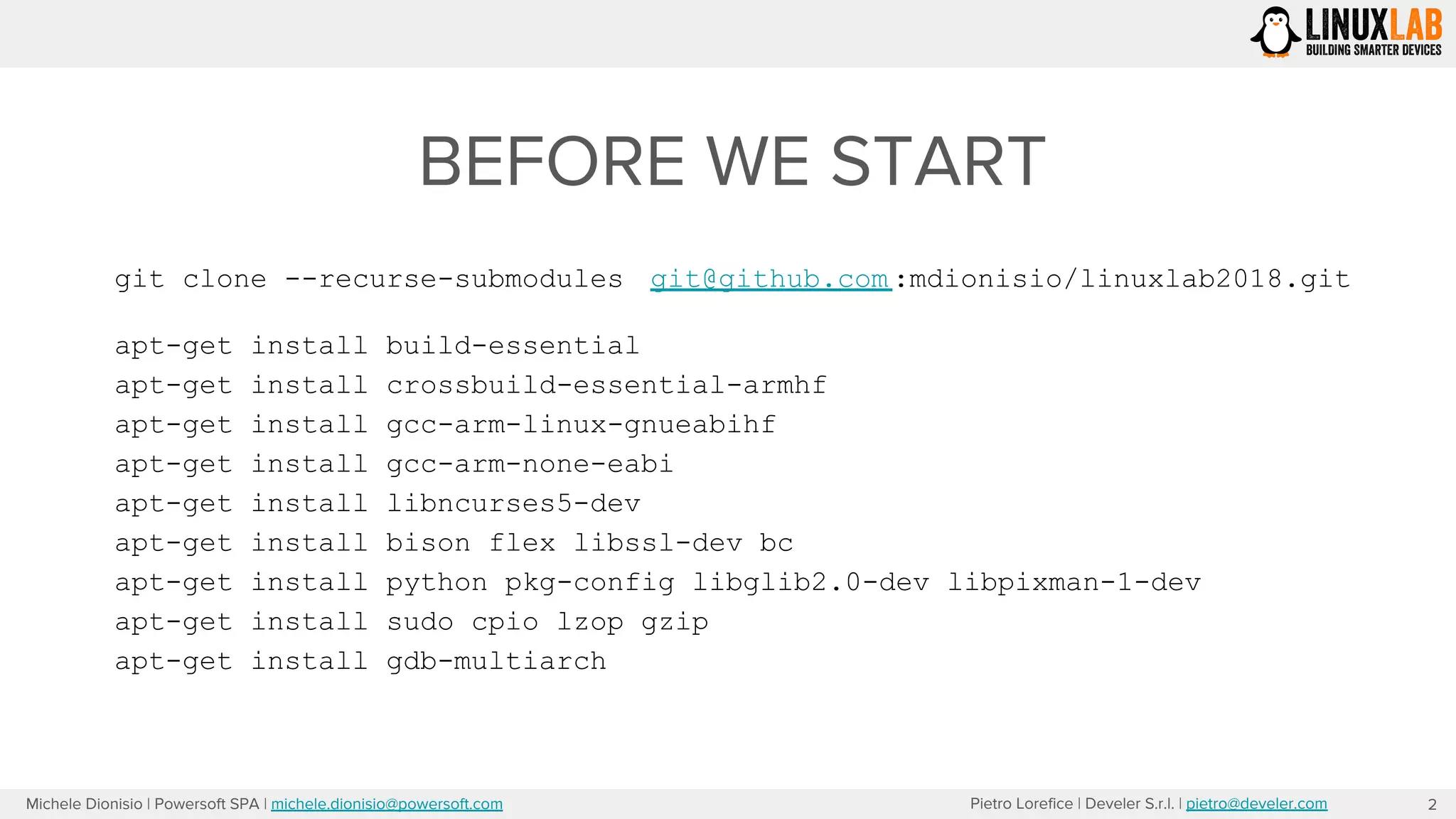
git clone --recurse-submodules git@github.com :mdionisio/linuxlab2018.git
apt-get install build-essential
apt-get install crossbuild-essential-armhf
apt-get install gcc-arm-linux-gnueabihf
apt-get install gcc-arm-none-eabi
apt-get install libncurses5-dev
apt-get install bison flex libssl-dev bc
apt-get install python pkg-config libglib2.0-dev libpixman-1-dev
apt-get install sudo cpio lzop gzip
apt-get install gdb-multiarch
Pietro Lorefice | Develer S.r.l. | pietro@develer.comMichele Dionisio | Powersoft SPA | michele.dionisio@powersoft.com
Who we are
3
Pietro Lorefice | Develer S.r.l. | pietro@develer.comMichele Dionisio | Powersoft SPA | michele.dionisio@powersoft.com
What we will see
4
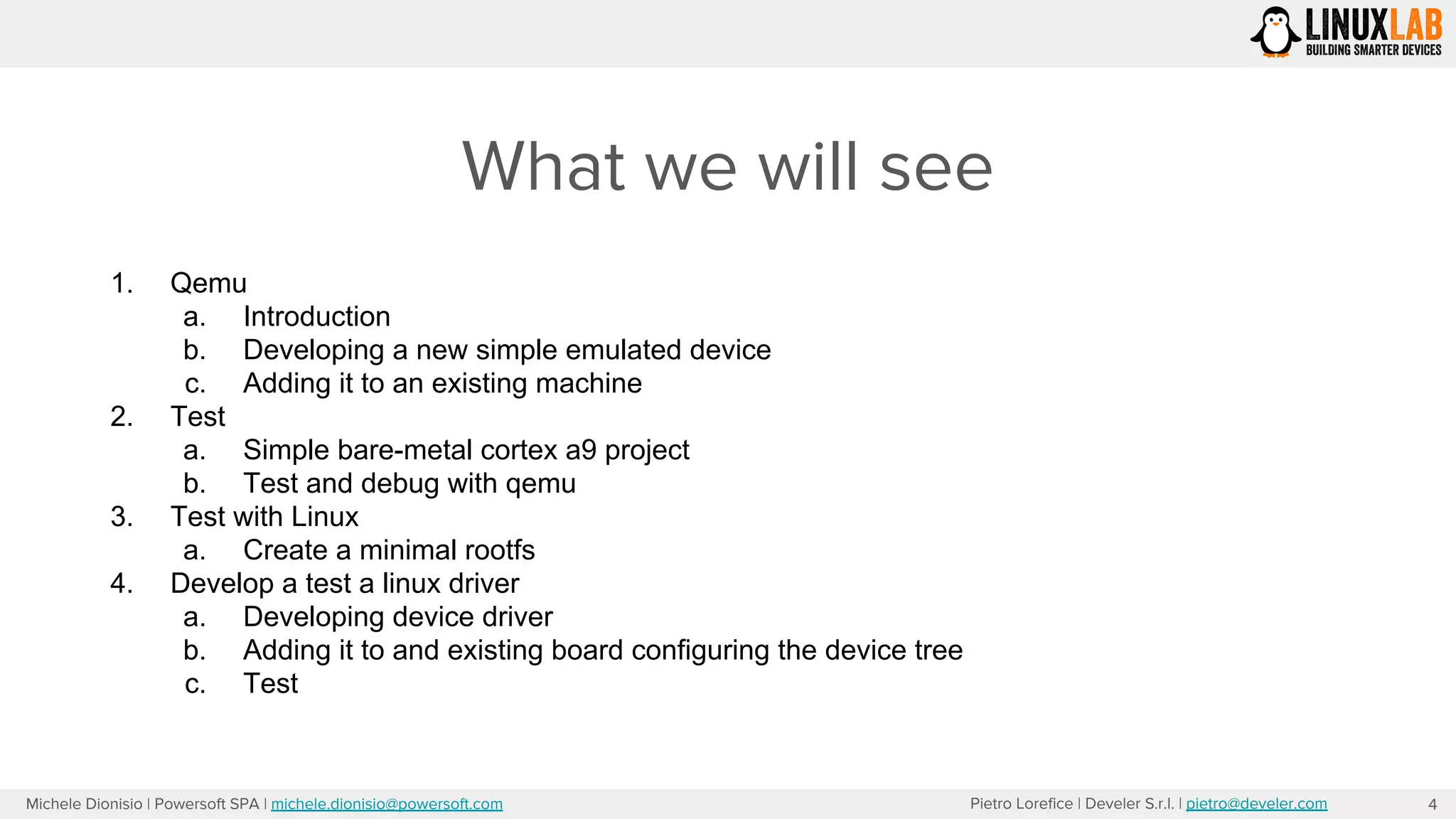
1. Qemu
a. Introduction
b. Developing a new simple emulated device
c. Adding it to an existing machine
2. Test
a. Simple bare-metal cortex a9 project
b. Test and debug with qemu
3. Test with Linux
a. Create a minimal rootfs
4. Develop a test a linux driver
a. Developing device driver
b. Adding it to and existing board configuring the device tree
c. Test
Pietro Lorefice | Develer S.r.l. | pietro@develer.comMichele Dionisio | Powersoft SPA | michele.dionisio@powersoft.com 5
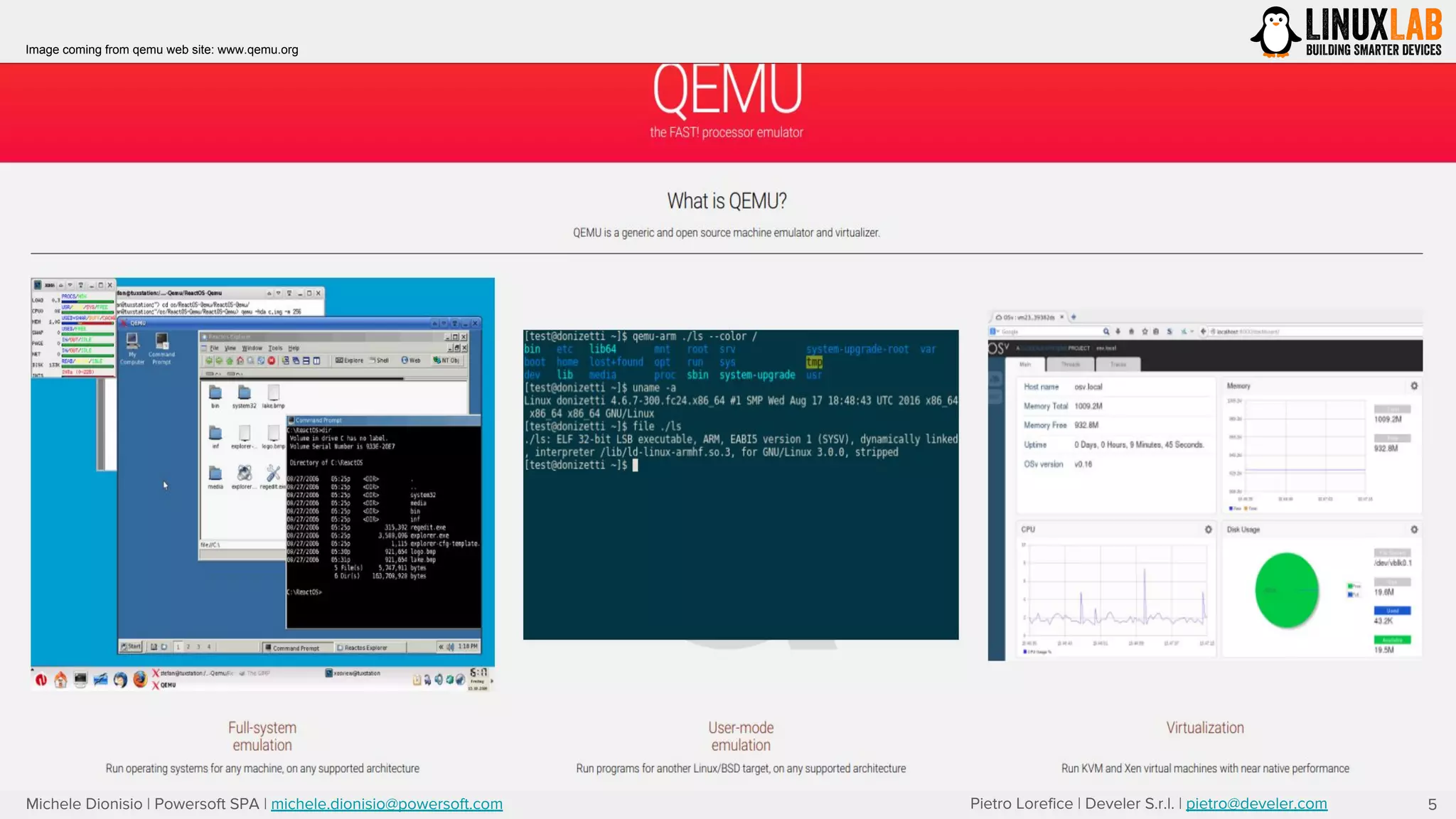
Image coming from qemu web site: www.qemu.org
Pietro Lorefice | Develer S.r.l. | pietro@develer.comMichele Dionisio | Powersoft SPA | michele.dionisio@powersoft.com
Device Specification
6
1. One memory mapped RW registry. You can read on it the last value write plus 1.
2. If you write 1 and interrupt is raised and writing 0 the interrupt is acknowledged
Device is installed in a custom board
coming from Sambrelite board
This board is based on i.mx6 that is a ARM Cortex A9 MP processor so we will use a
gcc for that platform for developing and testing
Pietro Lorefice | Develer S.r.l. | pietro@develer.comMichele Dionisio | Powersoft SPA | michele.dionisio@powersoft.com
And now …. A brief introduction to QOM.
And jump to the C code
7
Pietro Lorefice | Develer S.r.l. | pietro@develer.comMichele Dionisio | Powersoft SPA | michele.dionisio@powersoft.com
We have the device emulated and we
can start to add it to a machine emulated.
So go back to the QEMU source code
8
Pietro Lorefice | Develer S.r.l. | pietro@develer.comMichele Dionisio | Powersoft SPA | michele.dionisio@powersoft.com
A bare metal CORTEX-A9
startup.S
9
Pietro Lorefice | Develer S.r.l. | pietro@develer.comMichele Dionisio | Powersoft SPA | michele.dionisio@powersoft.com
And now LINUX
10
To develop and test a linux device driver we need a working Linux system.
So before start to develop we have to create a minimal Linux system.
1. Build linux kernel
2. Build busybox
3. Build a minimal rootfs that can be mounted in ram. INITRAMFS
The result is not a full linux distribution but is something perfect for develop and test.
Pietro Lorefice | Develer S.r.l. | pietro@develer.comMichele Dionisio | Powersoft SPA | michele.dionisio@powersoft.com
Test the created Linux system
11
Pietro Lorefice | Develer S.r.l. | pietro@develer.comMichele Dionisio | Powersoft SPA | michele.dionisio@powersoft.com 12
Questions ?
Image coming from film Io Robot
Pietro Lorefice | Develer S.r.l. | pietro@develer.comMichele Dionisio | Powersoft SPA | michele.dionisio@powersoft.com
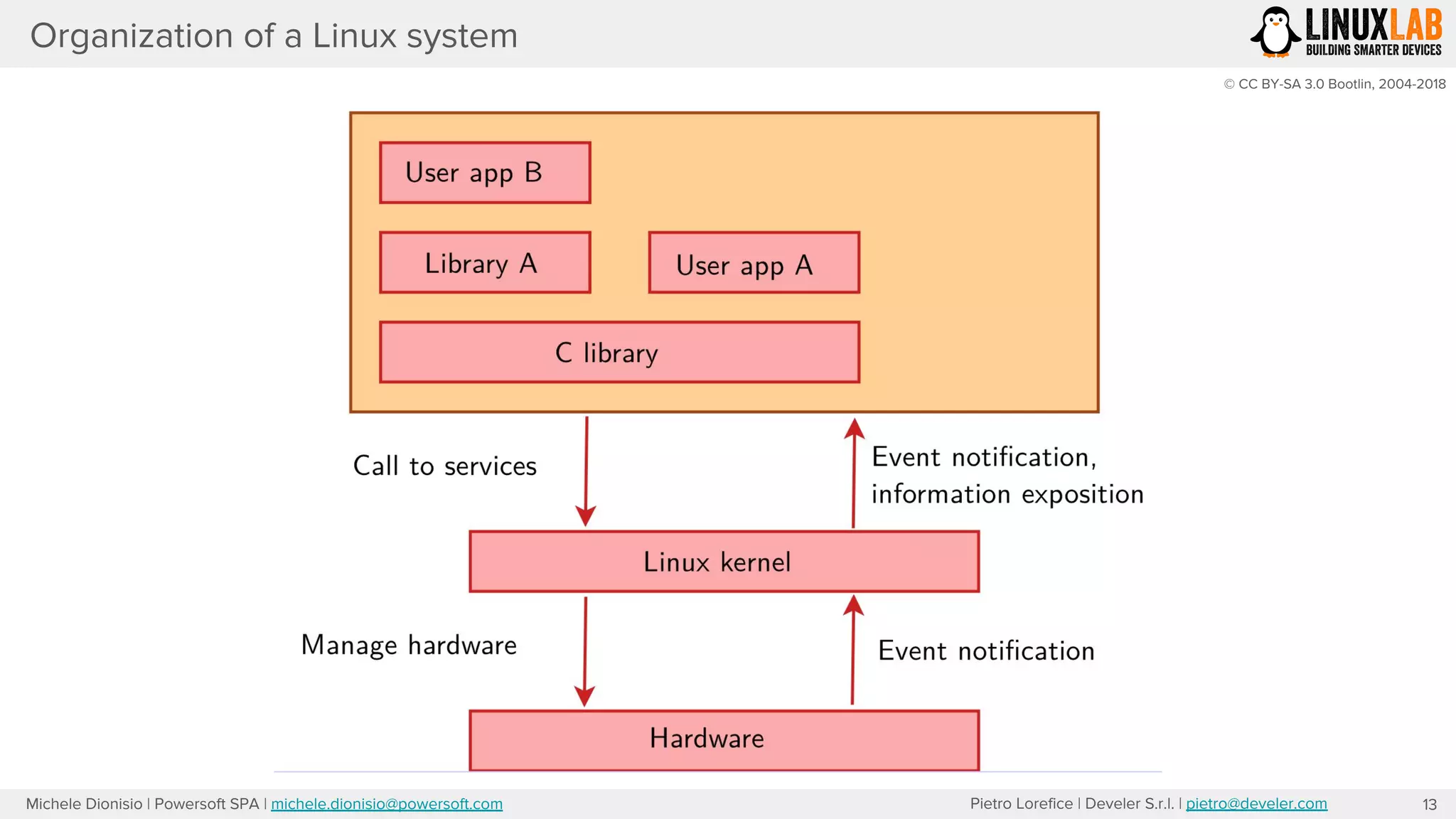
Organization of a Linux system
13
© CC BY-SA 3.0 Bootlin, 2004-2018
Pietro Lorefice | Develer S.r.l. | pietro@develer.comMichele Dionisio | Powersoft SPA | michele.dionisio@powersoft.com
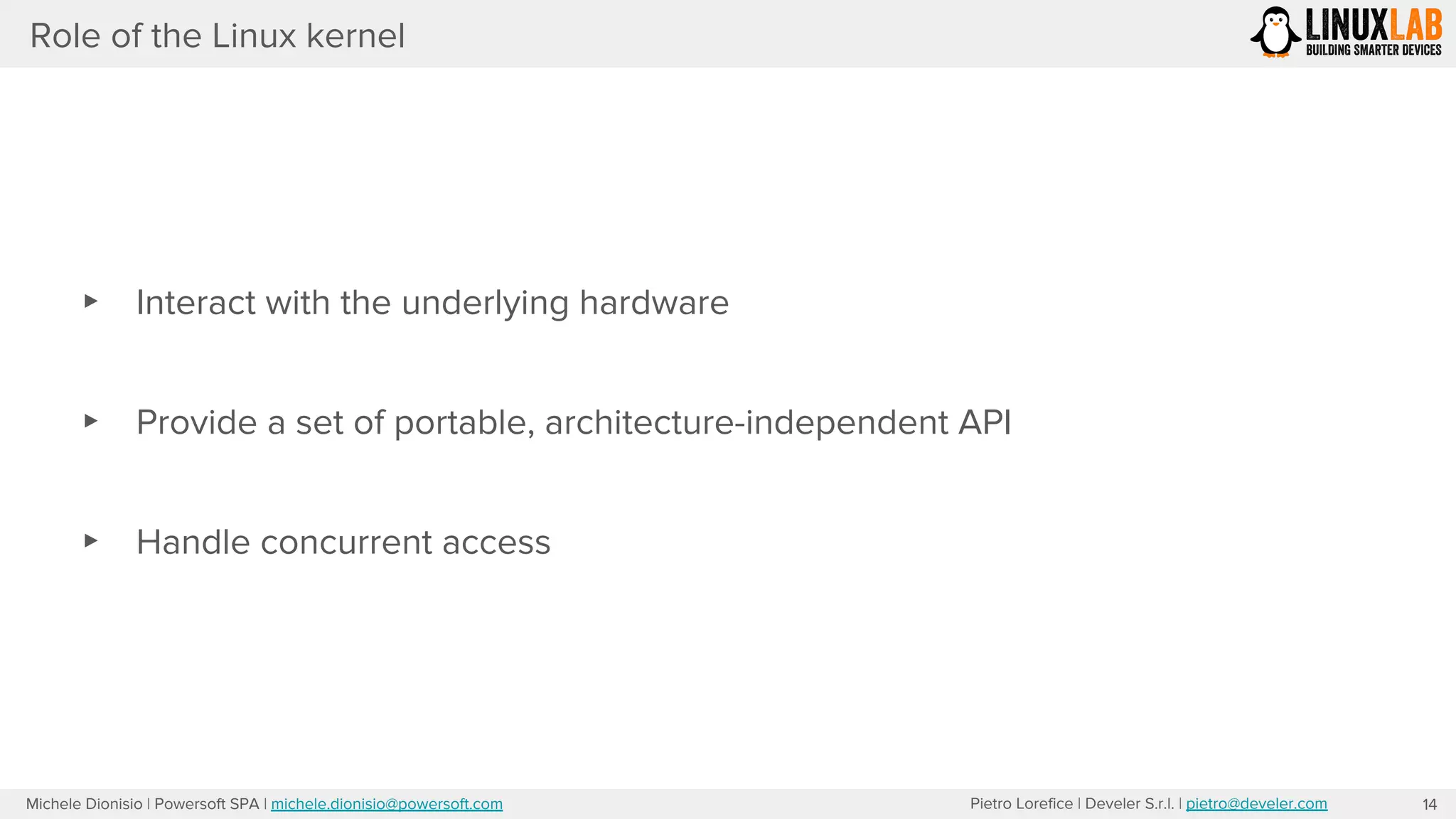
Role of the Linux kernel
▸ Interact with the underlying hardware
▸ Provide a set of portable, architecture-independent API
▸ Handle concurrent access
14
Pietro Lorefice | Develer S.r.l. | pietro@develer.comMichele Dionisio | Powersoft SPA | michele.dionisio@powersoft.com
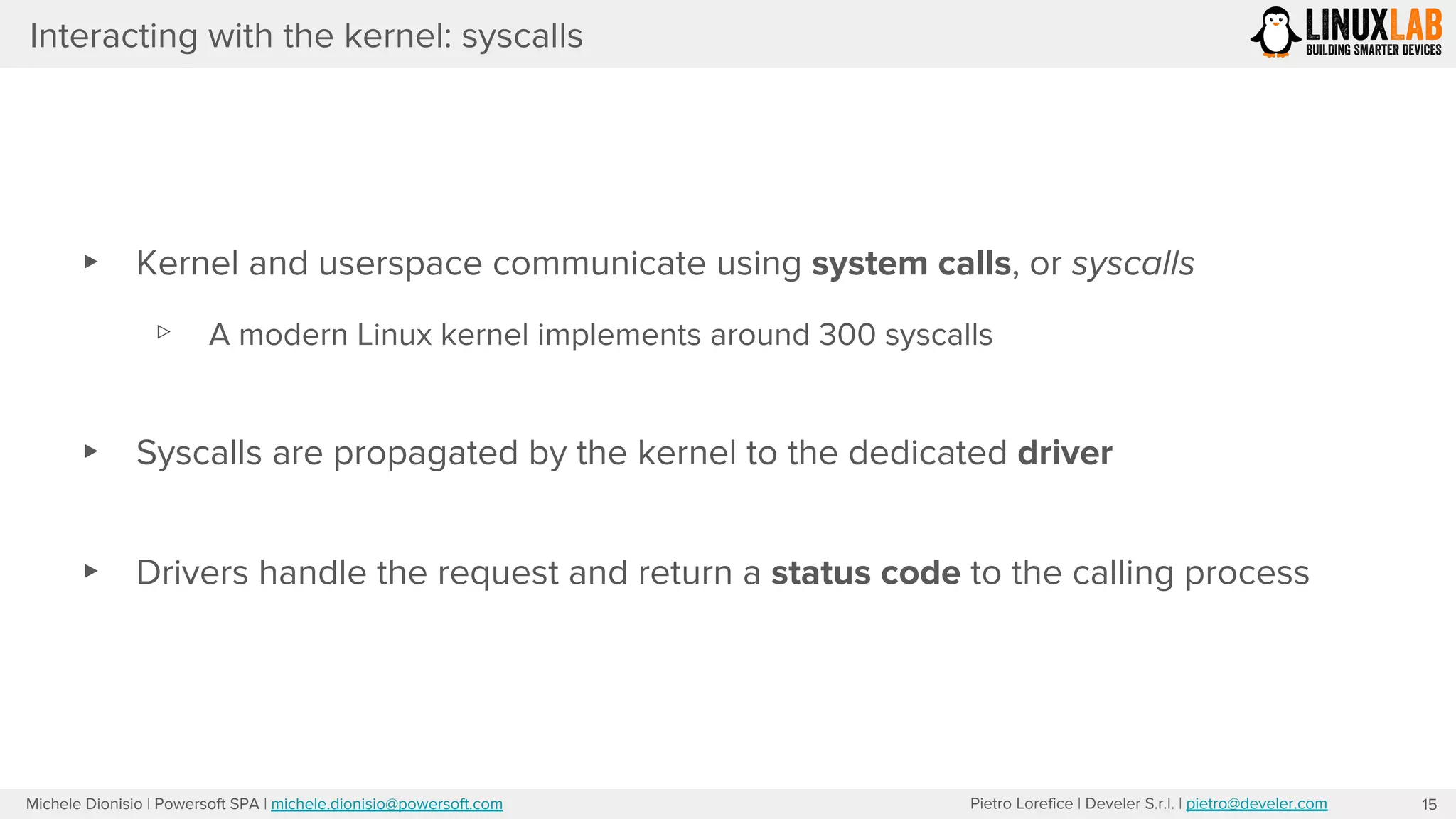
Interacting with the kernel: syscalls
▸ Kernel and userspace communicate using system calls, or syscalls
▹ A modern Linux kernel implements around 300 syscalls
▸ Syscalls are propagated by the kernel to the dedicated driver
▸ Drivers handle the request and return a status code to the calling process
15
Pietro Lorefice | Develer S.r.l. | pietro@develer.comMichele Dionisio | Powersoft SPA | michele.dionisio@powersoft.com
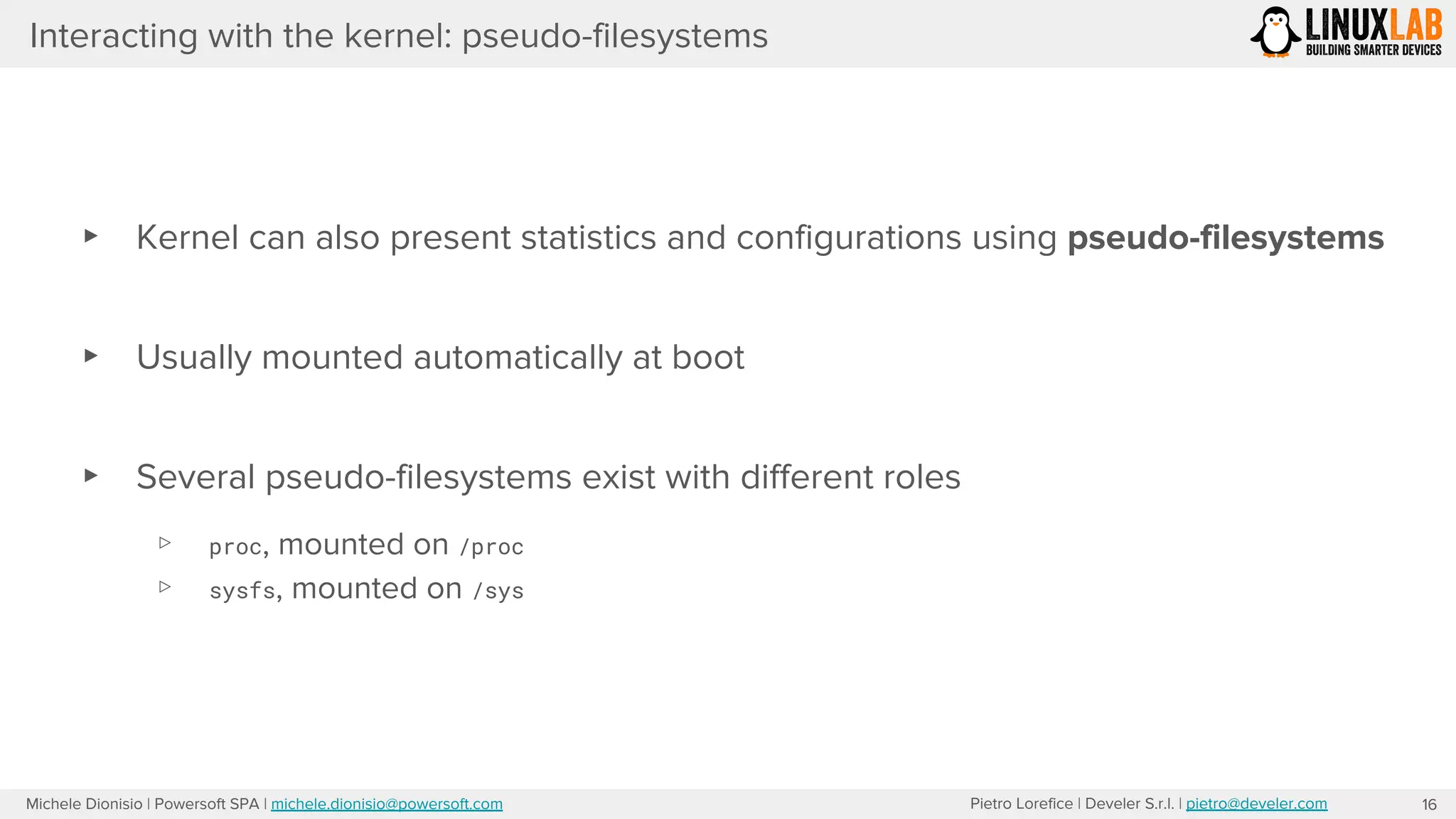
Interacting with the kernel: pseudo-filesystems
▸ Kernel can also present statistics and configurations using pseudo-filesystems
▸ Usually mounted automatically at boot
▸ Several pseudo-filesystems exist with different roles
▹ proc, mounted on /proc
▹ sysfs, mounted on /sys
16
Pietro Lorefice | Develer S.r.l. | pietro@develer.comMichele Dionisio | Powersoft SPA | michele.dionisio@powersoft.com
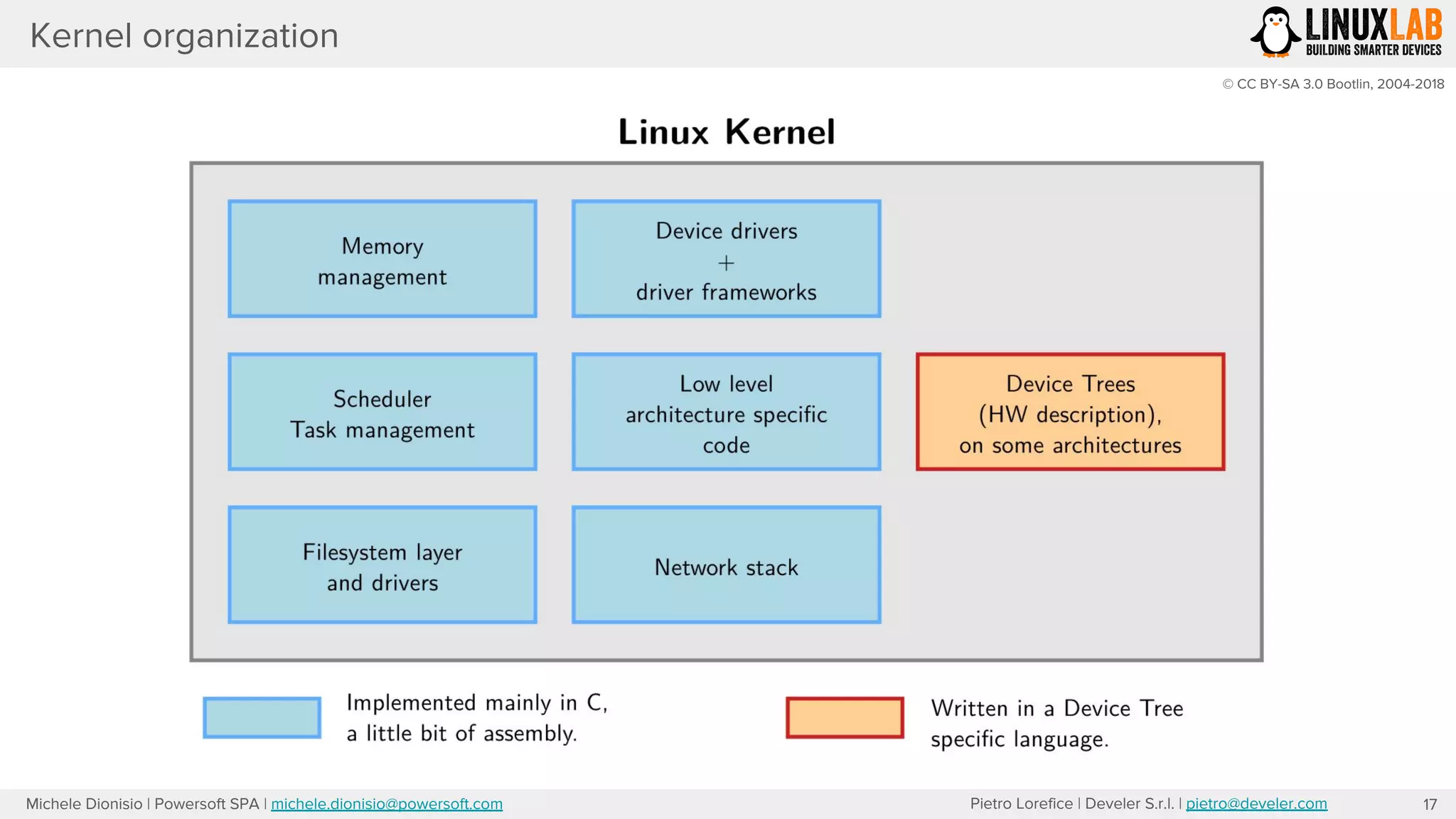
Kernel organization
17
© CC BY-SA 3.0 Bootlin, 2004-2018
Pietro Lorefice | Develer S.r.l. | pietro@develer.comMichele Dionisio | Powersoft SPA | michele.dionisio@powersoft.com
Working on the Linux kernel
18
Pietro Lorefice | Develer S.r.l. | pietro@develer.comMichele Dionisio | Powersoft SPA | michele.dionisio@powersoft.com
Cross-compiling
19
▸ By default, Linux is configured and built for the host system
▸ Use ARCH and CROSS_COMPILE variables to change target platform
▸ Different configuration options are available for different platforms
Pietro Lorefice | Develer S.r.l. | pietro@develer.comMichele Dionisio | Powersoft SPA | michele.dionisio@powersoft.com
Configuring the kernel
20
▸ To use an existing configuration: make <config-name>_defconfig
▹ Configurations available in arch/<arch>/configs/
▸ To modify the current configuration: make menuconfig
Pietro Lorefice | Develer S.r.l. | pietro@develer.comMichele Dionisio | Powersoft SPA | michele.dionisio@powersoft.com
Building the kernel
21
▸ To build the kernel: make -jN
▸ Build outputs
▹ ./vmlinux
▹ ./arch/<arch>/boot/*Image
▹ ./arch/<arch>/boot/dts/*.dtb
▹ ./**/*.ko
Pietro Lorefice | Develer S.r.l. | pietro@develer.comMichele Dionisio | Powersoft SPA | michele.dionisio@powersoft.com
Writing a kernel driver
22
Pietro Lorefice | Develer S.r.l. | pietro@develer.comMichele Dionisio | Powersoft SPA | michele.dionisio@powersoft.com
Hello World!
23
▸ (Optional) Create a dedicated directory under drivers/
▸ Create the necessary Kconfig options and Makefile rules
▸ Write code!
Pietro Lorefice | Develer S.r.l. | pietro@develer.comMichele Dionisio | Powersoft SPA | michele.dionisio@powersoft.com
Some words of warning
▸ A kernel module is not a userspace application!
▹ Does not execute sequentially
▹ Does no automatic cleanup
▹ Can be interrupted
▹ Does not have floating-point support
24
Pietro Lorefice | Develer S.r.l. | pietro@develer.comMichele Dionisio | Powersoft SPA | michele.dionisio@powersoft.com
Device drivers
25
Pietro Lorefice | Develer S.r.l. | pietro@develer.comMichele Dionisio | Powersoft SPA | michele.dionisio@powersoft.com
▸ Access to the hardware is abstracted as a stream of bytes
▹ Serial ports and text consoles are example of char devices
▸ Many hardware peripherals can be abstracted as char devices
▹ Flash memories
▹ Frame grabbers
▹ ADC, DAC, shift registers
Character device
26
Pietro Lorefice | Develer S.r.l. | pietro@develer.comMichele Dionisio | Powersoft SPA | michele.dionisio@powersoft.com
Majors and minors
27
▸ Char devices are accessed using device nodes
▹ Usually located in the /dev directory
▸ A combination of major and minor is used to identify the device
▹ The major number identifies the device driver
▹ Minors usually identify a device instance of a given driver
Pietro Lorefice | Develer S.r.l. | pietro@develer.comMichele Dionisio | Powersoft SPA | michele.dionisio@powersoft.com
Platform drivers
28
Pietro Lorefice | Develer S.r.l. | pietro@develer.comMichele Dionisio | Powersoft SPA | michele.dionisio@powersoft.com
Platform device
▸ A device located on a bus with minimal infrastructure
▹ Most peripheral controllers on ARM SoCs are platform devices
▸ Usually addressed directly by the CPU
▹ Eg. using memory-mapped registers
▸ In Linux, they are handled using platform drivers
29
Pietro Lorefice | Develer S.r.l. | pietro@develer.comMichele Dionisio | Powersoft SPA | michele.dionisio@powersoft.com
Platform driver
▸ Implemented using struct platform_driver
▹ Registered using platform_driver_register()
▸ Enumeration is performed by the kernel
▹ During enumeration, .probe() is invoked
▹ During shutdown, .remove() is invoked
▸ The driver should actually check that the hardware exists
30
Pietro Lorefice | Develer S.r.l. | pietro@develer.comMichele Dionisio | Powersoft SPA | michele.dionisio@powersoft.com
Device Tree
31
Pietro Lorefice | Develer S.r.l. | pietro@develer.comMichele Dionisio | Powersoft SPA | michele.dionisio@powersoft.com
Device Tree
32
▸ Embedded architectures often have non-discoverable peripherals
▹ This is the case for ARM processors, for example
▸ We need a way to describe the hardware connected to such platforms
▸ Enter the Device Tree!
Pietro Lorefice | Develer S.r.l. | pietro@develer.comMichele Dionisio | Powersoft SPA | michele.dionisio@powersoft.com
Device Tree
33
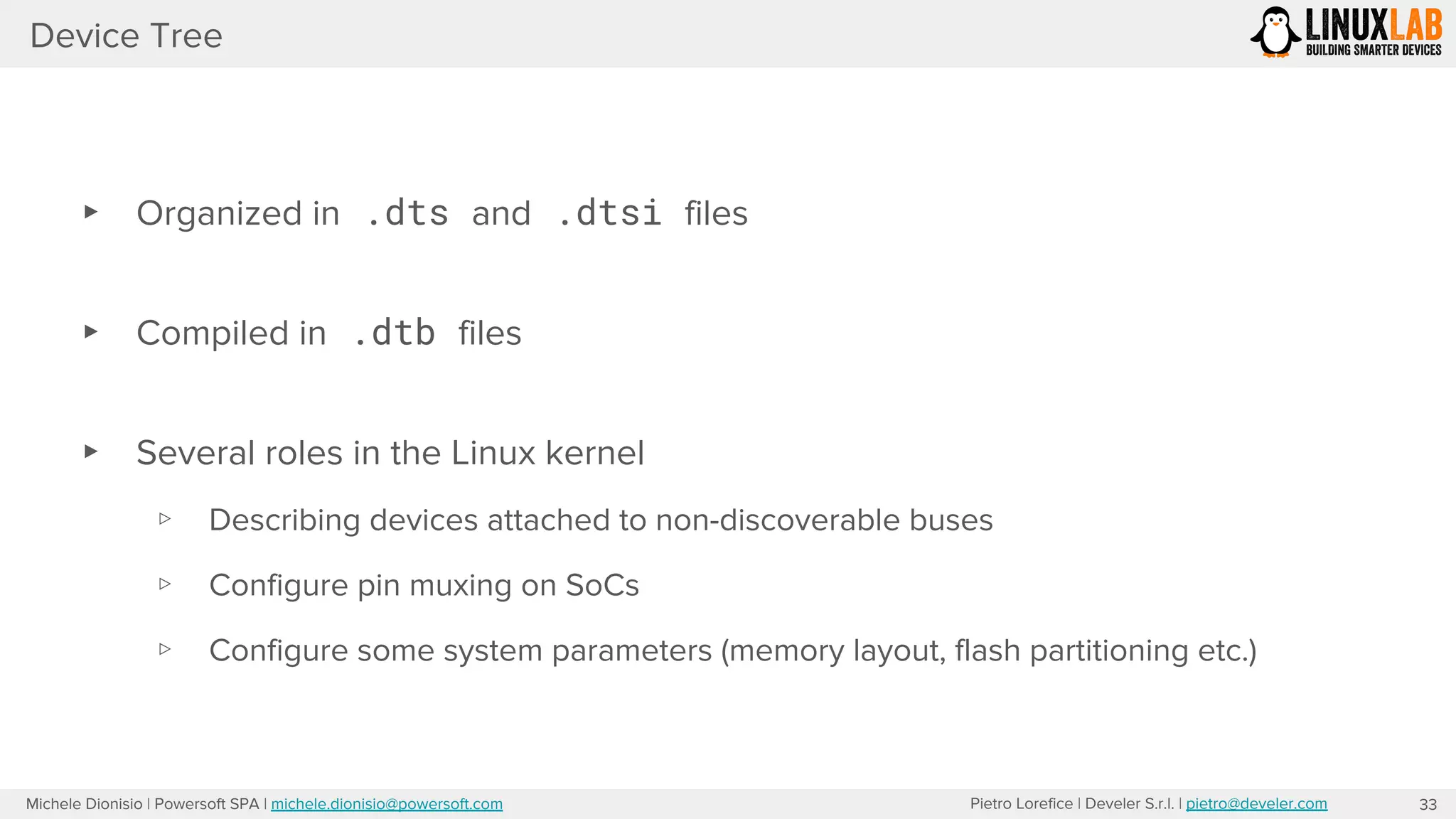
▸ Organized in .dts and .dtsi files
▸ Compiled in .dtb files
▸ Several roles in the Linux kernel
▹ Describing devices attached to non-discoverable buses
▹ Configure pin muxing on SoCs
▹ Configure some system parameters (memory layout, flash partitioning etc.)
Pietro Lorefice | Develer S.r.l. | pietro@develer.comMichele Dionisio | Powersoft SPA | michele.dionisio@powersoft.com
Device Tree
34
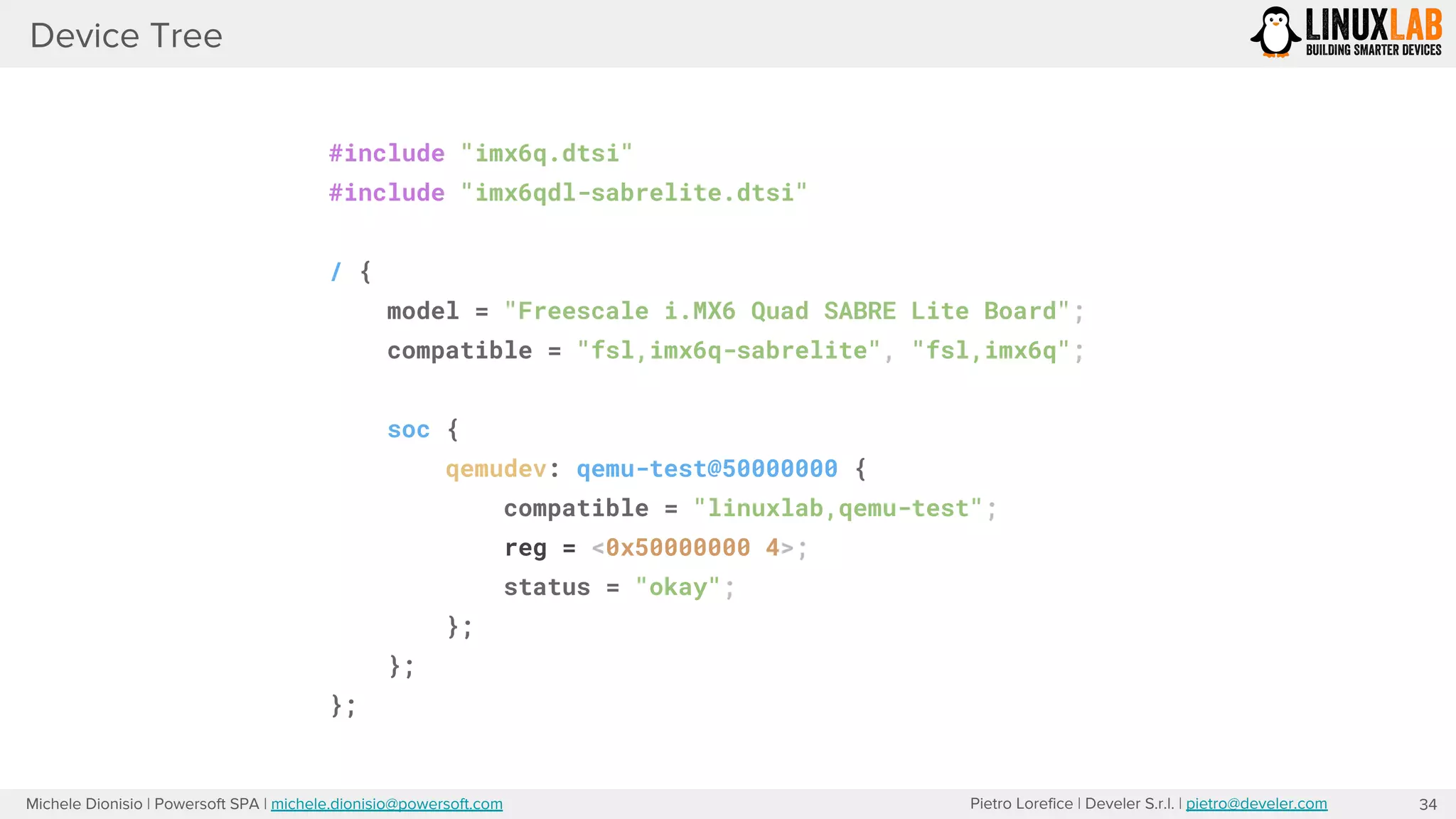
#include "imx6q.dtsi"
#include "imx6qdl-sabrelite.dtsi"
/ {
model = "Freescale i.MX6 Quad SABRE Lite Board";
compatible = "fsl,imx6q-sabrelite", "fsl,imx6q";
soc {
qemudev: qemu-test@50000000 {
compatible = "linuxlab,qemu-test";
reg = <0x50000000 4>;
status = "okay";
};
};
};
Pietro Lorefice | Develer S.r.l. | pietro@develer.comMichele Dionisio | Powersoft SPA | michele.dionisio@powersoft.com
I/O operations
35
Pietro Lorefice | Develer S.r.l. | pietro@develer.comMichele Dionisio | Powersoft SPA | michele.dionisio@powersoft.com
I/O operations
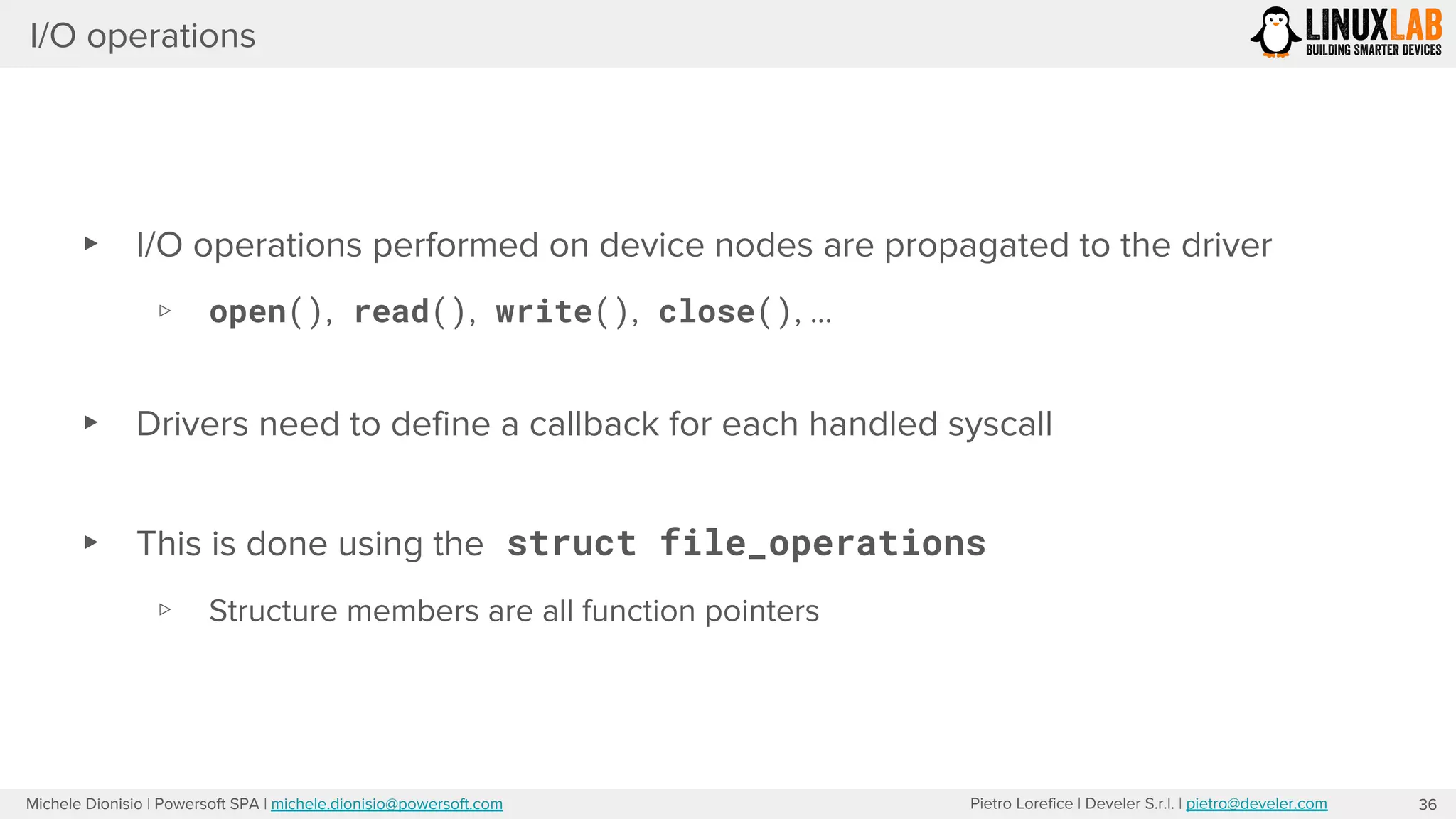
▸ I/O operations performed on device nodes are propagated to the driver
▹ open(), read(), write(), close(), …
▸ Drivers need to define a callback for each handled syscall
▸ This is done using the struct file_operations
▹ Structure members are all function pointers
36
Pietro Lorefice | Develer S.r.l. | pietro@develer.comMichele Dionisio | Powersoft SPA | michele.dionisio@powersoft.com
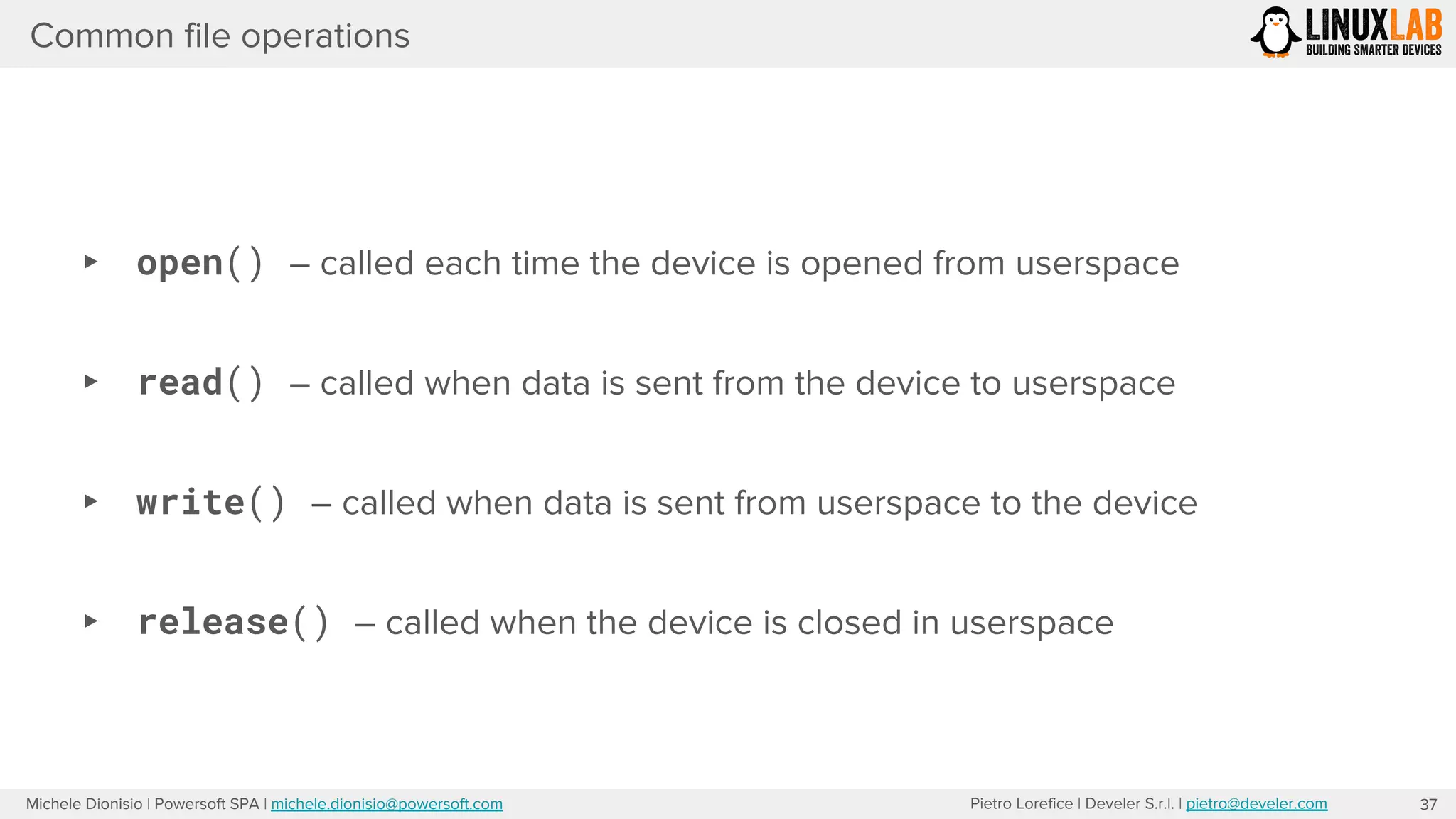
Common file operations
▸ open() – called each time the device is opened from userspace
▸ read() – called when data is sent from the device to userspace
▸ write() – called when data is sent from userspace to the device
▸ release() – called when the device is closed in userspace
37
Pietro Lorefice | Develer S.r.l. | pietro@develer.comMichele Dionisio | Powersoft SPA | michele.dionisio@powersoft.com
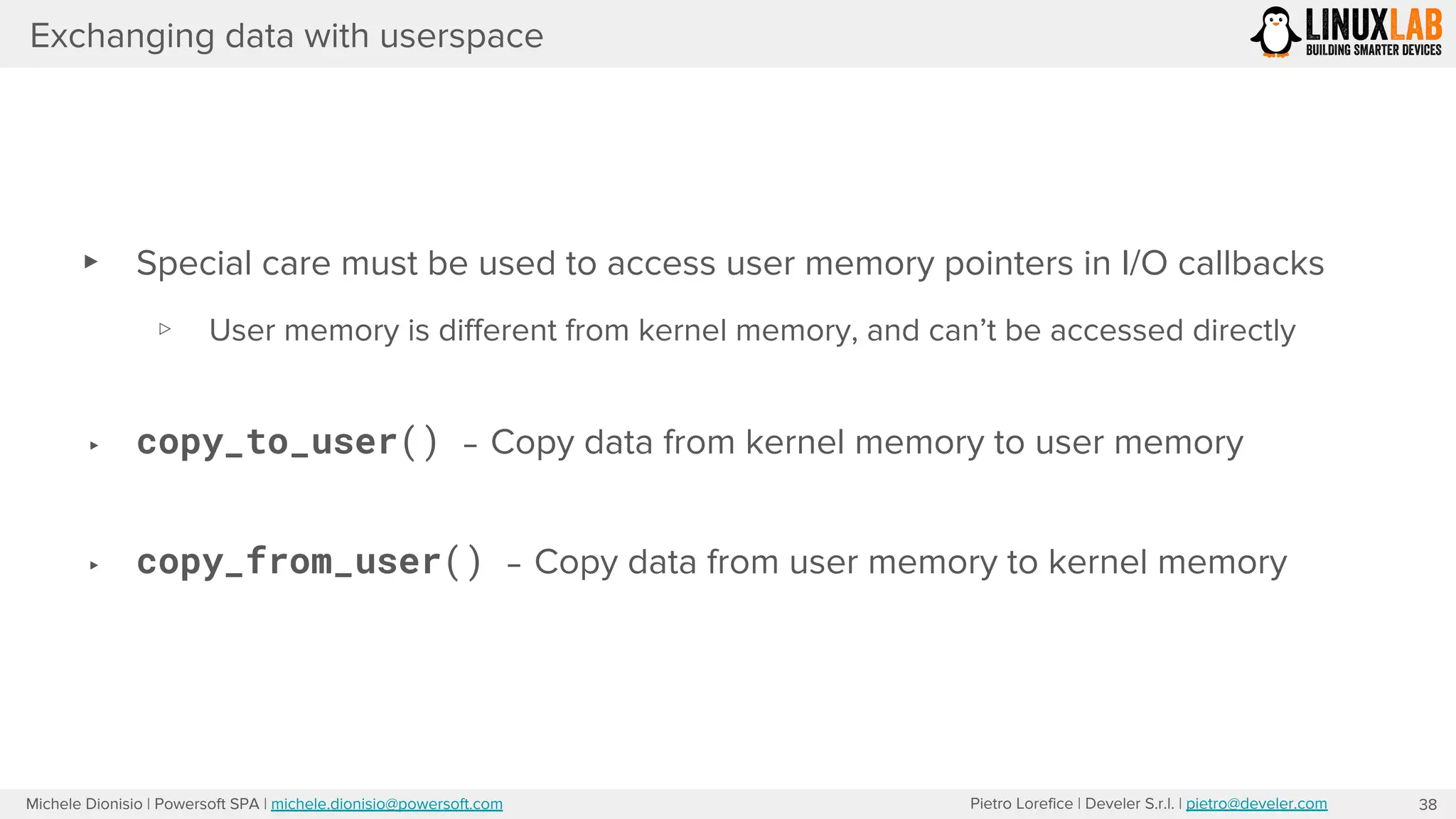
Exchanging data with userspace
▸ Special care must be used to access user memory pointers in I/O callbacks
▹ User memory is different from kernel memory, and can’t be accessed directly
▸ copy_to_user() – Copy data from kernel memory to user memory
▸ copy_from_user() – Copy data from user memory to kernel memory
38
Pietro Lorefice | Develer S.r.l. | pietro@develer.comMichele Dionisio | Powersoft SPA | michele.dionisio@powersoft.com
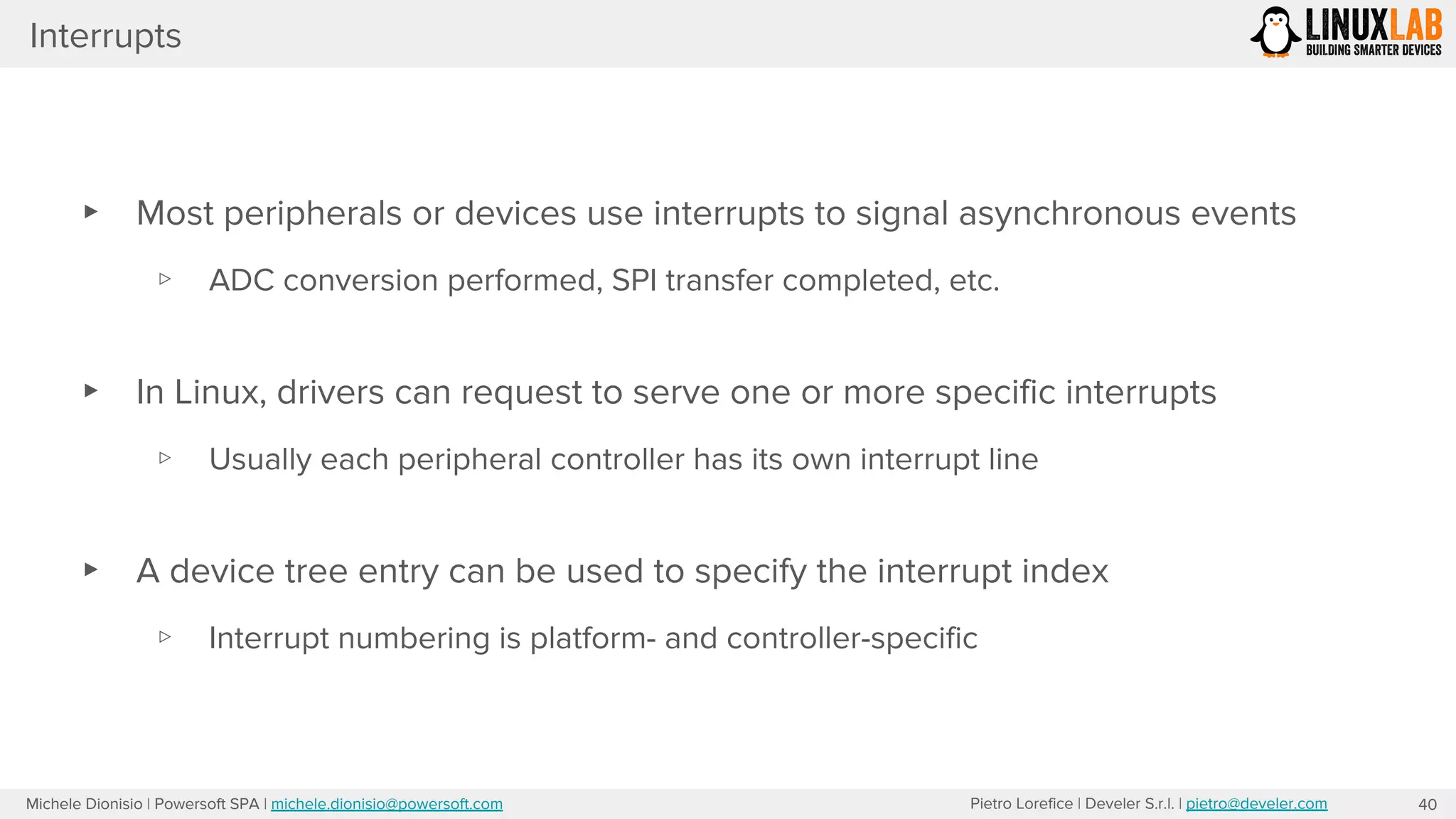
Interrupt handling
39
Pietro Lorefice | Develer S.r.l. | pietro@develer.comMichele Dionisio | Powersoft SPA | michele.dionisio@powersoft.com
Interrupts
▸ Most peripherals or devices use interrupts to signal asynchronous events
▹ ADC conversion performed, SPI transfer completed, etc.
▸ In Linux, drivers can request to serve one or more specific interrupts
▹ Usually each peripheral controller has its own interrupt line
▸ A device tree entry can be used to specify the interrupt index
▹ Interrupt numbering is platform- and controller-specific
40

Michele Dionisio & Pietro Lorefice - Developing and testing a device driver without the device

  • 1.
    Pietro Lorefice |Develer S.r.l. | pietro@develer.comMichele Dionisio | Powersoft SPA | michele.dionisio@powersoft.com Developing and testing a device driver without the device 1 git clone --recurse-submodules git@github.com:mdionisio/linuxlab2018.git
  • 2.
    Pietro Lorefice |Develer S.r.l. | pietro@develer.comMichele Dionisio | Powersoft SPA | michele.dionisio@powersoft.com BEFORE WE START 2 git clone --recurse-submodules git@github.com :mdionisio/linuxlab2018.git apt-get install build-essential apt-get install crossbuild-essential-armhf apt-get install gcc-arm-linux-gnueabihf apt-get install gcc-arm-none-eabi apt-get install libncurses5-dev apt-get install bison flex libssl-dev bc apt-get install python pkg-config libglib2.0-dev libpixman-1-dev apt-get install sudo cpio lzop gzip apt-get install gdb-multiarch
  • 3.
    Pietro Lorefice |Develer S.r.l. | pietro@develer.comMichele Dionisio | Powersoft SPA | michele.dionisio@powersoft.com Who we are 3
  • 4.
    Pietro Lorefice |Develer S.r.l. | pietro@develer.comMichele Dionisio | Powersoft SPA | michele.dionisio@powersoft.com What we will see 4 1. Qemu a. Introduction b. Developing a new simple emulated device c. Adding it to an existing machine 2. Test a. Simple bare-metal cortex a9 project b. Test and debug with qemu 3. Test with Linux a. Create a minimal rootfs 4. Develop a test a linux driver a. Developing device driver b. Adding it to and existing board configuring the device tree c. Test
  • 5.
    Pietro Lorefice |Develer S.r.l. | pietro@develer.comMichele Dionisio | Powersoft SPA | michele.dionisio@powersoft.com 5 Image coming from qemu web site: www.qemu.org
  • 6.
    Pietro Lorefice |Develer S.r.l. | pietro@develer.comMichele Dionisio | Powersoft SPA | michele.dionisio@powersoft.com Device Specification 6 1. One memory mapped RW registry. You can read on it the last value write plus 1. 2. If you write 1 and interrupt is raised and writing 0 the interrupt is acknowledged Device is installed in a custom board coming from Sambrelite board This board is based on i.mx6 that is a ARM Cortex A9 MP processor so we will use a gcc for that platform for developing and testing
  • 7.
    Pietro Lorefice |Develer S.r.l. | pietro@develer.comMichele Dionisio | Powersoft SPA | michele.dionisio@powersoft.com And now …. A brief introduction to QOM. And jump to the C code 7
  • 8.
    Pietro Lorefice |Develer S.r.l. | pietro@develer.comMichele Dionisio | Powersoft SPA | michele.dionisio@powersoft.com We have the device emulated and we can start to add it to a machine emulated. So go back to the QEMU source code 8
  • 9.
    Pietro Lorefice |Develer S.r.l. | pietro@develer.comMichele Dionisio | Powersoft SPA | michele.dionisio@powersoft.com A bare metal CORTEX-A9 startup.S 9
  • 10.
    Pietro Lorefice |Develer S.r.l. | pietro@develer.comMichele Dionisio | Powersoft SPA | michele.dionisio@powersoft.com And now LINUX 10 To develop and test a linux device driver we need a working Linux system. So before start to develop we have to create a minimal Linux system. 1. Build linux kernel 2. Build busybox 3. Build a minimal rootfs that can be mounted in ram. INITRAMFS The result is not a full linux distribution but is something perfect for develop and test.
  • 11.
    Pietro Lorefice |Develer S.r.l. | pietro@develer.comMichele Dionisio | Powersoft SPA | michele.dionisio@powersoft.com Test the created Linux system 11
  • 12.
    Pietro Lorefice |Develer S.r.l. | pietro@develer.comMichele Dionisio | Powersoft SPA | michele.dionisio@powersoft.com 12 Questions ? Image coming from film Io Robot
  • 13.
    Pietro Lorefice |Develer S.r.l. | pietro@develer.comMichele Dionisio | Powersoft SPA | michele.dionisio@powersoft.com Organization of a Linux system 13 © CC BY-SA 3.0 Bootlin, 2004-2018
  • 14.
    Pietro Lorefice |Develer S.r.l. | pietro@develer.comMichele Dionisio | Powersoft SPA | michele.dionisio@powersoft.com Role of the Linux kernel ▸ Interact with the underlying hardware ▸ Provide a set of portable, architecture-independent API ▸ Handle concurrent access 14
  • 15.
    Pietro Lorefice |Develer S.r.l. | pietro@develer.comMichele Dionisio | Powersoft SPA | michele.dionisio@powersoft.com Interacting with the kernel: syscalls ▸ Kernel and userspace communicate using system calls, or syscalls ▹ A modern Linux kernel implements around 300 syscalls ▸ Syscalls are propagated by the kernel to the dedicated driver ▸ Drivers handle the request and return a status code to the calling process 15
  • 16.
    Pietro Lorefice |Develer S.r.l. | pietro@develer.comMichele Dionisio | Powersoft SPA | michele.dionisio@powersoft.com Interacting with the kernel: pseudo-filesystems ▸ Kernel can also present statistics and configurations using pseudo-filesystems ▸ Usually mounted automatically at boot ▸ Several pseudo-filesystems exist with different roles ▹ proc, mounted on /proc ▹ sysfs, mounted on /sys 16
  • 17.
    Pietro Lorefice |Develer S.r.l. | pietro@develer.comMichele Dionisio | Powersoft SPA | michele.dionisio@powersoft.com Kernel organization 17 © CC BY-SA 3.0 Bootlin, 2004-2018
  • 18.
    Pietro Lorefice |Develer S.r.l. | pietro@develer.comMichele Dionisio | Powersoft SPA | michele.dionisio@powersoft.com Working on the Linux kernel 18
  • 19.
    Pietro Lorefice |Develer S.r.l. | pietro@develer.comMichele Dionisio | Powersoft SPA | michele.dionisio@powersoft.com Cross-compiling 19 ▸ By default, Linux is configured and built for the host system ▸ Use ARCH and CROSS_COMPILE variables to change target platform ▸ Different configuration options are available for different platforms
  • 20.
    Pietro Lorefice |Develer S.r.l. | pietro@develer.comMichele Dionisio | Powersoft SPA | michele.dionisio@powersoft.com Configuring the kernel 20 ▸ To use an existing configuration: make <config-name>_defconfig ▹ Configurations available in arch/<arch>/configs/ ▸ To modify the current configuration: make menuconfig
  • 21.
    Pietro Lorefice |Develer S.r.l. | pietro@develer.comMichele Dionisio | Powersoft SPA | michele.dionisio@powersoft.com Building the kernel 21 ▸ To build the kernel: make -jN ▸ Build outputs ▹ ./vmlinux ▹ ./arch/<arch>/boot/*Image ▹ ./arch/<arch>/boot/dts/*.dtb ▹ ./**/*.ko
  • 22.
    Pietro Lorefice |Develer S.r.l. | pietro@develer.comMichele Dionisio | Powersoft SPA | michele.dionisio@powersoft.com Writing a kernel driver 22
  • 23.
    Pietro Lorefice |Develer S.r.l. | pietro@develer.comMichele Dionisio | Powersoft SPA | michele.dionisio@powersoft.com Hello World! 23 ▸ (Optional) Create a dedicated directory under drivers/ ▸ Create the necessary Kconfig options and Makefile rules ▸ Write code!
  • 24.
    Pietro Lorefice |Develer S.r.l. | pietro@develer.comMichele Dionisio | Powersoft SPA | michele.dionisio@powersoft.com Some words of warning ▸ A kernel module is not a userspace application! ▹ Does not execute sequentially ▹ Does no automatic cleanup ▹ Can be interrupted ▹ Does not have floating-point support 24
  • 25.
    Pietro Lorefice |Develer S.r.l. | pietro@develer.comMichele Dionisio | Powersoft SPA | michele.dionisio@powersoft.com Device drivers 25
  • 26.
    Pietro Lorefice |Develer S.r.l. | pietro@develer.comMichele Dionisio | Powersoft SPA | michele.dionisio@powersoft.com ▸ Access to the hardware is abstracted as a stream of bytes ▹ Serial ports and text consoles are example of char devices ▸ Many hardware peripherals can be abstracted as char devices ▹ Flash memories ▹ Frame grabbers ▹ ADC, DAC, shift registers Character device 26
  • 27.
    Pietro Lorefice |Develer S.r.l. | pietro@develer.comMichele Dionisio | Powersoft SPA | michele.dionisio@powersoft.com Majors and minors 27 ▸ Char devices are accessed using device nodes ▹ Usually located in the /dev directory ▸ A combination of major and minor is used to identify the device ▹ The major number identifies the device driver ▹ Minors usually identify a device instance of a given driver
  • 28.
    Pietro Lorefice |Develer S.r.l. | pietro@develer.comMichele Dionisio | Powersoft SPA | michele.dionisio@powersoft.com Platform drivers 28
  • 29.
    Pietro Lorefice |Develer S.r.l. | pietro@develer.comMichele Dionisio | Powersoft SPA | michele.dionisio@powersoft.com Platform device ▸ A device located on a bus with minimal infrastructure ▹ Most peripheral controllers on ARM SoCs are platform devices ▸ Usually addressed directly by the CPU ▹ Eg. using memory-mapped registers ▸ In Linux, they are handled using platform drivers 29
  • 30.
    Pietro Lorefice |Develer S.r.l. | pietro@develer.comMichele Dionisio | Powersoft SPA | michele.dionisio@powersoft.com Platform driver ▸ Implemented using struct platform_driver ▹ Registered using platform_driver_register() ▸ Enumeration is performed by the kernel ▹ During enumeration, .probe() is invoked ▹ During shutdown, .remove() is invoked ▸ The driver should actually check that the hardware exists 30
  • 31.
    Pietro Lorefice |Develer S.r.l. | pietro@develer.comMichele Dionisio | Powersoft SPA | michele.dionisio@powersoft.com Device Tree 31
  • 32.
    Pietro Lorefice |Develer S.r.l. | pietro@develer.comMichele Dionisio | Powersoft SPA | michele.dionisio@powersoft.com Device Tree 32 ▸ Embedded architectures often have non-discoverable peripherals ▹ This is the case for ARM processors, for example ▸ We need a way to describe the hardware connected to such platforms ▸ Enter the Device Tree!
  • 33.
    Pietro Lorefice |Develer S.r.l. | pietro@develer.comMichele Dionisio | Powersoft SPA | michele.dionisio@powersoft.com Device Tree 33 ▸ Organized in .dts and .dtsi files ▸ Compiled in .dtb files ▸ Several roles in the Linux kernel ▹ Describing devices attached to non-discoverable buses ▹ Configure pin muxing on SoCs ▹ Configure some system parameters (memory layout, flash partitioning etc.)
  • 34.
    Pietro Lorefice |Develer S.r.l. | pietro@develer.comMichele Dionisio | Powersoft SPA | michele.dionisio@powersoft.com Device Tree 34 #include "imx6q.dtsi" #include "imx6qdl-sabrelite.dtsi" / { model = "Freescale i.MX6 Quad SABRE Lite Board"; compatible = "fsl,imx6q-sabrelite", "fsl,imx6q"; soc { qemudev: qemu-test@50000000 { compatible = "linuxlab,qemu-test"; reg = <0x50000000 4>; status = "okay"; }; }; };
  • 35.
    Pietro Lorefice |Develer S.r.l. | pietro@develer.comMichele Dionisio | Powersoft SPA | michele.dionisio@powersoft.com I/O operations 35
  • 36.
    Pietro Lorefice |Develer S.r.l. | pietro@develer.comMichele Dionisio | Powersoft SPA | michele.dionisio@powersoft.com I/O operations ▸ I/O operations performed on device nodes are propagated to the driver ▹ open(), read(), write(), close(), … ▸ Drivers need to define a callback for each handled syscall ▸ This is done using the struct file_operations ▹ Structure members are all function pointers 36
  • 37.
    Pietro Lorefice |Develer S.r.l. | pietro@develer.comMichele Dionisio | Powersoft SPA | michele.dionisio@powersoft.com Common file operations ▸ open() – called each time the device is opened from userspace ▸ read() – called when data is sent from the device to userspace ▸ write() – called when data is sent from userspace to the device ▸ release() – called when the device is closed in userspace 37
  • 38.
    Pietro Lorefice |Develer S.r.l. | pietro@develer.comMichele Dionisio | Powersoft SPA | michele.dionisio@powersoft.com Exchanging data with userspace ▸ Special care must be used to access user memory pointers in I/O callbacks ▹ User memory is different from kernel memory, and can’t be accessed directly ▸ copy_to_user() – Copy data from kernel memory to user memory ▸ copy_from_user() – Copy data from user memory to kernel memory 38
  • 39.
    Pietro Lorefice |Develer S.r.l. | pietro@develer.comMichele Dionisio | Powersoft SPA | michele.dionisio@powersoft.com Interrupt handling 39
  • 40.
    Pietro Lorefice |Develer S.r.l. | pietro@develer.comMichele Dionisio | Powersoft SPA | michele.dionisio@powersoft.com Interrupts ▸ Most peripherals or devices use interrupts to signal asynchronous events ▹ ADC conversion performed, SPI transfer completed, etc. ▸ In Linux, drivers can request to serve one or more specific interrupts ▹ Usually each peripheral controller has its own interrupt line ▸ A device tree entry can be used to specify the interrupt index ▹ Interrupt numbering is platform- and controller-specific 40