

UX London 2011 &User centred DesignHow we can use user centred design methods to build better websites
What was UX London 2011?Learn from pioneers in the field of user experience1 day of inspiring talks2 days of in-depth workshops
What is User eXperience?User“a person that uses something”Experience“a person's perceptions, feelings, and memories of something”
What is user centred designA process with the user at the centre, that gives us the tools to make a better user experienceIt’s a cyclical process, but can involve these stagesResearch & analysisCreating the design solutionEvaluating the solutionContinue to measure
Research1Is that the part of the project where you just surf the internet all day?
ResearchWe need to understand who we are designing forTalk to users face to faceUse questionnairesInformation from the clientSite statistics from the existing siteMosaic profilesThen we can use tools to make the research useful1324
PersonasA way to define who the users areArchetypal users based on real life peopleConsider their background, lifestyle, goals and habitsShould be relevant to the project1324
Kim GoodwinThe person writing the persona should be doing the researchBase them on behaviour / activities not job titlesEveryone needs to be happy with themOnly do as much as you needUX Consultant, over a decades worth of experience1324Making personas work...without breaking the bankUX London 2011 workshop
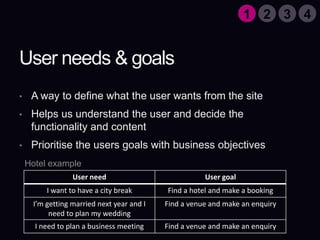
User needs & goalsA way to define what the user wants from the siteHelps us understand the user and decide the functionality and contentPrioritise the users goals with business objectives1324Hotel example
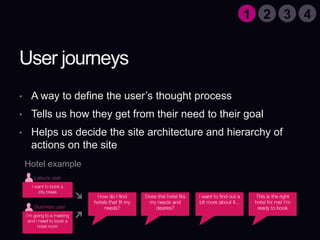
User journeysA way to define the user’s thought processTells us how they get from their need to their goalHelps us decide the site architecture and hierarchy of actions on the site1324Hotel example
What else do we research?Business structure and brandBusiness servicesBusiness objectivesCompetitionWhat other industries are doingWhat else is happening online1324
Design2Don’t you guys just colour in?
DesignBring the research together to get the functionality right and put the right content in the right placeWhat we’re designing must satisfy the user, but must also satisfy the business objectives3142
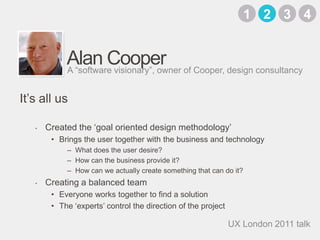
Alan CooperCreated the ‘goal oriented design methodology’Brings the user together with the business and technologyWhat does the user desire?How can the business provide it?How can we actually create something that can do it?Creating a balanced teamEveryone works together to find a solutionThe ‘experts’ control the direction of the projectA “software visionary”, owner of Cooper, design consultancyIt’s all us3142UX London 2011 talk
Creating a good user experienceUse the research, business objectives and scoped out requirements as a basisConsider the interactions, as well as the look & feelKeep the interface as simple as possible3142
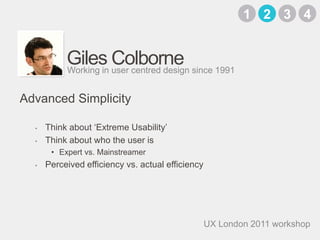
Giles ColborneThink about ‘Extreme Usability’Think about who the user isExpert vs. Mainstreamer Perceived efficiency vs. actual efficiencyWorking in user centred design since 1991Advanced Simplicity3142UX London 2011 workshop
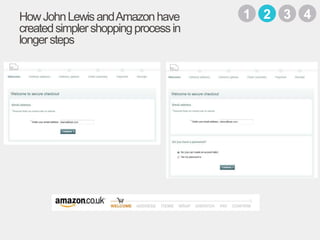
3142How John Lewis and Amazon have created simpler shopping process in longer steps
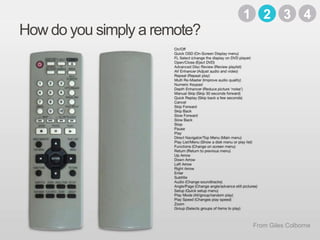
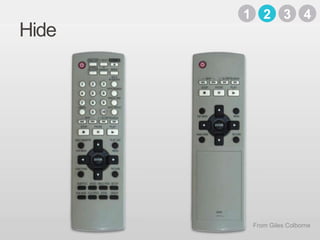
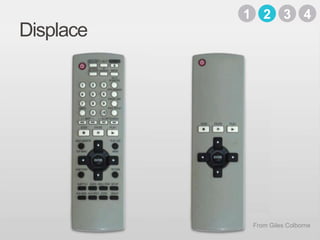
3142How do you simply a remote?From Giles Colborne
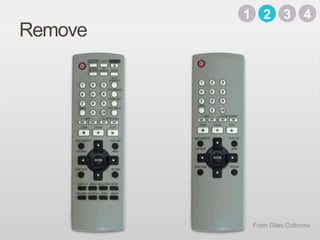
3142RemoveFrom Giles Colborne
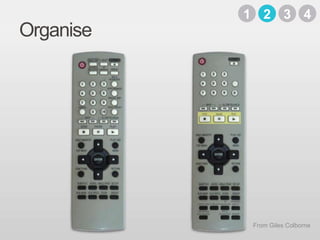
3142OrganiseFrom Giles Colborne
3142HideFrom Giles Colborne
3142DisplaceFrom Giles Colborne
Evaluate3It’s rubbish. Do it again, but this time make it good!
EvaluateNo matter how thorough you’ve been you won’t get it right first timeDo user testing to find out what works and what doesn’t2143
User testingYou can find out early on what isn’t workingWhen creating a prototype only test what you need to and set the expectations of the clientChoose the right tool for the job	Often should be the tool you know how to useMust be capable of prototyping the functionality requireWe’ve used Umbraco, wireframes, Hotgloo, InvisionApp2143
Todd ZakiwarfelBetter for complicated interactionsLocal data storageMay help later on with final build (risky!)Founder of Messagefirst, design research consulting firmPrototyping using HTML5 & CSS32143UX London 2011 workshop
Measure4It’s gone live! We never have to think about it again 
MeasureOnce a site is live we need to keep measuring it and find ways to improve it2134
Lou RosenfeldDoesn’t fix the problemsInstead...Prioritise – Focus on the important pages / featuresTune – Constantly refineBe opportunistic – Find high value easy fixes and just do themIndependent information architecture consultantWhy redesign must die2134UX London 2011 talk & workshop
So how can this help us create better websites?
What it means for usUX London 2011 confirmed that we’re already doing a lot of the right thingsIt can help us think about how to refine our process and do more of it, and do it better
What it means for usThinking about the user and the client will make projects more successfulWorking better as a team will make us more productive and efficient
The end

User Centred Design

  • 1.
    UX London 2011&User centred DesignHow we can use user centred design methods to build better websites
  • 2.
    What was UXLondon 2011?Learn from pioneers in the field of user experience1 day of inspiring talks2 days of in-depth workshops
  • 3.
    What is UsereXperience?User“a person that uses something”Experience“a person's perceptions, feelings, and memories of something”
  • 4.
    What is usercentred designA process with the user at the centre, that gives us the tools to make a better user experienceIt’s a cyclical process, but can involve these stagesResearch & analysisCreating the design solutionEvaluating the solutionContinue to measure
  • 5.
    Research1Is that thepart of the project where you just surf the internet all day?
  • 6.
    ResearchWe need tounderstand who we are designing forTalk to users face to faceUse questionnairesInformation from the clientSite statistics from the existing siteMosaic profilesThen we can use tools to make the research useful1324
  • 7.
    PersonasA way todefine who the users areArchetypal users based on real life peopleConsider their background, lifestyle, goals and habitsShould be relevant to the project1324
  • 8.
    Kim GoodwinThe personwriting the persona should be doing the researchBase them on behaviour / activities not job titlesEveryone needs to be happy with themOnly do as much as you needUX Consultant, over a decades worth of experience1324Making personas work...without breaking the bankUX London 2011 workshop
  • 9.
    User needs &goalsA way to define what the user wants from the siteHelps us understand the user and decide the functionality and contentPrioritise the users goals with business objectives1324Hotel example
  • 10.
    User journeysA wayto define the user’s thought processTells us how they get from their need to their goalHelps us decide the site architecture and hierarchy of actions on the site1324Hotel example
  • 11.
    What else dowe research?Business structure and brandBusiness servicesBusiness objectivesCompetitionWhat other industries are doingWhat else is happening online1324
  • 12.
  • 13.
    DesignBring the researchtogether to get the functionality right and put the right content in the right placeWhat we’re designing must satisfy the user, but must also satisfy the business objectives3142
  • 14.
    Alan CooperCreated the‘goal oriented design methodology’Brings the user together with the business and technologyWhat does the user desire?How can the business provide it?How can we actually create something that can do it?Creating a balanced teamEveryone works together to find a solutionThe ‘experts’ control the direction of the projectA “software visionary”, owner of Cooper, design consultancyIt’s all us3142UX London 2011 talk
  • 15.
    Creating a gooduser experienceUse the research, business objectives and scoped out requirements as a basisConsider the interactions, as well as the look & feelKeep the interface as simple as possible3142
  • 16.
    Giles ColborneThink about‘Extreme Usability’Think about who the user isExpert vs. Mainstreamer Perceived efficiency vs. actual efficiencyWorking in user centred design since 1991Advanced Simplicity3142UX London 2011 workshop
  • 17.
    3142How John Lewisand Amazon have created simpler shopping process in longer steps
  • 18.
    3142How do yousimply a remote?From Giles Colborne
  • 19.
  • 20.
  • 21.
  • 22.
  • 23.
    Evaluate3It’s rubbish. Doit again, but this time make it good!
  • 24.
    EvaluateNo matter howthorough you’ve been you won’t get it right first timeDo user testing to find out what works and what doesn’t2143
  • 25.
    User testingYou canfind out early on what isn’t workingWhen creating a prototype only test what you need to and set the expectations of the clientChoose the right tool for the job Often should be the tool you know how to useMust be capable of prototyping the functionality requireWe’ve used Umbraco, wireframes, Hotgloo, InvisionApp2143
  • 26.
    Todd ZakiwarfelBetter forcomplicated interactionsLocal data storageMay help later on with final build (risky!)Founder of Messagefirst, design research consulting firmPrototyping using HTML5 & CSS32143UX London 2011 workshop
  • 27.
    Measure4It’s gone live!We never have to think about it again 
  • 28.
    MeasureOnce a siteis live we need to keep measuring it and find ways to improve it2134
  • 29.
    Lou RosenfeldDoesn’t fixthe problemsInstead...Prioritise – Focus on the important pages / featuresTune – Constantly refineBe opportunistic – Find high value easy fixes and just do themIndependent information architecture consultantWhy redesign must die2134UX London 2011 talk & workshop
  • 30.
    So how canthis help us create better websites?
  • 31.
    What it meansfor usUX London 2011 confirmed that we’re already doing a lot of the right thingsIt can help us think about how to refine our process and do more of it, and do it better
  • 32.
    What it meansfor usThinking about the user and the client will make projects more successfulWorking better as a team will make us more productive and efficient
  • 33.