User
Experience
Introduction
www.graspin.in
Topics covered
 What is User Experience?
 A General Example
 Multi-Disciplinary Contributions
 Factors that affects ux
 Good And Bad User Experiences
 Good And Bad UX example
www.graspin.in
What is User Experience?
 User experience (UX) is the amount of a
serial interactions of a person with a product,
service, or organization.
 UX covers a range of interactions a person
can have with a business, and in an
increasingly connected world i.e., interaction
of a person in between Digital and Non Digital
world
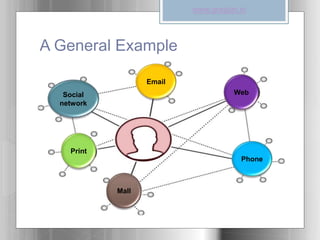
 A general example : a person having
continuous interactions with digital life through
phone, web etc
www.graspin.in
A General Example
Web
Email
Mall
Social
network
Phone
Print
www.graspin.in
Multi-Disciplinary Contributions
UX incorporates contributions from many disciplines,
including:
 interaction design
 human factors engineering (HFE)
 industrial design
 psychology
 anthropology
 sociology
 computer science
 graphic design
 cognitive science
www.graspin.in
Factors that affects UX
 Usefulness: is the product useful, with a clear purpose?
 Usability: is the product easy to use—navigating within and
interacting with—and requiring little need for guidance?
 Learnability: is the product simple to master quickly with
minimal instruction required?
 Aesthetics: is the visual appearance of the product and its
design appealing to the user?
 Emotions: are the emotional feelings evoked in response to
the product and the brand positive, and do they have a lasting
impact on the user and their willingness to use the product?
www.graspin.in
User Centered design methodology
Examining users needs with a series of contextual methods
known as a User-centered Design (UCD) methodology. This
is a framework that enables us to engage with and listen to our
users to determine what they want.
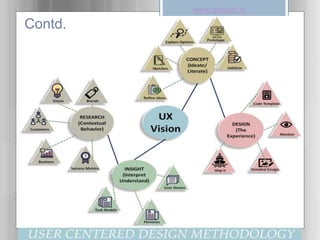
The 4 steps under this methodology is:
 Research phase (understanding the problem and the user
context)
 Insights (making sense of what you’ve found).
 Concept stage (sketching, prototyping, and iterating your
designs, as well as involving users in this process to validate
your approach).
 Design experience (where you implement the final product,
and monitor and improve it over time).
www.graspin.in
Contd.
www.graspin.in
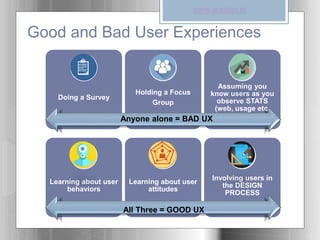
Good and Bad User Experiences
Doing a Survey
Holding a Focus
Group
Assuming you
know users as you
observe STATS
(web, usage etc.
Anyone alone = BAD UX
Learning about user
behaviors
Learning about user
attitudes
Involving users in
the DESIGN
PROCESS
All Three = GOOD UX
www.graspin.in
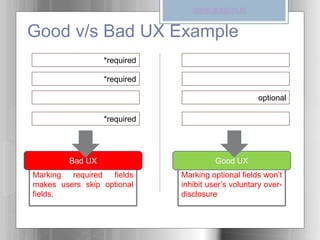
Marking required fields
makes users skip optional
fields.
Bad UX
Good v/s Bad UX Example
www.graspin.in
*required
*required
*required
optional
Marking optional fields won’t
inhibit user’s voluntary over-
disclosure
Good UX

User experience

  • 1.
  • 2.
    Topics covered  Whatis User Experience?  A General Example  Multi-Disciplinary Contributions  Factors that affects ux  Good And Bad User Experiences  Good And Bad UX example www.graspin.in
  • 3.
    What is UserExperience?  User experience (UX) is the amount of a serial interactions of a person with a product, service, or organization.  UX covers a range of interactions a person can have with a business, and in an increasingly connected world i.e., interaction of a person in between Digital and Non Digital world  A general example : a person having continuous interactions with digital life through phone, web etc www.graspin.in
  • 4.
  • 5.
    Multi-Disciplinary Contributions UX incorporatescontributions from many disciplines, including:  interaction design  human factors engineering (HFE)  industrial design  psychology  anthropology  sociology  computer science  graphic design  cognitive science www.graspin.in
  • 6.
    Factors that affectsUX  Usefulness: is the product useful, with a clear purpose?  Usability: is the product easy to use—navigating within and interacting with—and requiring little need for guidance?  Learnability: is the product simple to master quickly with minimal instruction required?  Aesthetics: is the visual appearance of the product and its design appealing to the user?  Emotions: are the emotional feelings evoked in response to the product and the brand positive, and do they have a lasting impact on the user and their willingness to use the product? www.graspin.in
  • 7.
    User Centered designmethodology Examining users needs with a series of contextual methods known as a User-centered Design (UCD) methodology. This is a framework that enables us to engage with and listen to our users to determine what they want. The 4 steps under this methodology is:  Research phase (understanding the problem and the user context)  Insights (making sense of what you’ve found).  Concept stage (sketching, prototyping, and iterating your designs, as well as involving users in this process to validate your approach).  Design experience (where you implement the final product, and monitor and improve it over time). www.graspin.in
  • 8.
  • 9.
    Good and BadUser Experiences Doing a Survey Holding a Focus Group Assuming you know users as you observe STATS (web, usage etc. Anyone alone = BAD UX Learning about user behaviors Learning about user attitudes Involving users in the DESIGN PROCESS All Three = GOOD UX www.graspin.in
  • 10.
    Marking required fields makesusers skip optional fields. Bad UX Good v/s Bad UX Example www.graspin.in *required *required *required optional Marking optional fields won’t inhibit user’s voluntary over- disclosure Good UX