UX crash course for beginners
nguyphadzu@gmail.com
Hanoi Dec 2020
Agenda
1. Fundamental
2. Behavior basics
2
FUNDAMENTAL
3
What is UX?
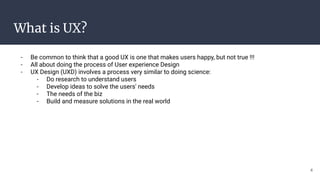
- Be common to think that a good UX is one that makes users happy, but not true !!!
- All about doing the process of User experience Design
- UX Design (UXD) involves a process very similar to doing science:
- Do research to understand users
- Develop ideas to solve the users' needs
- The needs of the biz
- Build and measure solutions in the real world
4
The five main ingredients of UX (1)
- 5 main ingredients of UX: Psychology, Usability, Design, Copywriting, Analysis
- Psychology:
- User's motivation to be here in the first place (motivation)
- How does this make them feel? (emotion)
- How much work does the user have to do to get what they want? (effort)
- What habits are created if they do this over and over? (habits)
- What do they expect when they click this? (expectation)
- Are you assuming they know something that they haven’t learned yet? (ease)
- Anything that they want to do again? Why? How often? (exciting)
- Are you thinking of the user's wants and needs, or your own? (reality)
- Rewarding good behavior (Reward)
5
The five main ingredients of UX (2)
- Usability:
- Job done with less input from the user (less for more)
- Any user mistakes you could prevent?
- Clear and direct
- Easy to find (good) OR hard to miss (better) OR subconsciously expected (best)
- Working with user’s assumptions or against them?
- Have you provided everything the user needs to know?
- Solve by doing something more common?
- Base decisions on your own logic or categories or the user’s intuition?
- If the user doesn't read the fine print, does it still work/ make sense?
6
The five main ingredients of UX (3)
- Design:
- In UX, design is how it works, and it's something you can prove, not a matter of style
- Do users think it looks good? Do they trust it immediately?
- Communicate the purpose and function without words?
- Represent the brand? Does it all feel like the same site?
- Does the design lead the user’s eyes to the right places? How to know?
- Do the colors, shapes, typo help people find what they want and improve usability of the
details?
- Clickable things look different than non-clickable things?
7
The five main ingredients of UX (4)
- Copywriting:
- UX copy gets shit done as directly and simply as possible
- Be confident and tell the user what to do?
- Motivate the user to complete their goal
- Biggest text is the most important text
- Inform the user/ assume that they already understand
- Reduce anxiety
- Clear, direct, simple, functional
8
The five main ingredients of UX (5)
- Analysis: Most designers' weak spot is analysis
- Using data to prove that you are right/ to learn the truth
- Looking for subjective opinions or objective facts
- Collect information that can give answers
- Know why users do that/ interpreting their behavior
- Looking at absolute numbers/ relative improvements
- Measuring the right things
- Looking for bad results
- Use analysis to make improvements
9
Your perspective
- The way you look at a problem can make or break your work
- Before you can start understanding users well:
- You want things that don’t matter to users → empathy
What we want by nature might not be what the users want
Do research, talk to users, study the data
Ask yourself:
+ To choose a feature for your users or having this design in your portfolio, what will you do?
+ If users don't like your design, what would probably be the reason?
+ Have you actually tried the software, or are you just clicking “next" to get through it
- You know things that don’t matter to users → designing for the people who know less than you is
a core part of UX
Users don't know, even do know → users don’t care
Ask yourself:
+ If you didn't read the text, would you understand?
+ If a user had a few clicks to find what they want, would this design be your best bet?
+ Judge a feature based on the time it will take to build it or the value to the user
+ Are your assuming users will click it just because it exists?
10
3 “whats” of user perspective
A good design communicates 3 things: what is this/ benefit for the user/ what should they do next?
- What is this?
Just tell them directly, use simple words.
- Benefit for the user: what can the user gain?
Show users what they will get rather than tell them.
Remember: saying what’s in it for them, not why you want them to register/ buy/ click
User motivation is a thousand times more valuable than beauty or usability
- What should they do next?
There is always a “next" step. Just figure out what the users might need, and tell them how to get it.
11
Solutions vs Ideas
- You should care a lot about creativity, but if your ideas are not meaningful for users - then they are not
meaningful for you. → spend a lot of time to understand problems that mean nothing to you.
- Solutions are ideas that can be wrong. And we can prove that it is wrong.
- In UX, we can test things. We can design more than one solution to the same problem and see which
one is better. And we can ask users which solution they prefer.
- The same solution can be right for one site, and wrong for another.
12
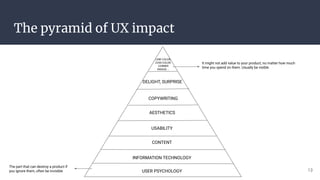
The pyramid of UX impact
USER PSYCHOLOGY
INFORMATION TECHNOLOGY
CONTENT
USABILITY
AESTHETICS
COPYWRITING
DELIGHT, SURPRISE
LINK COLOR,
ICON COLOR,
CORNER
RADIUS ...
It might not add value to your product, no matter how much
time you spend on them. Usually be visible
The part that can destroy a product if
you ignore them, often be invisible 13
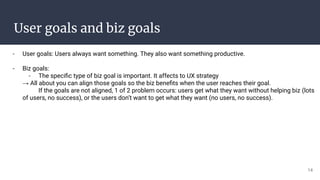
User goals and biz goals
- User goals: Users always want something. They also want something productive.
- Biz goals:
- The specific type of biz goal is important. It affects to UX strategy
→ All about you can align those goals so the biz benefits when the user reaches their goal.
If the goals are not aligned, 1 of 2 problem occurs: users get what they want without helping biz (lots
of users, no success), or the users don’t want to get what they want (no users, no success).
14
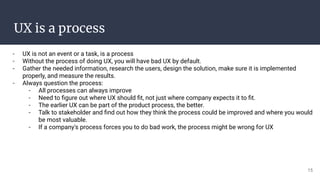
UX is a process
- UX is not an event or a task, is a process
- Without the process of doing UX, you will have bad UX by default.
- Gather the needed information, research the users, design the solution, make sure it is implemented
properly, and measure the results.
- Always question the process:
- All processes can always improve
- Need to figure out where UX should fit, not just where company expects it to fit.
- The earlier UX can be part of the product process, the better.
- Talk to stakeholder and find out how they think the process could be improved and where you would
be most valuable.
- If a company's process forces you to do bad work, the process might be wrong for UX
15
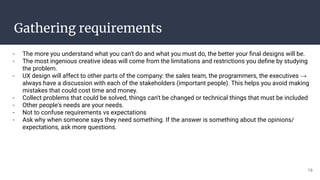
Gathering requirements
- The more you understand what you can't do and what you must do, the better your final designs will be.
- The most ingenious creative ideas will come from the limitations and restrictions you define by studying
the problem.
- UX design will affect to other parts of the company: the sales team, the programmers, the executives →
always have a discussion with each of the stakeholders (important people). This helps you avoid making
mistakes that could cost time and money.
- Collect problems that could be solved, things can't be changed or technical things that must be included
- Other people's needs are your needs.
- Not to confuse requirements vs expectations
- Ask why when someone says they need something. If the answer is something about the opinions/
expectations, ask more questions.
16
Building consensus
- As a UX designer, you need to have reasons to support your design before you design it, and you have to
be able to defend your choices. You might have to prove that you are right.
- Remember: good research, good theory, good data are persuasive. You might prove that you have a solid
understanding of the users, their problems, the goals. Then you take time to explain important ideas to
stakeholders to build agreement among stakeholders.
- Your opinion isn't better than anyone else's. So if you don’t know the answer to a question, admit it, and
say you will find it out. Lying in UX makes us all look bad.
17
BEHAVIOR BASICS
18
Psychology vs Culture
- Psychology: we are all born with the same brain. The details might vary a bit, but overall, it's the same
machine. It's something that you can predict and use in your designs.
- Culture: is different for each of us, in other words, is at individual level.
- Psychology elements can become focused over time as you move toward “optimal" functionality. The
purpose is usually more general, but they have the most impact overall.
- Culture elements will expand over time as users want to personalize or categorize things more and
more. They cannot be optimized, only customized.
UX is the practice of creating non-random effects in people to solve a problem. You make them feel, think
and do stuff - on purpose
19
Experience definition
An experience consists six parts:
- What the user feels?
- What the user wants? User's motivations are the engine of behavior
- What the user thinks? Psychologists call it cognitive load. If you give the users too many things to
carry, they will drop everything.
- What the user believes? Your intuition has predictable flaws that most people don't know about. If you
know about them, it allows you to predict what people will believe, before they believe it.
- What the user remembers? We only remember certain parts, we change those memories over time,
and sometimes we remember things that never even happened. Your design can determine which
parts someone remembers, and which are forgotten.
- What the user doesn’t realize?
UX designers must also design things that users will never notice, never give you feedback on, and maybe
never remember, like information architecture & heuristics (models of how users act). Those design
elements will change the user's behavior, and only the data can show you how.
20
Conscious vs subconscious experience
Conscious experience:
- To create something delight (wow experience), there is a truth you should note: the user must be
aware of it consciously.
- Conscious mind (Daniel Kahneman - Nobel prize winning psychologist) is like a supporting character
who believes herself to be the lead actor and often has little idea of what's going on.
- Consequence of conscious experience you might know: share, like, comment, download, register. For
example: YouTube often tells you subscribe at the end of each video.
Subconscious experience:
- It's how we decide what we trust, what we believe, and what is easy
- A user will only notice that your form design is easy if they expected it to be harder, otherwise they
might not even mention it. Things are supposed to be easy → Subconscious design.
- If you want users to trust or understand, your design must feel trustworthy or obvious. The more aware
the user is of your form design, the worse the experience. It should feel automatic. The more clever
you get with your form design, or your copywriting, the less people will finish the form.
21
Emotions
- Emotions come in two flavors: good and bad, positive and negative, happy and unhappy → gain and
loss. Gains give you positive feelings. Losses give you negative feelings.
- Emotions are reactions, not goals.
- There are two types of feelings: emotions and motivations. Motivations are what we want (feelings),
and emotions are how we feel when we gain or lose what we want (feedback) → Tips: you can give the
user a score, or an email, or a badge, or levels, or likes, or followers, or any other method of feedback
so they feel useful emotions about their gains and losses.
- Time makes emotions more complicated. → Tips: Think about more than happiness. Manage the
user's feelings throughout their experience by giving them the information and signals they need to feel
comfortable.
22
Motivations
- Motivations are built-in psychological needs.
- Motivations can fall anywhere between conscious experience and subconscious experience
- Motivations are relative. It's about how much more you get compared to what you have or what other
people have.
- Fourteen universal motivations: it can be useful in UX, some of those are the foundation of
gamification and social networks. They are:
- Avoid death, avoid pain, air/water/food/ homeostasis, sleep, sex, love
- Protection of children
- Affiliation
- Status
- Justice
- Understanding
When users become loyal or have a deep appreciation for your product, it's because of gains in these
motivations.
23
Motivation - Sex and love
- Sex is motivation to touch each other's warm and fuzzy parts, love is the motivation that feels all
warm and fuzzy.
- As an UX designer, you should provide the info users need to judge “quality" (popularity, interests,
physical appearance, etc) and to find whatever matches their taste, such as: a number of followers and
a picture, videos & descriptions & niche categories. Fun fact: porn sites consider one-handed
navigation experience.
- Love is made of hopes and dreams and caring and mutual interest… Love, basically, is the motivation
to reciprocate motivations with someone else.
- As an UX designer, helping users to find love is like helping them shop for a dishwasher. They only
need one, everyone has their own idea of what is “perfect". Provide features to filter, compare, ask
questions, save, follow-up...
24
Motivation - Affiliation
- Affiliation is the desire to belong. It bases on the matter when you compare yourself to other people.
- As an UX designer, you should allow users to belong to a group or be identified by things they have in
common.
25
Motivation - Status
- People always want to be in charge of themselves and their own decisions.
- You should let users have control, but help them make better decisions if you can and eliminate any
chance of a major screw-up. Confirm dangerous choices or make choices hard to do accidentally.
- Anything that can be done by all users, can become a competition. So we should choose a way to use
competitive motivation (e.g. looking good in a profile picture, having the most followers)
- Never move down. Remember: user is motivated protect what he has gained.
→ As an UX designer, you should let user personalize some features, and never take big choices out of their
control. Create a way to measure users' actions so they can compare themselves to others.
26
Motivation - Justice
- Justice is our emotional need for balance in the force.
- The most interesting about justice motivation is that only applies to other motivation.
→ As an UX designer, you should have rules of conduct, or symbols of respect and honor, or give users the
power to choose champions.
27
Motivation - Understanding (curiosity)
- Understanding is the motivation to get information about a situation that involve other motivations
- Marketers and designers screw this motivation all the time
- 3 rules for creating curiosity:
- The user must understand enough to know there will be a gain or loss in one of the other
motivations.
- The bigger the gain or loss seems to be, the more interesting it becomes.
- Hold something back.
- Users will choose something they understand over something they don't, if you give them a choice. It
doesn't matter which one is actually better.
- When you change or remove features, tell users what is coming, tell them why, show how it work, and
give them time to adjust. Otherwise, users will be angry or afraid, because you're taking away
something they already understand.
28

UX crash course - part 1

  • 1.
    UX crash coursefor beginners nguyphadzu@gmail.com Hanoi Dec 2020
  • 2.
  • 3.
  • 4.
    What is UX? -Be common to think that a good UX is one that makes users happy, but not true !!! - All about doing the process of User experience Design - UX Design (UXD) involves a process very similar to doing science: - Do research to understand users - Develop ideas to solve the users' needs - The needs of the biz - Build and measure solutions in the real world 4
  • 5.
    The five mainingredients of UX (1) - 5 main ingredients of UX: Psychology, Usability, Design, Copywriting, Analysis - Psychology: - User's motivation to be here in the first place (motivation) - How does this make them feel? (emotion) - How much work does the user have to do to get what they want? (effort) - What habits are created if they do this over and over? (habits) - What do they expect when they click this? (expectation) - Are you assuming they know something that they haven’t learned yet? (ease) - Anything that they want to do again? Why? How often? (exciting) - Are you thinking of the user's wants and needs, or your own? (reality) - Rewarding good behavior (Reward) 5
  • 6.
    The five mainingredients of UX (2) - Usability: - Job done with less input from the user (less for more) - Any user mistakes you could prevent? - Clear and direct - Easy to find (good) OR hard to miss (better) OR subconsciously expected (best) - Working with user’s assumptions or against them? - Have you provided everything the user needs to know? - Solve by doing something more common? - Base decisions on your own logic or categories or the user’s intuition? - If the user doesn't read the fine print, does it still work/ make sense? 6
  • 7.
    The five mainingredients of UX (3) - Design: - In UX, design is how it works, and it's something you can prove, not a matter of style - Do users think it looks good? Do they trust it immediately? - Communicate the purpose and function without words? - Represent the brand? Does it all feel like the same site? - Does the design lead the user’s eyes to the right places? How to know? - Do the colors, shapes, typo help people find what they want and improve usability of the details? - Clickable things look different than non-clickable things? 7
  • 8.
    The five mainingredients of UX (4) - Copywriting: - UX copy gets shit done as directly and simply as possible - Be confident and tell the user what to do? - Motivate the user to complete their goal - Biggest text is the most important text - Inform the user/ assume that they already understand - Reduce anxiety - Clear, direct, simple, functional 8
  • 9.
    The five mainingredients of UX (5) - Analysis: Most designers' weak spot is analysis - Using data to prove that you are right/ to learn the truth - Looking for subjective opinions or objective facts - Collect information that can give answers - Know why users do that/ interpreting their behavior - Looking at absolute numbers/ relative improvements - Measuring the right things - Looking for bad results - Use analysis to make improvements 9
  • 10.
    Your perspective - Theway you look at a problem can make or break your work - Before you can start understanding users well: - You want things that don’t matter to users → empathy What we want by nature might not be what the users want Do research, talk to users, study the data Ask yourself: + To choose a feature for your users or having this design in your portfolio, what will you do? + If users don't like your design, what would probably be the reason? + Have you actually tried the software, or are you just clicking “next" to get through it - You know things that don’t matter to users → designing for the people who know less than you is a core part of UX Users don't know, even do know → users don’t care Ask yourself: + If you didn't read the text, would you understand? + If a user had a few clicks to find what they want, would this design be your best bet? + Judge a feature based on the time it will take to build it or the value to the user + Are your assuming users will click it just because it exists? 10
  • 11.
    3 “whats” ofuser perspective A good design communicates 3 things: what is this/ benefit for the user/ what should they do next? - What is this? Just tell them directly, use simple words. - Benefit for the user: what can the user gain? Show users what they will get rather than tell them. Remember: saying what’s in it for them, not why you want them to register/ buy/ click User motivation is a thousand times more valuable than beauty or usability - What should they do next? There is always a “next" step. Just figure out what the users might need, and tell them how to get it. 11
  • 12.
    Solutions vs Ideas -You should care a lot about creativity, but if your ideas are not meaningful for users - then they are not meaningful for you. → spend a lot of time to understand problems that mean nothing to you. - Solutions are ideas that can be wrong. And we can prove that it is wrong. - In UX, we can test things. We can design more than one solution to the same problem and see which one is better. And we can ask users which solution they prefer. - The same solution can be right for one site, and wrong for another. 12
  • 13.
    The pyramid ofUX impact USER PSYCHOLOGY INFORMATION TECHNOLOGY CONTENT USABILITY AESTHETICS COPYWRITING DELIGHT, SURPRISE LINK COLOR, ICON COLOR, CORNER RADIUS ... It might not add value to your product, no matter how much time you spend on them. Usually be visible The part that can destroy a product if you ignore them, often be invisible 13
  • 14.
    User goals andbiz goals - User goals: Users always want something. They also want something productive. - Biz goals: - The specific type of biz goal is important. It affects to UX strategy → All about you can align those goals so the biz benefits when the user reaches their goal. If the goals are not aligned, 1 of 2 problem occurs: users get what they want without helping biz (lots of users, no success), or the users don’t want to get what they want (no users, no success). 14
  • 15.
    UX is aprocess - UX is not an event or a task, is a process - Without the process of doing UX, you will have bad UX by default. - Gather the needed information, research the users, design the solution, make sure it is implemented properly, and measure the results. - Always question the process: - All processes can always improve - Need to figure out where UX should fit, not just where company expects it to fit. - The earlier UX can be part of the product process, the better. - Talk to stakeholder and find out how they think the process could be improved and where you would be most valuable. - If a company's process forces you to do bad work, the process might be wrong for UX 15
  • 16.
    Gathering requirements - Themore you understand what you can't do and what you must do, the better your final designs will be. - The most ingenious creative ideas will come from the limitations and restrictions you define by studying the problem. - UX design will affect to other parts of the company: the sales team, the programmers, the executives → always have a discussion with each of the stakeholders (important people). This helps you avoid making mistakes that could cost time and money. - Collect problems that could be solved, things can't be changed or technical things that must be included - Other people's needs are your needs. - Not to confuse requirements vs expectations - Ask why when someone says they need something. If the answer is something about the opinions/ expectations, ask more questions. 16
  • 17.
    Building consensus - Asa UX designer, you need to have reasons to support your design before you design it, and you have to be able to defend your choices. You might have to prove that you are right. - Remember: good research, good theory, good data are persuasive. You might prove that you have a solid understanding of the users, their problems, the goals. Then you take time to explain important ideas to stakeholders to build agreement among stakeholders. - Your opinion isn't better than anyone else's. So if you don’t know the answer to a question, admit it, and say you will find it out. Lying in UX makes us all look bad. 17
  • 18.
  • 19.
    Psychology vs Culture -Psychology: we are all born with the same brain. The details might vary a bit, but overall, it's the same machine. It's something that you can predict and use in your designs. - Culture: is different for each of us, in other words, is at individual level. - Psychology elements can become focused over time as you move toward “optimal" functionality. The purpose is usually more general, but they have the most impact overall. - Culture elements will expand over time as users want to personalize or categorize things more and more. They cannot be optimized, only customized. UX is the practice of creating non-random effects in people to solve a problem. You make them feel, think and do stuff - on purpose 19
  • 20.
    Experience definition An experienceconsists six parts: - What the user feels? - What the user wants? User's motivations are the engine of behavior - What the user thinks? Psychologists call it cognitive load. If you give the users too many things to carry, they will drop everything. - What the user believes? Your intuition has predictable flaws that most people don't know about. If you know about them, it allows you to predict what people will believe, before they believe it. - What the user remembers? We only remember certain parts, we change those memories over time, and sometimes we remember things that never even happened. Your design can determine which parts someone remembers, and which are forgotten. - What the user doesn’t realize? UX designers must also design things that users will never notice, never give you feedback on, and maybe never remember, like information architecture & heuristics (models of how users act). Those design elements will change the user's behavior, and only the data can show you how. 20
  • 21.
    Conscious vs subconsciousexperience Conscious experience: - To create something delight (wow experience), there is a truth you should note: the user must be aware of it consciously. - Conscious mind (Daniel Kahneman - Nobel prize winning psychologist) is like a supporting character who believes herself to be the lead actor and often has little idea of what's going on. - Consequence of conscious experience you might know: share, like, comment, download, register. For example: YouTube often tells you subscribe at the end of each video. Subconscious experience: - It's how we decide what we trust, what we believe, and what is easy - A user will only notice that your form design is easy if they expected it to be harder, otherwise they might not even mention it. Things are supposed to be easy → Subconscious design. - If you want users to trust or understand, your design must feel trustworthy or obvious. The more aware the user is of your form design, the worse the experience. It should feel automatic. The more clever you get with your form design, or your copywriting, the less people will finish the form. 21
  • 22.
    Emotions - Emotions comein two flavors: good and bad, positive and negative, happy and unhappy → gain and loss. Gains give you positive feelings. Losses give you negative feelings. - Emotions are reactions, not goals. - There are two types of feelings: emotions and motivations. Motivations are what we want (feelings), and emotions are how we feel when we gain or lose what we want (feedback) → Tips: you can give the user a score, or an email, or a badge, or levels, or likes, or followers, or any other method of feedback so they feel useful emotions about their gains and losses. - Time makes emotions more complicated. → Tips: Think about more than happiness. Manage the user's feelings throughout their experience by giving them the information and signals they need to feel comfortable. 22
  • 23.
    Motivations - Motivations arebuilt-in psychological needs. - Motivations can fall anywhere between conscious experience and subconscious experience - Motivations are relative. It's about how much more you get compared to what you have or what other people have. - Fourteen universal motivations: it can be useful in UX, some of those are the foundation of gamification and social networks. They are: - Avoid death, avoid pain, air/water/food/ homeostasis, sleep, sex, love - Protection of children - Affiliation - Status - Justice - Understanding When users become loyal or have a deep appreciation for your product, it's because of gains in these motivations. 23
  • 24.
    Motivation - Sexand love - Sex is motivation to touch each other's warm and fuzzy parts, love is the motivation that feels all warm and fuzzy. - As an UX designer, you should provide the info users need to judge “quality" (popularity, interests, physical appearance, etc) and to find whatever matches their taste, such as: a number of followers and a picture, videos & descriptions & niche categories. Fun fact: porn sites consider one-handed navigation experience. - Love is made of hopes and dreams and caring and mutual interest… Love, basically, is the motivation to reciprocate motivations with someone else. - As an UX designer, helping users to find love is like helping them shop for a dishwasher. They only need one, everyone has their own idea of what is “perfect". Provide features to filter, compare, ask questions, save, follow-up... 24
  • 25.
    Motivation - Affiliation -Affiliation is the desire to belong. It bases on the matter when you compare yourself to other people. - As an UX designer, you should allow users to belong to a group or be identified by things they have in common. 25
  • 26.
    Motivation - Status -People always want to be in charge of themselves and their own decisions. - You should let users have control, but help them make better decisions if you can and eliminate any chance of a major screw-up. Confirm dangerous choices or make choices hard to do accidentally. - Anything that can be done by all users, can become a competition. So we should choose a way to use competitive motivation (e.g. looking good in a profile picture, having the most followers) - Never move down. Remember: user is motivated protect what he has gained. → As an UX designer, you should let user personalize some features, and never take big choices out of their control. Create a way to measure users' actions so they can compare themselves to others. 26
  • 27.
    Motivation - Justice -Justice is our emotional need for balance in the force. - The most interesting about justice motivation is that only applies to other motivation. → As an UX designer, you should have rules of conduct, or symbols of respect and honor, or give users the power to choose champions. 27
  • 28.
    Motivation - Understanding(curiosity) - Understanding is the motivation to get information about a situation that involve other motivations - Marketers and designers screw this motivation all the time - 3 rules for creating curiosity: - The user must understand enough to know there will be a gain or loss in one of the other motivations. - The bigger the gain or loss seems to be, the more interesting it becomes. - Hold something back. - Users will choose something they understand over something they don't, if you give them a choice. It doesn't matter which one is actually better. - When you change or remove features, tell users what is coming, tell them why, show how it work, and give them time to adjust. Otherwise, users will be angry or afraid, because you're taking away something they already understand. 28