Chapter 15:
IMMIGRATIONAND
URBANIZATIONObjectives:
1.Explain howU.S. immigration patterns changed during the
late 1800s.
2.Describe the challenges immigrants faced in a new life.
3.Why some people were against immigration.
Key Vocabulary:
Ellis Island, Angel Island, melting pot,
nativism, Chinese Exclusion Act,
Gentleman’s Agreement
3.
Academic Vocabulary
• Persecution-punishment for your beliefs
• Push factor- reason to leave a place
• Pull factor- reason to enter a new place
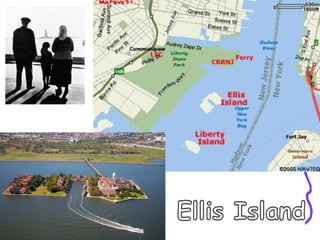
Arrival at EllisIsland
• http://my.hrw.com/SocialStudies/ss_2010/
student/hs_american_survey/bookpages/li
brary/videos/video.html?
shortvid=722240938001&longvid=722240
938001_long&title=Arrival at Ellis Island
Why are immigrantscoming to
America?
• Between 1870 and 1920, about 20
million Europeans immigrated to the US
• Many came from eastern and southern
Europe
• Why did they come:
»Escape religious persecution
»Many were poor, looking to improve
their lives
»Others wanted greater freedom
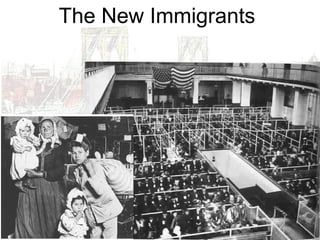
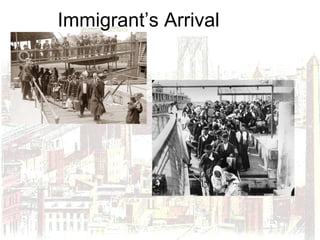
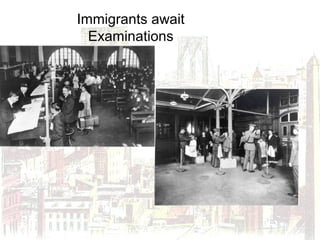
Quick-Write
• Looking atthe images, generate (think
of) a list of 5-10 words related the
pictures.
• Copy the words from the class list.
• Then, use all of the words on the class
list to write a paragraph about the
immigrants’ arrival on Ellis Island.
Immigrants from Asia
•A smaller number of immigrants came
from Asia
• Around 200,000 Chinese immigrants
came between 1851 to 1883
• They arrived on the West Coast
– Many Chinese immigrants helped to
build the nation’s transcontinental
railroad
16.
More Immigrants
• WhenHawaii was annexed in 1898,
several thousand Japanese immigrants
came to the US
• More immigrants came from various
islands in the Caribbean Sea
• Many Mexicans came to the US, about a
million between 1910-1930
17.
Life in theNew Land
• Immigrants traveled by steamship, harsh
conditions on the ships (many died
before reaching the US)
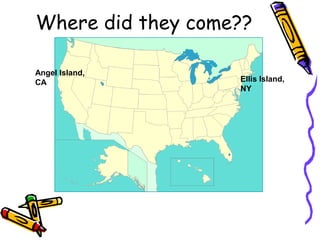
• Once here immigrants were inspected at
either
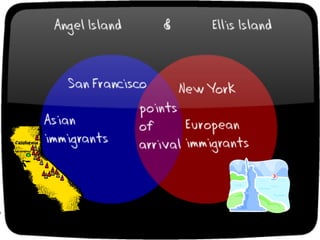
– Ellis Island (New York)
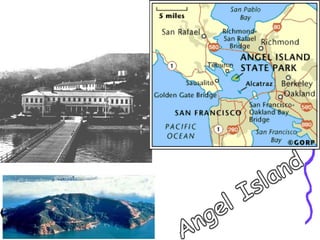
– Angel Island (San Francisco)
Officials at these 2 inspection stations
deiced if immigrants could enter the
country or if they had to return to
their native country
18.
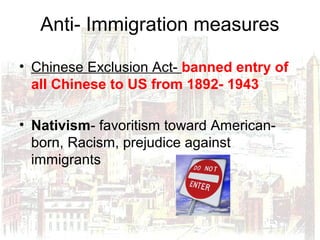
Anti- Immigration measures
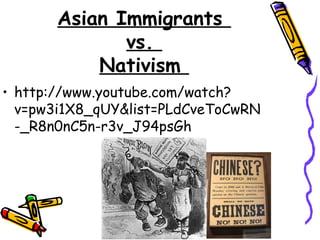
•Chinese Exclusion Act- banned entry of
all Chinese to US from 1892- 1943
• Nativism- favoritism toward American-
born, Racism, prejudice against
immigrants
19.
Old World toNew
• http://my.hrw.com/SocialStudies/ss_2010/
student/hs_american_survey/bookpages/li
brary/videos/video.html?
shortvid=721472781001&longvid=721472
781001_long&title=Italians in America: Old
World, New Land
20.
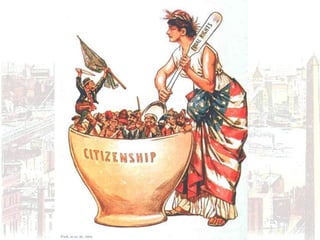
Melting Pot
• Meltingpot- blend of different
cultures who abandon their native
culture
Adjusting to Lifein America
• A new country and a new language was a
great challenge for immigrants
• Many immigrants settled in communities
with other immigrants from the same
country
• They also formed organizations to help
each other (start of gangs in the big
cities)
30.
Immigration Restrictions
• Bythe turn of the century, some called
American a melting pot, a blend of
different cultures and races
• Many new immigrants refused to give up
their culture to become par of American
society
• The arrival of immigrants led to the growth of
NATIVISM, the preference for native-born
Americans
31.
Nativism
• Anti-immigration- Pro-American-
favoritism toward Native-born Americans
–Effects:
• Led to prejudice, racism Chinese
Exclusion Act
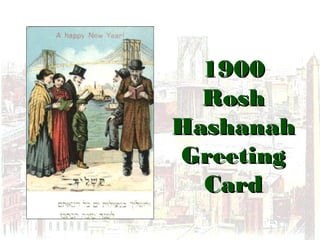
• Anti- Catholic or Anti- Jewish attacks,
barred from jobs
Chinese Exclusion Act
•After examining the documents, please
answer in 2-3 paragraphs (one-
page,written):
• What factors contributed to the
Chinese Exclusion Act? Why did
Americans pass the Act in 1882?
Hand in by end of period!
34.
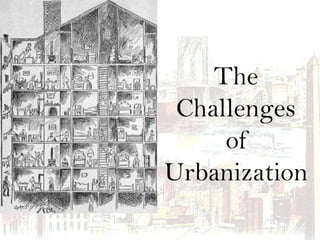
15-2: Challenges ofUrbanization
• Objectives:
• - Describe movement of immigrants into cities
• Explain how cities dealt with housing and other
problems
• How organizations helped immigrants in cities
Vocabulary:
Urbanization, Americanization movement,
tenement, mass transit, Social Gospel
movement, settlement house, Jane Addams
35.
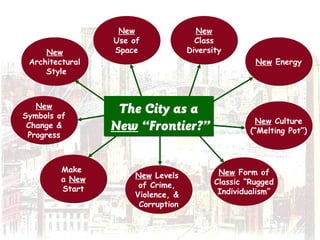
New
Architectural
Style
New
Architectural
Style
New
Use of
Space
New
Use of
Space
New
Class
Diversity
New
Class
Diversity
NewEnergyNew Energy
New Culture
(“Melting Pot”)
New Culture
(“Melting Pot”)
New Form of
Classic “Rugged
Individualism”
New Form of
Classic “Rugged
Individualism”
New Levels
of Crime,
Violence, &
Corruption
New Levels
of Crime,
Violence, &
Corruption
Make
a New
Start
Make
a New
Start
New
Symbols of
Change &
Progress
New
Symbols of
Change &
Progress
The City as a
New “Frontier?”
The City as a
New “Frontier?”
36.
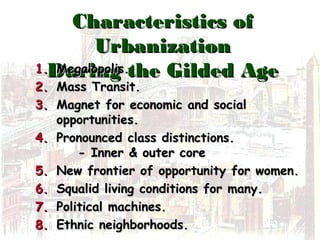
Characteristics ofCharacteristics of
UrbanizationUrbanization
Duringthe Gilded AgeDuring the Gilded Age1.1. Megalopolis.Megalopolis.
2.2. Mass Transit.Mass Transit.
3.3. Magnet for economic and socialMagnet for economic and social
opportunities.opportunities.
4.4. Pronounced class distinctions.Pronounced class distinctions.
- Inner & outer core- Inner & outer core
5.5. New frontier of opportunity for women.New frontier of opportunity for women.
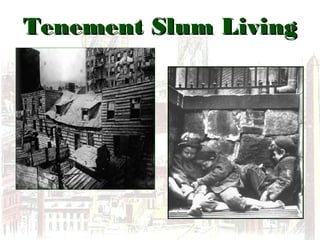
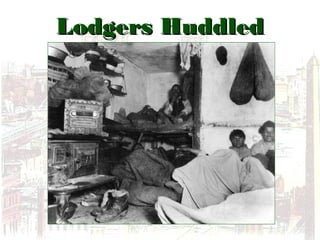
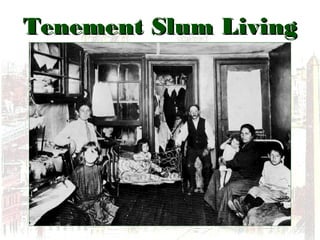
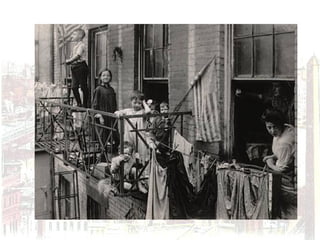
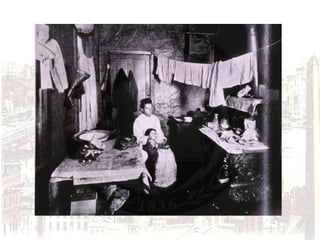
6.6. Squalid living conditions for many.Squalid living conditions for many.
7.7. Political machines.Political machines.
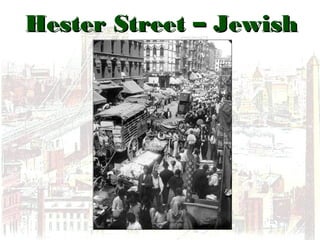
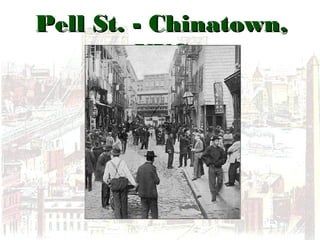
8.8. Ethnic neighborhoods.Ethnic neighborhoods.
Big Question- handin!
1-2 paragraphs- 10 minutes-10 points
• Compare the lives of immigrants
living in cities today vs. in the late
1800s/early 1900s. What do you
think is similar/different about their
experiences?
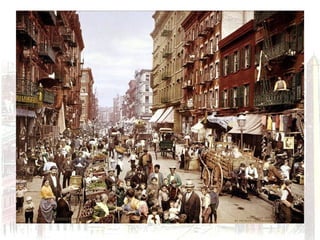
Urbanization
• Rapid growthof cities, was centered in
areas in the Northeast and Midwest
• Most immigrants settled in American Cities
(Boston, New York City, Philadelphia)
• Cities offered jobs in mills and
factories
44.
Making Immigrants “American”
•Americanization Movement: program
designed to absorb immigrants into the
American culture
• This program was supported by the
government and concerned American
citizens
• Programs to teach English, cooking, and
social etiquette (manners)
Real Gangs ofNew York
• https://www.youtube.com/watch?
v=Idp7fLSo-nE
47.
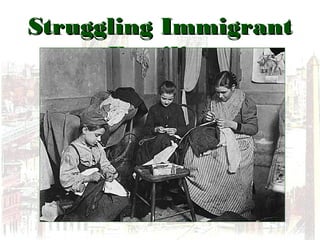
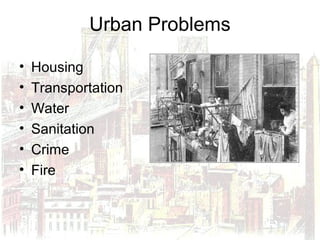
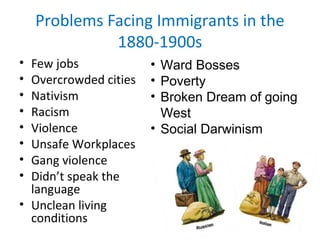
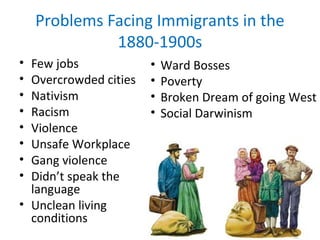
Problems Facing Immigrantsin the
1880-1900s
• Few jobs
• Overcrowded cities
• Nativism
• Racism
• Violence
• Unsafe Workplaces
• Gang violence
• Didn’t speak the
language
• Unclean living
conditions
• Ward Bosses
• Poverty
• Broken Dream of going
West
• Social Darwinism
48.
Create this “T”-Chart& complete it
Immigrants’ Vision of America Reality of America
(1) Streets paved in gold (1)
(2) (2)prejudice
(3) Free land (3)
(4) (4)
49.
Reformers
• Social Gospelmovement: reform
program that preached service to the poor
• Created community centers in the slums
to help the people in the cities
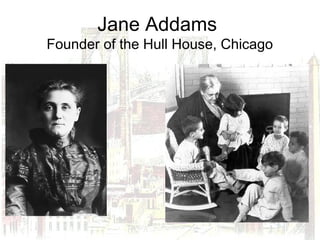
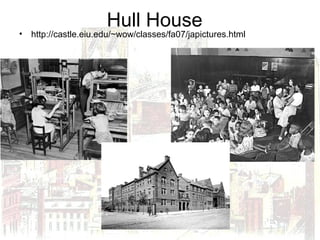
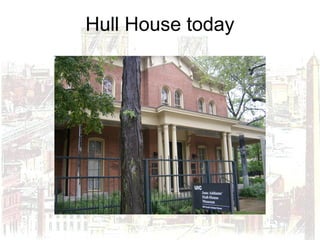
• Jane Addams: important member-created
Chicago’s Hull House
Problems Facing Immigrantsin the
1880-1900s
• Few jobs
• Overcrowded cities
• Nativism
• Racism
• Violence
• Unsafe Workplaces
• Gang violence
• Didn’t speak the
language
• Unclean living
conditions
• Ward Bosses
• Poverty
• Broken Dream of going West
• Social Darwinism
55.
Writing Assignment
• Ina 4 paragraph response, please answer the
following prompt
Why did Immigrants leave their home
countries to come to America, and
what were three problems they ran
into once they arrived?
56.
Essay Outline:
• Paragraph#1: Introduction (countries of origin,
reasons for immigration, problems they faced)
• Paragraph #2: 1st
problem
• Paragraph #3: 2nd
problem
• Paragraph #4: Conclusion (review two major issues
they ran into, discuss why immigrants stayed in the
USA even if their lives were difficult)
57.
By: Susan M.Pojer
Horace Greeley HS Chappaqua, NY
By: Susan M. Pojer
Horace Greeley HS Chappaqua, NY
59.
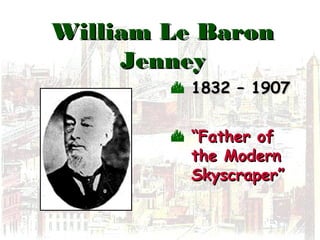
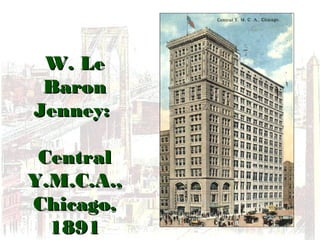
William Le BaronWilliamLe Baron
JenneyJenney
1832 – 19071832 – 1907
““Father ofFather of
the Modernthe Modern
Skyscraper”Skyscraper”
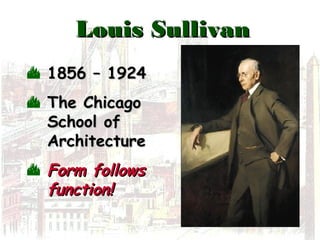
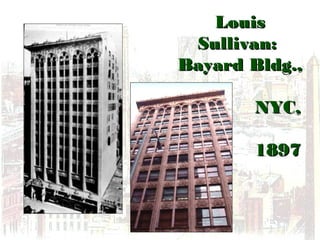
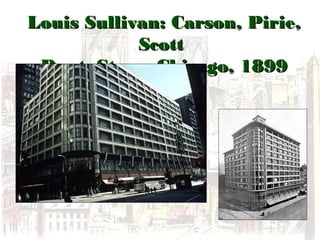
Louis SullivanLouis Sullivan
1856 – 19241856 – 1924
The ChicagoThe Chicago
School ofSchool of
ArchitectureArchitecture
Form followsForm follows
function!function!
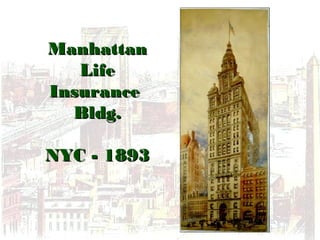
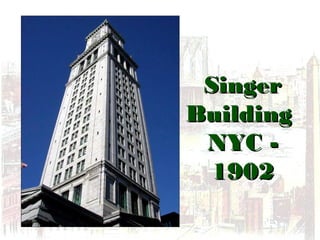
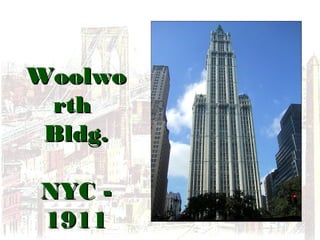
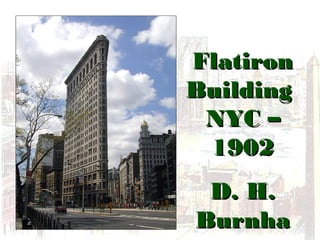
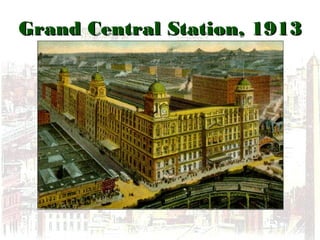
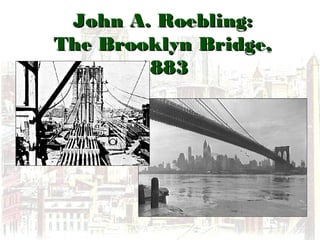
New York CityArchitectural Style:New York City Architectural Style:
1870s-1910s1870s-1910s
1.1. The style was less innovative thanThe style was less innovative than
in Chicago.in Chicago.
2.2. NYC was the source of the capital forNYC was the source of the capital for
Chicago.Chicago.
3.3. Most major business firms had theirMost major business firms had their
headquarters in NYCheadquarters in NYC their bldgs.their bldgs.
became “logos” for their companies.became “logos” for their companies.
4.4. NYC buildings and skyscrapers wereNYC buildings and skyscrapers were
taller than in Chicago.taller than in Chicago.
Mini Quiz
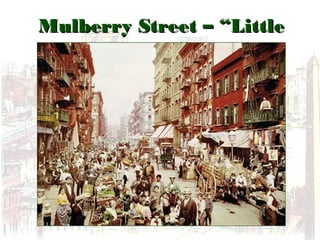
1. Nametwo ethnic neighborhoods in New York City and list
the ethnic group who lives there.
2. Why do you think immigrants lived near each other?
106.
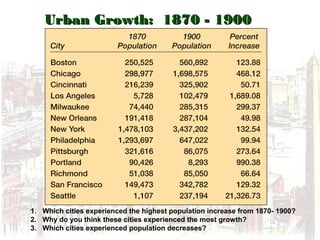
Urban Growth: 1870- 1900Urban Growth: 1870 - 1900
1. Which cities experienced the highest population increase from 1870- 1900?
2. Why do you think these cities experienced the most growth?
3. Which cities experienced population decreases?




![DH Burnham:DH Burnham:
Fisher [Apt.] Bldg,Fisher [Apt.] Bldg,
Chicago, 1896Chicago, 1896](https://image.slidesharecdn.com/15-1and15-2ppt-160115153346/85/Ch-15-Section-1-2-Immigration-66-320.jpg)
![Frank Lloyd Wright:Frank Lloyd Wright:
Hollyhock House [LosHollyhock House [Los
Angeles], 1917Angeles], 1917](https://image.slidesharecdn.com/15-1and15-2ppt-160115153346/85/Ch-15-Section-1-2-Immigration-71-320.jpg)