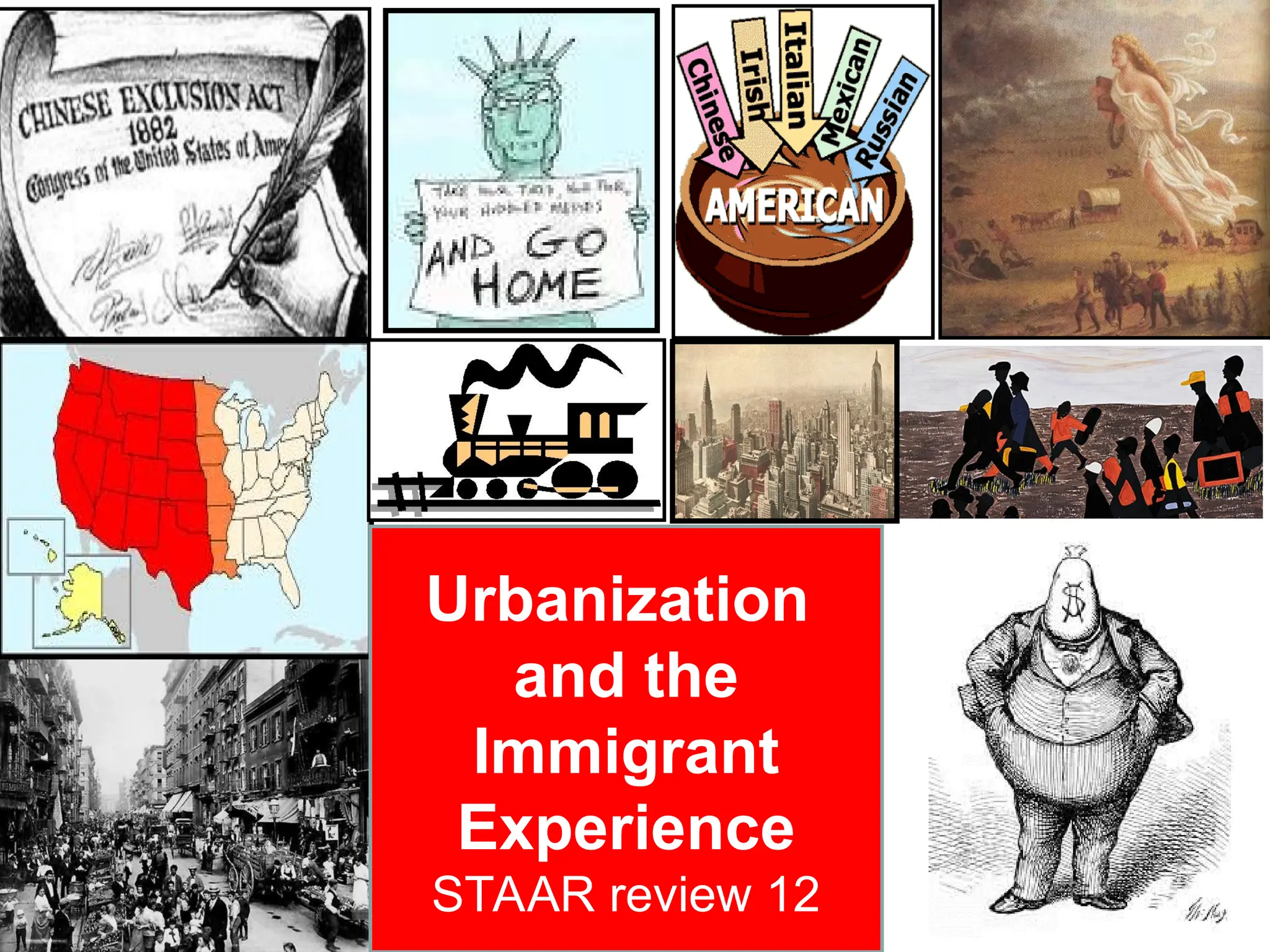
Urbanization
and the
Immigrant
Experience
STAAR review 12
TEKS – A Changing Society
• US.12 (A) analyze the impact of physical and human geographic factors on the
settlement of the Great Plains, the Klondike Gold Rush (pg. 34)
• US.13 (A) analyze the causes and effects of changing demographic patterns resulting
from migration within the United States, including western expansion, rural to urban,
the Great Migration, (pg. 35)
• US.13 (B) analyze the causes and effects of changing demographic patterns
resulting from legal and illegal immigration to the United States. (pg. 36)
• US.14 (A) identify the effects of population growth and distribution on the physical
environment; (pg. 37)
• US.25 (B) describe impacts of significant cultural movements country and western
music on American society; (pg. 50)
• US.3 (D) describe the optimism of the many immigrants who sought a better life in
America. (pg. 62)
• US.15 (A) describe how the economic impact of the Transcontinental Railroad and
Homestead Act contributed to the close of the frontier in the late 19th century; (pg. 93)
• US.15 (C) explain how foreign policies affected economic issues such as the
Chinese Exclusion Act of 1882, and immigration quotas; (pg. 94)
• US.23 (B) evaluate various means of achieving equality of political rights,
congressional acts such as the American Indian Citizenship Act of 1924; (pg. 109)
• US.26 (B) discuss the Americanization movement to assimilate immigrants and
American Indians into American culture; (pg. 115)
Learning Objective
• US.13 (A) analyze the causes and effects of changing demographic
patterns resulting from migration within the United States, including
western expansion, rural to urban, the Great Migration, (pg. 35)
• US.3 (D) describe the optimism of the many immigrants who
sought a better life in America. (pg. 62)
• US.15 (C) explain how foreign policies affected economic issues
such as the Chinese Exclusion Act of 1882, and immigration
quotas; (pg. 94)
Vocabulary
 Nativists – Anti-immigrant groups who support protecting the ‘natives’
(those here first) at the expense of immigrants. “Welcome to America,
now go home.”
 Assimilation – adopting the culture of a particular nation, forcing
someone to give up their culture, language, religion, etc. to become
‘similar’ to others. Often called ‘Americanization’.
 Political Machines – politicians that used bribery and votes in return
for favors to stay in office. Led to corruption in government.
Proof of Learning
Critical Writing and Purposeful Talk
By the end of the lesson you will be expected to –
•Discuss with your partner/group –
– Analyze why ‘nativists’ hated on immigrants and do you think
this still happens today? Give support for your opinion.
– Compare and Contrast the ‘good’ and the ‘bad’ of political
machines.
•Critical Writing –
• You are a ‘New’ Immigrant and have been in the USA for a
short time. Write a letter home to a loved one telling them
about the Push/Pull factors that led you to America.
• Describe how your immigrant experience. (problems with
housing, jobs, friends, neighbors, language, other cultures)
Urbanization
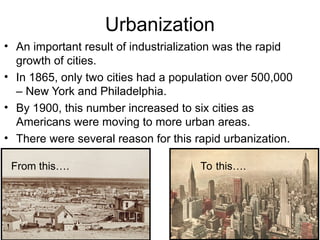
• An important result of industrialization was the rapid
growth of cities.
• In 1865, only two cities had a population over 500,000
– New York and Philadelphia.
• By 1900, this number increased to six cities as
Americans were moving to more urban areas.
• There were several reason for this rapid urbanization.
From this…. To this….
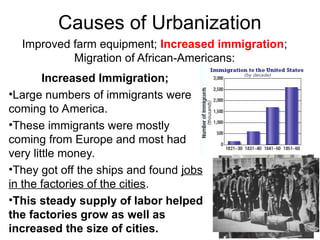
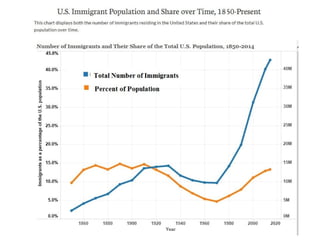
Increased Immigration;
•Large numbers of immigrants were
coming to America.
•These immigrants were mostly
coming from Europe and most had
very little money.
•They got off the ships and found jobs
in the factories of the cities.
•This steady supply of labor helped
the factories grow as well as
increased the size of cities.
Causes of Urbanization
Improved farm equipment; Increased immigration;
Migration of African-Americans:
Immigration
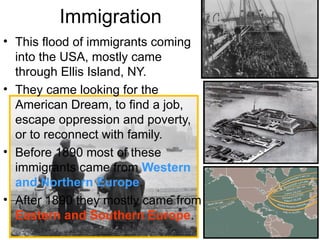
• This flood of immigrants coming
into the USA, mostly came
through Ellis Island, NY.
• They came looking for the
American Dream, to find a job,
escape oppression and poverty,
or to reconnect with family.
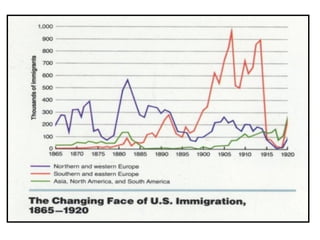
• Before 1890 most of these
immigrants came from Western
and Northern Europe.
• After 1890 they mostly came from
Eastern and Southern Europe.
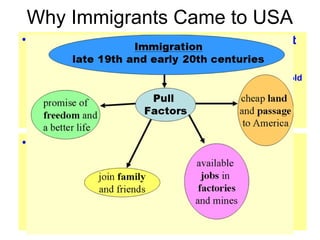
Why Immigrants Came to USA
• Push Factors – things that force people to
leave their home country for another
– Wars in their homelands
– Famines (a severe lack of food)
– Lack of quality jobs
– Political unrest (bad leaders)
– Religious differences
• Pull Factors – things that make a person want
to move to another country
– Religious freedoms
– Job opportunities in factories, Transcontinental Railroad, gold
mines, etc.
– Stable, democratic governments
– Hook up with family members already here
– Availability of cheap or free land
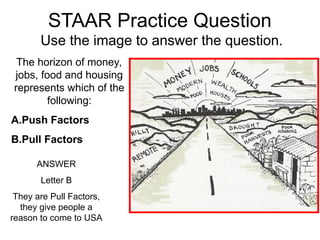
Use the image to answer the question.
STAAR Practice Question
The horizon of money,
jobs, food and housing
represents which of the
following:
A.Push Factors
B.Pull Factors
ANSWER
Letter B
They are Pull Factors,
they give people a
reason to come to USA
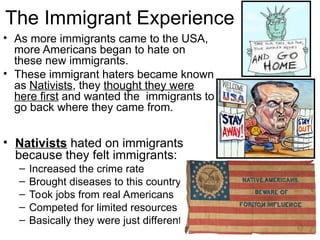
The Immigrant Experience
• As more immigrants came to the USA,
more Americans began to hate on
these new immigrants.
• These immigrant haters became known
as Nativists, they thought they were
here first and wanted the immigrants to
go back where they came from.
• Nativists hated on immigrants
because they felt immigrants:
– Increased the crime rate
– Brought diseases to this country
– Took jobs from real Americans
– Competed for limited resources
– Basically they were just different!
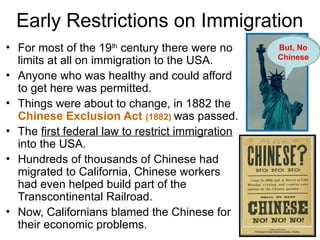
• For most of the 19th
century there were no
limits at all on immigration to the USA.
• Anyone who was healthy and could afford
to get here was permitted.
• Things were about to change, in 1882 the
Chinese Exclusion Act (1882) was passed.
• The first federal law to restrict immigration
into the USA.
• Hundreds of thousands of Chinese had
migrated to California, Chinese workers
had even helped build part of the
Transcontinental Railroad.
• Now, Californians blamed the Chinese for
their economic problems.
Early Restrictions on Immigration
Send us
your …
But, No
Chinese
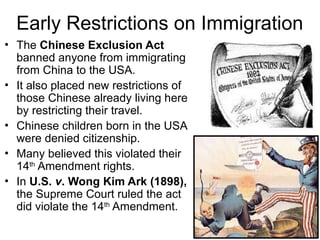
• The Chinese Exclusion Act
banned anyone from immigrating
from China to the USA.
• It also placed new restrictions of
those Chinese already living here
by restricting their travel.
• Chinese children born in the USA
were denied citizenship.
• Many believed this violated their
14th
Amendment rights.
• In U.S. v. Wong Kim Ark (1898),
the Supreme Court ruled the act
did violate the 14th
Amendment.
Early Restrictions on Immigration
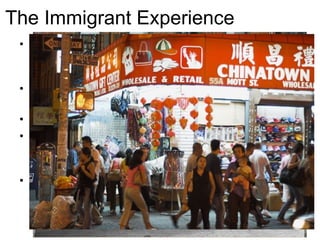
• After 1880 immigration changed, now they came from
Southern and Eastern Europe, especially Poland, Italy,
Greece, & Russia.
• Immigrants settled in areas of the cities where others
of the same nationality lived.
• These ethnic neighborhoods were called ghettos.
• People felt more comfortable around those from the
“Old Country” or those who spoke the same language
and had similar customs.
• But, these ethnic ghettos often isolated immigrants
from mainstream American life, making it difficult for
them to adapt to their new lives.
The Immigrant Experience
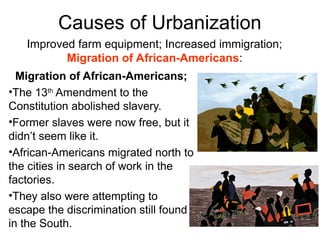
Migration of African-Americans;
•The 13th
Amendment to the
Constitution abolished slavery.
•Former slaves were now free, but it
didn’t seem like it.
•African-Americans migrated north to
the cities in search of work in the
factories.
•They also were attempting to
escape the discrimination still found
in the South.
Causes of Urbanization
Improved farm equipment; Increased immigration;
Migration of African-Americans:
The Great Migration
Causes of Urbanization
Improved farm equipment; Increased immigration;
Migration of African-Americans:
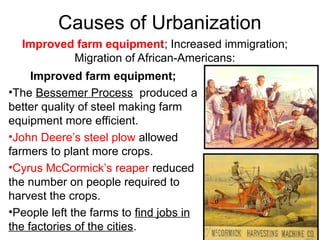
Improved farm equipment;
•The Bessemer Process produced a
better quality of steel making farm
equipment more efficient.
•John Deere’s steel plow allowed
farmers to plant more crops.
•Cyrus McCormick’s reaper reduced
the number on people required to
harvest the crops.
•People left the farms to find jobs in
the factories of the cities.
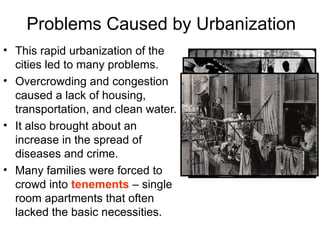
Problems Caused by Urbanization
• This rapid urbanization of the
cities led to many problems.
• Overcrowding and congestion
caused a lack of housing,
transportation, and clean water.
• It also brought about an
increase in the spread of
diseases and crime.
• Many families were forced to
crowd into tenements – single
room apartments that often
lacked the basic necessities.
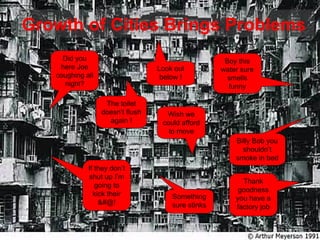
Growth of Cities Brings Problems
Did you
here Joe
coughing all
night?
Boy this
water sure
smells
funny
If they don’t
shut up I’m
going to
kick their
&#@!
Look out
below !
Billy Bob you
shouldn’t
smoke in bed
Wish we
could afford
to move
Something
sure stinks
The toilet
doesn’t flush
again !
Thank
goodness
you have a
factory job
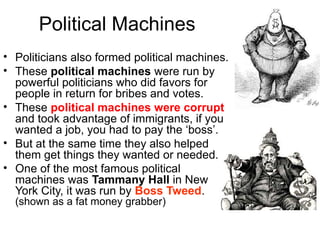
Political Machines
• Politicians also formed political machines.
• These political machines were run by
powerful politicians who did favors for
people in return for bribes and votes.
• These political machines were corrupt
and took advantage of immigrants, if you
wanted a job, you had to pay the ‘boss’.
• But at the same time they also helped
them get things they wanted or needed.
• One of the most famous political
machines was Tammany Hall in New
York City, it was run by Boss Tweed.
(shown as a fat money grabber)
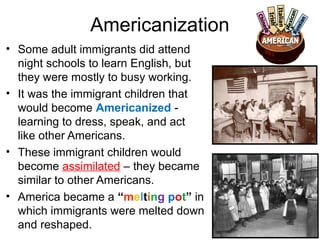
Americanization
• Some adult immigrants did attend
night schools to learn English, but
they were mostly to busy working.
• It was the immigrant children that
would become Americanized -
learning to dress, speak, and act
like other Americans.
• These immigrant children would
become assimilated – they became
similar to other Americans.
• America became a “melting pot” in
which immigrants were melted down
and reshaped.
Proof of Learning
Critical Writing and Purposeful Talk
By the end of the lesson you will be expected to –
•Discuss with your partner/group –
– Analyze why ‘nativists’ hated on immigrants and do you think
this still happens today? Give support for your opinion.
– Compare and Contrast the ‘good’ and the ‘bad’ of political
machines.
•Critical Writing –
• You are a ‘New’ Immigrant and have been in the USA for a
short time. Write a letter home to a loved one telling them
about the Push/Pull factors that led you to America.
• Describe how your immigrant experience. (problems with
housing, jobs, friends, neighbors, language, other cultures)

STAAR_12_Urbanization_and_the_Immigrant_Experience.ppt

  • 1.
  • 2.
    TEKS – AChanging Society • US.12 (A) analyze the impact of physical and human geographic factors on the settlement of the Great Plains, the Klondike Gold Rush (pg. 34) • US.13 (A) analyze the causes and effects of changing demographic patterns resulting from migration within the United States, including western expansion, rural to urban, the Great Migration, (pg. 35) • US.13 (B) analyze the causes and effects of changing demographic patterns resulting from legal and illegal immigration to the United States. (pg. 36) • US.14 (A) identify the effects of population growth and distribution on the physical environment; (pg. 37) • US.25 (B) describe impacts of significant cultural movements country and western music on American society; (pg. 50) • US.3 (D) describe the optimism of the many immigrants who sought a better life in America. (pg. 62) • US.15 (A) describe how the economic impact of the Transcontinental Railroad and Homestead Act contributed to the close of the frontier in the late 19th century; (pg. 93) • US.15 (C) explain how foreign policies affected economic issues such as the Chinese Exclusion Act of 1882, and immigration quotas; (pg. 94) • US.23 (B) evaluate various means of achieving equality of political rights, congressional acts such as the American Indian Citizenship Act of 1924; (pg. 109) • US.26 (B) discuss the Americanization movement to assimilate immigrants and American Indians into American culture; (pg. 115)
  • 3.
    Learning Objective • US.13(A) analyze the causes and effects of changing demographic patterns resulting from migration within the United States, including western expansion, rural to urban, the Great Migration, (pg. 35) • US.3 (D) describe the optimism of the many immigrants who sought a better life in America. (pg. 62) • US.15 (C) explain how foreign policies affected economic issues such as the Chinese Exclusion Act of 1882, and immigration quotas; (pg. 94) Vocabulary  Nativists – Anti-immigrant groups who support protecting the ‘natives’ (those here first) at the expense of immigrants. “Welcome to America, now go home.”  Assimilation – adopting the culture of a particular nation, forcing someone to give up their culture, language, religion, etc. to become ‘similar’ to others. Often called ‘Americanization’.  Political Machines – politicians that used bribery and votes in return for favors to stay in office. Led to corruption in government.
  • 4.
    Proof of Learning CriticalWriting and Purposeful Talk By the end of the lesson you will be expected to – •Discuss with your partner/group – – Analyze why ‘nativists’ hated on immigrants and do you think this still happens today? Give support for your opinion. – Compare and Contrast the ‘good’ and the ‘bad’ of political machines. •Critical Writing – • You are a ‘New’ Immigrant and have been in the USA for a short time. Write a letter home to a loved one telling them about the Push/Pull factors that led you to America. • Describe how your immigrant experience. (problems with housing, jobs, friends, neighbors, language, other cultures)
  • 6.
    Urbanization • An importantresult of industrialization was the rapid growth of cities. • In 1865, only two cities had a population over 500,000 – New York and Philadelphia. • By 1900, this number increased to six cities as Americans were moving to more urban areas. • There were several reason for this rapid urbanization. From this…. To this….
  • 7.
    Increased Immigration; •Large numbersof immigrants were coming to America. •These immigrants were mostly coming from Europe and most had very little money. •They got off the ships and found jobs in the factories of the cities. •This steady supply of labor helped the factories grow as well as increased the size of cities. Causes of Urbanization Improved farm equipment; Increased immigration; Migration of African-Americans:
  • 9.
    Immigration • This floodof immigrants coming into the USA, mostly came through Ellis Island, NY. • They came looking for the American Dream, to find a job, escape oppression and poverty, or to reconnect with family. • Before 1890 most of these immigrants came from Western and Northern Europe. • After 1890 they mostly came from Eastern and Southern Europe.
  • 11.
    Why Immigrants Cameto USA • Push Factors – things that force people to leave their home country for another – Wars in their homelands – Famines (a severe lack of food) – Lack of quality jobs – Political unrest (bad leaders) – Religious differences • Pull Factors – things that make a person want to move to another country – Religious freedoms – Job opportunities in factories, Transcontinental Railroad, gold mines, etc. – Stable, democratic governments – Hook up with family members already here – Availability of cheap or free land
  • 12.
    Use the imageto answer the question. STAAR Practice Question The horizon of money, jobs, food and housing represents which of the following: A.Push Factors B.Pull Factors ANSWER Letter B They are Pull Factors, they give people a reason to come to USA
  • 13.
    The Immigrant Experience •As more immigrants came to the USA, more Americans began to hate on these new immigrants. • These immigrant haters became known as Nativists, they thought they were here first and wanted the immigrants to go back where they came from. • Nativists hated on immigrants because they felt immigrants: – Increased the crime rate – Brought diseases to this country – Took jobs from real Americans – Competed for limited resources – Basically they were just different!
  • 14.
    • For mostof the 19th century there were no limits at all on immigration to the USA. • Anyone who was healthy and could afford to get here was permitted. • Things were about to change, in 1882 the Chinese Exclusion Act (1882) was passed. • The first federal law to restrict immigration into the USA. • Hundreds of thousands of Chinese had migrated to California, Chinese workers had even helped build part of the Transcontinental Railroad. • Now, Californians blamed the Chinese for their economic problems. Early Restrictions on Immigration Send us your … But, No Chinese
  • 15.
    • The ChineseExclusion Act banned anyone from immigrating from China to the USA. • It also placed new restrictions of those Chinese already living here by restricting their travel. • Chinese children born in the USA were denied citizenship. • Many believed this violated their 14th Amendment rights. • In U.S. v. Wong Kim Ark (1898), the Supreme Court ruled the act did violate the 14th Amendment. Early Restrictions on Immigration
  • 16.
    • After 1880immigration changed, now they came from Southern and Eastern Europe, especially Poland, Italy, Greece, & Russia. • Immigrants settled in areas of the cities where others of the same nationality lived. • These ethnic neighborhoods were called ghettos. • People felt more comfortable around those from the “Old Country” or those who spoke the same language and had similar customs. • But, these ethnic ghettos often isolated immigrants from mainstream American life, making it difficult for them to adapt to their new lives. The Immigrant Experience
  • 17.
    Migration of African-Americans; •The13th Amendment to the Constitution abolished slavery. •Former slaves were now free, but it didn’t seem like it. •African-Americans migrated north to the cities in search of work in the factories. •They also were attempting to escape the discrimination still found in the South. Causes of Urbanization Improved farm equipment; Increased immigration; Migration of African-Americans:
  • 18.
  • 19.
    Causes of Urbanization Improvedfarm equipment; Increased immigration; Migration of African-Americans: Improved farm equipment; •The Bessemer Process produced a better quality of steel making farm equipment more efficient. •John Deere’s steel plow allowed farmers to plant more crops. •Cyrus McCormick’s reaper reduced the number on people required to harvest the crops. •People left the farms to find jobs in the factories of the cities.
  • 20.
    Problems Caused byUrbanization • This rapid urbanization of the cities led to many problems. • Overcrowding and congestion caused a lack of housing, transportation, and clean water. • It also brought about an increase in the spread of diseases and crime. • Many families were forced to crowd into tenements – single room apartments that often lacked the basic necessities.
  • 21.
    Growth of CitiesBrings Problems Did you here Joe coughing all night? Boy this water sure smells funny If they don’t shut up I’m going to kick their &#@! Look out below ! Billy Bob you shouldn’t smoke in bed Wish we could afford to move Something sure stinks The toilet doesn’t flush again ! Thank goodness you have a factory job
  • 22.
    Political Machines • Politiciansalso formed political machines. • These political machines were run by powerful politicians who did favors for people in return for bribes and votes. • These political machines were corrupt and took advantage of immigrants, if you wanted a job, you had to pay the ‘boss’. • But at the same time they also helped them get things they wanted or needed. • One of the most famous political machines was Tammany Hall in New York City, it was run by Boss Tweed. (shown as a fat money grabber)
  • 23.
    Americanization • Some adultimmigrants did attend night schools to learn English, but they were mostly to busy working. • It was the immigrant children that would become Americanized - learning to dress, speak, and act like other Americans. • These immigrant children would become assimilated – they became similar to other Americans. • America became a “melting pot” in which immigrants were melted down and reshaped.
  • 24.
    Proof of Learning CriticalWriting and Purposeful Talk By the end of the lesson you will be expected to – •Discuss with your partner/group – – Analyze why ‘nativists’ hated on immigrants and do you think this still happens today? Give support for your opinion. – Compare and Contrast the ‘good’ and the ‘bad’ of political machines. •Critical Writing – • You are a ‘New’ Immigrant and have been in the USA for a short time. Write a letter home to a loved one telling them about the Push/Pull factors that led you to America. • Describe how your immigrant experience. (problems with housing, jobs, friends, neighbors, language, other cultures)