Mid-Term Review
Westward Expansion
What had an impact on the
development and settlement of the
West?
Gold miners
Farmers
Chinese laborers
Immigrants from Europe
What happened at Little Big Horn?
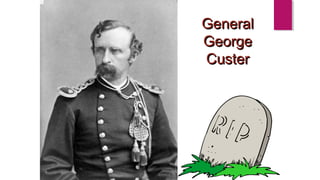
GeneralGeneral
GeorgeGeorge
CusterCuster
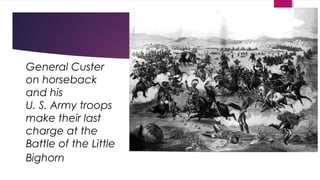
General Custer
on horseback
and his
U. S. Army troops
make their last
charge at the
Battle of the Little
Bighorn
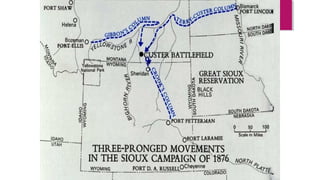
Battle of the Little Big Horn
•“Custer’s Last Stand”
•268 die (all of Custer’s 7th
Cavalry)
•Indians led by – Crazy Horse
and Sitting Bull
•Great Indian victory - - - but
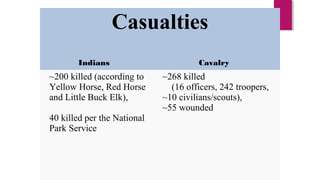
Casualties
~200 killed (according to
Yellow Horse, Red Horse
and Little Buck Elk),
40 killed per the National
Park Service
~268 killed
(16 officers, 242 troopers,
~10 civilians/scouts),
~55 wounded
Indians Cavalry
18301830
INDIAN REMOVAL ACTINDIAN REMOVAL ACT
GOAL –GOAL –
Remove all Indians fromRemove all Indians from
southern and easternsouthern and eastern
states west across thestates west across the
MississippiMississippi
The Morrill Act 1862
The college land grant act
Federal land was given to states to
sell for education purposes.
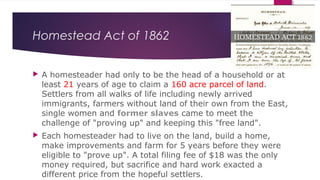
Homestead Act of 1862
 A homesteader had only to be the head of a household or at
least 21 years of age to claim a 160 acre parcel of land.
Settlers from all walks of life including newly arrived
immigrants, farmers without land of their own from the East,
single women and former slaves came to meet the
challenge of "proving up" and keeping this "free land".
 Each homesteader had to live on the land, build a home,
make improvements and farm for 5 years before they were
eligible to "prove up". A total filing fee of $18 was the only
money required, but sacrifice and hard work exacted a
different price from the hopeful settlers.
The Pacific Railroad Act of 1862
The Pacific Railway Act was signed
into law by President Abraham Lincoln
on July 1, 1862. This act provided
Federal government support for the
building of the first
transcontinental railroad, which was
completed on May 10, 1869
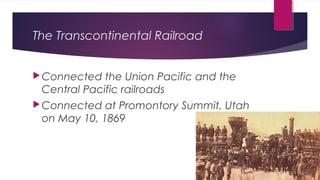
The Transcontinental Railroad
Connected the Union Pacific and the
Central Pacific railroads
Connected at Promontory Summit, Utah
on May 10, 1869
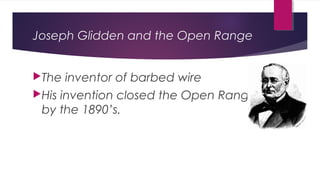
Joseph Glidden and the Open Range
The inventor of barbed wire
His invention closed the Open Range
by the 1890’s.
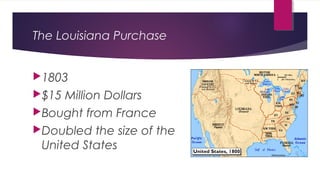
The Louisiana Purchase
1803
$15 Million Dollars
Bought from France
Doubled the size of the
United States
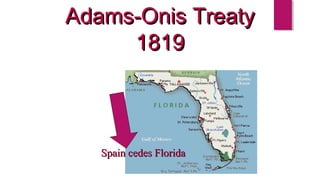
Adams-Onis TreatyAdams-Onis Treaty
18191819
Spain cedes FloridaSpain cedes Florida
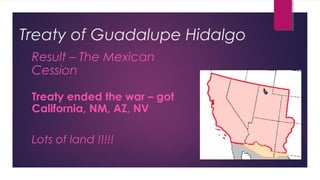
Treaty of Guadalupe Hidalgo
Result – The Mexican
Cession
Treaty ended the war – got
California, NM, AZ, NV
Lots of land !!!!!
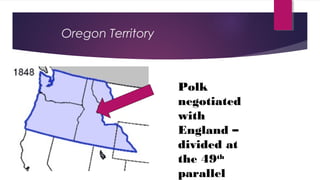
Oregon Territory
Polk
negotiated
with
England –
divided at
the 49th
parallel
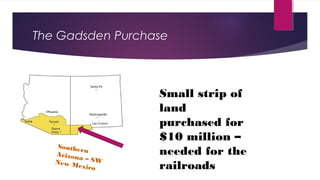
The Gadsden Purchase
Small strip of
land
purchased for
$10 million –
needed for the
railroads
Southern
Arizona – SWNew Mexico
Industrialization and Immigration
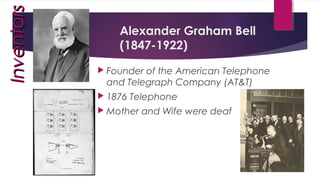
Alexander Graham Bell
(1847-1922)
 Founder of the American Telephone
and Telegraph Company (AT&T)
 1876 Telephone
 Mother and Wife were deaf
InventorsInventors
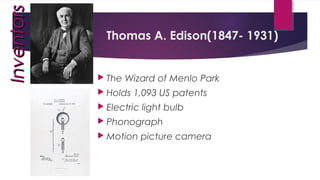
Thomas A. Edison(1847- 1931)
 The Wizard of Menlo Park
 Holds 1,093 US patents
 Electric light bulb
 Phonograph
 Motion picture camera
InventorsInventors
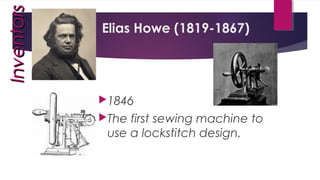
Elias Howe (1819-1867)
1846
The first sewing machine to
use a lockstitch design.
InventorsInventors
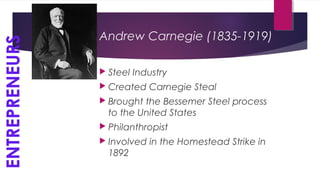
Andrew Carnegie (1835-1919)
 Steel Industry
 Created Carnegie Steal
 Brought the Bessemer Steel process
to the United States
 Philanthropist
 Involved in the Homestead Strike in
1892
ENTREPRENEURS
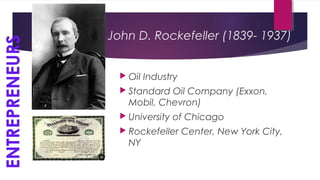
John D. Rockefeller (1839- 1937)
 Oil Industry
 Standard Oil Company (Exxon,
Mobil, Chevron)
 University of Chicago
 Rockefeller Center, New York City,
NY
ENTREPRENEURS
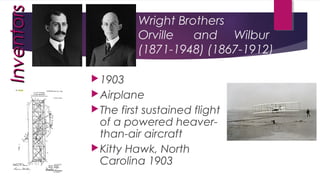
Wright Brothers
Orville and Wilbur
(1871-1948) (1867-1912)
1903
Airplane
The first sustained flight
of a powered heaver-
than-air aircraft
Kitty Hawk, North
Carolina 1903
InventorsInventors
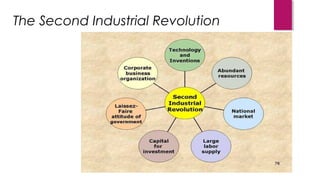
The Second Industrial Revolution
The Homestead Steel Strike 1892
Homestead Works near Pittsburgh, Pa.
Andrew Carnegie and H.C. Frick
Frick and Carnegie wanted to bust up the
unions in the factory
June 29 a lockout began.
Frick brings in 300 Pinkertons to protect the
factory.
The Homestead Steel Strike 1892
On July 6th
, 1892 a fight breaks out between
the Pinkertons and the workers.
6 workers and 3 Pinkertons were killed with
many more hurt.
Eventually federal troops were brought in.
Result- Public opinion of the unions fell and the
Union ended at the factory.
Ellis Island
Port of entry on the east
coast –
over 16 million people
(1 million a year –
5 thousand a day)
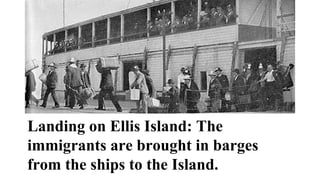
Landing on Ellis Island: The
immigrants are brought in barges
from the ships to the Island.
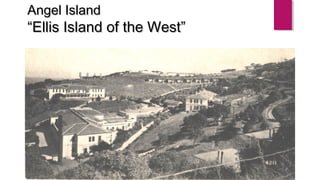
Angel IslandAngel Island
““Ellis Island of the West”Ellis Island of the West”
Angel Island
Port of entry on the west
coast
Processed over 1 million
**slower process –
sometimes months
No privacy – harsh
conditions
The Progressive Era- 1890-1920
Who were the progressives?
 Progressives were:
Men and Women
Democrats, Republicans, and Populists
Labor unionist and business executives
Teachers and professors
Christians, atheists and agnostics
They were mostly middle-class urban reformers
They were good well intentioned people focused on improving
the quality of life through change in society and government.
The Origins of Progressivism
 As America entered the 20th
century, middle class reformers at
the municipal, state, and national levels addressed the
problems of the Gilded Age including:
Economic inequities
Environmental issues
Social welfare
Working conditions
Rights for women and children
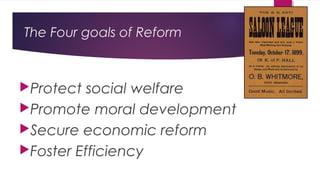
The Four goals of Reform
Protect social welfare
Promote moral development
Secure economic reform
Foster Efficiency
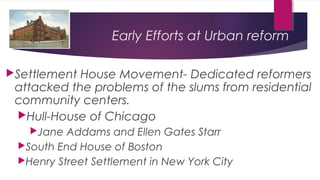
Early Efforts at Urban reform
Settlement House Movement- Dedicated reformers
attacked the problems of the slums from residential
community centers.
Hull-House of Chicago
Jane Addams and Ellen Gates Starr
South End House of Boston
Henry Street Settlement in New York City
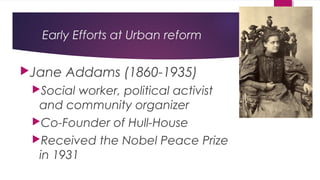
Early Efforts at Urban reform
Jane Addams (1860-1935)
Social worker, political activist
and community organizer
Co-Founder of Hull-House
Received the Nobel Peace Prize
in 1931
16th
Amendment to the U.S. Constitution
Established the Federal Income Tax
17th
Amendment to the U.S. Constitution
 Established popular elections of U.S. Senators
18th
Amendment to the U.S. Constitution
Established the prohibition of alcoholic
beverages in the United States by
declaring the production, transport, and
sale of alcohol (though not the
consumption or private possession) illegal.
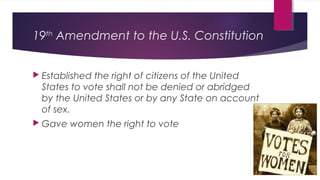
19th
Amendment to the U.S. Constitution
 Established the right of citizens of the United
States to vote shall not be denied or abridged
by the United States or by any State on account
of sex.
 Gave women the right to vote
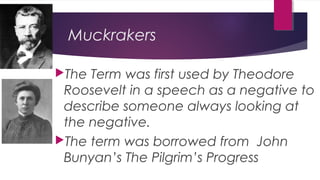
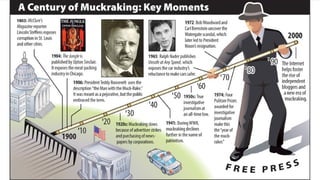
Muckrakers
The Term was first used by Theodore
Roosevelt in a speech as a negative to
describe someone always looking at
the negative.
The term was borrowed from John
Bunyan’s The Pilgrim’s Progress
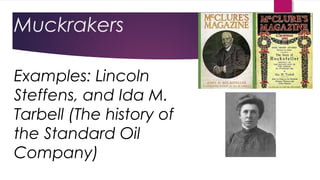
Muckrakers
Examples: Lincoln
Steffens, and Ida M.
Tarbell (The history of
the Standard Oil
Company)
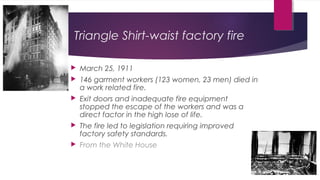
Triangle Shirt-waist factory fire
 March 25, 1911
 146 garment workers (123 women, 23 men) died in
a work related fire.
 Exit doors and inadequate fire equipment
stopped the escape of the workers and was a
direct factor in the high lose of life.
 The fire led to legislation requiring improved
factory safety standards.
 From the White House
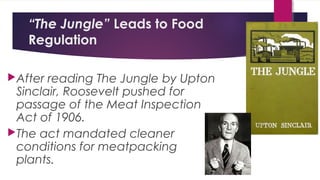
“The Jungle” Leads to Food
Regulation
After reading The Jungle by Upton
Sinclair, Roosevelt pushed for
passage of the Meat Inspection
Act of 1906.
The act mandated cleaner
conditions for meatpacking
plants.
The Mann-Elkins Act
Increased the regulatory powers of
the Interstate Commerce
Commission (ICC) which regulated
the telecommunications industry.
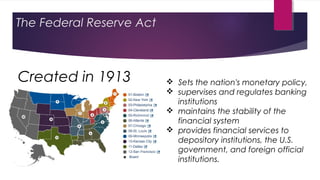
The Federal Reserve Act
 Sets the nation's monetary policy,
 supervises and regulates banking
institutions
 maintains the stability of the
financial system
 provides financial services to
depository institutions, the U.S.
government, and foreign official
institutions.
Created in 1913
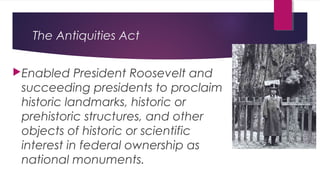
The Antiquities Act
Enabled President Roosevelt and
succeeding presidents to proclaim
historic landmarks, historic or
prehistoric structures, and other
objects of historic or scientific
interest in federal ownership as
national monuments.
The Spanish American War
Democracy
John Quincy Adams
The United States should be “the well-wisher to the
freedoms and independence of all” nations but that it must
not go “abroad in search of monsters to destroy”
What did Adams mean by this remark?
We shouldn’t be off looking for countries that are not
democratic to fight.
Isolationism
a policy of remaining apart from the
affairs or interests of other groups,
especially the political affairs of other
countries.
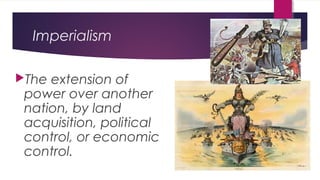
Imperialism
The extension of
power over another
nation, by land
acquisition, political
control, or economic
control.
Nationalism
patriotic feeling, principles, or efforts.
an extreme form of patriotism, especially
marked by a feeling of superiority over
other countries.
 advocacy of political independence for a
particular country
Militarism
the belief or desire of a government
or people that a country should
maintain a strong military capability
and be prepared to use it
aggressively to defend or promote
national interests.
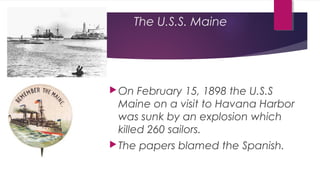
The U.S.S. Maine
On February 15, 1898 the U.S.S
Maine on a visit to Havana Harbor
was sunk by an explosion which
killed 260 sailors.
The papers blamed the Spanish.
Platt Amendment
 U.S. forced amendment to Cuba’s new Constitution.
1. Cuba can’t sign any treaties
2. U.S. can intervene in any affairs (domestic or foreign)
3. U.S. gets Guantanamo Bay
4. Cuba can’t overspend (no deficits)
 Was repealed in 1934.
World War I
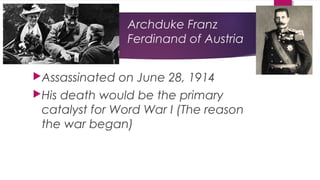
Archduke Franz
Ferdinand of Austria
Assassinated on June 28, 1914
His death would be the primary
catalyst for Word War I (The reason
the war began)
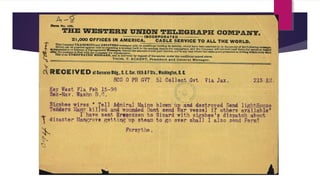
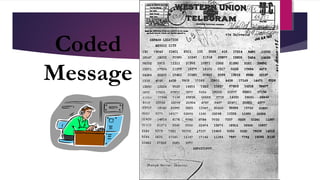
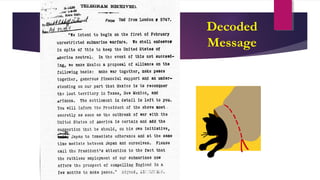
Zimmerman Telegram Intercepted
Zimmerman Telegram
 From the Ambassador of Germany to the
leader of Mexico
 Encourages Mexico to go to war with the
United States
 Outrage !!!!!
Coded
Message
Decoded
Message
Sedition Act of 1918
 Punished anyone who said anything to
obstruct the government or printed
anything disloyal.
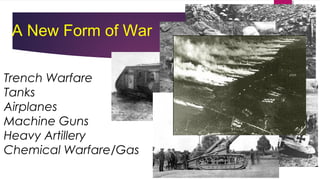
A New Form of War
Trench Warfare
Tanks
Airplanes
Machine Guns
Heavy Artillery
Chemical Warfare/Gas
World War I Ends
 October 3, 1918 The new German
chancellor asked to an end to the
fighting based on Wilson’s Fourteen
Points.
 November 11th
at 11am the guns fell silent.
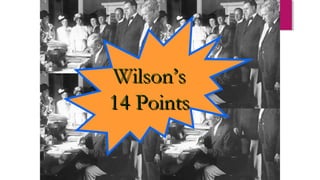
Wilson’sWilson’s
14 Points14 Points
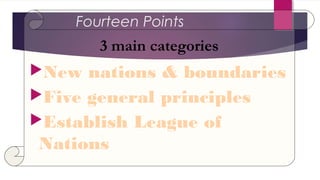
Fourteen Points
New nations & boundaries
Five general principles
Establish League of
Nations
3 main categories
New Nations & Boundaries
Self-determination
(remember?)
New countries replace Austro-
Hungarian Empire
Ethnic division
Five General Principles
1. Freedom of the Seas
2. No secret treaties
3. Reduction of military arms
4. Free trade between countries
5. Mediate colonial claims
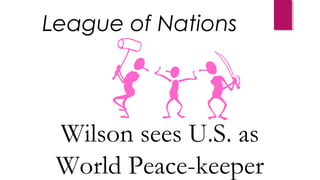
League of Nations
Wilson sees U.S. as
World Peace-keeper
The Roaring 20’s
Prohibition
What did prohibition prohibit?
The transportation of alcoholic
beverages.
The manufacture of alcoholic
beverages
The sale of alcoholic beverages
Enforced by the Volstead Act
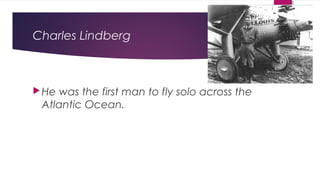
Charles Lindberg
He was the first man to fly solo across the
Atlantic Ocean.
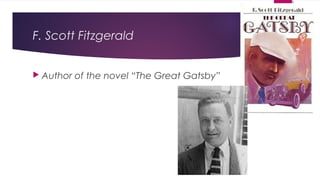
F. Scott Fitzgerald
 Author of the novel “The Great Gatsby”
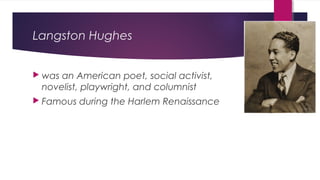
Langston Hughes
 was an American poet, social activist,
novelist, playwright, and columnist
 Famous during the Harlem Renaissance

Mid term review

  • 1.
  • 2.
  • 3.
    What had animpact on the development and settlement of the West? Gold miners Farmers Chinese laborers Immigrants from Europe
  • 4.
    What happened atLittle Big Horn?
  • 5.
  • 7.
    General Custer on horseback andhis U. S. Army troops make their last charge at the Battle of the Little Bighorn
  • 8.
    Battle of theLittle Big Horn •“Custer’s Last Stand” •268 die (all of Custer’s 7th Cavalry) •Indians led by – Crazy Horse and Sitting Bull •Great Indian victory - - - but
  • 9.
    Casualties ~200 killed (accordingto Yellow Horse, Red Horse and Little Buck Elk), 40 killed per the National Park Service ~268 killed (16 officers, 242 troopers, ~10 civilians/scouts), ~55 wounded Indians Cavalry
  • 10.
    18301830 INDIAN REMOVAL ACTINDIANREMOVAL ACT GOAL –GOAL – Remove all Indians fromRemove all Indians from southern and easternsouthern and eastern states west across thestates west across the MississippiMississippi
  • 11.
    The Morrill Act1862 The college land grant act Federal land was given to states to sell for education purposes.
  • 12.
    Homestead Act of1862  A homesteader had only to be the head of a household or at least 21 years of age to claim a 160 acre parcel of land. Settlers from all walks of life including newly arrived immigrants, farmers without land of their own from the East, single women and former slaves came to meet the challenge of "proving up" and keeping this "free land".  Each homesteader had to live on the land, build a home, make improvements and farm for 5 years before they were eligible to "prove up". A total filing fee of $18 was the only money required, but sacrifice and hard work exacted a different price from the hopeful settlers.
  • 13.
    The Pacific RailroadAct of 1862 The Pacific Railway Act was signed into law by President Abraham Lincoln on July 1, 1862. This act provided Federal government support for the building of the first transcontinental railroad, which was completed on May 10, 1869
  • 14.
    The Transcontinental Railroad Connectedthe Union Pacific and the Central Pacific railroads Connected at Promontory Summit, Utah on May 10, 1869
  • 15.
    Joseph Glidden andthe Open Range The inventor of barbed wire His invention closed the Open Range by the 1890’s.
  • 16.
    The Louisiana Purchase 1803 $15Million Dollars Bought from France Doubled the size of the United States
  • 17.
    Adams-Onis TreatyAdams-Onis Treaty 18191819 Spaincedes FloridaSpain cedes Florida
  • 18.
    Treaty of GuadalupeHidalgo Result – The Mexican Cession Treaty ended the war – got California, NM, AZ, NV Lots of land !!!!!
  • 19.
  • 20.
    The Gadsden Purchase Smallstrip of land purchased for $10 million – needed for the railroads Southern Arizona – SWNew Mexico
  • 21.
  • 22.
    Alexander Graham Bell (1847-1922) Founder of the American Telephone and Telegraph Company (AT&T)  1876 Telephone  Mother and Wife were deaf InventorsInventors
  • 23.
    Thomas A. Edison(1847-1931)  The Wizard of Menlo Park  Holds 1,093 US patents  Electric light bulb  Phonograph  Motion picture camera InventorsInventors
  • 24.
    Elias Howe (1819-1867) 1846 Thefirst sewing machine to use a lockstitch design. InventorsInventors
  • 25.
    Andrew Carnegie (1835-1919) Steel Industry  Created Carnegie Steal  Brought the Bessemer Steel process to the United States  Philanthropist  Involved in the Homestead Strike in 1892 ENTREPRENEURS
  • 26.
    John D. Rockefeller(1839- 1937)  Oil Industry  Standard Oil Company (Exxon, Mobil, Chevron)  University of Chicago  Rockefeller Center, New York City, NY ENTREPRENEURS
  • 27.
    Wright Brothers Orville andWilbur (1871-1948) (1867-1912) 1903 Airplane The first sustained flight of a powered heaver- than-air aircraft Kitty Hawk, North Carolina 1903 InventorsInventors
  • 28.
  • 29.
    The Homestead SteelStrike 1892 Homestead Works near Pittsburgh, Pa. Andrew Carnegie and H.C. Frick Frick and Carnegie wanted to bust up the unions in the factory June 29 a lockout began. Frick brings in 300 Pinkertons to protect the factory.
  • 30.
    The Homestead SteelStrike 1892 On July 6th , 1892 a fight breaks out between the Pinkertons and the workers. 6 workers and 3 Pinkertons were killed with many more hurt. Eventually federal troops were brought in. Result- Public opinion of the unions fell and the Union ended at the factory.
  • 31.
    Ellis Island Port ofentry on the east coast – over 16 million people (1 million a year – 5 thousand a day)
  • 32.
    Landing on EllisIsland: The immigrants are brought in barges from the ships to the Island.
  • 33.
    Angel IslandAngel Island ““EllisIsland of the West”Ellis Island of the West”
  • 34.
    Angel Island Port ofentry on the west coast Processed over 1 million **slower process – sometimes months No privacy – harsh conditions
  • 35.
  • 36.
    Who were theprogressives?  Progressives were: Men and Women Democrats, Republicans, and Populists Labor unionist and business executives Teachers and professors Christians, atheists and agnostics They were mostly middle-class urban reformers They were good well intentioned people focused on improving the quality of life through change in society and government.
  • 37.
    The Origins ofProgressivism  As America entered the 20th century, middle class reformers at the municipal, state, and national levels addressed the problems of the Gilded Age including: Economic inequities Environmental issues Social welfare Working conditions Rights for women and children
  • 38.
    The Four goalsof Reform Protect social welfare Promote moral development Secure economic reform Foster Efficiency
  • 39.
    Early Efforts atUrban reform Settlement House Movement- Dedicated reformers attacked the problems of the slums from residential community centers. Hull-House of Chicago Jane Addams and Ellen Gates Starr South End House of Boston Henry Street Settlement in New York City
  • 40.
    Early Efforts atUrban reform Jane Addams (1860-1935) Social worker, political activist and community organizer Co-Founder of Hull-House Received the Nobel Peace Prize in 1931
  • 41.
    16th Amendment to theU.S. Constitution Established the Federal Income Tax
  • 42.
    17th Amendment to theU.S. Constitution  Established popular elections of U.S. Senators
  • 43.
    18th Amendment to theU.S. Constitution Established the prohibition of alcoholic beverages in the United States by declaring the production, transport, and sale of alcohol (though not the consumption or private possession) illegal.
  • 44.
    19th Amendment to theU.S. Constitution  Established the right of citizens of the United States to vote shall not be denied or abridged by the United States or by any State on account of sex.  Gave women the right to vote
  • 45.
    Muckrakers The Term wasfirst used by Theodore Roosevelt in a speech as a negative to describe someone always looking at the negative. The term was borrowed from John Bunyan’s The Pilgrim’s Progress
  • 46.
    Muckrakers Examples: Lincoln Steffens, andIda M. Tarbell (The history of the Standard Oil Company)
  • 48.
    Triangle Shirt-waist factoryfire  March 25, 1911  146 garment workers (123 women, 23 men) died in a work related fire.  Exit doors and inadequate fire equipment stopped the escape of the workers and was a direct factor in the high lose of life.  The fire led to legislation requiring improved factory safety standards.  From the White House
  • 49.
    “The Jungle” Leadsto Food Regulation After reading The Jungle by Upton Sinclair, Roosevelt pushed for passage of the Meat Inspection Act of 1906. The act mandated cleaner conditions for meatpacking plants.
  • 50.
    The Mann-Elkins Act Increasedthe regulatory powers of the Interstate Commerce Commission (ICC) which regulated the telecommunications industry.
  • 51.
    The Federal ReserveAct  Sets the nation's monetary policy,  supervises and regulates banking institutions  maintains the stability of the financial system  provides financial services to depository institutions, the U.S. government, and foreign official institutions. Created in 1913
  • 52.
    The Antiquities Act EnabledPresident Roosevelt and succeeding presidents to proclaim historic landmarks, historic or prehistoric structures, and other objects of historic or scientific interest in federal ownership as national monuments.
  • 53.
  • 54.
    Democracy John Quincy Adams TheUnited States should be “the well-wisher to the freedoms and independence of all” nations but that it must not go “abroad in search of monsters to destroy” What did Adams mean by this remark? We shouldn’t be off looking for countries that are not democratic to fight.
  • 55.
    Isolationism a policy ofremaining apart from the affairs or interests of other groups, especially the political affairs of other countries.
  • 56.
    Imperialism The extension of powerover another nation, by land acquisition, political control, or economic control.
  • 57.
    Nationalism patriotic feeling, principles,or efforts. an extreme form of patriotism, especially marked by a feeling of superiority over other countries.  advocacy of political independence for a particular country
  • 58.
    Militarism the belief ordesire of a government or people that a country should maintain a strong military capability and be prepared to use it aggressively to defend or promote national interests.
  • 59.
    The U.S.S. Maine OnFebruary 15, 1898 the U.S.S Maine on a visit to Havana Harbor was sunk by an explosion which killed 260 sailors. The papers blamed the Spanish.
  • 61.
    Platt Amendment  U.S.forced amendment to Cuba’s new Constitution. 1. Cuba can’t sign any treaties 2. U.S. can intervene in any affairs (domestic or foreign) 3. U.S. gets Guantanamo Bay 4. Cuba can’t overspend (no deficits)  Was repealed in 1934.
  • 62.
  • 63.
    Archduke Franz Ferdinand ofAustria Assassinated on June 28, 1914 His death would be the primary catalyst for Word War I (The reason the war began)
  • 64.
  • 65.
    Zimmerman Telegram  Fromthe Ambassador of Germany to the leader of Mexico  Encourages Mexico to go to war with the United States  Outrage !!!!!
  • 66.
  • 67.
  • 68.
    Sedition Act of1918  Punished anyone who said anything to obstruct the government or printed anything disloyal.
  • 69.
    A New Formof War Trench Warfare Tanks Airplanes Machine Guns Heavy Artillery Chemical Warfare/Gas
  • 70.
    World War IEnds  October 3, 1918 The new German chancellor asked to an end to the fighting based on Wilson’s Fourteen Points.  November 11th at 11am the guns fell silent.
  • 71.
  • 72.
    Fourteen Points New nations& boundaries Five general principles Establish League of Nations 3 main categories
  • 73.
    New Nations &Boundaries Self-determination (remember?) New countries replace Austro- Hungarian Empire Ethnic division
  • 74.
    Five General Principles 1.Freedom of the Seas 2. No secret treaties 3. Reduction of military arms 4. Free trade between countries 5. Mediate colonial claims
  • 75.
    League of Nations Wilsonsees U.S. as World Peace-keeper
  • 76.
  • 77.
    Prohibition What did prohibitionprohibit? The transportation of alcoholic beverages. The manufacture of alcoholic beverages The sale of alcoholic beverages Enforced by the Volstead Act
  • 78.
    Charles Lindberg He wasthe first man to fly solo across the Atlantic Ocean.
  • 79.
    F. Scott Fitzgerald Author of the novel “The Great Gatsby”
  • 80.
    Langston Hughes  wasan American poet, social activist, novelist, playwright, and columnist  Famous during the Harlem Renaissance