Gaurav Nahar
DNB Urology Resident,
MMHRC, Madurai
URODYNAMICS
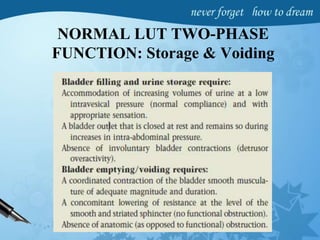
NORMAL LUT TWO-PHASE
FUNCTION: Storage & Voiding
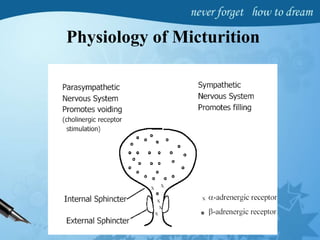
Physiology of Micturition
• LUT innervation:
Somatic, parasympathetic (PNS) &
sympathetic (SNS)
• As urine fills the bladder, detrusor stretches
and allows bladder to expand.
• ~300 ml in bladder before the brain
recognizes bladder fullness.
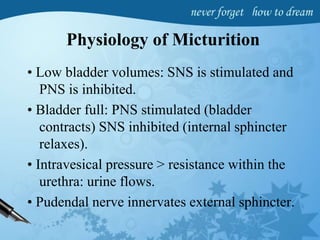
Physiology of Micturition
• Low bladder volumes: SNS is stimulated and
PNS is inhibited.
• Bladder full: PNS stimulated (bladder
contracts) SNS inhibited (internal sphincter
relaxes).
• Intravesical pressure > resistance within the
urethra: urine flows.
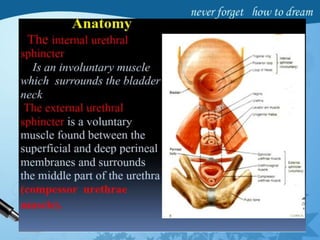
• Pudendal nerve innervates external sphincter.
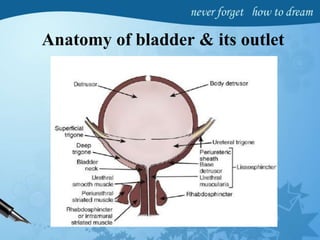
Anatomy of bladder & its outlet
URODYNAMICS
• Dynamic study of transport, storage &
evacuation of urine.
• Main goal of UDS: to reproduce pt.'s
symptoms and determine their cause by
various tests.
UDS Armamentarium
• Cystometry(most important test), filling
cystometry & voiding cystometry
• Uroflowmetry
• Urethral pressure studies
• Pressure flow micturition studies
• Video-urodynamic studies
• Electromyography
INDICATIONS
• Incontinence:
-recurrent incontinence in whom surgery is
planned.
-mixed urge & stress symptoms.
-associated voiding problems.
-pts. with neurologic disorders.
-pts. with mismatch between signs and
symptoms.
INDICATIONS (contd..)
• Outflow Obstruction:
-pt with LUTS, at least uroflow study.
• Neurogenic bladder:
-all neurologically impaired patients with
neurogenic bladder dysfunction.
• Children with voiding dysfunction:
-kids with daytime urgency and urge incontinence,
recurrent infection, reflux, or upper tract changes.
Clinical role
• Characterization of detrusor function.
• Evaluation of bladder outlet.
• Evaluation of voiding function.
• Diagnosis and characterization of
neuropathy.
Three important rules before starting
UDS evaluation:
• 1. Decide on questions to be answered before
starting a study.
• 2. Design the study to answer these
questions.
• 3. Customize the study as necessary.
CYSTOMETRY
• Measurement of intravesical bladder pressure
during bladder filling(measures volume-pressure
relationships).
• Used to assess bladder sensation, capacity,
compliance, detrusor activity.
• Bladder access by transurethral catheter, or rarely
by percutaneous suprapubic tube.
• Filling medium either gas (CO2) or liquid (water,
saline, or contrast material at body temp).
• Liquid cystometry is more physiologic.
• Ideally, filling should be performed in standing
position.
CYSTOMETRY(contd...)
• Bladder filling either by diuresis or filling through a
catheter.
• Filling
– slow (up to 10 ml/min), physiologic
– medium (10 to 100 ml/min)
– fast (> 100 ml/min)
• Children and pts with known bladder hyperactivity require
slow fill rates.
• Reference point:- superior edge of symphysis pubis.
• All systems should be zeroed to atmospheric pressure.
• No air bubbles.
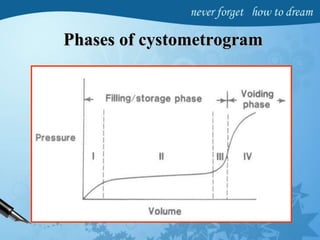
Phases of cystometrogram
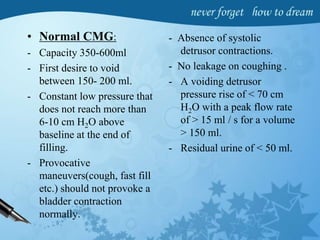
• Normal CMG:
- Capacity 350-600ml
- First desire to void
between 150- 200 ml.
- Constant low pressure that
does not reach more than
6-10 cm H2O above
baseline at the end of
filling.
- Provocative
maneuvers(cough, fast fill
etc.) should not provoke a
bladder contraction
normally.
- Absence of systolic
detrusor contractions.
- No leakage on coughing .
- A voiding detrusor
pressure rise of < 70 cm
H2O with a peak flow rate
of > 15 ml / s for a volume
> 150 ml.
- Residual urine of < 50 ml.
CYSTOMETRY(contd...)
• Single Vs multi-channel UDS:
-single: Pves only
-multi: Pves, Pdet, Pabd
CMG PARAMETERS
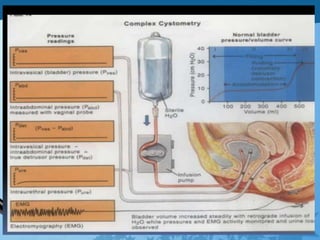
• Intravesical pressure(Pves): Total Pressure within
the bladder.
• Abdominal pressure(Pabd): Pressure surrounding the
bladder; currently estimated from rectal, vaginal, or
extraperitoneal pressure or a bowel stoma.
• Detrusor pressure(Pdet): Component of intravesical
pressure created by forces on the bladder wall, both
passive and active.
• True detrusor pressure = Intravesical pressure -
Intraabdominal pressure.(Pdet = Pves-Pabd)
• Physiologic filling rate: A filling rate < predicted
maximum. Predicted maximum = body weight in kg divided
by 4 and expressed as ml/min.
• Nonphysiologic filling rate: A filling rate > predicted
maximum.
• First sensation of bladder filling: Volume at which patient
first becomes aware of bladder filling.
• First desire to void: Feeling during filling cystometry that
would lead the patient to pass urine at the next convenient
moment.
• Strong desire to void: Persistent desire to void without fear
of leakage.
• Compliance:
- Relationship between change in bladder volume
and change in Pdet (Δvolume/Δpressure); measured
in ml/cm H2O.
- Normal bladder is highly compliant, and can hold
large volumes at low pressure.
- Normal pressure rise during the course of CMG in
normal bladder will be only 6-10 cm H2O.
- Decrease compliance < 20 ml/cm H2O, poorly
distensible bladder.
Impaired compliance is seen in:
• neurologic conditions: spinal cord injury/lesion,
spina bifida, usually results from increased outlet
resistance (e.g., detrusor external sphincter
dyssynergia [DESD]) or decentralization in the
case of lower motor neuron lesions,
• Long-term BOO (e.g., from benign prostatic
obstruction),
• Structural changes- radiation cystitis or
tuberculosis.
• Impaired compliance with prolonged elevated
storage pressures is a urodynamic risk factor and
needs treatment to prevent renal damage.
• Urgency: A sudden compelling desire to void.
• Normal detrusor function: Allows bladder filling
with little or no change in pressure, no involuntary
contractions.
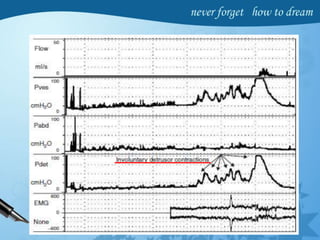
• Detrusor overactivity: Involuntary detrusor
contractions during the filling phase, spontaneous
or provoked.
• Storage greater than 40 cm H2O is associated
with harmful effects on the upper tract.
• Overactive bladder: storage symptoms of urgency
with or without urgency incontinence, usually with
frequency and nocturia.
• Neurogenic detrusor overactivity: Overactivity
accompanied by a neurologic condition; also k/a
detrusor hyperreflexia.
• Idiopathic detrusor overactivity: Detrusor
overactivity without concurrent neurologic cause; also
k/a detrusor instability.
• Abdominal leak point pressure(ALPP):
Intravesical pressure at which urine leakage occurs
because of increased abdominal pressure in the
absence of a detrusor contraction.
• ALPP is a measure of sphincteric strength or
ability of the sphincter to resist changes in Pabd
• Applicable to stress incontinence; ALPP can be
demonstrated only in a patient with SUI.
• There is no normal ALPP, because patients without
stress incontinence will not leak at any physiologic
Pabd.
• Lower the ALPP, weaker is the sphincter.
– ALPP<60 cm H2O: significant ISD
– ALPP 60-90 cm H2O: equivocal
– ALPP>90 cm H2O: urethral
hypermobility; little or no ISD
• Detrusor leak point pressure(DLPP): Lowest
detrusor pressure at which urine leakage occurs in
the absence of either a detrusor contraction or
increased abdominal pressure (risk with > 40cm
H2O).
• Its a measure of Pdet in a patient with decreased
bladder compliance.
• Higher the urethral resistance, higher the DLPP, the
more likely is upper tract damage as intravesical
pressure is transferred to the kidneys.
UROFLOMETRY
• Non invasive study.
• Measurement of the rate of urine flow over time.
• Estimate of effectiveness of the act of voiding along with
PVR.
• Influenced by
– effectiveness of detrusor contraction
– completeness of sphincteric relaxation
– patency of the urethra
• 3 methods used
– gravimetric
– rotating disk
– electronic dipstick
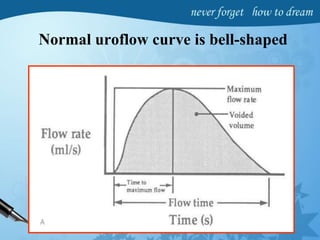
Recorded variables during UFM study:
• Voided volume (VV in milliliters)
• Flow rate (Q in milliliters per second)
• Maximum flow rate (Qmax in milliliters per second)
• Average flow rate (Qave in milliliters per second)
• Voiding time (total time during micturition in seconds)
• Flow time (the time during which flow occurred in seconds)
• Time to maximum flow (onset of flow to Qmax in seconds)
• Optimal voids 200 to 400cc.
• Voids < 150cc are difficult to interpret.
• Pt. should be well hydrated with full bladder, but
not overly distended bladder.
• Should be performed in privacy and pt.encouraged
to void in his normal fashion.
• Qmax & shape of curve- more reliable indicators of
BOO.
• Qmax- most reliable variable in detecting abnormal
voiding.
Normal uroflow curve is bell-shaped
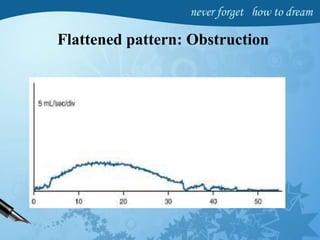
Flattened pattern: Obstruction
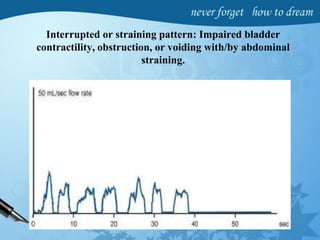
Interrupted or straining pattern: Impaired bladder
contractility, obstruction, or voiding with/by abdominal
straining.
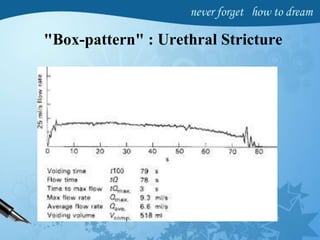
"Box-pattern" : Urethral Stricture
Post Void Residual Urine
• Excellent assessment of bladder emptying.
• Performed by ultrasound (bladder scan) or
catheterization.
• Normally, it is < 0.5ml, but < 10% of voided
volume is considered insignificant.
Urethral pressure profilometry
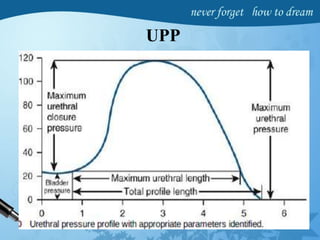
• Urethral pressure profile (UPP): a graph
indicating intraluminal pressure along the
length of urethra.
• Urethral pressure: fluid pressure needed to
just open a closed urethra.
• UPP is obtained by withdrawal of a pressure
sensor (catheter) along the length of urethra.
UPP Parameters:
• Urethral closure pressure profile is given by subtraction of
intravesical pressure from urethral pressure.
• Maximum urethral pressure is highest pressure measured
along the UPP.
• Maximum urethral closure pressure (MUCP) : maximum
difference between urethral pressure and intravesical
pressure.
• Functional profile length: length of urethra along which
urethral pressure exceeds intravesical pressure in women.
• In most continent women,
functional urethral length:approx.3 cm &
MUCP is 40 to 60 cm H2O.
• MUCP is not always indicative of severity of
incontinence hence not used commonly.
UPP
PRESSURE FLOW
MICTURITION STUDIES
• Simultaneous measurement of bladder pressure and
flow rate throughout the micturition cycle.
• Best method of quantitatively analyzing voiding
function.
• Access to bladder via transurethral or SPC 8F or
less.
• Intra-abdominal pressure measured by balloon
catheter in rectum or vagina.
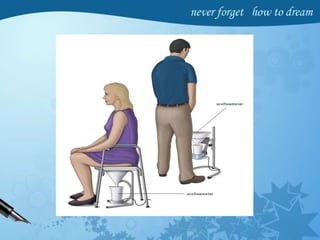
• Men should void in standing position, while
women seated on commode.
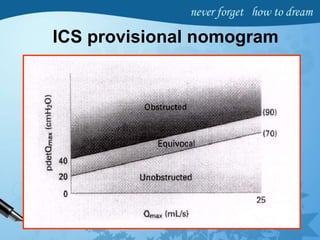
• Detrusor pressure at maximal flow(Pdet at Qmax):
Magnitude of micturition contraction at the time
when flow rate is at its maximum.
• Pressure <100 cm H2O indicate outlet obstruction
even if the flow rate is normal.
• Normal male generally voids with Pdet 40-60 cm
H2O and woman with lower pressure.
• Pdet more accurately measures bladder wall
contractions.
• Indications for pressure-flow studies:
- to differentiate between pts with a low Qmax sec.
to obstruction, from those sec.to poor contractility.
- Identify pt.with normal flow rates but high pressure
obstruction.
- LUTS in pt with hx of neurologic disease(CVA,
Parkinson’s).
- LUTS with normal flow rates (Qmax > 15cc/min).
younger men with LUTS.
- Men whom LUTS s/o bladder instability rather
than flow disorder.
- Men with little endoscopic evidence of prostate
occlusion
ICS provisional nomogram
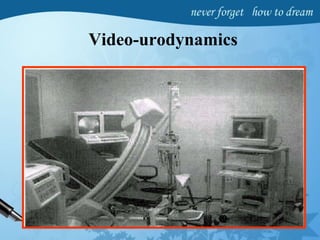
VIDEO-URODYNAMICS
• UDS with simultaneous fluoroscopic image of
lower urinary tract.
• Equipment and technique:
- CMG + PFS same as before but the study is
conducted on a fluoroscopy table, and the filling
medium is a radiographic contrast agent.
• clinical applicability:
– complex BOO
– evaluation of VUR during storage &/or filling.
– neurogenic bladder dysfunction
– identification of associated pathology
• Primary BNO diagnosis & differentiation
from dysfunctional voiding in women: only
on VUDS.
Video-urodynamics
ELECTROMYOGRAPHY
(EMG)
• Study of the electric potentials produced by depolarization
of muscle membranes.
• In case of UDS, EMG measurement of striated sphincteric
muscles of the perineum is done to evaluate possible
abnormalities of pelvic floor muscle function.
• EMG activity is measured during both filling and emptying.
• EMG is performed via electrodes placed in (needle
electrodes) or near (surface electrodes) the muscle to be
measured.
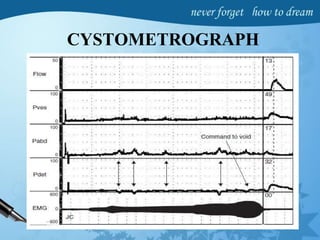
• Most important information obtained from
sphincter EMG is whether there is
coordination or not between the external
sphincter and the bladder.
• EMG activity gradually increases during
filling cystometry (recruitment) and then
cease and remains so for the time of voiding.
• Failure of the sphincter to relax or stay
completely relaxed during micturition is
abnormal.
• In pt with neurologic disease, this is called
detrusor-sphincter dyssenergia.
• In the absence of neurologic disease, it is
called pelvic floor hyperactivity,or
dysfunctional voiding.
CYSTOMETROGRAPH
URODYNAMIC RISK FACTORS
• Following urodynamics findings are potentially dangerous
and usually require intervention to prevent upper and lower
urinary tract decompensation:
• 1. Impaired compliance
• 2. Detrusor external sphincter dyssynergia (DESD)
• 3. Detrusor internal sphincter dyssynergia (DISD)
• 4. High-pressure detrusor overactivity present throughout
filling
• 5. Elevated detrusor leak point pressure (>40 cm H2O)
• 6. Poor emptying with high storage pressures

Urodynamic studies

  • 1.
    Gaurav Nahar DNB UrologyResident, MMHRC, Madurai URODYNAMICS
  • 3.
  • 4.
    Physiology of Micturition •LUT innervation: Somatic, parasympathetic (PNS) & sympathetic (SNS) • As urine fills the bladder, detrusor stretches and allows bladder to expand. • ~300 ml in bladder before the brain recognizes bladder fullness.
  • 5.
  • 6.
    Physiology of Micturition •Low bladder volumes: SNS is stimulated and PNS is inhibited. • Bladder full: PNS stimulated (bladder contracts) SNS inhibited (internal sphincter relaxes). • Intravesical pressure > resistance within the urethra: urine flows. • Pudendal nerve innervates external sphincter.
  • 7.
    Anatomy of bladder& its outlet
  • 9.
  • 10.
    • Dynamic studyof transport, storage & evacuation of urine. • Main goal of UDS: to reproduce pt.'s symptoms and determine their cause by various tests.
  • 11.
    UDS Armamentarium • Cystometry(mostimportant test), filling cystometry & voiding cystometry • Uroflowmetry • Urethral pressure studies • Pressure flow micturition studies • Video-urodynamic studies • Electromyography
  • 12.
    INDICATIONS • Incontinence: -recurrent incontinencein whom surgery is planned. -mixed urge & stress symptoms. -associated voiding problems. -pts. with neurologic disorders. -pts. with mismatch between signs and symptoms.
  • 13.
    INDICATIONS (contd..) • OutflowObstruction: -pt with LUTS, at least uroflow study. • Neurogenic bladder: -all neurologically impaired patients with neurogenic bladder dysfunction. • Children with voiding dysfunction: -kids with daytime urgency and urge incontinence, recurrent infection, reflux, or upper tract changes.
  • 14.
    Clinical role • Characterizationof detrusor function. • Evaluation of bladder outlet. • Evaluation of voiding function. • Diagnosis and characterization of neuropathy.
  • 15.
    Three important rulesbefore starting UDS evaluation: • 1. Decide on questions to be answered before starting a study. • 2. Design the study to answer these questions. • 3. Customize the study as necessary.
  • 16.
    CYSTOMETRY • Measurement ofintravesical bladder pressure during bladder filling(measures volume-pressure relationships). • Used to assess bladder sensation, capacity, compliance, detrusor activity. • Bladder access by transurethral catheter, or rarely by percutaneous suprapubic tube. • Filling medium either gas (CO2) or liquid (water, saline, or contrast material at body temp). • Liquid cystometry is more physiologic. • Ideally, filling should be performed in standing position.
  • 17.
    CYSTOMETRY(contd...) • Bladder fillingeither by diuresis or filling through a catheter. • Filling – slow (up to 10 ml/min), physiologic – medium (10 to 100 ml/min) – fast (> 100 ml/min) • Children and pts with known bladder hyperactivity require slow fill rates. • Reference point:- superior edge of symphysis pubis. • All systems should be zeroed to atmospheric pressure. • No air bubbles.
  • 18.
  • 19.
    • Normal CMG: -Capacity 350-600ml - First desire to void between 150- 200 ml. - Constant low pressure that does not reach more than 6-10 cm H2O above baseline at the end of filling. - Provocative maneuvers(cough, fast fill etc.) should not provoke a bladder contraction normally. - Absence of systolic detrusor contractions. - No leakage on coughing . - A voiding detrusor pressure rise of < 70 cm H2O with a peak flow rate of > 15 ml / s for a volume > 150 ml. - Residual urine of < 50 ml.
  • 20.
    CYSTOMETRY(contd...) • Single Vsmulti-channel UDS: -single: Pves only -multi: Pves, Pdet, Pabd
  • 21.
    CMG PARAMETERS • Intravesicalpressure(Pves): Total Pressure within the bladder. • Abdominal pressure(Pabd): Pressure surrounding the bladder; currently estimated from rectal, vaginal, or extraperitoneal pressure or a bowel stoma. • Detrusor pressure(Pdet): Component of intravesical pressure created by forces on the bladder wall, both passive and active. • True detrusor pressure = Intravesical pressure - Intraabdominal pressure.(Pdet = Pves-Pabd)
  • 22.
    • Physiologic fillingrate: A filling rate < predicted maximum. Predicted maximum = body weight in kg divided by 4 and expressed as ml/min. • Nonphysiologic filling rate: A filling rate > predicted maximum. • First sensation of bladder filling: Volume at which patient first becomes aware of bladder filling. • First desire to void: Feeling during filling cystometry that would lead the patient to pass urine at the next convenient moment. • Strong desire to void: Persistent desire to void without fear of leakage.
  • 23.
    • Compliance: - Relationshipbetween change in bladder volume and change in Pdet (Δvolume/Δpressure); measured in ml/cm H2O. - Normal bladder is highly compliant, and can hold large volumes at low pressure. - Normal pressure rise during the course of CMG in normal bladder will be only 6-10 cm H2O. - Decrease compliance < 20 ml/cm H2O, poorly distensible bladder.
  • 24.
    Impaired compliance isseen in: • neurologic conditions: spinal cord injury/lesion, spina bifida, usually results from increased outlet resistance (e.g., detrusor external sphincter dyssynergia [DESD]) or decentralization in the case of lower motor neuron lesions, • Long-term BOO (e.g., from benign prostatic obstruction), • Structural changes- radiation cystitis or tuberculosis. • Impaired compliance with prolonged elevated storage pressures is a urodynamic risk factor and needs treatment to prevent renal damage.
  • 25.
    • Urgency: Asudden compelling desire to void. • Normal detrusor function: Allows bladder filling with little or no change in pressure, no involuntary contractions. • Detrusor overactivity: Involuntary detrusor contractions during the filling phase, spontaneous or provoked. • Storage greater than 40 cm H2O is associated with harmful effects on the upper tract. • Overactive bladder: storage symptoms of urgency with or without urgency incontinence, usually with frequency and nocturia.
  • 27.
    • Neurogenic detrusoroveractivity: Overactivity accompanied by a neurologic condition; also k/a detrusor hyperreflexia. • Idiopathic detrusor overactivity: Detrusor overactivity without concurrent neurologic cause; also k/a detrusor instability.
  • 28.
    • Abdominal leakpoint pressure(ALPP): Intravesical pressure at which urine leakage occurs because of increased abdominal pressure in the absence of a detrusor contraction. • ALPP is a measure of sphincteric strength or ability of the sphincter to resist changes in Pabd • Applicable to stress incontinence; ALPP can be demonstrated only in a patient with SUI. • There is no normal ALPP, because patients without stress incontinence will not leak at any physiologic Pabd. • Lower the ALPP, weaker is the sphincter.
  • 29.
    – ALPP<60 cmH2O: significant ISD – ALPP 60-90 cm H2O: equivocal – ALPP>90 cm H2O: urethral hypermobility; little or no ISD
  • 30.
    • Detrusor leakpoint pressure(DLPP): Lowest detrusor pressure at which urine leakage occurs in the absence of either a detrusor contraction or increased abdominal pressure (risk with > 40cm H2O). • Its a measure of Pdet in a patient with decreased bladder compliance. • Higher the urethral resistance, higher the DLPP, the more likely is upper tract damage as intravesical pressure is transferred to the kidneys.
  • 32.
    UROFLOMETRY • Non invasivestudy. • Measurement of the rate of urine flow over time. • Estimate of effectiveness of the act of voiding along with PVR. • Influenced by – effectiveness of detrusor contraction – completeness of sphincteric relaxation – patency of the urethra • 3 methods used – gravimetric – rotating disk – electronic dipstick
  • 33.
    Recorded variables duringUFM study: • Voided volume (VV in milliliters) • Flow rate (Q in milliliters per second) • Maximum flow rate (Qmax in milliliters per second) • Average flow rate (Qave in milliliters per second) • Voiding time (total time during micturition in seconds) • Flow time (the time during which flow occurred in seconds) • Time to maximum flow (onset of flow to Qmax in seconds)
  • 34.
    • Optimal voids200 to 400cc. • Voids < 150cc are difficult to interpret. • Pt. should be well hydrated with full bladder, but not overly distended bladder. • Should be performed in privacy and pt.encouraged to void in his normal fashion. • Qmax & shape of curve- more reliable indicators of BOO. • Qmax- most reliable variable in detecting abnormal voiding.
  • 35.
    Normal uroflow curveis bell-shaped
  • 36.
  • 37.
    Interrupted or strainingpattern: Impaired bladder contractility, obstruction, or voiding with/by abdominal straining.
  • 38.
  • 39.
    Post Void ResidualUrine • Excellent assessment of bladder emptying. • Performed by ultrasound (bladder scan) or catheterization. • Normally, it is < 0.5ml, but < 10% of voided volume is considered insignificant.
  • 40.
    Urethral pressure profilometry •Urethral pressure profile (UPP): a graph indicating intraluminal pressure along the length of urethra. • Urethral pressure: fluid pressure needed to just open a closed urethra. • UPP is obtained by withdrawal of a pressure sensor (catheter) along the length of urethra.
  • 41.
    UPP Parameters: • Urethralclosure pressure profile is given by subtraction of intravesical pressure from urethral pressure. • Maximum urethral pressure is highest pressure measured along the UPP. • Maximum urethral closure pressure (MUCP) : maximum difference between urethral pressure and intravesical pressure. • Functional profile length: length of urethra along which urethral pressure exceeds intravesical pressure in women.
  • 42.
    • In mostcontinent women, functional urethral length:approx.3 cm & MUCP is 40 to 60 cm H2O. • MUCP is not always indicative of severity of incontinence hence not used commonly.
  • 43.
  • 44.
    PRESSURE FLOW MICTURITION STUDIES •Simultaneous measurement of bladder pressure and flow rate throughout the micturition cycle. • Best method of quantitatively analyzing voiding function. • Access to bladder via transurethral or SPC 8F or less. • Intra-abdominal pressure measured by balloon catheter in rectum or vagina. • Men should void in standing position, while women seated on commode.
  • 46.
    • Detrusor pressureat maximal flow(Pdet at Qmax): Magnitude of micturition contraction at the time when flow rate is at its maximum. • Pressure <100 cm H2O indicate outlet obstruction even if the flow rate is normal. • Normal male generally voids with Pdet 40-60 cm H2O and woman with lower pressure. • Pdet more accurately measures bladder wall contractions.
  • 47.
    • Indications forpressure-flow studies: - to differentiate between pts with a low Qmax sec. to obstruction, from those sec.to poor contractility. - Identify pt.with normal flow rates but high pressure obstruction. - LUTS in pt with hx of neurologic disease(CVA, Parkinson’s). - LUTS with normal flow rates (Qmax > 15cc/min). younger men with LUTS. - Men whom LUTS s/o bladder instability rather than flow disorder. - Men with little endoscopic evidence of prostate occlusion
  • 48.
  • 49.
    VIDEO-URODYNAMICS • UDS withsimultaneous fluoroscopic image of lower urinary tract. • Equipment and technique: - CMG + PFS same as before but the study is conducted on a fluoroscopy table, and the filling medium is a radiographic contrast agent. • clinical applicability: – complex BOO – evaluation of VUR during storage &/or filling. – neurogenic bladder dysfunction – identification of associated pathology
  • 50.
    • Primary BNOdiagnosis & differentiation from dysfunctional voiding in women: only on VUDS.
  • 51.
  • 52.
    ELECTROMYOGRAPHY (EMG) • Study ofthe electric potentials produced by depolarization of muscle membranes. • In case of UDS, EMG measurement of striated sphincteric muscles of the perineum is done to evaluate possible abnormalities of pelvic floor muscle function. • EMG activity is measured during both filling and emptying. • EMG is performed via electrodes placed in (needle electrodes) or near (surface electrodes) the muscle to be measured.
  • 53.
    • Most importantinformation obtained from sphincter EMG is whether there is coordination or not between the external sphincter and the bladder. • EMG activity gradually increases during filling cystometry (recruitment) and then cease and remains so for the time of voiding.
  • 54.
    • Failure ofthe sphincter to relax or stay completely relaxed during micturition is abnormal. • In pt with neurologic disease, this is called detrusor-sphincter dyssenergia. • In the absence of neurologic disease, it is called pelvic floor hyperactivity,or dysfunctional voiding.
  • 55.
  • 56.
    URODYNAMIC RISK FACTORS •Following urodynamics findings are potentially dangerous and usually require intervention to prevent upper and lower urinary tract decompensation: • 1. Impaired compliance • 2. Detrusor external sphincter dyssynergia (DESD) • 3. Detrusor internal sphincter dyssynergia (DISD) • 4. High-pressure detrusor overactivity present throughout filling • 5. Elevated detrusor leak point pressure (>40 cm H2O) • 6. Poor emptying with high storage pressures