Acute Urinary Retention
By Dr LINGO PHILIPPE-ALBERT
1st
EM Resident FHS/UB
Plan
• Introduction
• Pathophysiology
• Clinical features
• Paraclinic Investigations
• Management
Introduction
• Urinary retention is the inability to voluntarily urinate. Acute urinary
retention is the sudden and often painful inability to void despite
having a full bladder.
• Chronic urinary retention is painless retention associated with an
increased volume of residual urine. Patients with urinary retention
can present with complete lack of voiding, incomplete bladder
emptying, or overflow incontinence. Complications include infection
and renal failure.
Introduction
Epidemiology :
• Family physicians often encounter patients with urinary retention. In
two large cohort studies of U.S. men 40 to 83 years of age, the overall
incidence was 4.5 to 6.8 per 1,000 men per year.
• The incidence dramatically increases with age so that a man in his 70s
has a 10 percent chance and a man in his 80s has a more than 30
percent chance of having an episode of acute urinary retention.
Introduction
• In Cameroon, Epoupa et al found that the most common urological
emergency was urinary retention (45.05 %) with the most common
cause of urinary retention being prostate tumors
Pathophysiology
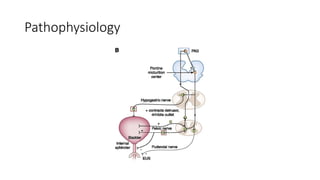
• The voiding process, or micturition, involves the complex integration and coordination
of high cortical neurologic (sympathetic, parasympathetic, and somatic) and muscular
(detrusor and sphincter smooth muscle) functions.
• As the sensory impulse of bladder distention transmits to cortical centers, these areas
of the brain smoothly coordinate voluntary urination.
• Continent urine storage in the bladder requires both relaxation of the detrusor muscle
(through β-adrenergic stimulation and parasympathetic inhibition) and contraction of
the bladder neck and internal sphincter (through α-adrenergic stimulation).
• The contraction of bladder detrusor muscle (by cholinergic muscarinic receptors) and
relaxation of both the internal sphincter of bladder neck and the urethral sphincter
(through α-adrenergic inhibition) contribute to smooth urination.
Pathophysiology
Pathophysiology
Clinical features
• Patients will present with acute suprapubic pain and an inability to
micturate.
• This may be associated with symptoms suggestive of the predisposing
cause, such as a urinary tract infection, recent change to medication, or
worsening voiding LUTS.
• On examination, the patient may have a palpably distended bladder,
with suprapubic tenderness.
• Any associated fevers, rigors, or lethargy may suggest an infective cause.
• Ensure to perform a digital rectal examination, especially in older
patients, to assess for any prostate enlargement or constipation.
Clinical features
Paraclinical Investigations
• A post-void bedside bladder Ultrasound will show the volume of
retained urine, helping to confirm the diagnosis.
• Urine culture
• FBC, Urea-Creatinine, Serum Electrolytes
• Abdominal US/ Abdominal CT
• Neuroimaging (MRI of Spinal cord) in case of clinical neurologic
deficits
• Cystourethrography may be beneficial but it is not an ED procedure
Management
Goals :
• Relieve the symptoms
• Permit emptying of the bladder
• Prevent complications
• Identify the cause
Management
• Immediate urethral catheterisation to resolve the retention. Ensure to measure
the volume drained post-catheterisation.
• Contraindications to Urethral Catheterisation :
• Urethral trauma
• Recent instrumentation
• Stricture
• suprapubic Urinary catheter if impossibility to place Foley catheter
• Case of obstruction from Hematuria:
• A 3-port Foley catheter should be placed and the bladder irrigated until returning fluid is free of blood.
• These patients are likely to need admission for continued irrigation as the catheter often becomes
blocked with clot following placement
Management
• Medications : (not systematic)
• Analgesics : Paracetamol 1g/8-6hrs IV
• Anti cholinergics : Oybutinin 2.5mg/12hrs or 2.5mg/8hrs oral
• Alpha blockers if BPH : Alfuzosin 10mg/24hrs oral
• Antibiotics ONLY if evidence of infection
• Ciprofloxacin 500mg /12 hrs PO
• Ceftriaxone 2g/24h IV if severe infection
• Address precipitating causes of retention.
• Discontinue offending medications.
• Infectious or neurologic causes must be completely evaluated; urgency of workup
depends on patient acuity and comorbidities.
Management
Case of Chronic Urinary Retention :
• If urinary retention has been chronic, postobstructive diuresis may
occur even in the presence of normal blood urea nitrogen and
creatinine levels.
• In such patients, closely monitor urinary output, for 4 to 6 hours after
catheterization.
• Hourly output of greater than 200 mL for more than 4 to 6 hours is an
indication for admission and fluid replacement.
Management
• In all cases of urinary retention, urologic follow-up in 3 to 7 days is
indicated for a complete genitourinary evaluation. Patients should
usually expect to have the catheter removed at that visit
Conclusion
• Acute urinary retention is common in emergency settings
• Various causes or factors can precipitate its occurrence
• Therapeutic action aims mainly at voiding of the bladder
• Etiologic treatment should be done when possible
References
• Rosenstein D, McAninch JW. Urologic emergencies. Med Clin North
Am. 2004;88(2):495-518.
• Tintinalli’s Emergency Medicine: A Comprehensive Study Guide, 8th ed.,
see Chapter 92, “Acute Urinary Retention,” by David Hung-Tsang Yen
and Chen-Hsen Lee.
• Epoupa Ngalle , Landry Oriole Mbouche, Axel Stephane Nwaha Makon,
Jean Cedrick Fouda , Junior Barthelemy Mekeme Mekeme, Armel
Quentin Essomba, Jean-Jacques Nwatchap, Edouard Herve Moby Mpah
Urological emergencies in two university hospitals in Douala: a
retrospective study (2016-2020); Pan Afr Med J 2023 Mar 16:44:135.

Acute Urinary Retention_114032 2024.pptx

  • 1.
    Acute Urinary Retention ByDr LINGO PHILIPPE-ALBERT 1st EM Resident FHS/UB
  • 2.
    Plan • Introduction • Pathophysiology •Clinical features • Paraclinic Investigations • Management
  • 3.
    Introduction • Urinary retentionis the inability to voluntarily urinate. Acute urinary retention is the sudden and often painful inability to void despite having a full bladder. • Chronic urinary retention is painless retention associated with an increased volume of residual urine. Patients with urinary retention can present with complete lack of voiding, incomplete bladder emptying, or overflow incontinence. Complications include infection and renal failure.
  • 4.
    Introduction Epidemiology : • Familyphysicians often encounter patients with urinary retention. In two large cohort studies of U.S. men 40 to 83 years of age, the overall incidence was 4.5 to 6.8 per 1,000 men per year. • The incidence dramatically increases with age so that a man in his 70s has a 10 percent chance and a man in his 80s has a more than 30 percent chance of having an episode of acute urinary retention.
  • 5.
    Introduction • In Cameroon,Epoupa et al found that the most common urological emergency was urinary retention (45.05 %) with the most common cause of urinary retention being prostate tumors
  • 6.
    Pathophysiology • The voidingprocess, or micturition, involves the complex integration and coordination of high cortical neurologic (sympathetic, parasympathetic, and somatic) and muscular (detrusor and sphincter smooth muscle) functions. • As the sensory impulse of bladder distention transmits to cortical centers, these areas of the brain smoothly coordinate voluntary urination. • Continent urine storage in the bladder requires both relaxation of the detrusor muscle (through β-adrenergic stimulation and parasympathetic inhibition) and contraction of the bladder neck and internal sphincter (through α-adrenergic stimulation). • The contraction of bladder detrusor muscle (by cholinergic muscarinic receptors) and relaxation of both the internal sphincter of bladder neck and the urethral sphincter (through α-adrenergic inhibition) contribute to smooth urination.
  • 7.
  • 8.
  • 9.
    Clinical features • Patientswill present with acute suprapubic pain and an inability to micturate. • This may be associated with symptoms suggestive of the predisposing cause, such as a urinary tract infection, recent change to medication, or worsening voiding LUTS. • On examination, the patient may have a palpably distended bladder, with suprapubic tenderness. • Any associated fevers, rigors, or lethargy may suggest an infective cause. • Ensure to perform a digital rectal examination, especially in older patients, to assess for any prostate enlargement or constipation.
  • 10.
  • 11.
    Paraclinical Investigations • Apost-void bedside bladder Ultrasound will show the volume of retained urine, helping to confirm the diagnosis. • Urine culture • FBC, Urea-Creatinine, Serum Electrolytes • Abdominal US/ Abdominal CT • Neuroimaging (MRI of Spinal cord) in case of clinical neurologic deficits • Cystourethrography may be beneficial but it is not an ED procedure
  • 12.
    Management Goals : • Relievethe symptoms • Permit emptying of the bladder • Prevent complications • Identify the cause
  • 13.
    Management • Immediate urethralcatheterisation to resolve the retention. Ensure to measure the volume drained post-catheterisation. • Contraindications to Urethral Catheterisation : • Urethral trauma • Recent instrumentation • Stricture • suprapubic Urinary catheter if impossibility to place Foley catheter • Case of obstruction from Hematuria: • A 3-port Foley catheter should be placed and the bladder irrigated until returning fluid is free of blood. • These patients are likely to need admission for continued irrigation as the catheter often becomes blocked with clot following placement
  • 14.
    Management • Medications :(not systematic) • Analgesics : Paracetamol 1g/8-6hrs IV • Anti cholinergics : Oybutinin 2.5mg/12hrs or 2.5mg/8hrs oral • Alpha blockers if BPH : Alfuzosin 10mg/24hrs oral • Antibiotics ONLY if evidence of infection • Ciprofloxacin 500mg /12 hrs PO • Ceftriaxone 2g/24h IV if severe infection • Address precipitating causes of retention. • Discontinue offending medications. • Infectious or neurologic causes must be completely evaluated; urgency of workup depends on patient acuity and comorbidities.
  • 15.
    Management Case of ChronicUrinary Retention : • If urinary retention has been chronic, postobstructive diuresis may occur even in the presence of normal blood urea nitrogen and creatinine levels. • In such patients, closely monitor urinary output, for 4 to 6 hours after catheterization. • Hourly output of greater than 200 mL for more than 4 to 6 hours is an indication for admission and fluid replacement.
  • 16.
    Management • In allcases of urinary retention, urologic follow-up in 3 to 7 days is indicated for a complete genitourinary evaluation. Patients should usually expect to have the catheter removed at that visit
  • 17.
    Conclusion • Acute urinaryretention is common in emergency settings • Various causes or factors can precipitate its occurrence • Therapeutic action aims mainly at voiding of the bladder • Etiologic treatment should be done when possible
  • 18.
    References • Rosenstein D,McAninch JW. Urologic emergencies. Med Clin North Am. 2004;88(2):495-518. • Tintinalli’s Emergency Medicine: A Comprehensive Study Guide, 8th ed., see Chapter 92, “Acute Urinary Retention,” by David Hung-Tsang Yen and Chen-Hsen Lee. • Epoupa Ngalle , Landry Oriole Mbouche, Axel Stephane Nwaha Makon, Jean Cedrick Fouda , Junior Barthelemy Mekeme Mekeme, Armel Quentin Essomba, Jean-Jacques Nwatchap, Edouard Herve Moby Mpah Urological emergencies in two university hospitals in Douala: a retrospective study (2016-2020); Pan Afr Med J 2023 Mar 16:44:135.