Medical Terminology
Chapter 9
Urinary System
5 Abbreviations
Terry Prince
5 Abbreviation/Acronyms
• UTI - Urinary Tract Infection
• BNO – Bladder Neck Obstruction
• KUB – Kidneys, Ureters, Bladder
• ESWL – Extracorporeal Shockwave Lithotripsy
• Cath - Catheterization
UTI - Urinary Tract Infection
Urinary tract infections are caused by bacteria that invades the Urinary
System and multiply. The infection can occur in any part of the urinary system,
but usually starts in the urethra. Bacteria cling to the opening of the urethra and
start to multiply from there. Bacteria moves to the bladder causing a bladder
infection. If not treated promptly the bacteria may enter the ureters, infecting
the kidneys. UTI’s can also be sexually transmitted.
A urine sample will be tested for blood, pus and bacteria.
UTI’s can be treated with antibiotic drugs. In severe cases the patient will be
treated with intravenous or intramuscular antibiotics followed by oral therapy.
The patient should feel better after a couple of days.
To avoid UTI’S you should:
• Wash genitals daily.
• Take showers instead of baths.
• Drink plenty of liquids.
• Urinate when you feel the need and do not
resist the urge.
• Empty your bladder completely and drink a
full glass of water after having sex.
• Women should always wipe from front to
back after having a bowel movement.
• Avoid using douches and feminine hygiene
sprays.
• Drinking cranberry juice may help prevent
and relieve UTIs.
Bladder Neck Obstruction
BNO
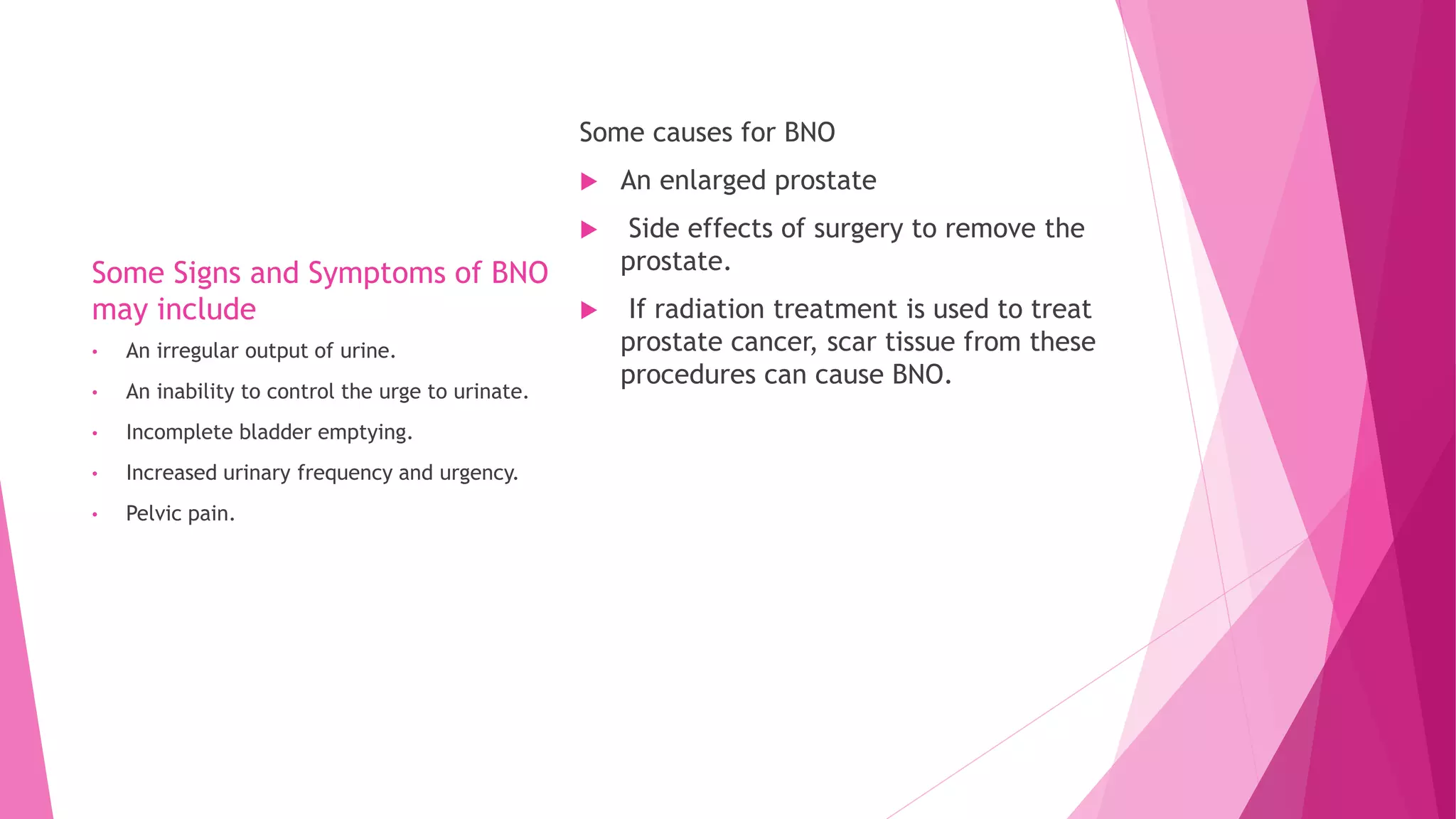
The bladder neck is a group of muscles that connect the bladder to the urethra.
The muscles tighten to hold urine in the bladder, and relax to release it through
the urethra. Urinary problems occur when abnormalities block the bladder neck
and prevent it from opening completely during urination.
The bladder can become permanently weakened if treatment is delayed for an
extended period of time. A weakened bladder may lead to complications such as:
• Urinary Tract Infections
• Kidney Damage
• Bladder Diverticula, which are bulging pouches that can form in the
bladder
• Long-term incontinence, which is a lack of bladder control
Some Signs and Symptoms of BNO
may include
Some causes for BNO
 An enlarged prostate
 Side effects of surgery to remove the
prostate.
 If radiation treatment is used to treat
prostate cancer, scar tissue from these
procedures can cause BNO.
• An irregular output of urine.
• An inability to control the urge to urinate.
• Incomplete bladder emptying.
• Increased urinary frequency and urgency.
• Pelvic pain.
Views of BNO
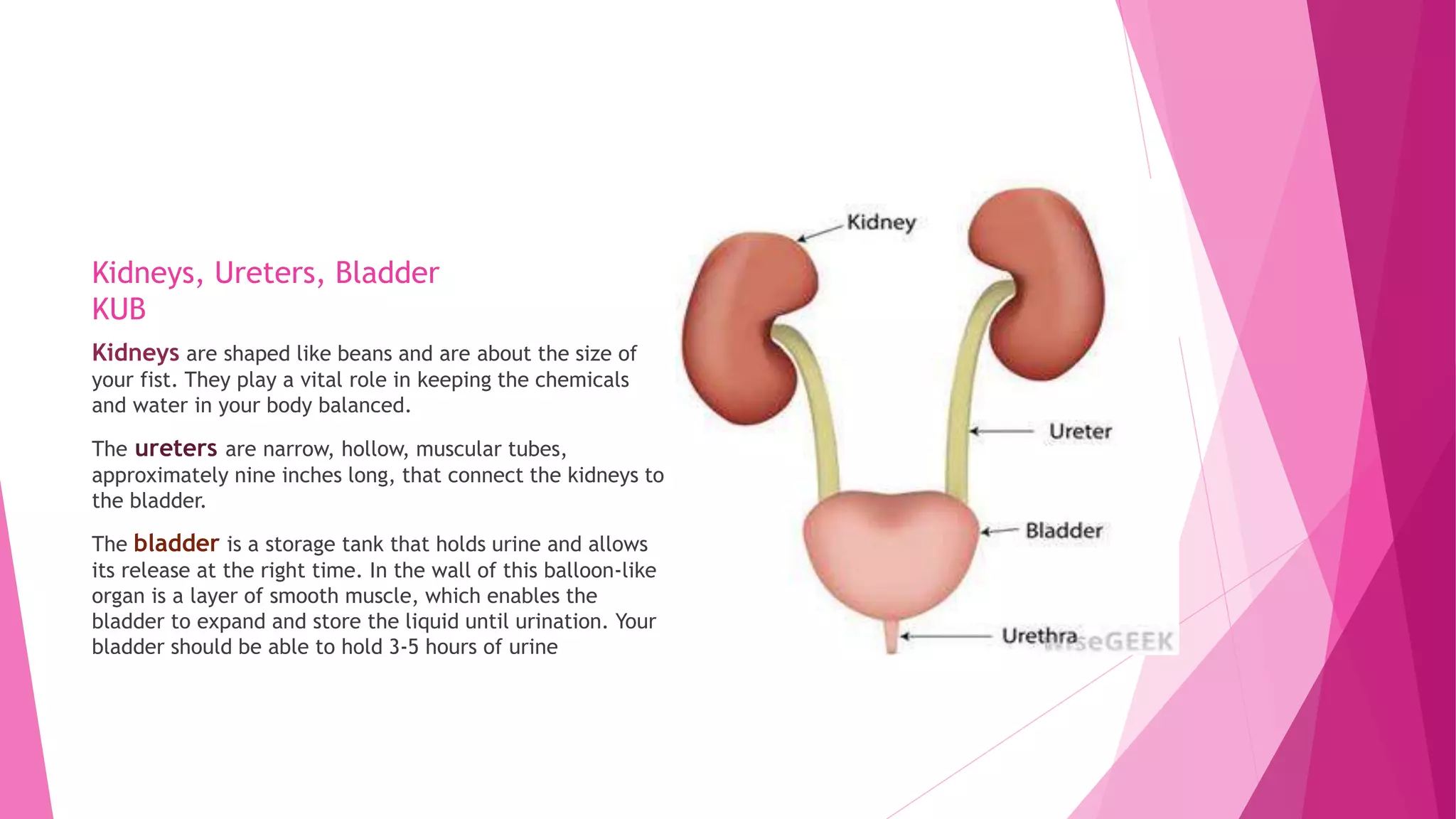
Kidneys, Ureters, Bladder
KUB
Kidneys are shaped like beans and are about the size of
your fist. They play a vital role in keeping the chemicals
and water in your body balanced.
The ureters are narrow, hollow, muscular tubes,
approximately nine inches long, that connect the kidneys to
the bladder.
The bladder is a storage tank that holds urine and allows
its release at the right time. In the wall of this balloon-like
organ is a layer of smooth muscle, which enables the
bladder to expand and store the liquid until urination. Your
bladder should be able to hold 3-5 hours of urine
Kidneys, Ureters, Bladder
KUB
Reasons for this x-ray…..
 To identify a blockage in the intestine.
 To help diagnose the source of nausea,
vomiting, pain or other symptoms
related to the abdomen
 To locate a foreign object that has
been swallowed
 To help detect and locate
calcifications (kidney stones )
 To identify suspected urinary system
problems
A KUB is a plain film of the abdomen
providing information about abdominal
organs such as kidneys, ureters and bladder.
Factors that may interfere with
x-rays may include…….
Prior to exam….
 You will probably be asked not to eat
or drink anything for 4 hours before
your exam
 You'll remove your clothes and put on
a hospital gown.
 You’ll remove all metal-containing
items, including jewelry and watches
Large amounts of gas or stool in the
intestines
Excessive peritoneal fluid
Obesity
Fibroids
Dye or barium left from previous tests
Mass in either the uterus or ovary
EXTRACORPEAL SHOCKWAVE
LITHOTRIPSY-ESWL
For this procedure….
 You lie on a water-filled cushion, and
the surgeon uses X-rays or ultrasound
to precisely locate the stone. High-
energy sound waves pass through your
body and break the stone into small
pieces. These small pieces move
through the urinary tract and out of
the body more easily than a large
stone.
 The process takes about an hour.
 You may receive sedatives or local
anesthesia.
 If you have a large stone your surgeon
may use a stent to hold the ureter
open. This helps the small stone
pieces to pass without blocking the
ureter.
A use of ultrasound waves to break up stones
into small pieces so that they can easily travel
through the urinary tract.
ESWL may be used on a person who has a
kidney stone that is causing pain or blocking the
urine flow.
Lithotripsy is used to remove kidney stones
that are causing:
• Bleeding
• Damage to your kidney
• Pain
• Urinary tract infections
IMAGES OF ESWL
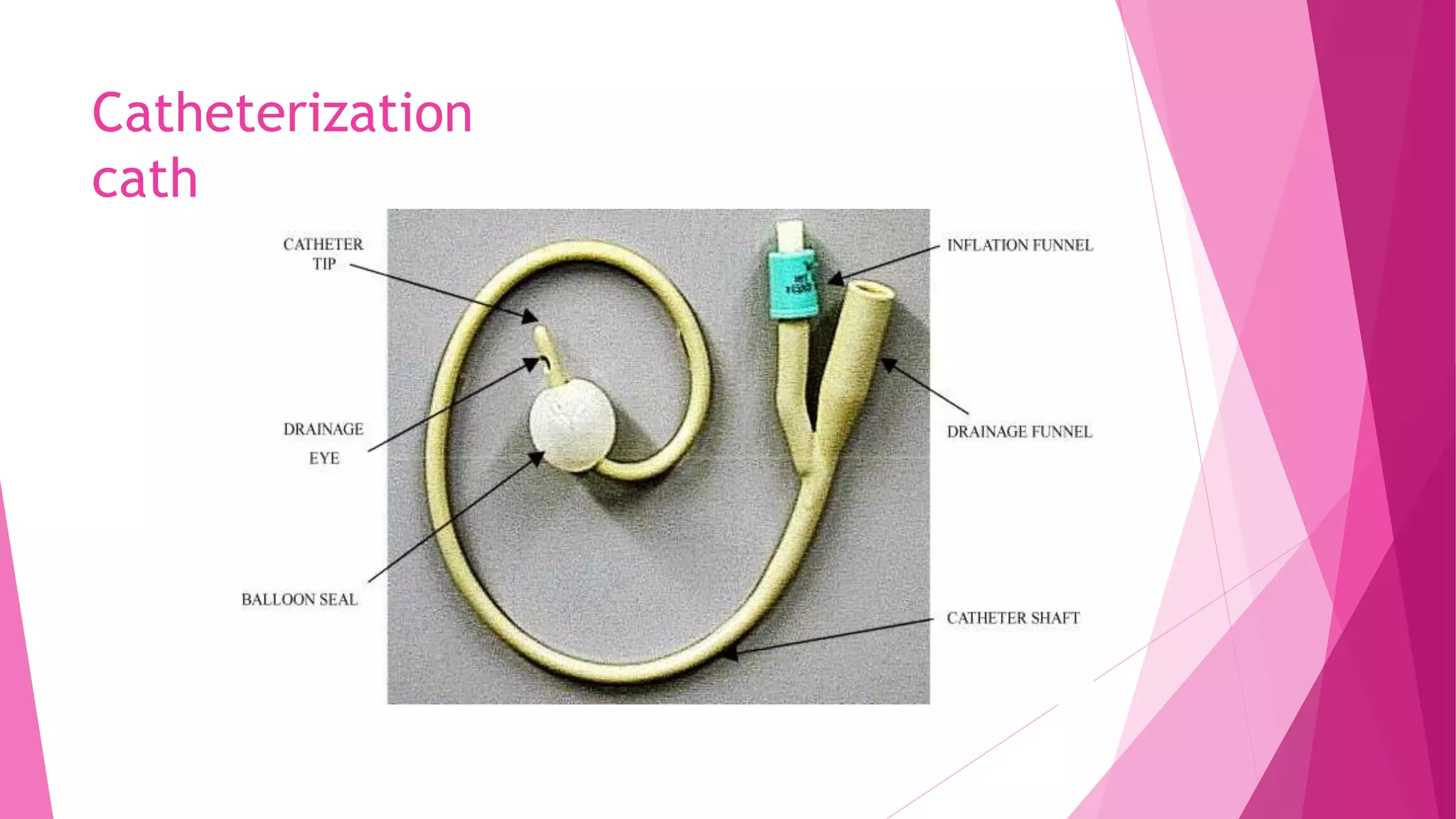
Catheterization
cath
Catheterization allows the patients urine to drain freely from
the bladder for collection. It may also be used to inject
liquids for treatment or diagnosis of bladder conditions.
When a person is unable to urinate the problem can quickly
become a serious one. As urine builds up in the bladder, the
condition becomes uncomfortable, and painful. If the bladder
become overly full and urine back up into the kidneys, this
causes damage that can be permanent.
When this happens, a urinary catheter is inserted into the
bladder. This is a sterile and flexible tube that is inserted
into the urethra (where urine comes out of the body) and is
gently pushed into the body until the end rests in the
bladder.
Catheters come in several basic designs
 A Foley catheter (indwelling urinary catheter)
is retained by means of a balloon at the tip
that is inflated with sterile water. They are
commonly made in silicone rubber or natural
rubber.
 An intermittent catheter (Robinson catheter)
is a flexible catheter used for short term
drainage of urine. It has no balloon on its tip
and therefore cannot stay in place unaided.
 Intermittent self catheterization in males is
best performed with a flexible catheter to
drain the bladder periodically.
 A coudé catheter is designed with a curved
tip that makes it easier to pass through the
curvature of the prostatic urethra.
 A hematuria catheter is a type of Foley
catheter used for Post-TURP hemostasis. This
is useful following endoscopic surgical
procedures, or in the case of gross hematuria.
 An external, urisheat, Texas or condom
catheter is used for incontinent males and
carries a lower risk of infection than an
indwelling catheter.
A catheter that is left in place for more than a short
period of time is generally attached to a drainage
bag to collect the urine. This also allows for
measurement of urine volume. There are three
types of drainage bags:
A leg bag, a smaller drainage device that attaches
by elastic. bands to the leg. A leg bag is usually
worn during the day, as it fits discreetly under pants
or skirts, and is easily emptied into a toilet.
A down drain may be used overnight. This
device is hung on a hook under the patient's bed—
never placed on the floor.
A belly bag is secured around the waist. This
bag can be worn at all times. It can be worn under
the patient's underwear for an undetectable look
A male catheter attached to the leg A female catheter attached to the leg
Some common side effects of Catheterization
 Urinary tract infections
 Cystitis
 Urethral Injury
 Blood Infection
 Blood in the Urine and Latex Allergy
 Bacteriuria
 Difficulty Urinating After Catheter Removal
 Narrowing of the urethra (this complication
usually occurs in long term insertion due to scar
tissue formation by the insertion of the catheter)
 Bladder injury (caused due to incorrect
insertion)
 Bladder stones
 Kidney stones and kidney damage
 Bladder Cancer
Resources
http://kidney.niddk.nih.gov/index.htm
http://www.afud.org
https://www.nlm.nih.gov/medlineplus/ency/article/007487.htm
<a href="http://medical-dictionary.thefreedictionary.com/KUB">KUB</a>
http://www.healthline.com/health/urinary-catheters

Presentation9

  • 1.
    Medical Terminology Chapter 9 UrinarySystem 5 Abbreviations Terry Prince
  • 2.
    5 Abbreviation/Acronyms • UTI- Urinary Tract Infection • BNO – Bladder Neck Obstruction • KUB – Kidneys, Ureters, Bladder • ESWL – Extracorporeal Shockwave Lithotripsy • Cath - Catheterization
  • 3.
    UTI - UrinaryTract Infection Urinary tract infections are caused by bacteria that invades the Urinary System and multiply. The infection can occur in any part of the urinary system, but usually starts in the urethra. Bacteria cling to the opening of the urethra and start to multiply from there. Bacteria moves to the bladder causing a bladder infection. If not treated promptly the bacteria may enter the ureters, infecting the kidneys. UTI’s can also be sexually transmitted. A urine sample will be tested for blood, pus and bacteria. UTI’s can be treated with antibiotic drugs. In severe cases the patient will be treated with intravenous or intramuscular antibiotics followed by oral therapy. The patient should feel better after a couple of days.
  • 4.
    To avoid UTI’Syou should: • Wash genitals daily. • Take showers instead of baths. • Drink plenty of liquids. • Urinate when you feel the need and do not resist the urge. • Empty your bladder completely and drink a full glass of water after having sex. • Women should always wipe from front to back after having a bowel movement. • Avoid using douches and feminine hygiene sprays. • Drinking cranberry juice may help prevent and relieve UTIs.
  • 5.
    Bladder Neck Obstruction BNO Thebladder neck is a group of muscles that connect the bladder to the urethra. The muscles tighten to hold urine in the bladder, and relax to release it through the urethra. Urinary problems occur when abnormalities block the bladder neck and prevent it from opening completely during urination. The bladder can become permanently weakened if treatment is delayed for an extended period of time. A weakened bladder may lead to complications such as: • Urinary Tract Infections • Kidney Damage • Bladder Diverticula, which are bulging pouches that can form in the bladder • Long-term incontinence, which is a lack of bladder control
  • 6.
    Some Signs andSymptoms of BNO may include Some causes for BNO  An enlarged prostate  Side effects of surgery to remove the prostate.  If radiation treatment is used to treat prostate cancer, scar tissue from these procedures can cause BNO. • An irregular output of urine. • An inability to control the urge to urinate. • Incomplete bladder emptying. • Increased urinary frequency and urgency. • Pelvic pain.
  • 7.
  • 8.
    Kidneys, Ureters, Bladder KUB Kidneysare shaped like beans and are about the size of your fist. They play a vital role in keeping the chemicals and water in your body balanced. The ureters are narrow, hollow, muscular tubes, approximately nine inches long, that connect the kidneys to the bladder. The bladder is a storage tank that holds urine and allows its release at the right time. In the wall of this balloon-like organ is a layer of smooth muscle, which enables the bladder to expand and store the liquid until urination. Your bladder should be able to hold 3-5 hours of urine
  • 9.
    Kidneys, Ureters, Bladder KUB Reasonsfor this x-ray…..  To identify a blockage in the intestine.  To help diagnose the source of nausea, vomiting, pain or other symptoms related to the abdomen  To locate a foreign object that has been swallowed  To help detect and locate calcifications (kidney stones )  To identify suspected urinary system problems A KUB is a plain film of the abdomen providing information about abdominal organs such as kidneys, ureters and bladder.
  • 10.
    Factors that mayinterfere with x-rays may include……. Prior to exam….  You will probably be asked not to eat or drink anything for 4 hours before your exam  You'll remove your clothes and put on a hospital gown.  You’ll remove all metal-containing items, including jewelry and watches Large amounts of gas or stool in the intestines Excessive peritoneal fluid Obesity Fibroids Dye or barium left from previous tests Mass in either the uterus or ovary
  • 11.
    EXTRACORPEAL SHOCKWAVE LITHOTRIPSY-ESWL For thisprocedure….  You lie on a water-filled cushion, and the surgeon uses X-rays or ultrasound to precisely locate the stone. High- energy sound waves pass through your body and break the stone into small pieces. These small pieces move through the urinary tract and out of the body more easily than a large stone.  The process takes about an hour.  You may receive sedatives or local anesthesia.  If you have a large stone your surgeon may use a stent to hold the ureter open. This helps the small stone pieces to pass without blocking the ureter. A use of ultrasound waves to break up stones into small pieces so that they can easily travel through the urinary tract. ESWL may be used on a person who has a kidney stone that is causing pain or blocking the urine flow. Lithotripsy is used to remove kidney stones that are causing: • Bleeding • Damage to your kidney • Pain • Urinary tract infections
  • 12.
  • 13.
  • 14.
    Catheterization allows thepatients urine to drain freely from the bladder for collection. It may also be used to inject liquids for treatment or diagnosis of bladder conditions. When a person is unable to urinate the problem can quickly become a serious one. As urine builds up in the bladder, the condition becomes uncomfortable, and painful. If the bladder become overly full and urine back up into the kidneys, this causes damage that can be permanent. When this happens, a urinary catheter is inserted into the bladder. This is a sterile and flexible tube that is inserted into the urethra (where urine comes out of the body) and is gently pushed into the body until the end rests in the bladder.
  • 15.
    Catheters come inseveral basic designs  A Foley catheter (indwelling urinary catheter) is retained by means of a balloon at the tip that is inflated with sterile water. They are commonly made in silicone rubber or natural rubber.  An intermittent catheter (Robinson catheter) is a flexible catheter used for short term drainage of urine. It has no balloon on its tip and therefore cannot stay in place unaided.  Intermittent self catheterization in males is best performed with a flexible catheter to drain the bladder periodically.  A coudé catheter is designed with a curved tip that makes it easier to pass through the curvature of the prostatic urethra.  A hematuria catheter is a type of Foley catheter used for Post-TURP hemostasis. This is useful following endoscopic surgical procedures, or in the case of gross hematuria.  An external, urisheat, Texas or condom catheter is used for incontinent males and carries a lower risk of infection than an indwelling catheter. A catheter that is left in place for more than a short period of time is generally attached to a drainage bag to collect the urine. This also allows for measurement of urine volume. There are three types of drainage bags: A leg bag, a smaller drainage device that attaches by elastic. bands to the leg. A leg bag is usually worn during the day, as it fits discreetly under pants or skirts, and is easily emptied into a toilet. A down drain may be used overnight. This device is hung on a hook under the patient's bed— never placed on the floor. A belly bag is secured around the waist. This bag can be worn at all times. It can be worn under the patient's underwear for an undetectable look
  • 16.
    A male catheterattached to the leg A female catheter attached to the leg
  • 17.
    Some common sideeffects of Catheterization  Urinary tract infections  Cystitis  Urethral Injury  Blood Infection  Blood in the Urine and Latex Allergy  Bacteriuria  Difficulty Urinating After Catheter Removal  Narrowing of the urethra (this complication usually occurs in long term insertion due to scar tissue formation by the insertion of the catheter)  Bladder injury (caused due to incorrect insertion)  Bladder stones  Kidney stones and kidney damage  Bladder Cancer
  • 18.