










HumAN Sexuality By: Miss Shenell A. Delfin Lecturer NCM 101
A dirty book is rarely dusty
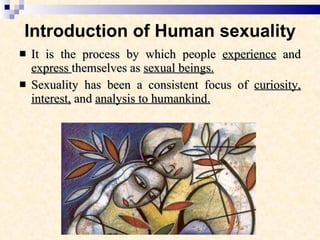
Introduction of Human sexuality It is the process by which people  experience  and  express  themselves as  sexual beings. Sexuality has been a consistent focus of  curiosity, interest,  and  analysis to humankind.
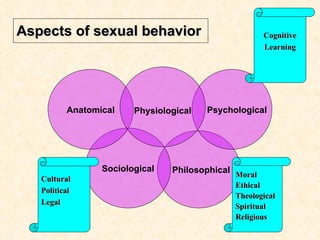
Aspects of sexual behavior Philosophical Sociological Psychological Anatomical Physiological Cognitive Learning Cultural  Political Legal Moral Ethical Theological Spiritual Religious
Anatomical  and physiological aspect
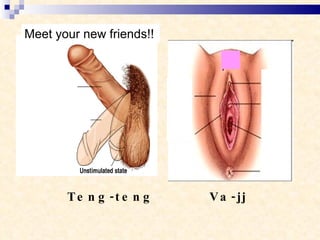
Teng-teng Va-jj Meet your new friends!!
Key terms: Adrenarche-  development of pubic and axilliary hair Thelarche-  beginning of breast development Menarche-  first menstrual period Gonad-  is a body system that produces sex cells. Oocytes-  cells that develop into eggs
Oogenesis-  the process where mature egg cells are produced in the ovary. Spermatogenesis-  production of sperm Aspermia-  absence of sperm Oligospermia-  fewer than 20 million sperms per ml Gynecology-  study of female reproductive system Andrology-  study of male reproductive system Obstetrics-  study on women during pregnancy & childbirth
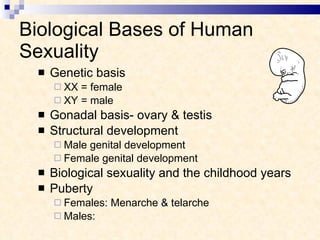
Biological Bases of Human Sexuality Genetic basis XX = female XY = male Gonadal basis- ovary & testis Structural development Male genital development  Female genital development Biological sexuality and the childhood years Puberty Females: Menarche & telarche Males:
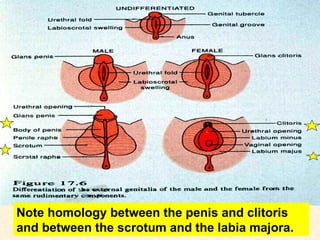
Note homology between the penis and clitoris and between the scrotum and the labia majora.
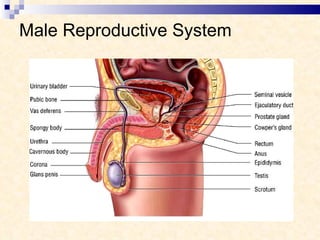
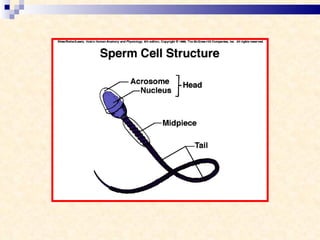
Male Reproductive System Testes Firm, smooth and egg shape Leydig’s cells- production of testosterone Seminiferous tubule- production of spermatozoa Scrotum-   support the testes & regulate temperature of the sperm DUCTS Epididymis- carries  away sperm from testes Vas   deferens-  carries sperm from epididymis Seminal   vesicles-  a gland that secrete a viscous portion of semen,high in basic sugar, protein, &prostaglandin
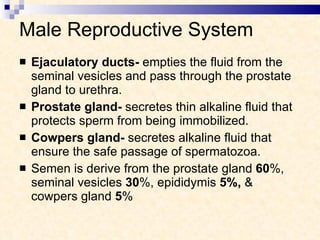
Male Reproductive System Ejaculatory ducts-  empties the fluid from the seminal vesicles and pass through the prostate gland to urethra. Prostate gland-  secretes thin alkaline fluid that protects sperm from being immobilized. Cowpers gland-  secretes alkaline fluid that ensure the safe passage of spermatozoa. Semen is derive from the prostate gland  60 %, seminal vesicles  30 %, epididymis  5%,  & cowpers gland  5 %
Male Reproductive System
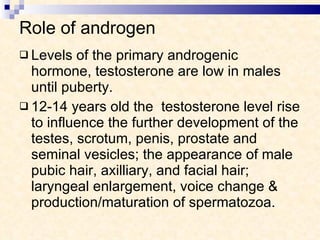
Role of androgen Levels of the primary androgenic hormone, testosterone are low in males until puberty. 12-14 years old the  testosterone level rise to influence the further development of the testes, scrotum, penis, prostate and seminal vesicles; the appearance of male pubic hair, axilliary, and facial hair; laryngeal enlargement, voice change & production/maturation of spermatozoa.
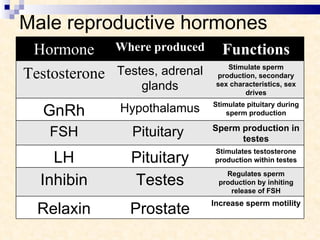
Male reproductive hormones Hormone Where produced Functions Testosterone Testes, adrenal glands Stimulate sperm production, secondary sex characteristics, sex drives GnRh Hypothalamus Stimulate pituitary during sperm production FSH Pituitary  Sperm production in testes LH Pituitary Stimulates testosterone production within testes Inhibin Testes Regulates sperm production by inhiting release of FSH Relaxin Prostate Increase sperm motility
SPERM PRODUCTION Physiology of penile erection
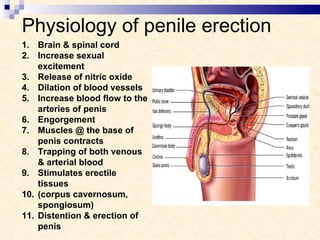
Physiology of penile erection Brain & spinal cord Increase sexual excitement Release of nitric oxide Dilation of blood vessels Increase blood flow to the arteries of penis Engorgement Muscles @ the base of penis contracts Trapping of both venous & arterial blood Stimulates erectile tissues (corpus cavernosum, spongiosum) Distention & erection of penis
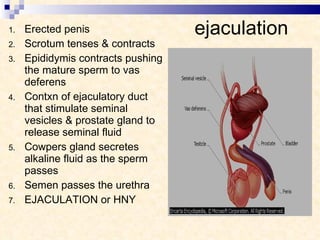
ejaculation Erected penis Scrotum tenses & contracts Epididymis contracts pushing the mature sperm to vas deferens Contxn of ejaculatory duct that stimulate seminal vesicles & prostate gland to release seminal fluid Cowpers gland secretes alkaline fluid as the sperm passes Semen passes the urethra EJACULATION or HNY
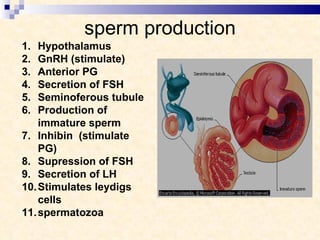
sperm production Hypothalamus GnRH (stimulate) Anterior PG Secretion of FSH Seminoferous tubule Production of immature sperm Inhibin  (stimulate PG) Supression of FSH Secretion of LH Stimulates leydigs cells spermatozoa
 
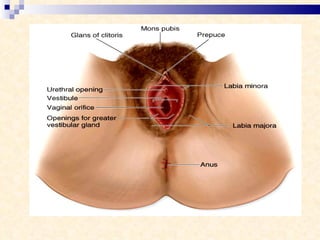
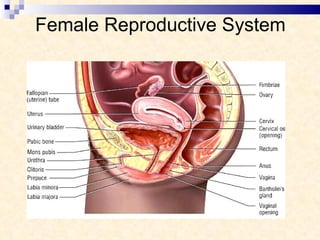
Female Reproductive System Mons pubis-  protect the junction of the pubic bone from trauma Labia majora- enclosing the clitoris, urethral opening, & vaginal entrance  Labia minora-  smaller folds that is sensitive to touch & swell during sexual arousal, doubling or tripling in size. Clitoris-  center of sexual arousal ,  concentration of nerve endings & sensitive to stimulation. Vestibule-  encloses labia minora
Female Reproductive System Bartholin’s gland-  secretes small amount of moisture during arousal. Hymen-  (named for the roman God of marriage) thin membrane covering the introitus. Introitus-  opening of the vagina Vagina-  (latin word sheath) 2 reproductive fxn: encompasses the penis during coitus & birth canal through which an infant is born.
 
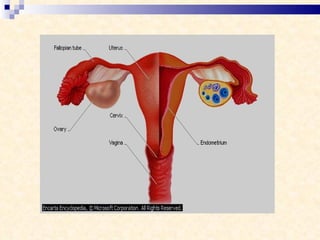
Female Reproductive System Uterus-  or womb. Expands during pregnancy to the size of a football or larger. Cervix-  pear-shaped tapered end extending down and opening of vagina Ovaries-  female gonad that produces gametes. Hormone production: estrogen & progesterone Fallopian tubes-  convey the ovum from the ovaries to the uterus & to provide place for fertilization.
 
Female Reproductive System
Role of estrogen When triggered @ puberty by FSH, ovarian follicles in females begin to excrete high levels of hormone estrogen (3 compounds: estrone E1, estraidol E2, estriol E3) This increase influence the development of uterus, fallopian tubes, & vagina; typical female fat distribution & hair patterns; breast development (thelarche).
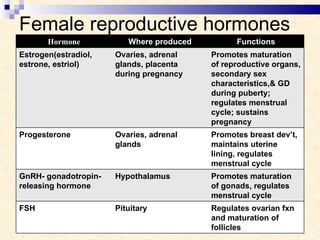
Female reproductive hormones Hormone Where produced Functions Estrogen(estradiol, estrone, estriol) Ovaries, adrenal glands, placenta during pregnancy Promotes maturation of reproductive organs, secondary sex characteristics,& GD during puberty; regulates menstrual cycle; sustains pregnancy Progesterone Ovaries, adrenal glands Promotes breast dev’t, maintains uterine lining, regulates menstrual cycle GnRH- gonadotropin-releasing hormone Hypothalamus Promotes maturation of gonads, regulates menstrual cycle FSH Pituitary Regulates ovarian fxn and maturation of follicles
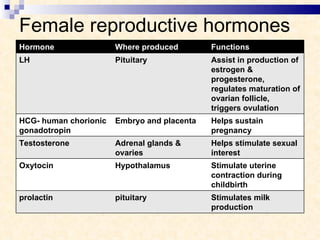
Female reproductive hormones Hormone Where produced Functions LH Pituitary  Assist in production of estrogen & progesterone, regulates maturation of ovarian follicle, triggers ovulation HCG- human chorionic gonadotropin Embryo and placenta Helps sustain pregnancy Testosterone Adrenal glands & ovaries Helps stimulate sexual interest Oxytocin Hypothalamus Stimulate uterine contraction during childbirth prolactin pituitary Stimulates milk production
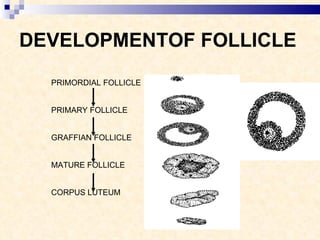
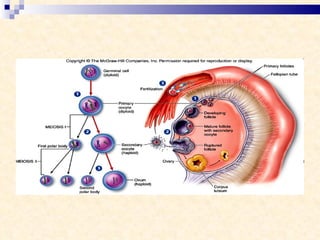
DEVELOPMENTOF FOLLICLE PRIMORDIAL FOLLICLE PRIMARY FOLLICLE GRAFFIAN FOLLICLE MATURE FOLLICLE CORPUS LUTEUM
 
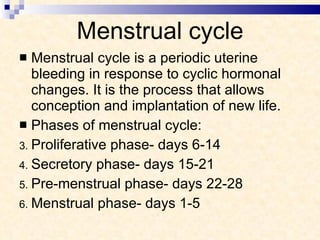
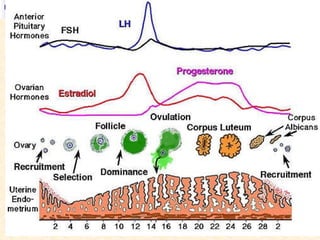
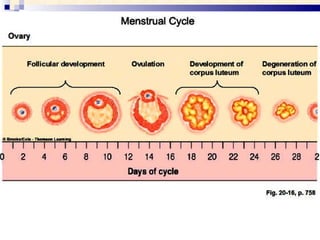
Menstrual cycle Menstrual cycle is a periodic uterine bleeding in response to cyclic hormonal changes. It is the process that allows conception and implantation of new life. Phases of menstrual cycle: Proliferative phase- days 6-14 Secretory phase- days 15-21 Pre-menstrual phase- days 22-28 Menstrual phase- days 1-5
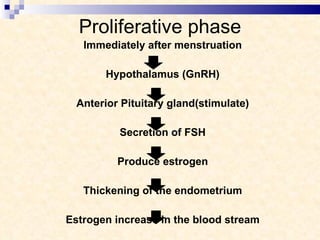
Proliferative phase Immediately after menstruation Hypothalamus (GnRH) Anterior Pituitary gland(stimulate) Secretion of FSH Produce estrogen Thickening of the endometrium Estrogen increase in the blood stream
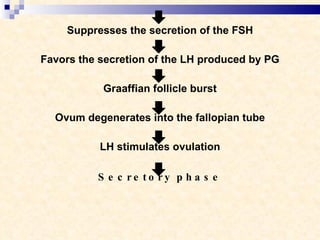
Suppresses the secretion of the FSH Favors the secretion of the LH produced by PG Graaffian follicle burst Ovum degenerates into the fallopian tube LH stimulates ovulation Secretory phase
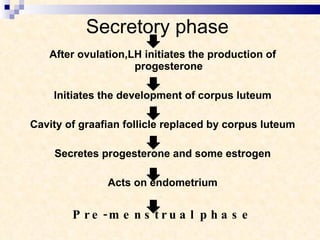
Secretory phase After ovulation,LH initiates the production of progesterone Initiates the development of corpus luteum Cavity of graafian follicle replaced by corpus luteum Secretes progesterone and some estrogen Acts on endometrium Pre-menstrual phase
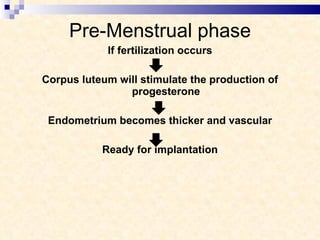
Pre-Menstrual phase If fertilization occurs Corpus luteum will stimulate the production of progesterone Endometrium becomes thicker and vascular Ready for implantation
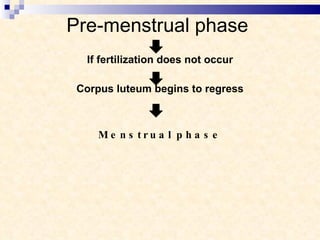
Pre-menstrual phase If fertilization does not occur Corpus luteum begins to regress Menstrual phase
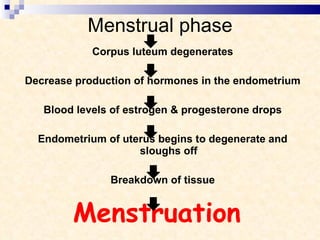
Menstrual phase Corpus luteum degenerates Decrease production of hormones in the endometrium Blood levels of estrogen & progesterone drops Endometrium of uterus begins to degenerate and sloughs off Breakdown of tissue Menstruation
 
Menstrual Cycle
Discomforts of Menstruation  Breast tenderness and feelings of fullness Tendency towards fatigue Temperament and mood changes because of hormonal influence and decreased levels of estrogen and progesterone Discomfort in pelvic area, lower back and legs Retained fluids and weight gain
Abnormalities of Menstruation Amenorrhea  -absence of menstrual  flow Dysmenorrhea -painful menstruation Oligomenorrhea-  infrequent  menstruation Polymenorrhea-  too frequent  menstruation
Abnormalities of Menstruation Menorrhagia-  excessive menstrual  bleeding Metrorrhagia-  bleeding between  periods Hypomenorrhea-  abnormaly short  menstruation Hypermenorrhea-  abnormaly long  menstruation  
Related Conditions Premenstrual syndrome (PMS)  Physical and psychological symptoms that recur during the same phase of the menstrual cycle Premenstrual dysphoric disorder (PMDD) Severe form of PMS Fibrocystic breast condition  Excessive secretory activity producing swollen, firm, or hardened tender breast tissue Menopause  Gradual decline in reproductive system function, usually by late 40s to mid 50s
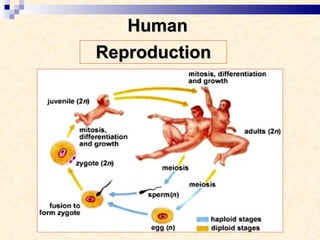
Human  Reproduction
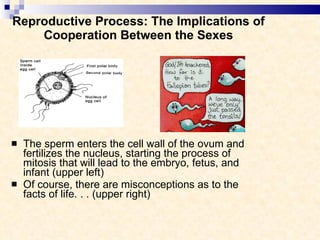
Reproductive Process: The Implications of Cooperation Between the Sexes The sperm enters the cell wall of the ovum and fertilizes the nucleus, starting the process of mitosis that will lead to the embryo, fetus, and infant (upper left) Of course, there are misconceptions as to the facts of life. . . (upper right)
Psychological and sociological  aspect
Sex, gender, and gender roles: what’s the difference? Sex-  refers to whether one is biologically female or male, based on genetic and anatomical sex. Genetic   sex-  refers to one’s chromosomal and hormonal sex characteristics. Anatomical   sex-  refers to physical sex: gonads, uterus, vulva, vagina, penis and so on.
Sex, gender, and gender roles: what’s the difference? Gender-  is femininity or masculinity, the social and cultural characteristics associated with biological sex. Gender identity-  is the gender a person believes him or herself to be. Gender role s- the way that a person acts as a female or male. Public expression of gender identity.
Sex, gender, and gender roles: what’s the difference? Gender-role stereotype- is a rigidly held over simplified, and over generalized belief that all males and females possess distinct psychological & behavioral traits. Examples:  “ women are more interested in relationship than sex” “ men who wear pink shirt are gays” “ males are generally taller than females” “  men: sex first love later, women: love first sex later”
Gender biases Stereotyping Ex. wife should stay at home  Marginalization Ex. Women are paid lesser compared to men VAWC Ex. Men boxing their wives to show they are macho or strong Multiple burden Ex. Mothers doing all household chores, aside from doing other works Commodification Ex. Advertisements using bodies of women in wine commercials subordination Ex. In some families, the decision of the father is final & absolute, even if it is against the wife or children
Sexual Orientation Sexual orientation describes the object of a person's sexual impulses:   - Heterosexual  (opposite sex),  - Homosexual  (same sex),  - Bisexual  (both sexes).   - Transexuality  (desire to be a member of the opposite sex)
A “masculine” man is attracted to women. A “feminine” woman is attracted to men. “ If a man is gay, he cannot be masculine.” “ if a woman is lesbian, she cannot be feminine.”
Theories of gender role development Cognitive – Development theory  – process that gender – role development emerges through children's growing cognitive awareness of their identity. Behavioral theory –  gender role behavior are conditioned by the environment.  Social – Learning theory –  gender – role are learned through invitation of sex-typed behaviors. Identification theory –  a psychoanalytic theory that suggest a child develops a gender role by interacting closely with and emulating the behavior of the parent of the same sex.
Issues on sexuality
Teenage sex: are you ready ? Some causes of teenage sex: Wants to experiment sex Rebellion to parents Peer pressure Pornography Boy-girl in love Just an accident
Teenage sex: are you ready ? Consequences of early sex Some physical health risk: Vulnerability of getting pregnant at an early age Risk of abortion Maternal & child birth Risk of hemorrhage Risk for STD’s and HIV
Teenage sex: are you ready ? Some social consequences Ostracism from family and friends Out of school Some emotional consequences Depression Stress Thoughts to commit suicide
Some tips on how to avoid getting pregnant: Learn how to say no to friends with risky sexual invitation Know the consequences if you get pregnant Know the risk of teen-age pregnancy Some tips for males: Focus on your studies Concentrate on other productive activities like sports, skills development, etc. Take good care of your hands Tips for both: Learn more on contraception Set your priorities in life Have a passion for a dream
Sexual harassments –  consists of unwelcomed sexual advances, request for sexual favors, or other verbal or physical conduct of sexual nature as condition of instruction, grades, salaries or employment. Same-sex marriages- ???????
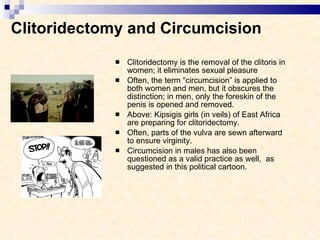
Clitoridectomy and Circumcision Clitoridectomy is the removal of the clitoris in women; it eliminates sexual pleasure Often, the term “circumcision” is applied to both women and men, but it obscures the distinction; in men, only the foreskin of the penis is opened and removed. Above: Kipsigis girls (in veils) of East Africa are preparing for clitoridectomy. Often, parts of the vulva are sewn afterward to ensure virginity. Circumcision in males has also been questioned as a valid practice as well,  as  suggested in this political cartoon.
 
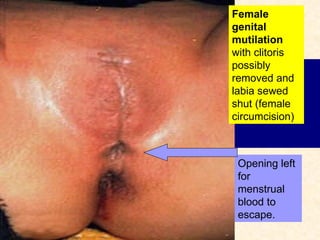
Female genital mutilation   with clitoris possibly removed and labia sewed shut (female circumcision) Opening left for menstrual blood to escape.
 
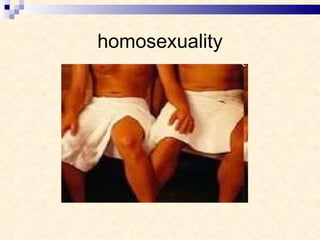
homosexuality
homosexuality
Types of sexual relationships Premarital – having sex before marriage. Post marital – having sex after a death of a spouse. Extra marital – having sex with another man or woman. Non – traditionals A. Homosexuality B. Bisexual
Human sexual response
Sexual expression Sexual attractiveness Sexual desire- erotophillia-is a + response to sexuality & erotophobia- is a – response to sexuality Autoerotism- consists of sexual activities that involved only one self.(masturbation) Sexual fantasies- 54% of men & 23% of women think about sex/ day  masturbation.ppt Erotic dreams-nocturnal orgasm
Sexual Stimulation a.  Psychological Stimulation -use of smell, taste, hearing, sight or fantasy b.  Physical Stimulation-  use of touch pressure or bodily contact 1. Erogenous zones 2. Kissing- lip-lip, teeth & tongue & mouth 3. Breast stimulation- creates pelvic contraction 4. Oral-genital stimulation/ soixante neuf “69” 5. Anal stimulation- anilingus & sodomy 6. Manual stimulation of genitals 7. Cunnilingus-female genitalia 8. Fellatio- male genitalia “bj”
 
Pinpointing Erogenous Zones Tactile stimulations- touching any body area. a. Body – the entire body, particularly the skin. b. Lips – respond to touch, kissing or licking. c. Neck/ nape d. Back of the Ears e. Breast -nipple f. Buttocks g. Thighs – inner thigh h. Genitals
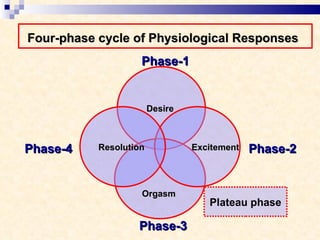
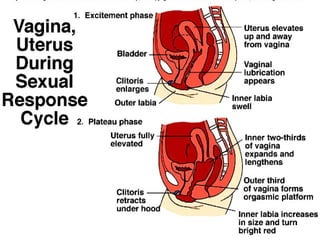
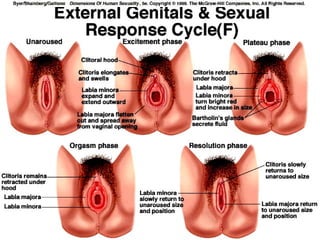
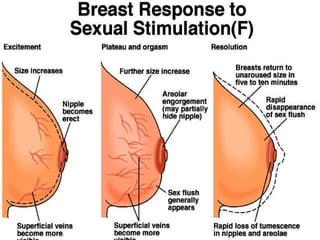
Four-phase cycle of Physiological Responses   Phase-1 Desire  Orgasm  Excitement   Resolution  Phase-2 Phase-3 Phase-4 Plateau phase
Four-phase cycle of Physiological Responses   The sequence of responses can overlap and fluctuate
Phase 1: Desire The desire (or appetitive) phase, identified solely through physiology, reflects the psychiatric concern with  motivations ,  drives , and  personality .  The phase is characterized by  sexual fantasies  and the  desire to have sexual activity .
Phase 2: Excitement   The excitement and arousal phase, brought on by  psychological stimulation  (fantasy or the presence of a love object) or  physiological stimulation  ( Foreplays-stroking or kissing) or a  combination  of the two, consists of a  subjective sense of pleasure.
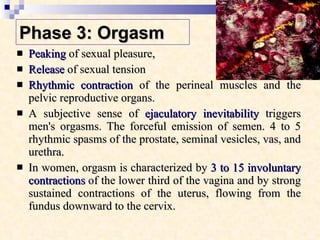
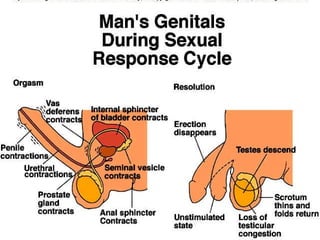
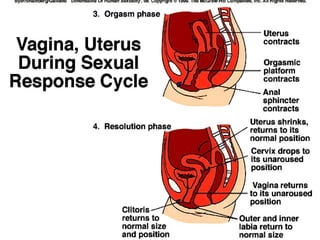
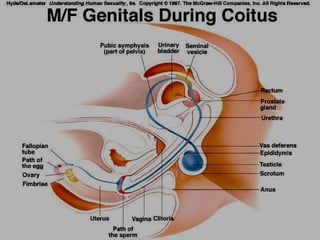
Phase 3: Orgasm   Peaking  of sexual pleasure,  Release  of sexual tension  Rhythmic contraction  of the perineal muscles and the pelvic reproductive organs.  A subjective sense of  ejaculatory inevitability  triggers men's orgasms. The forceful emission of semen. 4 to 5 rhythmic spasms of the prostate, seminal vesicles, vas, and urethra.  In women, orgasm is characterized by  3 to 15 involuntary contractions  of the lower third of the vagina and by strong sustained contractions of the uterus, flowing from the fundus downward to the cervix.
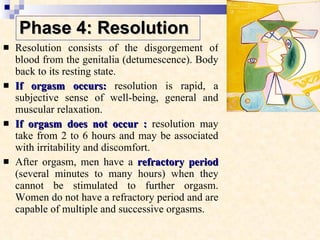
Phase 4: Resolution Resolution consists of the disgorgement of blood from the genitalia (detumescence). Body back to its resting state.  If orgasm occurs:  resolution is rapid, a subjective sense of well-being, general and muscular relaxation.  If orgasm does not occur :  resolution may take from 2 to 6 hours and may be associated with irritability and discomfort.  After orgasm, men have a  refractory period  (several minutes to many hours) when they cannot be stimulated to further orgasm. Women do not have a refractory period and are capable of multiple and successive orgasms.


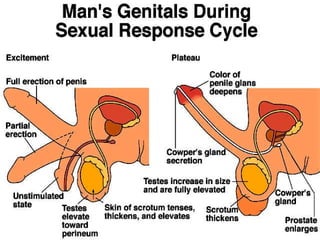
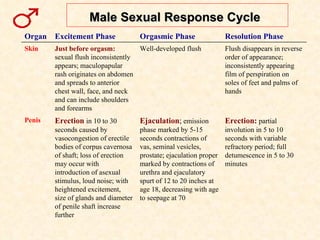
Male Sexual Response Cycle   Organ Excitement Phase Orgasmic Phase Resolution Phase Skin Just before orgasm:  sexual flush inconsistently appears; maculopapular rash originates on abdomen and spreads to anterior chest wall, face, and neck and can include shoulders and forearms Well-developed flush Flush disappears in reverse order of appearance; inconsistently appearing film of perspiration on soles of feet and palms of hands Penis Erection  in 10 to 30 seconds caused by vasocongestion of erectile bodies of corpus cavernosa of shaft; loss of erection may occur with introduction of asexual stimulus, loud noise; with heightened excitement, size of glands and diameter of penile shaft increase further Ejaculation ;  emission phase marked by 5-15 seconds contractions of vas, seminal vesicles, prostate; ejaculation proper marked by contractions of urethra and ejaculatory spurt of 12 to 20 inches at age 18, decreasing with age to seepage at 70 Erection:  partial involution in 5 to 10 seconds with variable refractory period; full detumescence in 5 to 30 minutes
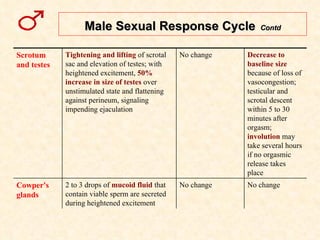
Male Sexual Response Cycle   Contd Scrotum and testes Tightening and lifting  of scrotal sac and elevation of testes; with heightened excitement,  50% increase in size of testes  over unstimulated state and flattening against perineum, signaling impending ejaculation No change Decrease to baseline size  because of loss of vasocongestion; testicular and scrotal descent within 5 to 30 minutes after orgasm;  involution  may take several hours if no orgasmic release takes place Cowper's glands 2 to 3 drops of  mucoid fluid  that contain viable sperm are secreted during heightened excitement No change No change
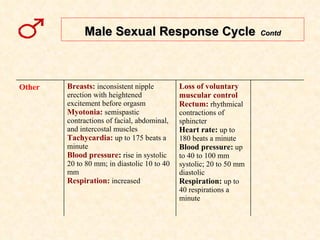
Male Sexual Response Cycle   Contd Other Breasts:  inconsistent nipple erection with heightened excitement before orgasm Myotonia:  semispastic contractions of facial, abdominal, and intercostal muscles Tachycardia:  up to 175 beats a minute Blood pressure :  rise in systolic 20 to 80 mm; in diastolic 10 to 40 mm Respiration:  increased Loss of voluntary muscular control Rectum:  rhythmical contractions of sphincter Heart rate:  up to 180 beats a minute Blood pressure:  up to 40 to 100 mm systolic; 20 to 50 mm diastolic Respiration:  up to 40 respirations a minute
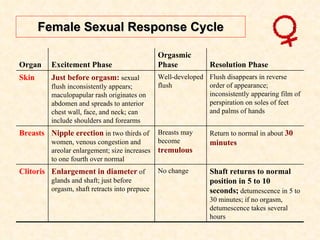
Female Sexual Response Cycle Organ Excitement Phase Orgasmic Phase Resolution Phase Skin Just before orgasm:  sexual flush inconsistently appears; maculopapular rash originates on abdomen and spreads to anterior chest wall, face, and neck; can include shoulders and forearms Well-developed flush Flush disappears in reverse order of appearance; inconsistently appearing film of perspiration on soles of feet and palms of hands Breasts Nipple erection  in two thirds of women, venous congestion and areolar enlargement; size increases to one fourth over normal Breasts may become  tremulous Return to normal in about  30 minutes Clitoris Enlargement in diameter  of glands and shaft; just before orgasm, shaft retracts into prepuce No change Shaft returns to normal position in 5 to 10 seconds;  detumescence in 5 to 30 minutes; if no orgasm, detumescence takes several hours
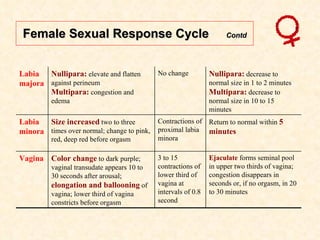
Female Sexual Response Cycle  Contd Labia majora Nullipara:  elevate and flatten against perineum Multipara:  congestion and edema No change Nullipara:  decrease to normal size in 1 to 2 minutes Multipara:  decrease to normal size in 10 to 15 minutes Labia minora Size increased  two to three times over normal; change to pink, red, deep red before orgasm Contractions of proximal labia minora Return to normal within  5 minutes Vagina Color change  to dark purple; vaginal transudate appears 10 to 30 seconds after arousal;  elongation and ballooning  of vagina; lower third of vagina constricts before orgasm 3 to 15 contractions of lower third of vagina at intervals of 0.8 second Ejaculate  forms seminal pool in upper two thirds of vagina; congestion disappears in seconds or, if no orgasm, in 20 to 30 minutes
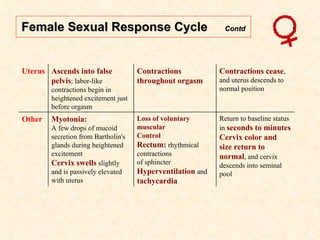
Female Sexual Response Cycle  Contd Uterus Ascends into false pelvis ; labor-like contractions begin in heightened excitement just before orgasm Contractions  throughout orgasm Contractions cease , and uterus descends to normal position Other Myotonia: A few drops of mucoid secretion from Bartholin's glands during heightened excitement Cervix swells  slightly and is passively elevated with uterus Loss of voluntary muscular Control  Rectum:  rhythmical contractions of sphincter Hyperventilation  and  tachycardia Return to baseline status in  seconds to minutes Cervix color and size return to normal , and cervix descends into seminal pool
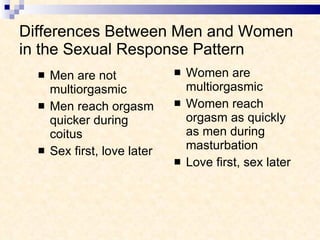
Differences Between Men and Women in the Sexual Response Pattern Men are not multiorgasmic  Men reach orgasm quicker during coitus Sex first, love later Women are multiorgasmic Women reach orgasm as quickly as men during masturbation Love first, sex later
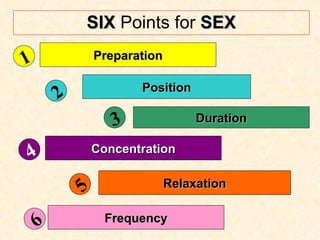
SIX  Points for  SEX Preparation Position Duration Concentration Relaxation 3 2 1 4 5 Frequency 6
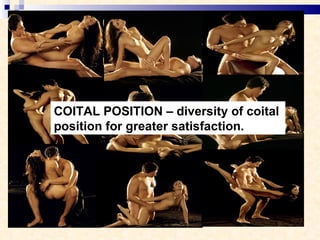
COITAL POSITION – diversity of coital position for greater satisfaction.
Benefits  of  SEX  beyond reproduction
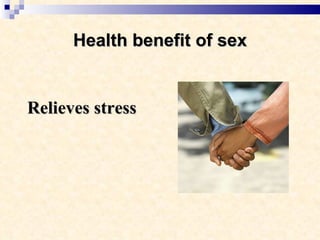
Health benefit of sex Relieves stress
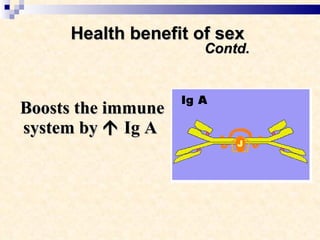
Health benefit of sex    Contd. Boosts the immune system by    Ig A
Health benefit of sex    Contd.   Improves CVS ( Lower BP)
Health benefit of sex    Contd.    Self esteem
Health benefit of sex    Contd. Improves intimacy   with partner
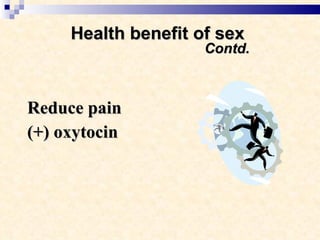
Health benefit of sex    Contd. Reduce pain  (+) oxytocin
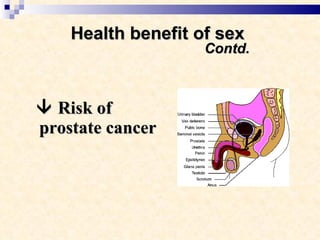
Health benefit of sex    Contd.    Risk of prostate cancer
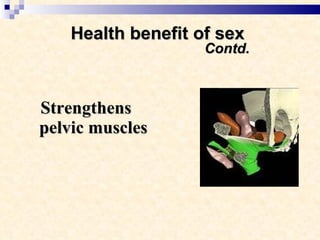
Health benefit of sex    Contd. Strengthens pelvic muscles
Health benefit of sex    Contd. Promotes good sleep
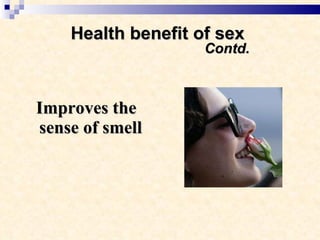
Health benefit of sex    Contd. Improves the sense of smell
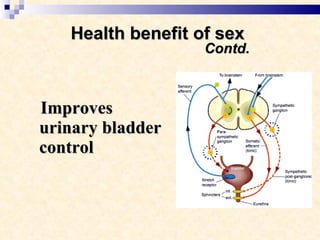
Health benefit of sex    Contd. Improves urinary bladder control
Sexual dysfunctions
The term sexual dysfunction refers to an impairment in the ability to obtain gratification from sexual intercourse.  Problems that prevent an individual or couple from engaging in or enjoying satisfactory sexual intercourse and orgasm.
A. Male Impotence  – inability to achieve or maintain an erection Premature ejaculation  – exclusively short period of orgasm or before penile-vaginal contact. Retarded ejaculation  – inability to ejaculate into vagina. -  is a condition in which an erection is maintained but ejaculation is delayed for prolonged period. Priapism - prolonged erection longer than 6 hours.
B. Female Inhibited sexual desire/orgasm  - is a disorder in which a woman either has no orgasms, has orgasms that are delayed much longer than she and her partner desire, or has orgasms that are difficult to achieve despite appropriate stimulation.  Orgasmic dysfunction/ anorgasm –  inability to achieve orgasm.
Vaginismus –  involuntary contraction of muscles at the outlet of vagina when coitus is attempted.   - is an involuntary contraction of the lower vaginal muscles that prevents the penis from penetrating the vagina.  Dyspareunia  – painful intercourse.   - is genital or deep pelvic pain experienced during intercourse.
Low Sexual Desire Disorder  - is a persistent loss of sexual fantasy and little desire for sexual activity. Sexual Aversion Disorder  - is persistent, extreme aversion to virtually sexual activity, characterized by fear and sometimes accompanied by panic attacks. Sexual Arousal Disorder in Women  - is the persistent failure to attain or maintain sexual excitement despite adequate sexual stimulation, it is similar to impotence in men. Both disorders have physical or psychologic causes.
Psychosexual disorders
Paraphilla- any sexual disorders in which sexual activity or fantasies are expressed in ways that are usually unacceptable or prohibited.
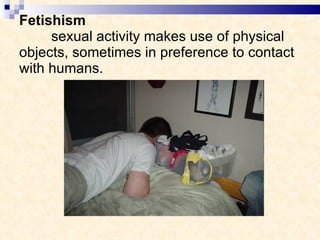
Fetishism sexual activity makes use of physical objects, sometimes in preference to contact with humans.
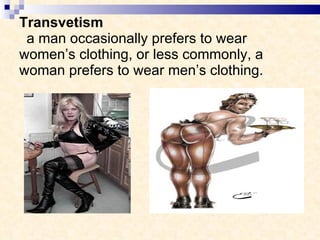
Transvetism   a man occasionally prefers to wear women’s clothing, or less commonly, a woman prefers to wear men’s clothing.
Pedophilia   is a preference for sexual activity with young children.  
Exhibitionism   a person ( usually a man ) exposes his genitals to unsuspecting strangers and becomes sexually excited when doing so.
Voyeurism   a person becomes sexually aroused by watching someone who is disrobing, naked, or engaged in sexual activity.  
Masochism   it constitutes sexual enjoyment in being physically harmed, threatened, or abused
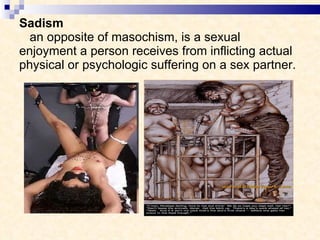
Sadism   an opposite of masochism, is a sexual enjoyment a person receives from inflicting actual physical or psychologic suffering on a sex partner.
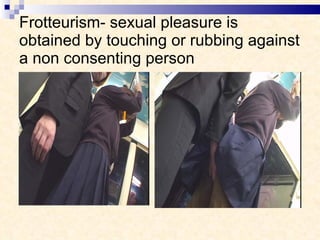
Frotteurism- sexual pleasure is obtained by touching or rubbing against a non consenting person
Zoophillia or bestiality- sexual contact with an animals
Coprophillia
Telephone scatologia- sexual gratification from or during a telephone call. (phonesex) Text sex Cyber sex Necrophillia-sexual gratification is obtained from engaging sexual activity to a dead person
Love, intimacy, and sexuality
Men, sex, and love Men are more likely to separate sex from affection. Some men initially seek physical relationship Men indicated that their most erotic sexual experiences took place in a relational context.
Women, sex, and love Women generally view sex from a relational perspective In a decision to have sexual intercourse, the quality & degree of intimacy of relationship is important Women seek emotional relationships.
Gay men, lesbians, and love It is well documented that love is important for gay men and lesbians. Their relationships have multiple emotional dimensions and are not based solely on sex, as others might believe. Lesbians share sex less often than gay men Caressing, nongenital stimulation,& affectionate foreplay are preffered expressions of sexuality and love
Sex without love Is love necessary for sex? Sex without love violates our overt beliefs about sexuality, it is the least threatening form of extrarelational sex.
Love without sex: celibacy as a choice Celibacy- not engaging in any kind of sexual activity. YOU ARE WORTHWHILE AND YOU ARE WORTH WAITING FOR. because you are not a slave to your hormones; you are a free being who is not going to be the object of anybody’s lust.
Conclusion Human sexuality is a very complex and multi-dimensional behavior that is affected by many facets of our lives including anatomy, physiology, cognition, and learning. As well as influenced by culture, ethnicity and even economy and politics.
Conclusion   Contd. Sex Education is very much needed in every society- specially in the school curriculum- otherwise faulty learning about sex  misguided one’s personal life and may produce many sexual as well as psycho-social problem. Accepted Sex-education from Scientific authority .
HumAN Sexuality By: Miss Shenell A. Delfin Lecturer NCM 101
THANK YOU

Normalsexuality

  • 1.
    HumAN Sexuality By:Miss Shenell A. Delfin Lecturer NCM 101
  • 2.
    A dirty bookis rarely dusty
  • 3.
    Introduction of Humansexuality It is the process by which people experience and express themselves as sexual beings. Sexuality has been a consistent focus of curiosity, interest, and analysis to humankind.
  • 4.
    Aspects of sexualbehavior Philosophical Sociological Psychological Anatomical Physiological Cognitive Learning Cultural Political Legal Moral Ethical Theological Spiritual Religious
  • 5.
    Anatomical andphysiological aspect
  • 6.
    Teng-teng Va-jj Meetyour new friends!!
  • 7.
    Key terms: Adrenarche- development of pubic and axilliary hair Thelarche- beginning of breast development Menarche- first menstrual period Gonad- is a body system that produces sex cells. Oocytes- cells that develop into eggs
  • 8.
    Oogenesis- theprocess where mature egg cells are produced in the ovary. Spermatogenesis- production of sperm Aspermia- absence of sperm Oligospermia- fewer than 20 million sperms per ml Gynecology- study of female reproductive system Andrology- study of male reproductive system Obstetrics- study on women during pregnancy & childbirth
  • 9.
    Biological Bases ofHuman Sexuality Genetic basis XX = female XY = male Gonadal basis- ovary & testis Structural development Male genital development Female genital development Biological sexuality and the childhood years Puberty Females: Menarche & telarche Males:
  • 10.
    Note homology betweenthe penis and clitoris and between the scrotum and the labia majora.
  • 11.
    Male Reproductive SystemTestes Firm, smooth and egg shape Leydig’s cells- production of testosterone Seminiferous tubule- production of spermatozoa Scrotum- support the testes & regulate temperature of the sperm DUCTS Epididymis- carries away sperm from testes Vas deferens- carries sperm from epididymis Seminal vesicles- a gland that secrete a viscous portion of semen,high in basic sugar, protein, &prostaglandin
  • 12.
    Male Reproductive SystemEjaculatory ducts- empties the fluid from the seminal vesicles and pass through the prostate gland to urethra. Prostate gland- secretes thin alkaline fluid that protects sperm from being immobilized. Cowpers gland- secretes alkaline fluid that ensure the safe passage of spermatozoa. Semen is derive from the prostate gland 60 %, seminal vesicles 30 %, epididymis 5%, & cowpers gland 5 %
  • 13.
  • 14.
    Role of androgenLevels of the primary androgenic hormone, testosterone are low in males until puberty. 12-14 years old the testosterone level rise to influence the further development of the testes, scrotum, penis, prostate and seminal vesicles; the appearance of male pubic hair, axilliary, and facial hair; laryngeal enlargement, voice change & production/maturation of spermatozoa.
  • 15.
    Male reproductive hormonesHormone Where produced Functions Testosterone Testes, adrenal glands Stimulate sperm production, secondary sex characteristics, sex drives GnRh Hypothalamus Stimulate pituitary during sperm production FSH Pituitary Sperm production in testes LH Pituitary Stimulates testosterone production within testes Inhibin Testes Regulates sperm production by inhiting release of FSH Relaxin Prostate Increase sperm motility
  • 16.
    SPERM PRODUCTION Physiologyof penile erection
  • 17.
    Physiology of penileerection Brain & spinal cord Increase sexual excitement Release of nitric oxide Dilation of blood vessels Increase blood flow to the arteries of penis Engorgement Muscles @ the base of penis contracts Trapping of both venous & arterial blood Stimulates erectile tissues (corpus cavernosum, spongiosum) Distention & erection of penis
  • 18.
    ejaculation Erected penisScrotum tenses & contracts Epididymis contracts pushing the mature sperm to vas deferens Contxn of ejaculatory duct that stimulate seminal vesicles & prostate gland to release seminal fluid Cowpers gland secretes alkaline fluid as the sperm passes Semen passes the urethra EJACULATION or HNY
  • 19.
    sperm production HypothalamusGnRH (stimulate) Anterior PG Secretion of FSH Seminoferous tubule Production of immature sperm Inhibin (stimulate PG) Supression of FSH Secretion of LH Stimulates leydigs cells spermatozoa
  • 20.
  • 21.
    Female Reproductive SystemMons pubis- protect the junction of the pubic bone from trauma Labia majora- enclosing the clitoris, urethral opening, & vaginal entrance Labia minora- smaller folds that is sensitive to touch & swell during sexual arousal, doubling or tripling in size. Clitoris- center of sexual arousal , concentration of nerve endings & sensitive to stimulation. Vestibule- encloses labia minora
  • 22.
    Female Reproductive SystemBartholin’s gland- secretes small amount of moisture during arousal. Hymen- (named for the roman God of marriage) thin membrane covering the introitus. Introitus- opening of the vagina Vagina- (latin word sheath) 2 reproductive fxn: encompasses the penis during coitus & birth canal through which an infant is born.
  • 23.
  • 24.
    Female Reproductive SystemUterus- or womb. Expands during pregnancy to the size of a football or larger. Cervix- pear-shaped tapered end extending down and opening of vagina Ovaries- female gonad that produces gametes. Hormone production: estrogen & progesterone Fallopian tubes- convey the ovum from the ovaries to the uterus & to provide place for fertilization.
  • 25.
  • 26.
  • 27.
    Role of estrogenWhen triggered @ puberty by FSH, ovarian follicles in females begin to excrete high levels of hormone estrogen (3 compounds: estrone E1, estraidol E2, estriol E3) This increase influence the development of uterus, fallopian tubes, & vagina; typical female fat distribution & hair patterns; breast development (thelarche).
  • 28.
    Female reproductive hormonesHormone Where produced Functions Estrogen(estradiol, estrone, estriol) Ovaries, adrenal glands, placenta during pregnancy Promotes maturation of reproductive organs, secondary sex characteristics,& GD during puberty; regulates menstrual cycle; sustains pregnancy Progesterone Ovaries, adrenal glands Promotes breast dev’t, maintains uterine lining, regulates menstrual cycle GnRH- gonadotropin-releasing hormone Hypothalamus Promotes maturation of gonads, regulates menstrual cycle FSH Pituitary Regulates ovarian fxn and maturation of follicles
  • 29.
    Female reproductive hormonesHormone Where produced Functions LH Pituitary Assist in production of estrogen & progesterone, regulates maturation of ovarian follicle, triggers ovulation HCG- human chorionic gonadotropin Embryo and placenta Helps sustain pregnancy Testosterone Adrenal glands & ovaries Helps stimulate sexual interest Oxytocin Hypothalamus Stimulate uterine contraction during childbirth prolactin pituitary Stimulates milk production
  • 30.
    DEVELOPMENTOF FOLLICLE PRIMORDIALFOLLICLE PRIMARY FOLLICLE GRAFFIAN FOLLICLE MATURE FOLLICLE CORPUS LUTEUM
  • 31.
  • 32.
    Menstrual cycle Menstrualcycle is a periodic uterine bleeding in response to cyclic hormonal changes. It is the process that allows conception and implantation of new life. Phases of menstrual cycle: Proliferative phase- days 6-14 Secretory phase- days 15-21 Pre-menstrual phase- days 22-28 Menstrual phase- days 1-5
  • 33.
    Proliferative phase Immediatelyafter menstruation Hypothalamus (GnRH) Anterior Pituitary gland(stimulate) Secretion of FSH Produce estrogen Thickening of the endometrium Estrogen increase in the blood stream
  • 34.
    Suppresses the secretionof the FSH Favors the secretion of the LH produced by PG Graaffian follicle burst Ovum degenerates into the fallopian tube LH stimulates ovulation Secretory phase
  • 35.
    Secretory phase Afterovulation,LH initiates the production of progesterone Initiates the development of corpus luteum Cavity of graafian follicle replaced by corpus luteum Secretes progesterone and some estrogen Acts on endometrium Pre-menstrual phase
  • 36.
    Pre-Menstrual phase Iffertilization occurs Corpus luteum will stimulate the production of progesterone Endometrium becomes thicker and vascular Ready for implantation
  • 37.
    Pre-menstrual phase Iffertilization does not occur Corpus luteum begins to regress Menstrual phase
  • 38.
    Menstrual phase Corpusluteum degenerates Decrease production of hormones in the endometrium Blood levels of estrogen & progesterone drops Endometrium of uterus begins to degenerate and sloughs off Breakdown of tissue Menstruation
  • 39.
  • 40.
  • 41.
    Discomforts of Menstruation Breast tenderness and feelings of fullness Tendency towards fatigue Temperament and mood changes because of hormonal influence and decreased levels of estrogen and progesterone Discomfort in pelvic area, lower back and legs Retained fluids and weight gain
  • 42.
    Abnormalities of MenstruationAmenorrhea -absence of menstrual flow Dysmenorrhea -painful menstruation Oligomenorrhea- infrequent menstruation Polymenorrhea- too frequent menstruation
  • 43.
    Abnormalities of MenstruationMenorrhagia- excessive menstrual bleeding Metrorrhagia- bleeding between periods Hypomenorrhea- abnormaly short menstruation Hypermenorrhea- abnormaly long menstruation  
  • 44.
    Related Conditions Premenstrualsyndrome (PMS) Physical and psychological symptoms that recur during the same phase of the menstrual cycle Premenstrual dysphoric disorder (PMDD) Severe form of PMS Fibrocystic breast condition Excessive secretory activity producing swollen, firm, or hardened tender breast tissue Menopause Gradual decline in reproductive system function, usually by late 40s to mid 50s
  • 45.
  • 46.
    Reproductive Process: TheImplications of Cooperation Between the Sexes The sperm enters the cell wall of the ovum and fertilizes the nucleus, starting the process of mitosis that will lead to the embryo, fetus, and infant (upper left) Of course, there are misconceptions as to the facts of life. . . (upper right)
  • 47.
  • 48.
    Sex, gender, andgender roles: what’s the difference? Sex- refers to whether one is biologically female or male, based on genetic and anatomical sex. Genetic sex- refers to one’s chromosomal and hormonal sex characteristics. Anatomical sex- refers to physical sex: gonads, uterus, vulva, vagina, penis and so on.
  • 49.
    Sex, gender, andgender roles: what’s the difference? Gender- is femininity or masculinity, the social and cultural characteristics associated with biological sex. Gender identity- is the gender a person believes him or herself to be. Gender role s- the way that a person acts as a female or male. Public expression of gender identity.
  • 50.
    Sex, gender, andgender roles: what’s the difference? Gender-role stereotype- is a rigidly held over simplified, and over generalized belief that all males and females possess distinct psychological & behavioral traits. Examples: “ women are more interested in relationship than sex” “ men who wear pink shirt are gays” “ males are generally taller than females” “ men: sex first love later, women: love first sex later”
  • 51.
    Gender biases StereotypingEx. wife should stay at home Marginalization Ex. Women are paid lesser compared to men VAWC Ex. Men boxing their wives to show they are macho or strong Multiple burden Ex. Mothers doing all household chores, aside from doing other works Commodification Ex. Advertisements using bodies of women in wine commercials subordination Ex. In some families, the decision of the father is final & absolute, even if it is against the wife or children
  • 52.
    Sexual Orientation Sexualorientation describes the object of a person's sexual impulses: - Heterosexual (opposite sex), - Homosexual (same sex), - Bisexual (both sexes). - Transexuality (desire to be a member of the opposite sex)
  • 53.
    A “masculine” manis attracted to women. A “feminine” woman is attracted to men. “ If a man is gay, he cannot be masculine.” “ if a woman is lesbian, she cannot be feminine.”
  • 54.
    Theories of genderrole development Cognitive – Development theory – process that gender – role development emerges through children's growing cognitive awareness of their identity. Behavioral theory – gender role behavior are conditioned by the environment.  Social – Learning theory – gender – role are learned through invitation of sex-typed behaviors. Identification theory – a psychoanalytic theory that suggest a child develops a gender role by interacting closely with and emulating the behavior of the parent of the same sex.
  • 55.
  • 56.
    Teenage sex: areyou ready ? Some causes of teenage sex: Wants to experiment sex Rebellion to parents Peer pressure Pornography Boy-girl in love Just an accident
  • 57.
    Teenage sex: areyou ready ? Consequences of early sex Some physical health risk: Vulnerability of getting pregnant at an early age Risk of abortion Maternal & child birth Risk of hemorrhage Risk for STD’s and HIV
  • 58.
    Teenage sex: areyou ready ? Some social consequences Ostracism from family and friends Out of school Some emotional consequences Depression Stress Thoughts to commit suicide
  • 59.
    Some tips onhow to avoid getting pregnant: Learn how to say no to friends with risky sexual invitation Know the consequences if you get pregnant Know the risk of teen-age pregnancy Some tips for males: Focus on your studies Concentrate on other productive activities like sports, skills development, etc. Take good care of your hands Tips for both: Learn more on contraception Set your priorities in life Have a passion for a dream
  • 60.
    Sexual harassments – consists of unwelcomed sexual advances, request for sexual favors, or other verbal or physical conduct of sexual nature as condition of instruction, grades, salaries or employment. Same-sex marriages- ???????
  • 61.
    Clitoridectomy and CircumcisionClitoridectomy is the removal of the clitoris in women; it eliminates sexual pleasure Often, the term “circumcision” is applied to both women and men, but it obscures the distinction; in men, only the foreskin of the penis is opened and removed. Above: Kipsigis girls (in veils) of East Africa are preparing for clitoridectomy. Often, parts of the vulva are sewn afterward to ensure virginity. Circumcision in males has also been questioned as a valid practice as well, as suggested in this political cartoon.
  • 62.
  • 63.
    Female genital mutilation with clitoris possibly removed and labia sewed shut (female circumcision) Opening left for menstrual blood to escape.
  • 64.
  • 65.
  • 66.
  • 67.
    Types of sexualrelationships Premarital – having sex before marriage. Post marital – having sex after a death of a spouse. Extra marital – having sex with another man or woman. Non – traditionals A. Homosexuality B. Bisexual
  • 68.
  • 69.
    Sexual expression Sexualattractiveness Sexual desire- erotophillia-is a + response to sexuality & erotophobia- is a – response to sexuality Autoerotism- consists of sexual activities that involved only one self.(masturbation) Sexual fantasies- 54% of men & 23% of women think about sex/ day masturbation.ppt Erotic dreams-nocturnal orgasm
  • 70.
    Sexual Stimulation a. Psychological Stimulation -use of smell, taste, hearing, sight or fantasy b. Physical Stimulation- use of touch pressure or bodily contact 1. Erogenous zones 2. Kissing- lip-lip, teeth & tongue & mouth 3. Breast stimulation- creates pelvic contraction 4. Oral-genital stimulation/ soixante neuf “69” 5. Anal stimulation- anilingus & sodomy 6. Manual stimulation of genitals 7. Cunnilingus-female genitalia 8. Fellatio- male genitalia “bj”
  • 71.
  • 72.
    Pinpointing Erogenous ZonesTactile stimulations- touching any body area. a. Body – the entire body, particularly the skin. b. Lips – respond to touch, kissing or licking. c. Neck/ nape d. Back of the Ears e. Breast -nipple f. Buttocks g. Thighs – inner thigh h. Genitals
  • 73.
    Four-phase cycle ofPhysiological Responses Phase-1 Desire Orgasm Excitement Resolution Phase-2 Phase-3 Phase-4 Plateau phase
  • 74.
    Four-phase cycle ofPhysiological Responses The sequence of responses can overlap and fluctuate
  • 75.
    Phase 1: DesireThe desire (or appetitive) phase, identified solely through physiology, reflects the psychiatric concern with motivations , drives , and personality . The phase is characterized by sexual fantasies and the desire to have sexual activity .
  • 76.
    Phase 2: Excitement The excitement and arousal phase, brought on by psychological stimulation (fantasy or the presence of a love object) or physiological stimulation ( Foreplays-stroking or kissing) or a combination of the two, consists of a subjective sense of pleasure.
  • 77.
    Phase 3: Orgasm Peaking of sexual pleasure, Release of sexual tension Rhythmic contraction of the perineal muscles and the pelvic reproductive organs. A subjective sense of ejaculatory inevitability triggers men's orgasms. The forceful emission of semen. 4 to 5 rhythmic spasms of the prostate, seminal vesicles, vas, and urethra. In women, orgasm is characterized by 3 to 15 involuntary contractions of the lower third of the vagina and by strong sustained contractions of the uterus, flowing from the fundus downward to the cervix.
  • 78.
    Phase 4: ResolutionResolution consists of the disgorgement of blood from the genitalia (detumescence). Body back to its resting state. If orgasm occurs: resolution is rapid, a subjective sense of well-being, general and muscular relaxation. If orgasm does not occur : resolution may take from 2 to 6 hours and may be associated with irritability and discomfort. After orgasm, men have a refractory period (several minutes to many hours) when they cannot be stimulated to further orgasm. Women do not have a refractory period and are capable of multiple and successive orgasms.
  • 79.
  • 80.
  • 81.
  • 82.
  • 83.
  • 84.
  • 85.
  • 86.
    Male Sexual ResponseCycle Organ Excitement Phase Orgasmic Phase Resolution Phase Skin Just before orgasm: sexual flush inconsistently appears; maculopapular rash originates on abdomen and spreads to anterior chest wall, face, and neck and can include shoulders and forearms Well-developed flush Flush disappears in reverse order of appearance; inconsistently appearing film of perspiration on soles of feet and palms of hands Penis Erection in 10 to 30 seconds caused by vasocongestion of erectile bodies of corpus cavernosa of shaft; loss of erection may occur with introduction of asexual stimulus, loud noise; with heightened excitement, size of glands and diameter of penile shaft increase further Ejaculation ; emission phase marked by 5-15 seconds contractions of vas, seminal vesicles, prostate; ejaculation proper marked by contractions of urethra and ejaculatory spurt of 12 to 20 inches at age 18, decreasing with age to seepage at 70 Erection: partial involution in 5 to 10 seconds with variable refractory period; full detumescence in 5 to 30 minutes
  • 87.
    Male Sexual ResponseCycle Contd Scrotum and testes Tightening and lifting of scrotal sac and elevation of testes; with heightened excitement, 50% increase in size of testes over unstimulated state and flattening against perineum, signaling impending ejaculation No change Decrease to baseline size because of loss of vasocongestion; testicular and scrotal descent within 5 to 30 minutes after orgasm; involution may take several hours if no orgasmic release takes place Cowper's glands 2 to 3 drops of mucoid fluid that contain viable sperm are secreted during heightened excitement No change No change
  • 88.
    Male Sexual ResponseCycle Contd Other Breasts: inconsistent nipple erection with heightened excitement before orgasm Myotonia: semispastic contractions of facial, abdominal, and intercostal muscles Tachycardia: up to 175 beats a minute Blood pressure : rise in systolic 20 to 80 mm; in diastolic 10 to 40 mm Respiration: increased Loss of voluntary muscular control Rectum: rhythmical contractions of sphincter Heart rate: up to 180 beats a minute Blood pressure: up to 40 to 100 mm systolic; 20 to 50 mm diastolic Respiration: up to 40 respirations a minute
  • 89.
    Female Sexual ResponseCycle Organ Excitement Phase Orgasmic Phase Resolution Phase Skin Just before orgasm: sexual flush inconsistently appears; maculopapular rash originates on abdomen and spreads to anterior chest wall, face, and neck; can include shoulders and forearms Well-developed flush Flush disappears in reverse order of appearance; inconsistently appearing film of perspiration on soles of feet and palms of hands Breasts Nipple erection in two thirds of women, venous congestion and areolar enlargement; size increases to one fourth over normal Breasts may become tremulous Return to normal in about 30 minutes Clitoris Enlargement in diameter of glands and shaft; just before orgasm, shaft retracts into prepuce No change Shaft returns to normal position in 5 to 10 seconds; detumescence in 5 to 30 minutes; if no orgasm, detumescence takes several hours
  • 90.
    Female Sexual ResponseCycle Contd Labia majora Nullipara: elevate and flatten against perineum Multipara: congestion and edema No change Nullipara: decrease to normal size in 1 to 2 minutes Multipara: decrease to normal size in 10 to 15 minutes Labia minora Size increased two to three times over normal; change to pink, red, deep red before orgasm Contractions of proximal labia minora Return to normal within 5 minutes Vagina Color change to dark purple; vaginal transudate appears 10 to 30 seconds after arousal; elongation and ballooning of vagina; lower third of vagina constricts before orgasm 3 to 15 contractions of lower third of vagina at intervals of 0.8 second Ejaculate forms seminal pool in upper two thirds of vagina; congestion disappears in seconds or, if no orgasm, in 20 to 30 minutes
  • 91.
    Female Sexual ResponseCycle Contd Uterus Ascends into false pelvis ; labor-like contractions begin in heightened excitement just before orgasm Contractions throughout orgasm Contractions cease , and uterus descends to normal position Other Myotonia: A few drops of mucoid secretion from Bartholin's glands during heightened excitement Cervix swells slightly and is passively elevated with uterus Loss of voluntary muscular Control Rectum: rhythmical contractions of sphincter Hyperventilation and tachycardia Return to baseline status in seconds to minutes Cervix color and size return to normal , and cervix descends into seminal pool
  • 92.
    Differences Between Menand Women in the Sexual Response Pattern Men are not multiorgasmic Men reach orgasm quicker during coitus Sex first, love later Women are multiorgasmic Women reach orgasm as quickly as men during masturbation Love first, sex later
  • 93.
    SIX Pointsfor SEX Preparation Position Duration Concentration Relaxation 3 2 1 4 5 Frequency 6
  • 94.
    COITAL POSITION –diversity of coital position for greater satisfaction.
  • 95.
    Benefits of SEX beyond reproduction
  • 96.
    Health benefit ofsex Relieves stress
  • 97.
    Health benefit ofsex Contd. Boosts the immune system by  Ig A
  • 98.
    Health benefit ofsex Contd. Improves CVS ( Lower BP)
  • 99.
    Health benefit ofsex Contd.  Self esteem
  • 100.
    Health benefit ofsex Contd. Improves intimacy with partner
  • 101.
    Health benefit ofsex Contd. Reduce pain (+) oxytocin
  • 102.
    Health benefit ofsex Contd.  Risk of prostate cancer
  • 103.
    Health benefit ofsex Contd. Strengthens pelvic muscles
  • 104.
    Health benefit ofsex Contd. Promotes good sleep
  • 105.
    Health benefit ofsex Contd. Improves the sense of smell
  • 106.
    Health benefit ofsex Contd. Improves urinary bladder control
  • 107.
  • 108.
    The term sexualdysfunction refers to an impairment in the ability to obtain gratification from sexual intercourse. Problems that prevent an individual or couple from engaging in or enjoying satisfactory sexual intercourse and orgasm.
  • 109.
    A. Male Impotence – inability to achieve or maintain an erection Premature ejaculation – exclusively short period of orgasm or before penile-vaginal contact. Retarded ejaculation – inability to ejaculate into vagina. - is a condition in which an erection is maintained but ejaculation is delayed for prolonged period. Priapism - prolonged erection longer than 6 hours.
  • 110.
    B. Female Inhibitedsexual desire/orgasm - is a disorder in which a woman either has no orgasms, has orgasms that are delayed much longer than she and her partner desire, or has orgasms that are difficult to achieve despite appropriate stimulation. Orgasmic dysfunction/ anorgasm – inability to achieve orgasm.
  • 111.
    Vaginismus – involuntary contraction of muscles at the outlet of vagina when coitus is attempted. - is an involuntary contraction of the lower vaginal muscles that prevents the penis from penetrating the vagina. Dyspareunia – painful intercourse. - is genital or deep pelvic pain experienced during intercourse.
  • 112.
    Low Sexual DesireDisorder - is a persistent loss of sexual fantasy and little desire for sexual activity. Sexual Aversion Disorder - is persistent, extreme aversion to virtually sexual activity, characterized by fear and sometimes accompanied by panic attacks. Sexual Arousal Disorder in Women - is the persistent failure to attain or maintain sexual excitement despite adequate sexual stimulation, it is similar to impotence in men. Both disorders have physical or psychologic causes.
  • 113.
  • 114.
    Paraphilla- any sexualdisorders in which sexual activity or fantasies are expressed in ways that are usually unacceptable or prohibited.
  • 115.
    Fetishism sexual activitymakes use of physical objects, sometimes in preference to contact with humans.
  • 116.
    Transvetism a man occasionally prefers to wear women’s clothing, or less commonly, a woman prefers to wear men’s clothing.
  • 117.
    Pedophilia is a preference for sexual activity with young children.  
  • 118.
    Exhibitionism a person ( usually a man ) exposes his genitals to unsuspecting strangers and becomes sexually excited when doing so.
  • 119.
    Voyeurism a person becomes sexually aroused by watching someone who is disrobing, naked, or engaged in sexual activity.  
  • 120.
    Masochism it constitutes sexual enjoyment in being physically harmed, threatened, or abused
  • 121.
    Sadism an opposite of masochism, is a sexual enjoyment a person receives from inflicting actual physical or psychologic suffering on a sex partner.
  • 122.
    Frotteurism- sexual pleasureis obtained by touching or rubbing against a non consenting person
  • 123.
    Zoophillia or bestiality-sexual contact with an animals
  • 124.
  • 125.
    Telephone scatologia- sexualgratification from or during a telephone call. (phonesex) Text sex Cyber sex Necrophillia-sexual gratification is obtained from engaging sexual activity to a dead person
  • 126.
  • 127.
    Men, sex, andlove Men are more likely to separate sex from affection. Some men initially seek physical relationship Men indicated that their most erotic sexual experiences took place in a relational context.
  • 128.
    Women, sex, andlove Women generally view sex from a relational perspective In a decision to have sexual intercourse, the quality & degree of intimacy of relationship is important Women seek emotional relationships.
  • 129.
    Gay men, lesbians,and love It is well documented that love is important for gay men and lesbians. Their relationships have multiple emotional dimensions and are not based solely on sex, as others might believe. Lesbians share sex less often than gay men Caressing, nongenital stimulation,& affectionate foreplay are preffered expressions of sexuality and love
  • 130.
    Sex without loveIs love necessary for sex? Sex without love violates our overt beliefs about sexuality, it is the least threatening form of extrarelational sex.
  • 131.
    Love without sex:celibacy as a choice Celibacy- not engaging in any kind of sexual activity. YOU ARE WORTHWHILE AND YOU ARE WORTH WAITING FOR. because you are not a slave to your hormones; you are a free being who is not going to be the object of anybody’s lust.
  • 132.
    Conclusion Human sexualityis a very complex and multi-dimensional behavior that is affected by many facets of our lives including anatomy, physiology, cognition, and learning. As well as influenced by culture, ethnicity and even economy and politics.
  • 133.
    Conclusion Contd. Sex Education is very much needed in every society- specially in the school curriculum- otherwise faulty learning about sex misguided one’s personal life and may produce many sexual as well as psycho-social problem. Accepted Sex-education from Scientific authority .
  • 134.
    HumAN Sexuality By:Miss Shenell A. Delfin Lecturer NCM 101
  • 135.

Editor's Notes

  • #14 Figure 12-2 The male reproductive system
  • #27 Figure 12-3 The female reproductive system
  • #41 Figure 12-4 The Menstrual Cycle