ENDOCRINESYSTEM AND MAJOR DISORDERSBy: MISS SHENELL  A. DELFIN, RN
FUNCTION:Endocrine system consist of a series of glands “ductless” that function individually or conjointly to integrate and control innumerable metabolic activities in the body.These glands automatically regulate various body processes by releasing chemical messengers called hormones.OVERACTIVITY OR UNDERACTIVITY of any one of them affects the whole system.
FUNCTION:Control and coordination of the processes which are wide spread in the body such as:Response to stress or injury
Growth and development
Reproduction
Fluids and electrolytes
Acid base-balance
Energy metabolism
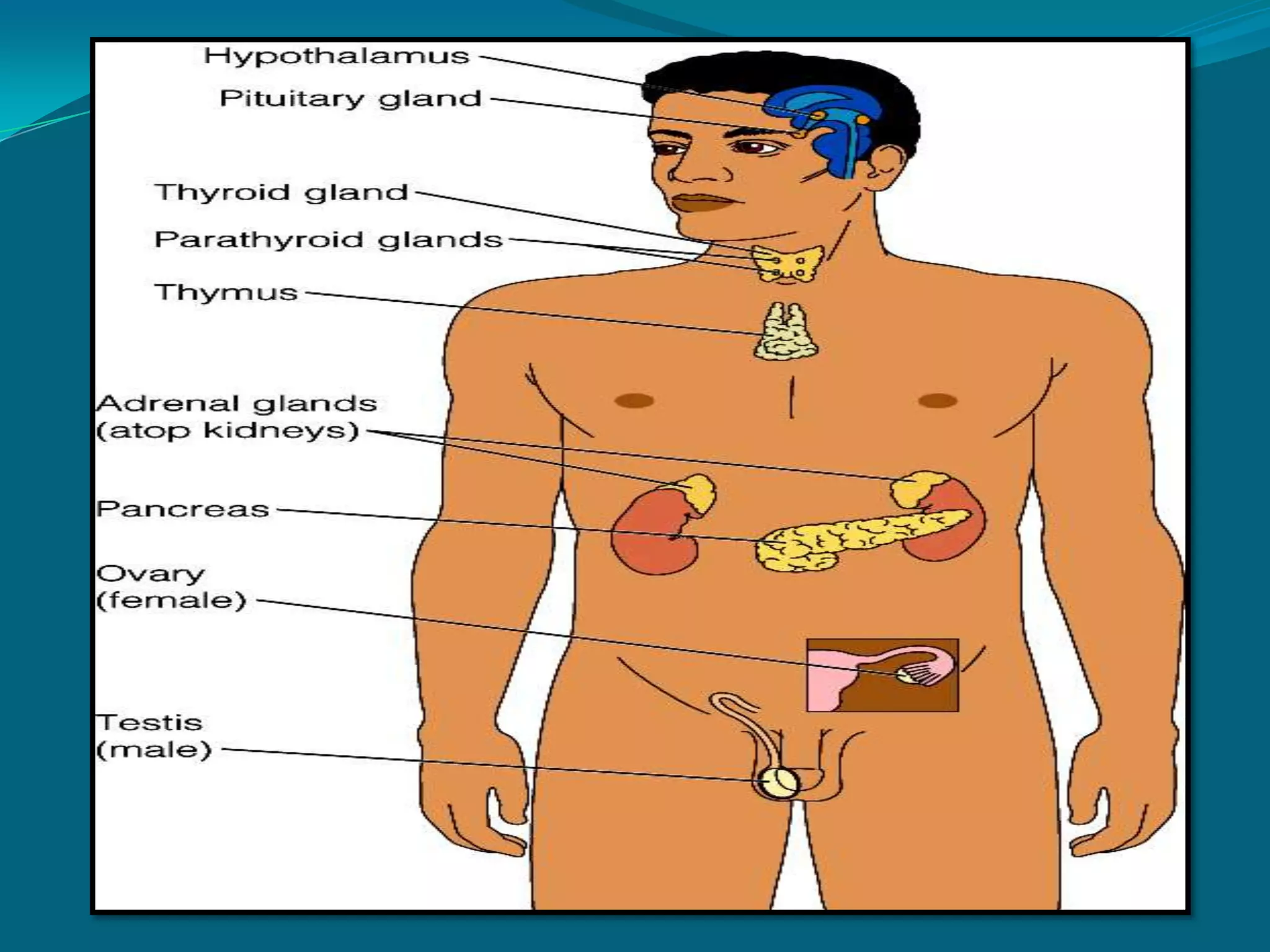
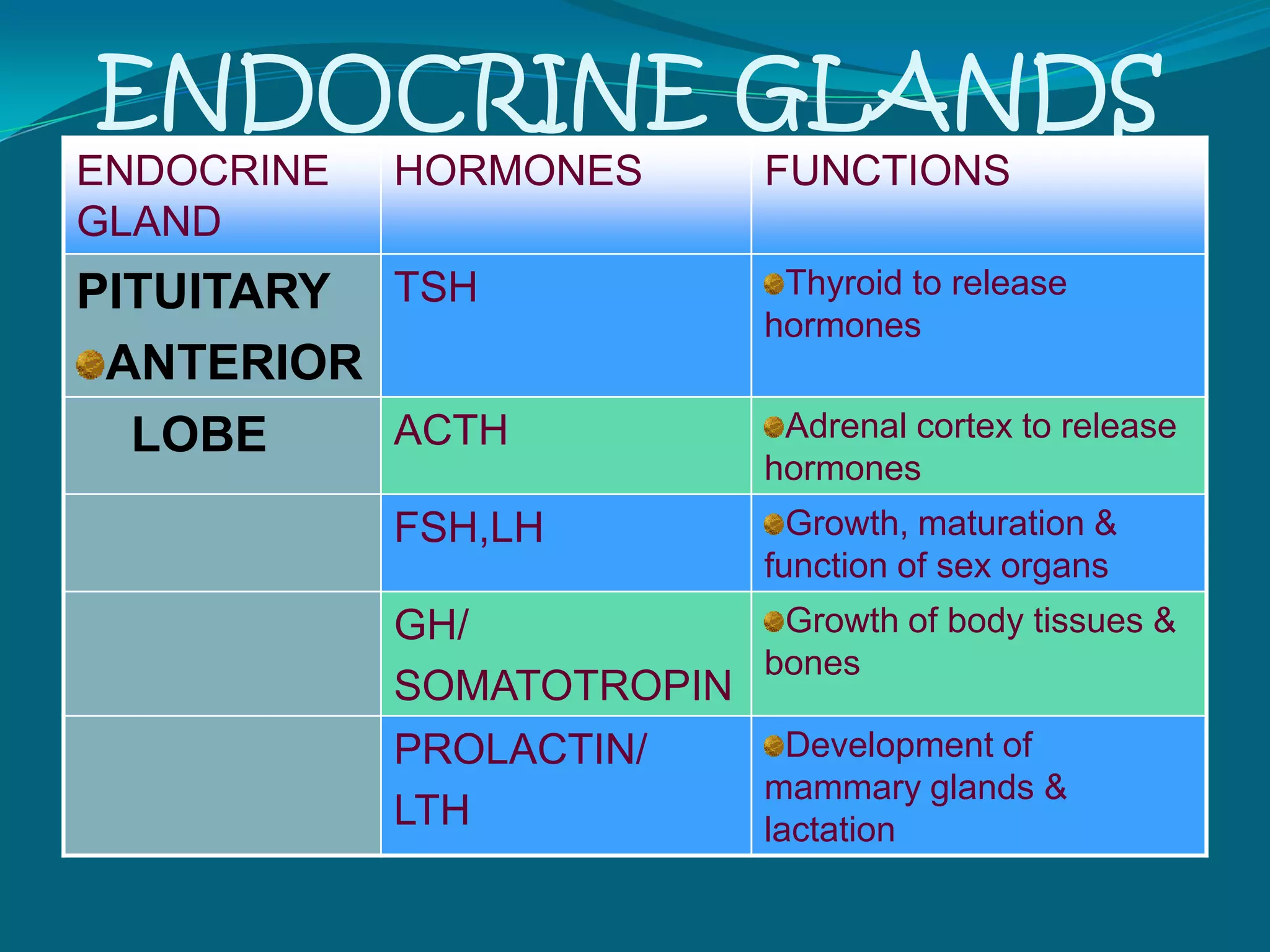
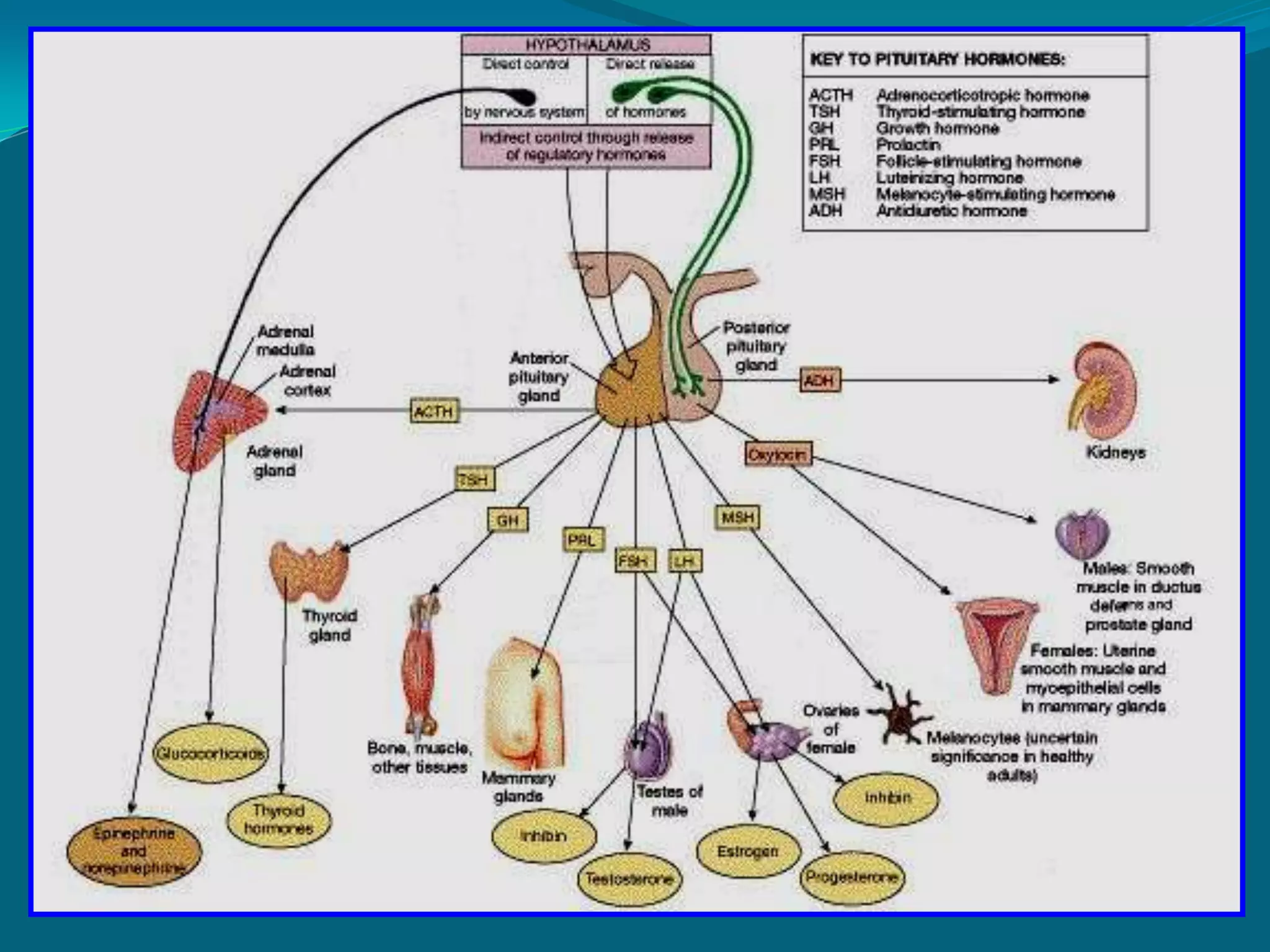
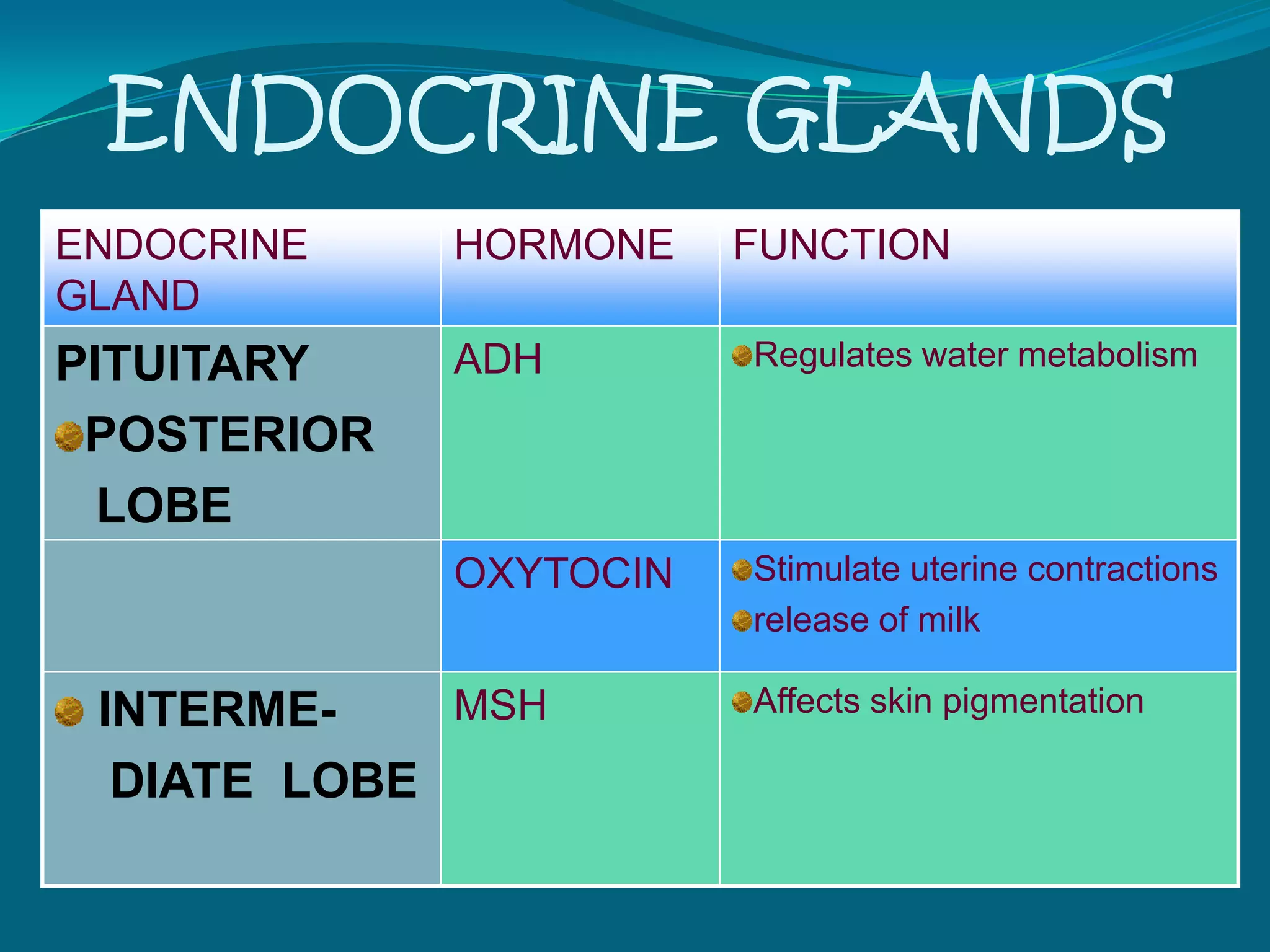
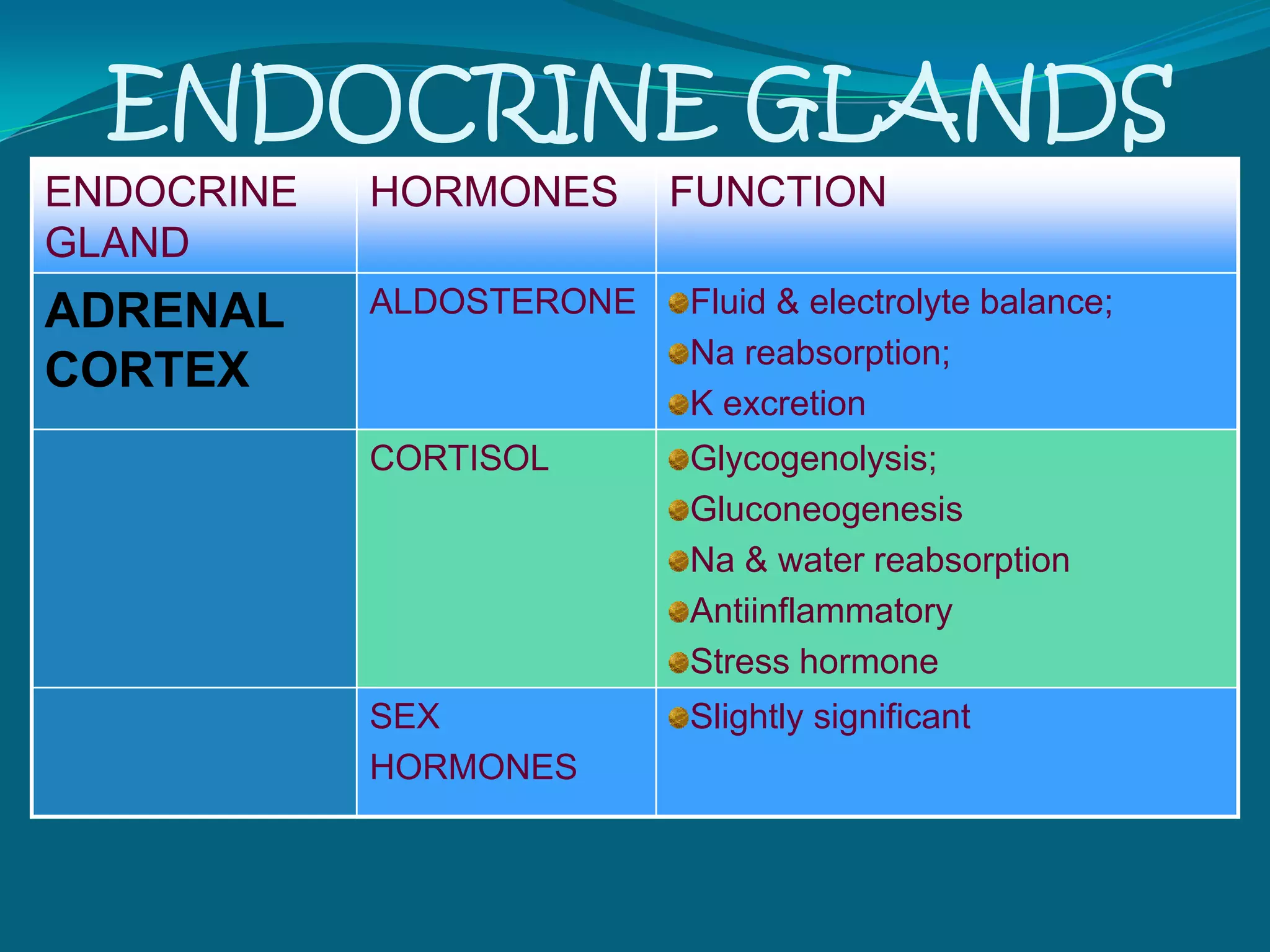
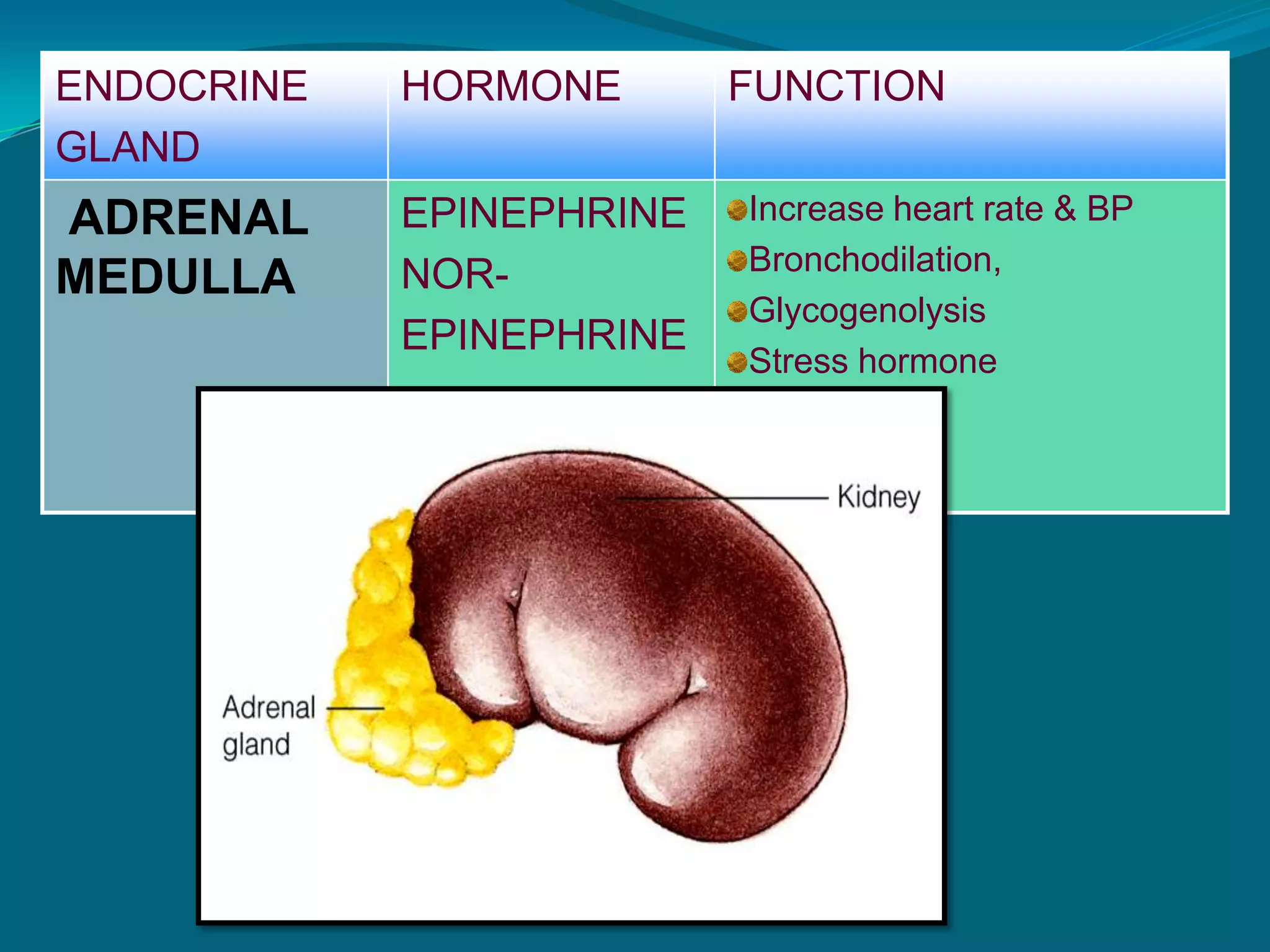
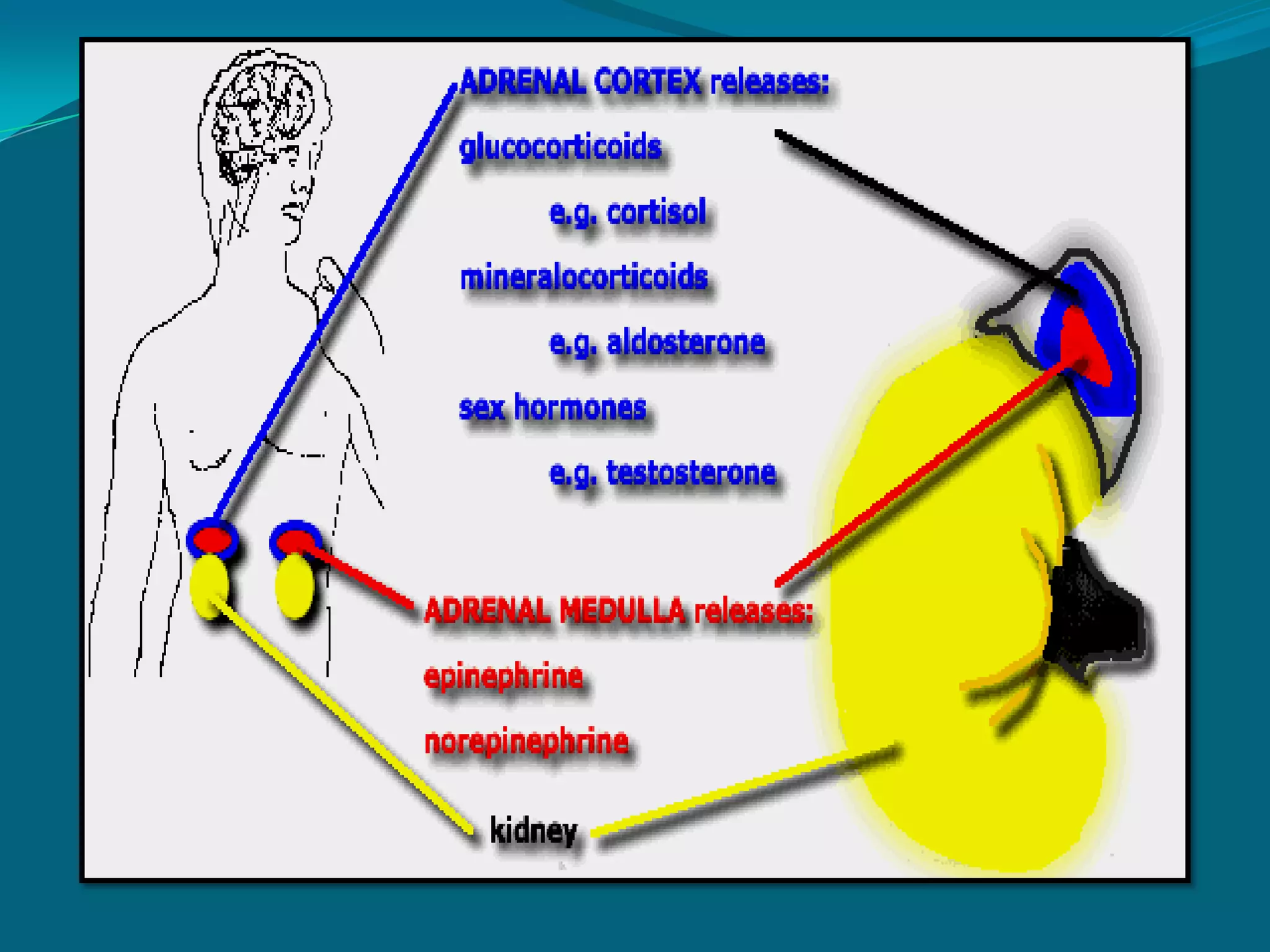
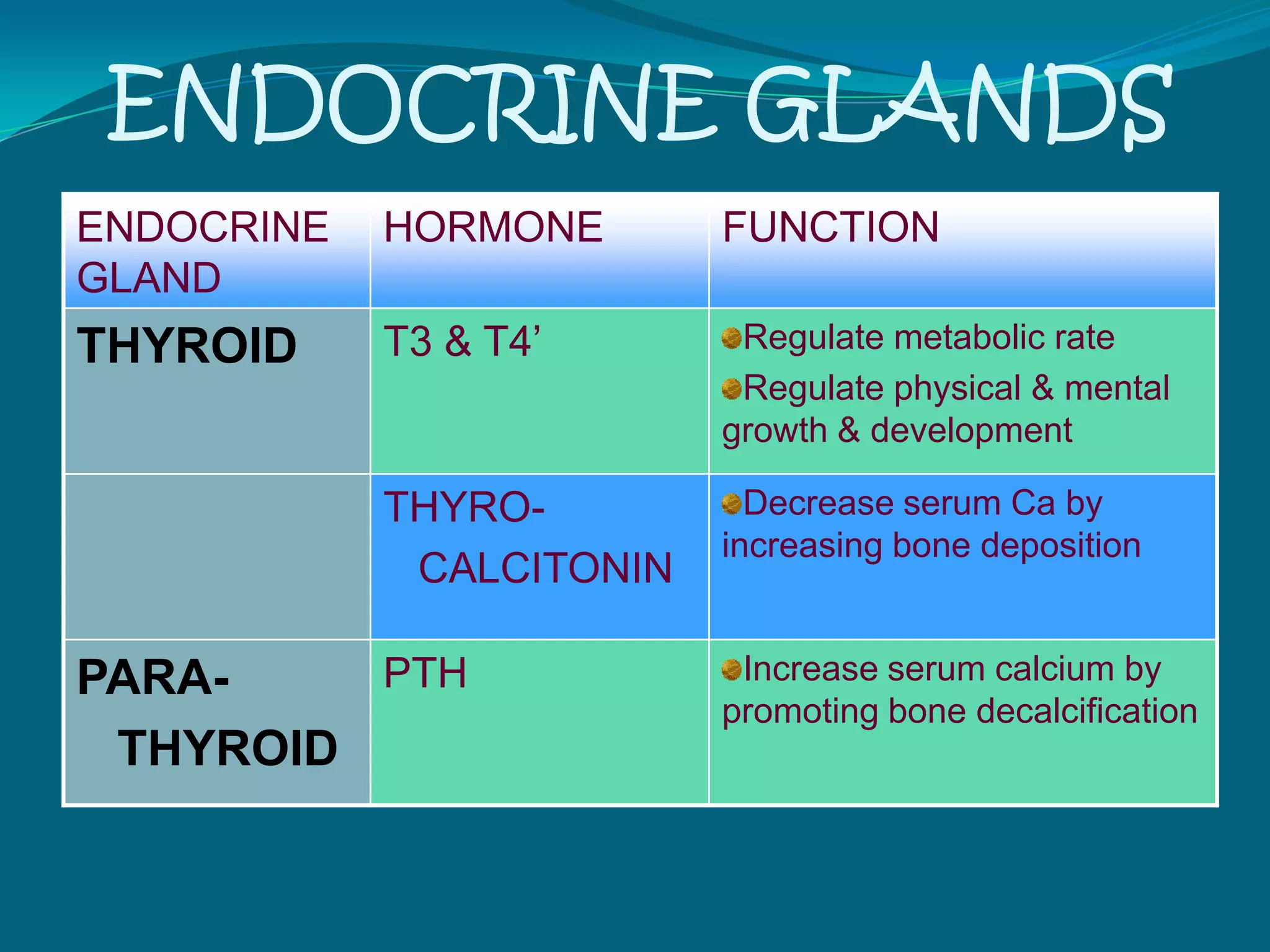
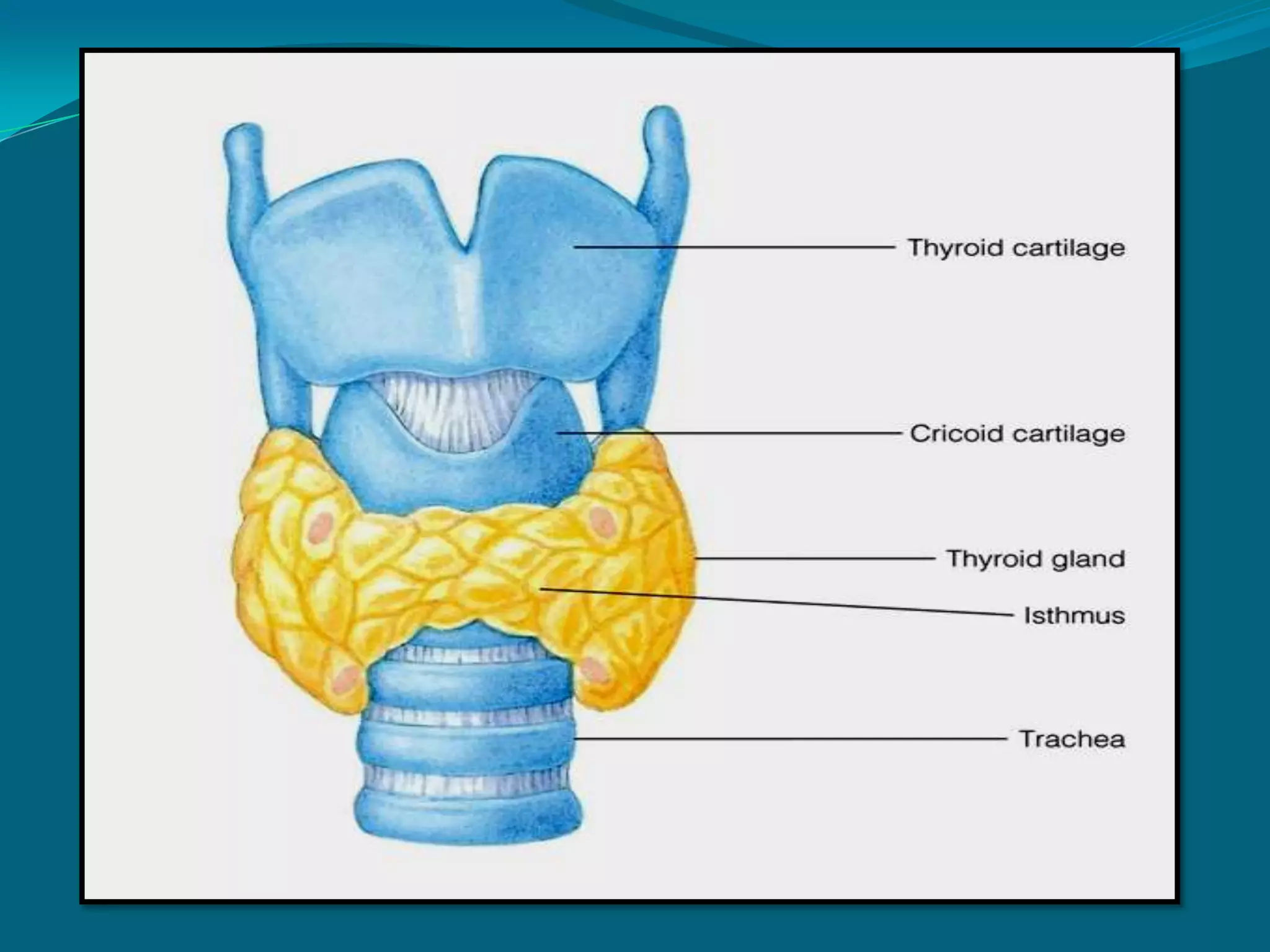
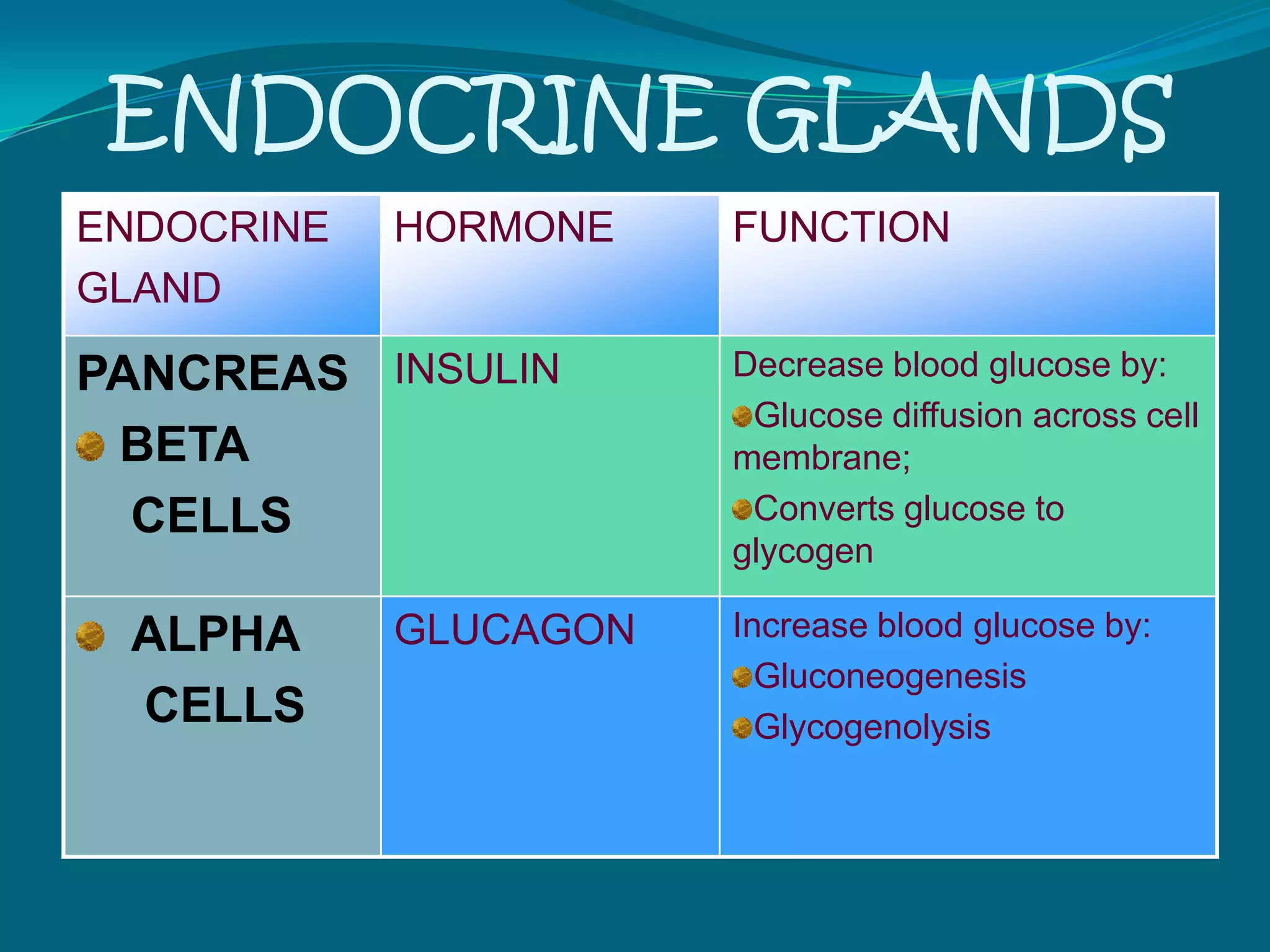
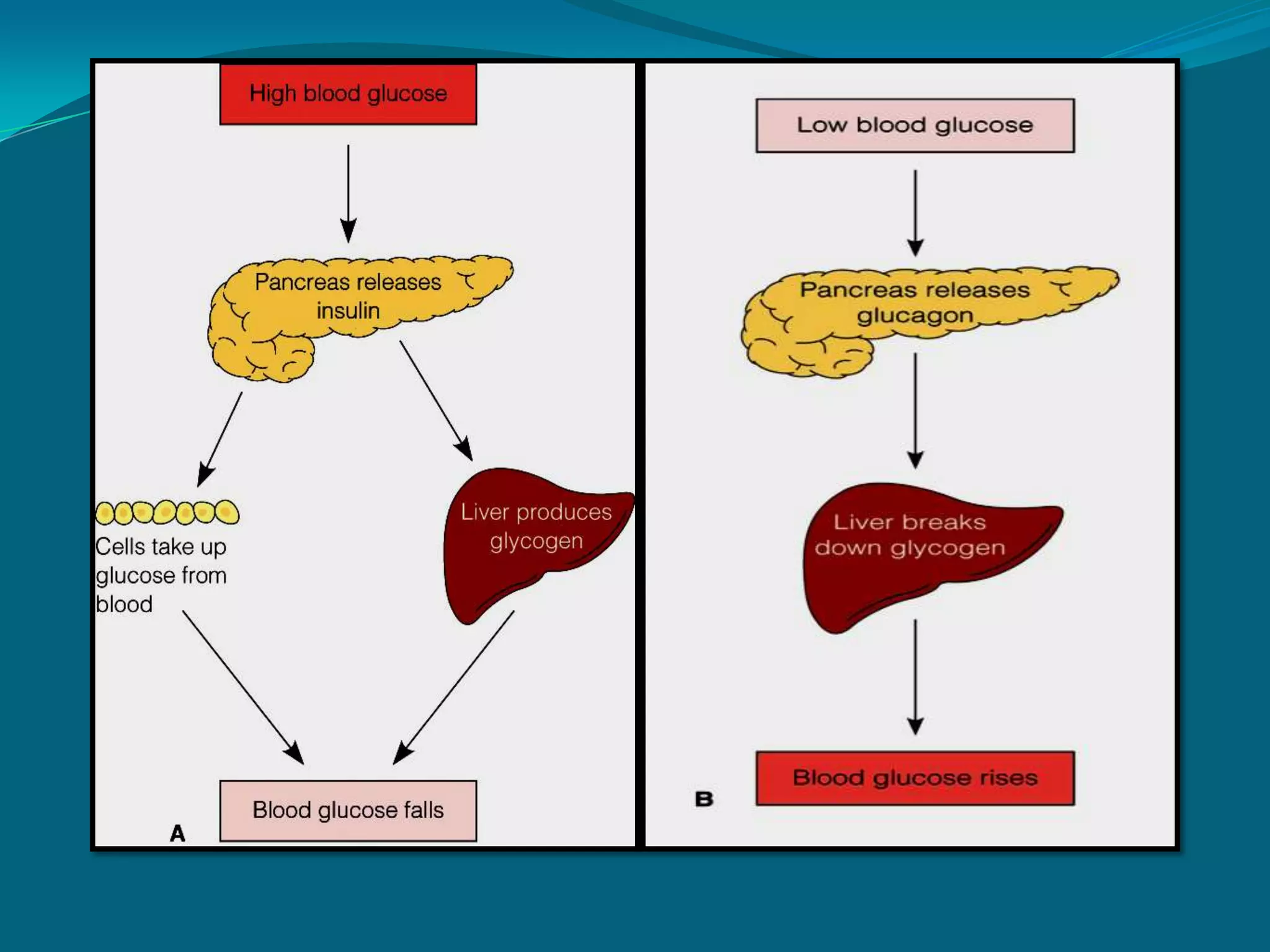
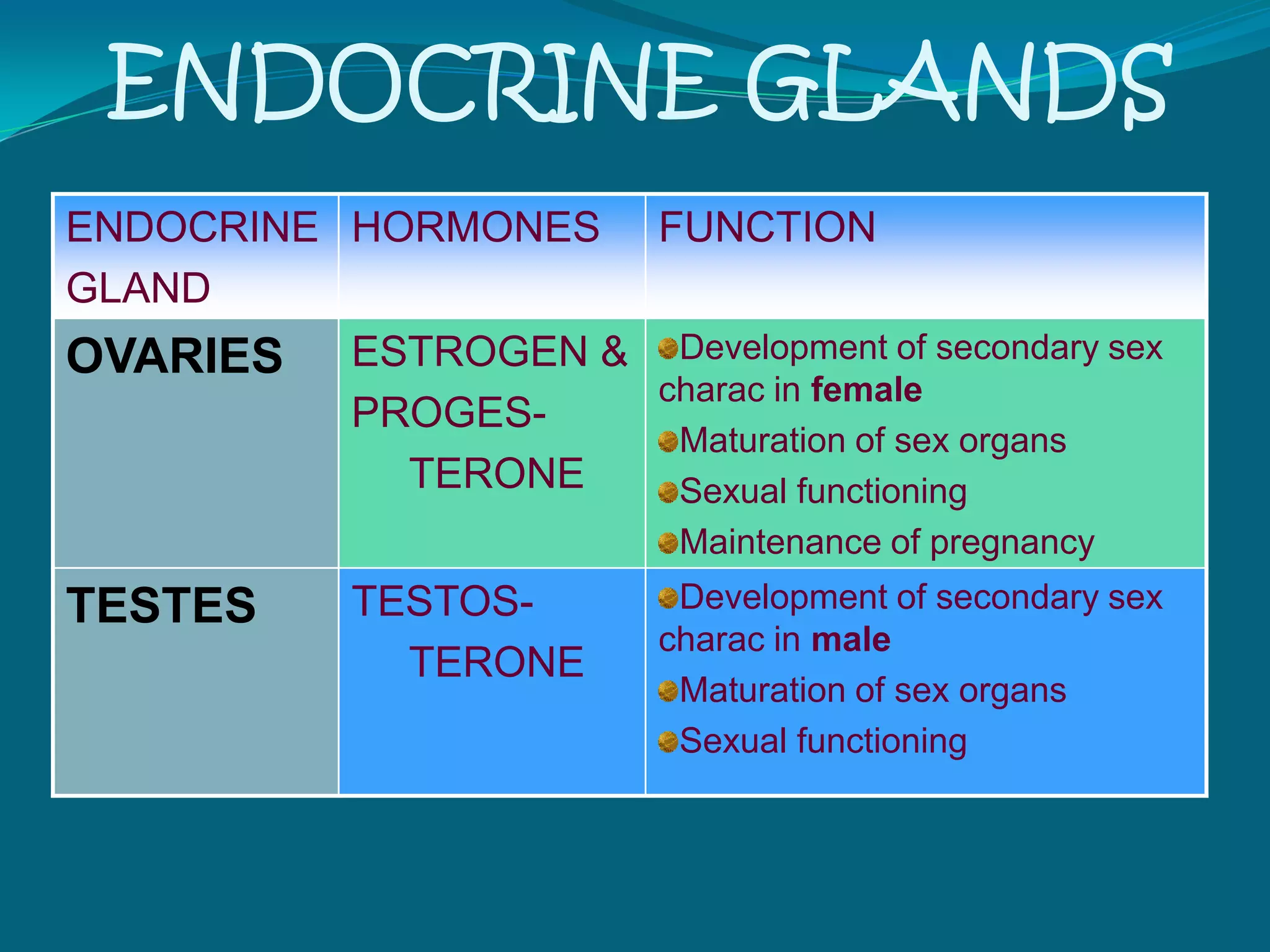
ENDOCRINE GLANDS
ENDOCRINE GLANDS
ENDOCRINE GLANDS
ENDOCRINE GLANDS
ENDOCRINE GLANDS
ENDOCRINE GLANDS
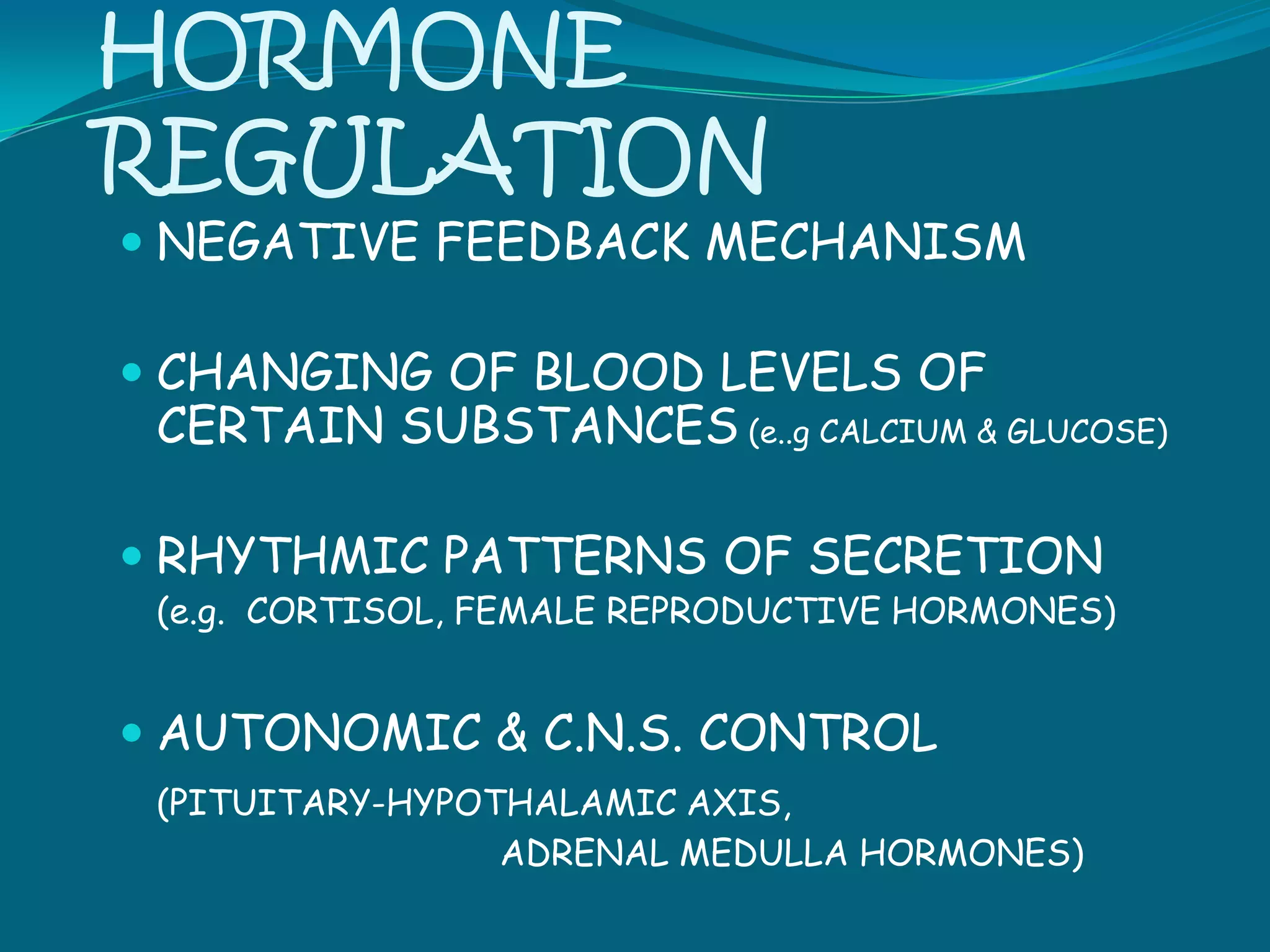
HORMONE REGULATIONNEGATIVE FEEDBACK MECHANISMCHANGING OF BLOOD LEVELS OF CERTAIN SUBSTANCES (e..g CALCIUM & GLUCOSE)RHYTHMIC PATTERNS OF SECRETION 	(e.g.  CORTISOL, FEMALE REPRODUCTIVE HORMONES)AUTONOMIC & C.N.S. CONTROL(PITUITARY-HYPOTHALAMIC AXIS, 				ADRENAL MEDULLA HORMONES)
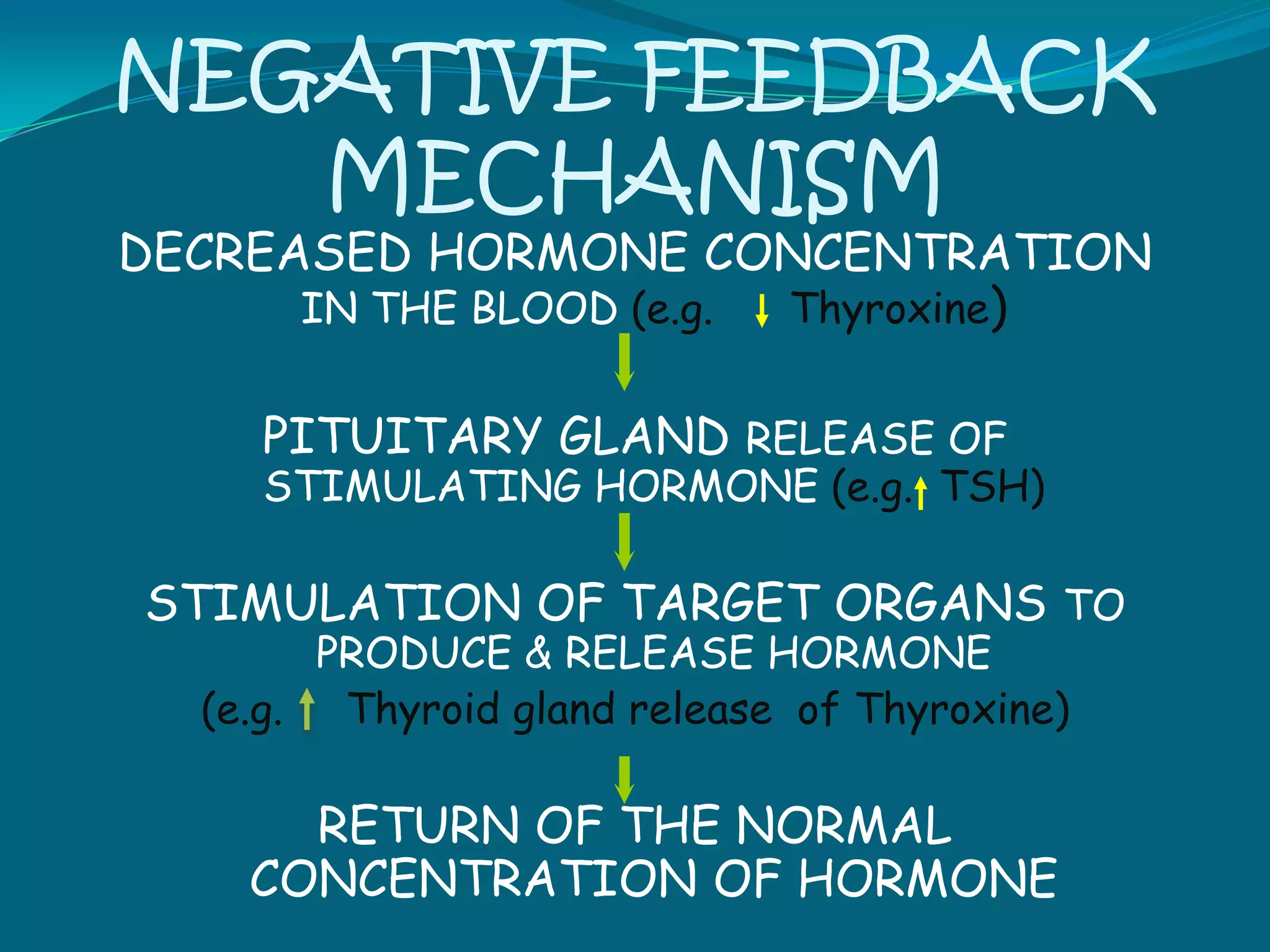
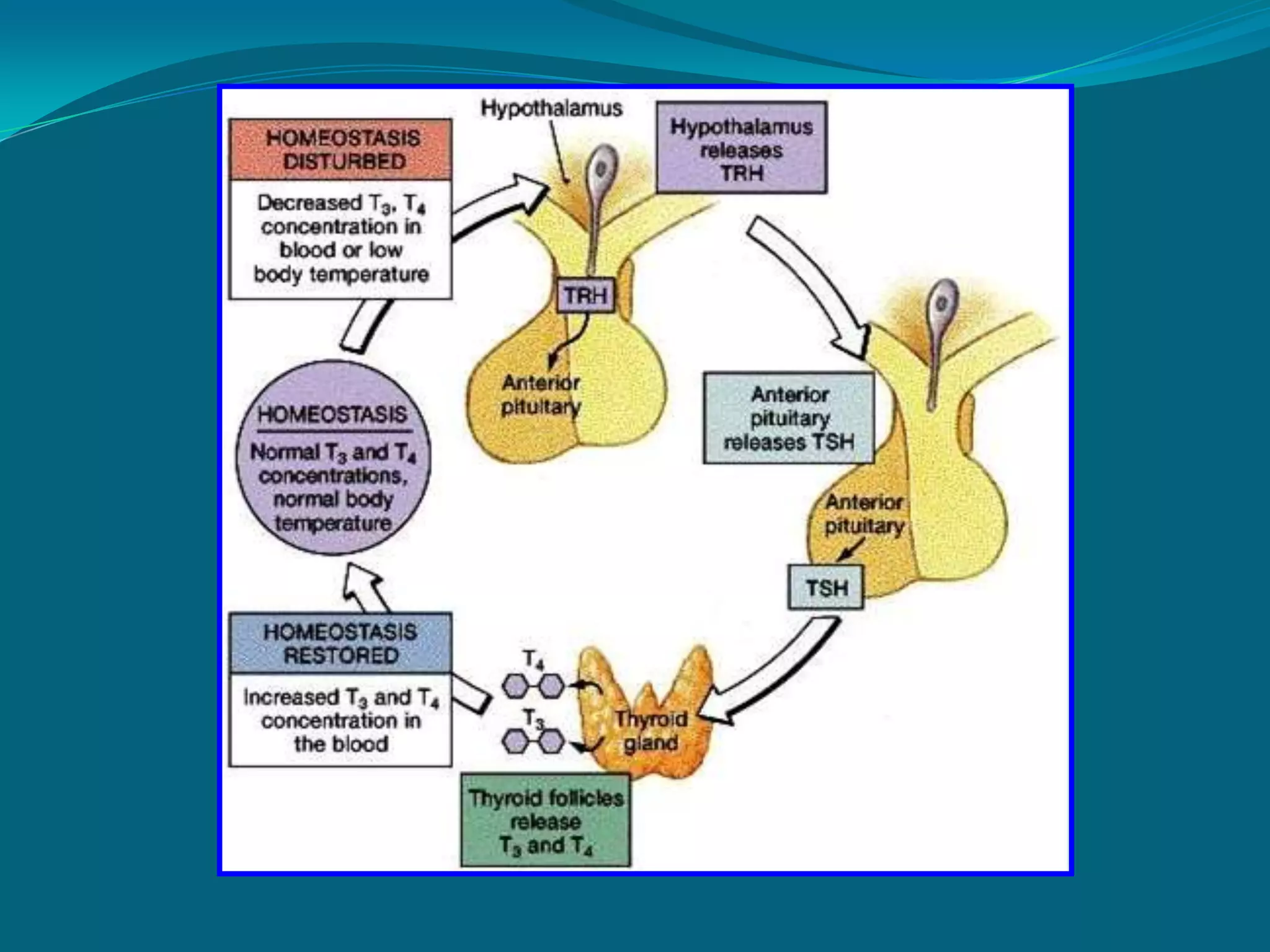
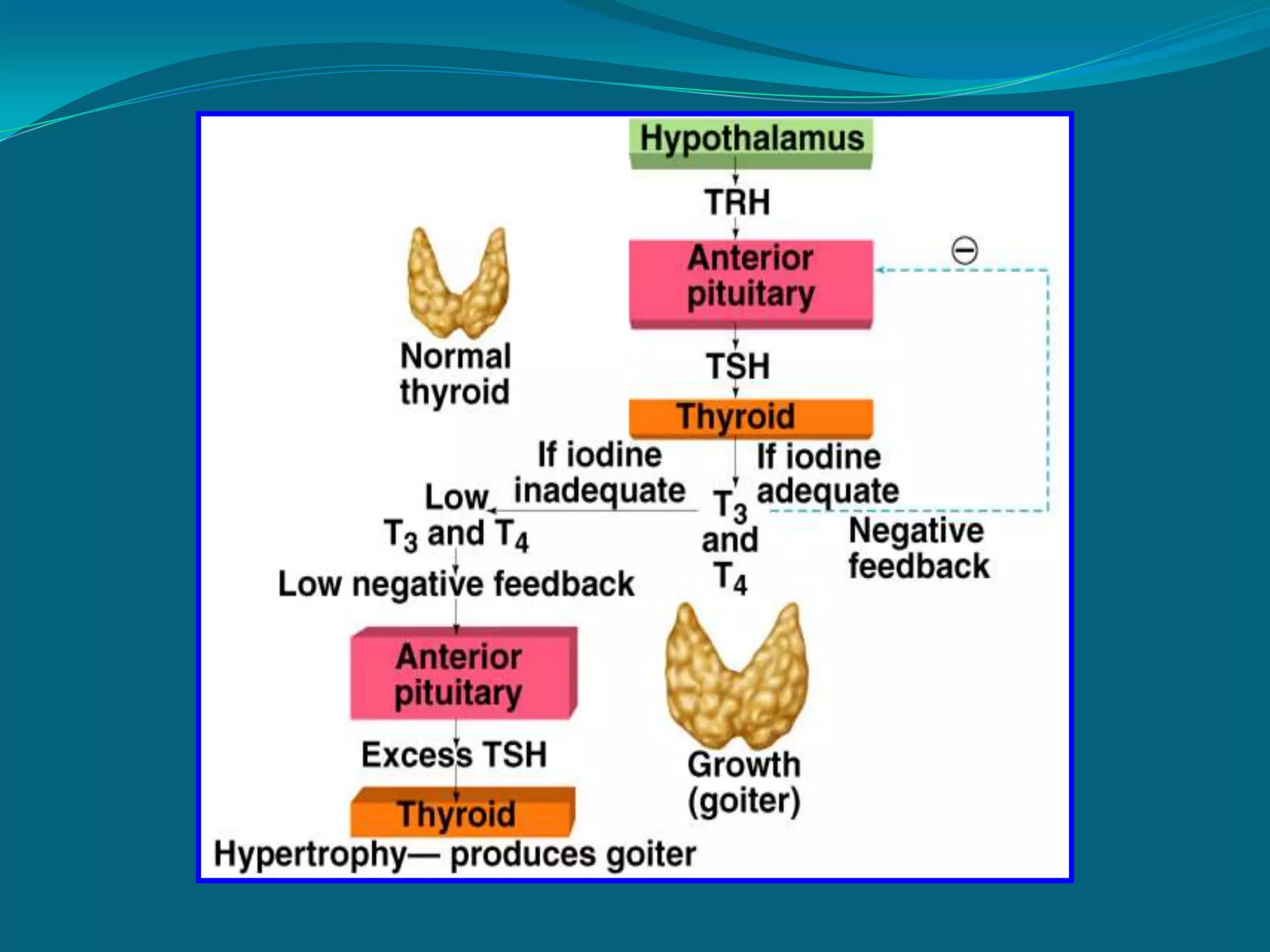
NEGATIVE FEEDBACK MECHANISMDECREASED HORMONE CONCENTRATION IN THE BLOOD (e.g.      Thyroxine)PITUITARY GLAND RELEASE OF STIMULATING HORMONE (e.g.  TSH)STIMULATION OF TARGET ORGANS TO PRODUCE & RELEASE HORMONE (e.g.     Thyroid gland release  of Thyroxine)RETURN OF THE NORMAL CONCENTRATION OF HORMONE
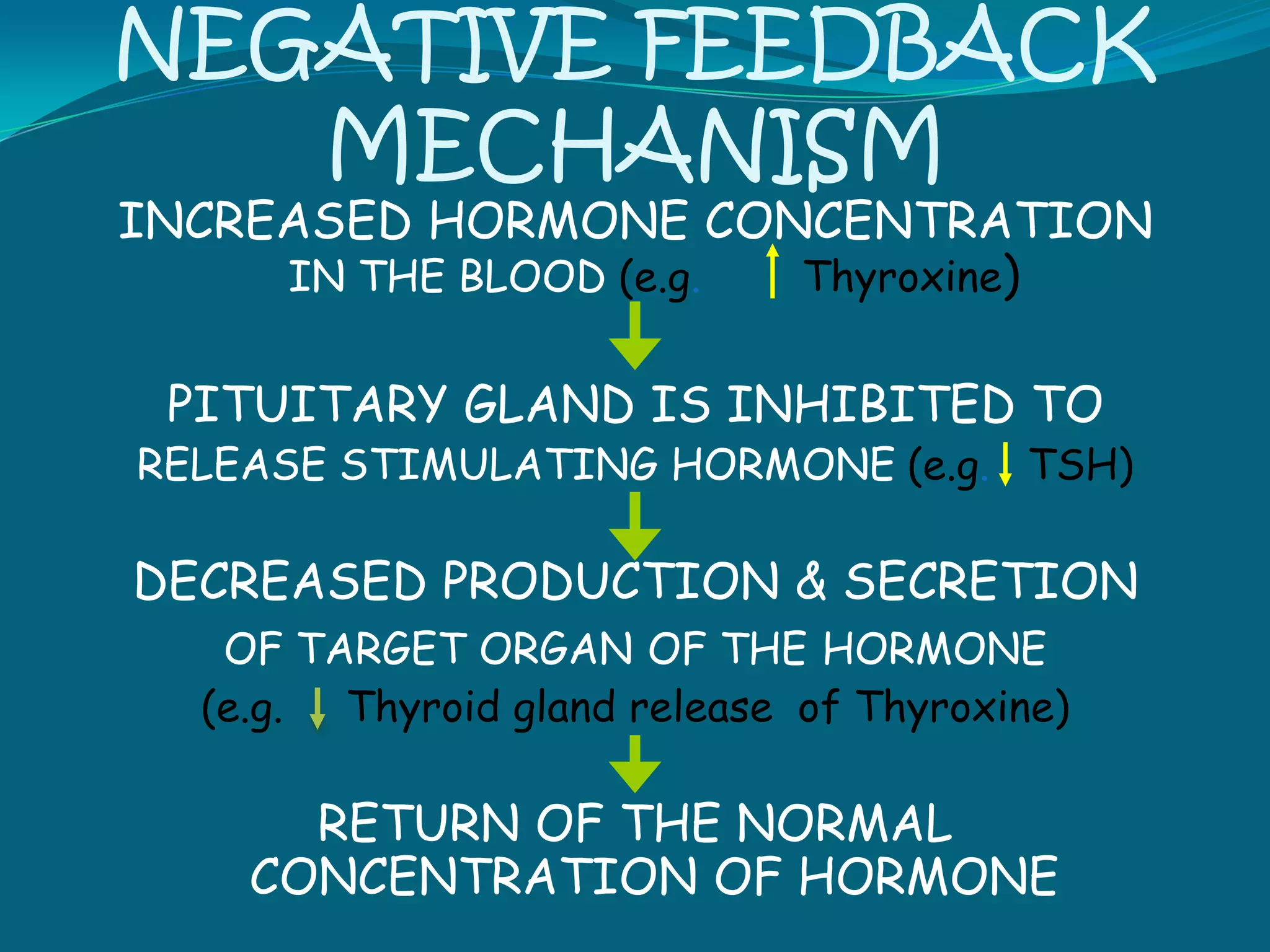
NEGATIVE FEEDBACK MECHANISMINCREASED HORMONE CONCENTRATION IN THE BLOOD(e.g.        Thyroxine)PITUITARY GLAND IS INHIBITED TORELEASE STIMULATING HORMONE (e.g.   TSH)DECREASED PRODUCTION & SECRETION OF TARGET ORGANOF THEHORMONE (e.g.     Thyroid gland release  of Thyroxine)RETURN OF THE NORMAL CONCENTRATION OF HORMONE
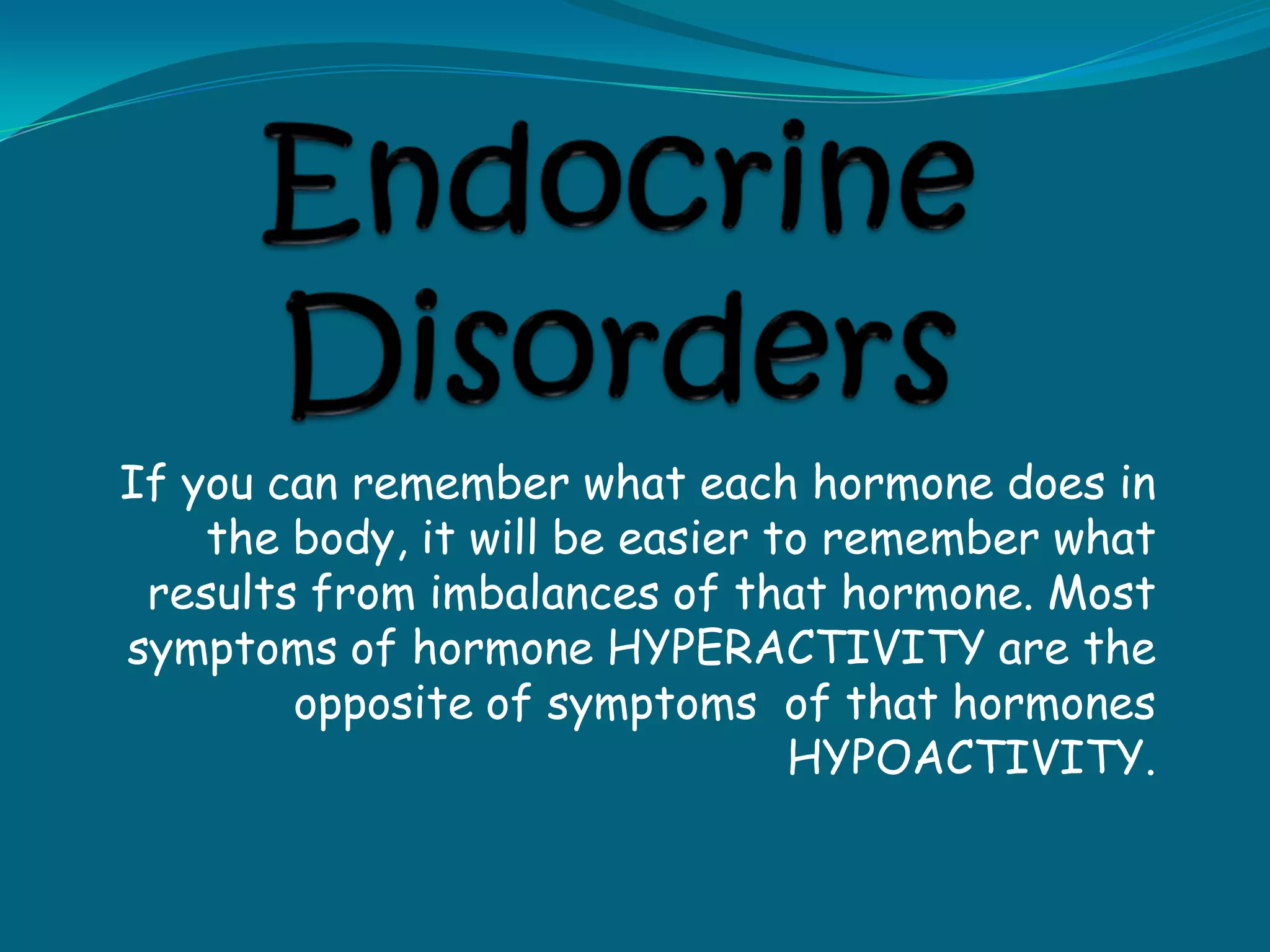
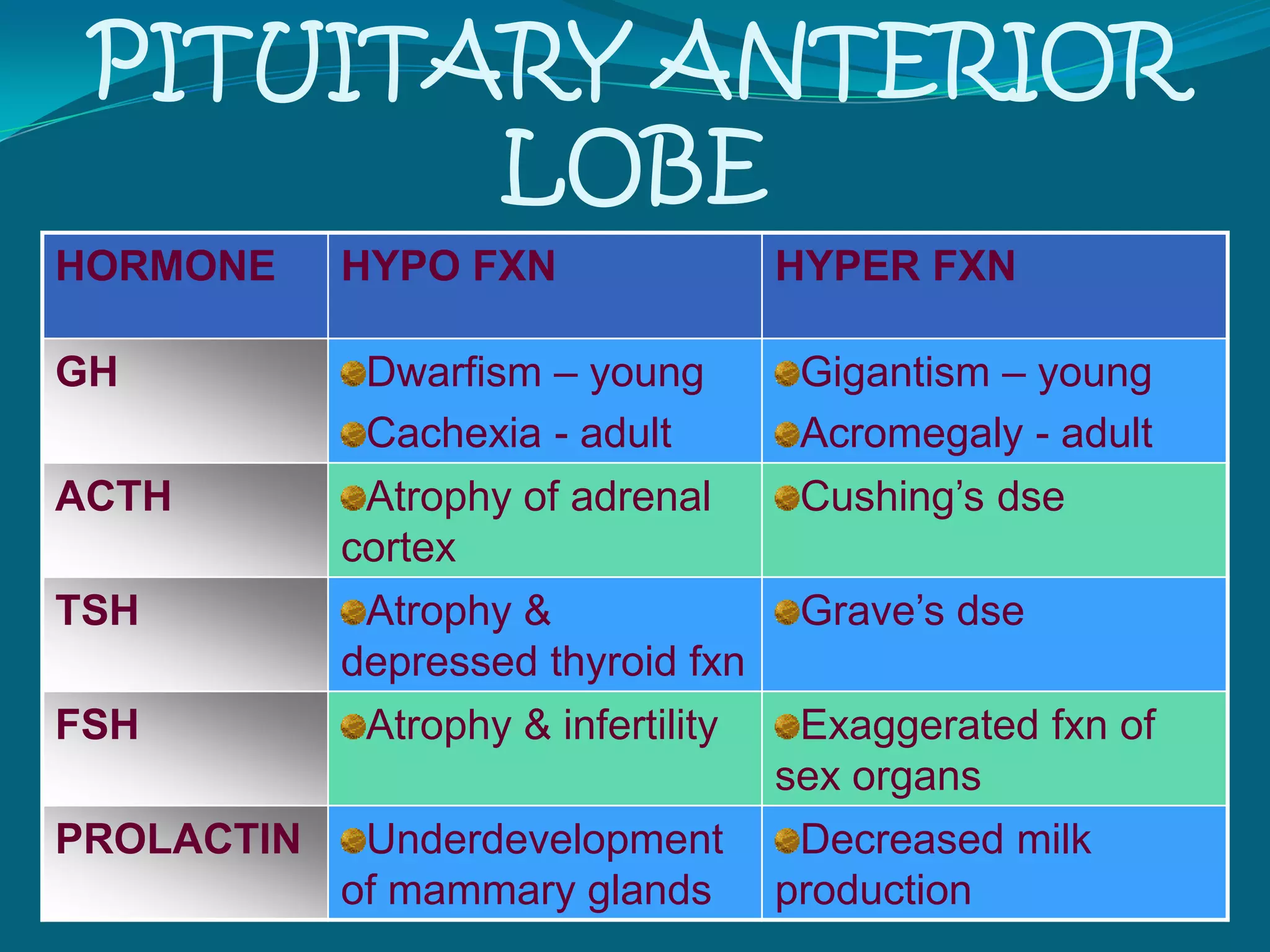
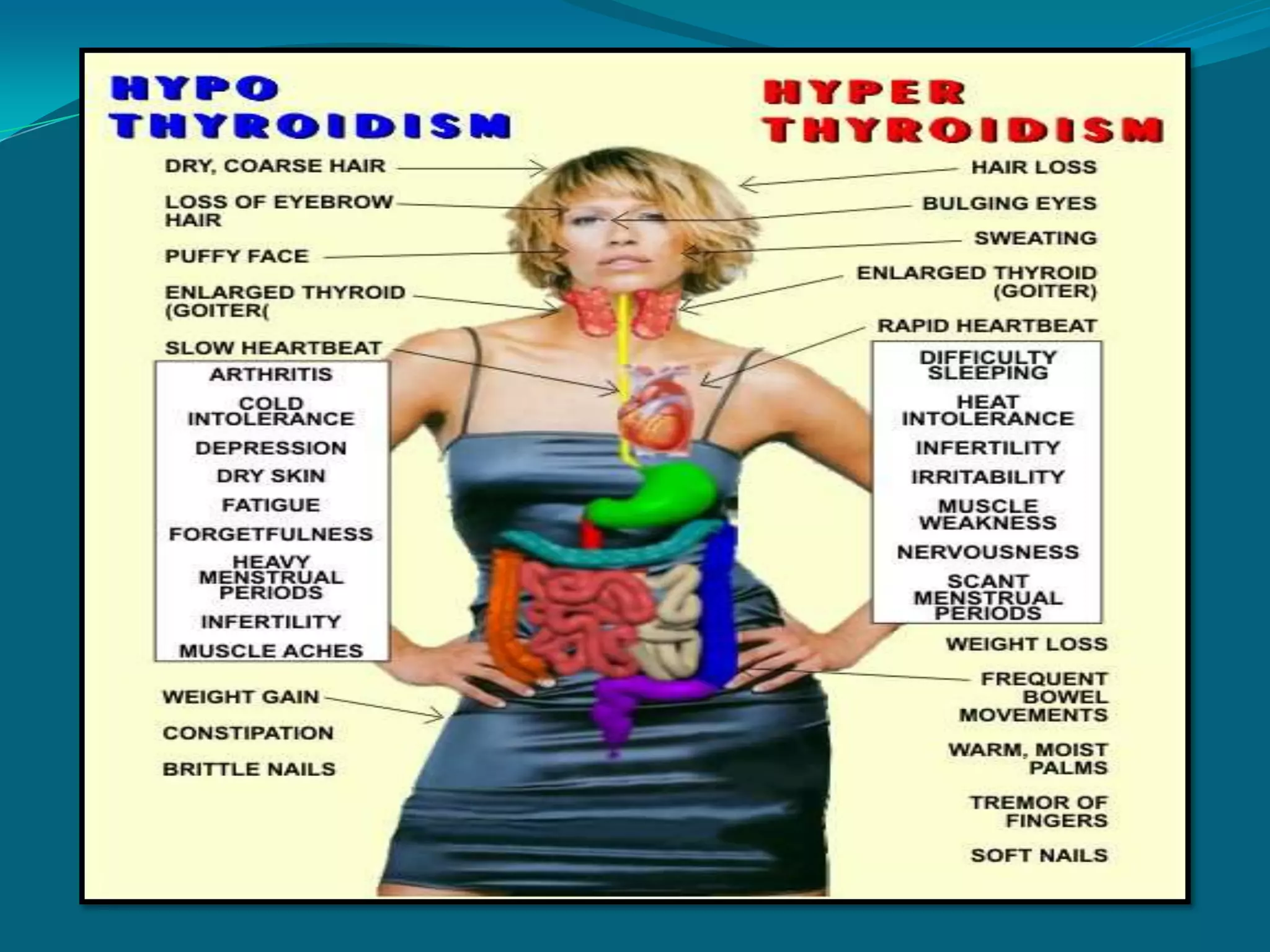
Endocrine DisordersIf you can remember what each hormone does in the body, it will be easier to remember what results from imbalances of that hormone. Most symptoms of hormone HYPERACTIVITY are the opposite of symptoms  of that hormones HYPOACTIVITY.
ANTERIOR PITUITARY  DISTURBANCESHYPOPITUITARISMHYPERPITUITARISM
PITUITARY ANTERIOR LOBE
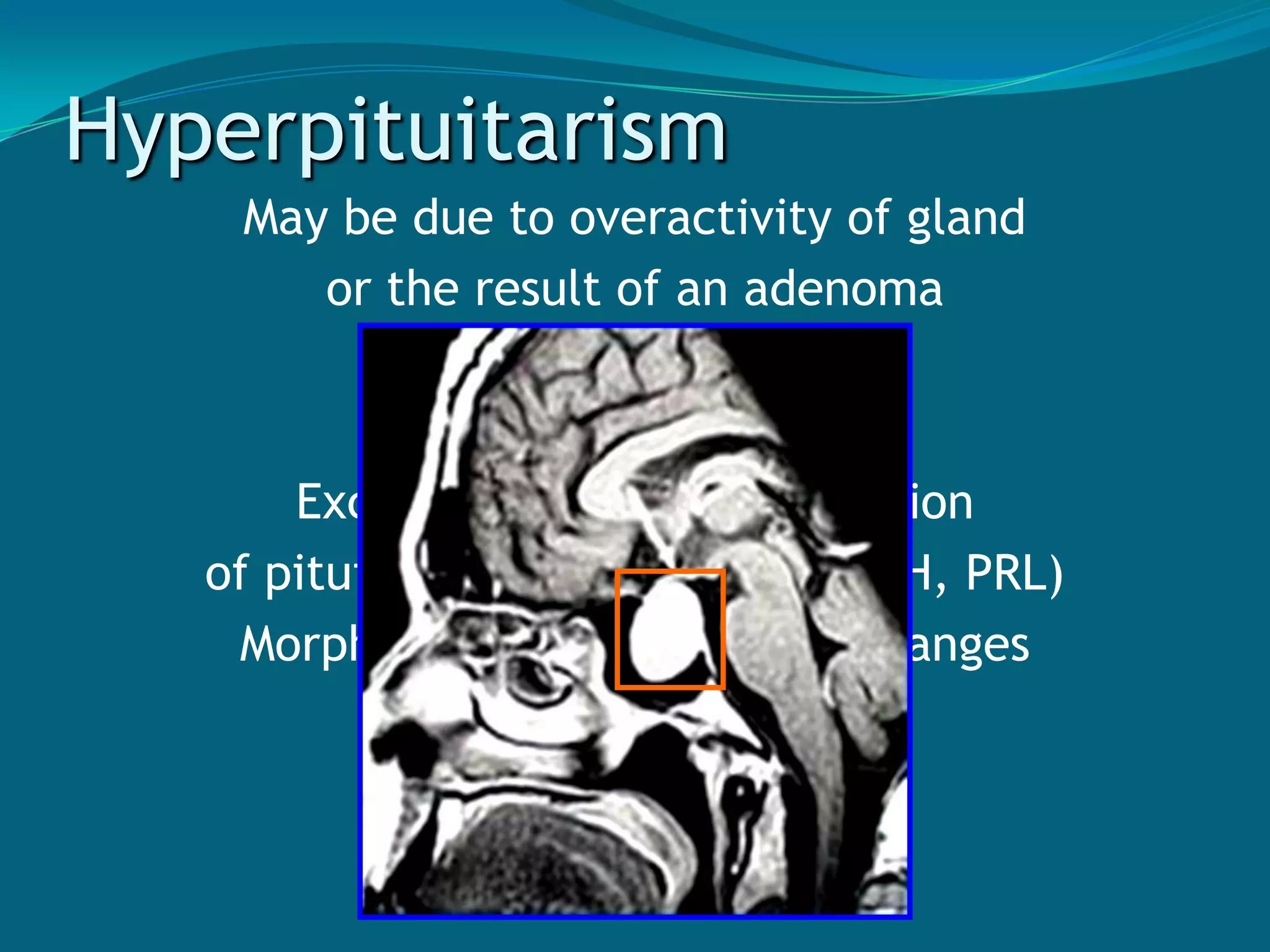
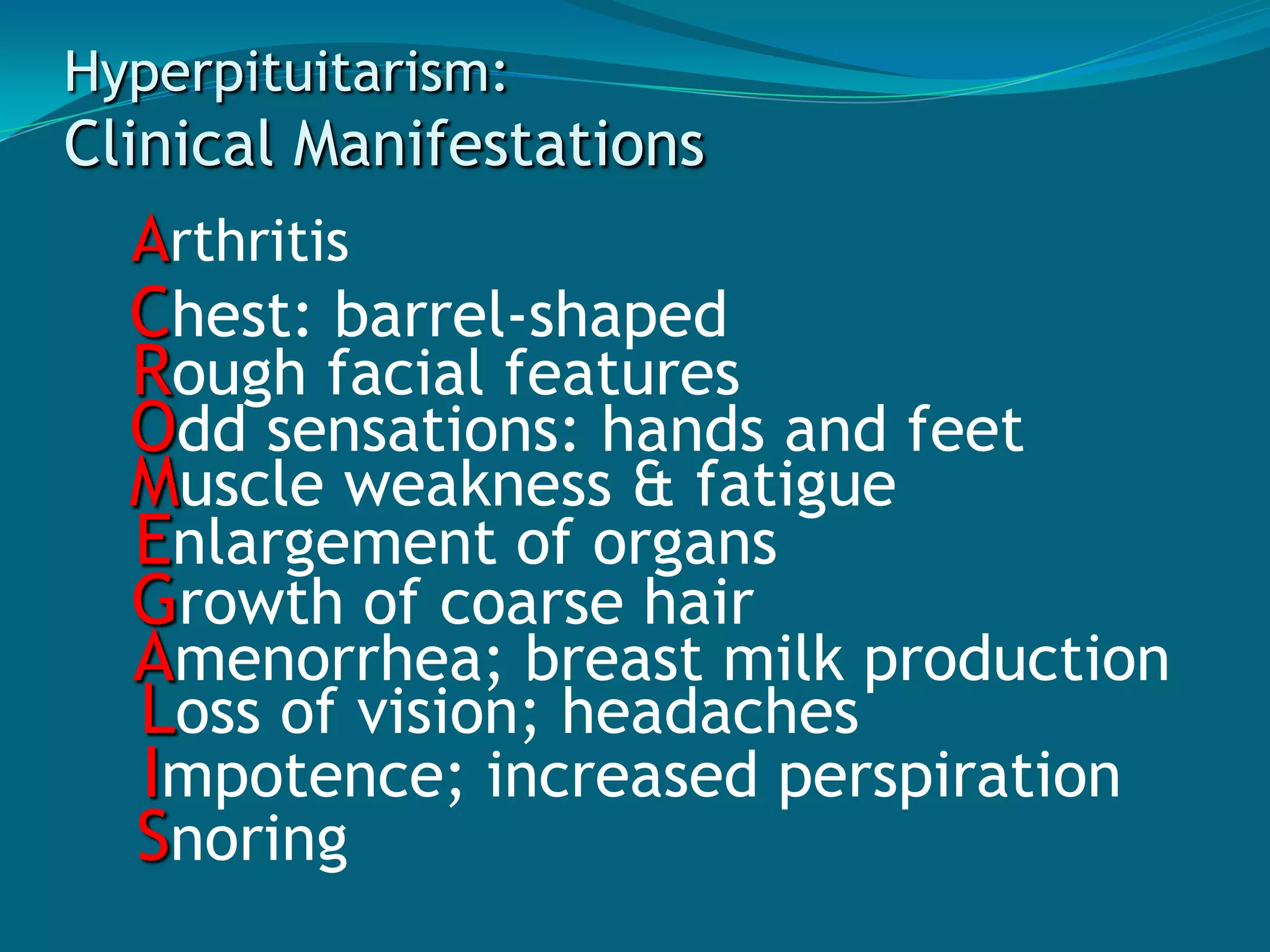
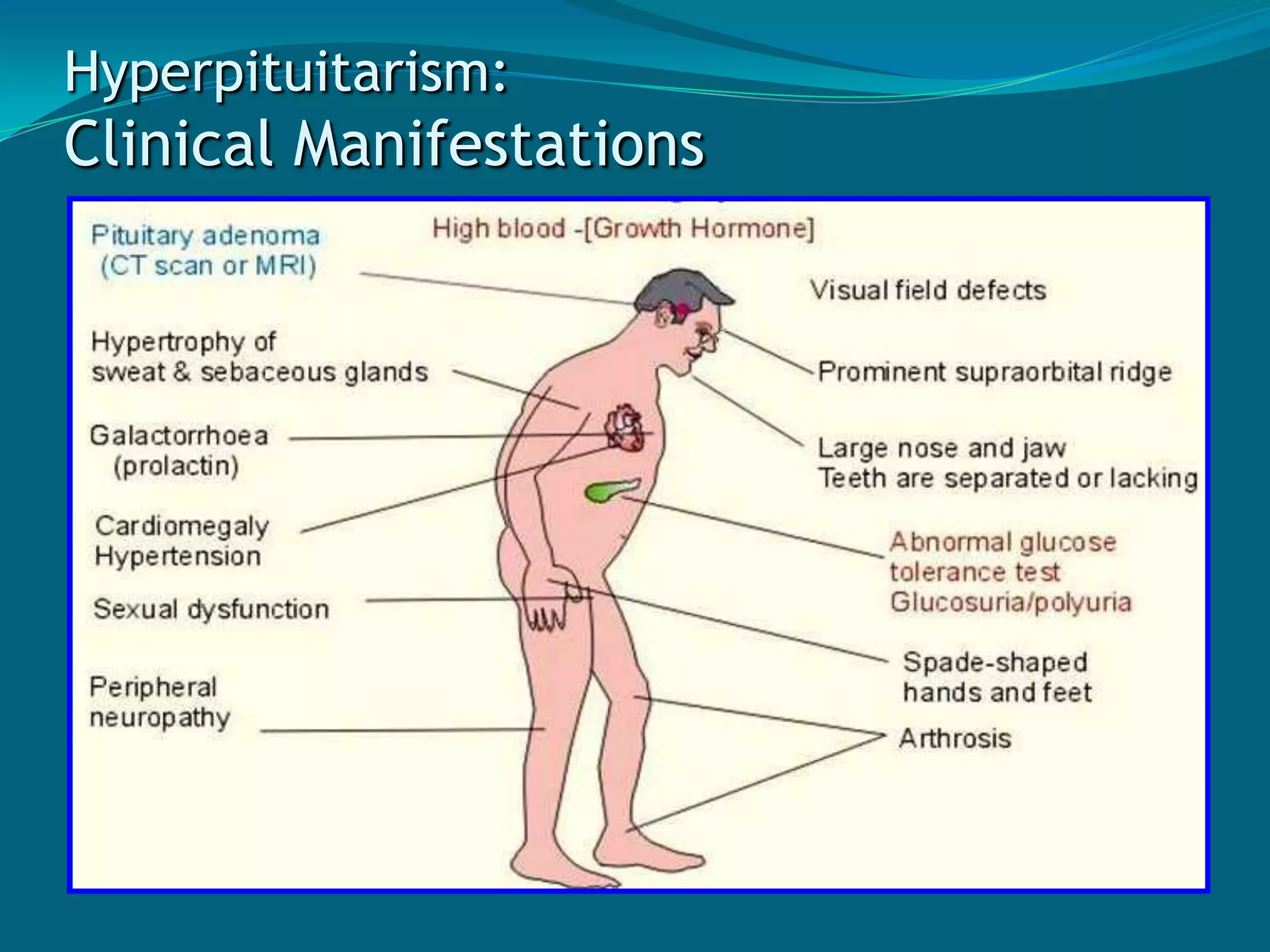
HyperpituitarismMay be due to overactivity of glandor the result of an adenomaCharacterized by:Excessive serum concentrationof pituitary hormones (GH, ACTH, PRL)Morphologic and functional changesin the anterior pituitary
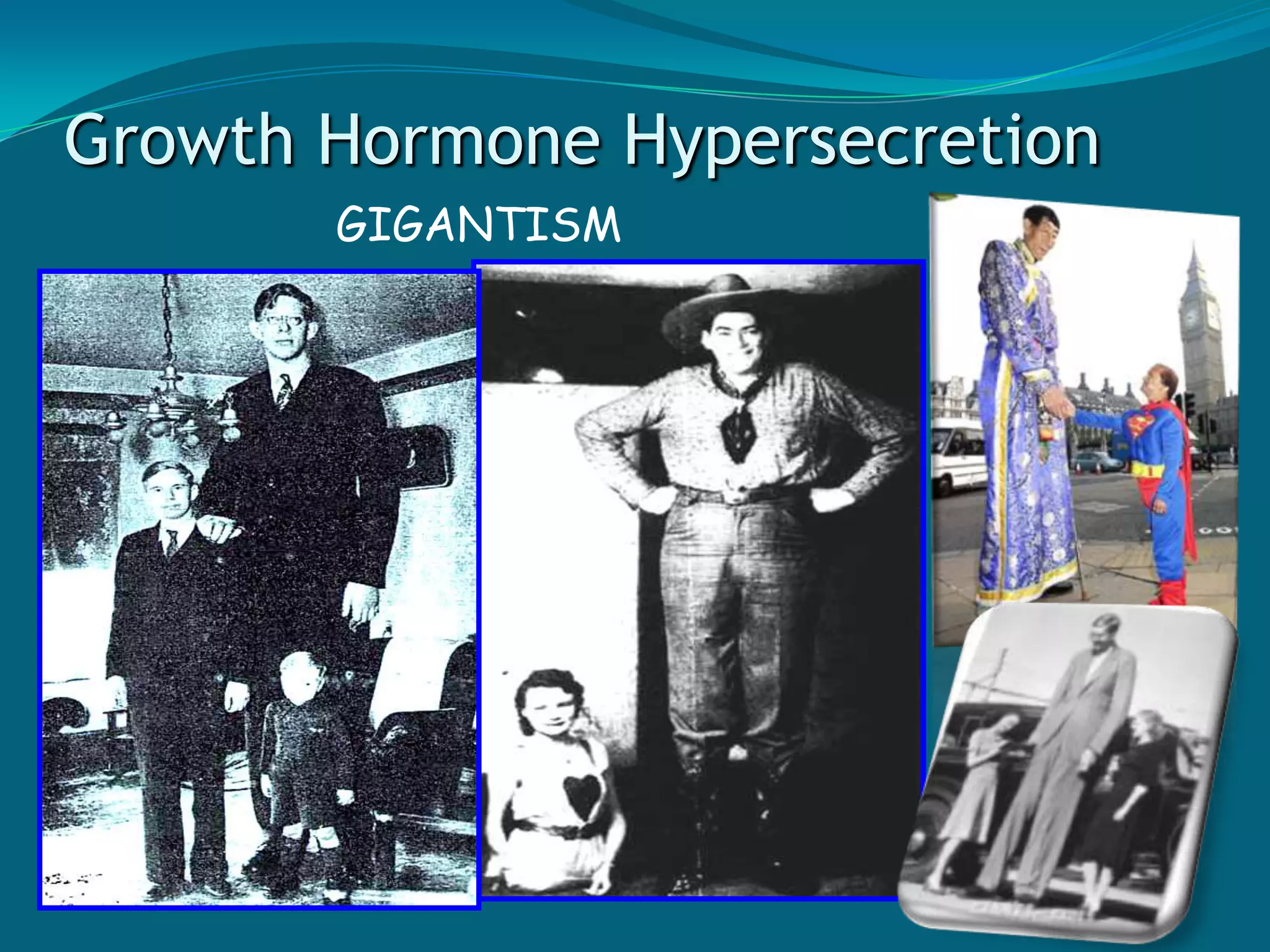
Growth Hormone HypersecretionGIGANTISM
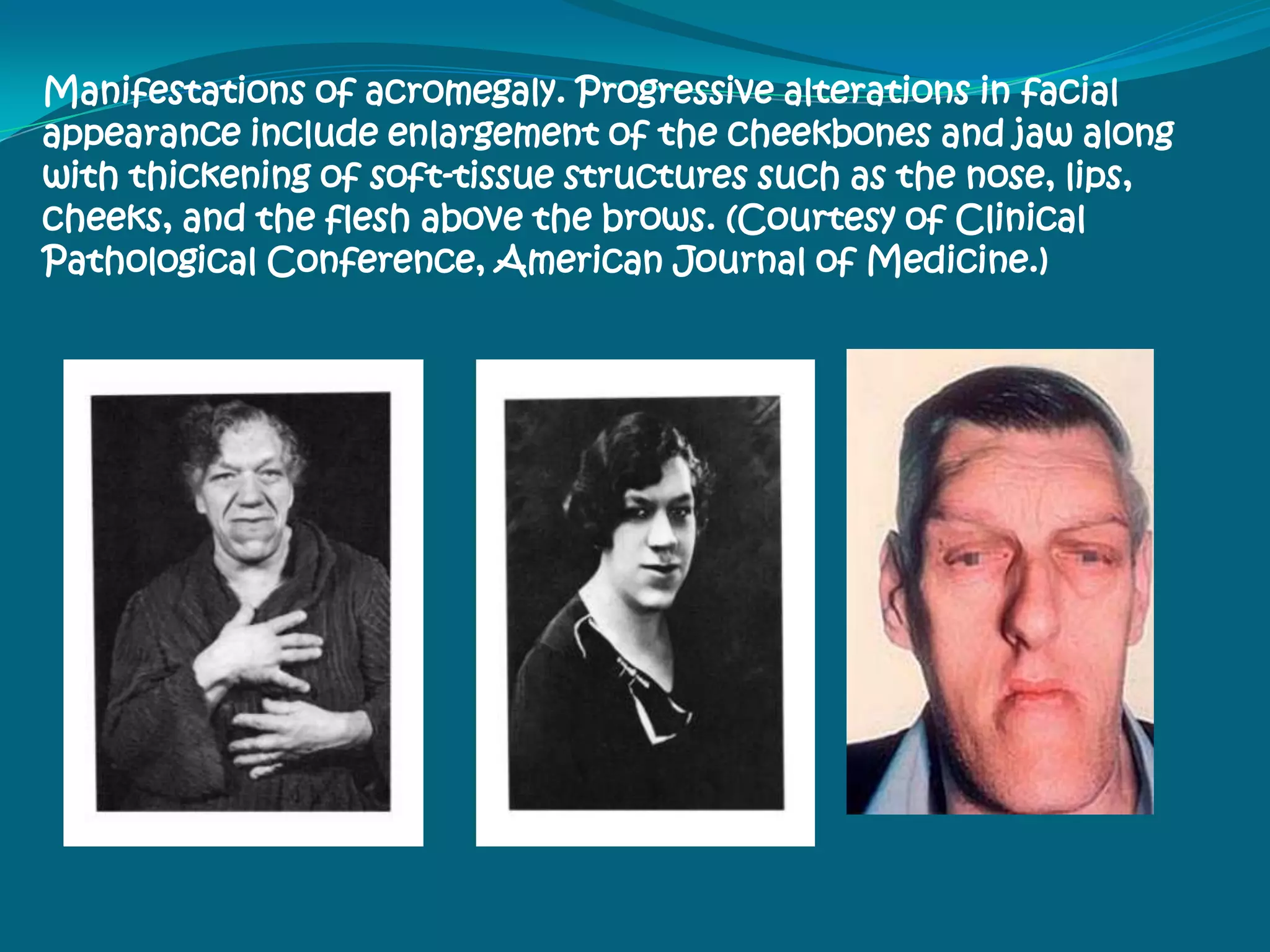
Manifestations of acromegaly. Progressive alterations in facial appearance include enlargement of the cheekbones and jaw along with thickening of soft-tissue structures such as the nose, lips, cheeks, and the flesh above the brows. (Courtesy of Clinical Pathological Conference, American Journal of Medicine.)
Hyperpituitarism:Clinical ManifestationsArthritisChest: barrel-shapedRough facial featuresOdd sensations: hands and feetMuscle weakness & fatigueEnlargement of organsGrowth of coarse hairAmenorrhea; breast milk productionLoss of vision; headachesImpotence; increased perspiration Snoring
Hyperpituitarism:Clinical Manifestations
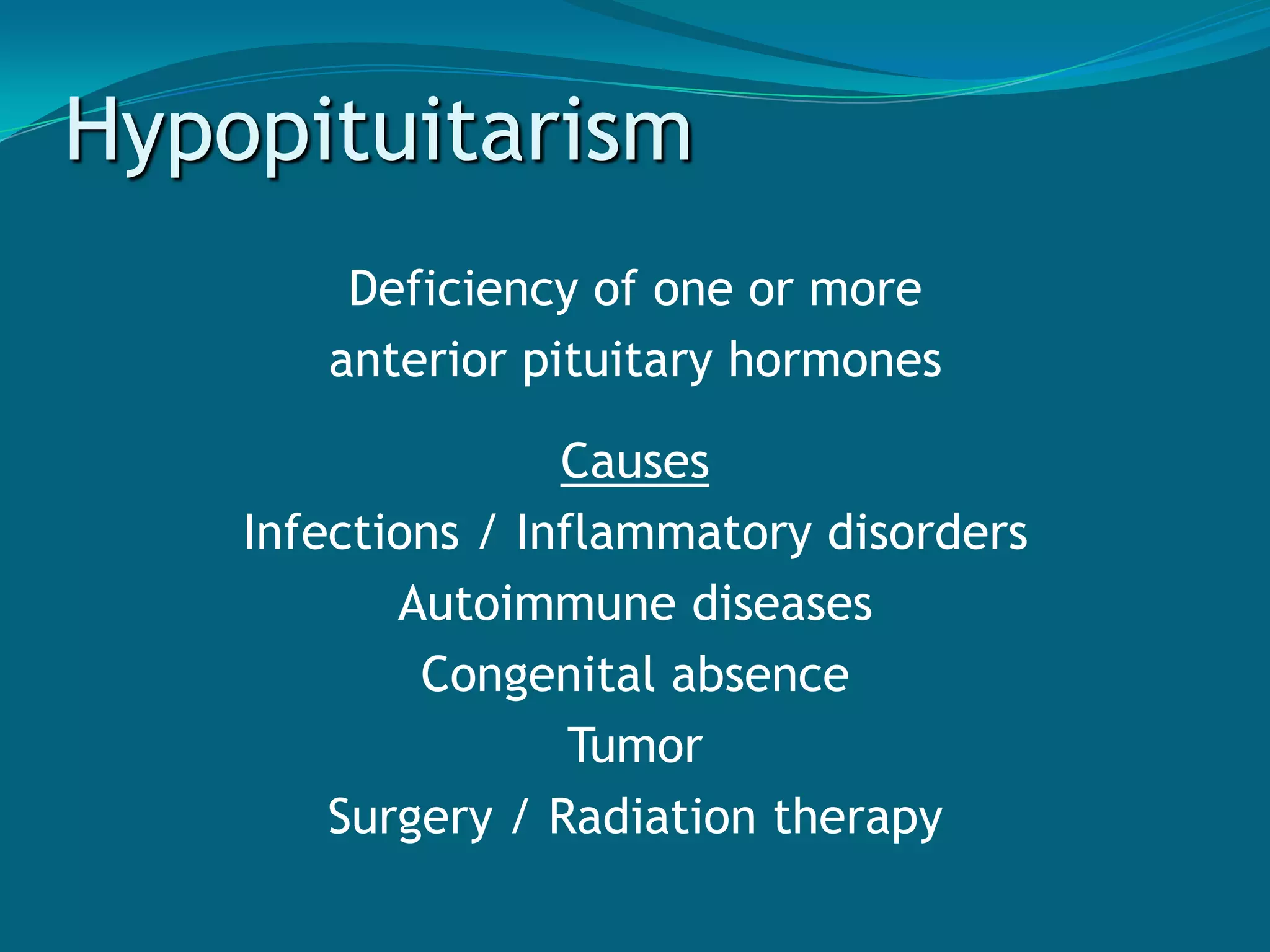
HypopituitarismDeficiency of one or moreanterior pituitary hormonesCausesInfections / Inflammatory disordersAutoimmune diseasesCongenital absenceTumorSurgery / Radiation therapy
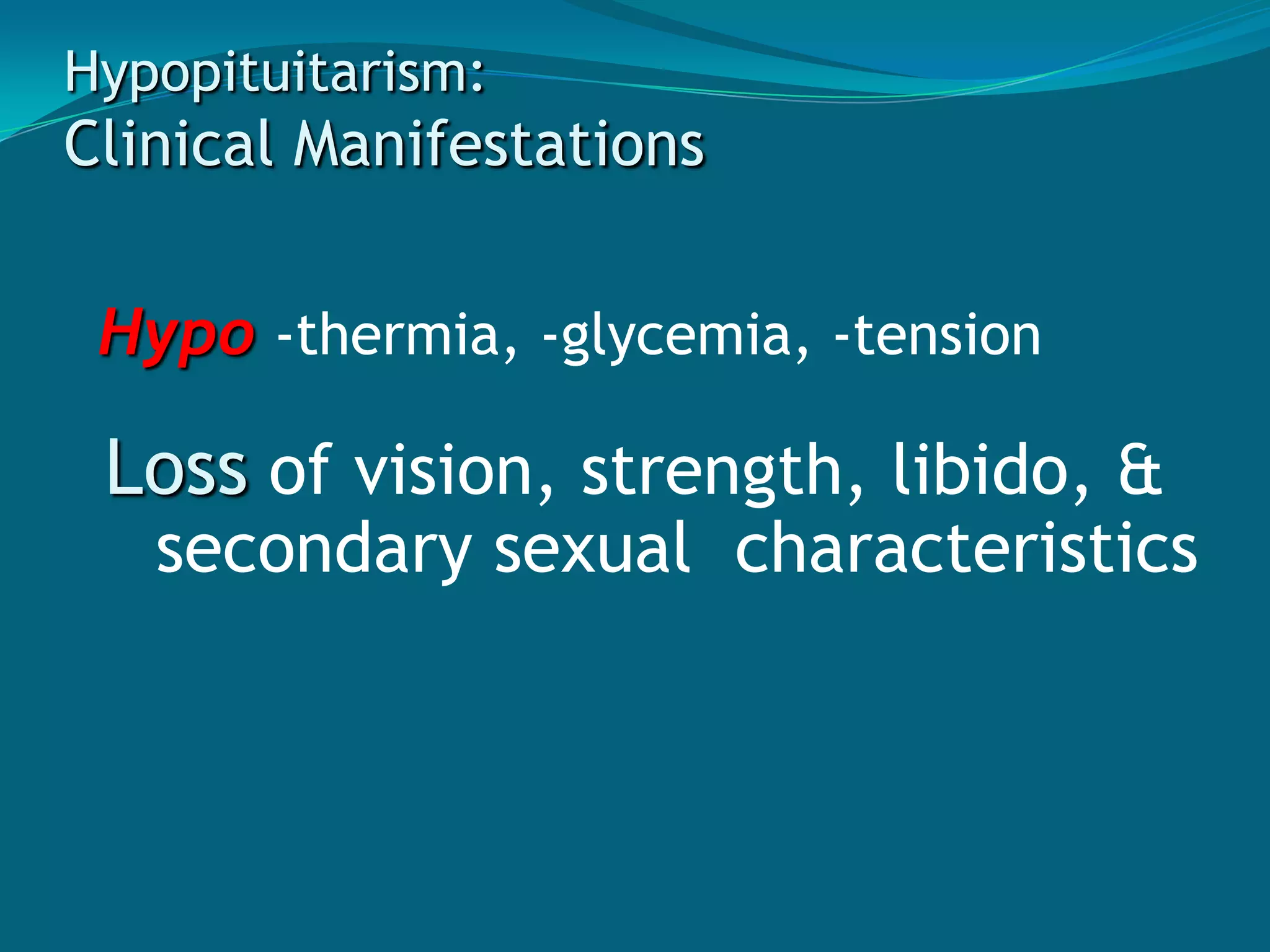
Hypopituitarism:Clinical ManifestationsHypo-thermia, -glycemia, -tensionLoss of vision, strength, libido, & secondary sexual  characteristics
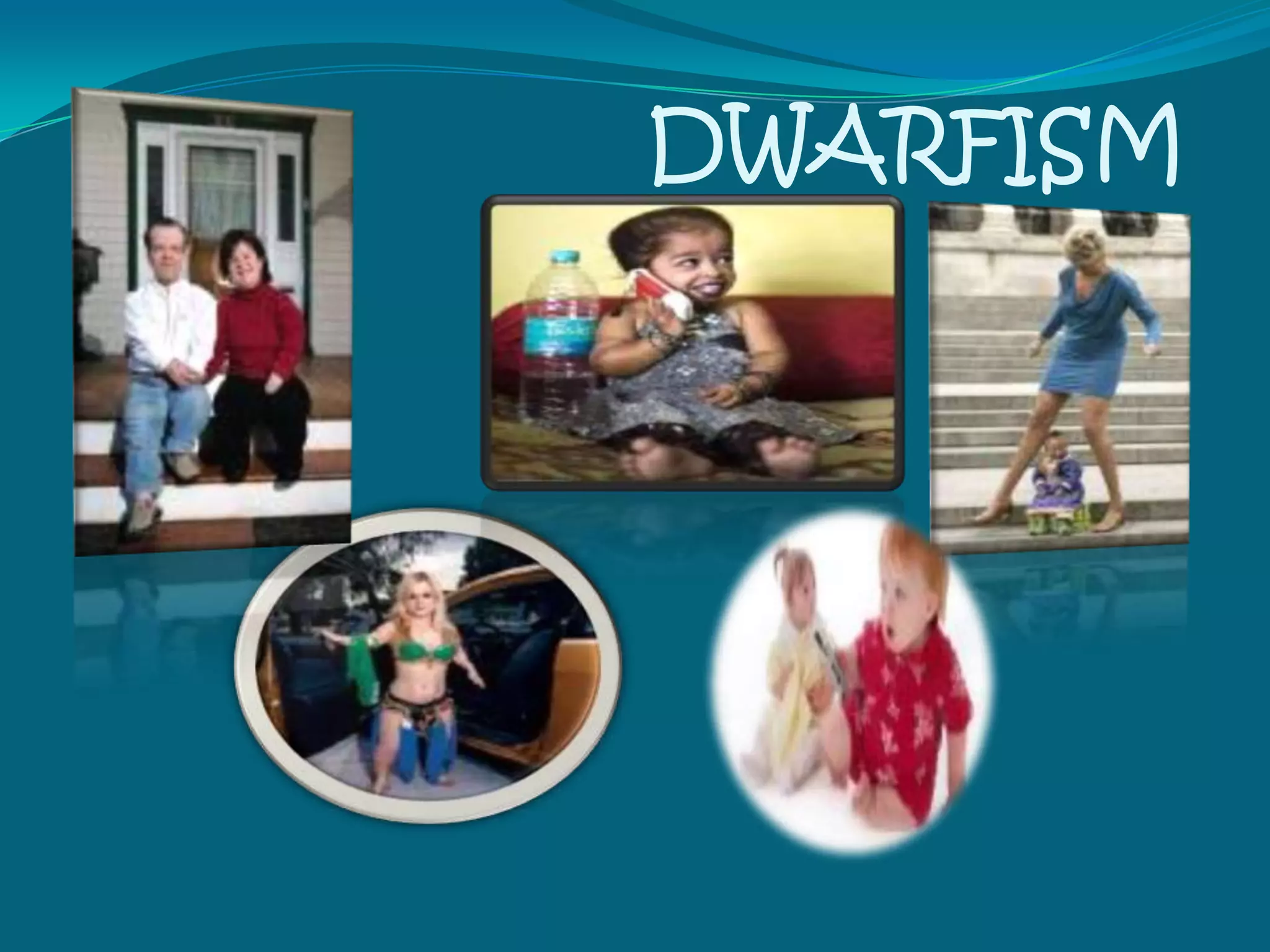
DWARFISM
MANAGEMENTHYPOPITUITARISMSURGICAL REMOVAL / IRRADIATIONREPLACEMENT THERAPYTHYROID HORMONESSTEROIDSSEX & GROWTH HORMONESGONADOTROPINS (restore fertility)HYPERPITUITARISMSURGICAL REMOVAL / IRRADIATIONMONITOR FOR HYPERGLYCEMIA & CARDIOVASCULAR PROBLEMS
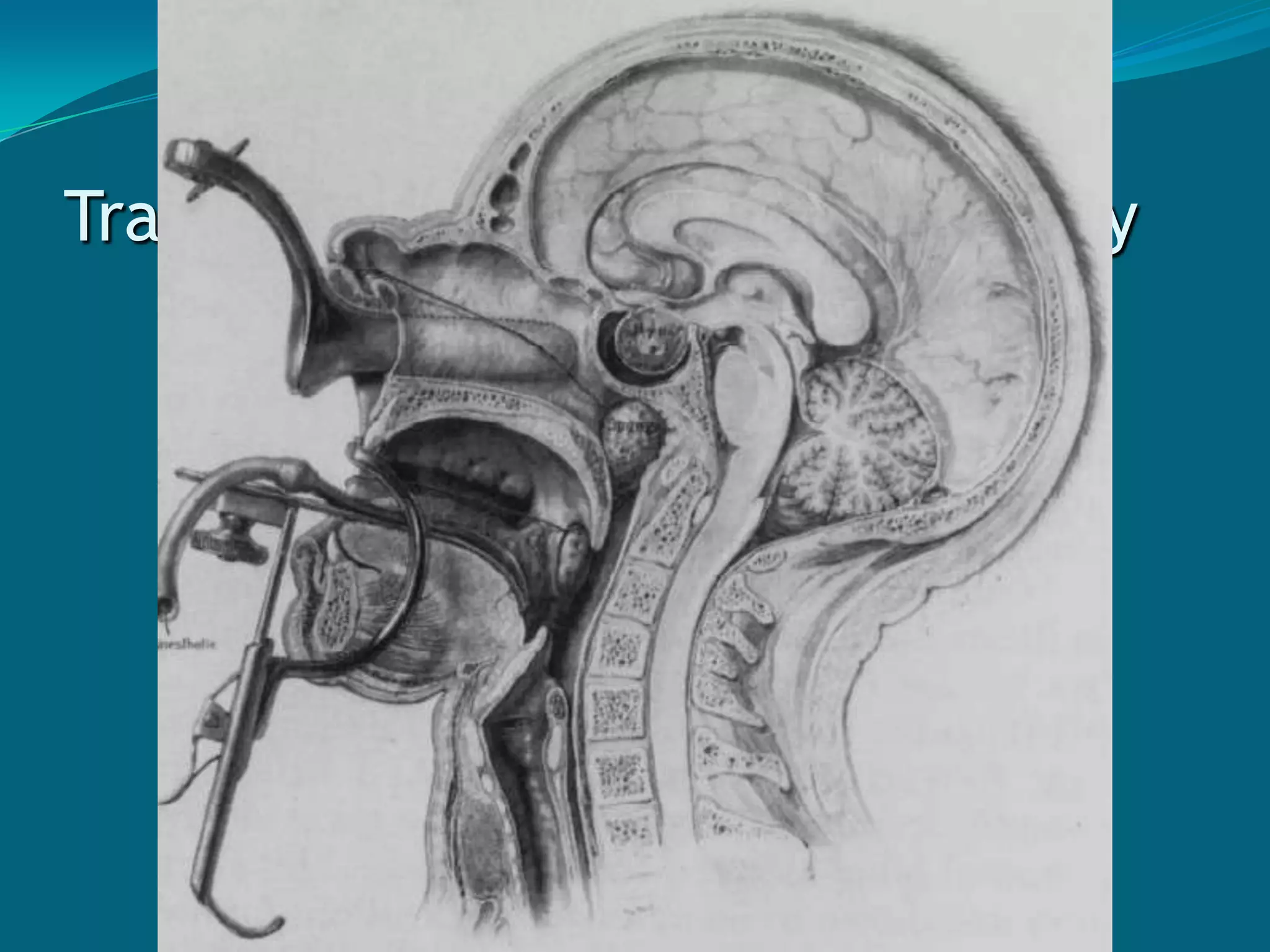
Trans-sphenoidal hypophysectomy
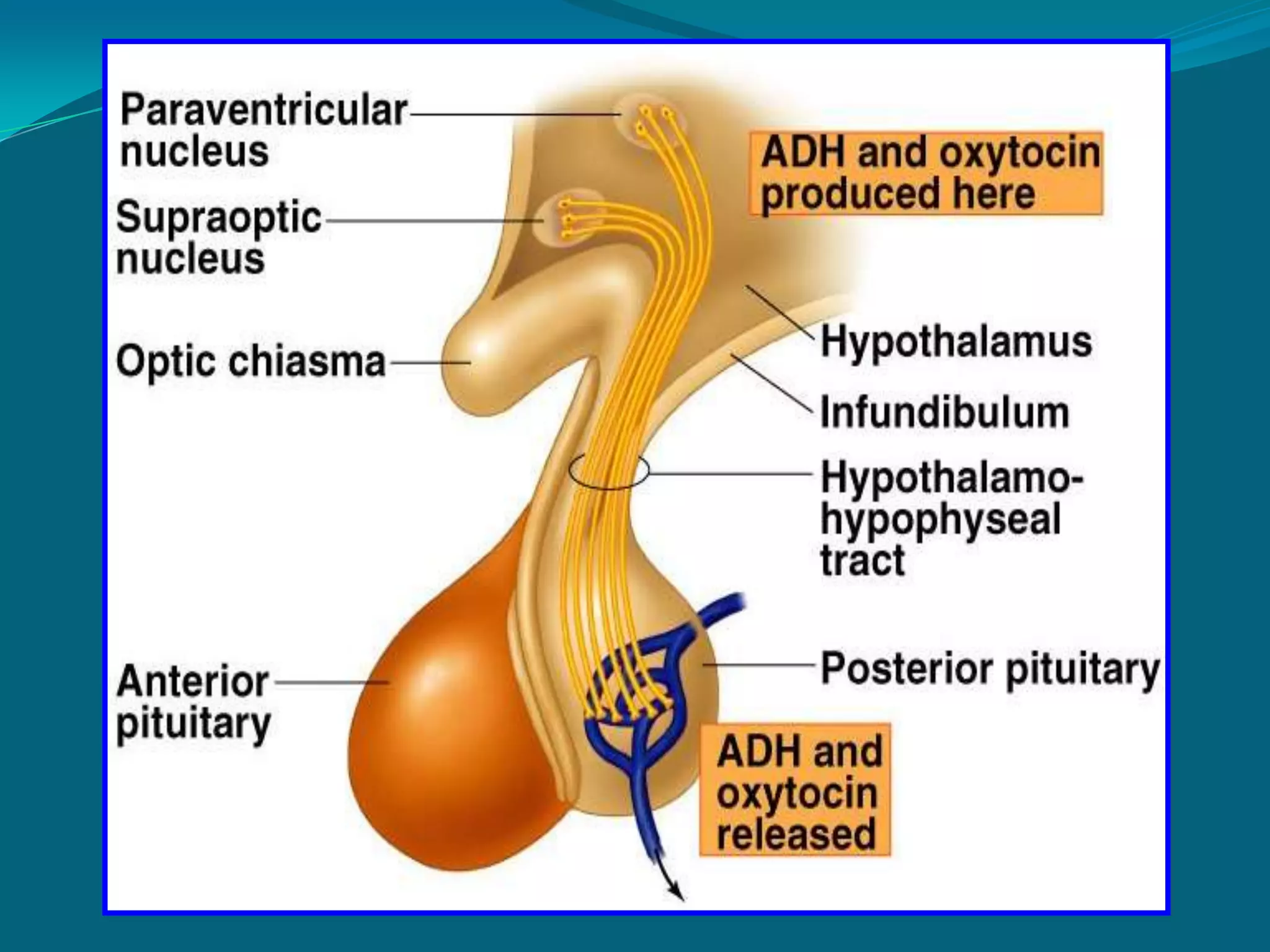
POSTERIOR PITUITARY DISTURBANCESDIABETES INSIPIDUSSYNDROME OF INAPPROPRIATE ANTIDIURETIC HORMONE
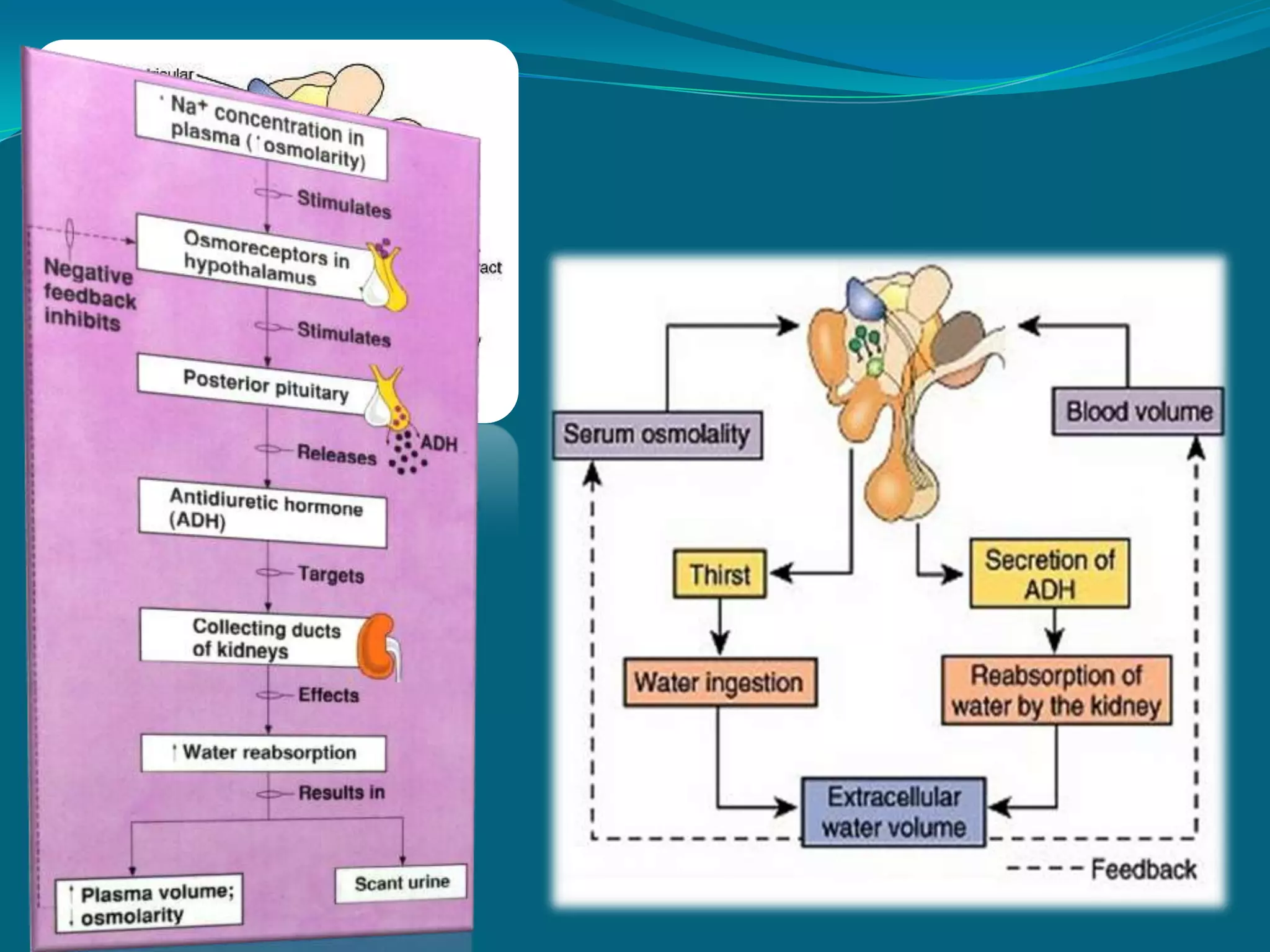
FUNCTION:WHEN  THERE IS A       OF SERUM OSMOLALITY, THE NORMAL BODY RESPONSE IS TO    THE SECRETION OF ADH.WHEN THE NORMAL FEEDBACK MECHANISM FOR ADH IS SUSTAINED, THERE IS EXCESSIVE WATER RETENTION IN THE BODYWHEN THERE IS     OR INADEQUATE AMOUNT OF ADH, THE BODY IS UNABLE TO CONCENTRATE URINE, & EXCESSIVE H2O LOSS OCCURS
DIABETES INSIPIDUSCHARACTERIZED BY A DEFICIENCY OF ADH. WHEN IT OCCURS, IT IS MOST OFTEN ASSOCIATED WITH :NEUROLOGICAL CONDITIONS, SURGERY, TUMORS, HEAD INJURY, OR INFLAMMATORY PROBLEMS
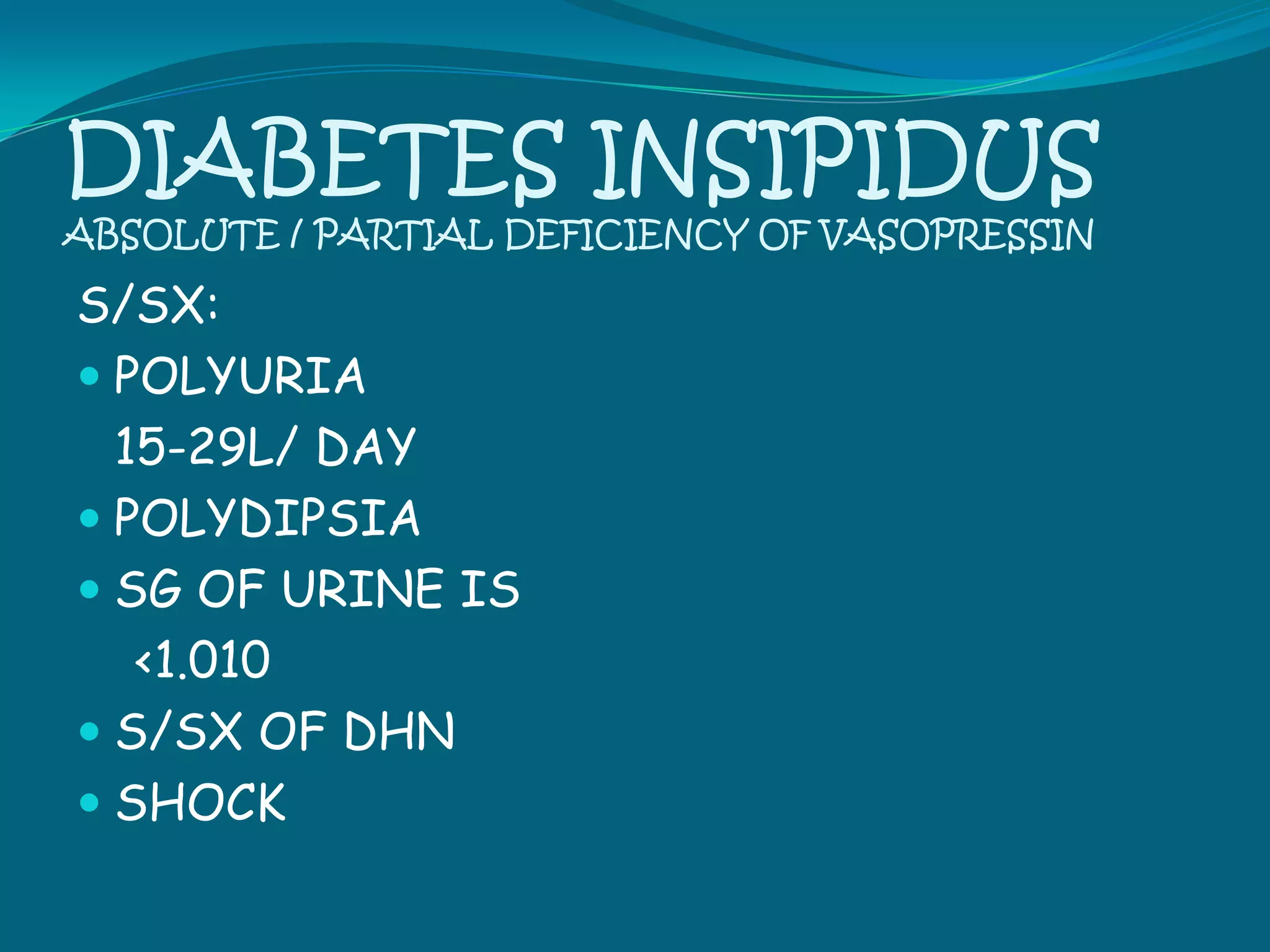
DIABETES INSIPIDUS ABSOLUTE / PARTIAL DEFICIENCY OF VASOPRESSINS/SX:POLYURIA 	15-29L/ DAYPOLYDIPSIASG OF URINE IS     <1.010S/SX OF DHNSHOCK
DIABETES INSIPIDUS ABSOLUTE / PARTIAL DEFICIENCY OF VASOPRESSINMANAGEMENTHORMONAL REPLACEMENT – FOR LIFEVASOPRESSIN (PITRESSIN TANNATE IN OIL) – IM OR NASAL SPRAYNON-HORMONAL THERAPYCHLORPROPRAMIDE – INCREASE RESPONSE OF THE BODY TO DECREASEDVASOPRESSININCREASE FLUIDSMONITOR I&O + WEIGHT (MIOW)MAINTAIN FLUID & ELECTROLYTE BALANCE
SYNDROME OF INAPPROPRIATE ADH(SIADH)ELEVATED ADHS/SX:DECREASED SERUM SODIUMCX IN LOC TO UNCONSCIOUSNESSSEIZURESWATER INTOXICATIONN/VMENTAL CONFUSIONPersistent excretion of concentrated urineSigns of fluid overloadHyponatremia
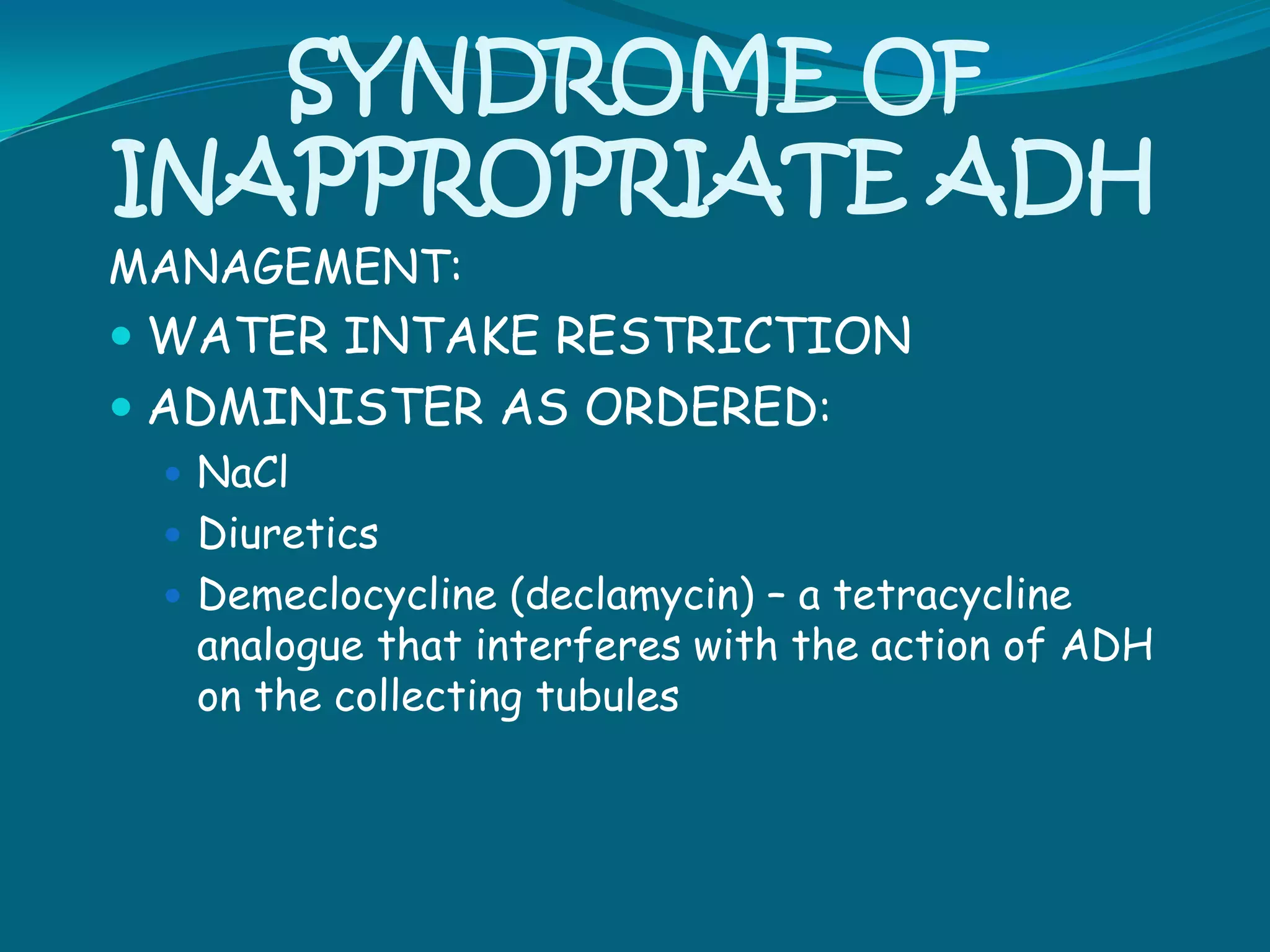
SYNDROME OF INAPPROPRIATE ADHMANAGEMENT:WATER INTAKE RESTRICTIONADMINISTER AS ORDERED:NaClDiureticsDemeclocycline (declamycin) – a tetracycline analogue that interferes with the action of ADH on the collecting tubules
THYROID DISORDERS
Hypothyroidism underactive state of the thyroid gland hyposecretion 		of thyroid hormone most common in women, middle-age primary function is to control the level of cellular 	metabolism 	by secreting thyroxin (T4) and 	triiodothyronine (T3)DX:  decreased T3, T4        Elevated TSH, cholesterol
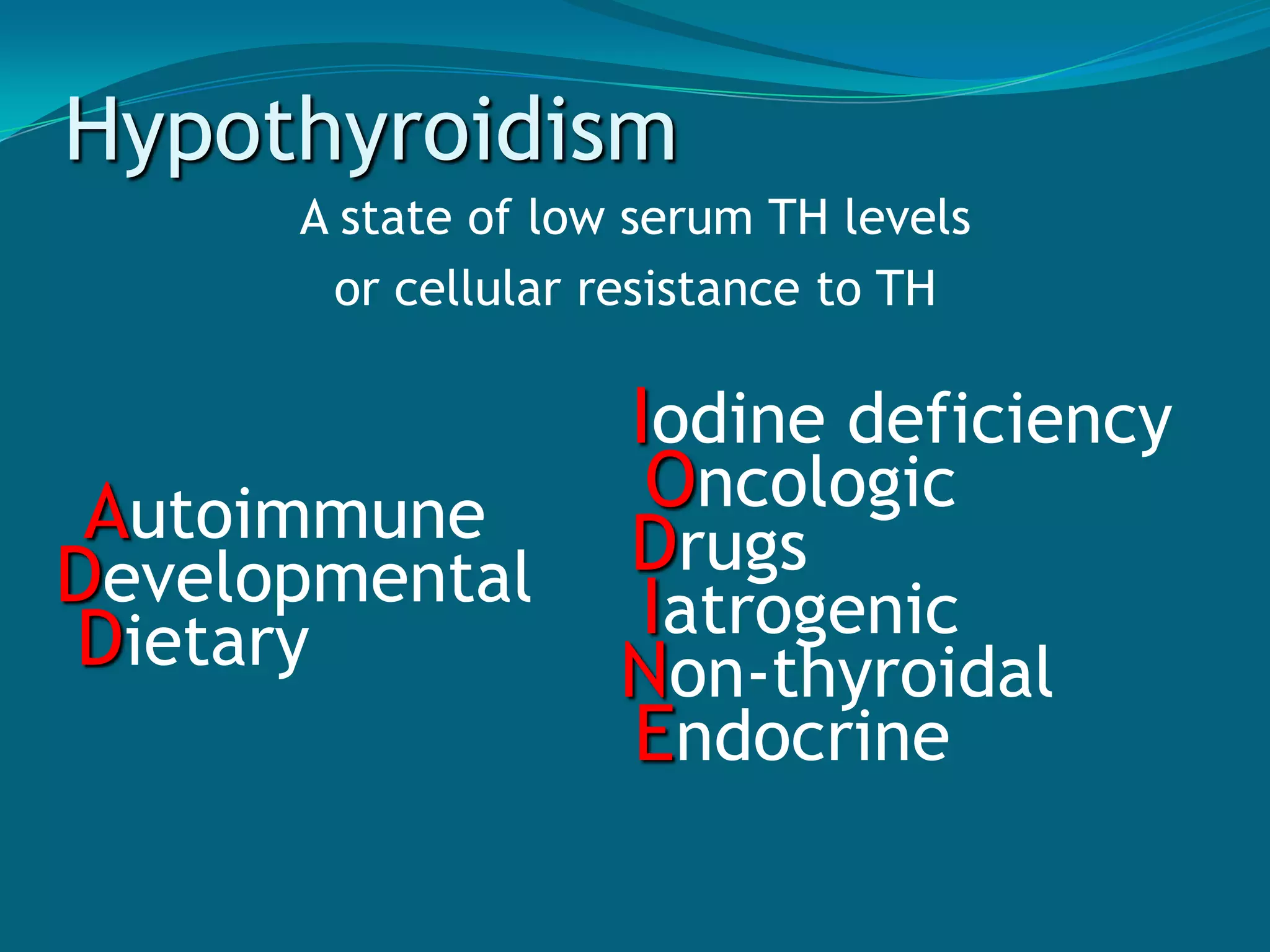
HypothyroidismA state of low serum TH levelsor cellular resistance to THIodine deficiencyOncologicAutoimmuneDrugsDevelopmentalIatrogenicDietaryNon-thyroidalEndocrine
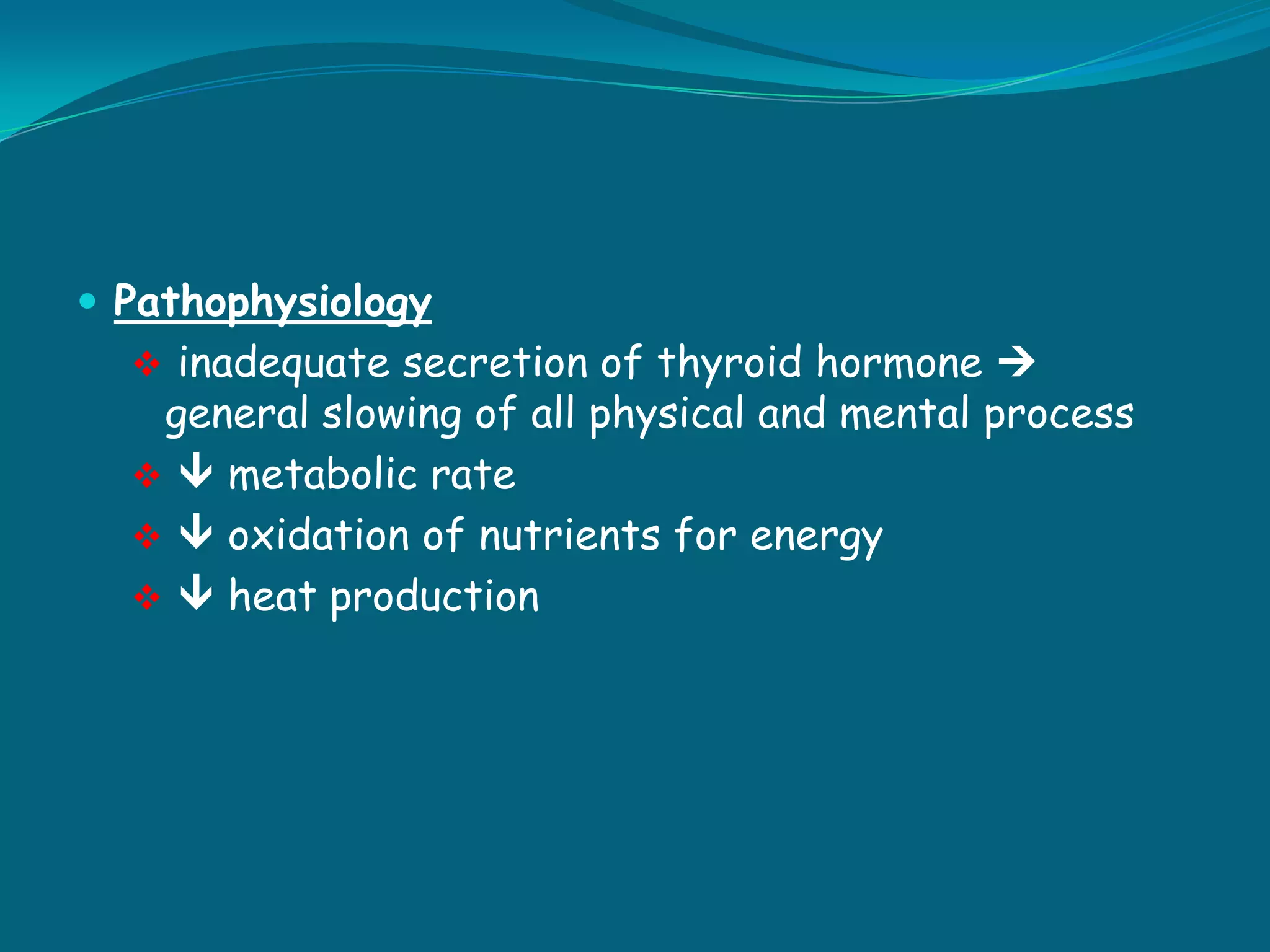
Pathophysiology inadequate secretion of thyroid hormone  general slowing of all physical and mental process
  metabolic rate
  oxidation of nutrients for energy
  heat production
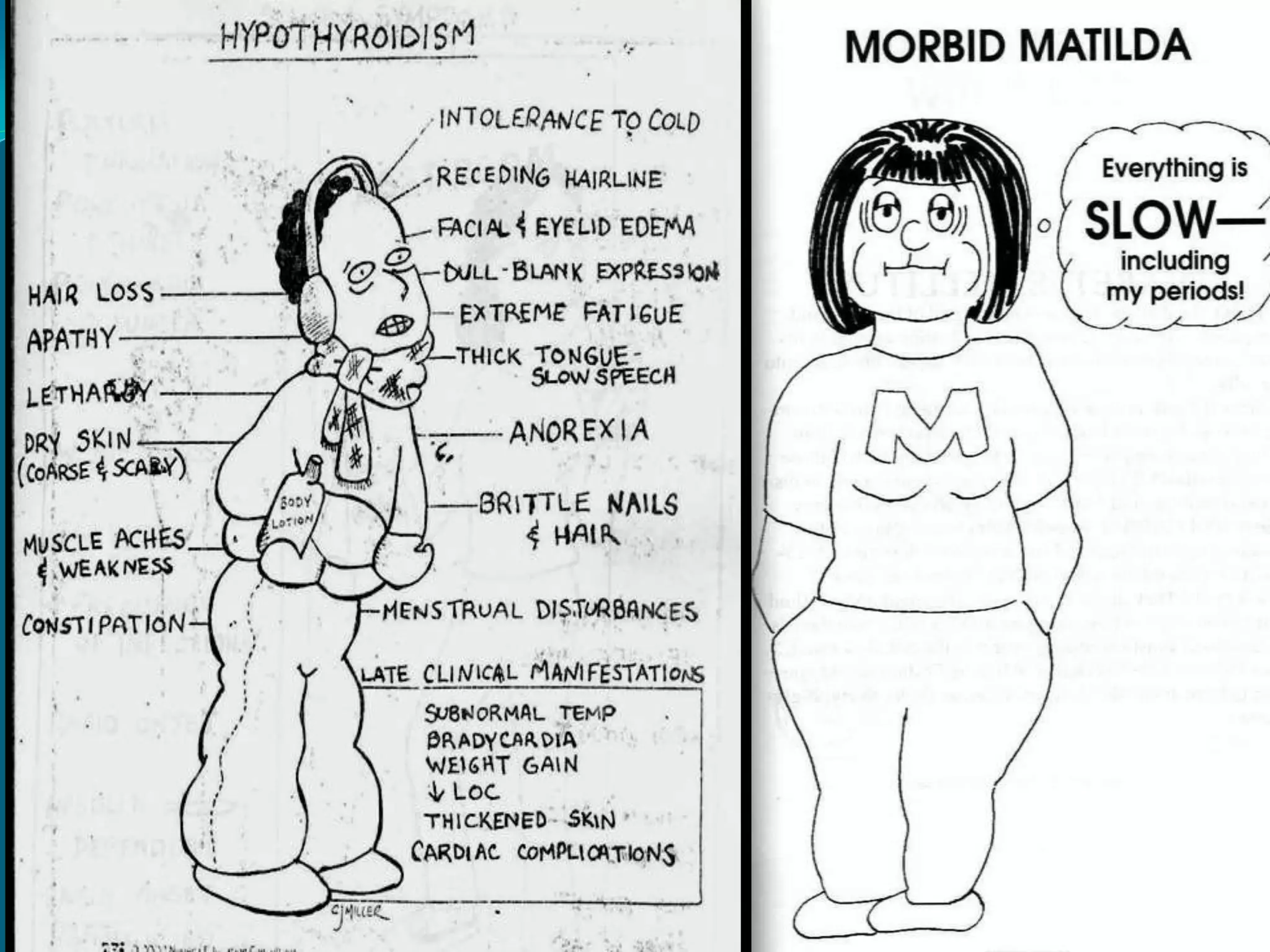
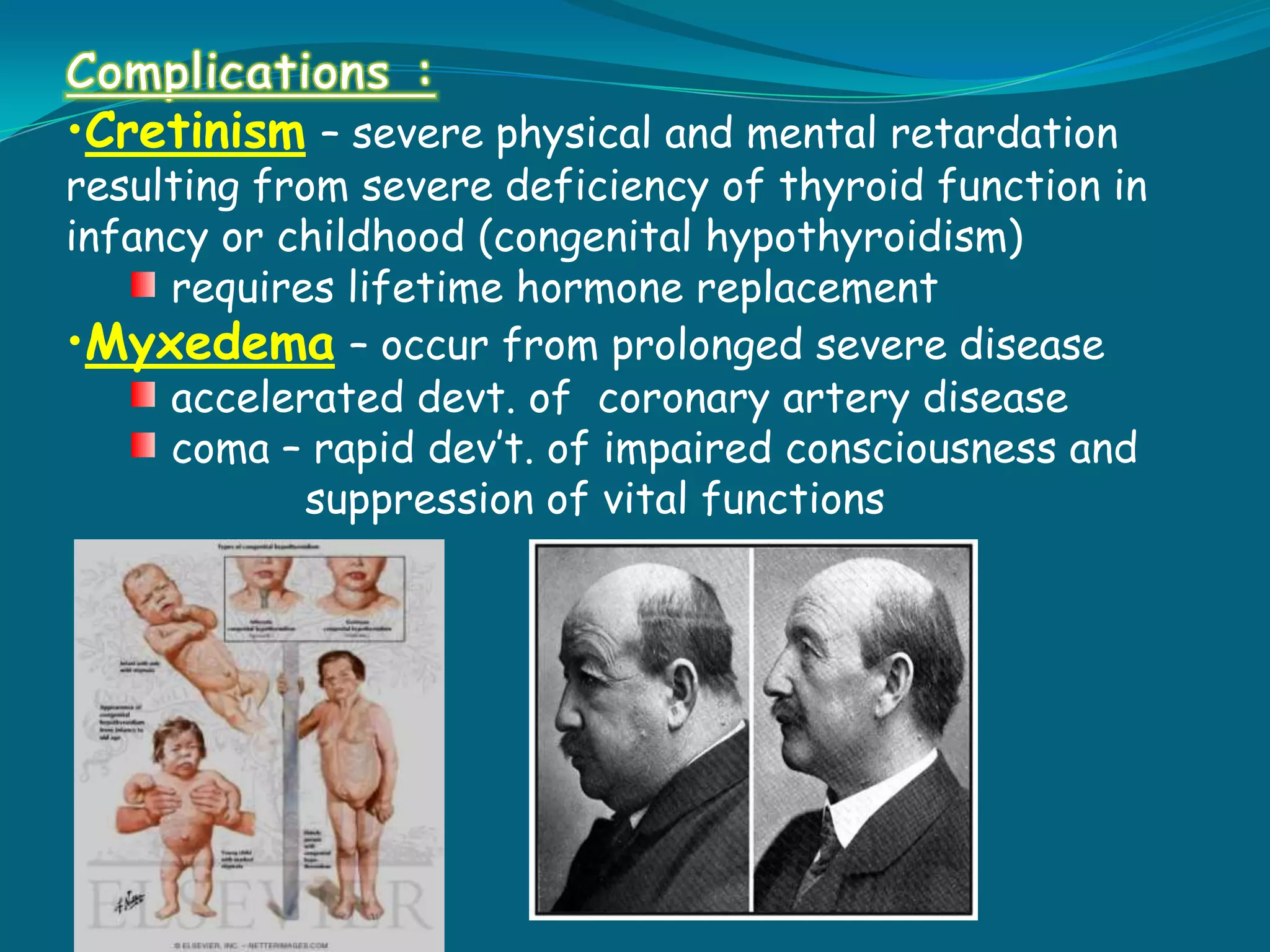
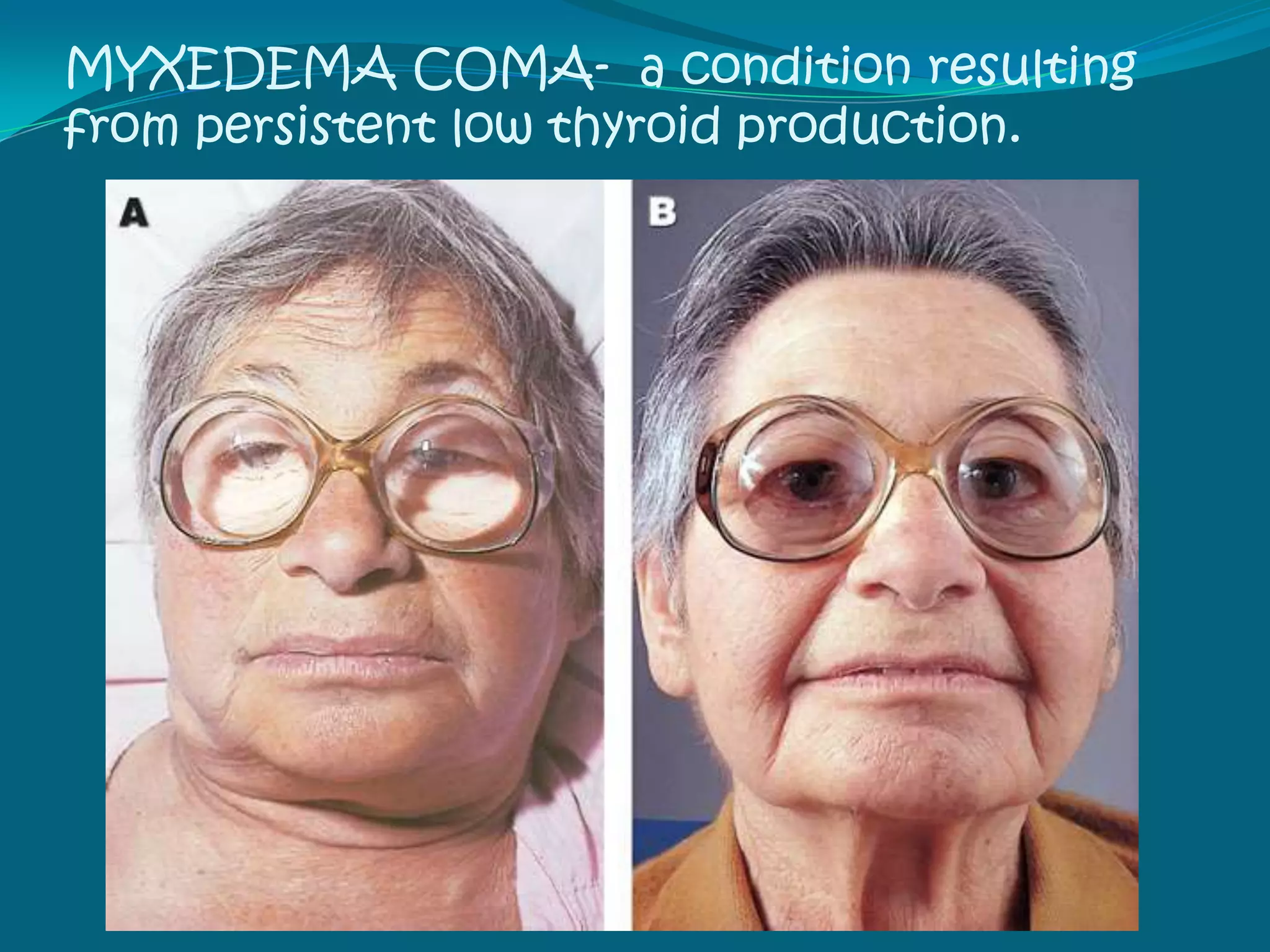
Complications :Cretinism– severe physical and mental retardation resulting from severe deficiency of thyroid function in infancy or childhood (congenital hypothyroidism) requires lifetime hormone replacementMyxedema– occur from prolonged severe disease accelerated devt. of  coronary artery disease coma – rapid dev’t. of impaired consciousness and              suppression of vital functions
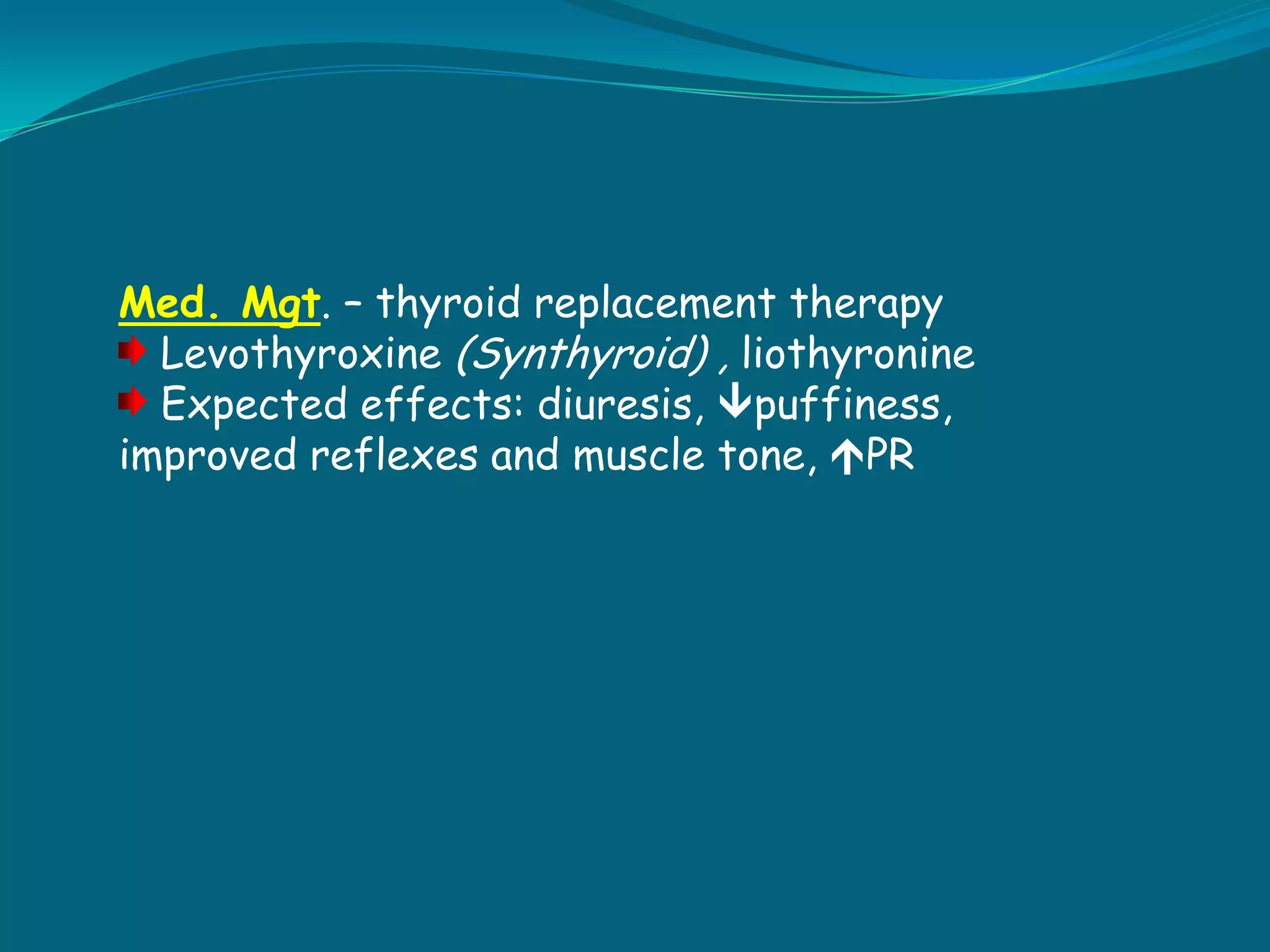
MYXEDEMA COMA-  a condition resulting from persistent low thyroid production.
Med. Mgt. – thyroid replacement therapyLevothyroxine(Synthyroid) ,liothyronine Expected effects: diuresis, puffiness, improved reflexes and muscle tone, PR
Nsg. Interventions  provide a warm environment, conducive to rest
  avoid use of all sedatives
  assist client in choosing calorie,  cholesterol 	diet
   fluid and fiber to relieve constipation
   physical activity and sensory stimulation 	gradually as condition improves
  monitor cardiovascular response to increased 	hormone levels carefully
  provide info. about prescribed medications (name, 	dosage, side effects) and importance of lifelong 	medical supervision
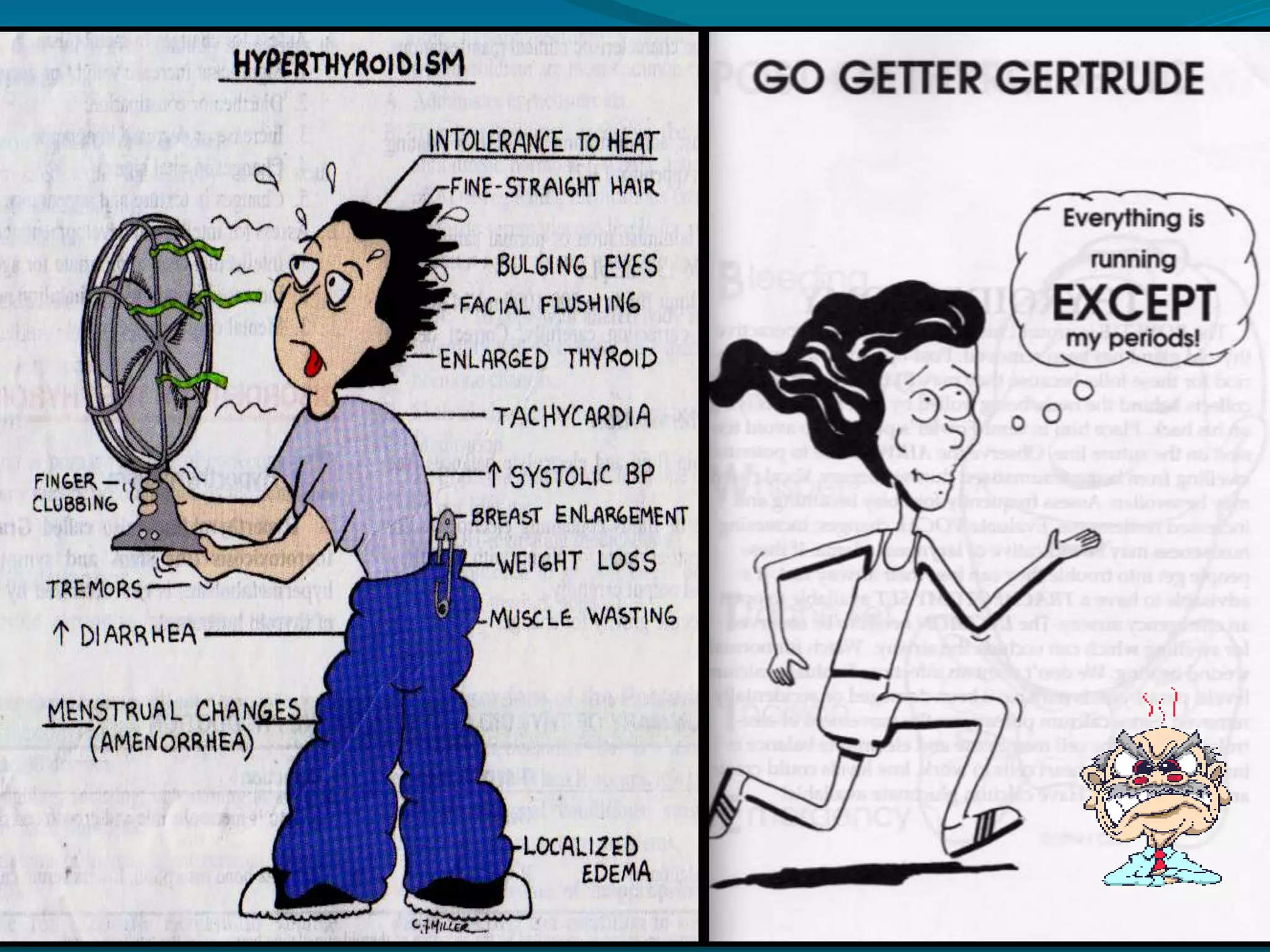
Hyperthyroidism over-secretion of the thyroid gland also called thyrotoxicosis  or graves disease, tissues 	are stimulated by excessive thyroid hormone  a recurrent syndrome, may appear after emotional   stress or infection occurs mostly in women 20-50 yrs oldCauses : adenoma, goiter,  viral inflammation, auto-immune glandular stimulation, grave’s disease  - most common cause
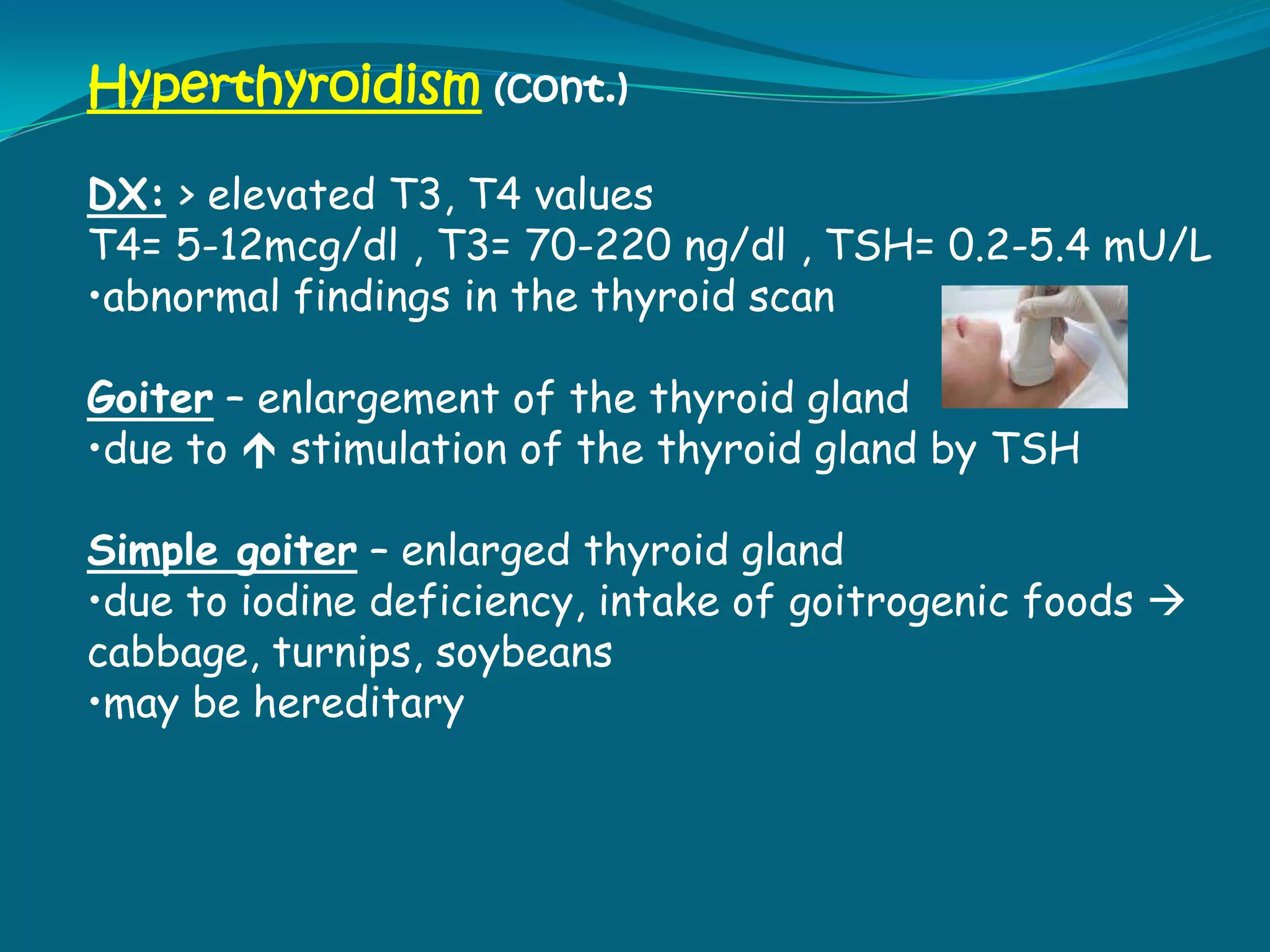
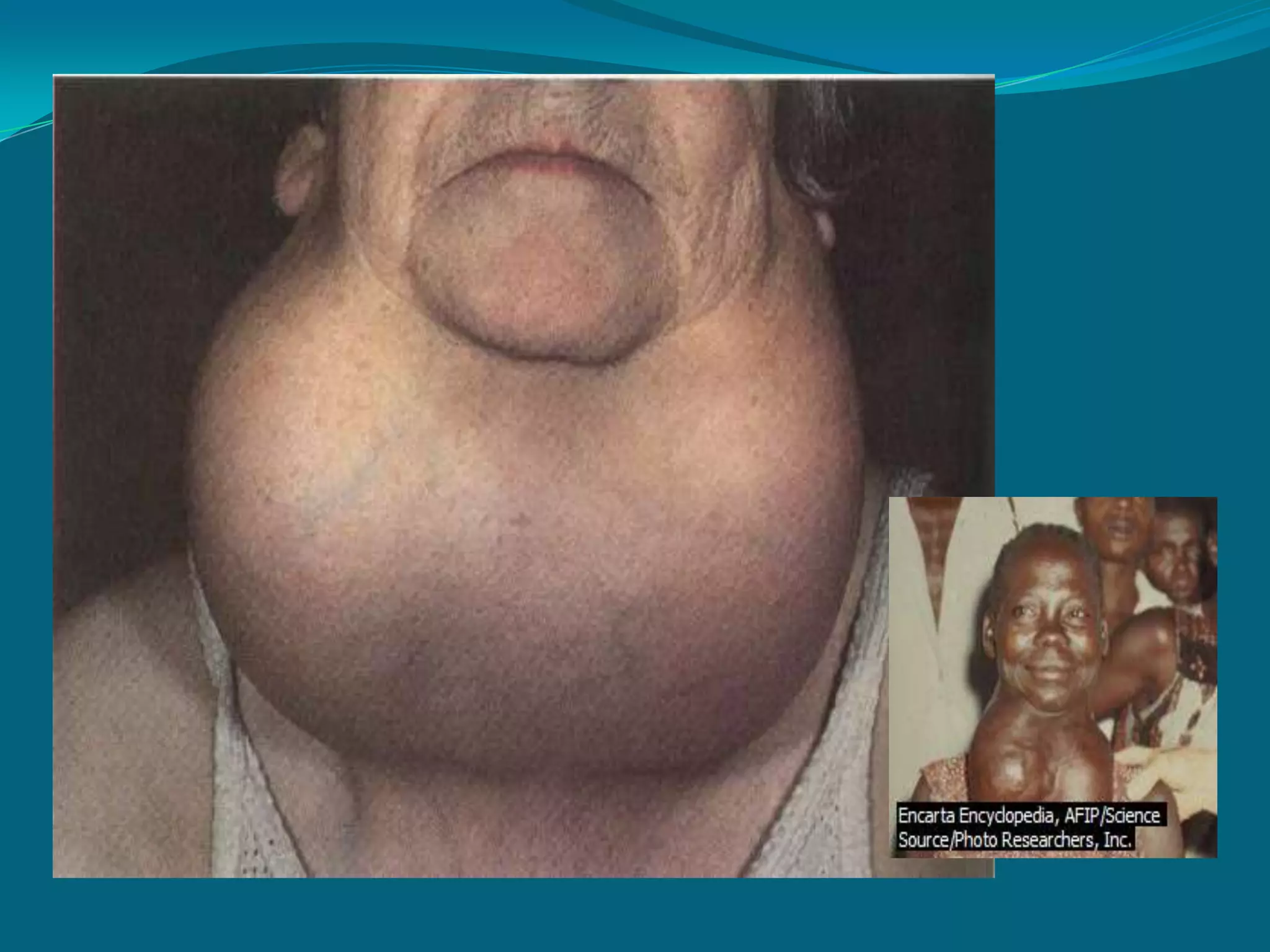
Hyperthyroidism (cont.)DX: > elevated T3, T4 valuesT4= 5-12mcg/dl , T3= 70-220 ng/dl , TSH= 0.2-5.4 mU/Labnormal findings in the thyroid scanGoiter – enlargement of the thyroid gland due to  stimulation of the thyroid gland by TSHSimple goiter – enlarged thyroid glanddue to iodine deficiency, intake of goitrogenic foods  cabbage, turnips, soybeans
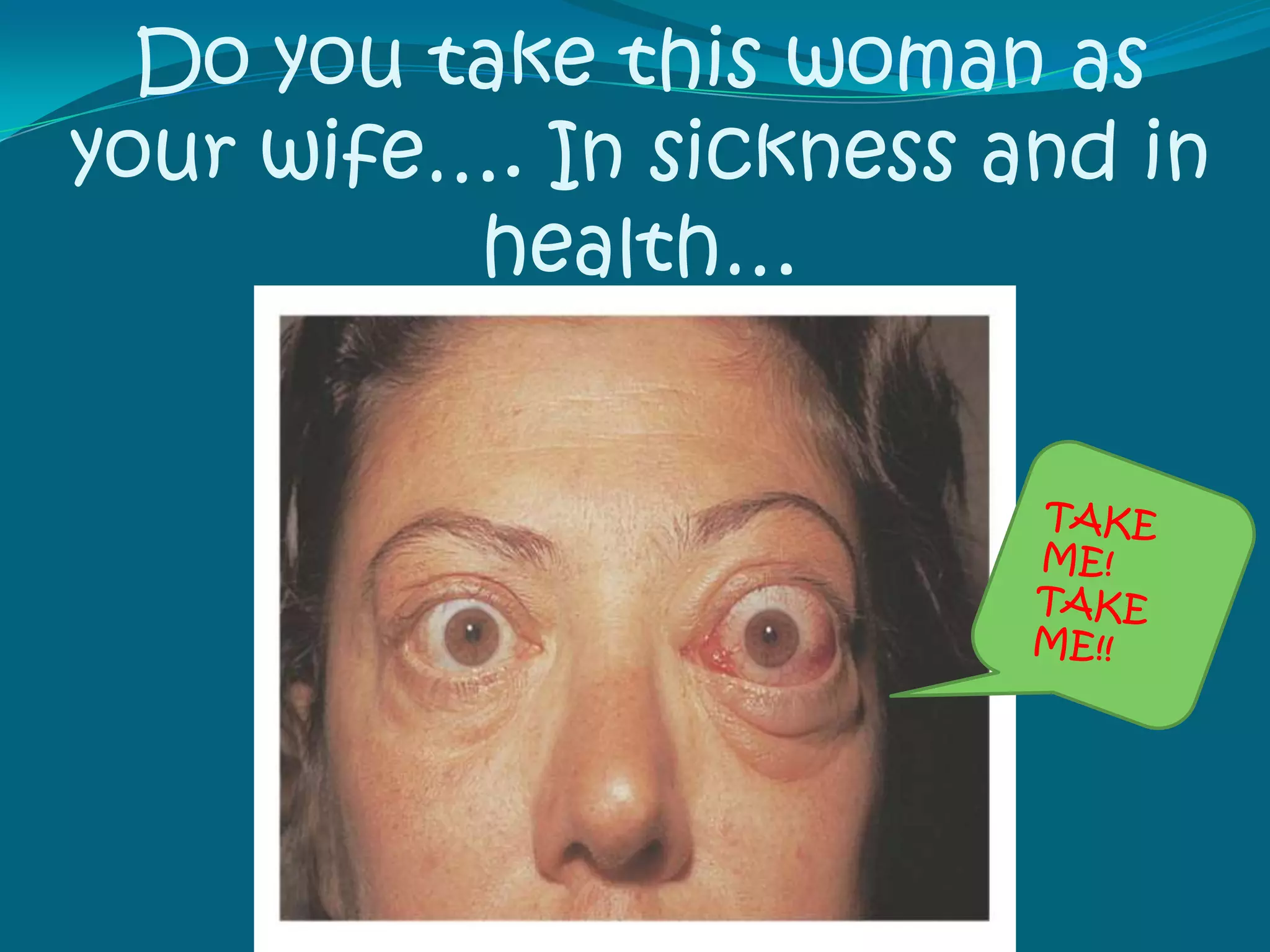
may be hereditaryGrave’s Disease disorder char. by one or more of the ff: diffuse goiter hyperthyroidism infiltrative opthalmopathy  exophthalmos seen in females under age 40
 result from stimulation of the thyroid gland by    thyroid-stimulating immunoglobulins (TSI) cause is unknown, may be hereditary, gender-related,    often occurs after severe emotional stress or    infection
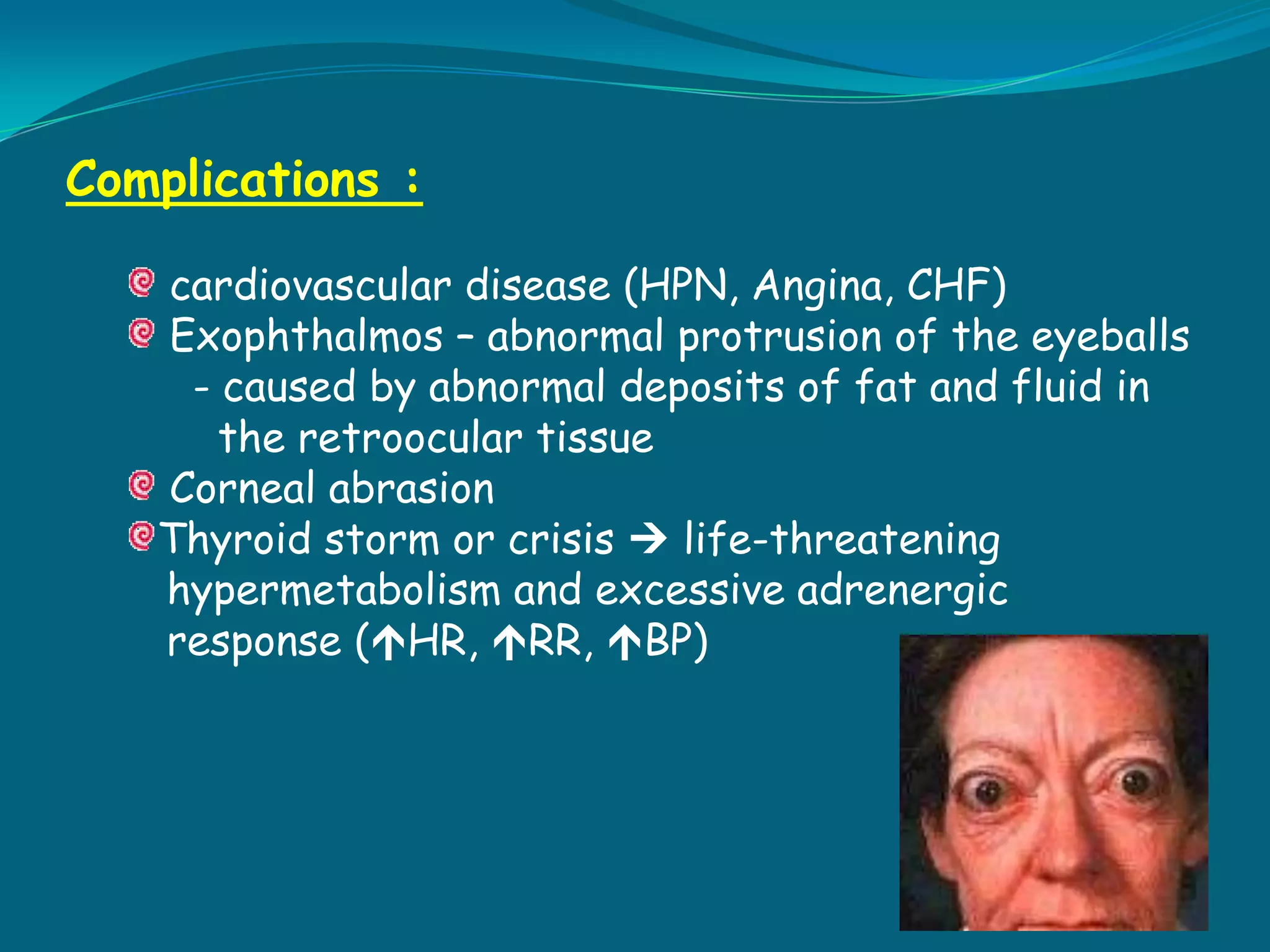
Complications : cardiovascular disease (HPN, Angina, CHF) Exophthalmos – abnormal protrusion of the eyeballs caused by abnormal deposits of fat and fluid in   the retroocular tissue Corneal abrasion Thyroid storm or crisis  life-threatening    hypermetabolism and excessive adrenergic   response (HR, RR, BP)
Thyroid Storm or Crisis a medical emergency pts. develop severe    manifestation of hyperthyroidism   temp., tachycardia, dysrhythmias worsening tremors, restlessness delirious or psychotic state or coma abdominal pain  BP and RRPrecipitated by a major stressor:  infection trauma or surgery (thyroidectomy) inadequate treatment
Do you take this woman as your wife…. In sickness and in health…TAKE ME! TAKE ME!!
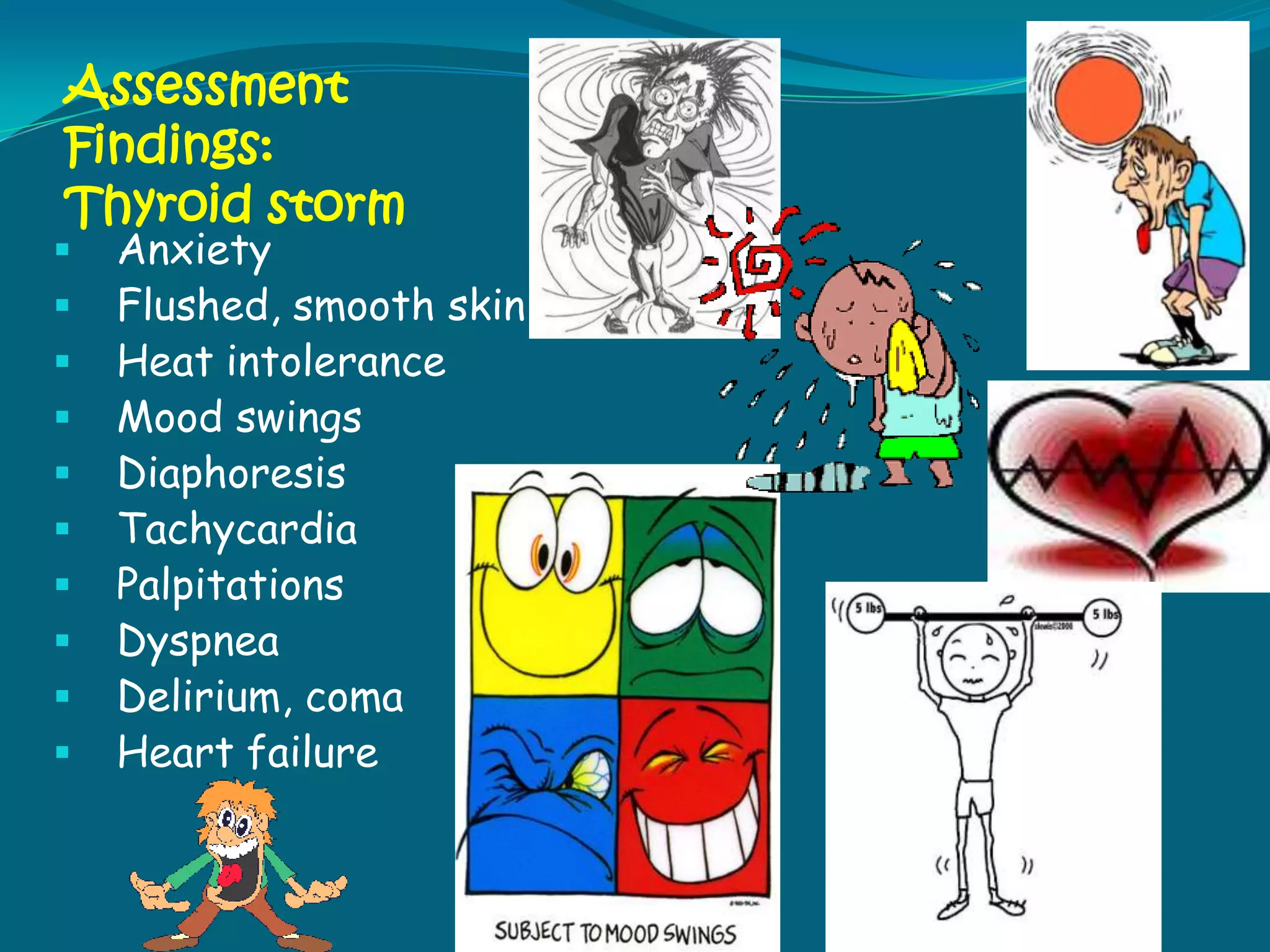
Assessment Findings: Thyroid stormAnxiety
Flushed, smooth skin
Heat intolerance
Mood swings
Diaphoresis
Tachycardia
Palpitations
Dyspnea
Delirium, coma
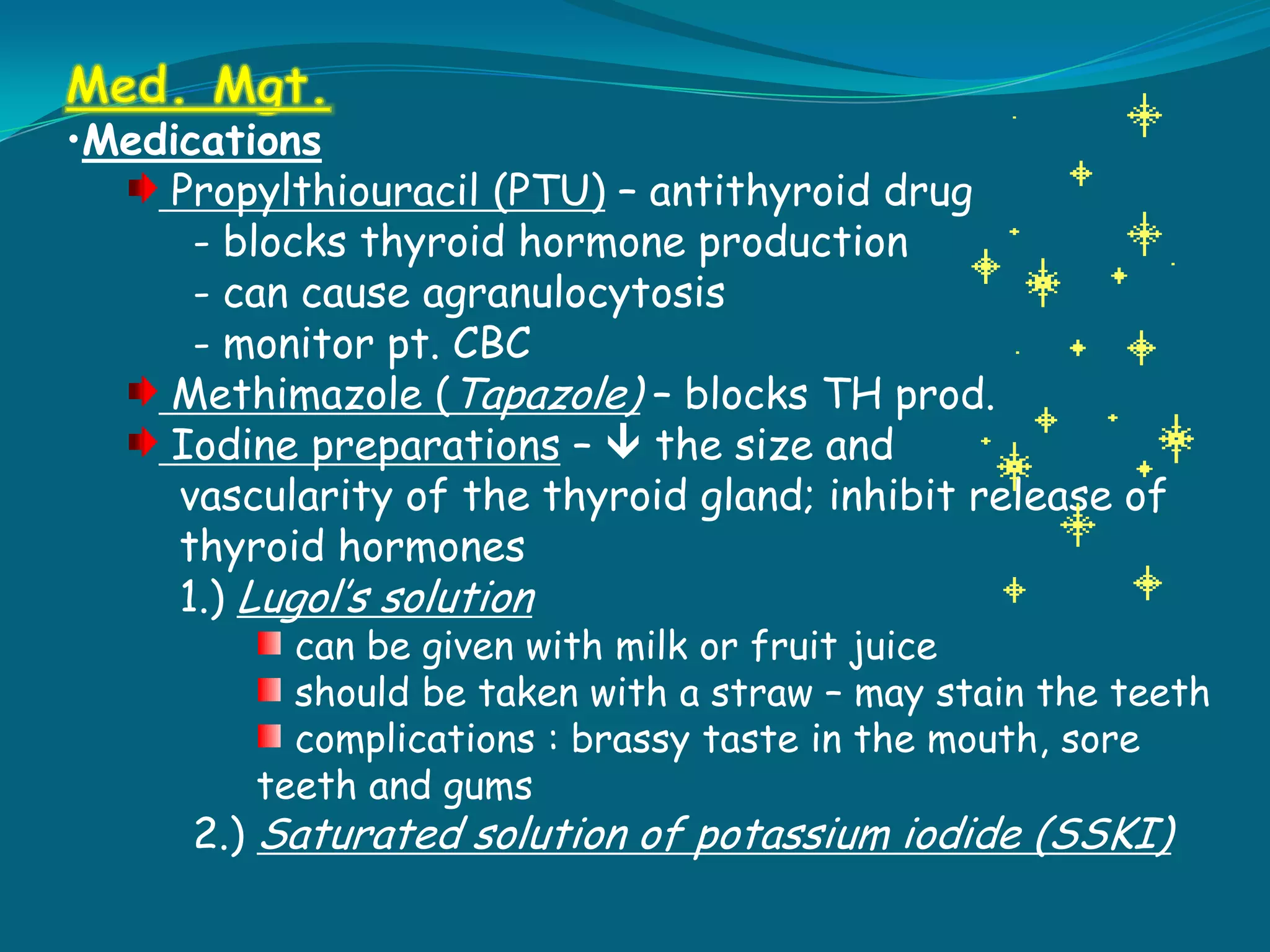
Heart failureMed. Mgt.Medications Propylthiouracil (PTU) – antithyroid drug 	- blocks thyroid hormone production	- can cause agranulocytosis	- monitor pt. CBCMethimazole (Tapazole) – blocks TH prod. Iodine preparations –  the size and vascularity of the thyroid gland; inhibit release of    thyroid hormones    1.) Lugol’s solution can be given with milk or fruit juice should be taken with a straw – may stain the teeth complications : brassy taste in the mouth, sore teeth and gums2.) Saturated solution of potassium iodide (SSKI)
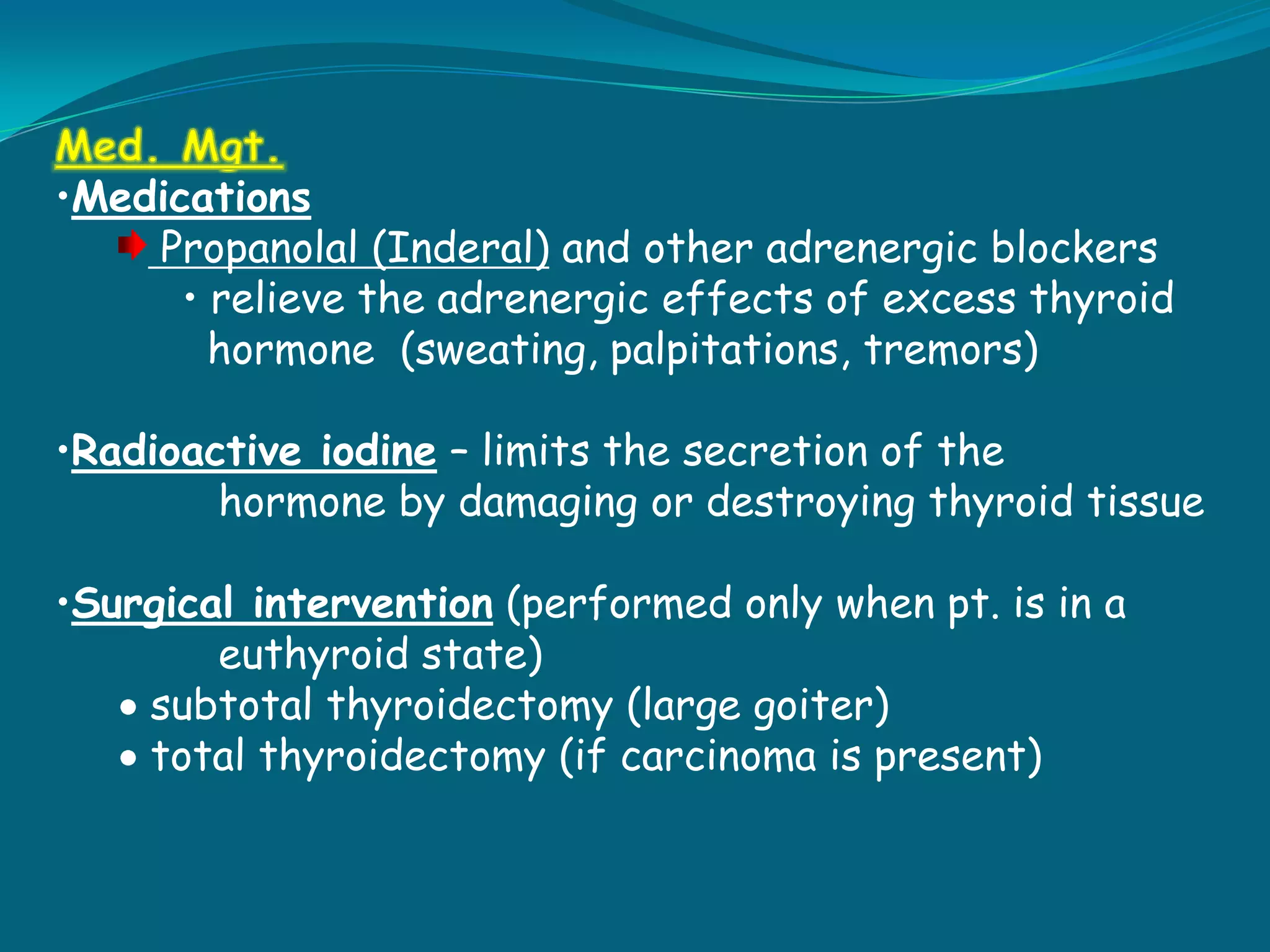
Med. Mgt.Medications Propanolal (Inderal) and other adrenergic blockers relieve the adrenergic effects of excess thyroid  hormone  (sweating, palpitations, tremors)Radioactive iodine – limits the secretion of the             hormone by damaging or destroying thyroid tissueSurgical intervention (performed only when pt. is in aeuthyroid state) subtotal thyroidectomy (large goiter)
 total thyroidectomy (if carcinoma is present)Nsg. Interventions:Provide calm, restful envt. physical comfort, cool envt. temp., bathe frequently w/ cool waterprovide adequate rest, avoid muscle fatigue stressors in the envt.— noise and lightsrelaxation techniquesProvide adequate nutrients calorie,  protein, balanced diet (4,000-5,000 cal/day) fluid intakeRestrict stimulants (tea, coffee, alcohol)small, frequent feedings if hypermotility is presentDaily wt.
Nsg. Interventions:Provide emotional supportProvide eye careeye drops, dark glasses, patch eyes if necessaryelevate head of bed for sleeprestrict dietary sodiumassess adequacy of lid closureBe alert for complications
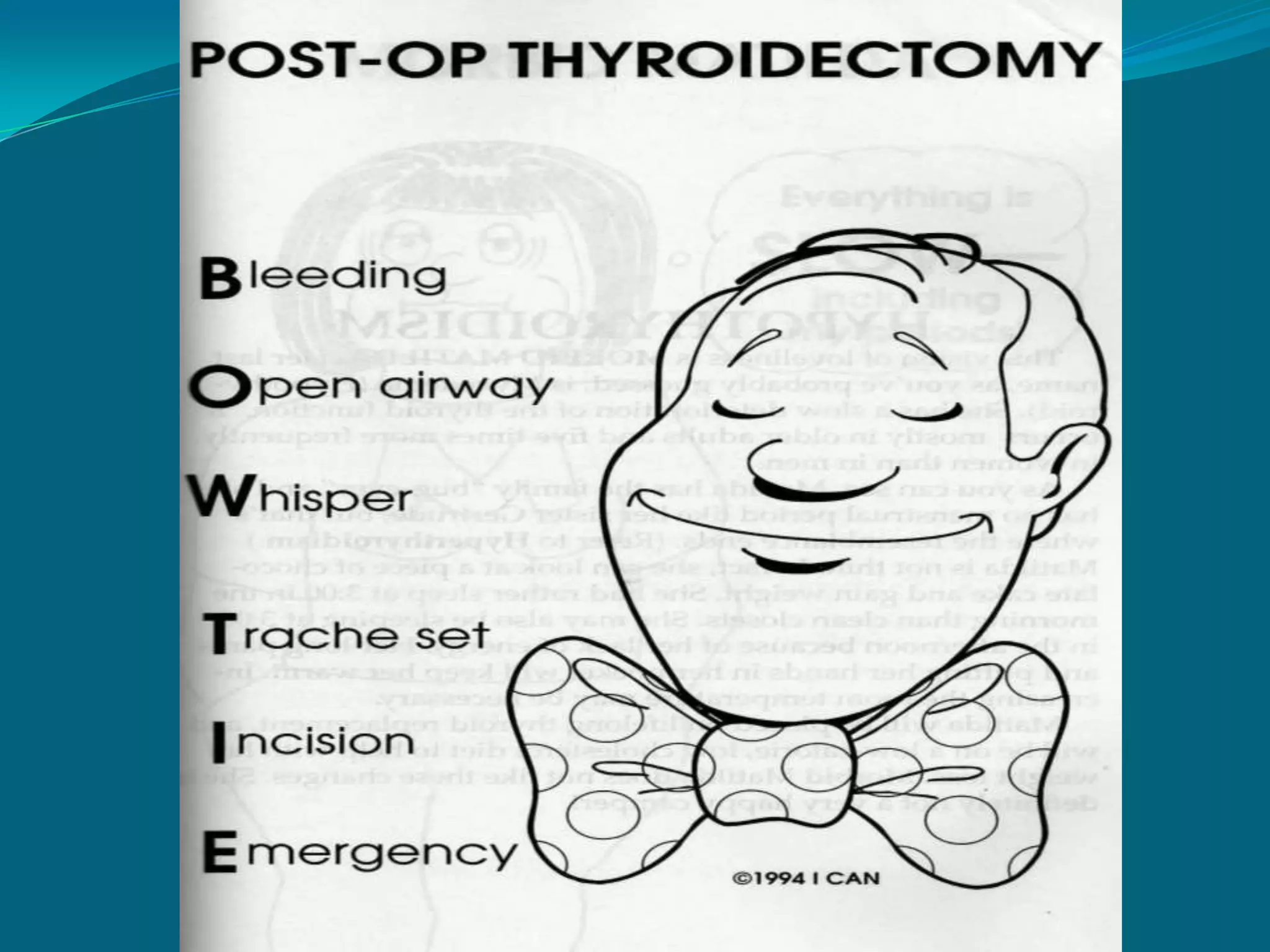
Post-op care after Thyroidectomy O2 therapy, suction secretions
 Monitor for signs of bleeding and excessive edema
 elevate head of bed 30o, support head and neck – to    avoid tension on suturescheck dressing frequently, check behind the neck for    bleeding assess for signs of resp. distress, hoarseness    (laryngeal edema or damage) keep tracheostomy set in patient’s room for emergency    use
Post-op Complications: be alert for the possibility of:1. Tetany(due to hypocalcemia caused by accidental removal of parathyroid glands)assess for numbness, tingling or muscle twitching
 Chvostek’s sign and Trousseau’s sign
 Ca+ gluconate IV2. HemorrhageWOF: hypotension, tachycardia, other signs of hypovolemia
WOF: irregular breathing, swelling, choking---possible hemorrhage and tracheal compression
WOF: early signs of hemorrhage: repeated clearing of the throat, difficulty swallowingPost-op Complications: be alert for the possibility of:3. Thyroid storm 		- life-threatening		- sudden  release of thyroid hormone		- fever, tachycardia, increasing restlessness and             agitation, delirium
PARATHYROID GLAND DISORDERS
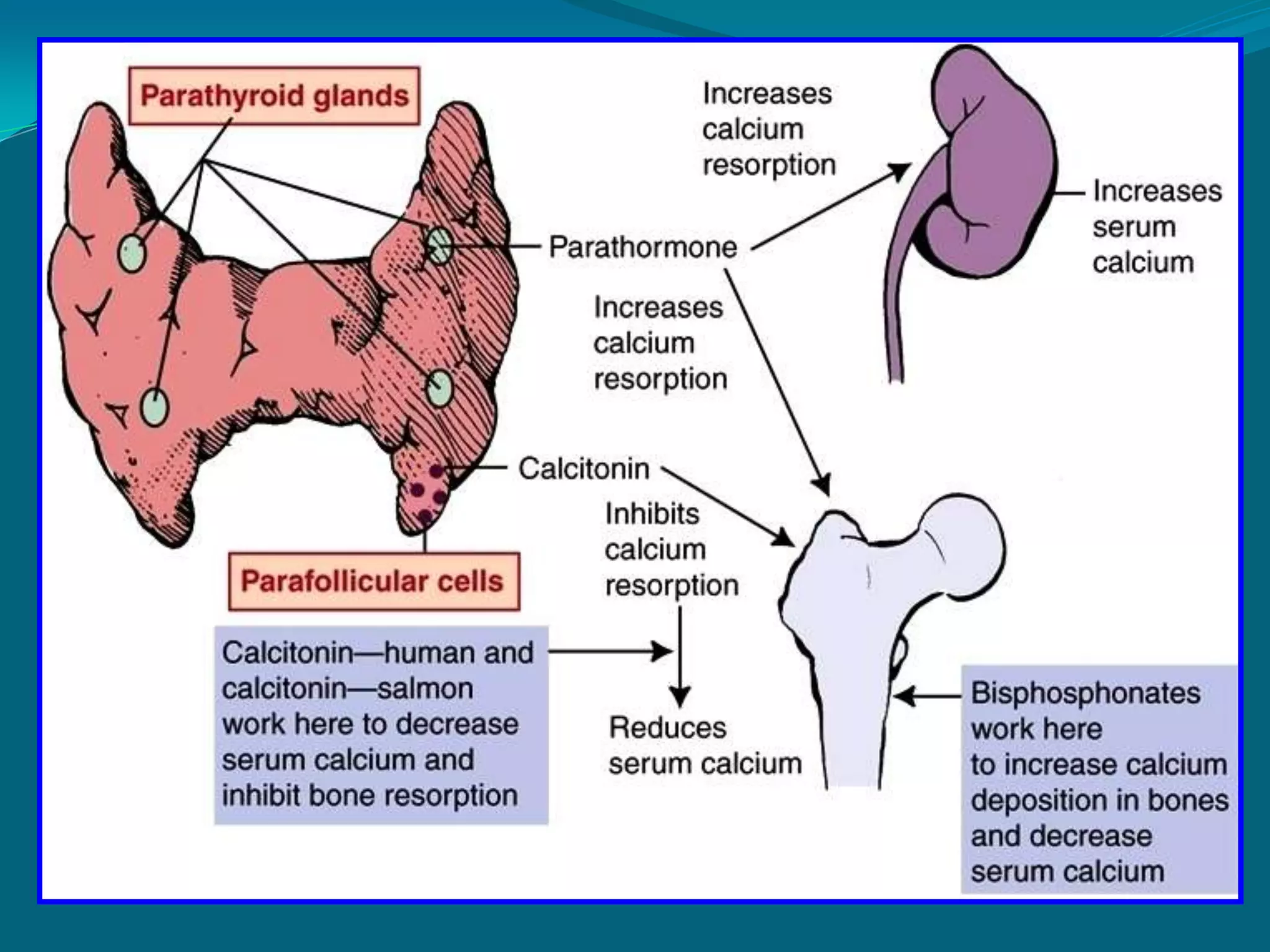
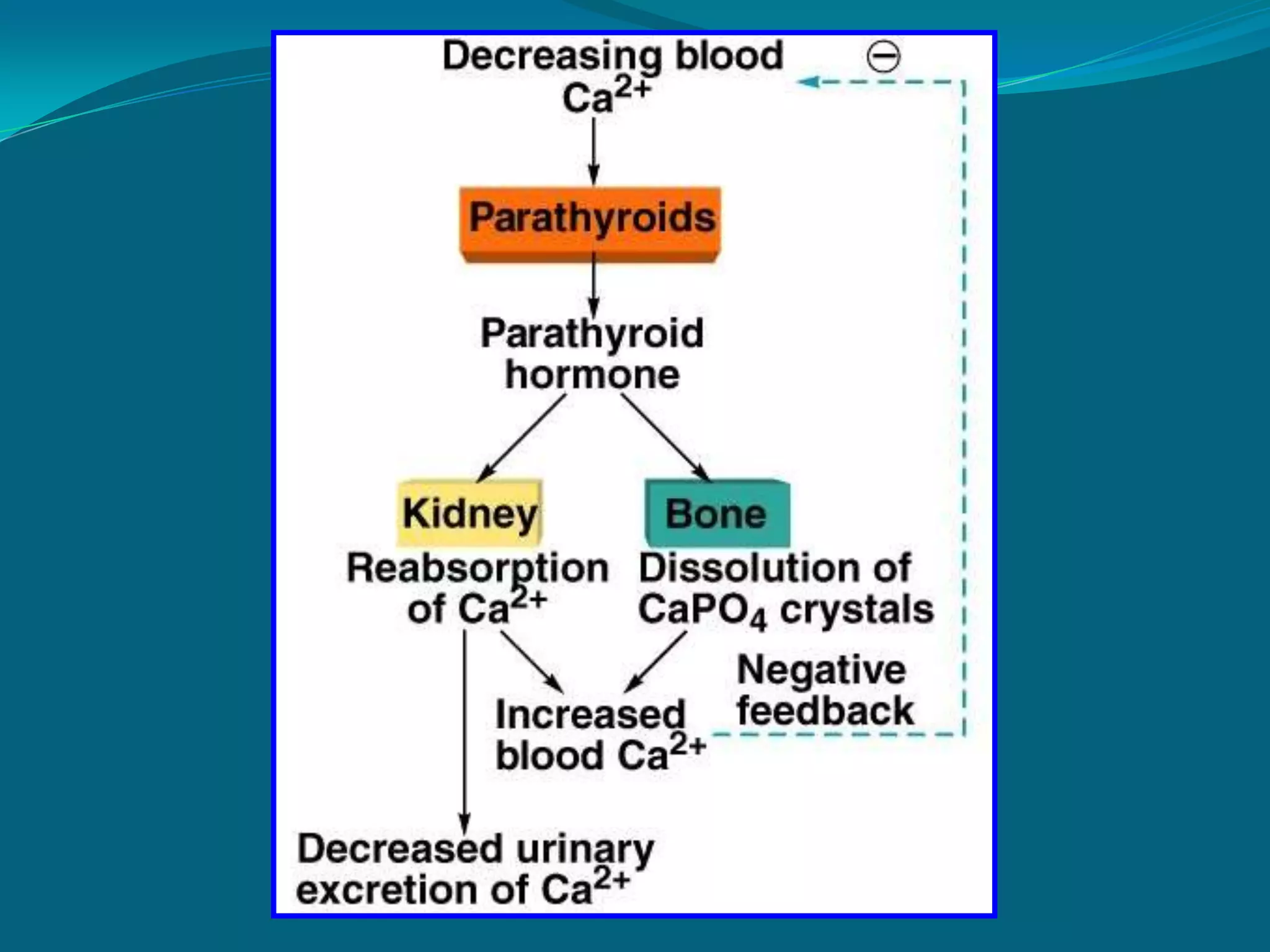
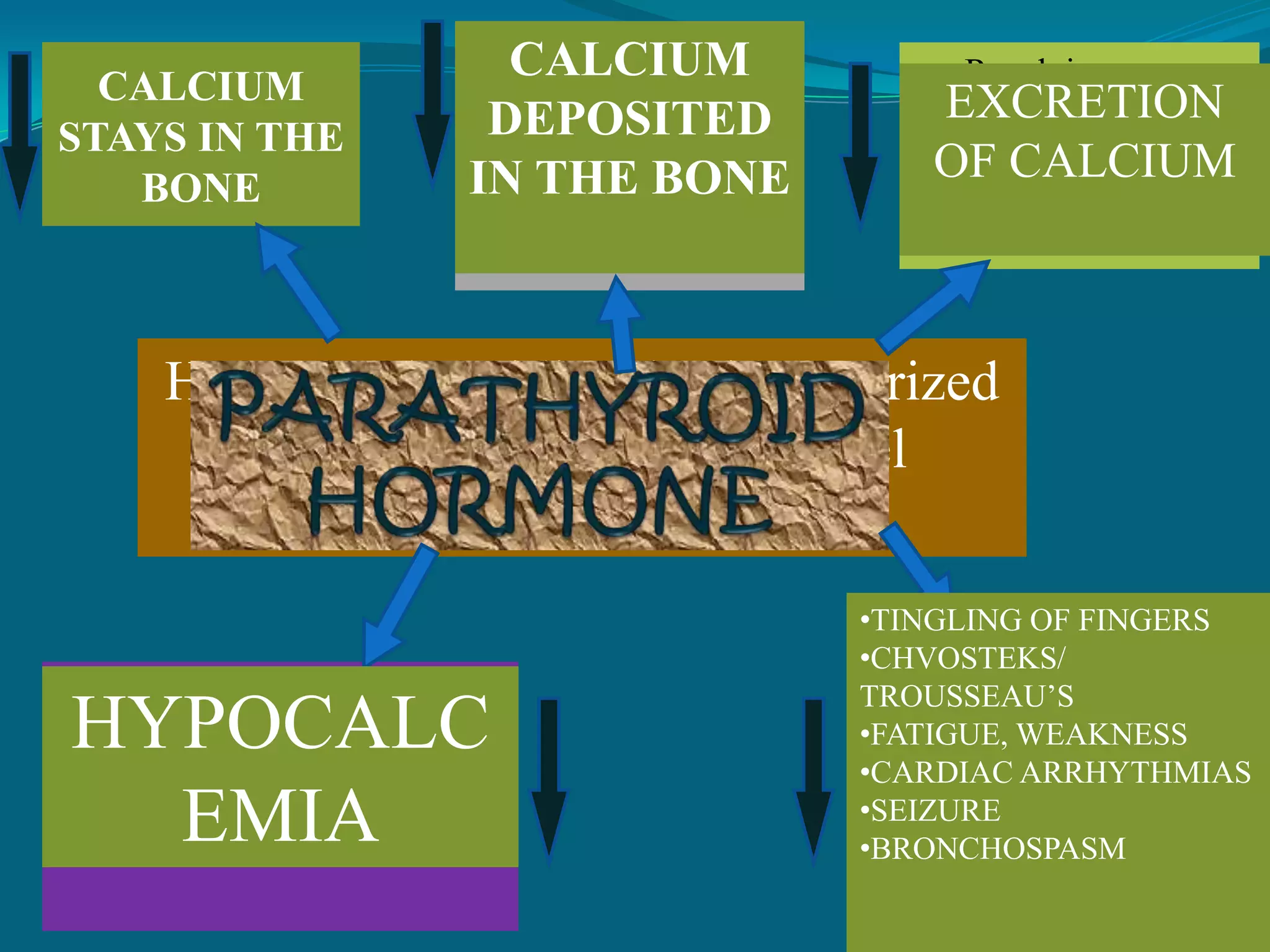
Promotes resorption of calcium from bone to maintain normal serum calcium levelsCALCIUM DEPOSITED IN THE BONEMobilization of calcium and phosphorous from boneRenal: increases calcium reabsorption and phosphate excretionCALCIUM STAYS IN THE BONEEXCRETION  OF CALCIUM Hypoparathyroidism is characterized by decrease in the PTH levelPARATHYROID HORMONETINGLING OF FINGERS
CHVOSTEKS/ TROUSSEAU’S
FATIGUE, WEAKNESS
CARDIAC ARRHYTHMIAS
SEIZURE
BRONCHOSPASMFunction of calcium: maintains N muscle and neuromuscular responses.
Necessary component for blood coagulation mechanismsPromotes absorption of calcium in the GI tract ( by stimulating kidneys to convert vit.D to its active form).HYPOCALCEMIA
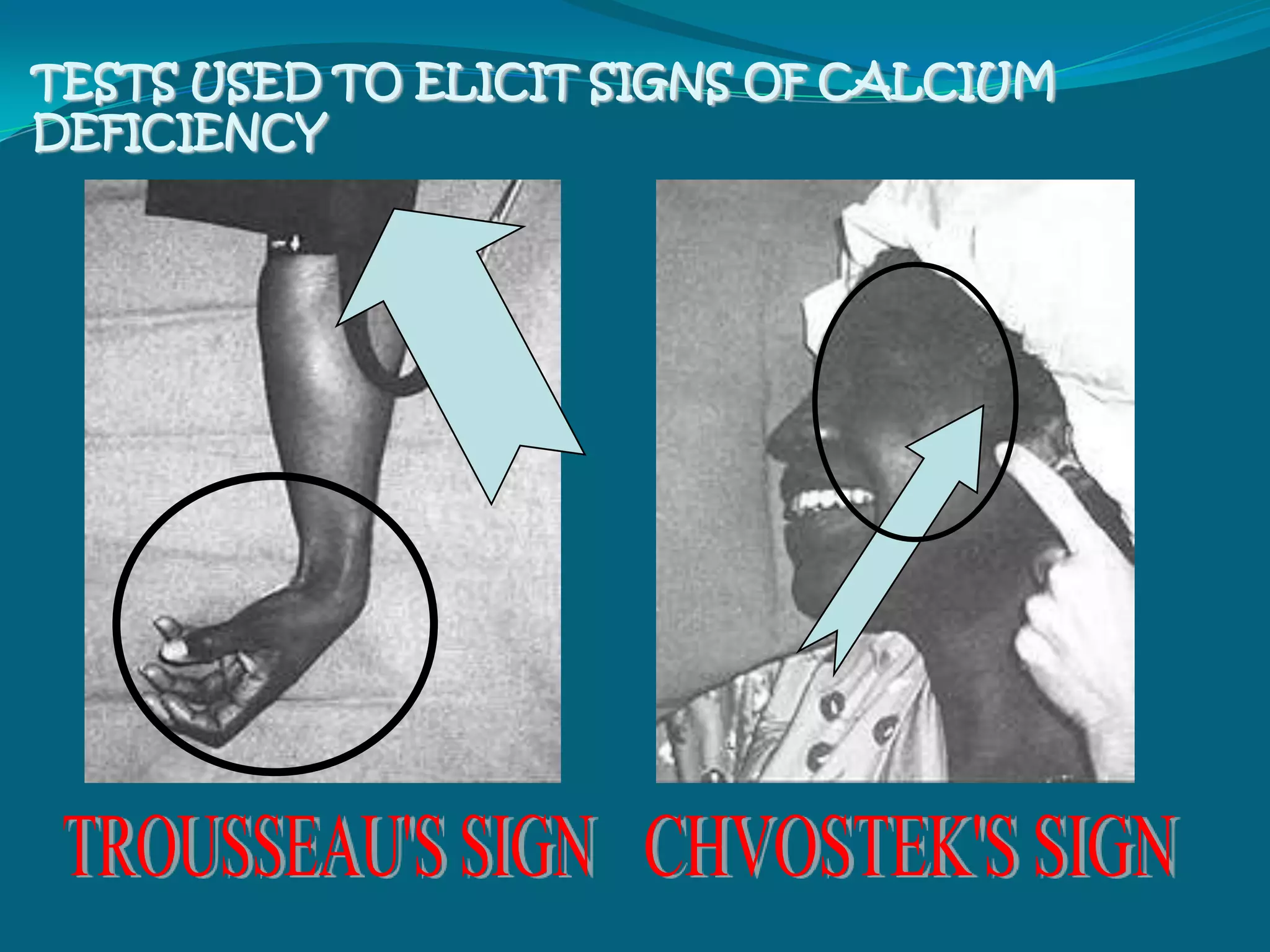
TESTS USED TO ELICIT SIGNS OF CALCIUM DEFICIENCYTROUSSEAU'SSIGNCHVOSTEK'SSIGN
PARATHYROID DISORDERSDIAGNOSTIC TESTS:HEMATOLOGICALSERUM CALCIUMSERUM PHOSPHORUSSERUM ALKALINE PHOSPHATASEURINARY STUDIESURINARY CALCIUMURINARY PHOSPHATE - TUBULAR REABSORPTION OF PHOSPHATE
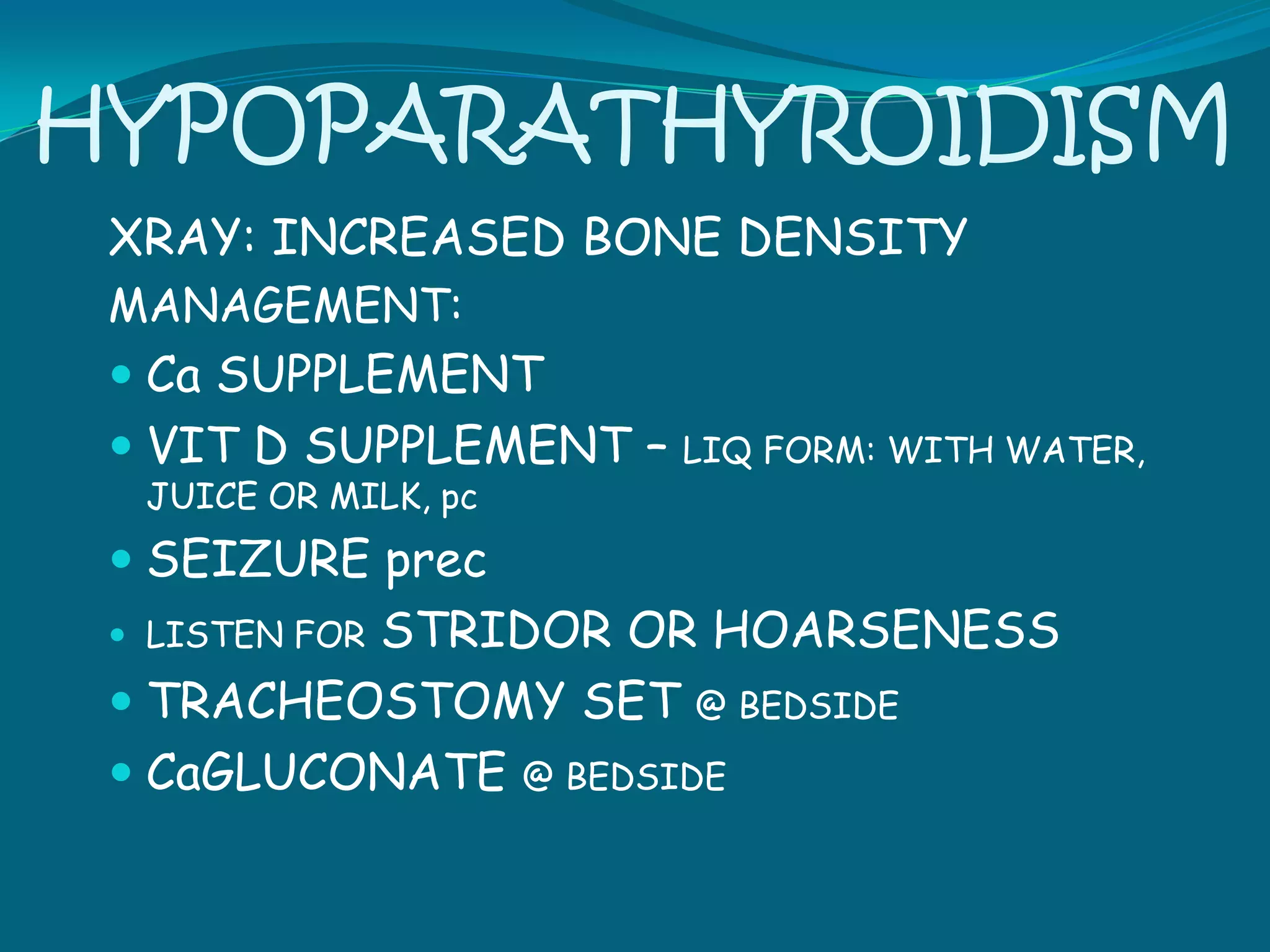
HYPOPARATHYROIDISMXRAY: INCREASED BONE DENSITYMANAGEMENT:Ca SUPPLEMENTVIT D SUPPLEMENT – LIQ FORM: WITH WATER, JUICE OR MILK, pcSEIZURE precLISTEN FOR STRIDOR OR HOARSENESSTRACHEOSTOMY SET @ BEDSIDECaGLUCONATE @ BEDSIDE
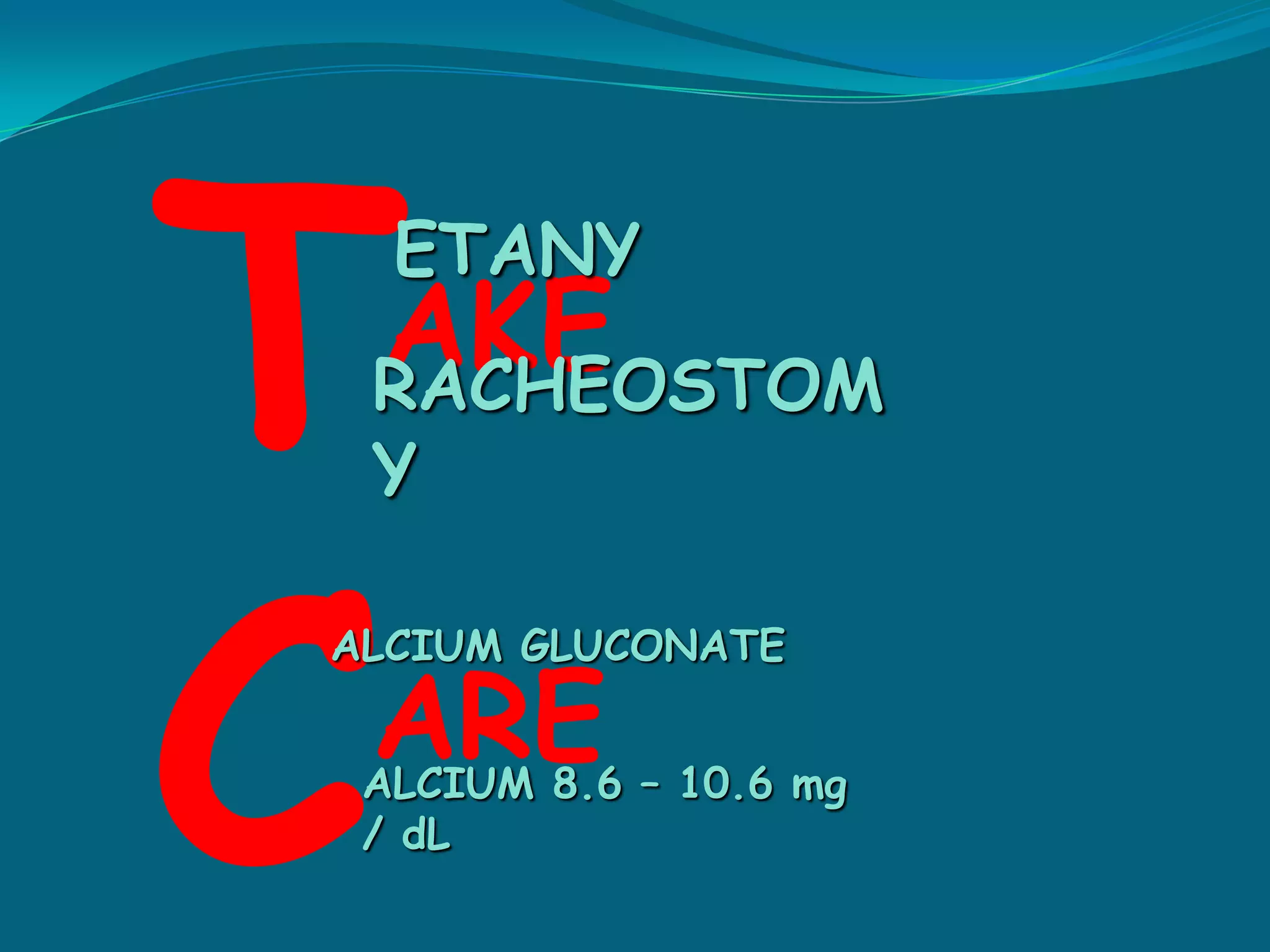
T ETANYAKERACHEOSTOMYC ALCIUM GLUCONATEAREALCIUM 8.6 – 10.6 mg / dL
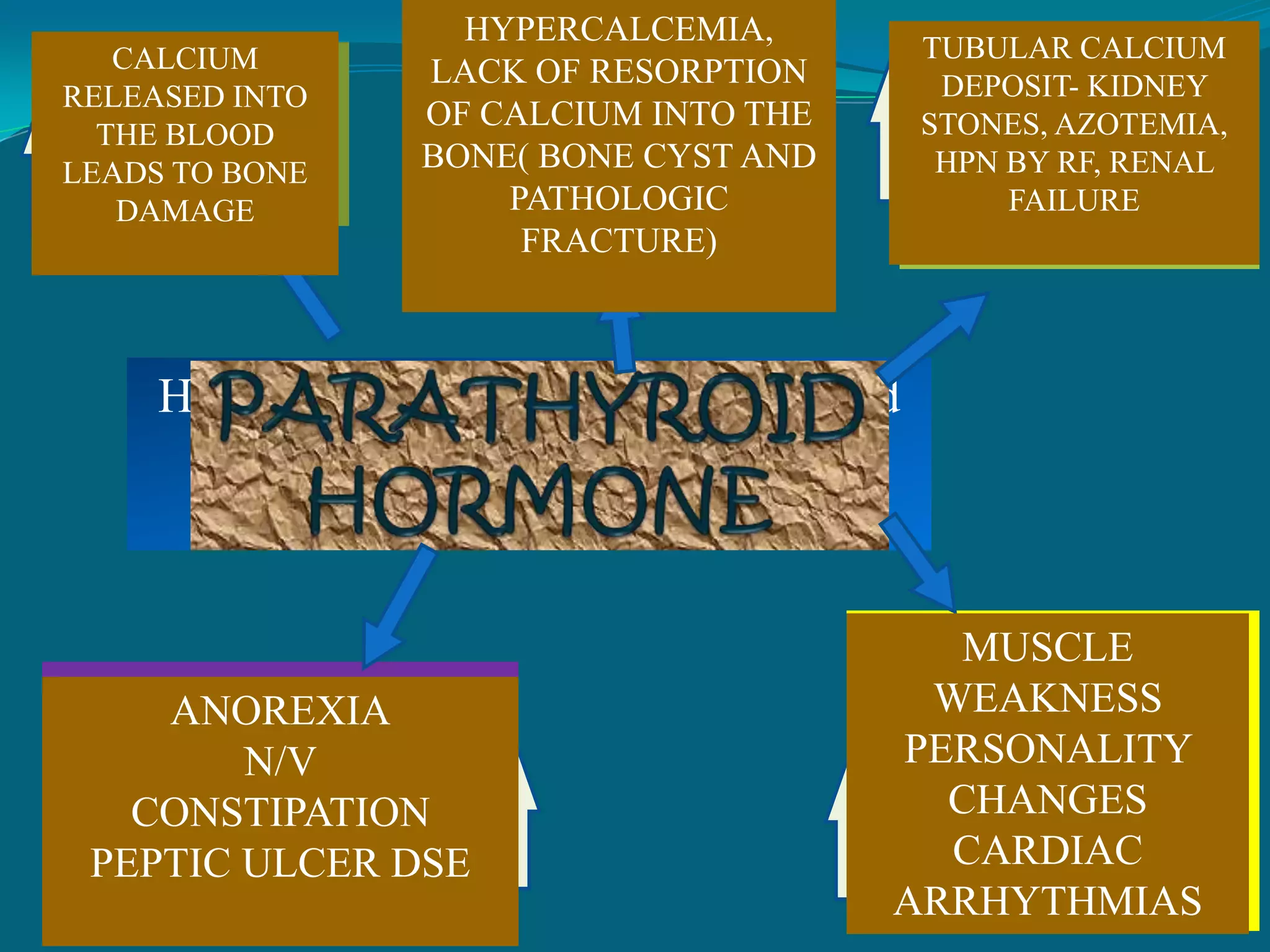
HYPERCALCEMIA, LACK OF RESORPTION OF CALCIUM INTO THE BONE( BONE CYST AND PATHOLOGIC FRACTURE)Promotes resorption of calcium from bone to maintain normal serum calcium levelsTUBULAR CALCIUM DEPOSIT- KIDNEY STONES, AZOTEMIA, HPN BY RF, RENAL FAILURECALCIUM RELEASED INTO THE BLOOD LEADS TO BONE DAMAGEMobilization of calcium and phosphorous from boneRenal: increases calcium reabsorption and phosphate excretionHyperparathyroidism is characterized by excesssive secretion of PTHPARATHYROID HORMONEFunction of calcium: maintains N muscle and neuromuscular responses.
Necessary component for blood coagulation mechanismsMUSCLE WEAKNESSPERSONALITY CHANGESCARDIAC ARRHYTHMIASPromotes absorption of calcium in the GI tract ( by stimulating kidneys to convert vit.D to its active form).ANOREXIAN/VCONSTIPATIONPEPTIC ULCER DSE
HYPERPARATHYROIDISMINCREASED  PTH  PRODUCTIONHYPERCALCEMIAHYPOPHOSPHATEMIAPRIMARY – TUMOR OR HYPERPLASIA OF THE PARATHYROID GLANDSECONDARY – COMPENSATORY OVERSECRETION OF PTH IN RESPONSE TO HYPOCALCEMIA FROM:CHRONIC RENAL DSEMALABSORPTION SYNDROMEOSTEOMALACIA
HYPERPARATHYROIDISMMANAGEMENT:TX OF CHOICE : SURGICAL REMOVAL OF HYPERPLASTIC TISSUEIV PNSS 5L/ DAY WITH DIURETICSCRANBERRY JUICE (ACID-ASH)LOW CaSTRAIN URINE FOR STONESCARE FOR PARATHYROIDECTOMY
DISORDERS OF THE PANCREAS
DIABETES MELLITUS(TYPE I, TYPE II)
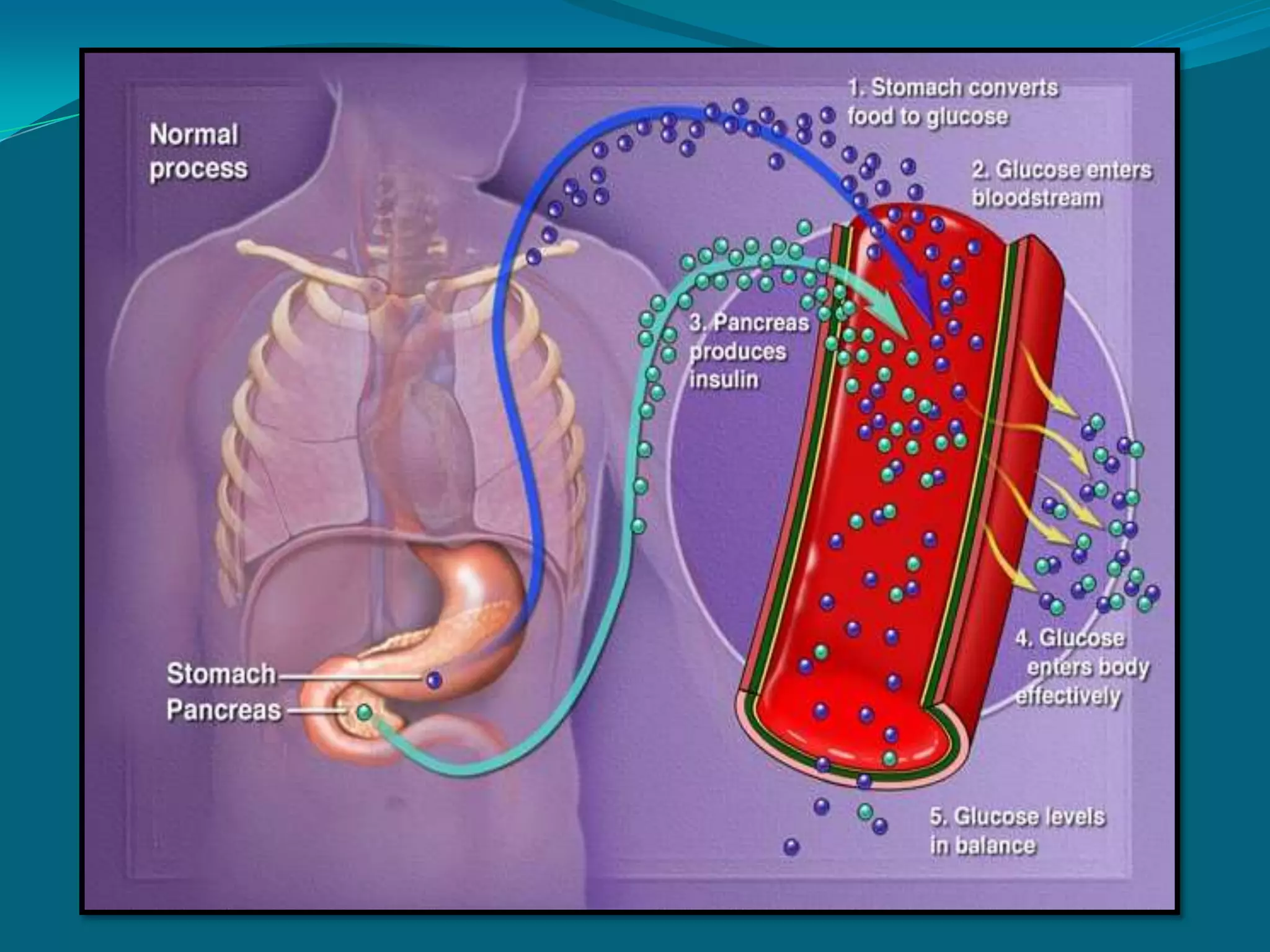
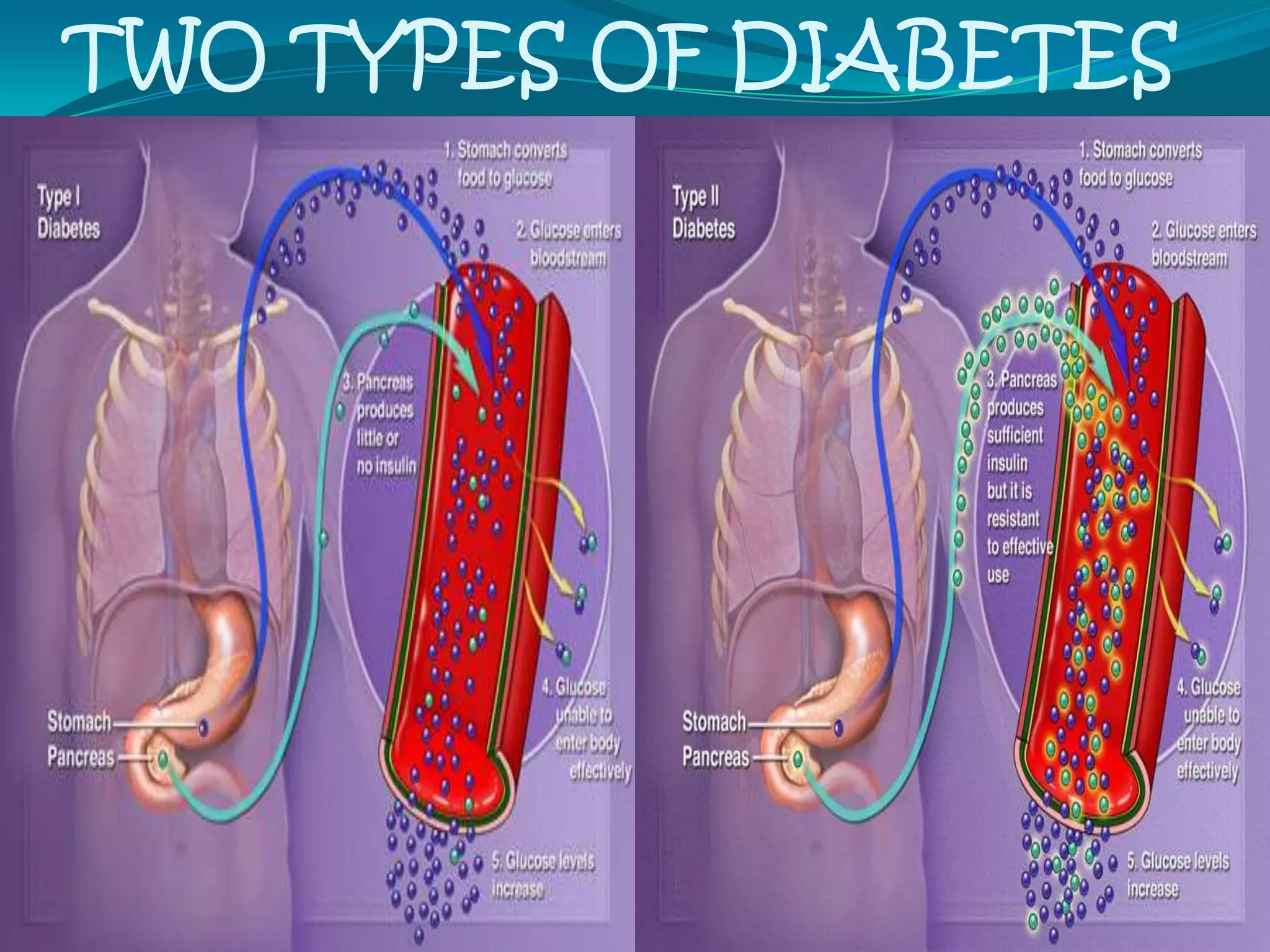
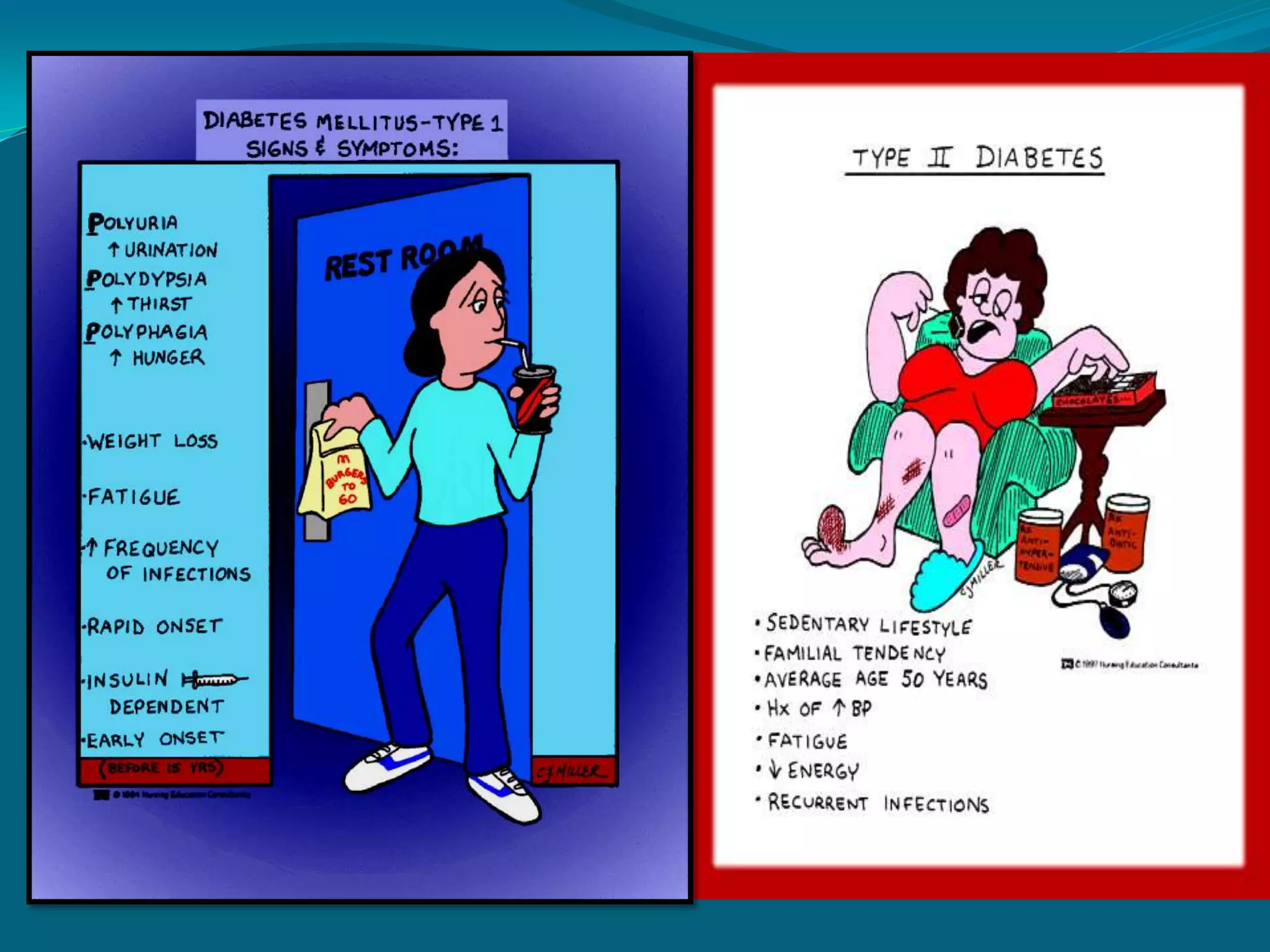
TWO TYPES OF DIABETES
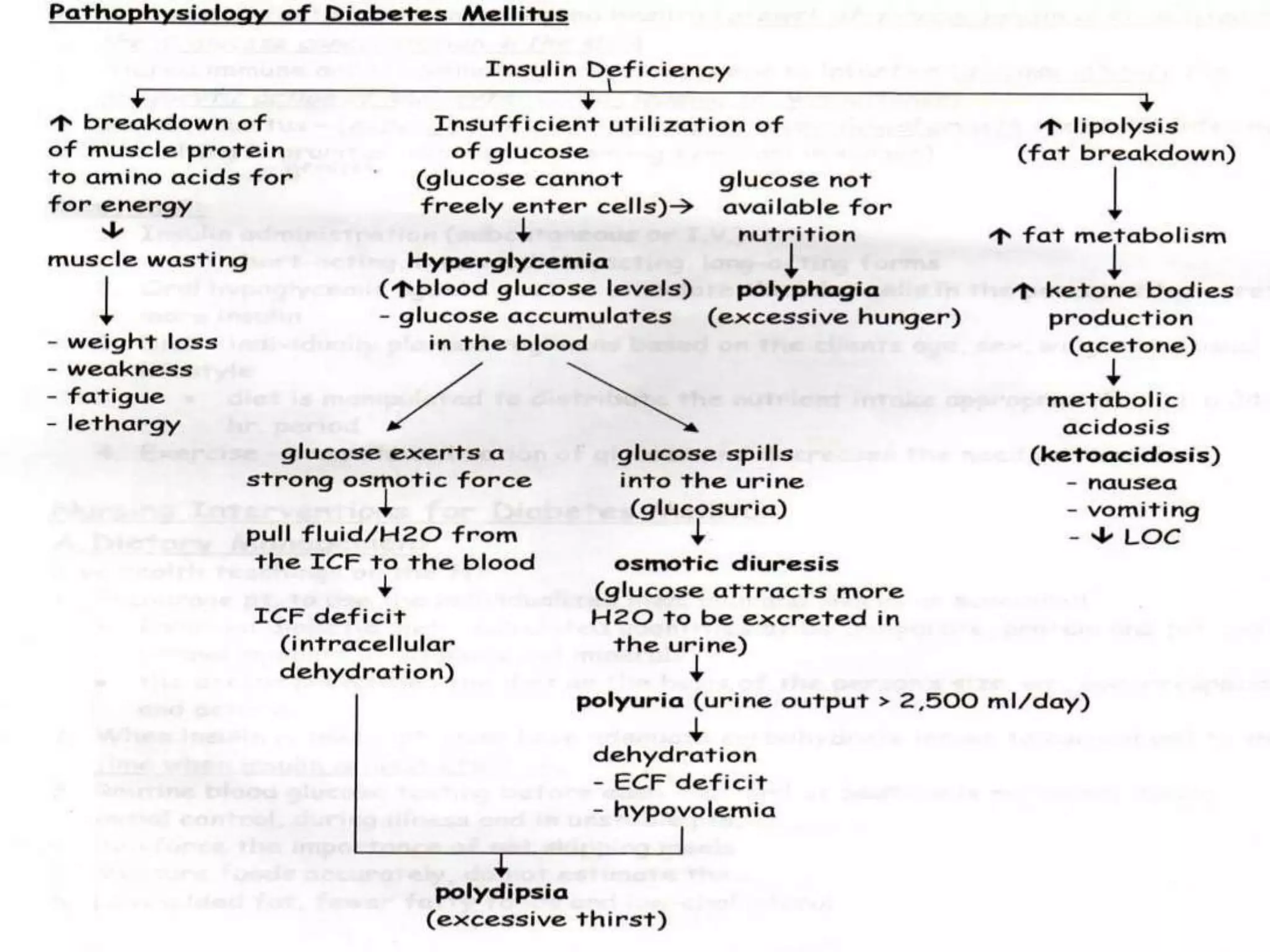
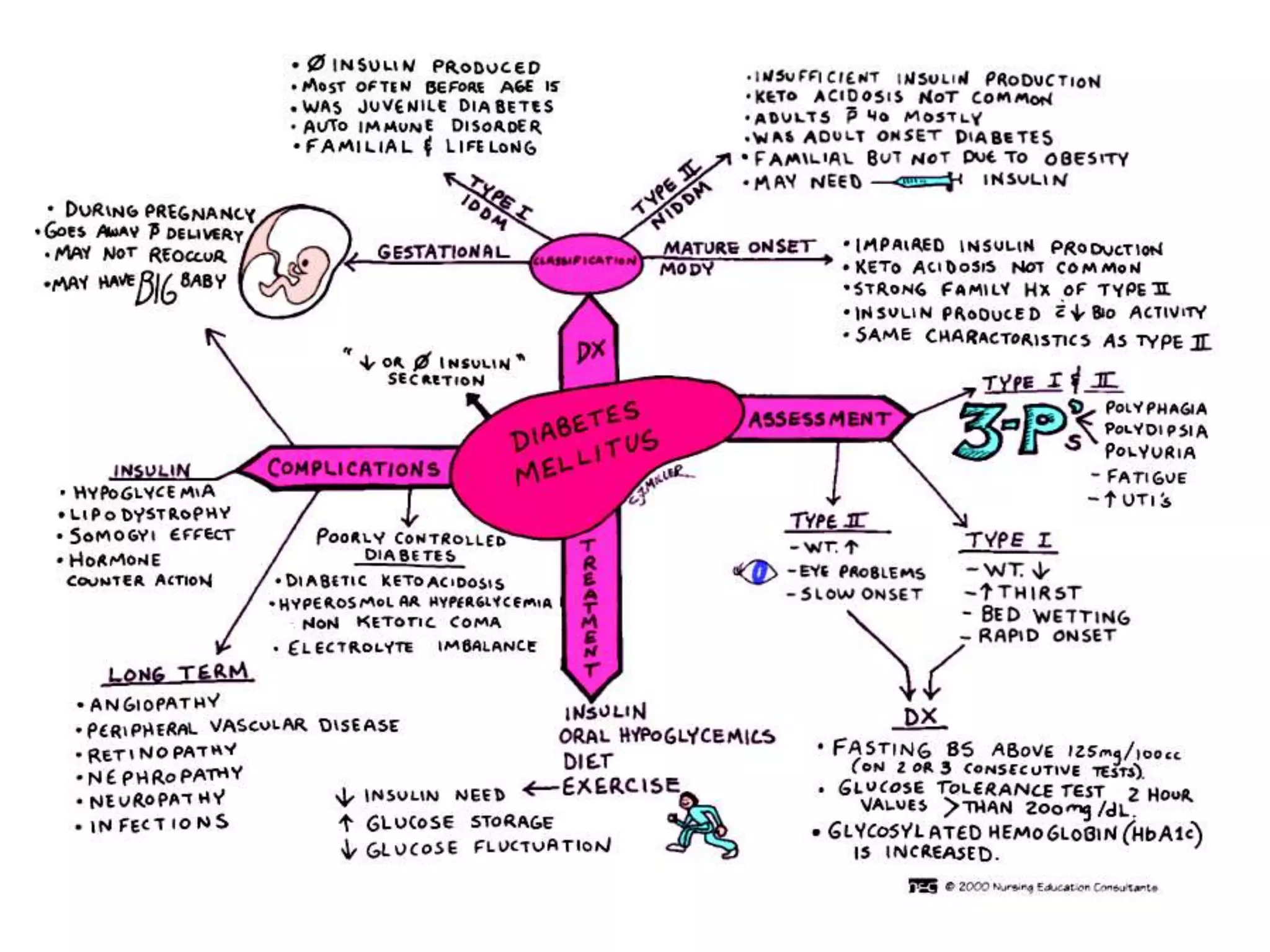
Diabetes Mellitus is a chronic disorder of carbohydrate, protein, and   fat metabolism resulting from insulin deficiency or   abnormality in the use of insulinPredisposing factors: exact cause of diabetes mellitus remain unknown
 genetic / hereditary predisposition
 viruses
 pancreatitis
 pancreatic tumor
 autoimmune disorder
 obesity (overweight people require more insulin        to metabolize the food they eat or the number of     insulin receptor sites in cells is decreased)
TypesInsulin – Dependent Diabetes Mellitus (IDDM) or Type I destruction of beta cells of the pancreas  little or no    insulin production requires daily insulin admin.
 may occur at any age, usually appears below age 15Non Insulin–Dependent Diabetes Mellitus (NIDDM) or Type II probably caused by:
 disturbance in insulin reception in the cells
 number of insulin receptors
 loss of beta cell responsiveness to glucose leading to   slow or  insulin release by the pancreas occurs over age 40 but can occur in children
 common in overweight or obese
 w/ some circulating insulin present, often do not require    insulin
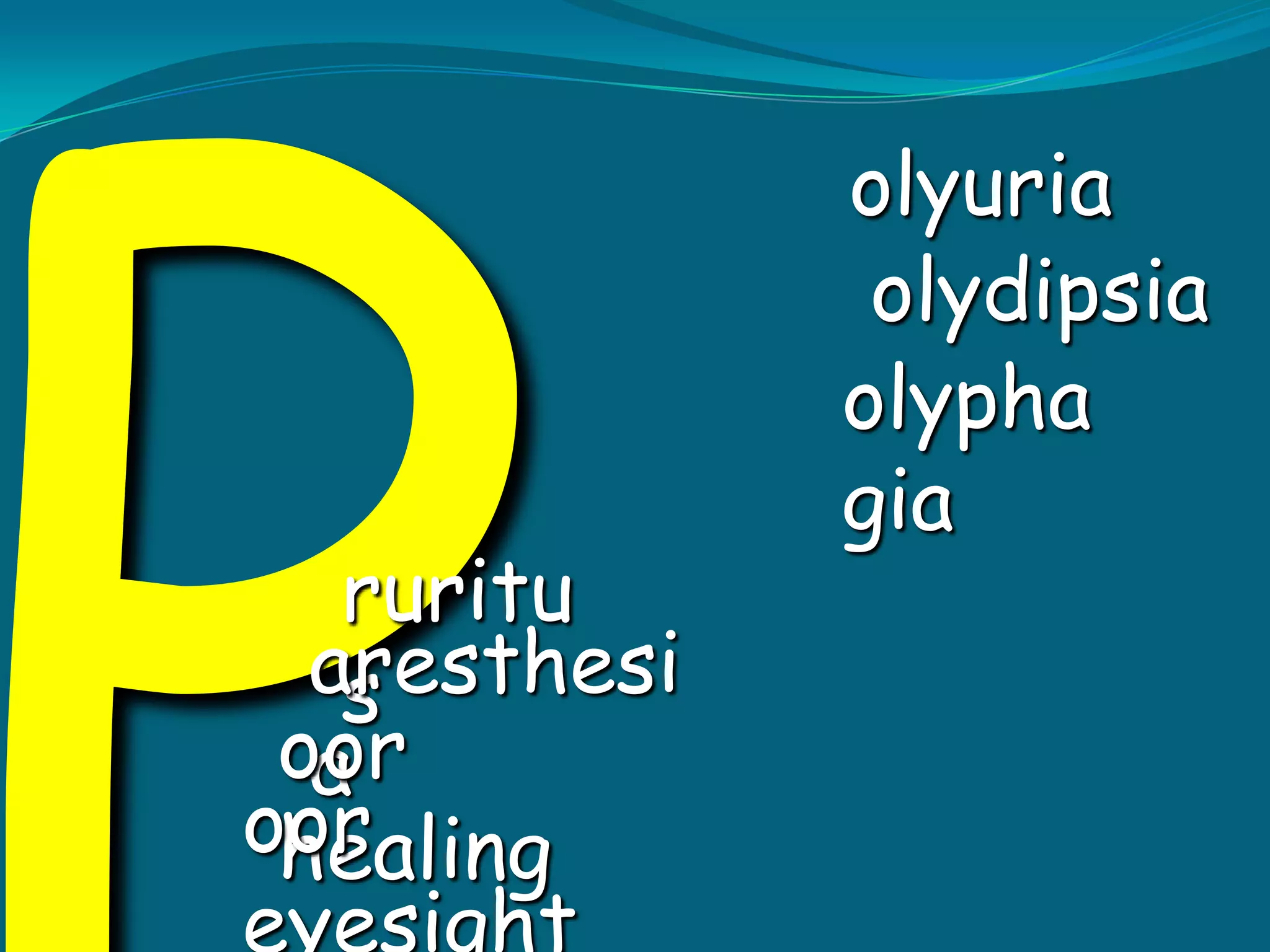
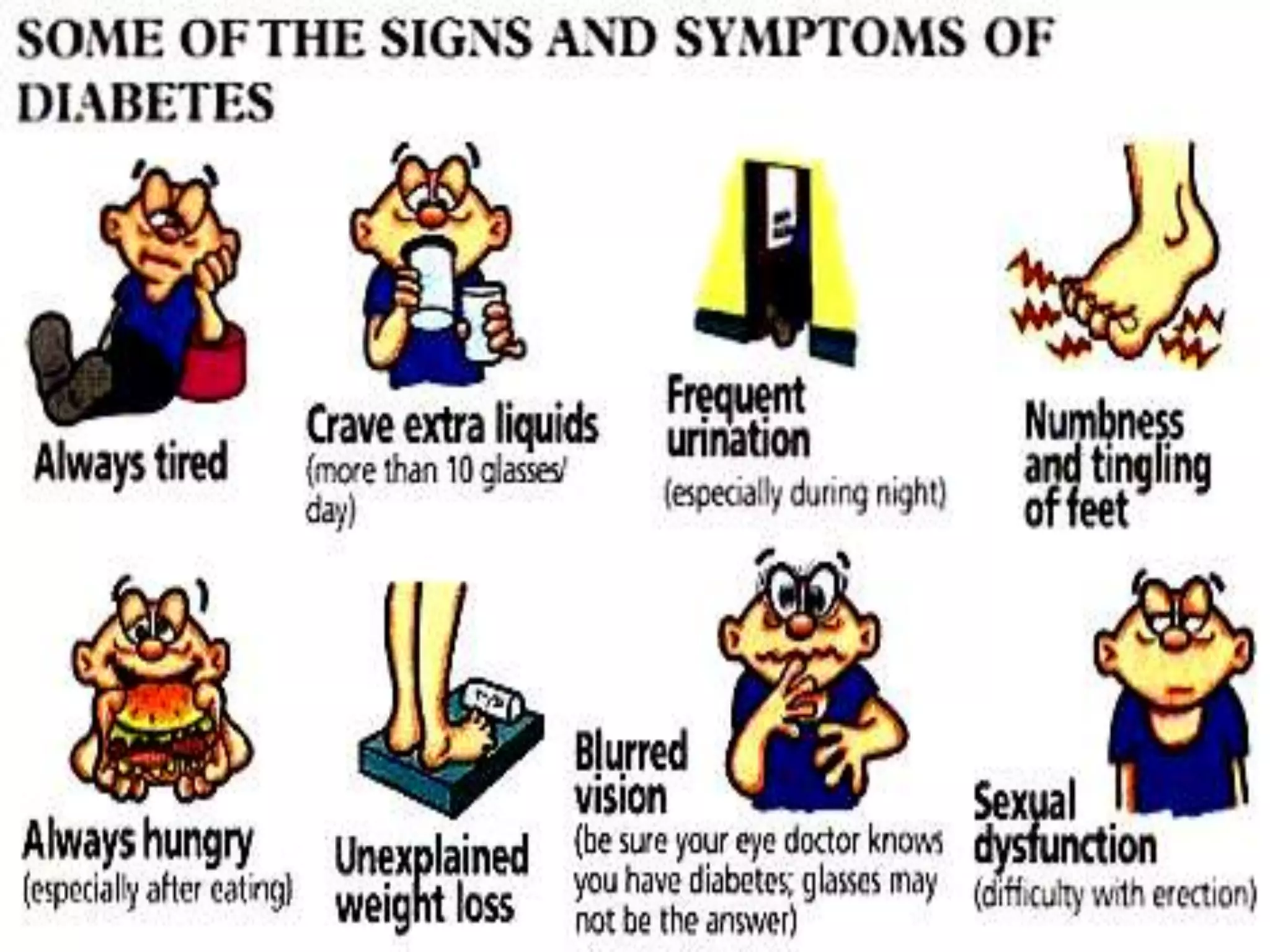
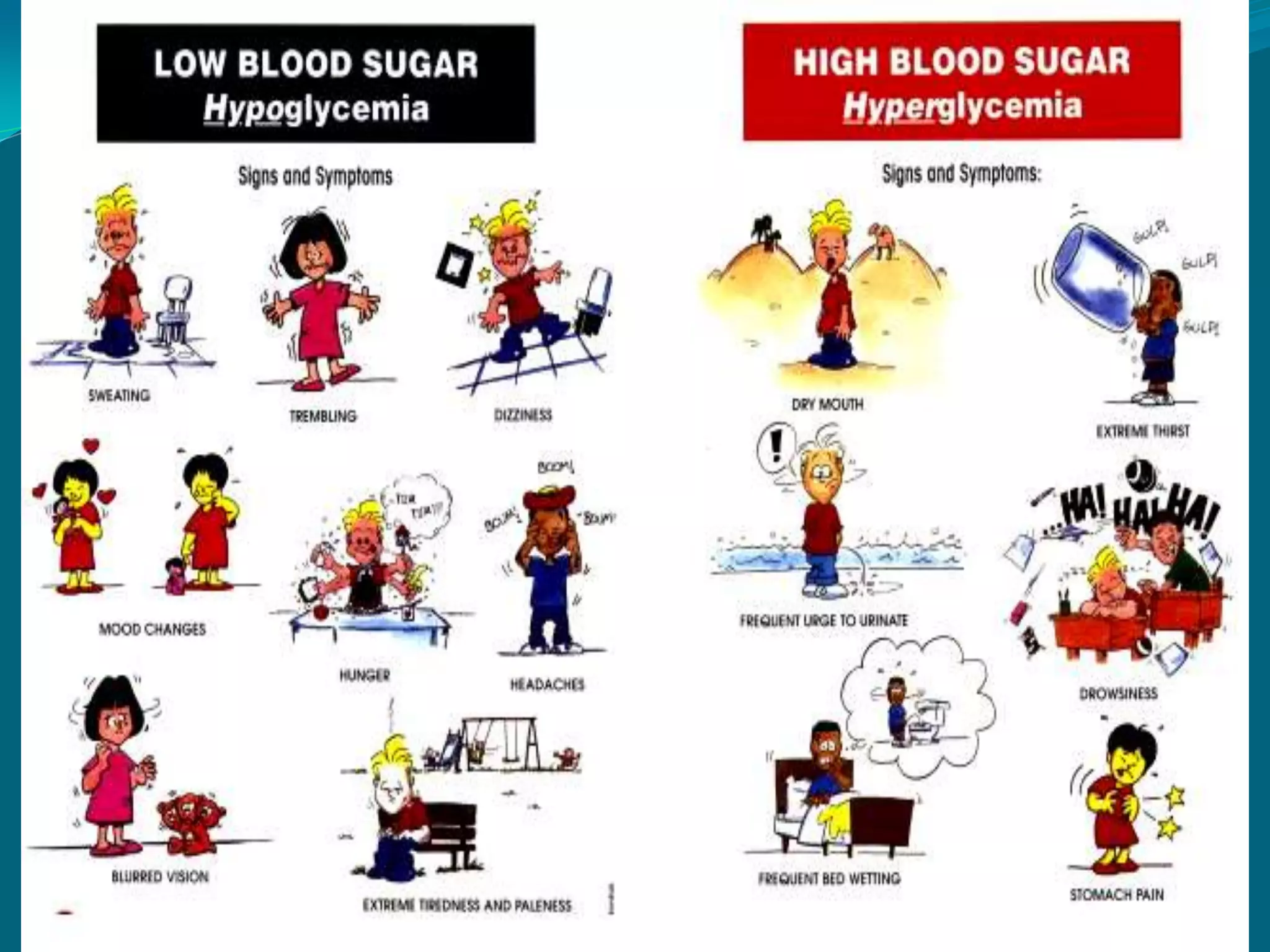
P olyuriaolydipsiaolyphagiaruritusaresthesiaoor healingoor eyesight
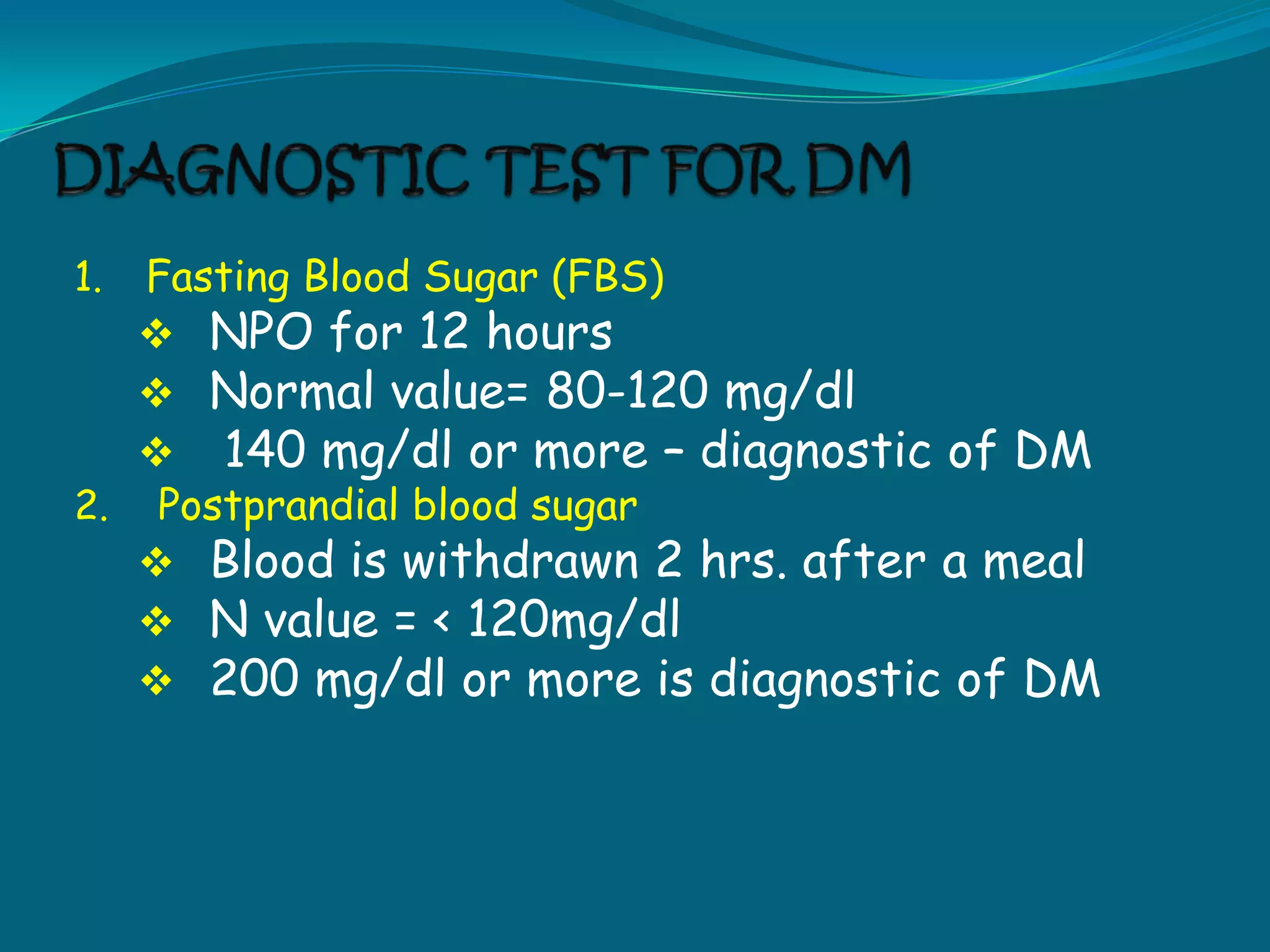
DIAGNOSTIC TEST FOR DMFasting Blood Sugar (FBS)NPO for 12 hours
Normal value= 80-120 mg/dl
 140 mg/dl or more – diagnostic of DMPostprandial blood sugarBlood is withdrawn 2 hrs. after a meal
N value = < 120mg/dl
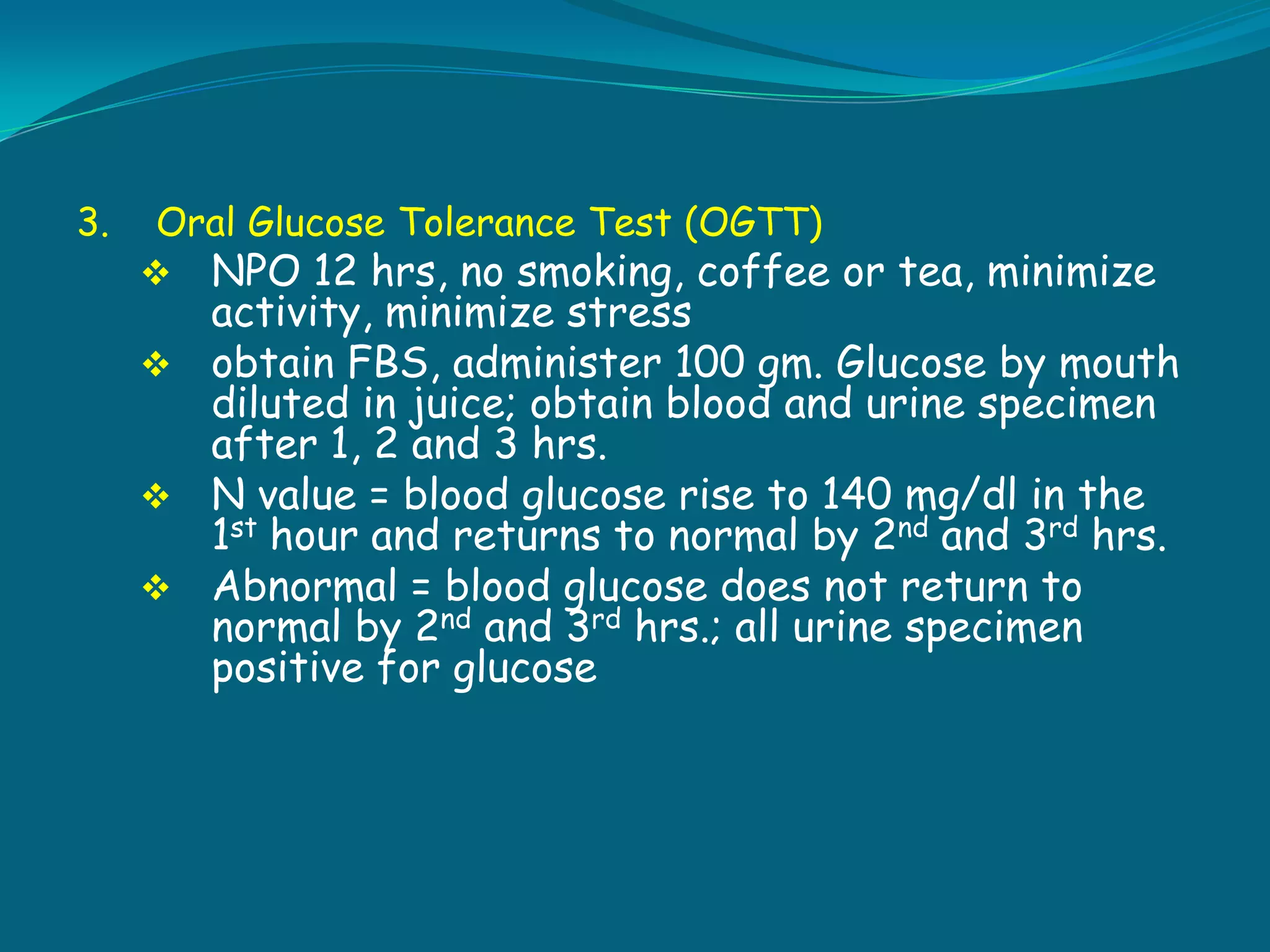
200 mg/dl or more is diagnostic of DM3.    Oral Glucose Tolerance Test (OGTT)NPO 12 hrs, no smoking, coffee or tea, minimize activity, minimize stress
obtain FBS, administer 100 gm. Glucose by mouth diluted in juice; obtain blood and urine specimen after 1, 2 and 3 hrs.
N value = blood glucose rise to 140 mg/dl in the 1st hour and returns to normal by 2nd and 3rd hrs.
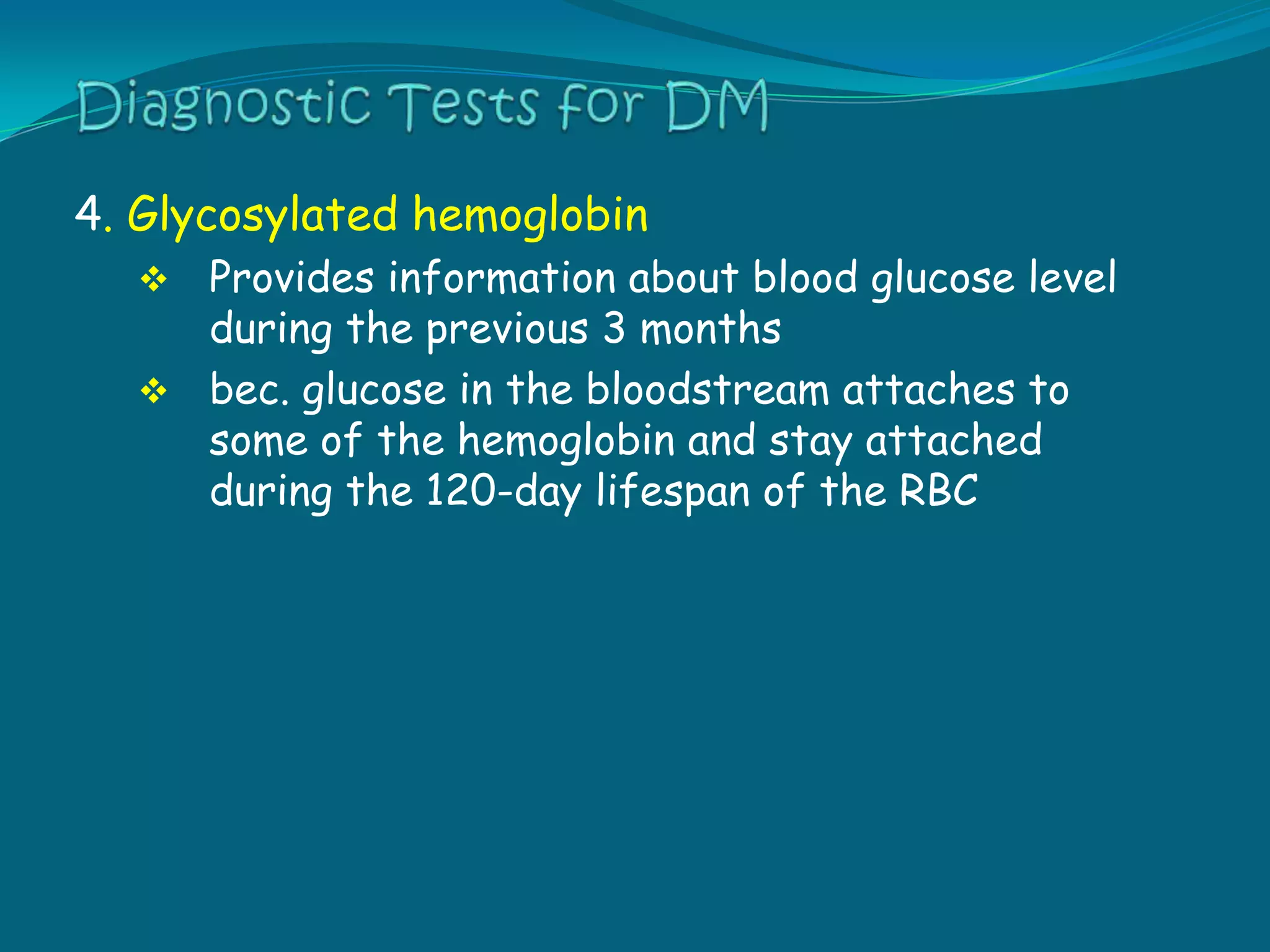
Abnormal = blood glucose does not return to normal by 2nd and 3rd hrs.; all urine specimen positive for glucoseDiagnostic Tests for DM4. Glycosylated hemoglobinProvides information about blood glucose level during the previous 3 months
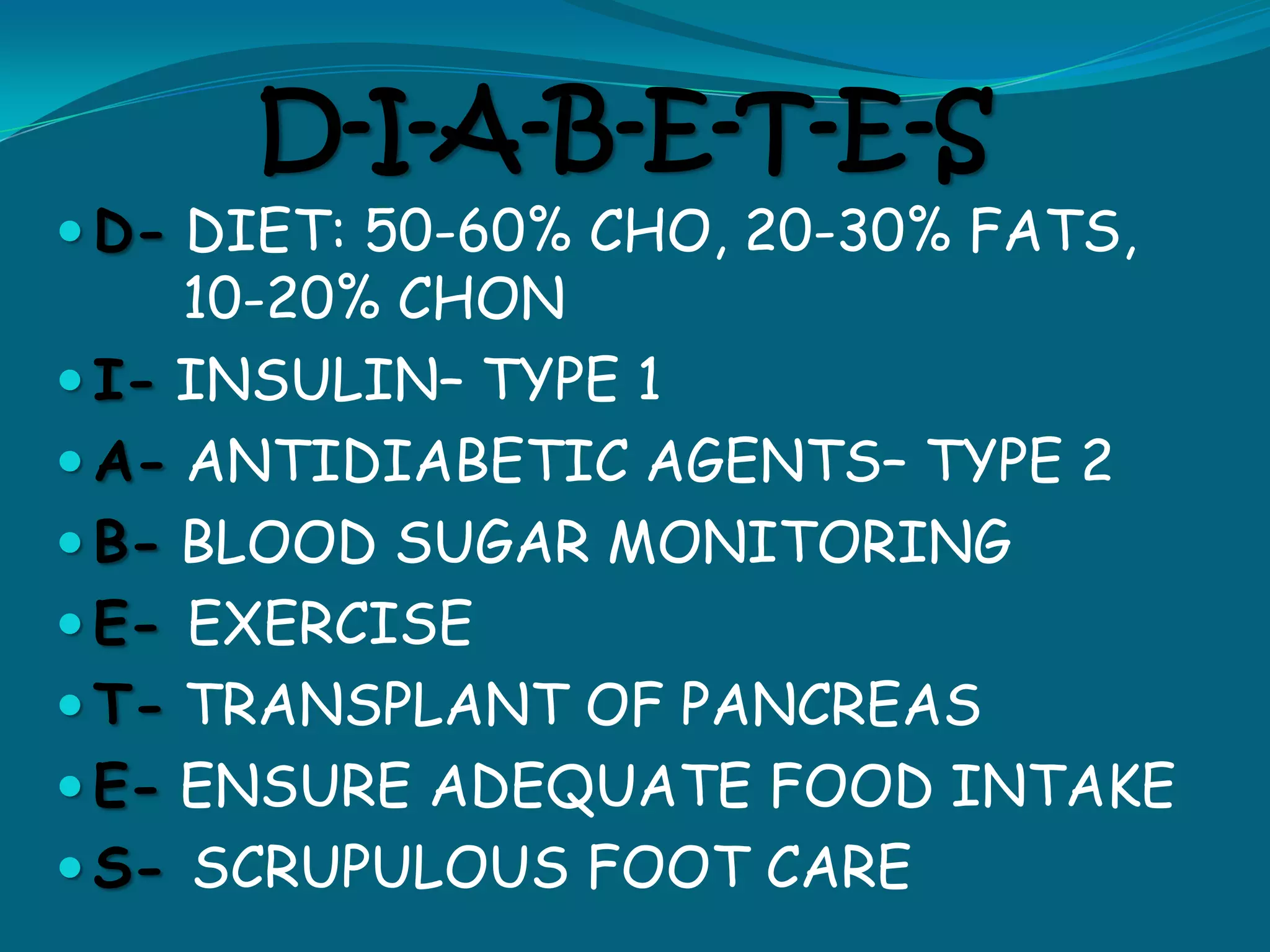
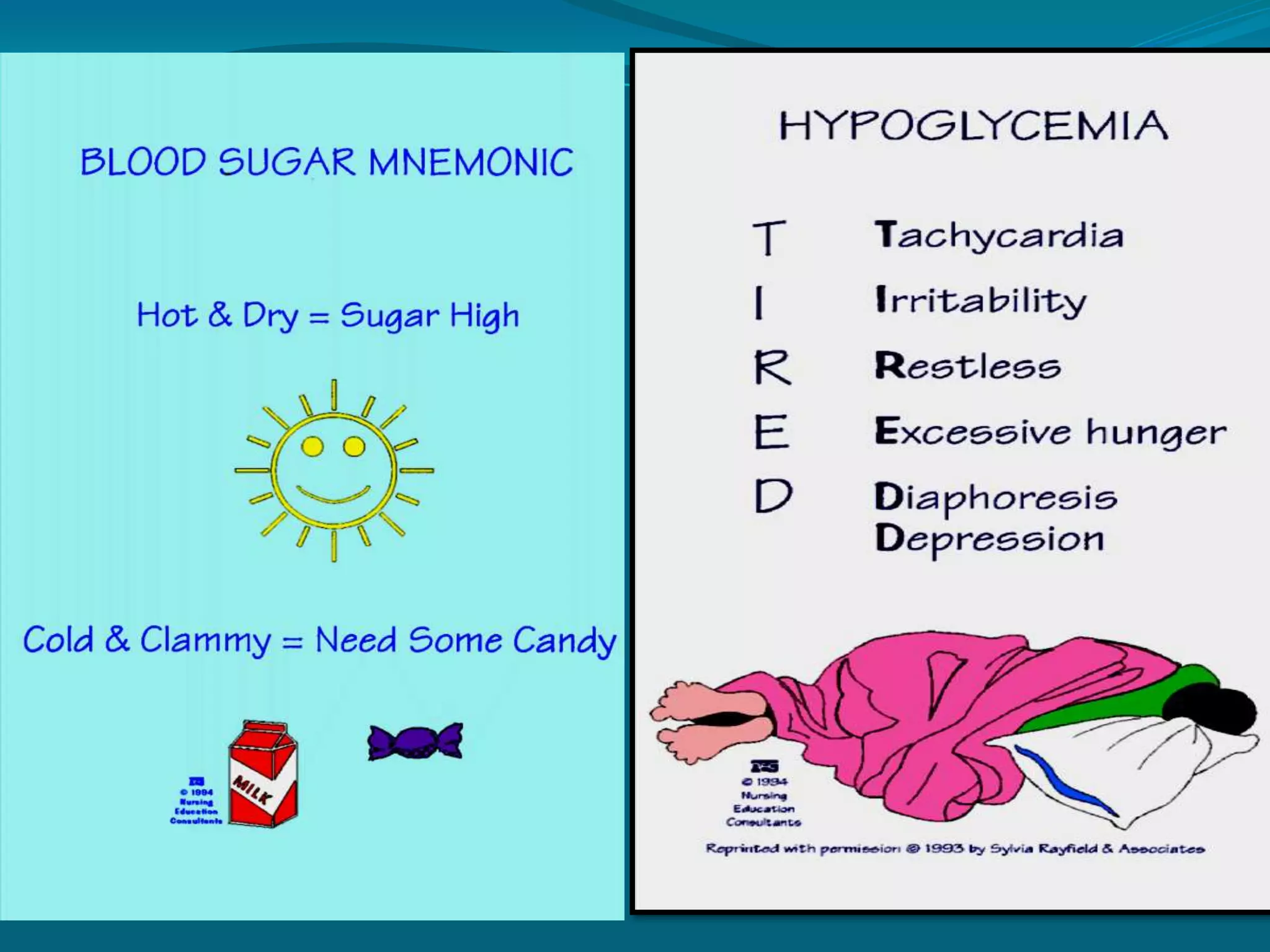
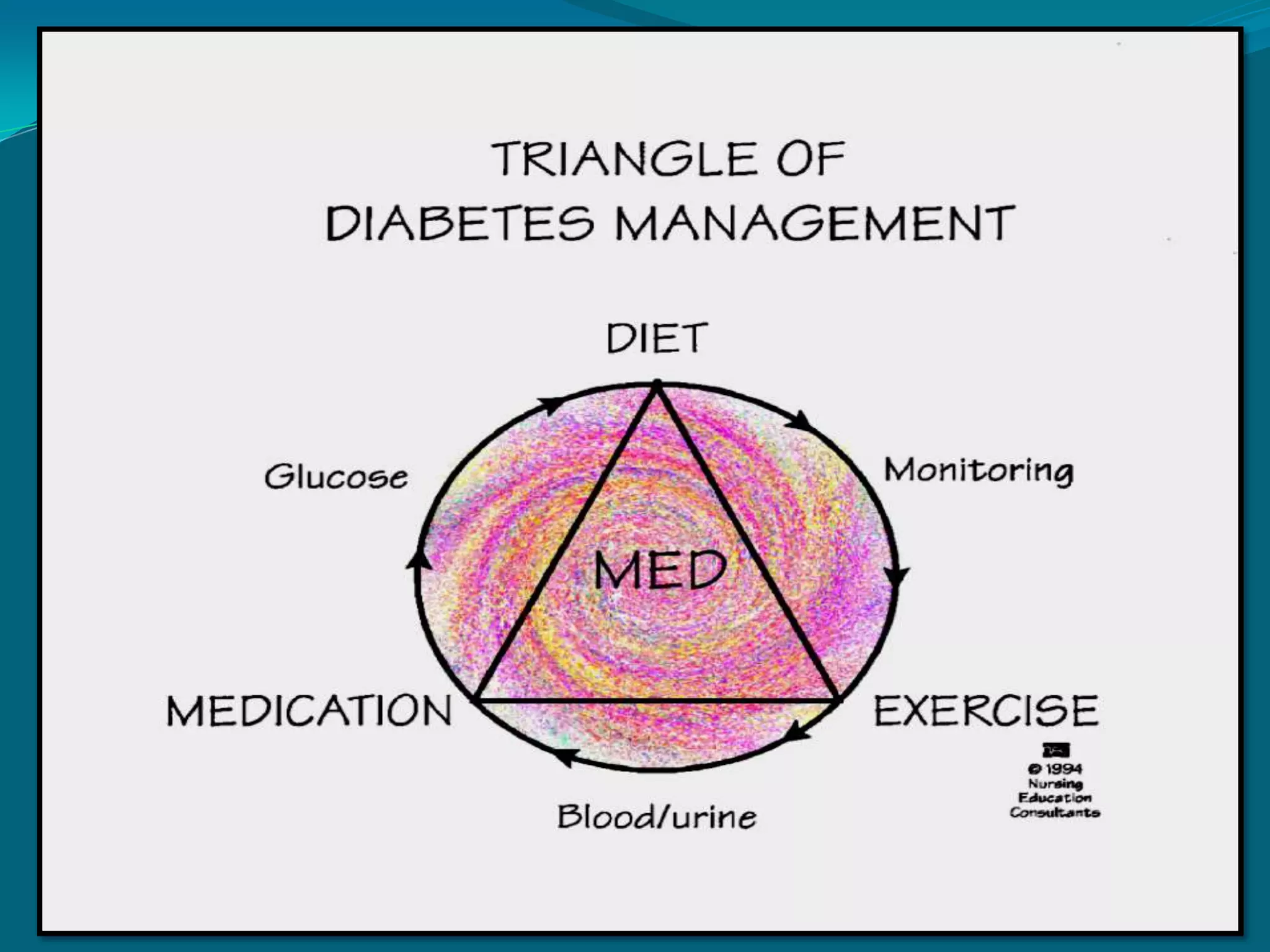
bec. glucose in the bloodstream attaches to some of the hemoglobin and stay attached during the 120-day lifespan of the RBCD-I-A-B-E-T-E-SD- DIET: 50-60% CHO, 20-30% FATS,   	10-20% CHONI- INSULIN– TYPE 1A- ANTIDIABETIC AGENTS– TYPE 2B- BLOOD SUGAR MONITORINGE- EXERCISET- TRANSPLANT OF PANCREASE- ENSURE ADEQUATE FOOD INTAKES- SCRUPULOUS FOOT CARE
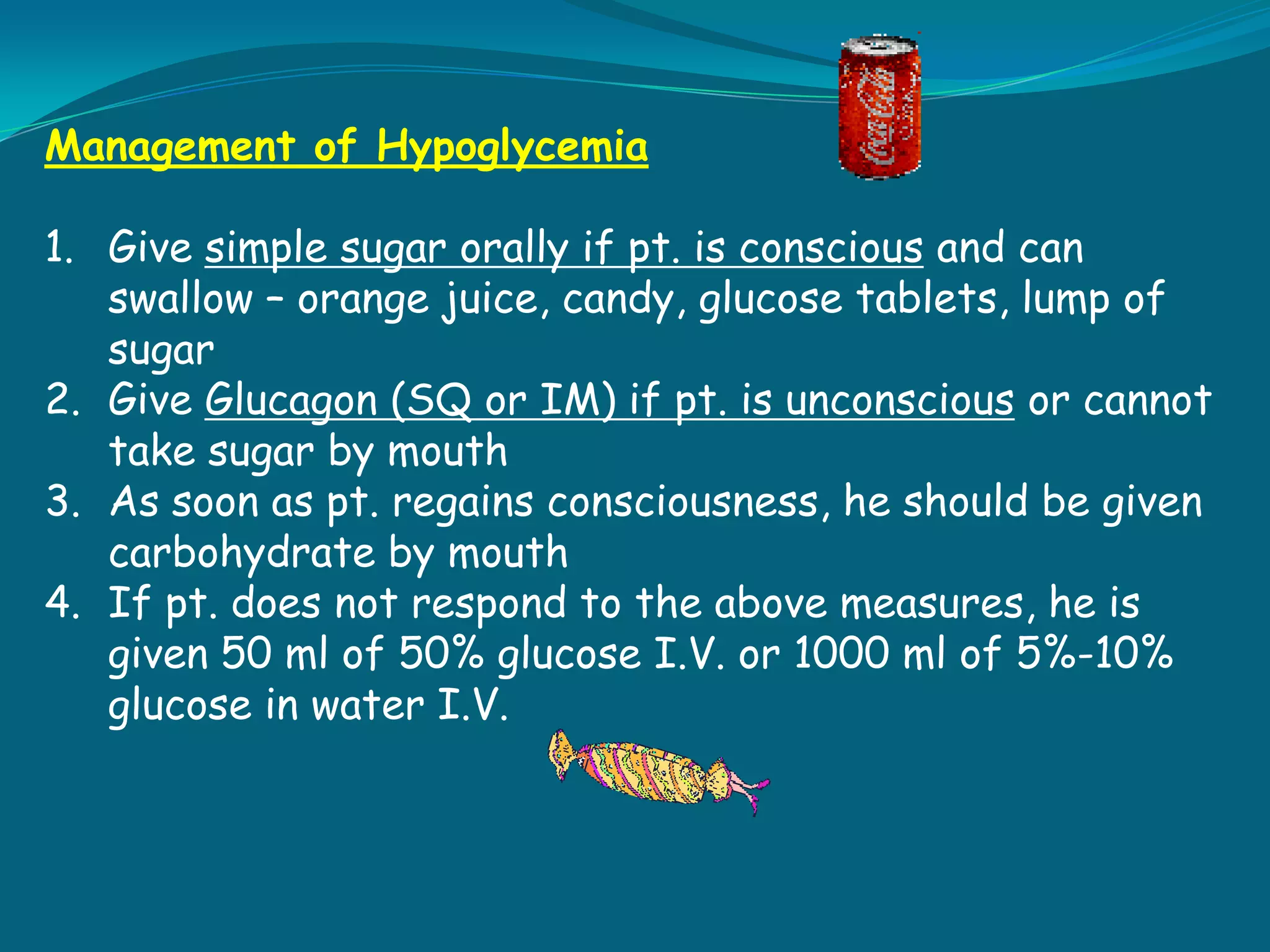
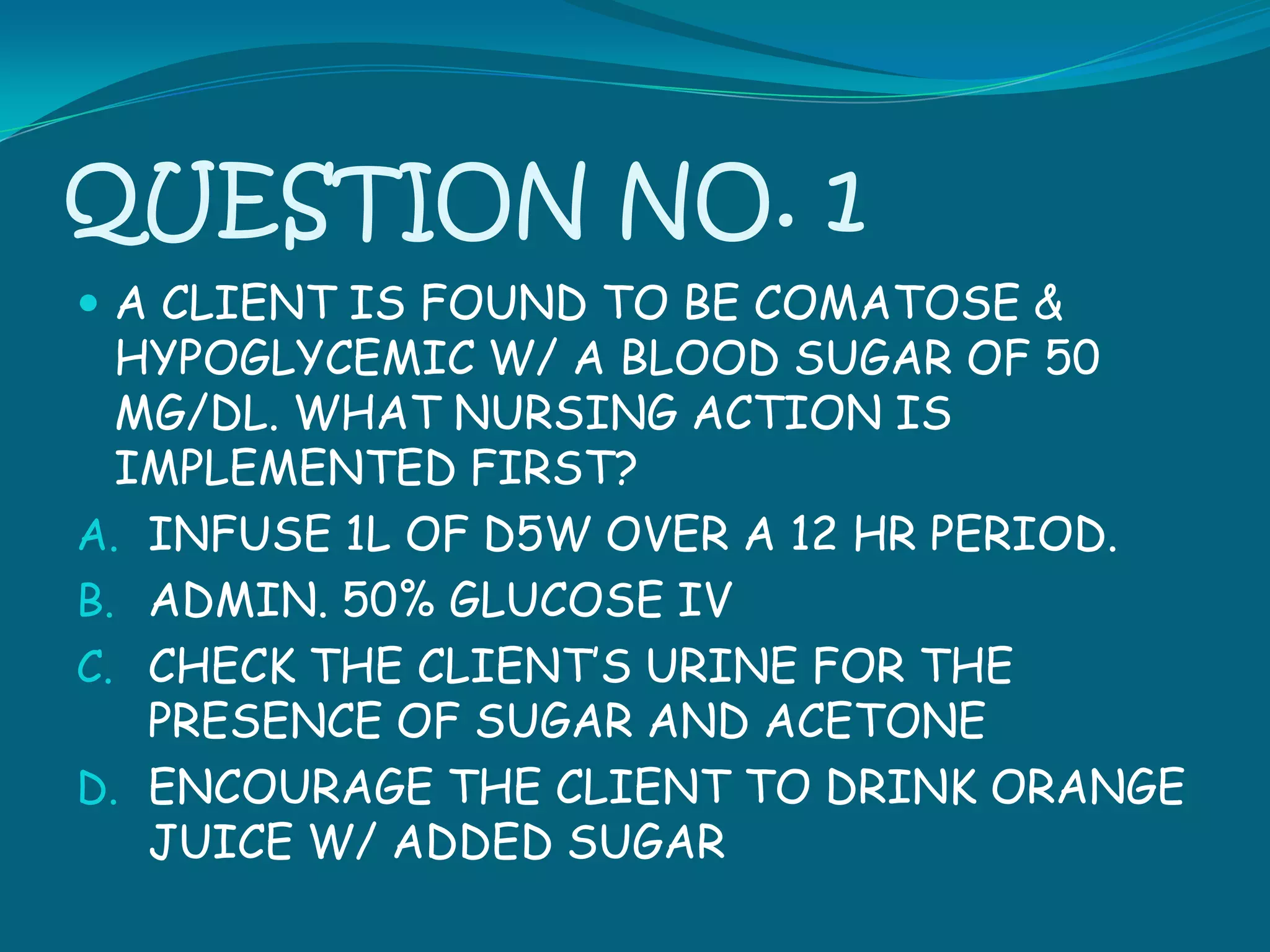
Management of HypoglycemiaGive simple sugar orally if pt. is conscious and can swallow – orange juice, candy, glucose tablets, lump of sugarGive Glucagon (SQ or IM) if pt. is unconscious or cannot take sugar by mouthAs soon as pt. regains consciousness, he should be given carbohydrate by mouthIf pt. does not respond to the above measures, he is given 50 ml of 50% glucose I.V. or 1000 ml of 5%-10% glucose in water I.V.
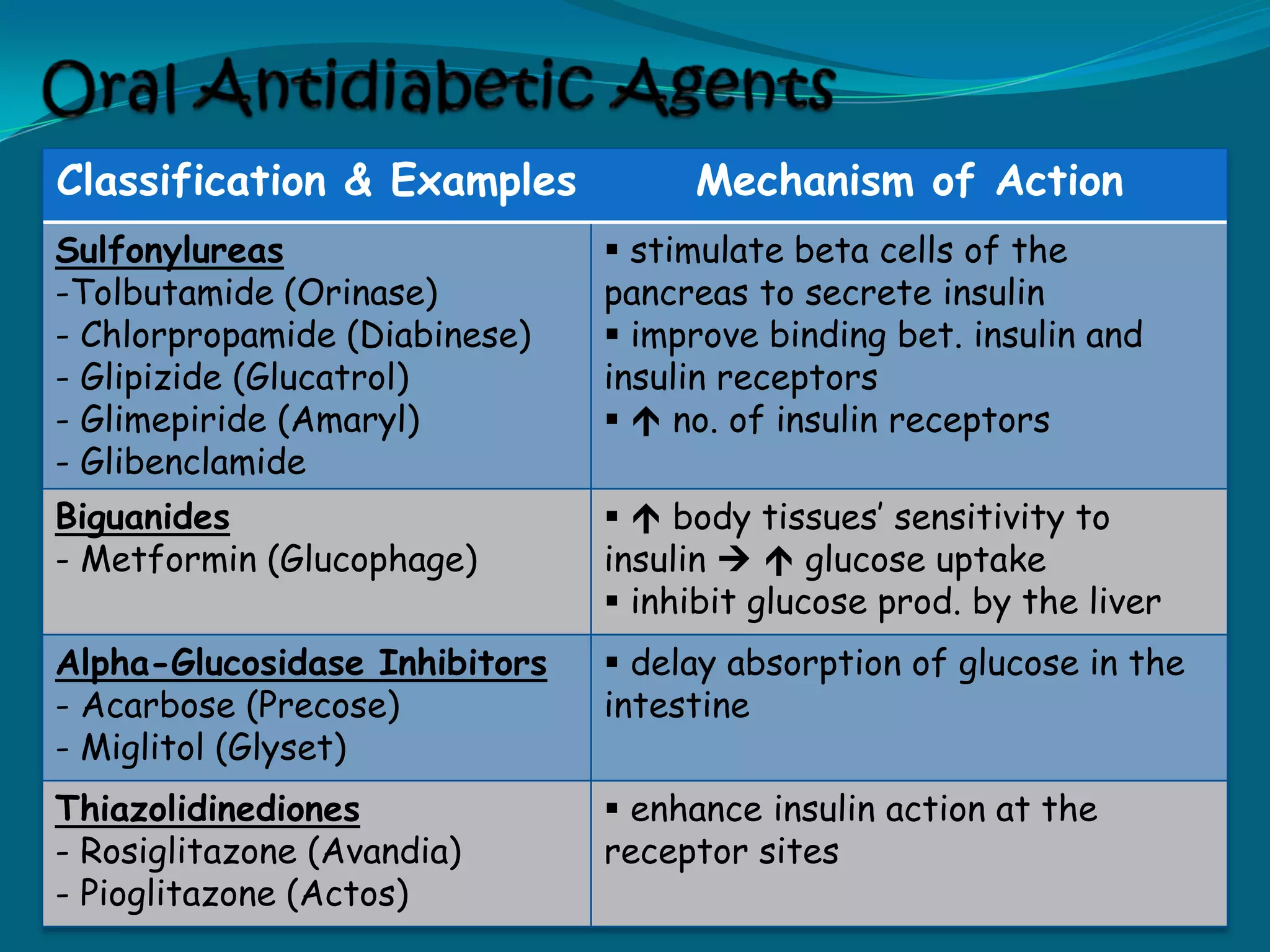
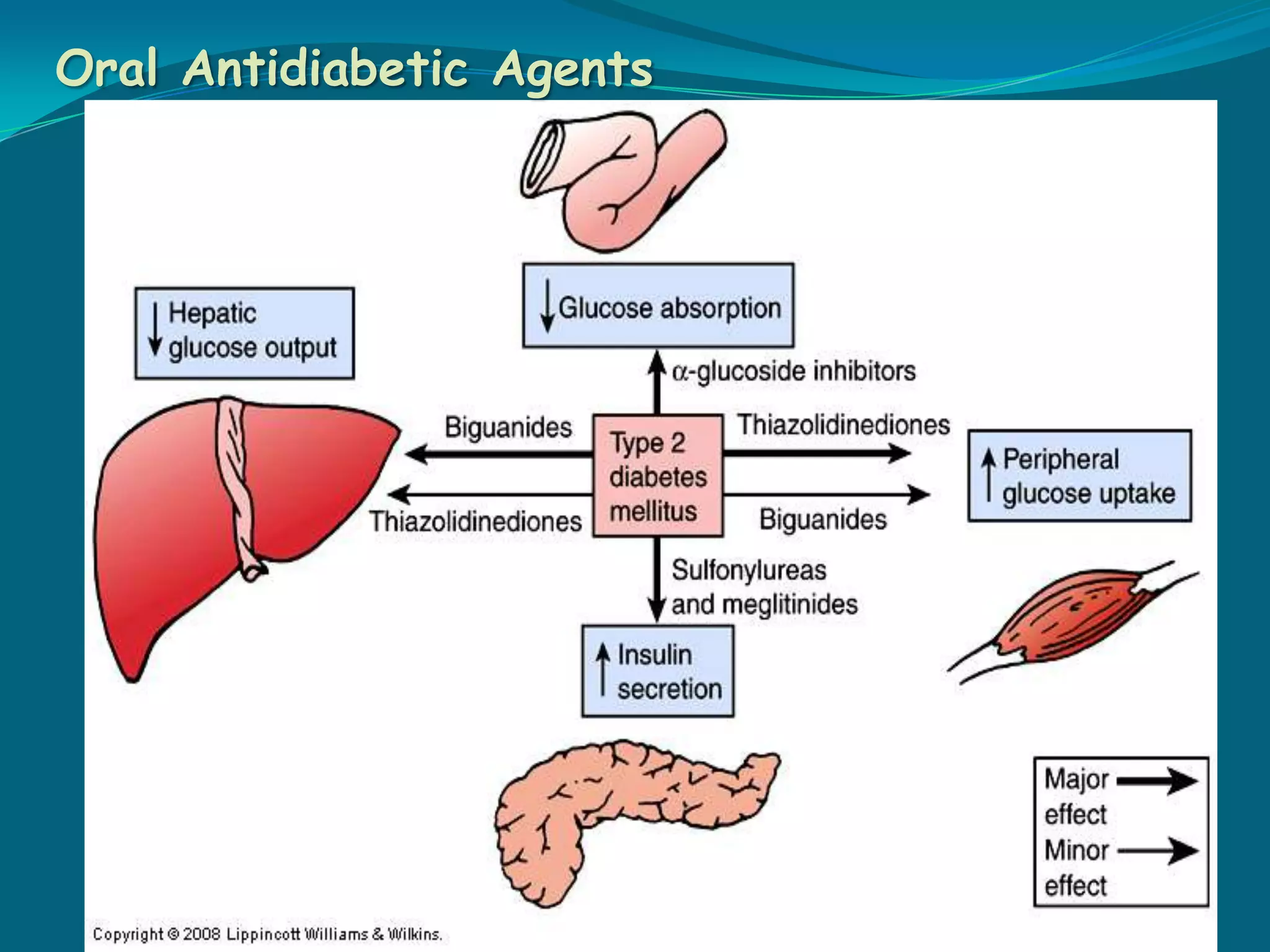
Oral Antidiabetic Agents
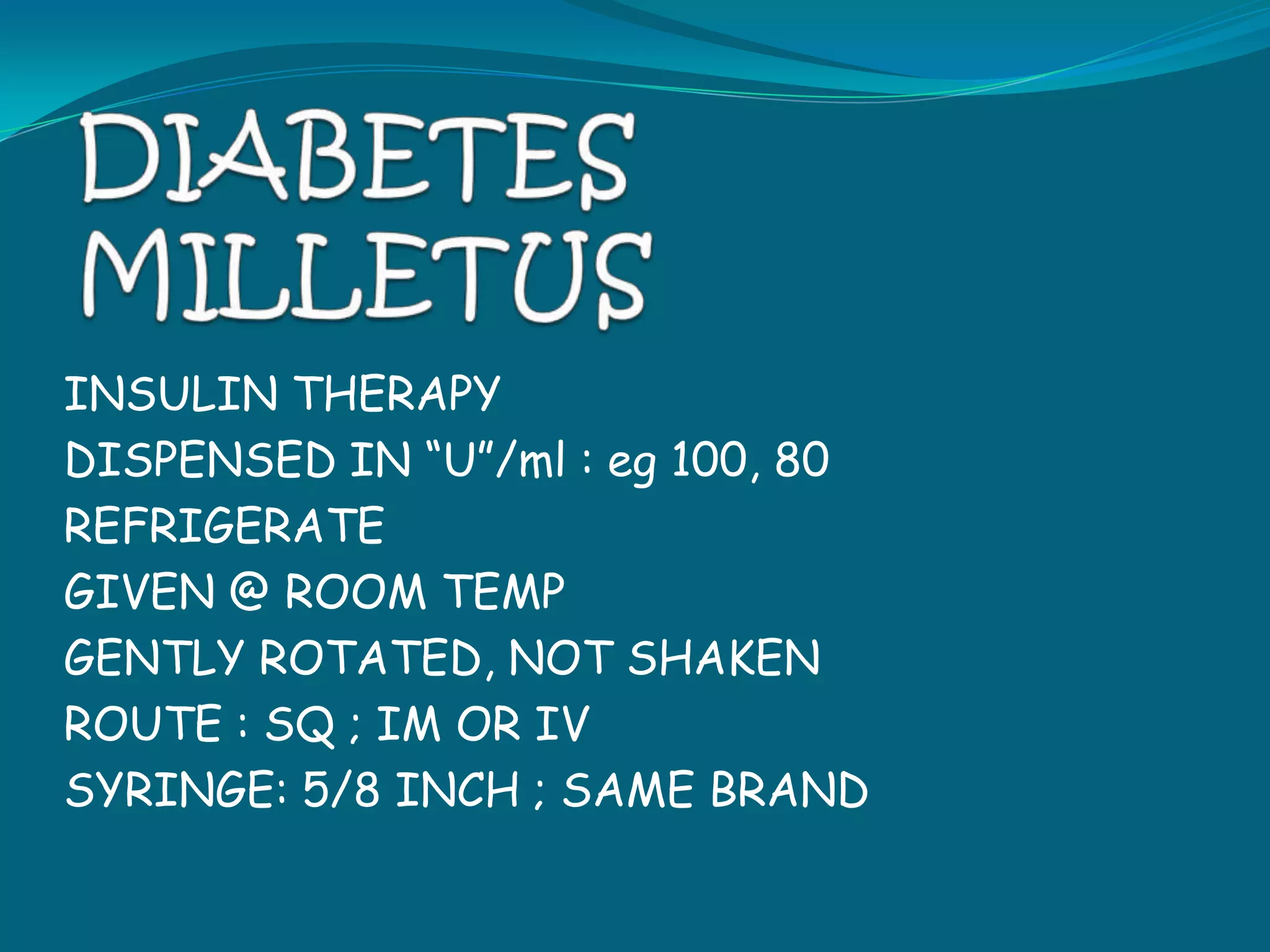
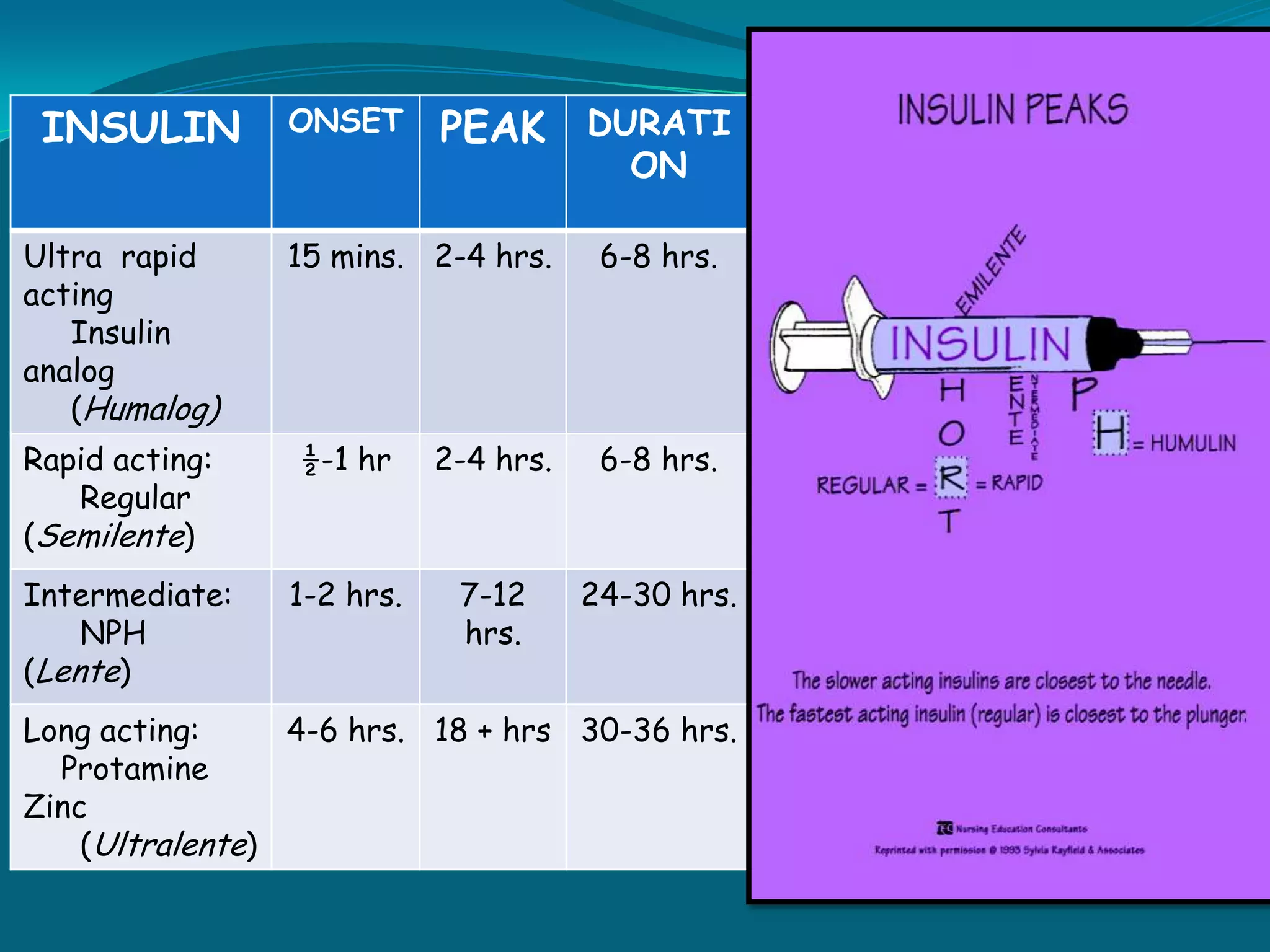
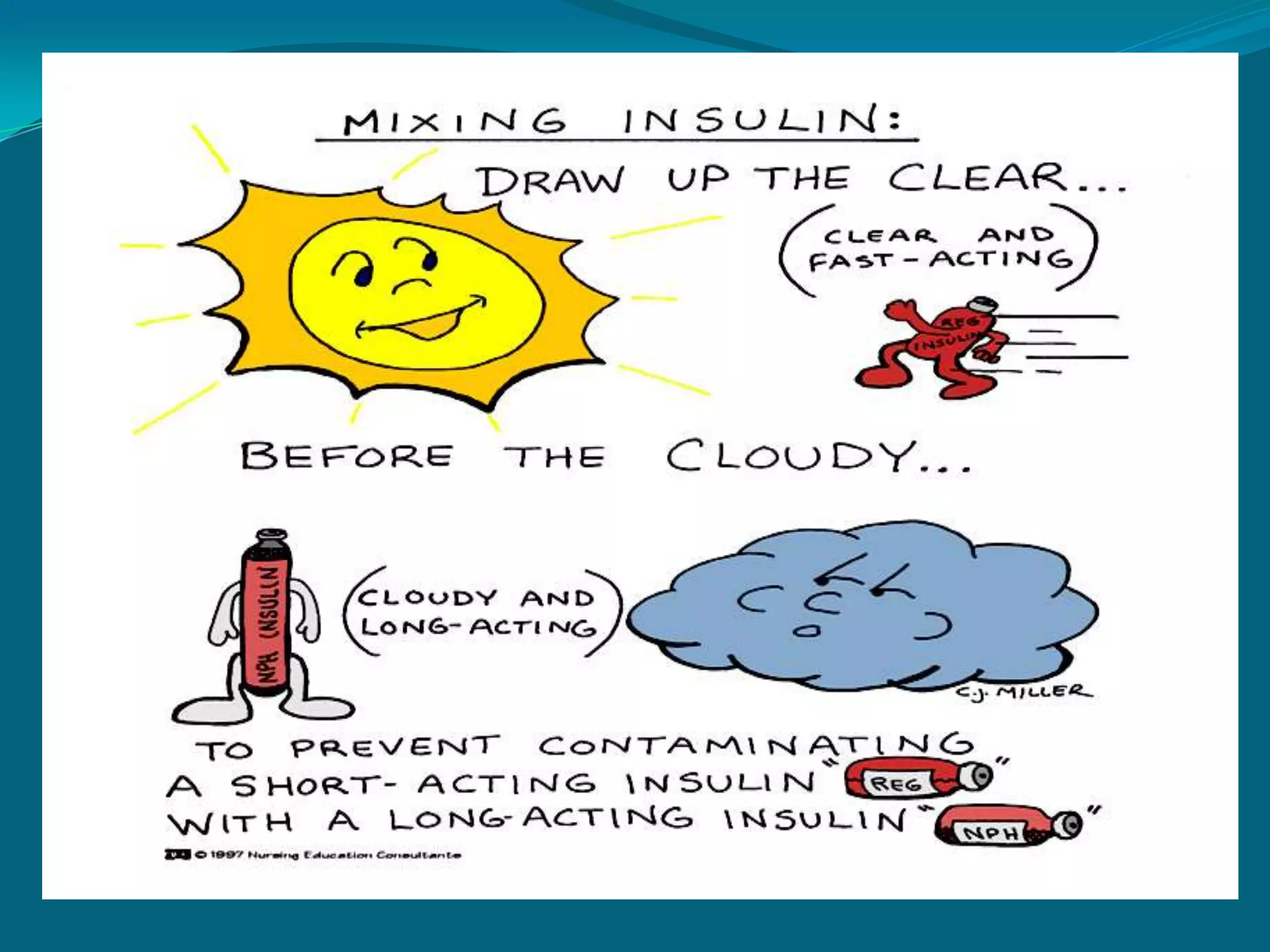
DIABETES MILLETUSINSULIN THERAPYDISPENSED IN “U”/ml : eg 100, 80REFRIGERATEGIVEN @ ROOM TEMPGENTLY ROTATED, NOT SHAKENROUTE : SQ ; IM OR IV SYRINGE: 5/8 INCH ; SAME BRAND

Endocrine New Edition

  • 1.
    ENDOCRINESYSTEM AND MAJORDISORDERSBy: MISS SHENELL A. DELFIN, RN
  • 2.
    FUNCTION:Endocrine system consistof a series of glands “ductless” that function individually or conjointly to integrate and control innumerable metabolic activities in the body.These glands automatically regulate various body processes by releasing chemical messengers called hormones.OVERACTIVITY OR UNDERACTIVITY of any one of them affects the whole system.
  • 3.
    FUNCTION:Control and coordinationof the processes which are wide spread in the body such as:Response to stress or injury
  • 4.
  • 5.
  • 6.
  • 7.
  • 8.
  • 9.
  • 11.
  • 12.
  • 15.
  • 17.
  • 19.
  • 20.
    HORMONE REGULATIONNEGATIVE FEEDBACKMECHANISMCHANGING OF BLOOD LEVELS OF CERTAIN SUBSTANCES (e..g CALCIUM & GLUCOSE)RHYTHMIC PATTERNS OF SECRETION (e.g. CORTISOL, FEMALE REPRODUCTIVE HORMONES)AUTONOMIC & C.N.S. CONTROL(PITUITARY-HYPOTHALAMIC AXIS, ADRENAL MEDULLA HORMONES)
  • 21.
    NEGATIVE FEEDBACK MECHANISMDECREASEDHORMONE CONCENTRATION IN THE BLOOD (e.g. Thyroxine)PITUITARY GLAND RELEASE OF STIMULATING HORMONE (e.g. TSH)STIMULATION OF TARGET ORGANS TO PRODUCE & RELEASE HORMONE (e.g. Thyroid gland release of Thyroxine)RETURN OF THE NORMAL CONCENTRATION OF HORMONE
  • 22.
    NEGATIVE FEEDBACK MECHANISMINCREASEDHORMONE CONCENTRATION IN THE BLOOD(e.g. Thyroxine)PITUITARY GLAND IS INHIBITED TORELEASE STIMULATING HORMONE (e.g. TSH)DECREASED PRODUCTION & SECRETION OF TARGET ORGANOF THEHORMONE (e.g. Thyroid gland release of Thyroxine)RETURN OF THE NORMAL CONCENTRATION OF HORMONE
  • 23.
    Endocrine DisordersIf youcan remember what each hormone does in the body, it will be easier to remember what results from imbalances of that hormone. Most symptoms of hormone HYPERACTIVITY are the opposite of symptoms of that hormones HYPOACTIVITY.
  • 24.
    ANTERIOR PITUITARY DISTURBANCESHYPOPITUITARISMHYPERPITUITARISM
  • 25.
  • 26.
    HyperpituitarismMay be dueto overactivity of glandor the result of an adenomaCharacterized by:Excessive serum concentrationof pituitary hormones (GH, ACTH, PRL)Morphologic and functional changesin the anterior pituitary
  • 27.
  • 28.
    Manifestations of acromegaly.Progressive alterations in facial appearance include enlargement of the cheekbones and jaw along with thickening of soft-tissue structures such as the nose, lips, cheeks, and the flesh above the brows. (Courtesy of Clinical Pathological Conference, American Journal of Medicine.)
  • 29.
    Hyperpituitarism:Clinical ManifestationsArthritisChest: barrel-shapedRoughfacial featuresOdd sensations: hands and feetMuscle weakness & fatigueEnlargement of organsGrowth of coarse hairAmenorrhea; breast milk productionLoss of vision; headachesImpotence; increased perspiration Snoring
  • 30.
  • 31.
    HypopituitarismDeficiency of oneor moreanterior pituitary hormonesCausesInfections / Inflammatory disordersAutoimmune diseasesCongenital absenceTumorSurgery / Radiation therapy
  • 32.
    Hypopituitarism:Clinical ManifestationsHypo-thermia, -glycemia,-tensionLoss of vision, strength, libido, & secondary sexual characteristics
  • 33.
  • 34.
    MANAGEMENTHYPOPITUITARISMSURGICAL REMOVAL /IRRADIATIONREPLACEMENT THERAPYTHYROID HORMONESSTEROIDSSEX & GROWTH HORMONESGONADOTROPINS (restore fertility)HYPERPITUITARISMSURGICAL REMOVAL / IRRADIATIONMONITOR FOR HYPERGLYCEMIA & CARDIOVASCULAR PROBLEMS
  • 35.
  • 36.
    POSTERIOR PITUITARY DISTURBANCESDIABETESINSIPIDUSSYNDROME OF INAPPROPRIATE ANTIDIURETIC HORMONE
  • 37.
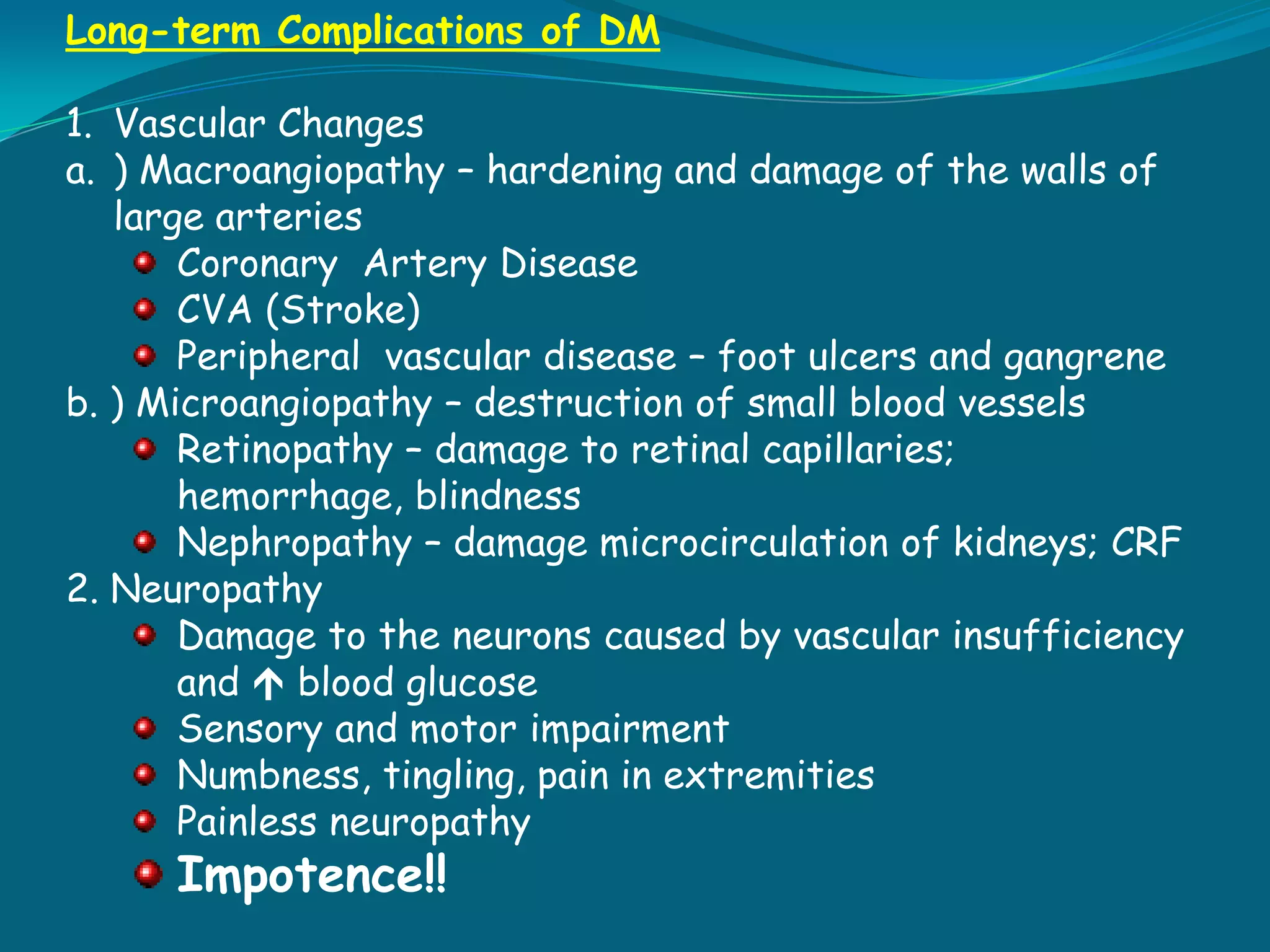
    FUNCTION:WHEN THEREIS A OF SERUM OSMOLALITY, THE NORMAL BODY RESPONSE IS TO THE SECRETION OF ADH.WHEN THE NORMAL FEEDBACK MECHANISM FOR ADH IS SUSTAINED, THERE IS EXCESSIVE WATER RETENTION IN THE BODYWHEN THERE IS OR INADEQUATE AMOUNT OF ADH, THE BODY IS UNABLE TO CONCENTRATE URINE, & EXCESSIVE H2O LOSS OCCURS
  • 40.
    DIABETES INSIPIDUSCHARACTERIZED BYA DEFICIENCY OF ADH. WHEN IT OCCURS, IT IS MOST OFTEN ASSOCIATED WITH :NEUROLOGICAL CONDITIONS, SURGERY, TUMORS, HEAD INJURY, OR INFLAMMATORY PROBLEMS
  • 41.
    DIABETES INSIPIDUS ABSOLUTE/ PARTIAL DEFICIENCY OF VASOPRESSINS/SX:POLYURIA 15-29L/ DAYPOLYDIPSIASG OF URINE IS <1.010S/SX OF DHNSHOCK
  • 42.
    DIABETES INSIPIDUS ABSOLUTE/ PARTIAL DEFICIENCY OF VASOPRESSINMANAGEMENTHORMONAL REPLACEMENT – FOR LIFEVASOPRESSIN (PITRESSIN TANNATE IN OIL) – IM OR NASAL SPRAYNON-HORMONAL THERAPYCHLORPROPRAMIDE – INCREASE RESPONSE OF THE BODY TO DECREASEDVASOPRESSININCREASE FLUIDSMONITOR I&O + WEIGHT (MIOW)MAINTAIN FLUID & ELECTROLYTE BALANCE
  • 43.
    SYNDROME OF INAPPROPRIATEADH(SIADH)ELEVATED ADHS/SX:DECREASED SERUM SODIUMCX IN LOC TO UNCONSCIOUSNESSSEIZURESWATER INTOXICATIONN/VMENTAL CONFUSIONPersistent excretion of concentrated urineSigns of fluid overloadHyponatremia
  • 44.
    SYNDROME OF INAPPROPRIATEADHMANAGEMENT:WATER INTAKE RESTRICTIONADMINISTER AS ORDERED:NaClDiureticsDemeclocycline (declamycin) – a tetracycline analogue that interferes with the action of ADH on the collecting tubules
  • 45.
  • 47.
    Hypothyroidism underactive stateof the thyroid gland hyposecretion of thyroid hormone most common in women, middle-age primary function is to control the level of cellular metabolism by secreting thyroxin (T4) and triiodothyronine (T3)DX: decreased T3, T4 Elevated TSH, cholesterol
  • 48.
    HypothyroidismA state oflow serum TH levelsor cellular resistance to THIodine deficiencyOncologicAutoimmuneDrugsDevelopmentalIatrogenicDietaryNon-thyroidalEndocrine
  • 49.
    Pathophysiology inadequate secretionof thyroid hormone  general slowing of all physical and mental process
  • 50.
  • 51.
     oxidationof nutrients for energy
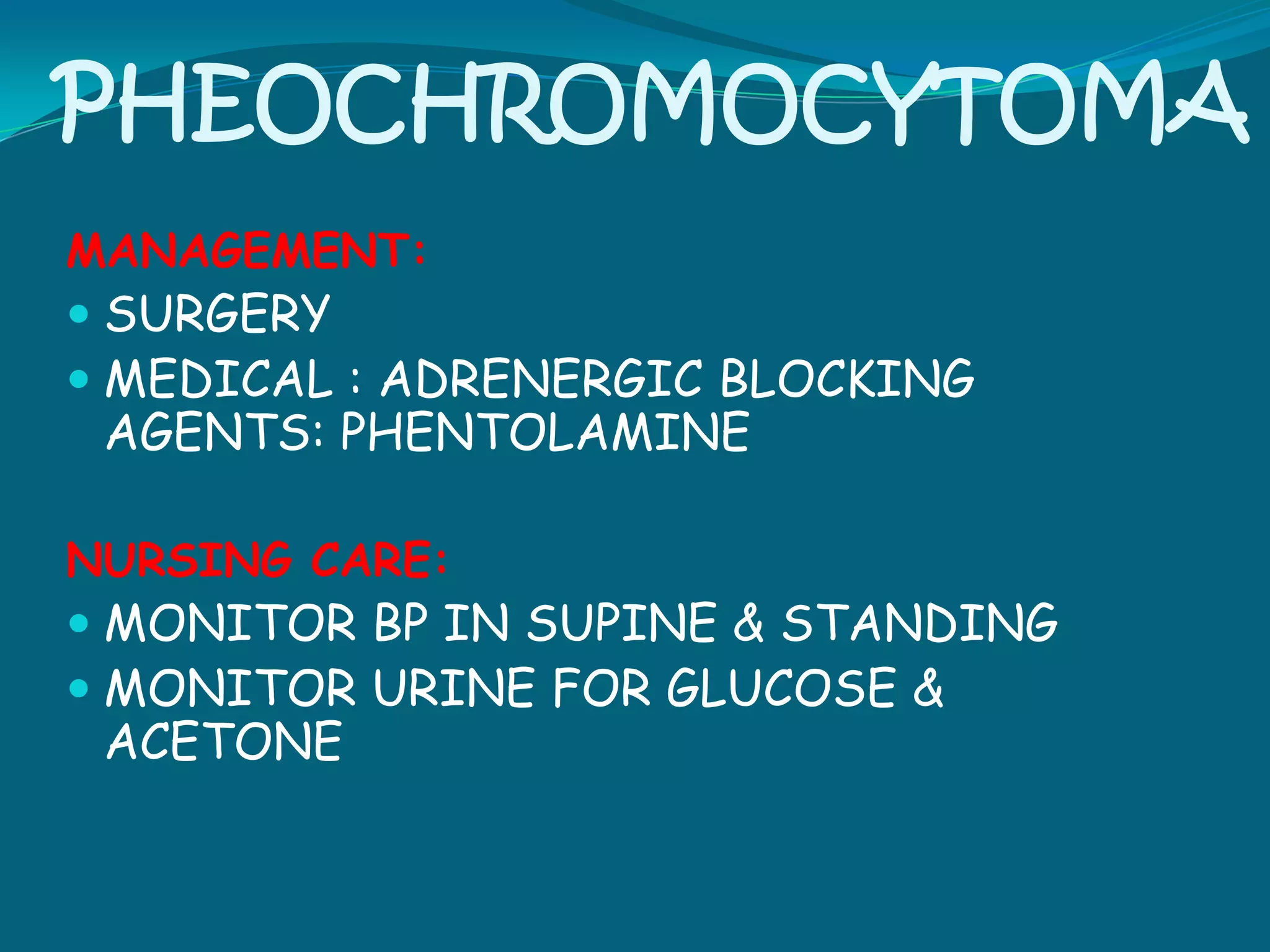
  • 52.
     heatproduction
  • 53.
    Complications :Cretinism– severephysical and mental retardation resulting from severe deficiency of thyroid function in infancy or childhood (congenital hypothyroidism) requires lifetime hormone replacementMyxedema– occur from prolonged severe disease accelerated devt. of coronary artery disease coma – rapid dev’t. of impaired consciousness and suppression of vital functions
  • 54.
    MYXEDEMA COMA- a condition resulting from persistent low thyroid production.
  • 55.
    Med. Mgt. –thyroid replacement therapyLevothyroxine(Synthyroid) ,liothyronine Expected effects: diuresis, puffiness, improved reflexes and muscle tone, PR
  • 56.
    Nsg. Interventions provide a warm environment, conducive to rest
  • 57.
    avoiduse of all sedatives
  • 58.
    assistclient in choosing calorie,  cholesterol diet
  • 59.
    fluid and fiber to relieve constipation
  • 60.
    physical activity and sensory stimulation gradually as condition improves
  • 61.
    monitorcardiovascular response to increased hormone levels carefully
  • 62.
    provideinfo. about prescribed medications (name, dosage, side effects) and importance of lifelong medical supervision
  • 63.
    Hyperthyroidism over-secretion ofthe thyroid gland also called thyrotoxicosis or graves disease, tissues are stimulated by excessive thyroid hormone a recurrent syndrome, may appear after emotional stress or infection occurs mostly in women 20-50 yrs oldCauses : adenoma, goiter, viral inflammation, auto-immune glandular stimulation, grave’s disease - most common cause
  • 64.
    Hyperthyroidism (cont.)DX: >elevated T3, T4 valuesT4= 5-12mcg/dl , T3= 70-220 ng/dl , TSH= 0.2-5.4 mU/Labnormal findings in the thyroid scanGoiter – enlargement of the thyroid gland due to  stimulation of the thyroid gland by TSHSimple goiter – enlarged thyroid glanddue to iodine deficiency, intake of goitrogenic foods  cabbage, turnips, soybeans
  • 65.
    may be hereditaryGrave’sDisease disorder char. by one or more of the ff: diffuse goiter hyperthyroidism infiltrative opthalmopathy  exophthalmos seen in females under age 40
  • 66.
    result fromstimulation of the thyroid gland by thyroid-stimulating immunoglobulins (TSI) cause is unknown, may be hereditary, gender-related, often occurs after severe emotional stress or infection
  • 68.
    Complications : cardiovasculardisease (HPN, Angina, CHF) Exophthalmos – abnormal protrusion of the eyeballs caused by abnormal deposits of fat and fluid in the retroocular tissue Corneal abrasion Thyroid storm or crisis  life-threatening hypermetabolism and excessive adrenergic response (HR, RR, BP)
  • 69.
    Thyroid Storm orCrisis a medical emergency pts. develop severe manifestation of hyperthyroidism  temp., tachycardia, dysrhythmias worsening tremors, restlessness delirious or psychotic state or coma abdominal pain  BP and RRPrecipitated by a major stressor: infection trauma or surgery (thyroidectomy) inadequate treatment
  • 70.
    Do you takethis woman as your wife…. In sickness and in health…TAKE ME! TAKE ME!!
  • 72.
  • 73.
  • 74.
  • 75.
  • 76.
  • 77.
  • 78.
  • 79.
  • 80.
  • 81.
    Heart failureMed. Mgt.MedicationsPropylthiouracil (PTU) – antithyroid drug - blocks thyroid hormone production - can cause agranulocytosis - monitor pt. CBCMethimazole (Tapazole) – blocks TH prod. Iodine preparations –  the size and vascularity of the thyroid gland; inhibit release of thyroid hormones 1.) Lugol’s solution can be given with milk or fruit juice should be taken with a straw – may stain the teeth complications : brassy taste in the mouth, sore teeth and gums2.) Saturated solution of potassium iodide (SSKI)
  • 82.
    Med. Mgt.Medications Propanolal(Inderal) and other adrenergic blockers relieve the adrenergic effects of excess thyroid hormone (sweating, palpitations, tremors)Radioactive iodine – limits the secretion of the hormone by damaging or destroying thyroid tissueSurgical intervention (performed only when pt. is in aeuthyroid state) subtotal thyroidectomy (large goiter)
  • 83.
    total thyroidectomy(if carcinoma is present)Nsg. Interventions:Provide calm, restful envt. physical comfort, cool envt. temp., bathe frequently w/ cool waterprovide adequate rest, avoid muscle fatigue stressors in the envt.— noise and lightsrelaxation techniquesProvide adequate nutrients calorie,  protein, balanced diet (4,000-5,000 cal/day) fluid intakeRestrict stimulants (tea, coffee, alcohol)small, frequent feedings if hypermotility is presentDaily wt.
  • 84.
    Nsg. Interventions:Provide emotionalsupportProvide eye careeye drops, dark glasses, patch eyes if necessaryelevate head of bed for sleeprestrict dietary sodiumassess adequacy of lid closureBe alert for complications
  • 85.
    Post-op care afterThyroidectomy O2 therapy, suction secretions
  • 86.
    Monitor forsigns of bleeding and excessive edema
  • 87.
    elevate headof bed 30o, support head and neck – to avoid tension on suturescheck dressing frequently, check behind the neck for bleeding assess for signs of resp. distress, hoarseness (laryngeal edema or damage) keep tracheostomy set in patient’s room for emergency use
  • 88.
    Post-op Complications: bealert for the possibility of:1. Tetany(due to hypocalcemia caused by accidental removal of parathyroid glands)assess for numbness, tingling or muscle twitching
  • 89.
    Chvostek’s signand Trousseau’s sign
  • 90.
    Ca+ gluconateIV2. HemorrhageWOF: hypotension, tachycardia, other signs of hypovolemia
  • 91.
    WOF: irregular breathing,swelling, choking---possible hemorrhage and tracheal compression
  • 92.
    WOF: early signsof hemorrhage: repeated clearing of the throat, difficulty swallowingPost-op Complications: be alert for the possibility of:3. Thyroid storm - life-threatening - sudden  release of thyroid hormone - fever, tachycardia, increasing restlessness and agitation, delirium
  • 95.
  • 98.
    Promotes resorption ofcalcium from bone to maintain normal serum calcium levelsCALCIUM DEPOSITED IN THE BONEMobilization of calcium and phosphorous from boneRenal: increases calcium reabsorption and phosphate excretionCALCIUM STAYS IN THE BONEEXCRETION OF CALCIUM Hypoparathyroidism is characterized by decrease in the PTH levelPARATHYROID HORMONETINGLING OF FINGERS
  • 99.
  • 100.
  • 101.
  • 102.
  • 103.
    BRONCHOSPASMFunction of calcium:maintains N muscle and neuromuscular responses.
  • 104.
    Necessary component forblood coagulation mechanismsPromotes absorption of calcium in the GI tract ( by stimulating kidneys to convert vit.D to its active form).HYPOCALCEMIA
  • 105.
    TESTS USED TOELICIT SIGNS OF CALCIUM DEFICIENCYTROUSSEAU'SSIGNCHVOSTEK'SSIGN
  • 106.
    PARATHYROID DISORDERSDIAGNOSTIC TESTS:HEMATOLOGICALSERUMCALCIUMSERUM PHOSPHORUSSERUM ALKALINE PHOSPHATASEURINARY STUDIESURINARY CALCIUMURINARY PHOSPHATE - TUBULAR REABSORPTION OF PHOSPHATE
  • 107.
    HYPOPARATHYROIDISMXRAY: INCREASED BONEDENSITYMANAGEMENT:Ca SUPPLEMENTVIT D SUPPLEMENT – LIQ FORM: WITH WATER, JUICE OR MILK, pcSEIZURE precLISTEN FOR STRIDOR OR HOARSENESSTRACHEOSTOMY SET @ BEDSIDECaGLUCONATE @ BEDSIDE
  • 108.
    T ETANYAKERACHEOSTOMYC ALCIUMGLUCONATEAREALCIUM 8.6 – 10.6 mg / dL
  • 109.
    HYPERCALCEMIA, LACK OFRESORPTION OF CALCIUM INTO THE BONE( BONE CYST AND PATHOLOGIC FRACTURE)Promotes resorption of calcium from bone to maintain normal serum calcium levelsTUBULAR CALCIUM DEPOSIT- KIDNEY STONES, AZOTEMIA, HPN BY RF, RENAL FAILURECALCIUM RELEASED INTO THE BLOOD LEADS TO BONE DAMAGEMobilization of calcium and phosphorous from boneRenal: increases calcium reabsorption and phosphate excretionHyperparathyroidism is characterized by excesssive secretion of PTHPARATHYROID HORMONEFunction of calcium: maintains N muscle and neuromuscular responses.
  • 110.
    Necessary component forblood coagulation mechanismsMUSCLE WEAKNESSPERSONALITY CHANGESCARDIAC ARRHYTHMIASPromotes absorption of calcium in the GI tract ( by stimulating kidneys to convert vit.D to its active form).ANOREXIAN/VCONSTIPATIONPEPTIC ULCER DSE
  • 111.
    HYPERPARATHYROIDISMINCREASED PTH PRODUCTIONHYPERCALCEMIAHYPOPHOSPHATEMIAPRIMARY – TUMOR OR HYPERPLASIA OF THE PARATHYROID GLANDSECONDARY – COMPENSATORY OVERSECRETION OF PTH IN RESPONSE TO HYPOCALCEMIA FROM:CHRONIC RENAL DSEMALABSORPTION SYNDROMEOSTEOMALACIA
  • 112.
    HYPERPARATHYROIDISMMANAGEMENT:TX OF CHOICE: SURGICAL REMOVAL OF HYPERPLASTIC TISSUEIV PNSS 5L/ DAY WITH DIURETICSCRANBERRY JUICE (ACID-ASH)LOW CaSTRAIN URINE FOR STONESCARE FOR PARATHYROIDECTOMY
  • 113.
  • 114.
  • 116.
    TWO TYPES OFDIABETES
  • 117.
    Diabetes Mellitus isa chronic disorder of carbohydrate, protein, and fat metabolism resulting from insulin deficiency or abnormality in the use of insulinPredisposing factors: exact cause of diabetes mellitus remain unknown
  • 118.
    genetic /hereditary predisposition
  • 119.
  • 120.
  • 121.
  • 122.
  • 123.
    obesity (overweightpeople require more insulin to metabolize the food they eat or the number of insulin receptor sites in cells is decreased)
  • 124.
    TypesInsulin – DependentDiabetes Mellitus (IDDM) or Type I destruction of beta cells of the pancreas  little or no insulin production requires daily insulin admin.
  • 125.
    may occurat any age, usually appears below age 15Non Insulin–Dependent Diabetes Mellitus (NIDDM) or Type II probably caused by:
  • 126.
    disturbance ininsulin reception in the cells
  • 127.
     number ofinsulin receptors
  • 128.
    loss ofbeta cell responsiveness to glucose leading to slow or  insulin release by the pancreas occurs over age 40 but can occur in children
  • 129.
    common inoverweight or obese
  • 130.
    w/ somecirculating insulin present, often do not require insulin
  • 133.
  • 135.
    DIAGNOSTIC TEST FORDMFasting Blood Sugar (FBS)NPO for 12 hours
  • 136.
  • 137.
    140 mg/dlor more – diagnostic of DMPostprandial blood sugarBlood is withdrawn 2 hrs. after a meal
  • 138.
    N value =< 120mg/dl
  • 139.
    200 mg/dl ormore is diagnostic of DM3. Oral Glucose Tolerance Test (OGTT)NPO 12 hrs, no smoking, coffee or tea, minimize activity, minimize stress
  • 140.
    obtain FBS, administer100 gm. Glucose by mouth diluted in juice; obtain blood and urine specimen after 1, 2 and 3 hrs.
  • 141.
    N value =blood glucose rise to 140 mg/dl in the 1st hour and returns to normal by 2nd and 3rd hrs.
  • 142.
    Abnormal = bloodglucose does not return to normal by 2nd and 3rd hrs.; all urine specimen positive for glucoseDiagnostic Tests for DM4. Glycosylated hemoglobinProvides information about blood glucose level during the previous 3 months
  • 143.
    bec. glucose inthe bloodstream attaches to some of the hemoglobin and stay attached during the 120-day lifespan of the RBCD-I-A-B-E-T-E-SD- DIET: 50-60% CHO, 20-30% FATS, 10-20% CHONI- INSULIN– TYPE 1A- ANTIDIABETIC AGENTS– TYPE 2B- BLOOD SUGAR MONITORINGE- EXERCISET- TRANSPLANT OF PANCREASE- ENSURE ADEQUATE FOOD INTAKES- SCRUPULOUS FOOT CARE
  • 145.
    Management of HypoglycemiaGivesimple sugar orally if pt. is conscious and can swallow – orange juice, candy, glucose tablets, lump of sugarGive Glucagon (SQ or IM) if pt. is unconscious or cannot take sugar by mouthAs soon as pt. regains consciousness, he should be given carbohydrate by mouthIf pt. does not respond to the above measures, he is given 50 ml of 50% glucose I.V. or 1000 ml of 5%-10% glucose in water I.V.
  • 147.
  • 148.
  • 149.
    DIABETES MILLETUSINSULIN THERAPYDISPENSEDIN “U”/ml : eg 100, 80REFRIGERATEGIVEN @ ROOM TEMPGENTLY ROTATED, NOT SHAKENROUTE : SQ ; IM OR IV SYRINGE: 5/8 INCH ; SAME BRAND
  • 151.
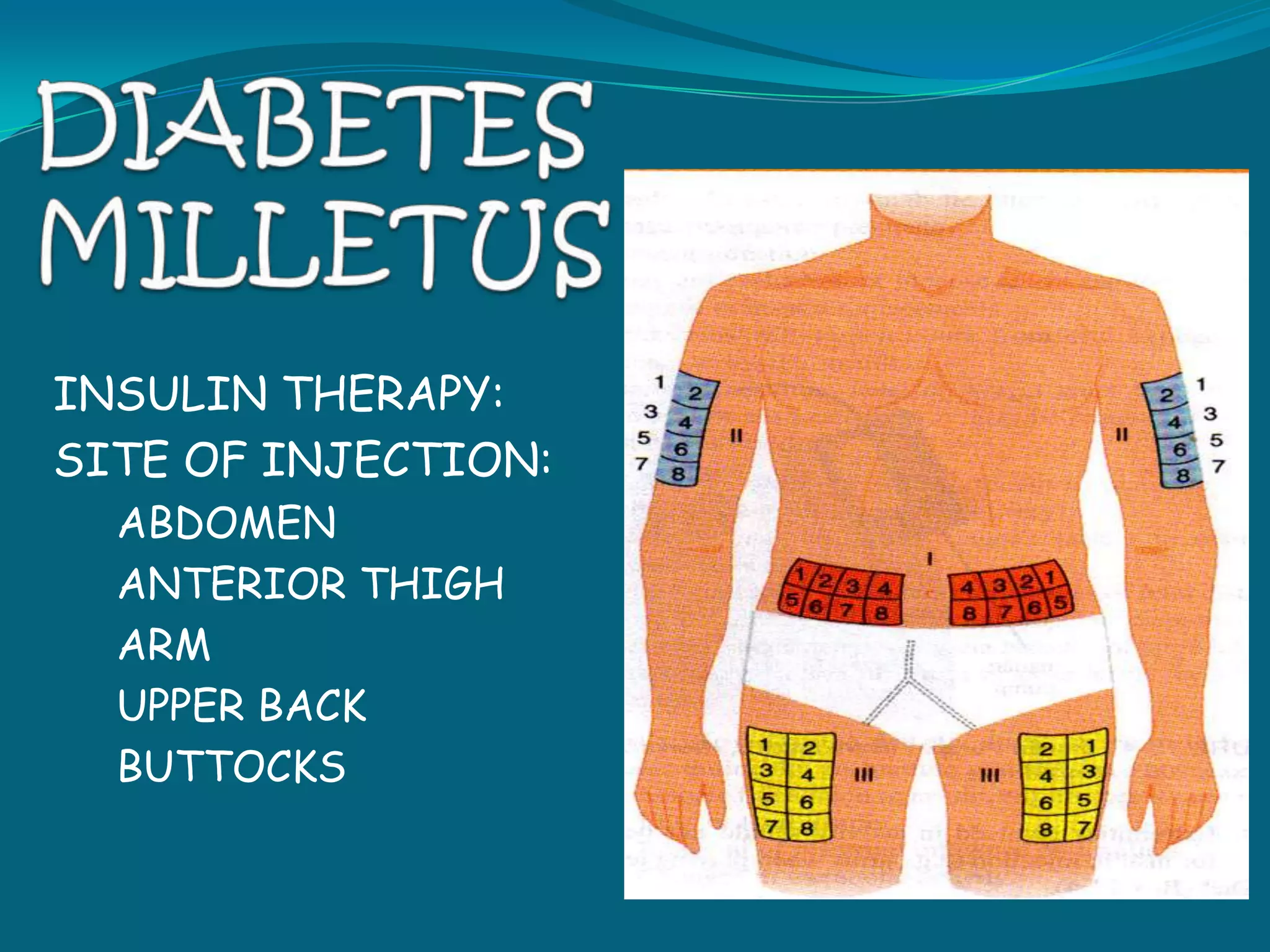
    DIABETES MILLETUSINSULIN THERAPY:SITEOF INJECTION:ABDOMENANTERIOR THIGHARM UPPER BACK BUTTOCKS
  • 154.
    B. Teach pt.on correct administration of insulin and other hypoglycemic agents.insulin in current use may be stored at room temp., all others in ref. or cool areaavoid injecting cold insulin  lead to tissue reactionroll insulin vial to mix, do not shake, remove air bubbles from syringepress (do not rub) the site after injection (rubbing may alter the rate of absorption of insulin)avoid smoking for 30 mins. after injection (cigarette smoking absorption)Rotate sitesFailure to rotate sites may lead to Lipodystrophy
  • 155.
    Lipodystrophy – localizeddisturbance of fat metabolism
  • 156.
    Ex. Lipohypertrophy –thickening of subcutaneous tissue at injection site, feel lumpy or hard, spongy result to  absorption of insulin making it difficult to control the pt.’s blood glucose
  • 157.
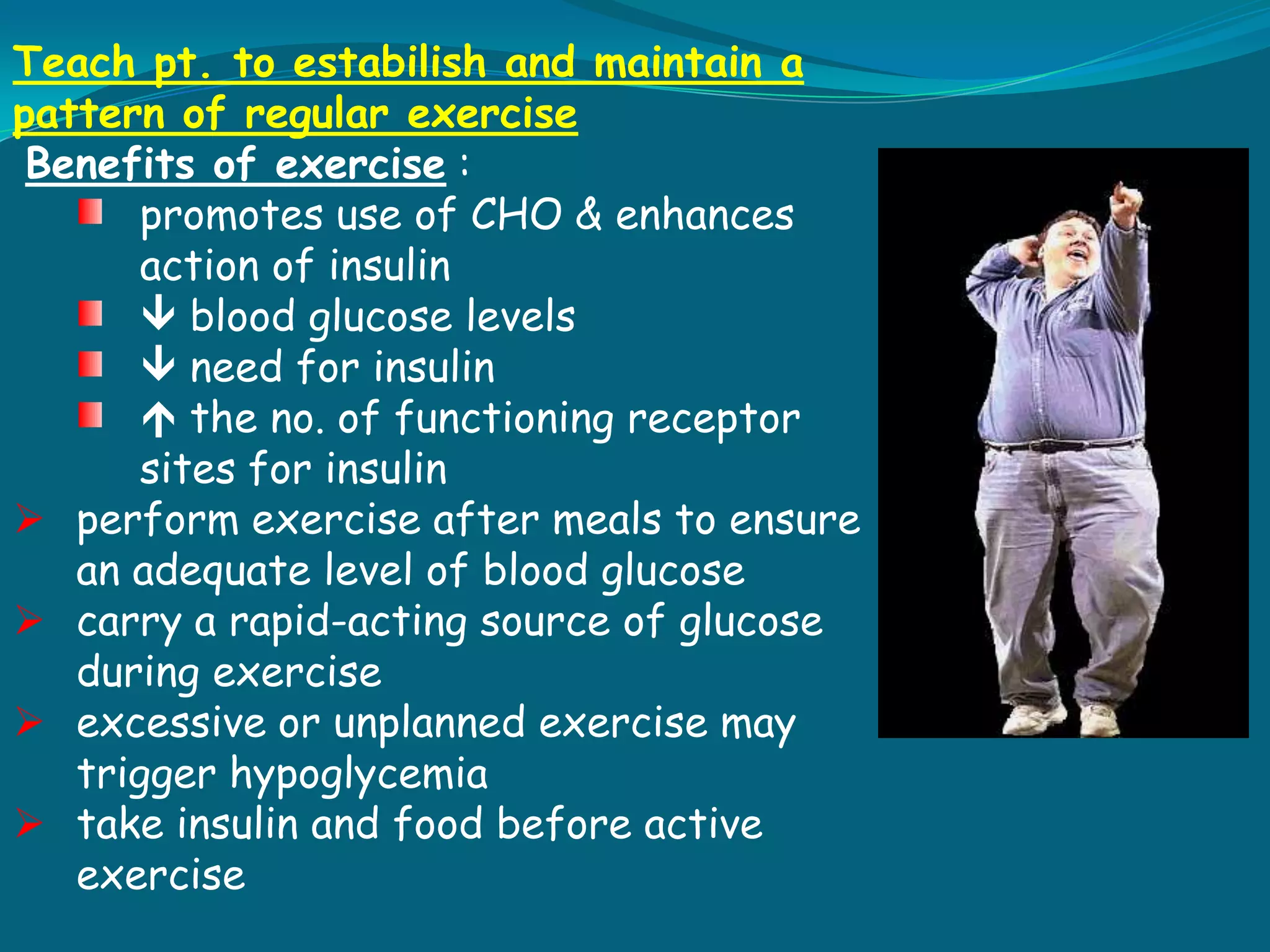
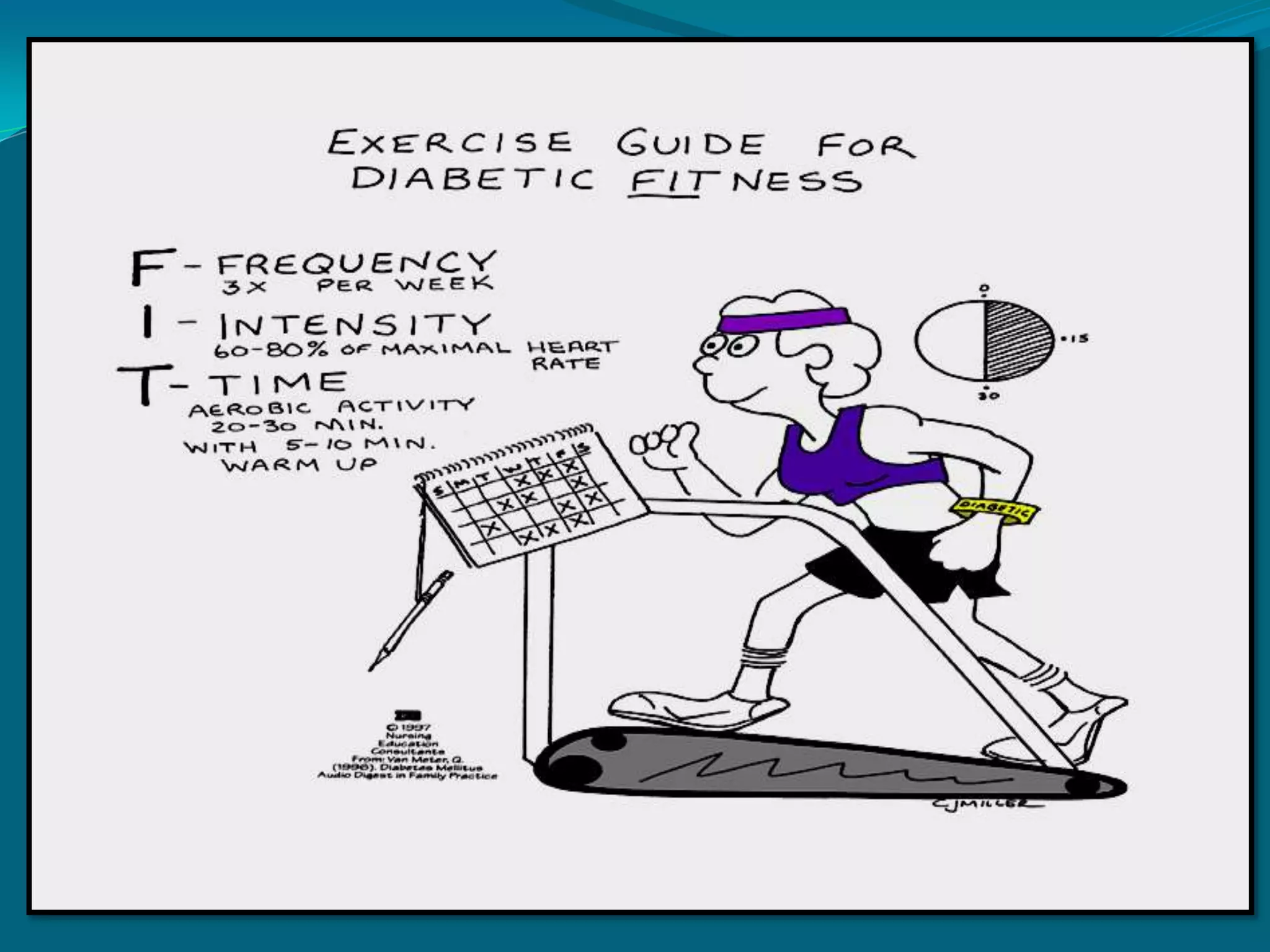
    Teach pt. toestabilish and maintain a pattern of regular exerciseBenefits of exercise : promotes use of CHO & enhances action of insulin blood glucose levels need for insulin the no. of functioning receptor sites for insulinperform exercise after meals to ensure an adequate level of blood glucose
  • 158.
    carry a rapid-actingsource of glucose during exercise
  • 159.
    excessive or unplannedexercise may trigger hypoglycemia
  • 160.
    take insulin andfood before active exercise
  • 161.
    ACUTE COMPLICATIONS OFDIABETES MILLETUSDIABETIC KETO-ACIDOSIS (DKA)INSULIN SHOCKHYPERGLYCEMIC, HYPEROSMOLAR, NONKETOTIC (HHONK) COMA
  • 163.
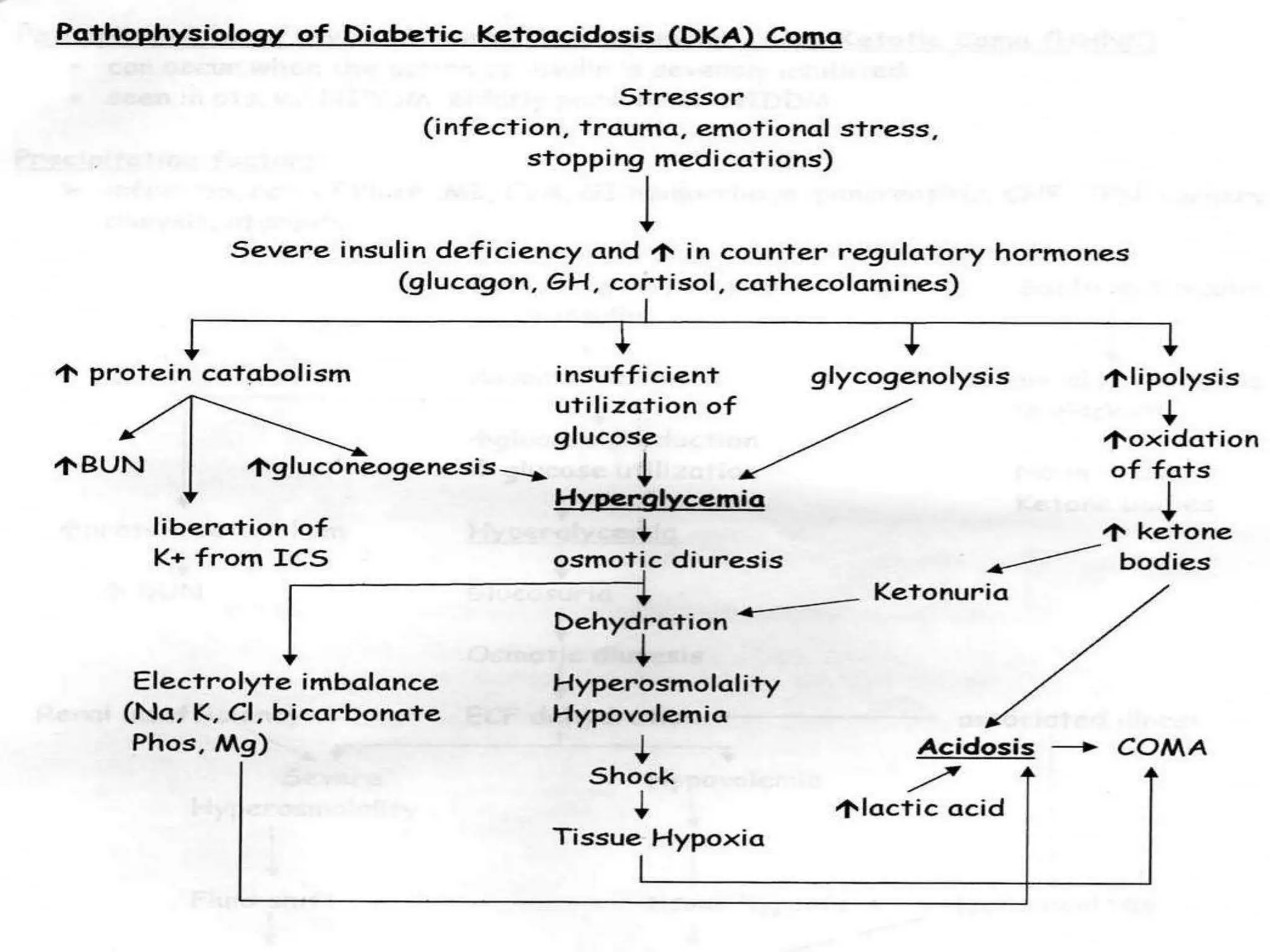
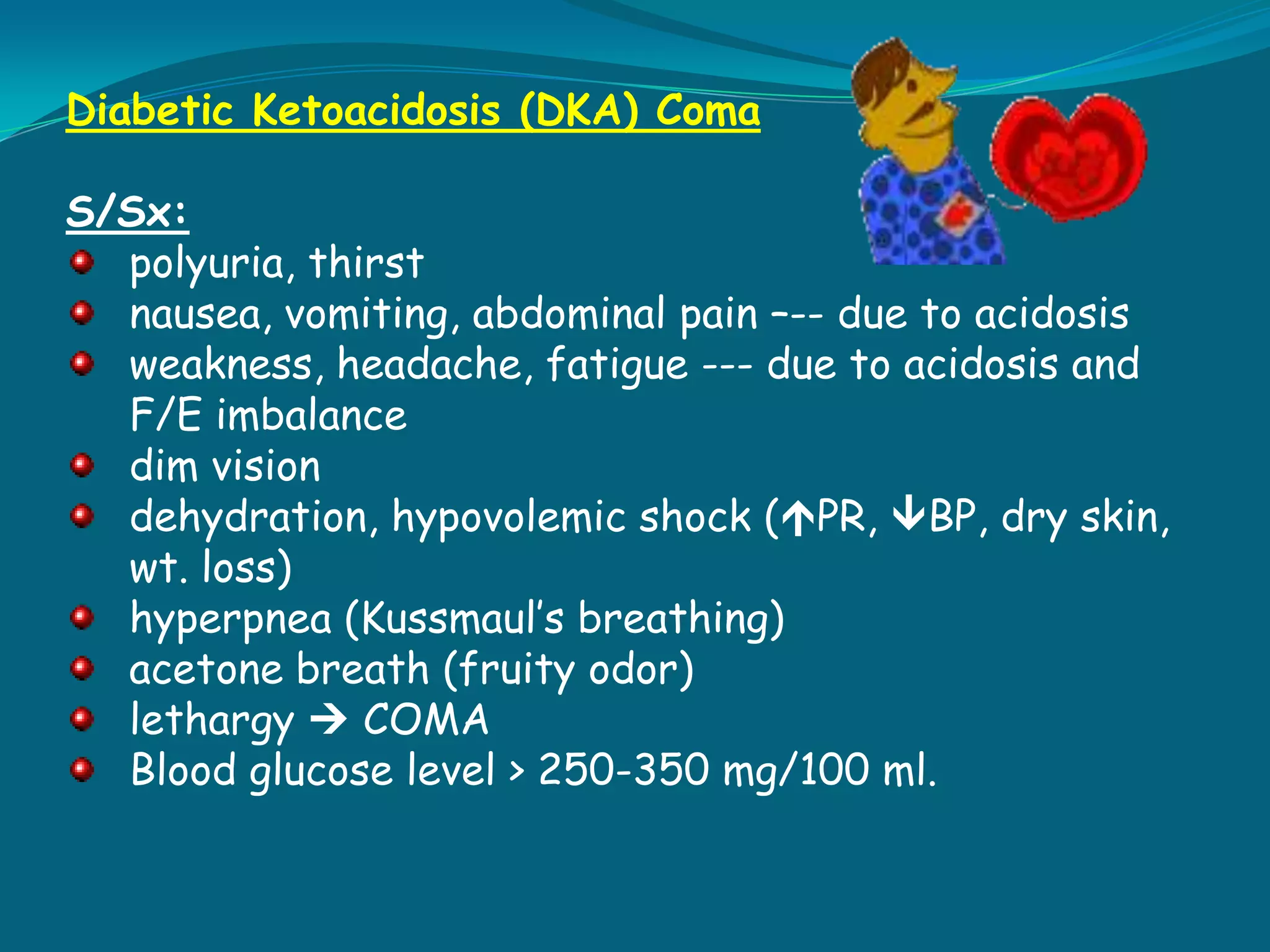
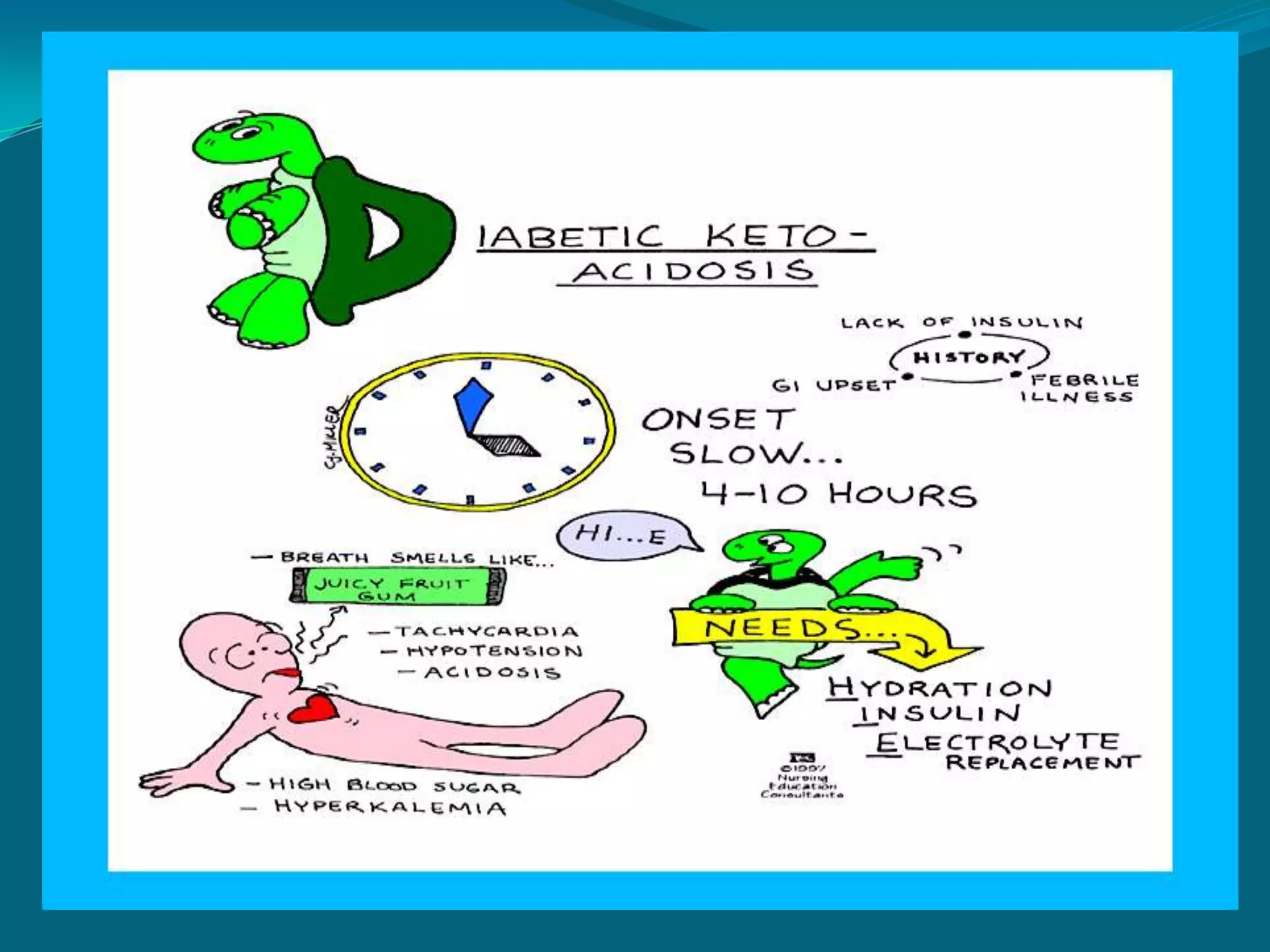
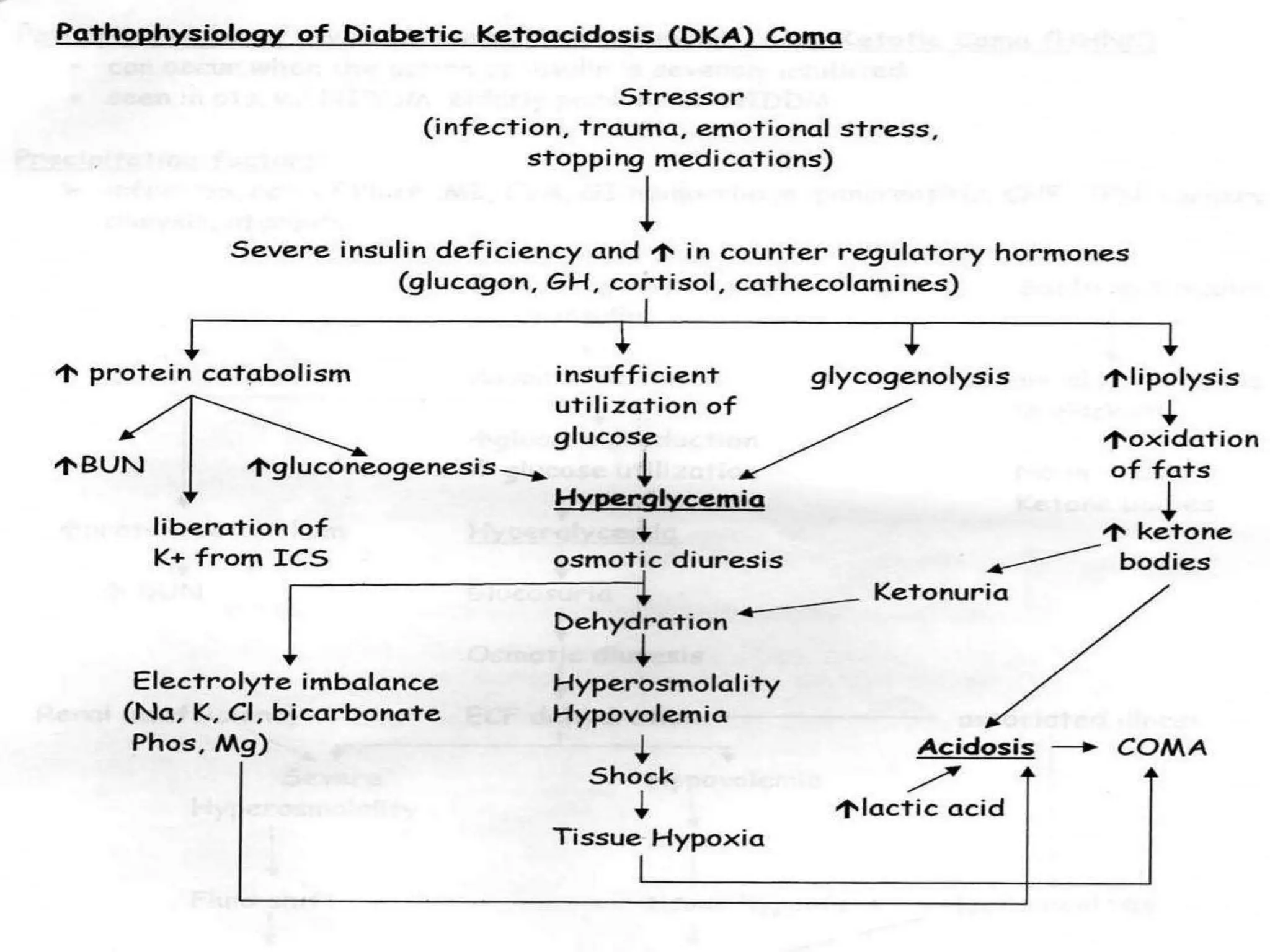
    Diabetic Ketoacidosis (DKA)ComaS/Sx:polyuria, thirstnausea, vomiting, abdominal pain –-- due to acidosisweakness, headache, fatigue --- due to acidosis and F/E imbalancedim visiondehydration, hypovolemic shock (PR, BP, dry skin, wt. loss)hyperpnea (Kussmaul’s breathing)acetone breath (fruity odor)lethargy  COMABlood glucose level > 250-350 mg/100 ml.
  • 167.
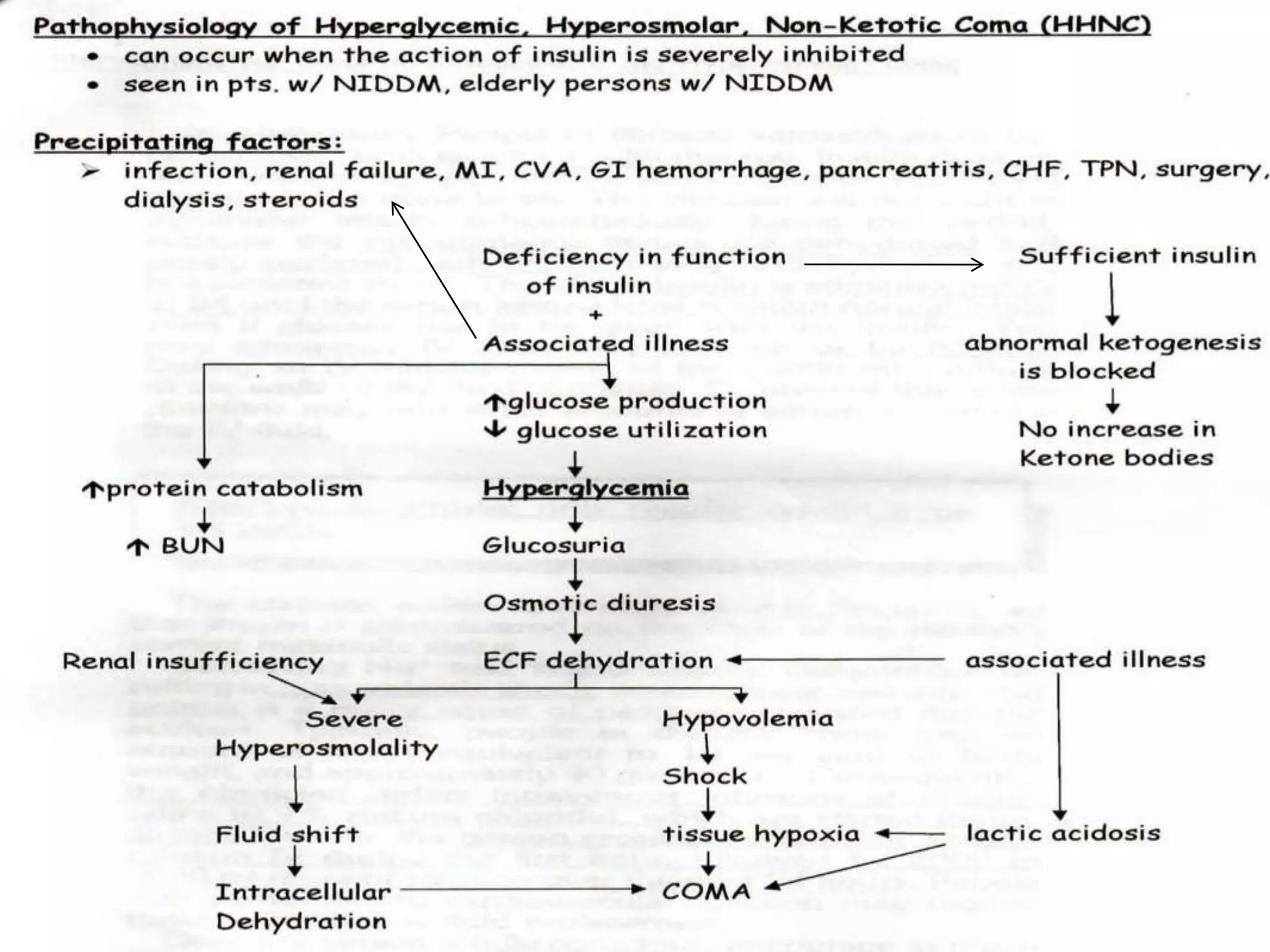
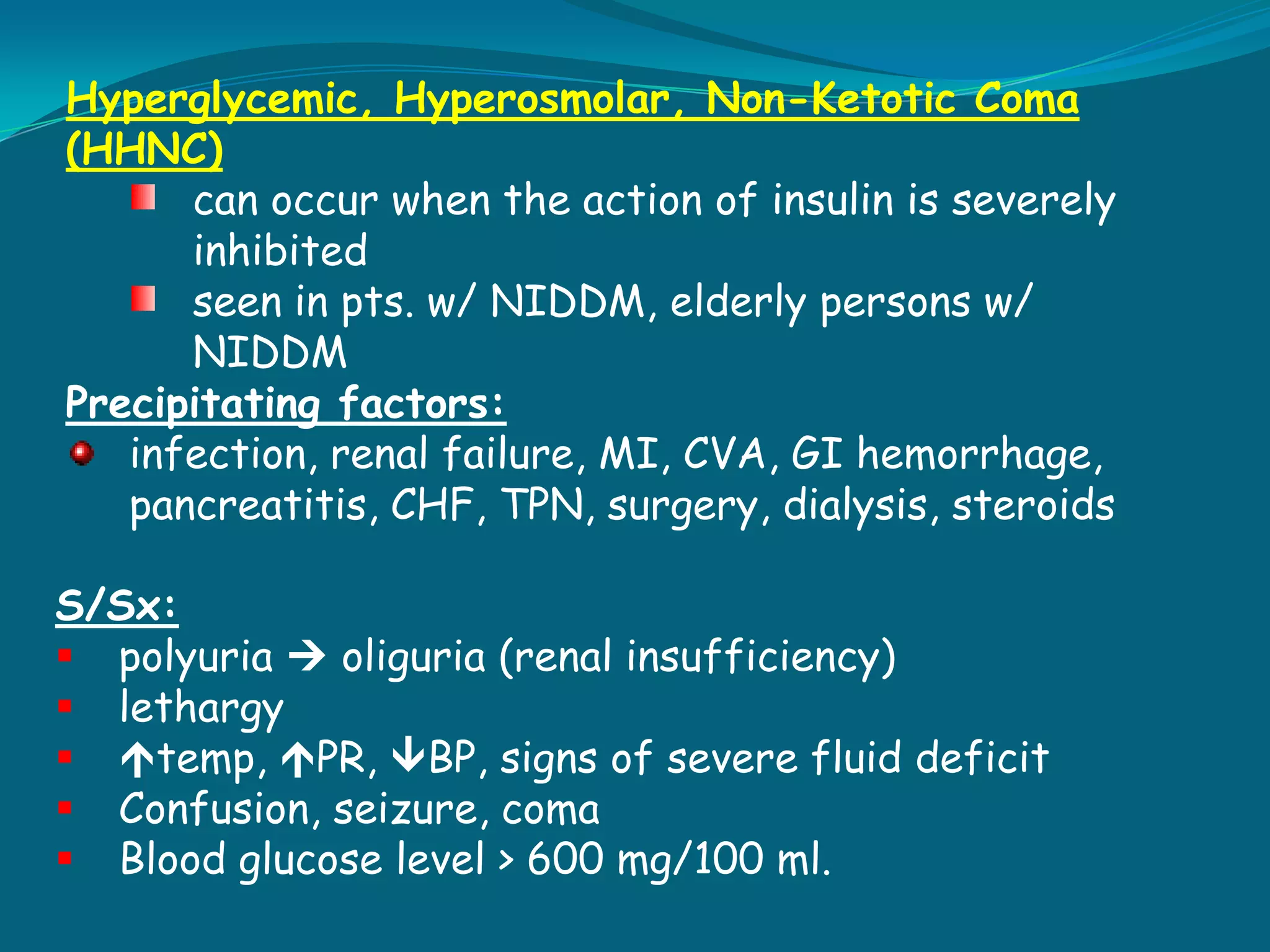
    Hyperglycemic, Hyperosmolar, Non-KetoticComa (HHNC)can occur when the action of insulin is severely inhibitedseen in pts. w/ NIDDM, elderly persons w/ NIDDMPrecipitating factors:infection, renal failure, MI, CVA, GI hemorrhage, pancreatitis, CHF, TPN, surgery, dialysis, steroidsS/Sx:polyuriaoliguria (renal insufficiency)
  • 168.
  • 169.
    temp, PR, BP,signs of severe fluid deficit
  • 170.
  • 171.
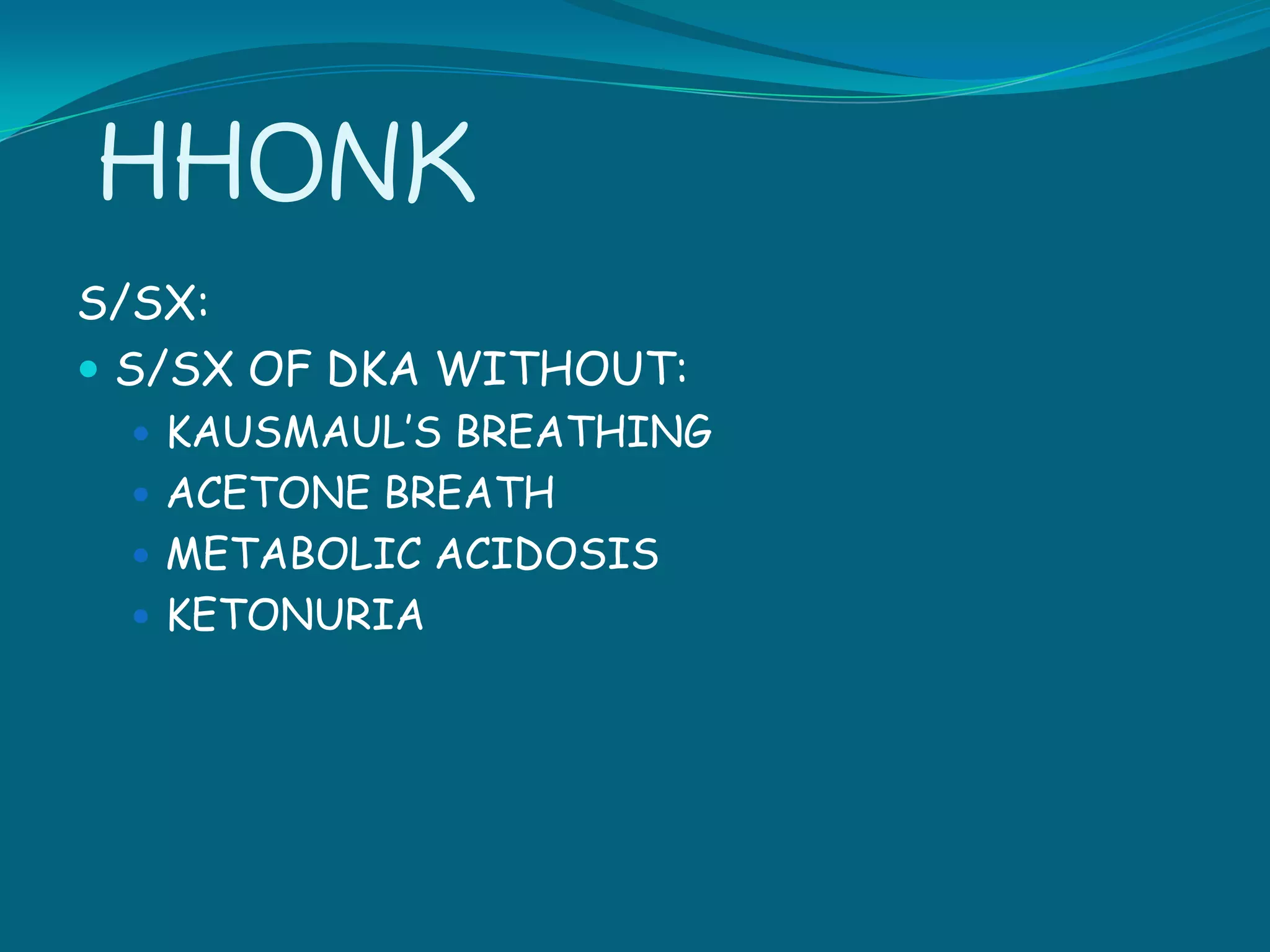
    Blood glucose level> 600 mg/100 ml.HHONKS/SX:S/SX OF DKA WITHOUT:KAUSMAUL’S BREATHINGACETONE BREATHMETABOLIC ACIDOSISKETONURIA
  • 172.
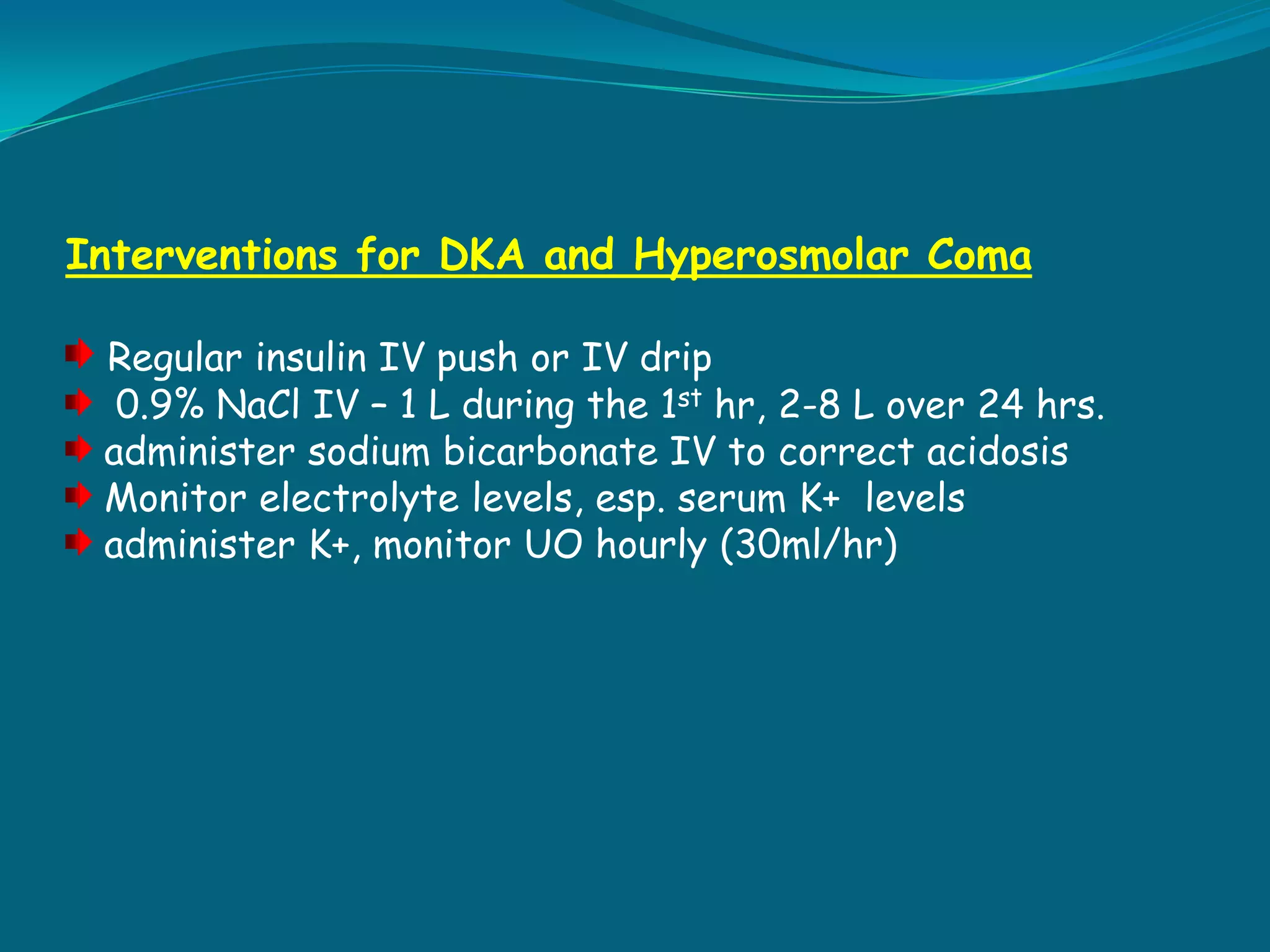
    Interventions for DKAand Hyperosmolar ComaRegular insulin IV push or IV drip 0.9% NaCl IV – 1 L during the 1st hr, 2-8 L over 24 hrs. administer sodium bicarbonate IV to correct acidosis Monitor electrolyte levels, esp. serum K+ levels administer K+, monitor UO hourly (30ml/hr)
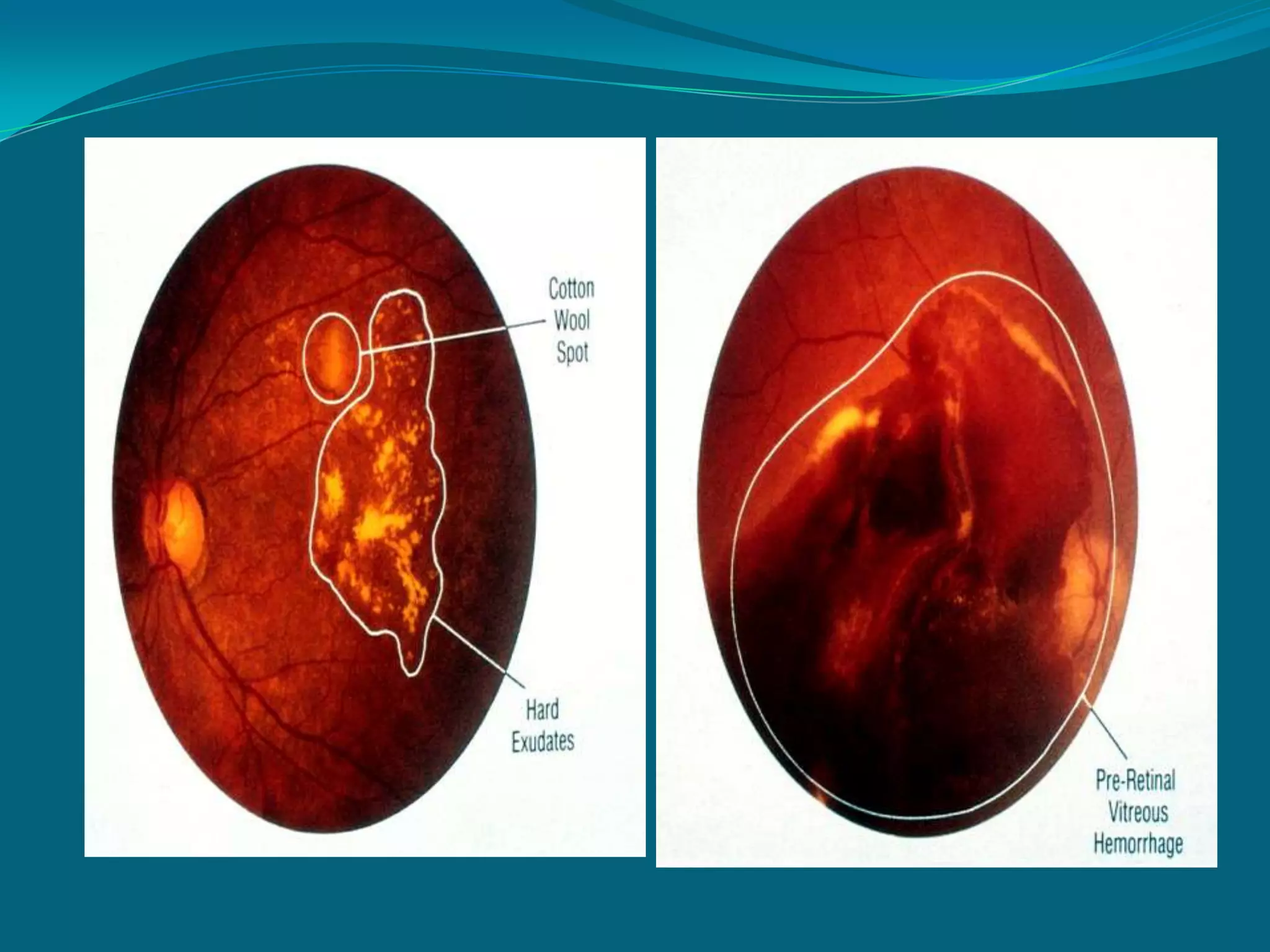
  • 173.
    Long-term Complications ofDMVascular Changes) Macroangiopathy – hardening and damage of the walls of large arteriesCoronary Artery DiseaseCVA (Stroke)Peripheral vascular disease – foot ulcers and gangreneb. ) Microangiopathy – destruction of small blood vesselsRetinopathy – damage to retinal capillaries; hemorrhage, blindnessNephropathy – damage microcirculation of kidneys; CRF2. Neuropathy Damage to the neurons caused by vascular insufficiency and  blood glucoseSensory and motor impairmentNumbness, tingling, pain in extremities Painless neuropathyImpotence!!
  • 177.
    DISORDERS OF THEADRENAL GLANDS
  • 178.
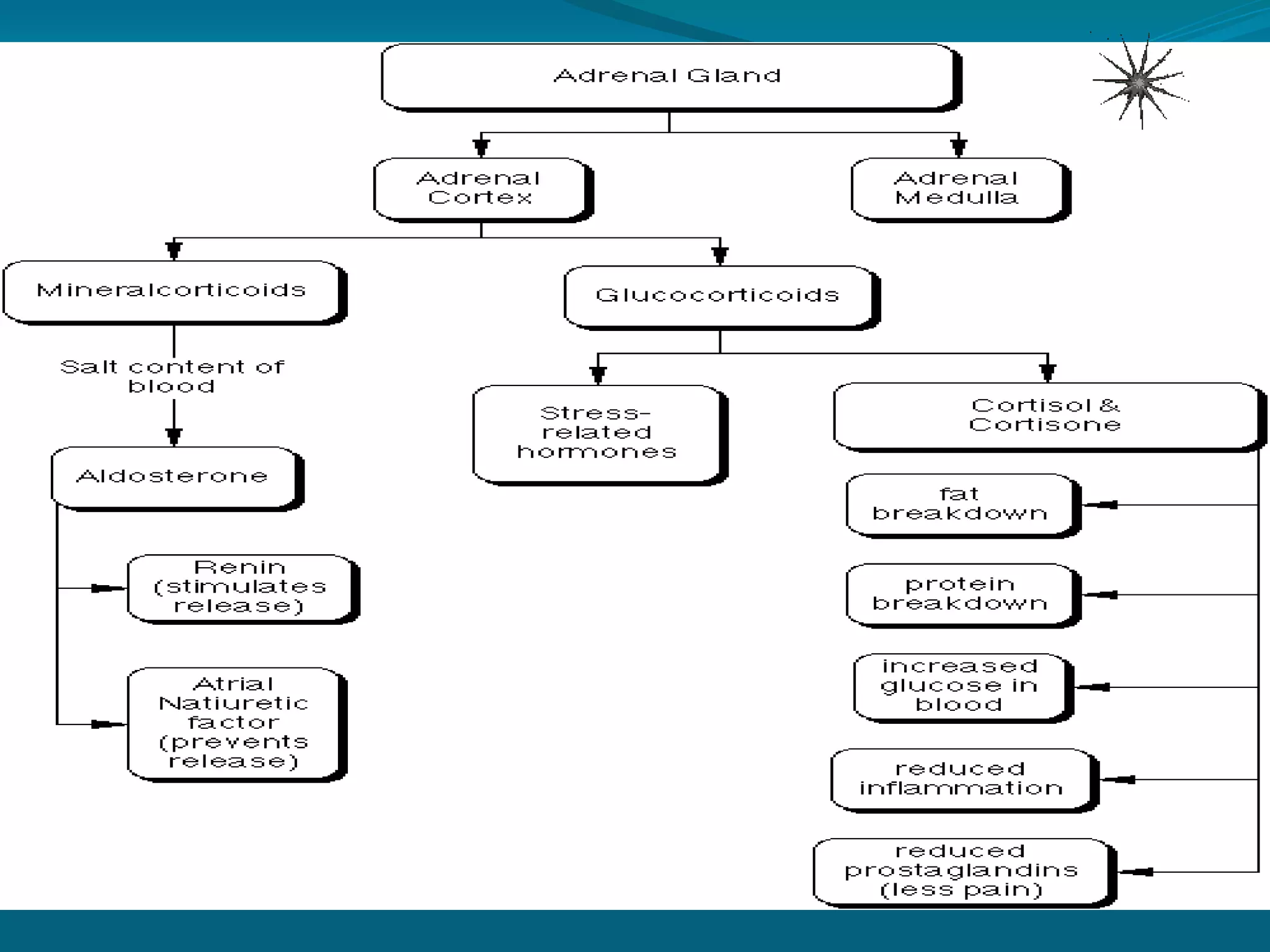
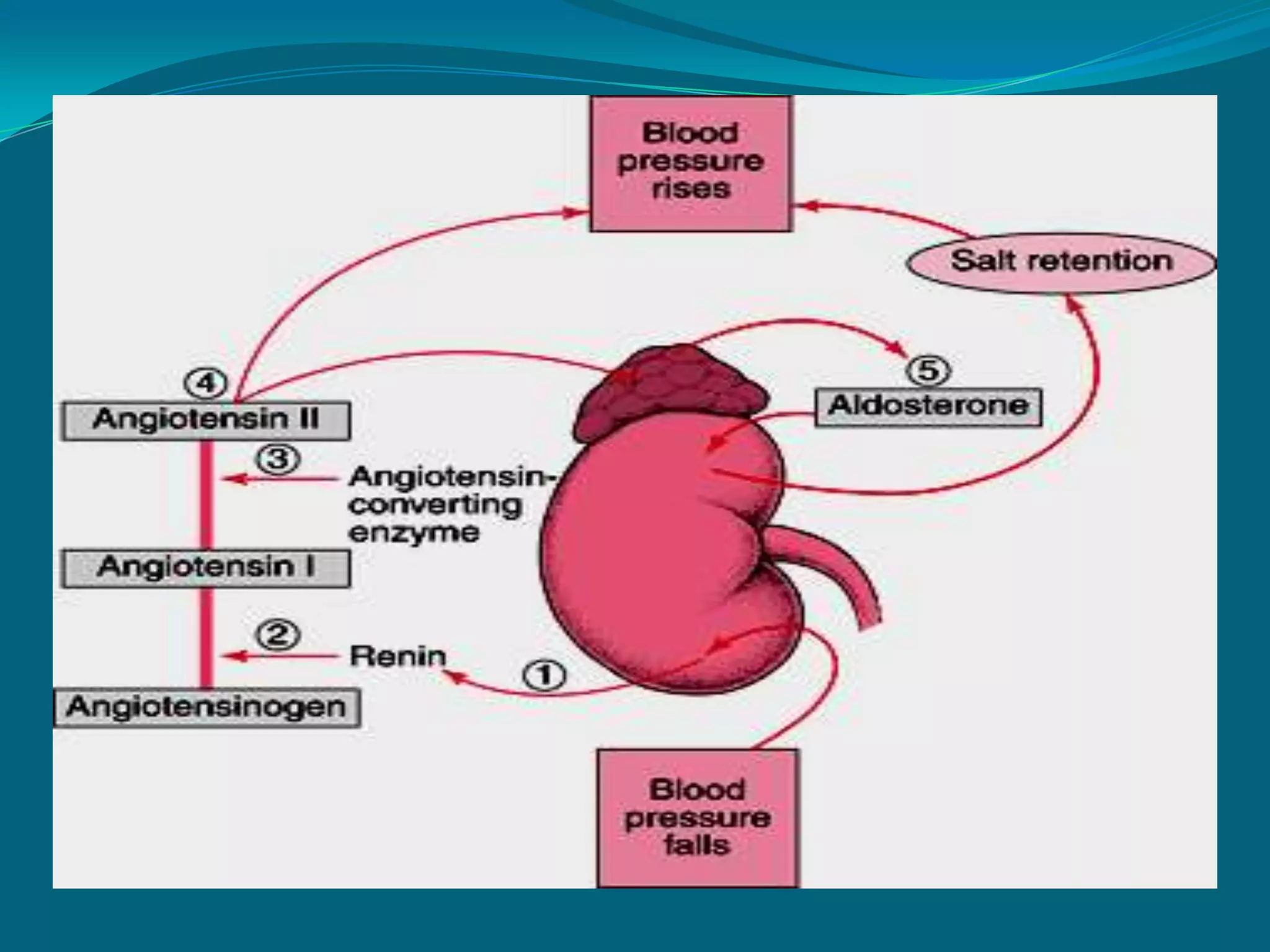
    ADRENAL GLANDSTIMULATED BYACTHADRENAL MEDULLA- SECRETES CATECOLAMINE, (EPINEPHRINE, & NOREPINEPHRINE).ADRENAL CORTEX- MAIN BODY; RESP FOR SECRETION OF GLUCO,MINERALO, SEX HORMONES (ANDRO & ESTRO)FUNCTION IS TO CONTROL THE (-) FEEDBACK MECHANISMS REGULATING HORMONE RELEASE
  • 180.
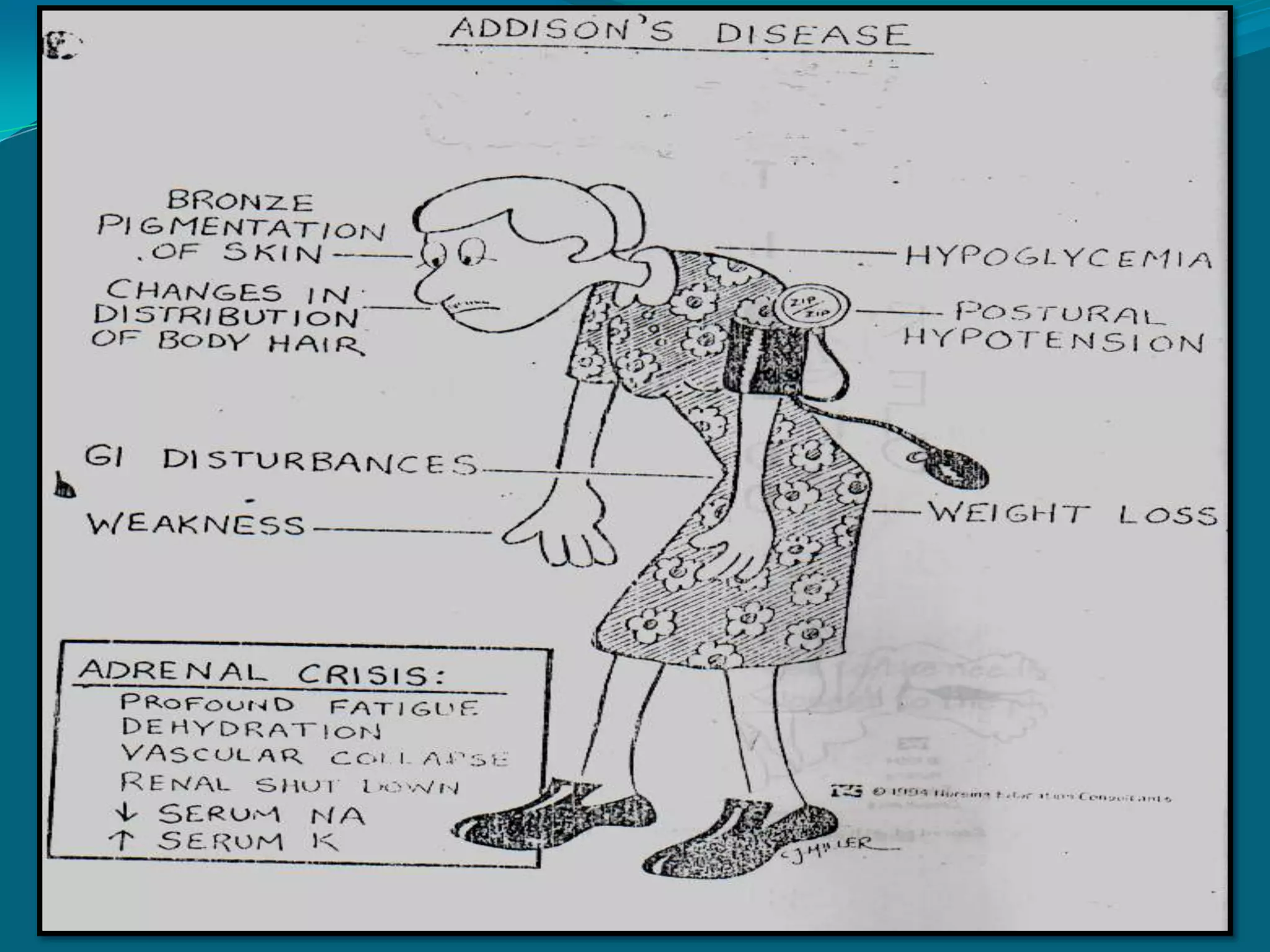
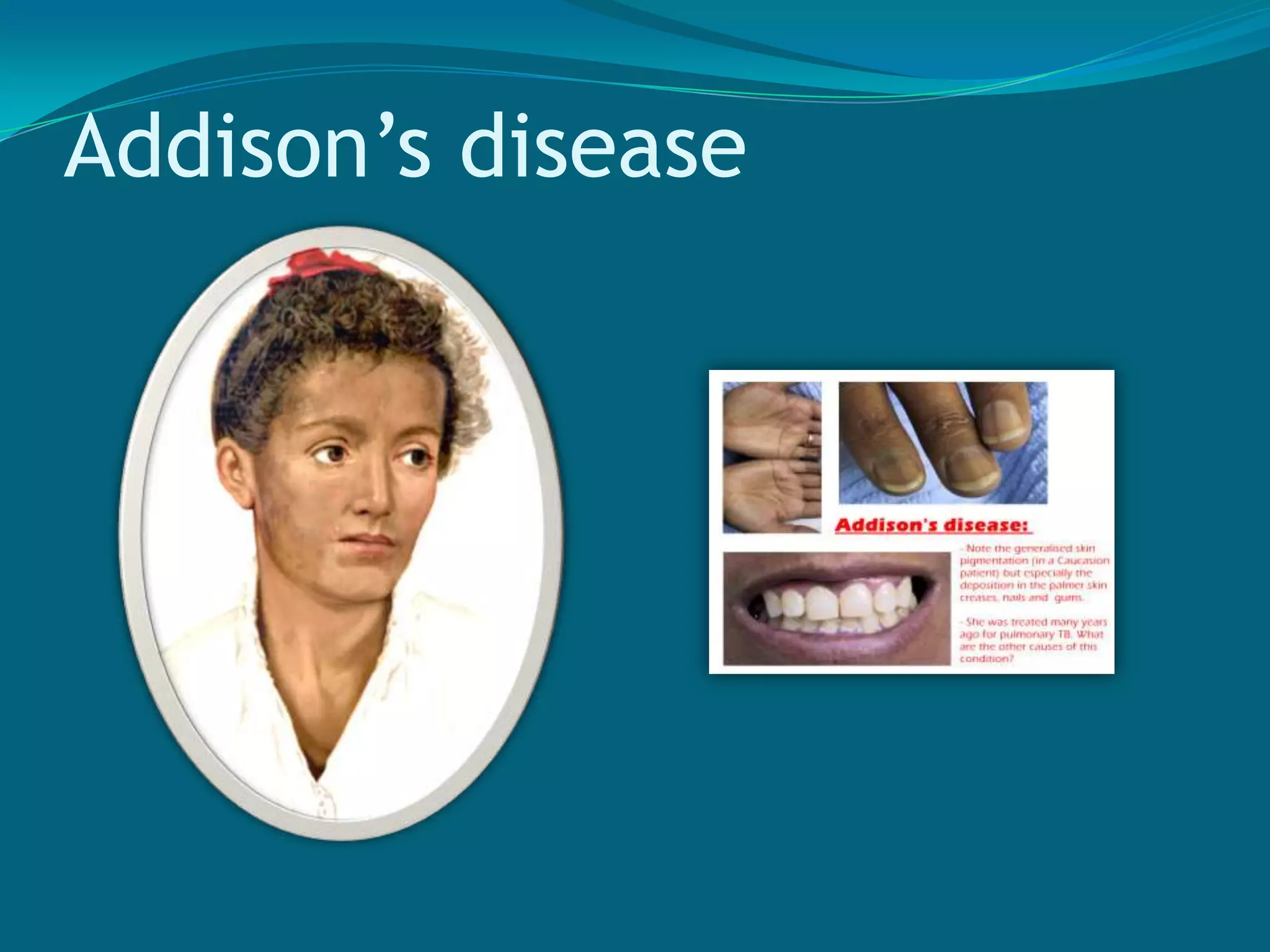
    ADRENAL CORTEX DISORERSADRENALINSUFFICIENCY ( ADDISON’S DSE)CUSHING’S SYNDROME
  • 181.
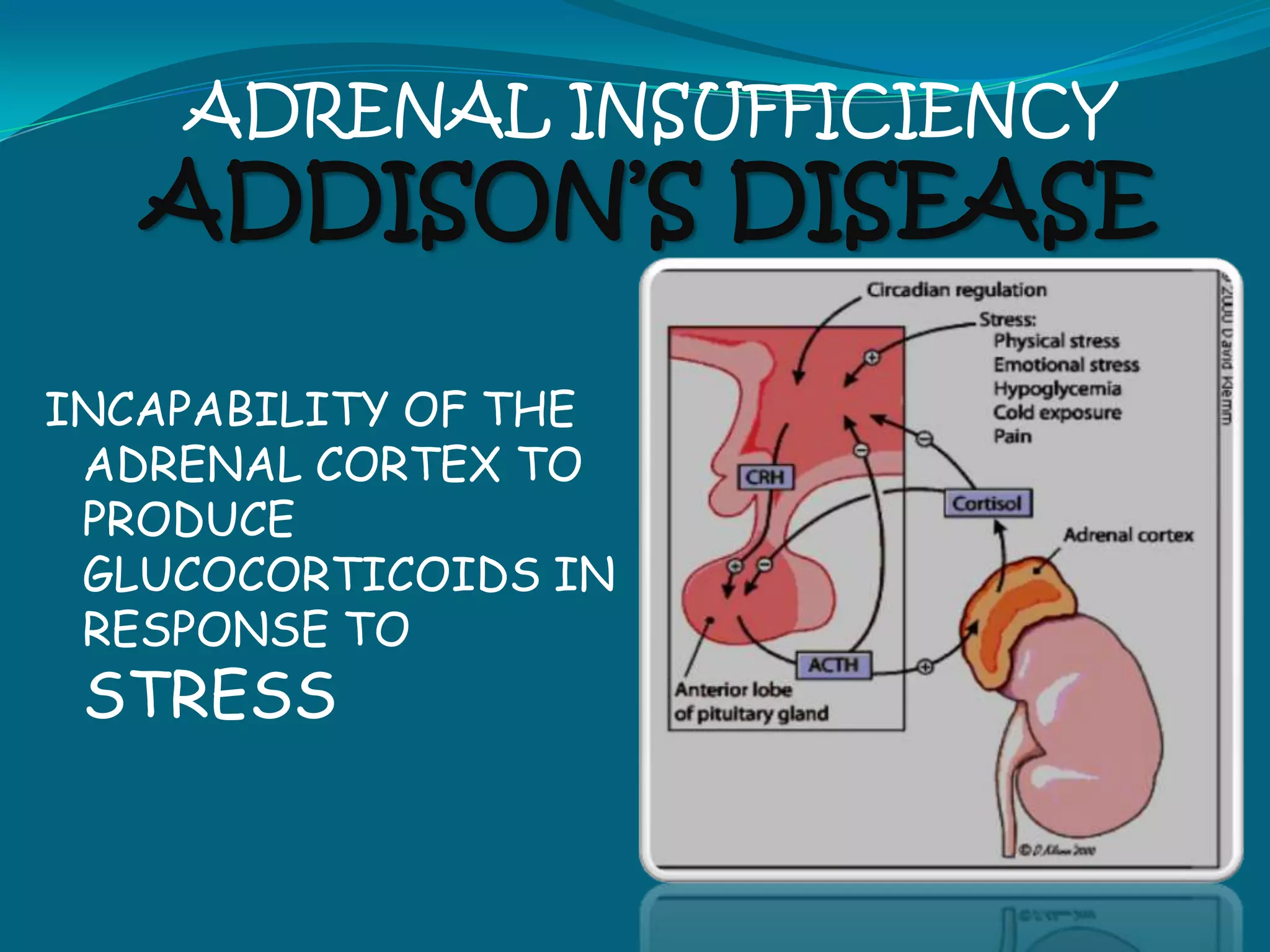
    ADRENAL INSUFFICIENCYADDISON’S DISEASEINCAPABILITYOF THE ADRENAL CORTEX TO PRODUCE GLUCOCORTICOIDS IN RESPONSE TO STRESS
  • 183.
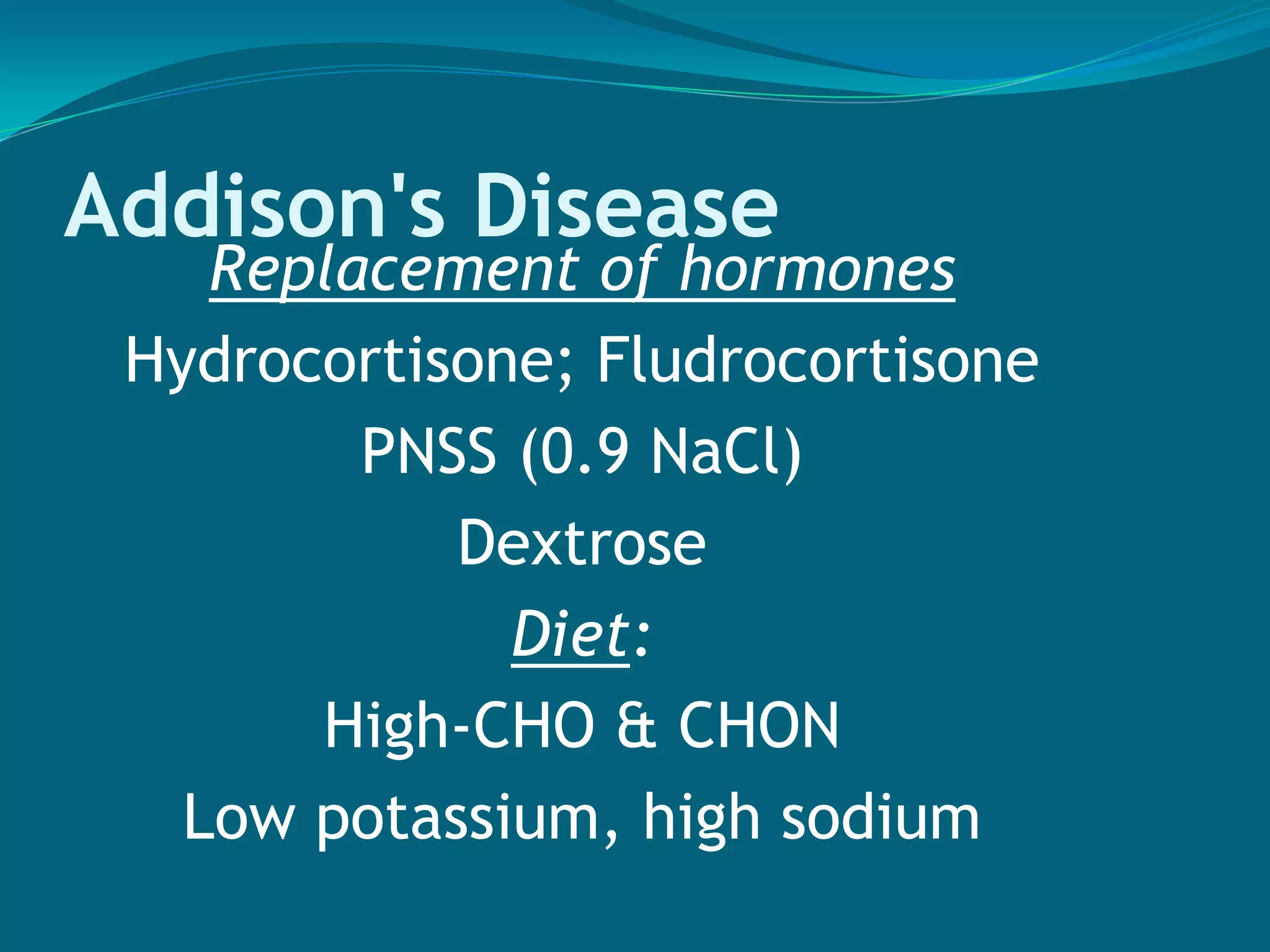
    Addison's DiseaseReplacement ofhormones Hydrocortisone; FludrocortisonePNSS (0.9 NaCl)Dextrose Diet:High-CHO & CHONLow potassium, high sodium
  • 184.
  • 185.
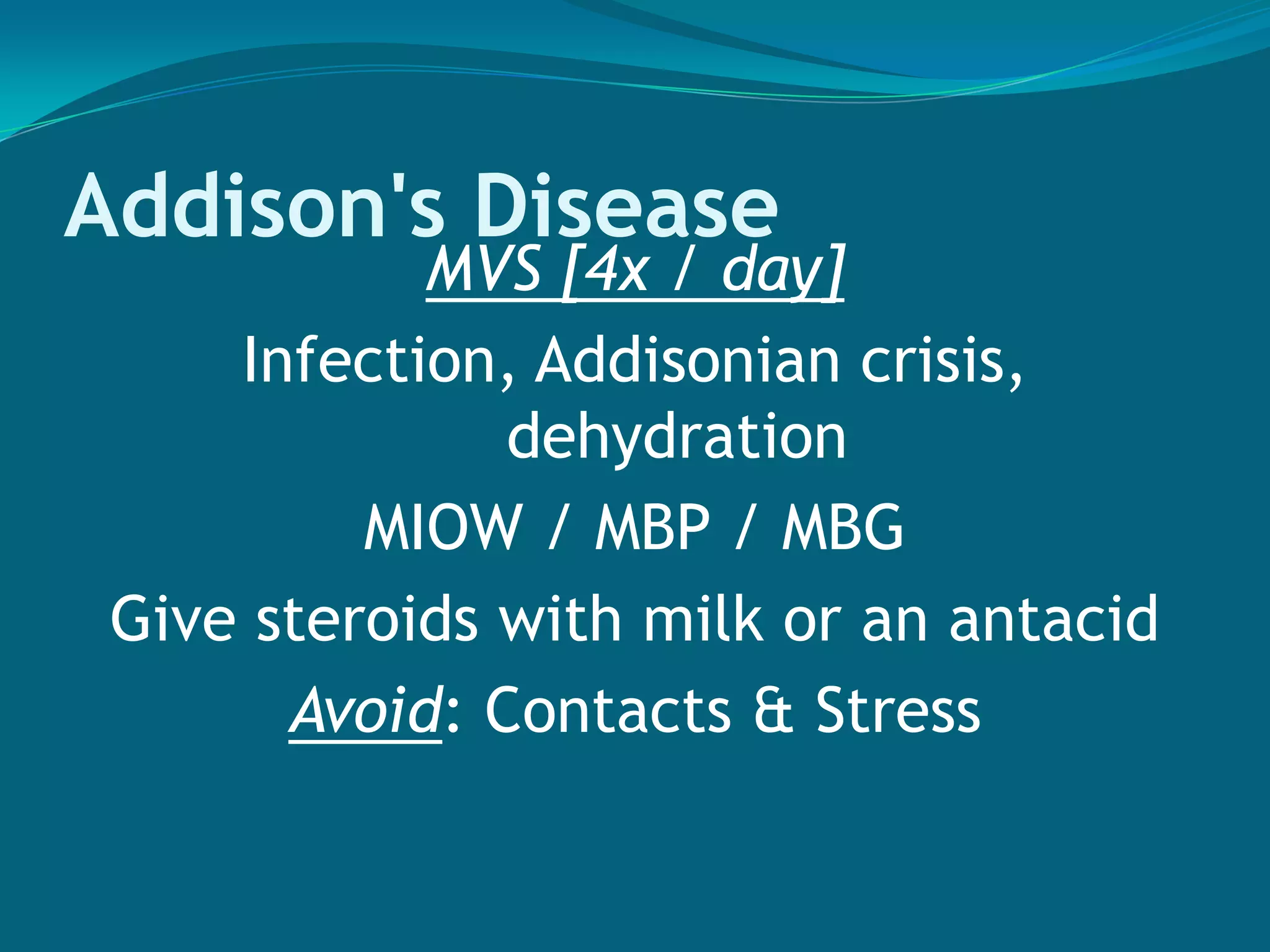
    Addison's DiseaseMVS [4x/ day]Infection, Addisonian crisis, dehydrationMIOW / MBP / MBGGive steroids with milk or an antacidAvoid: Contacts & Stress
  • 186.
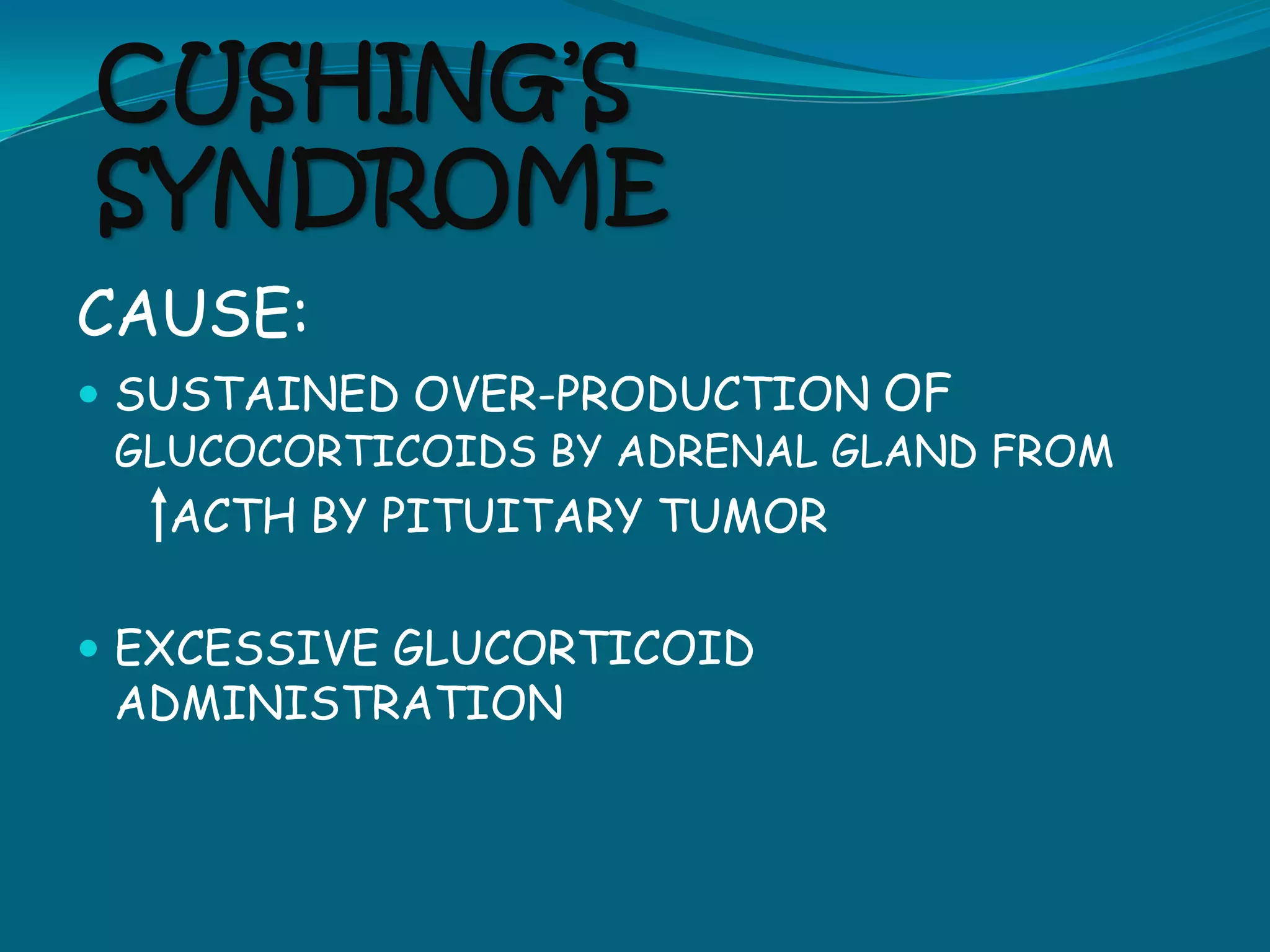
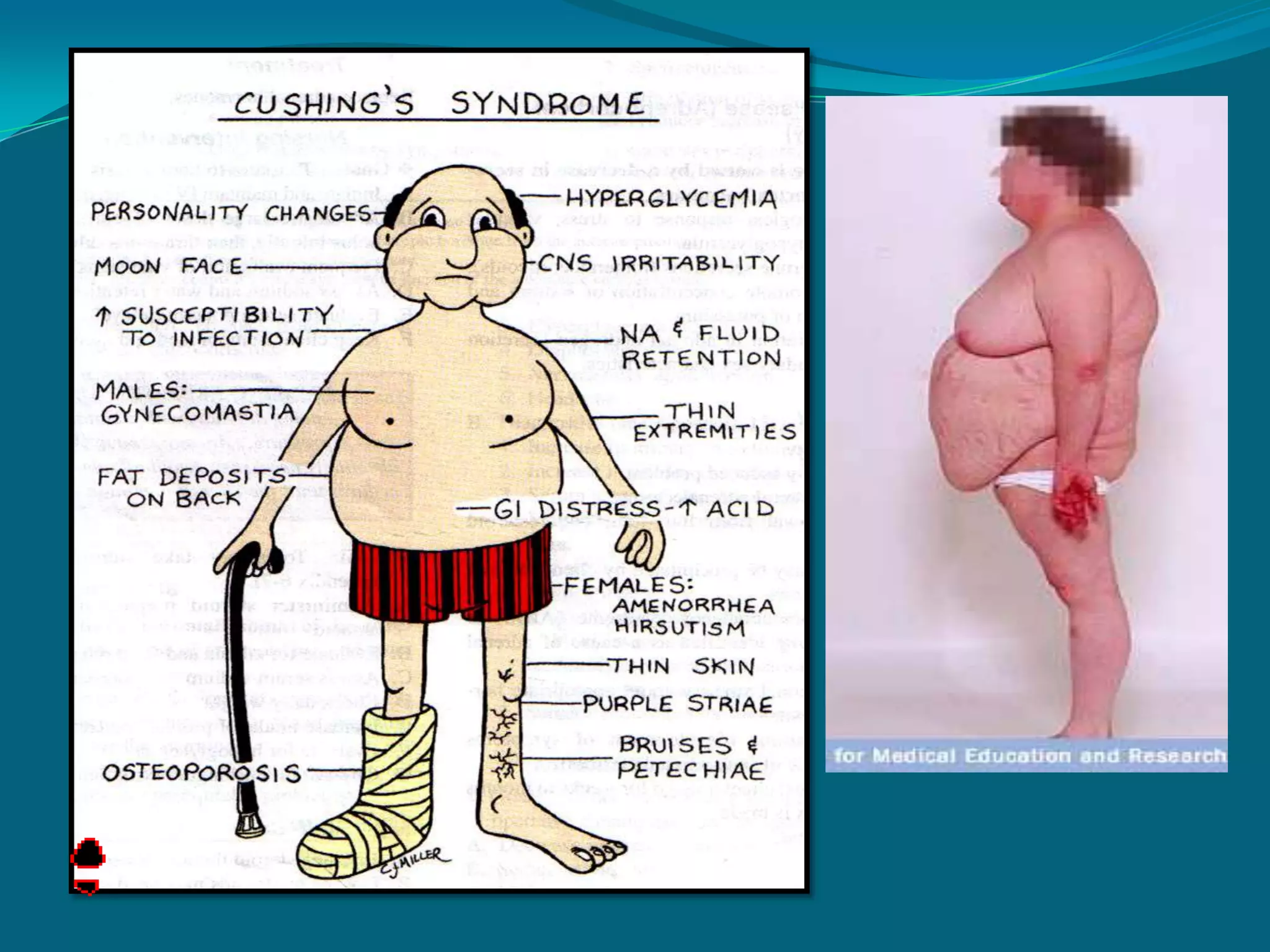
    CUSHING’S SYNDROMECAUSE:SUSTAINED OVER-PRODUCTIONOF GLUCOCORTICOIDS BY ADRENAL GLAND FROM ACTH BY PITUITARY TUMOREXCESSIVE GLUCORTICOID ADMINISTRATION
  • 187.
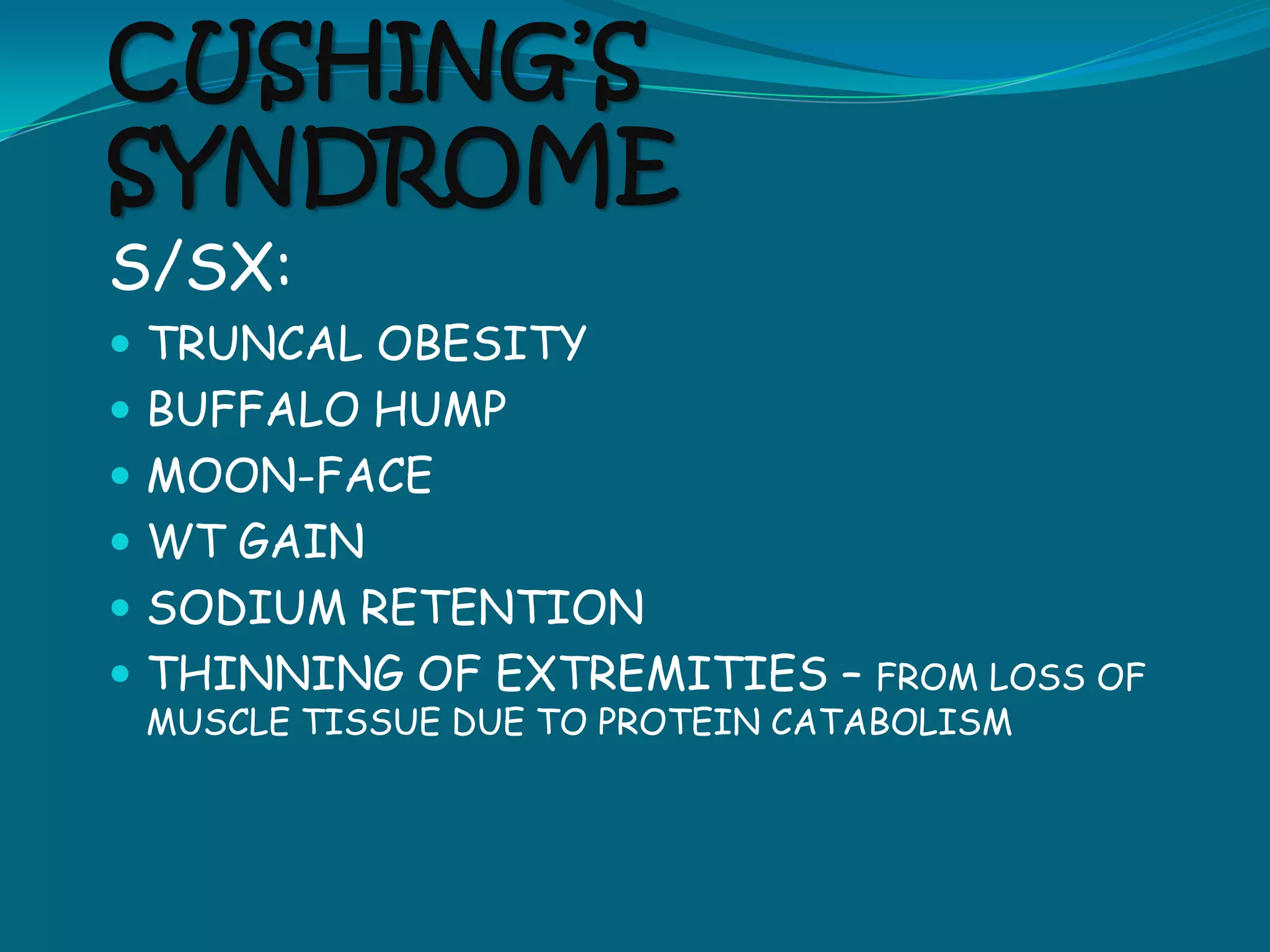
    CUSHING’S SYNDROMES/SX:TRUNCAL OBESITYBUFFALOHUMPMOON-FACEWT GAINSODIUM RETENTIONTHINNING OF EXTREMITIES – FROM LOSS OF MUSCLE TISSUE DUE TO PROTEIN CATABOLISM
  • 188.
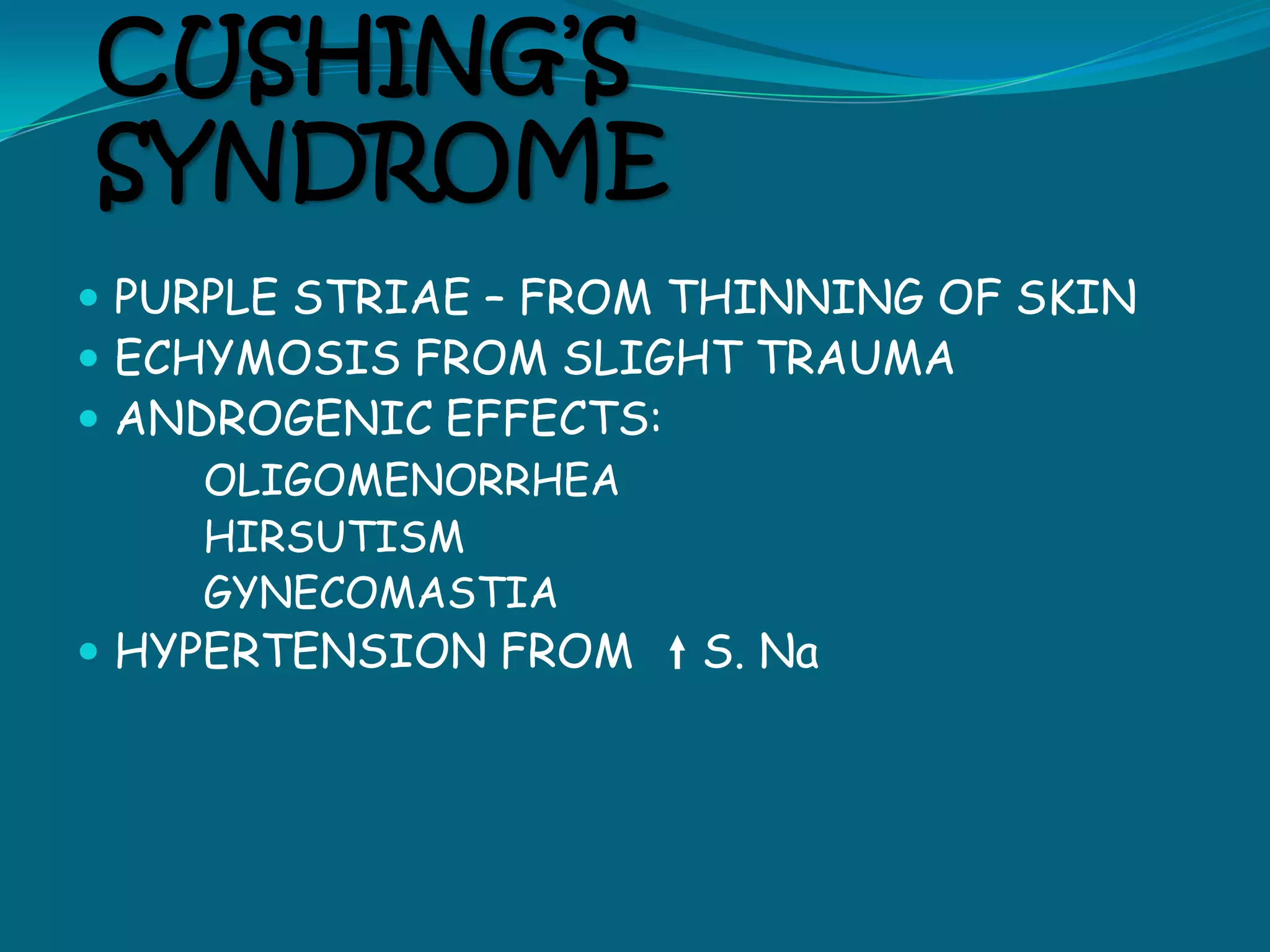
    CUSHING’S SYNDROMEPURPLE STRIAE– FROM THINNING OF SKINECHYMOSIS FROM SLIGHT TRAUMAANDROGENIC EFFECTS:OLIGOMENORRHEA HIRSUTISM GYNECOMASTIAHYPERTENSION FROM S. Na
  • 190.
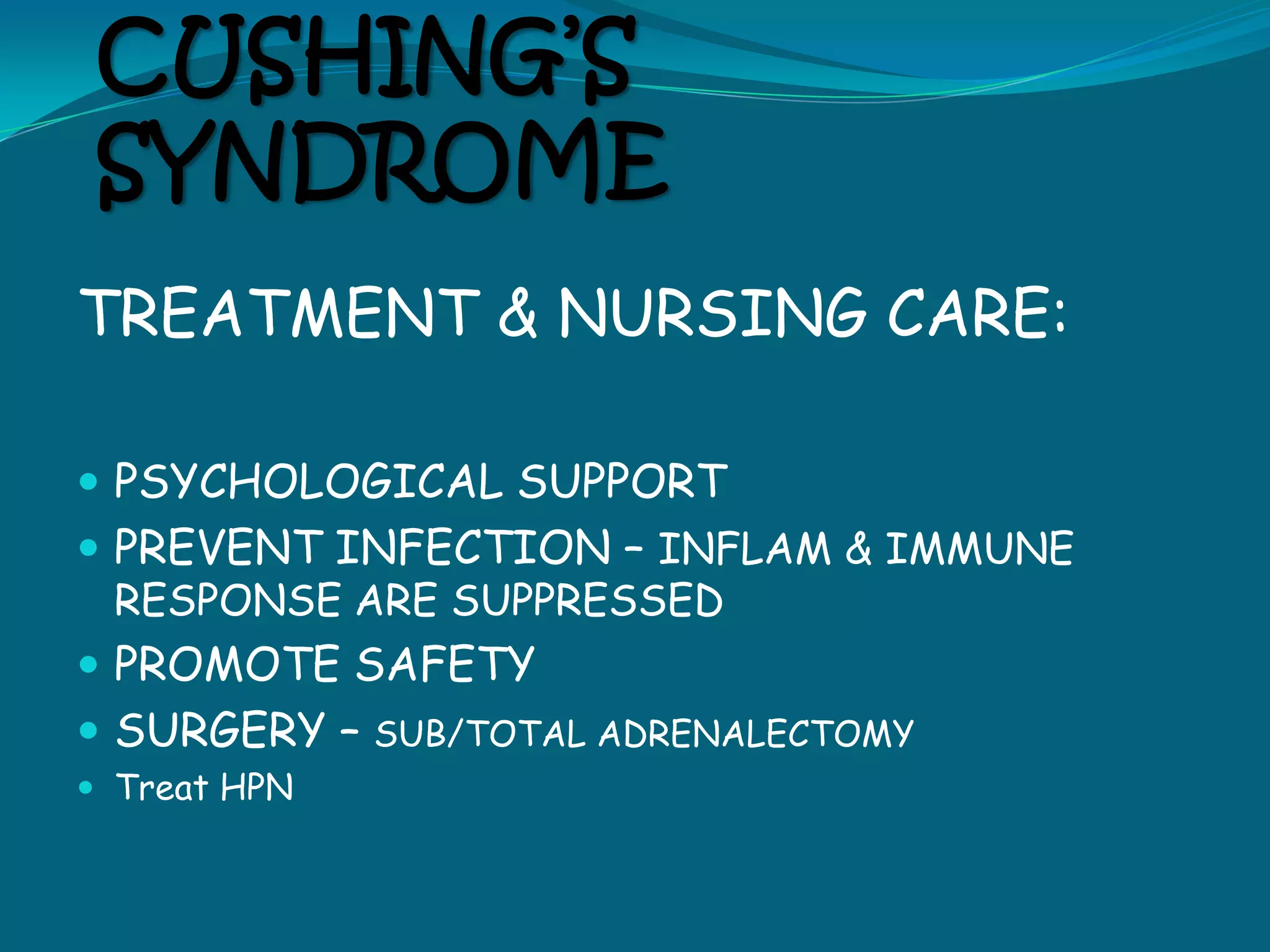
    CUSHING’S SYNDROMETREATMENT &NURSING CARE:PSYCHOLOGICAL SUPPORTPREVENT INFECTION – INFLAM & IMMUNE RESPONSE ARE SUPPRESSEDPROMOTE SAFETY SURGERY – SUB/TOTAL ADRENALECTOMYTreat HPN
  • 191.
  • 192.
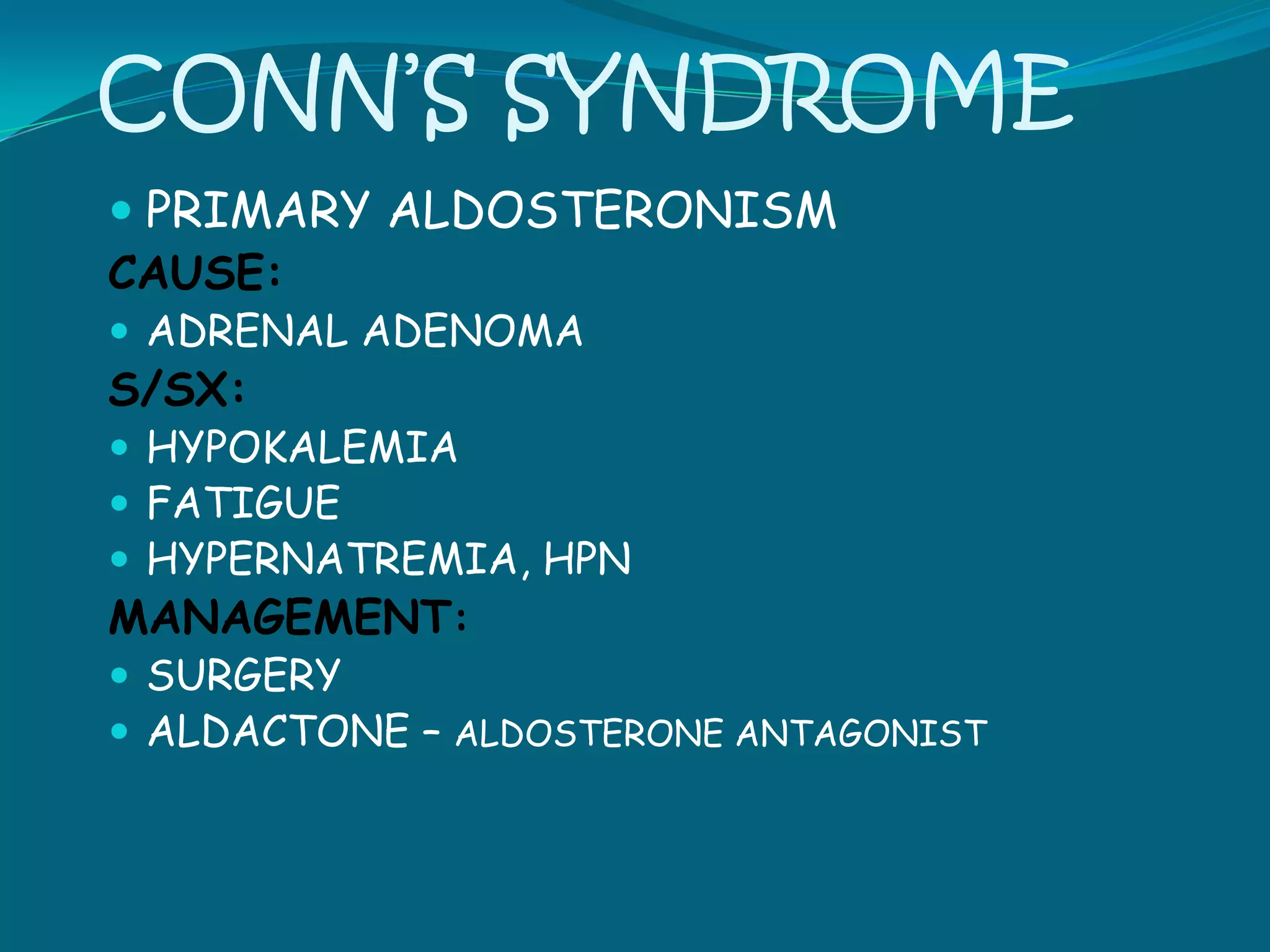
    CONN’S SYNDROMEPRIMARY ALDOSTERONISMCAUSE:ADRENALADENOMAS/SX:HYPOKALEMIAFATIGUEHYPERNATREMIA, HPNMANAGEMENT:SURGERYALDACTONE – ALDOSTERONE ANTAGONIST
  • 194.
    ADRENAL MEDULLAHORMONES :EPINEPHRINE NOREPINEPHRINE EFFECTS
  • 195.
    PHEOCHROMOCYTOMATUMOR OF ADRENALMEDULLA SECRETES INCREASED AMOUNT OF CATECHOLAMINESA small tumor in the adrenal gland that secretes large amounts of epinephrine and norepinephrine.S/SX:HPNHYPERGLYCEMIACARDIAC ARRHYTHMIA & CHF DIAGNOSTIC TEST : VMA IN 24H URINE- VANILLYMANDALIC ACID
  • 196.
    VMA IN 24HURINEEND PRODUCT OF CATECHOLAMINE METABOLISMDRUGS & FOOD TO BE WITHHELD 24H B4 THE TEST:COFFEE & TEABANANAVANILLACHOCOLATES
  • 197.
    PHEOCHROMOCYTOMAMANAGEMENT:SURGERYMEDICAL : ADRENERGICBLOCKING AGENTS: PHENTOLAMINENURSING CARE:MONITOR BP IN SUPINE & STANDINGMONITOR URINE FOR GLUCOSE & ACETONE
  • 199.
  • 200.
  • 201.
  • 202.
  • 203.
  • 204.
  • 205.
  • 206.
    RECAPPANCREAS:DMLOCATION: POSTERIOR TOLIVERPARATHYROID:HYPORATHYROIDISM
  • 207.
  • 208.
  • 209.
  • 210.
  • 211.
  • 212.
    QUESTION NO. 1ACLIENT IS FOUND TO BE COMATOSE & HYPOGLYCEMIC W/ A BLOOD SUGAR OF 50 MG/DL. WHAT NURSING ACTION IS IMPLEMENTED FIRST?INFUSE 1L OF D5W OVER A 12 HR PERIOD.ADMIN. 50% GLUCOSE IVCHECK THE CLIENT’S URINE FOR THE PRESENCE OF SUGAR AND ACETONEENCOURAGE THE CLIENT TO DRINK ORANGE JUICE W/ ADDED SUGAR
  • 213.
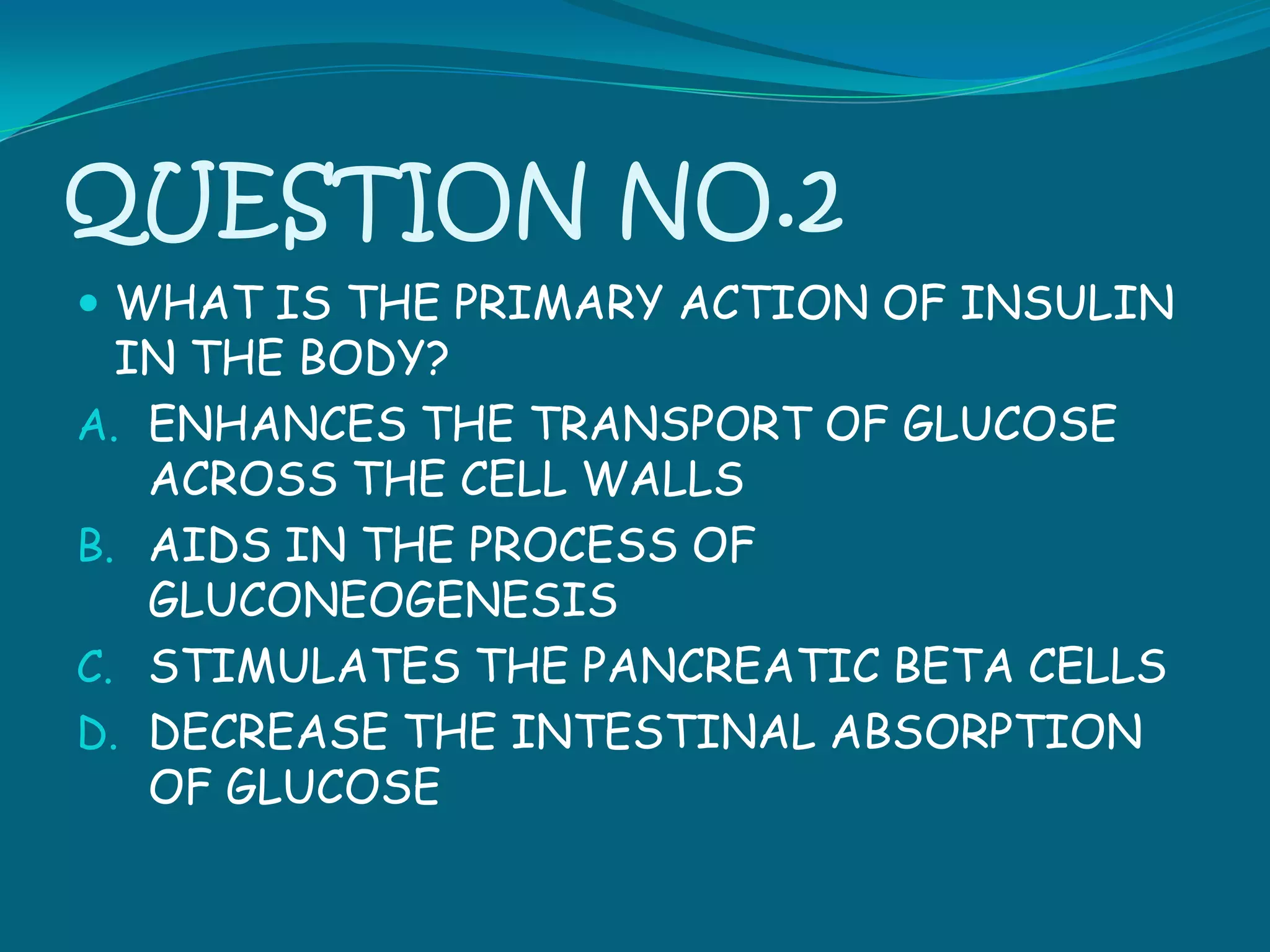
    QUESTION NO.2WHAT ISTHE PRIMARY ACTION OF INSULIN IN THE BODY?ENHANCES THE TRANSPORT OF GLUCOSE ACROSS THE CELL WALLSAIDS IN THE PROCESS OF GLUCONEOGENESISSTIMULATES THE PANCREATIC BETA CELLSDECREASE THE INTESTINAL ABSORPTION OF GLUCOSE
  • 214.
    QUESTION NO.3POSTOPERATIVE THYROIDECTOMYNURSING CARE INCLUDES WHICH MEASURES?HAVE CLIENT SPEAK EVERY 5-10 MINUTES IF HOARSENESS IS PRESENTPROVIDE LOW-CALCIUM DIET TO PREVENT HYPERCALCEMIACHECK THE DRESSING AT THE BACK OF THE NECK FOR BLEEDINGAPPLY SOFT CERVICAL COLLAR TO RESTRICT MOVEMENT
  • 215.