
 SCLEROTHERAPY involve direct
injection of a small amount of an
irritating solution into abnormally
dilated blood vessel followed by
immediate application of
compression to maintain contact of
the intravascular solution with the
endothelial cells of vessel wall.
INDICATIONS-
1)Superficial telangiectasis
2)Vericose vein
3)Haemangioma
4)Lymphangioma circumscriptum
5)Venous malformation
 Local infection
 Severe generalised infection
 Known allergy to sclerosant
 Pregnancy
 Pulmonary embolism
 Thromboplebitis
-Do not use in pregnancy.
-Protection of surrounding normal
tissue.
-Large lesions should be treated in
multiple sessions.
-Not more than 0.5 -1cc slerosant
to be injected at each site.
-Not more than 10cc sclrosant to be
injected per site.
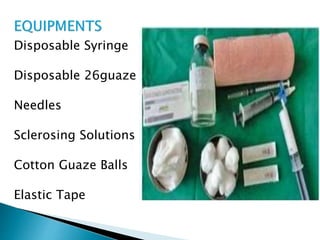
Disposable Syringe
Disposable 26guaze
Needles
Sclerosing Solutions
Cotton Guaze Balls
Elastic Tape
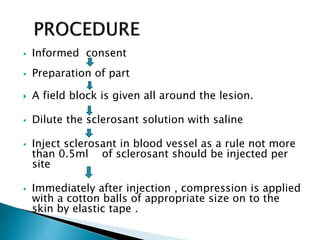
 Informed consent
 Preparation of part
 A field block is given all around the lesion.
 Dilute the sclerosant solution with saline
 Inject sclerosant in blood vessel as a rule not more
than 0.5ml of sclerosant should be injected per
site
 Immediately after injection , compression is applied
with a cotton balls of appropriate size on to the
skin by elastic tape .
 Ecchymosis
 Post sclerotherapy hyperpigmentation
 Cutaneous necrosis
 Ulceration
 Allergic reaction
 Superficial thrombophlebitis
 Arterial injection
 Pulmonary embolism
ADVANTAGES
 Simple OPD procedure
 Good patient compliance
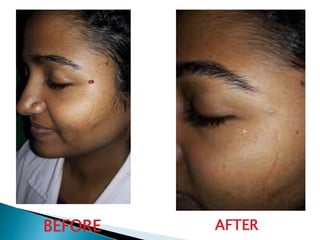
 Excellent result
 Faster resolution with minimal residual
scars
 Can be combined with other modalities like
cryosurgery,excision
 Painful procedure
 Multiple setting may required
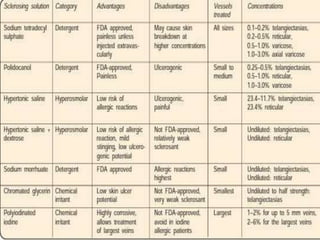
 Detergent agents-cause injury by altering the
surface tension arround endothelial cell.
Eg.sodium tetradecyl sulphate.
 Osmotic agents –cause endothelial cell
damage by dehydration. Eg. Hypertonic
saline.
 Chemical irritants-act by direct corrosive
action over endothelial cell. Eg. Polyiodinated
iodine.
BEFORE AFTER
Sclerotherapy

Sclerotherapy

  • 2.
     SCLEROTHERAPY involvedirect injection of a small amount of an irritating solution into abnormally dilated blood vessel followed by immediate application of compression to maintain contact of the intravascular solution with the endothelial cells of vessel wall.
  • 4.
  • 5.
     Local infection Severe generalised infection  Known allergy to sclerosant  Pregnancy  Pulmonary embolism  Thromboplebitis
  • 6.
    -Do not usein pregnancy. -Protection of surrounding normal tissue. -Large lesions should be treated in multiple sessions. -Not more than 0.5 -1cc slerosant to be injected at each site. -Not more than 10cc sclrosant to be injected per site.
  • 7.
    Disposable Syringe Disposable 26guaze Needles SclerosingSolutions Cotton Guaze Balls Elastic Tape
  • 8.
     Informed consent Preparation of part  A field block is given all around the lesion.  Dilute the sclerosant solution with saline  Inject sclerosant in blood vessel as a rule not more than 0.5ml of sclerosant should be injected per site  Immediately after injection , compression is applied with a cotton balls of appropriate size on to the skin by elastic tape .
  • 9.
     Ecchymosis  Postsclerotherapy hyperpigmentation  Cutaneous necrosis  Ulceration  Allergic reaction  Superficial thrombophlebitis  Arterial injection  Pulmonary embolism
  • 10.
    ADVANTAGES  Simple OPDprocedure  Good patient compliance  Excellent result  Faster resolution with minimal residual scars  Can be combined with other modalities like cryosurgery,excision
  • 11.
     Painful procedure Multiple setting may required
  • 12.
     Detergent agents-causeinjury by altering the surface tension arround endothelial cell. Eg.sodium tetradecyl sulphate.  Osmotic agents –cause endothelial cell damage by dehydration. Eg. Hypertonic saline.  Chemical irritants-act by direct corrosive action over endothelial cell. Eg. Polyiodinated iodine.
  • 14.