Urbanization in the Developing WorldUrbanization in the Developing World
Concepts, Processes and ComparisonsConcepts, Processes and Comparisons
Nature of Urbanization in DevelopmentNature of Urbanization in Development
ProcessProcess
• Development inevitably entails an increase inDevelopment inevitably entails an increase in
urbanization- why?urbanization- why?
• Because by and large impetus for economicBecause by and large impetus for economic
growth lies in the citiesgrowth lies in the cities
• Urban populations areUrban populations are capital accumulatingcapital accumulating
whereas rural populations arewhereas rural populations are capital consumingcapital consuming
• Search for regularities in urban systems hasSearch for regularities in urban systems has
revealed several important distinctionsrevealed several important distinctions
Concepts in UrbanizationConcepts in Urbanization
• UrbanizationUrbanization- process which leads to a higher- process which leads to a higher
proportion of the total population of an area toproportion of the total population of an area to
live in cities and townslive in cities and towns
• Urban growth-Urban growth- absolute or simple growth inabsolute or simple growth in
the number of urban dwellersthe number of urban dwellers
• UrbanismUrbanism-characteristic way of life of urban-characteristic way of life of urban
dwellersdwellers
• Exceptional is not so much the increasedExceptional is not so much the increased
proportion of urban growth, but the absoluteproportion of urban growth, but the absolute
growth of urban populationgrowth of urban population
• Rapid growth of cities in the developing worldRapid growth of cities in the developing world
has produced several distinctive forms andhas produced several distinctive forms and
processesprocesses
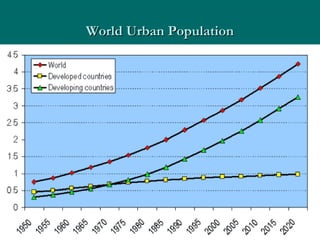
World Urban PopulationWorld Urban Population
Urbanization Distinctions Between DCs andUrbanization Distinctions Between DCs and
LDCsLDCs
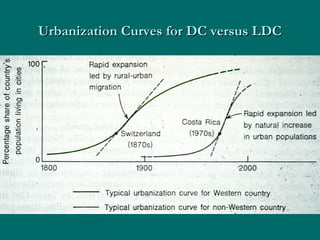
• Urbanization began earlier in the DCs and byUrbanization began earlier in the DCs and by
1900 a reduction in mortality occurred as well as1900 a reduction in mortality occurred as well as
a reduction in birth ratesa reduction in birth rates
• In the LDCs urbanization began laterIn the LDCs urbanization began later
• Urban mortality lower than in rural areas; thenUrban mortality lower than in rural areas; then
declining urban mortality but high birth ratesdeclining urban mortality but high birth rates
• Stronger surge of in-migration compared toStronger surge of in-migration compared to
DCs; industrialization lags behind urban growthDCs; industrialization lags behind urban growth
Urbanization Curves for DC versus LDCUrbanization Curves for DC versus LDC
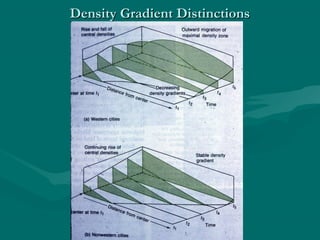
Density Gradient DistinctionsDensity Gradient Distinctions
Patterns of UrbanizationPatterns of Urbanization
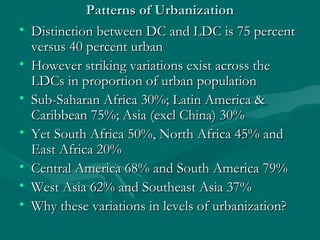
• Distinction between DC and LDC is 75 percentDistinction between DC and LDC is 75 percent
versus 40 percent urbanversus 40 percent urban
• However striking variations exist across theHowever striking variations exist across the
LDCs in proportion of urban populationLDCs in proportion of urban population
• Sub-Saharan Africa 30%; Latin America &Sub-Saharan Africa 30%; Latin America &
Caribbean 75%; Asia (excl China) 30%Caribbean 75%; Asia (excl China) 30%
• Yet South Africa 50%, North Africa 45% andYet South Africa 50%, North Africa 45% and
East Africa 20%East Africa 20%
• Central America 68% and South America 79%Central America 68% and South America 79%
• West Asia 62% and Southeast Asia 37%West Asia 62% and Southeast Asia 37%
• Why these variations in levels of urbanization?Why these variations in levels of urbanization?
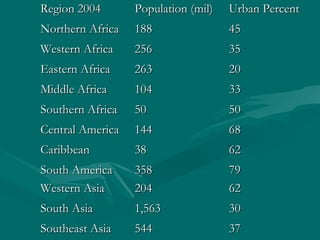
Region 2004Region 2004 Population (mil)Population (mil) Urban PercentUrban Percent
Northern AfricaNorthern Africa 188188 4545
Western AfricaWestern Africa 256256 3535
Eastern AfricaEastern Africa 263263 2020
Middle AfricaMiddle Africa 104104 3333
Southern AfricaSouthern Africa 5050 5050
Central AmericaCentral America 144144 6868
CaribbeanCaribbean 3838 6262
South AmericaSouth America 358358 7979
Western AsiaWestern Asia 204204 6262
South AsiaSouth Asia 1,5631,563 3030
Southeast AsiaSoutheast Asia 544544 3737
Some Answers to Varying Rates of UrbanizationSome Answers to Varying Rates of Urbanization
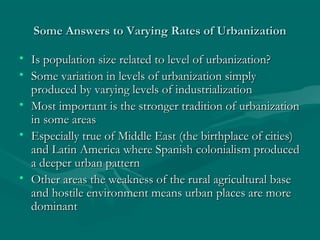
• Is population size related to level of urbanization?Is population size related to level of urbanization?
• Some variation in levels of urbanization simplySome variation in levels of urbanization simply
produced by varying levels of industrializationproduced by varying levels of industrialization
• Most important is the stronger tradition of urbanizationMost important is the stronger tradition of urbanization
in some areasin some areas
• Especially true of Middle East (the birthplace of cities)Especially true of Middle East (the birthplace of cities)
and Latin America where Spanish colonialism producedand Latin America where Spanish colonialism produced
a deeper urban patterna deeper urban pattern
• Other areas the weakness of the rural agricultural baseOther areas the weakness of the rural agricultural base
and hostile environment means urban places are moreand hostile environment means urban places are more
dominantdominant
Features of Urbanization in Developing WorldFeatures of Urbanization in Developing World
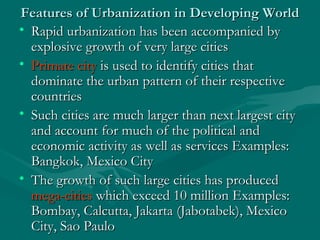
• Rapid urbanization has been accompanied byRapid urbanization has been accompanied by
explosive growth of very large citiesexplosive growth of very large cities
• Primate cityPrimate city is used to identify cities thatis used to identify cities that
dominate the urban pattern of their respectivedominate the urban pattern of their respective
countriescountries
• Such cities are much larger than next largest citySuch cities are much larger than next largest city
and account for much of the political andand account for much of the political and
economic activity as well as services Examples:economic activity as well as services Examples:
Bangkok, Mexico CityBangkok, Mexico City
• The growth of such large cities has producedThe growth of such large cities has produced
mega-citiesmega-cities which exceed 10 million Examples:which exceed 10 million Examples:
Bombay, Calcutta, Jakarta (Jabotabek), MexicoBombay, Calcutta, Jakarta (Jabotabek), Mexico
City, Sao PauloCity, Sao Paulo
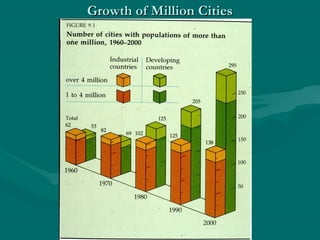
Growth of Million CitiesGrowth of Million Cities
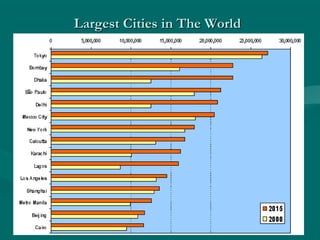
Largest Cities in The WorldLargest Cities in The World
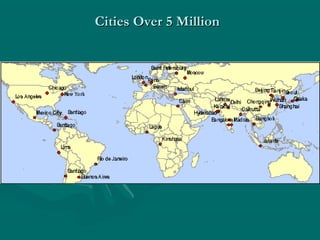
Cities Over 5 MillionCities Over 5 Million
Growth of Cities: Real or False UrbanizationGrowth of Cities: Real or False Urbanization
• The rapid growth of cities has been fueled byThe rapid growth of cities has been fueled by
rapid in-migration in addition to natural increaserapid in-migration in addition to natural increase
• Natural increase and internal migration eachNatural increase and internal migration each
account for 50 percent of urban growth in theaccount for 50 percent of urban growth in the
LDCsLDCs
• Must distinguish however betweenMust distinguish however between ‘true’‘true’
urbanizationurbanization where there is a concurrentwhere there is a concurrent
expansion of non-agricultural activities andexpansion of non-agricultural activities and
‘false’ urbanization‘false’ urbanization where people live in citieswhere people live in cities
but do not really have fulfilling jobsbut do not really have fulfilling jobs
• The latter produces anThe latter produces an urban involutionurban involution
whereby city feeds on itselfwhereby city feeds on itself
Urban InvolutionUrban Involution
• Rapid urbanization brings chronic un- andRapid urbanization brings chronic un- and
underemployment, over crowding andunderemployment, over crowding and
inadequate housing—why not revolutionaryinadequate housing—why not revolutionary
movement?movement?
• Contention is that the persistence of intensiveContention is that the persistence of intensive
traditional and often rural originated activitiestraditional and often rural originated activities
provide a sense of employmentprovide a sense of employment
• These labor intensive activities such as foodThese labor intensive activities such as food
vendors and self employed repair occupationsvendors and self employed repair occupations
provide minimum incomeprovide minimum income
• Thus the service or tertiary sector of city swellsThus the service or tertiary sector of city swells
to accommodate more and more jobless peopleto accommodate more and more jobless people
by involutionby involution
Economic Structure of the CityEconomic Structure of the City
• Involution is capacity of service sector to absorb moreInvolution is capacity of service sector to absorb more
and more labor in a finely expressed division of jobsand more labor in a finely expressed division of jobs
• Two parts:Two parts: Firm centeredFirm centered or formalor formal andand bazaar orbazaar or
informalinformal economyeconomy
• Firm centered consists of impersonal social institutions,Firm centered consists of impersonal social institutions,
specialized occupations for productive ends and isspecialized occupations for productive ends and is
capital intensivecapital intensive
• Bazaar economy consists of independent activities ofBazaar economy consists of independent activities of
highly competitive traders who relate to one anotherhighly competitive traders who relate to one another
through complex ad hoc means-very personalizedthrough complex ad hoc means-very personalized
Informal or Bazaar economyInformal or Bazaar economy
• Informal-Bazaar economy is the most absorptiveInformal-Bazaar economy is the most absorptive
• Consist of carefully managed creditConsist of carefully managed credit
relationships, splitting of risks and sliding pricesrelationships, splitting of risks and sliding prices
• Effect is to split trading activities to allow moreEffect is to split trading activities to allow more
to enter the systemto enter the system
• Process of involution and absorption isProcess of involution and absorption is
characterized by tenacity of basic patterns,characterized by tenacity of basic patterns,
internal ornateness and unending virtuosity-internal ornateness and unending virtuosity-
special skillsspecial skills
Formal versus Informal Sector ActivitiesFormal versus Informal Sector Activities
• InformalInformal- characterized by small scale, easy- characterized by small scale, easy
entry, adapted technology, flexible hours, no setentry, adapted technology, flexible hours, no set
wages and family or local organizationwages and family or local organization
• FormalFormal- large scale, more difficult entry- large scale, more difficult entry
requirements, often imported technology, fixedrequirements, often imported technology, fixed
hours of operation, daily/weekly or monthlyhours of operation, daily/weekly or monthly
wage, distant ownership or managementwage, distant ownership or management
Urban StructuresUrban Structures
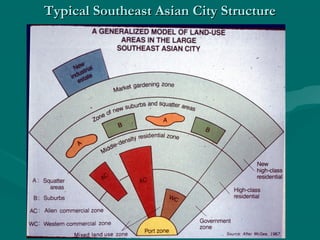
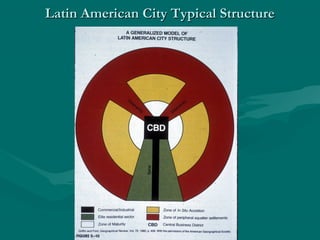
• Core areas of cities, known as Central BusinessCore areas of cities, known as Central Business
Districts, were usually of colonial originDistricts, were usually of colonial origin
• Once heart of city activity now often peripheralOnce heart of city activity now often peripheral
• Subsidiary cores have cropped up and areSubsidiary cores have cropped up and are
associated with new residential areasassociated with new residential areas
• Port areas-often the initial site-have nowPort areas-often the initial site-have now
declined in importancedeclined in importance
• Squatter settlements often on the fringeSquatter settlements often on the fringe
• Industrial areas have high access arteriesIndustrial areas have high access arteries
Typical Southeast Asian City StructureTypical Southeast Asian City Structure
Latin American City Typical StructureLatin American City Typical Structure
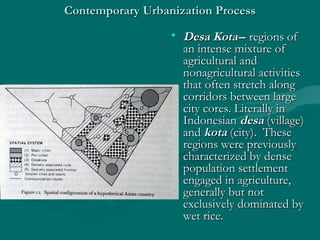
Contemporary Urbanization ProcessContemporary Urbanization Process
• Desa Kota-Desa Kota--- regions ofregions of
an intense mixture ofan intense mixture of
agricultural andagricultural and
nonagricultural activitiesnonagricultural activities
that often stretch alongthat often stretch along
corridors between largecorridors between large
city cores. Literally incity cores. Literally in
IndonesianIndonesian desadesa (village)(village)
andand kotakota (city). These(city). These
regions were previouslyregions were previously
characterized by densecharacterized by dense
population settlementpopulation settlement
engaged in agriculture,engaged in agriculture,
generally but notgenerally but not
exclusively dominated byexclusively dominated by
wet rice.wet rice.

Urbanization in the_developing_world

  • 1.
    Urbanization in theDeveloping WorldUrbanization in the Developing World Concepts, Processes and ComparisonsConcepts, Processes and Comparisons
  • 2.
    Nature of Urbanizationin DevelopmentNature of Urbanization in Development ProcessProcess • Development inevitably entails an increase inDevelopment inevitably entails an increase in urbanization- why?urbanization- why? • Because by and large impetus for economicBecause by and large impetus for economic growth lies in the citiesgrowth lies in the cities • Urban populations areUrban populations are capital accumulatingcapital accumulating whereas rural populations arewhereas rural populations are capital consumingcapital consuming • Search for regularities in urban systems hasSearch for regularities in urban systems has revealed several important distinctionsrevealed several important distinctions
  • 3.
    Concepts in UrbanizationConceptsin Urbanization • UrbanizationUrbanization- process which leads to a higher- process which leads to a higher proportion of the total population of an area toproportion of the total population of an area to live in cities and townslive in cities and towns • Urban growth-Urban growth- absolute or simple growth inabsolute or simple growth in the number of urban dwellersthe number of urban dwellers • UrbanismUrbanism-characteristic way of life of urban-characteristic way of life of urban dwellersdwellers • Exceptional is not so much the increasedExceptional is not so much the increased proportion of urban growth, but the absoluteproportion of urban growth, but the absolute growth of urban populationgrowth of urban population • Rapid growth of cities in the developing worldRapid growth of cities in the developing world has produced several distinctive forms andhas produced several distinctive forms and processesprocesses
  • 4.
  • 5.
    Urbanization Distinctions BetweenDCs andUrbanization Distinctions Between DCs and LDCsLDCs • Urbanization began earlier in the DCs and byUrbanization began earlier in the DCs and by 1900 a reduction in mortality occurred as well as1900 a reduction in mortality occurred as well as a reduction in birth ratesa reduction in birth rates • In the LDCs urbanization began laterIn the LDCs urbanization began later • Urban mortality lower than in rural areas; thenUrban mortality lower than in rural areas; then declining urban mortality but high birth ratesdeclining urban mortality but high birth rates • Stronger surge of in-migration compared toStronger surge of in-migration compared to DCs; industrialization lags behind urban growthDCs; industrialization lags behind urban growth
  • 6.
    Urbanization Curves forDC versus LDCUrbanization Curves for DC versus LDC
  • 7.
  • 8.
    Patterns of UrbanizationPatternsof Urbanization • Distinction between DC and LDC is 75 percentDistinction between DC and LDC is 75 percent versus 40 percent urbanversus 40 percent urban • However striking variations exist across theHowever striking variations exist across the LDCs in proportion of urban populationLDCs in proportion of urban population • Sub-Saharan Africa 30%; Latin America &Sub-Saharan Africa 30%; Latin America & Caribbean 75%; Asia (excl China) 30%Caribbean 75%; Asia (excl China) 30% • Yet South Africa 50%, North Africa 45% andYet South Africa 50%, North Africa 45% and East Africa 20%East Africa 20% • Central America 68% and South America 79%Central America 68% and South America 79% • West Asia 62% and Southeast Asia 37%West Asia 62% and Southeast Asia 37% • Why these variations in levels of urbanization?Why these variations in levels of urbanization?
  • 9.
    Region 2004Region 2004Population (mil)Population (mil) Urban PercentUrban Percent Northern AfricaNorthern Africa 188188 4545 Western AfricaWestern Africa 256256 3535 Eastern AfricaEastern Africa 263263 2020 Middle AfricaMiddle Africa 104104 3333 Southern AfricaSouthern Africa 5050 5050 Central AmericaCentral America 144144 6868 CaribbeanCaribbean 3838 6262 South AmericaSouth America 358358 7979 Western AsiaWestern Asia 204204 6262 South AsiaSouth Asia 1,5631,563 3030 Southeast AsiaSoutheast Asia 544544 3737
  • 10.
    Some Answers toVarying Rates of UrbanizationSome Answers to Varying Rates of Urbanization • Is population size related to level of urbanization?Is population size related to level of urbanization? • Some variation in levels of urbanization simplySome variation in levels of urbanization simply produced by varying levels of industrializationproduced by varying levels of industrialization • Most important is the stronger tradition of urbanizationMost important is the stronger tradition of urbanization in some areasin some areas • Especially true of Middle East (the birthplace of cities)Especially true of Middle East (the birthplace of cities) and Latin America where Spanish colonialism producedand Latin America where Spanish colonialism produced a deeper urban patterna deeper urban pattern • Other areas the weakness of the rural agricultural baseOther areas the weakness of the rural agricultural base and hostile environment means urban places are moreand hostile environment means urban places are more dominantdominant
  • 11.
    Features of Urbanizationin Developing WorldFeatures of Urbanization in Developing World • Rapid urbanization has been accompanied byRapid urbanization has been accompanied by explosive growth of very large citiesexplosive growth of very large cities • Primate cityPrimate city is used to identify cities thatis used to identify cities that dominate the urban pattern of their respectivedominate the urban pattern of their respective countriescountries • Such cities are much larger than next largest citySuch cities are much larger than next largest city and account for much of the political andand account for much of the political and economic activity as well as services Examples:economic activity as well as services Examples: Bangkok, Mexico CityBangkok, Mexico City • The growth of such large cities has producedThe growth of such large cities has produced mega-citiesmega-cities which exceed 10 million Examples:which exceed 10 million Examples: Bombay, Calcutta, Jakarta (Jabotabek), MexicoBombay, Calcutta, Jakarta (Jabotabek), Mexico City, Sao PauloCity, Sao Paulo
  • 12.
    Growth of MillionCitiesGrowth of Million Cities
  • 13.
    Largest Cities inThe WorldLargest Cities in The World
  • 14.
    Cities Over 5MillionCities Over 5 Million
  • 15.
    Growth of Cities:Real or False UrbanizationGrowth of Cities: Real or False Urbanization • The rapid growth of cities has been fueled byThe rapid growth of cities has been fueled by rapid in-migration in addition to natural increaserapid in-migration in addition to natural increase • Natural increase and internal migration eachNatural increase and internal migration each account for 50 percent of urban growth in theaccount for 50 percent of urban growth in the LDCsLDCs • Must distinguish however betweenMust distinguish however between ‘true’‘true’ urbanizationurbanization where there is a concurrentwhere there is a concurrent expansion of non-agricultural activities andexpansion of non-agricultural activities and ‘false’ urbanization‘false’ urbanization where people live in citieswhere people live in cities but do not really have fulfilling jobsbut do not really have fulfilling jobs • The latter produces anThe latter produces an urban involutionurban involution whereby city feeds on itselfwhereby city feeds on itself
  • 16.
    Urban InvolutionUrban Involution •Rapid urbanization brings chronic un- andRapid urbanization brings chronic un- and underemployment, over crowding andunderemployment, over crowding and inadequate housing—why not revolutionaryinadequate housing—why not revolutionary movement?movement? • Contention is that the persistence of intensiveContention is that the persistence of intensive traditional and often rural originated activitiestraditional and often rural originated activities provide a sense of employmentprovide a sense of employment • These labor intensive activities such as foodThese labor intensive activities such as food vendors and self employed repair occupationsvendors and self employed repair occupations provide minimum incomeprovide minimum income • Thus the service or tertiary sector of city swellsThus the service or tertiary sector of city swells to accommodate more and more jobless peopleto accommodate more and more jobless people by involutionby involution
  • 17.
    Economic Structure ofthe CityEconomic Structure of the City • Involution is capacity of service sector to absorb moreInvolution is capacity of service sector to absorb more and more labor in a finely expressed division of jobsand more labor in a finely expressed division of jobs • Two parts:Two parts: Firm centeredFirm centered or formalor formal andand bazaar orbazaar or informalinformal economyeconomy • Firm centered consists of impersonal social institutions,Firm centered consists of impersonal social institutions, specialized occupations for productive ends and isspecialized occupations for productive ends and is capital intensivecapital intensive • Bazaar economy consists of independent activities ofBazaar economy consists of independent activities of highly competitive traders who relate to one anotherhighly competitive traders who relate to one another through complex ad hoc means-very personalizedthrough complex ad hoc means-very personalized
  • 18.
    Informal or BazaareconomyInformal or Bazaar economy • Informal-Bazaar economy is the most absorptiveInformal-Bazaar economy is the most absorptive • Consist of carefully managed creditConsist of carefully managed credit relationships, splitting of risks and sliding pricesrelationships, splitting of risks and sliding prices • Effect is to split trading activities to allow moreEffect is to split trading activities to allow more to enter the systemto enter the system • Process of involution and absorption isProcess of involution and absorption is characterized by tenacity of basic patterns,characterized by tenacity of basic patterns, internal ornateness and unending virtuosity-internal ornateness and unending virtuosity- special skillsspecial skills
  • 19.
    Formal versus InformalSector ActivitiesFormal versus Informal Sector Activities • InformalInformal- characterized by small scale, easy- characterized by small scale, easy entry, adapted technology, flexible hours, no setentry, adapted technology, flexible hours, no set wages and family or local organizationwages and family or local organization • FormalFormal- large scale, more difficult entry- large scale, more difficult entry requirements, often imported technology, fixedrequirements, often imported technology, fixed hours of operation, daily/weekly or monthlyhours of operation, daily/weekly or monthly wage, distant ownership or managementwage, distant ownership or management
  • 20.
    Urban StructuresUrban Structures •Core areas of cities, known as Central BusinessCore areas of cities, known as Central Business Districts, were usually of colonial originDistricts, were usually of colonial origin • Once heart of city activity now often peripheralOnce heart of city activity now often peripheral • Subsidiary cores have cropped up and areSubsidiary cores have cropped up and are associated with new residential areasassociated with new residential areas • Port areas-often the initial site-have nowPort areas-often the initial site-have now declined in importancedeclined in importance • Squatter settlements often on the fringeSquatter settlements often on the fringe • Industrial areas have high access arteriesIndustrial areas have high access arteries
  • 21.
    Typical Southeast AsianCity StructureTypical Southeast Asian City Structure
  • 22.
    Latin American CityTypical StructureLatin American City Typical Structure
  • 23.
    Contemporary Urbanization ProcessContemporaryUrbanization Process • Desa Kota-Desa Kota--- regions ofregions of an intense mixture ofan intense mixture of agricultural andagricultural and nonagricultural activitiesnonagricultural activities that often stretch alongthat often stretch along corridors between largecorridors between large city cores. Literally incity cores. Literally in IndonesianIndonesian desadesa (village)(village) andand kotakota (city). These(city). These regions were previouslyregions were previously characterized by densecharacterized by dense population settlementpopulation settlement engaged in agriculture,engaged in agriculture, generally but notgenerally but not exclusively dominated byexclusively dominated by wet rice.wet rice.