
URBANISATION
&
ENVIRONMENT
ASST. PROF PRITI THAKKAR
SIES COLLEGE OF COMMERCE & ECO
URBAN AREAS
 Census of India 2011 defines urban area as:
 All places having a municipality, corporation,
cantonment board or
 Notified town etc.
 All other places which satisfied the following
criteria:-
 A minimum population of 5,000;
 At least 75 per cent of the male main working
population engaged in non-agricultural pursuits;
and
 A density of population of at least 400 persons
per sq. km.
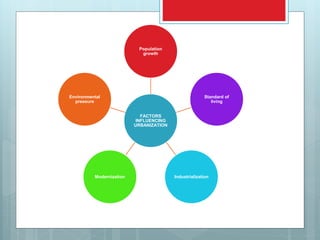
FACTORS
INFLUENCING
URBANIZATION
Population
growth
Standard of
living
IndustrializationModernization
Environmental
pressure
Effects of Urbanization
Positive Effects are as follows:
 Migration of people from rural to urban areas
 Transport and Communication facilities
 Educational choice
 Increase in standard of living
Negative effects are as follows:
 Overpopulation
 Disintegration of Joint Family.
 Cost of Living is high
 Problem of Pollution
 Increaser in crime rate
 Stress in Life.
Urbanization patterns in the
world
 Migration of rural people to urban areas.
 Employment opportunities in urban
centers.
 Transport and communication facilities.
 Educational facilities.
 Increase in the standard of living.
URBANISATION IN DIFFERENT
COUNTRIES
 Developed Countries have a high per capita income and GDP as
compared to Developing Countries.
 In Developed Countries the literacy rate is high, but in Developing
Countries illiteracy rate is high.
 Developed Countries have good infrastructure and a better environment
in terms of health and safety, which are absent in Developing Countries.
 Developed Countries generate revenue from the industrial sector.
Conversely, Developing Countries generate revenue from the service
sector.
 In developed countries, the standard of living of people is high, which is
moderate in developing countries.
 Resources are effectively and efficiently utilized in developed countries.
On the other hand, proper utilization of resources is not done in
developing countries.
 In developed countries, the birth rate and death rate are low, whereas in
developing countries both the rates are high.
Urbanisation – world patterns
 Continuing population growth and urbanization are projected to add 2.5
billion people to the world’s urban population by 2050, with nearly 90% of
the increase concentrated in Asia and Africa.
 The fastest growing urban agglomerations are medium-sized cities and
cities with less than 1 million inhabitants located in Asia and Africa.
 Most megacities and large cities are located in the global South.
 Just three countries — India, China and Nigeria – together are expected to
account for 37 per cent of the projected growth of the world’s urban
population between 2014 and 2050.
 The number of mega-cities has nearly tripled since 1990; and by 2030, 41
urban agglomerations are projected to house at least 10 million
inhabitants each.
 Tokyo is projected to remain the world’s largest city in 2030 with 37 million
inhabitants, followed closely by Delhi where the population is projected to
rise swiftly to 36 million.
Various characteristics of
urban growth or urbanization
 (A) Economic Development:
 (B) Industrialization and Density:
 (C) Secondary activities and urban growth:
 (D) Tertiary production and urbanization:
Urbanization in India
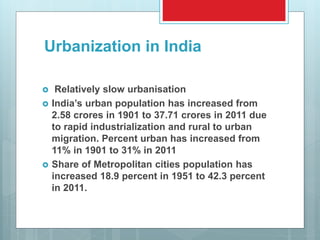
 Relatively slow urbanisation
 India’s urban population has increased from
2.58 crores in 1901 to 37.71 crores in 2011 due
to rapid industrialization and rural to urban
migration. Percent urban has increased from
11% in 1901 to 31% in 2011
 Share of Metropolitan cities population has
increased 18.9 percent in 1951 to 42.3 percent
in 2011.
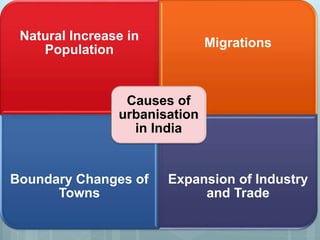
Natural Increase in
Population
Migrations
Boundary Changes of
Towns
Expansion of Industry
and Trade
Causes of
urbanisation
in India
Consequences of Rapid
Urbanisation
 (i) Healthy Aspects
 (ii) Unhealthy Aspects
 (iii) Urban Policy Measures:
Urban Policy Measures
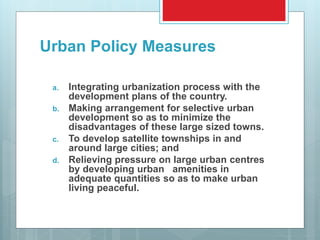
a. Integrating urbanization process with the
development plans of the country.
b. Making arrangement for selective urban
development so as to minimize the
disadvantages of these large sized towns.
c. To develop satellite townships in and
around large cities; and
d. Relieving pressure on large urban centres
by developing urban amenities in
adequate quantities so as to make urban
living peaceful.
Migration and Types of Migration
 In-migration Or Immigration
 Out-migration, Or Emigration
 Receiver Population
 Sender Population.
 Population Transfer.
 Step Migration.
 Chain Migration.
 Seasonal Migration.
EVERET LEE’S FACTORS OF
MIGRATION
Push Factors include:
 Few opportunities
 Inadequate conditions
 Famine or drought
 Political fear
 Forced labor
 Poor medical care
 Natural disasters
 Death threats
 Pollution
 Poor housing
 Discrimination
 War
Pull Factors:
 Job opportunities
 Better living conditions
 The feeling of having more political and/or religious freedom
 Education
 Better medical care
 Attractive climates
 Security
 Family links
 Industry
 Better chances of marrying
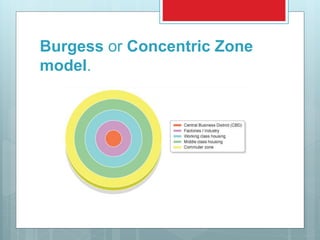
Burgess or Concentric Zone
model.
Hoyt Model
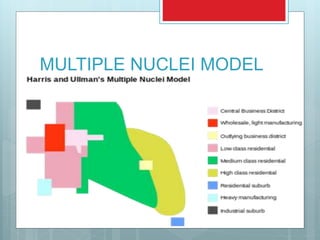
MULTIPLE NUCLEI MODEL
THANKYO
U

URBANISATION AND ENVIRONMENT

  • 1.
    URBANISATION & ENVIRONMENT ASST. PROF PRITITHAKKAR SIES COLLEGE OF COMMERCE & ECO
  • 2.
    URBAN AREAS  Censusof India 2011 defines urban area as:  All places having a municipality, corporation, cantonment board or  Notified town etc.  All other places which satisfied the following criteria:-  A minimum population of 5,000;  At least 75 per cent of the male main working population engaged in non-agricultural pursuits; and  A density of population of at least 400 persons per sq. km.
  • 3.
  • 4.
    Effects of Urbanization PositiveEffects are as follows:  Migration of people from rural to urban areas  Transport and Communication facilities  Educational choice  Increase in standard of living Negative effects are as follows:  Overpopulation  Disintegration of Joint Family.  Cost of Living is high  Problem of Pollution  Increaser in crime rate  Stress in Life.
  • 5.
    Urbanization patterns inthe world  Migration of rural people to urban areas.  Employment opportunities in urban centers.  Transport and communication facilities.  Educational facilities.  Increase in the standard of living.
  • 6.
    URBANISATION IN DIFFERENT COUNTRIES Developed Countries have a high per capita income and GDP as compared to Developing Countries.  In Developed Countries the literacy rate is high, but in Developing Countries illiteracy rate is high.  Developed Countries have good infrastructure and a better environment in terms of health and safety, which are absent in Developing Countries.  Developed Countries generate revenue from the industrial sector. Conversely, Developing Countries generate revenue from the service sector.  In developed countries, the standard of living of people is high, which is moderate in developing countries.  Resources are effectively and efficiently utilized in developed countries. On the other hand, proper utilization of resources is not done in developing countries.  In developed countries, the birth rate and death rate are low, whereas in developing countries both the rates are high.
  • 7.
    Urbanisation – worldpatterns  Continuing population growth and urbanization are projected to add 2.5 billion people to the world’s urban population by 2050, with nearly 90% of the increase concentrated in Asia and Africa.  The fastest growing urban agglomerations are medium-sized cities and cities with less than 1 million inhabitants located in Asia and Africa.  Most megacities and large cities are located in the global South.  Just three countries — India, China and Nigeria – together are expected to account for 37 per cent of the projected growth of the world’s urban population between 2014 and 2050.  The number of mega-cities has nearly tripled since 1990; and by 2030, 41 urban agglomerations are projected to house at least 10 million inhabitants each.  Tokyo is projected to remain the world’s largest city in 2030 with 37 million inhabitants, followed closely by Delhi where the population is projected to rise swiftly to 36 million.
  • 8.
    Various characteristics of urbangrowth or urbanization  (A) Economic Development:  (B) Industrialization and Density:  (C) Secondary activities and urban growth:  (D) Tertiary production and urbanization:
  • 9.
    Urbanization in India Relatively slow urbanisation  India’s urban population has increased from 2.58 crores in 1901 to 37.71 crores in 2011 due to rapid industrialization and rural to urban migration. Percent urban has increased from 11% in 1901 to 31% in 2011  Share of Metropolitan cities population has increased 18.9 percent in 1951 to 42.3 percent in 2011.
  • 10.
    Natural Increase in Population Migrations BoundaryChanges of Towns Expansion of Industry and Trade Causes of urbanisation in India
  • 11.
    Consequences of Rapid Urbanisation (i) Healthy Aspects  (ii) Unhealthy Aspects  (iii) Urban Policy Measures:
  • 12.
    Urban Policy Measures a.Integrating urbanization process with the development plans of the country. b. Making arrangement for selective urban development so as to minimize the disadvantages of these large sized towns. c. To develop satellite townships in and around large cities; and d. Relieving pressure on large urban centres by developing urban amenities in adequate quantities so as to make urban living peaceful.
  • 13.
    Migration and Typesof Migration  In-migration Or Immigration  Out-migration, Or Emigration  Receiver Population  Sender Population.  Population Transfer.  Step Migration.  Chain Migration.  Seasonal Migration.
  • 14.
    EVERET LEE’S FACTORSOF MIGRATION Push Factors include:  Few opportunities  Inadequate conditions  Famine or drought  Political fear  Forced labor  Poor medical care  Natural disasters  Death threats  Pollution  Poor housing  Discrimination  War Pull Factors:  Job opportunities  Better living conditions  The feeling of having more political and/or religious freedom  Education  Better medical care  Attractive climates  Security  Family links  Industry  Better chances of marrying
  • 15.
  • 16.
  • 17.
  • 18.