MobileMT
airborne surveys
from innovations to discoveries
info@expertgeophysics.com www.expertgeophysics.com
Presentation Outline
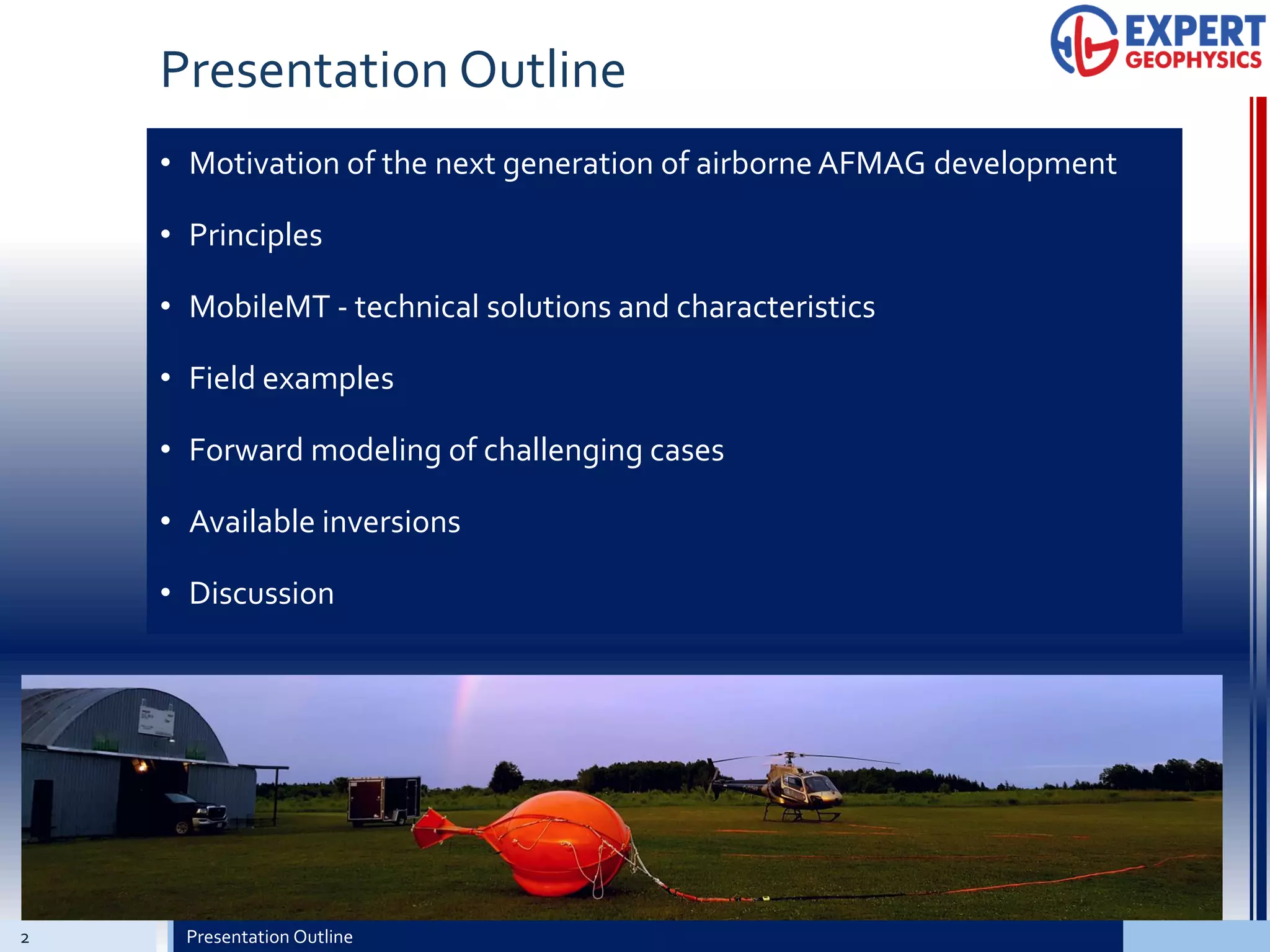
• Motivation of the next generation of airborne AFMAG development
• Principles
• MobileMT - technical solutions and characteristics
• Field examples
• Forward modeling of challenging cases
• Available inversions
• Discussion
2 Presentation Outline
motivation
• Limited depth of investigation of systems with controlled EM
field sources, especially in conductive environment or complex
terrain;
• Limited resolution, bandwidth, and sensitivity to any direction
of geoelectrical boundaries of previous airborneAFMAG
systems in commercial use;
• Latest achievements generally in electronics, digital
technologies for the last 10-15 years, since the lastAFMAG
development.
3 Motivation of the next generation of airborne AFMAG development
principles
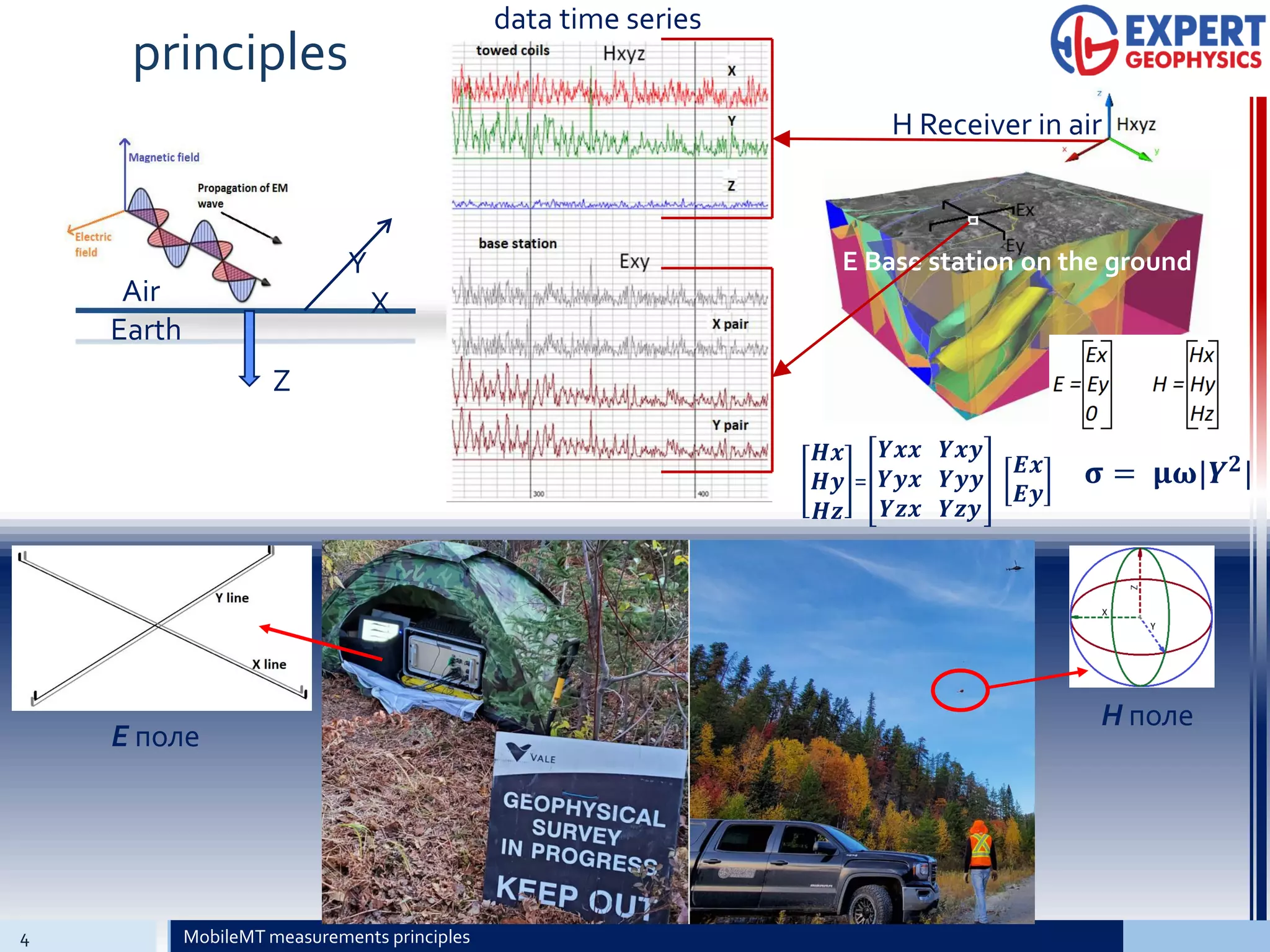
4 MobileMT measurements principles
Air
Earth
X
Y
Z
H Receiver in air
E Base station on the ground
𝑯𝒙
𝑯𝒚
𝑯𝒛
=
𝒀𝒙𝒙 𝒀𝒙𝒚
𝒀𝒚𝒙 𝒀𝒚𝒚
𝒀𝒛𝒙 𝒀𝒛𝒚
𝑬𝒙
𝑬𝒚
𝛔 = 𝛍𝛚|𝒀 𝟐
|
data time series
H поле
E поле
Technical features and advantages
• MobileMT - first airborne AFMAG system with electric
component (base station) and consisting of independent
”signal” and “reference” channels what provides bias-free
data
• 3 component towed magnetic receiver eliminates the
problems of spatial orientation in the air and related
noise
• MobileMT's electromagnetic data is digitized and
recorded at 74 kHz. It accumulates the input quantity over
a defined time to produce a representative output for
high quality data processing.
5 MobileMT technical advantages
Ex
Rx
Ey
Ry
0
250
500
750
1000
1250
1500
1750
2000
2250
2500
2750
3000
1 10 100 1000 10000 100000
h,depth,m
ρ,Halfspace resistivity, Ohm-m
34 Hz
42 Hz
53 Hz
67 Hz
84 Hz
106 Hz
134 Hz
169 Hz
213 Hz
268 Hz
337 Hz
426 Hz
536 Hz
676 Hz
851 Hz
1072 Hz
1351 Hz
1702 Hz
2145 Hz
2702 Hz
3405 Hz
4290 Hz
5404 Hz
6810 Hz
8580 Hz
10810 Hz
13619 Hz
17159 Hz
21619 Hz
f, 34Hz
f, 21,619Hz
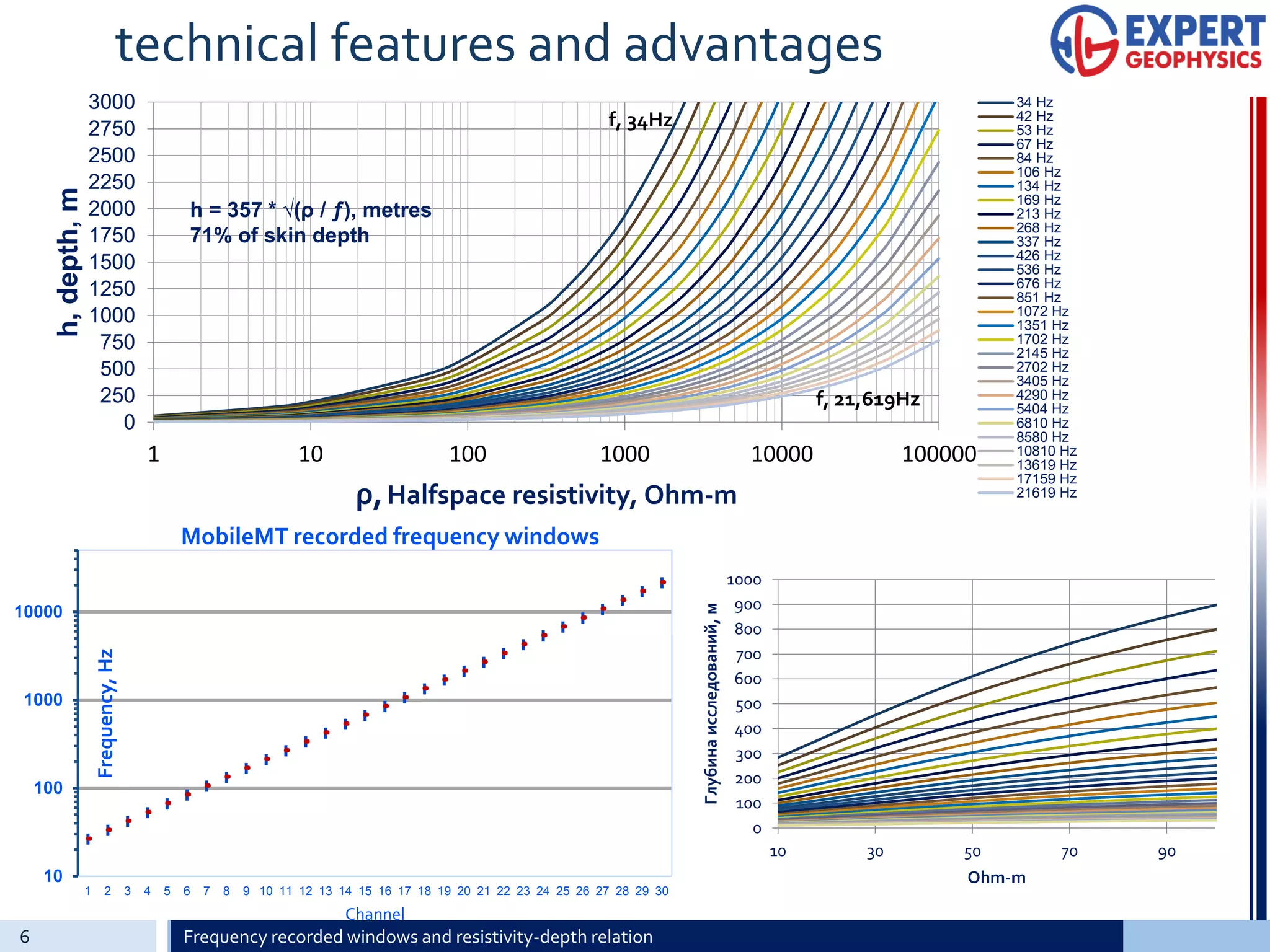
technical features and advantages
6 Frequency recorded windows and resistivity-depth relation
h = 357 * √(ρ / ƒ), metres
71% of skin depth
10
100
1000
10000
1 2 3 4 5 6 7 8 9 10 11 12 13 14 15 16 17 18 19 20 21 22 23 24 25 26 27 28 29 30
Frequency,Hz
Channel
MobileMT recorded frequency windows
0
100
200
300
400
500
600
700
800
900
1000
10 30 50 70 90
Глубинаисследований,м
Ohm-m
Field examples- Shea Creek, Athabasca
7 Add a footer
Kianna Zone
Basement boundary
Basement boundary
Full range depth
Sandstone depth range
Alteration zone
MobileMT
apparent conductivity
profiles
Typical schematic
Shea Creek
geological cross-
section (after Rhys
et.al., 2010)
8 Add a footer
Field examples- Cochrane, Ontario
Field examples Wawa, Ontario,
shear zone
9 Add a footer
Field example-Thomas Creek Co-Cu porphyry
target (Tasmania)
10 Add a footer
MobileMT
visible copper sulphides from 199m to 298m depth
11
4/22/202
Add a footer
MobileMT depth of investigation in resistive environment is 2.5 km
2d inversion of MobileMT data
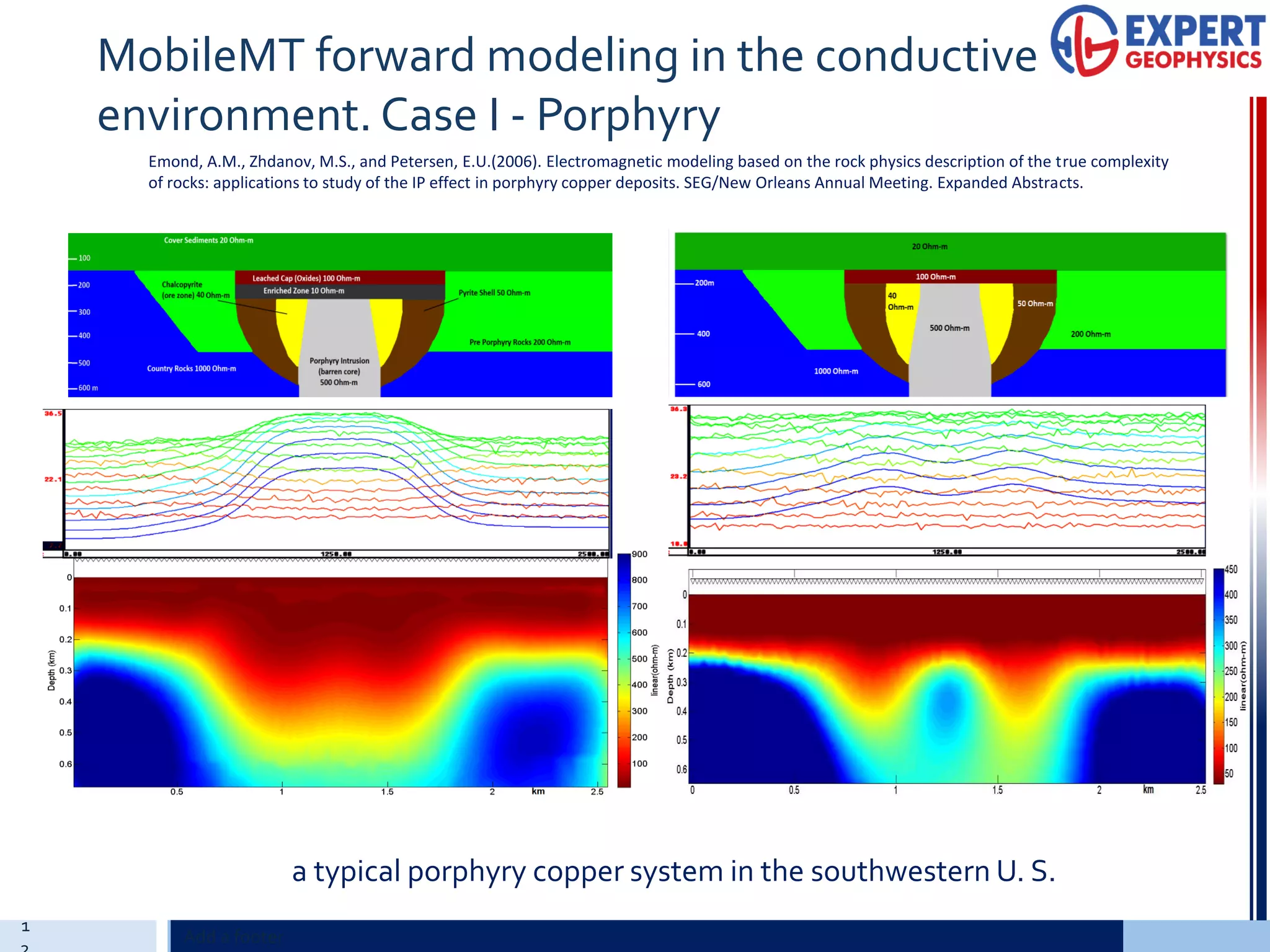
MobileMT forward modeling in the conductive
environment. Case I - Porphyry
1
Add a footer
Emond, A.M., Zhdanov, M.S., and Petersen, E.U.(2006). Electromagnetic modeling based on the rock physics description of the true complexity
of rocks: applications to study of the IP effect in porphyry copper deposits. SEG/New Orleans Annual Meeting. Expanded Abstracts.
a typical porphyry copper system in the southwestern U. S.
MobileMT forward modeling in the conductive
environment. Case II - Kimberlites
13 Add a footer
Arkhangelsk region. Russia
Kimberlite pipe 478b
(Stogny, Korotkov, 2010)
Model
calculated
Field
inversion
1 4/22/202
Add a footer
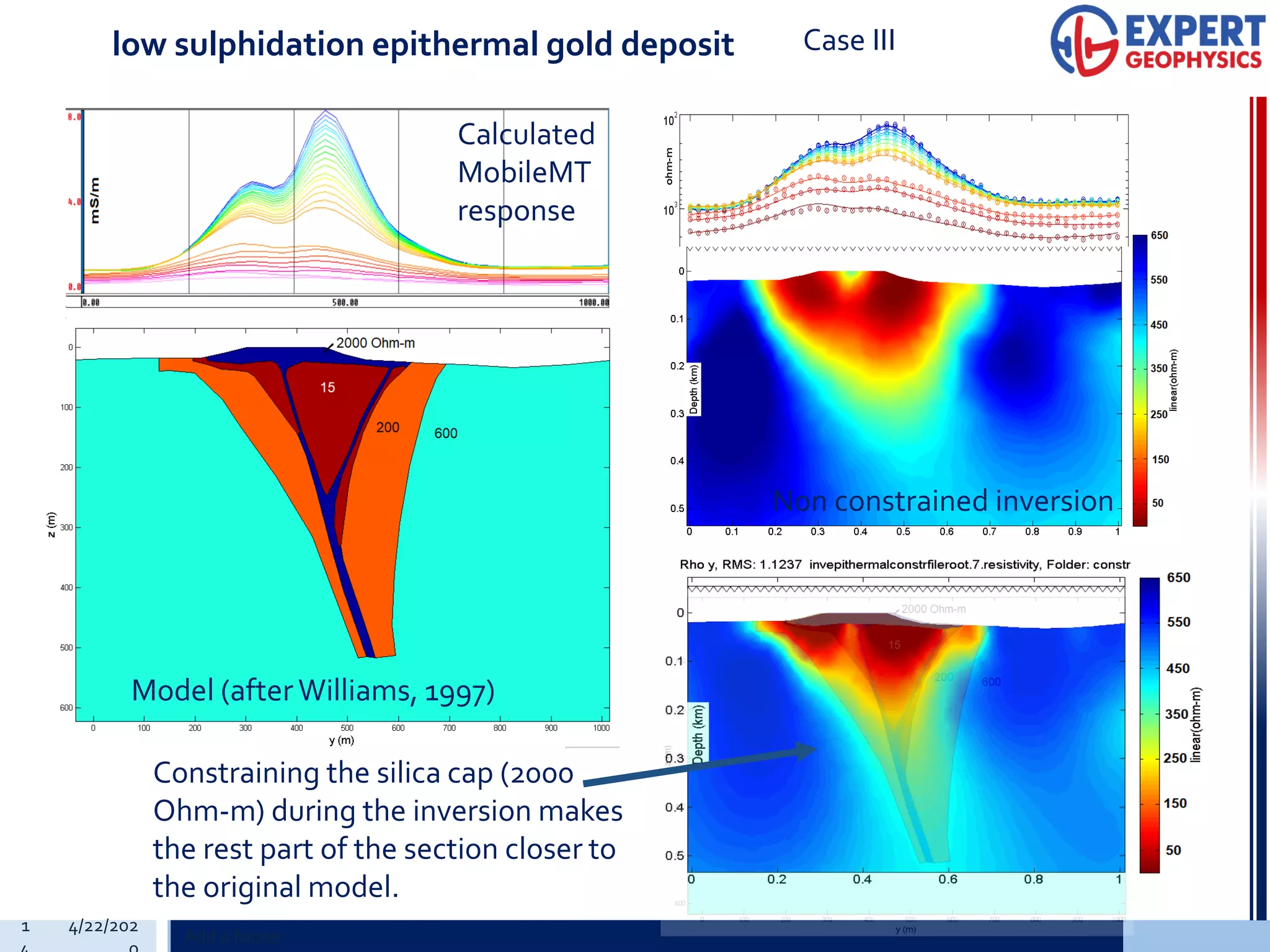
low sulphidation epithermal gold deposit
Model (after Williams, 1997)
Calculated
MobileMT
response
Constraining the silica cap (2000
Ohm-m) during the inversion makes
the rest part of the section closer to
the original model.
Non constrained inversion
Case III
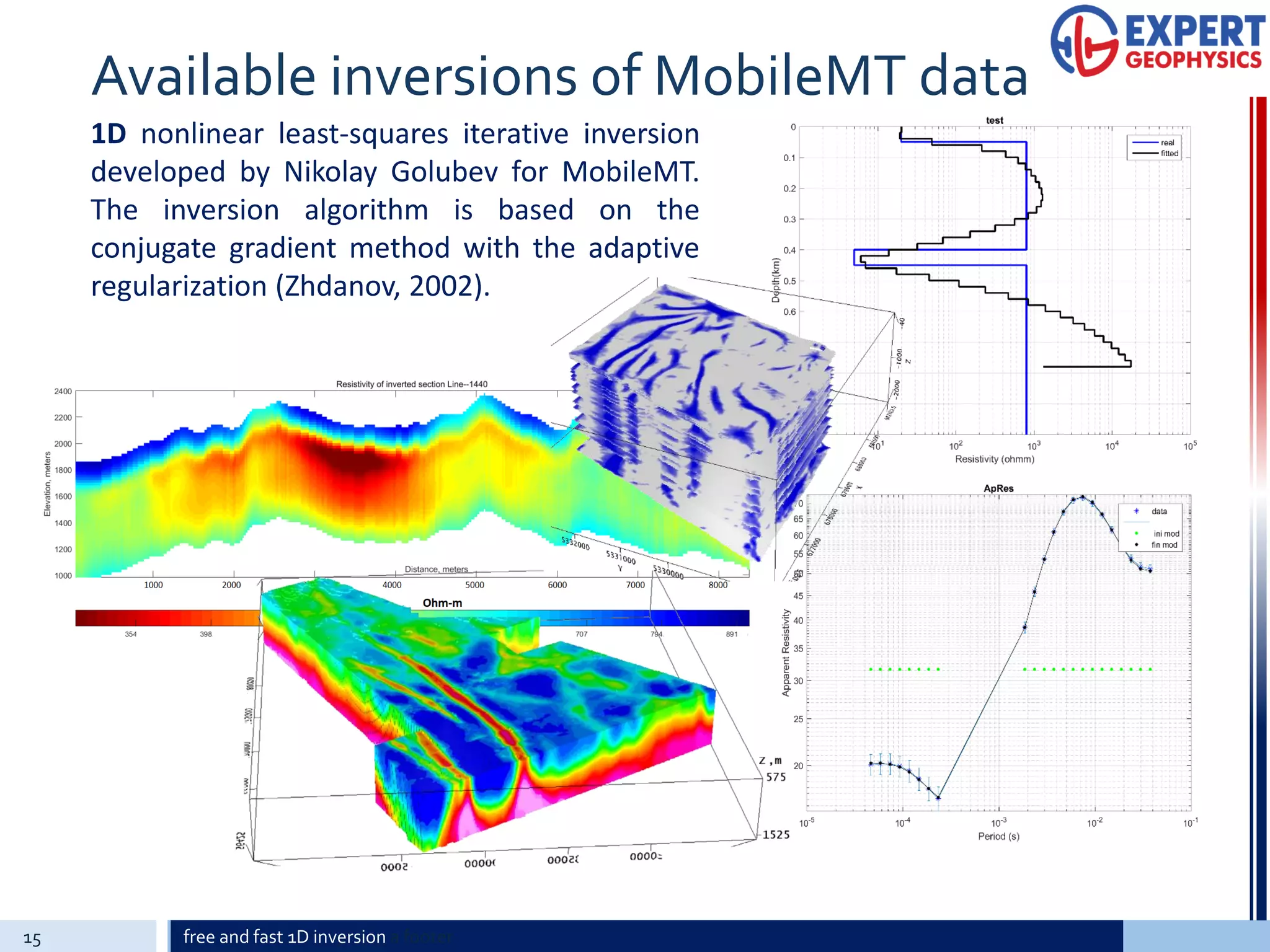
Available inversions of MobileMT data
15 free and fast 1D inversion a footer
1D nonlinear least-squares iterative inversion
developed by Nikolay Golubev for MobileMT.
The inversion algorithm is based on the
conjugate gradient method with the adaptive
regularization (Zhdanov, 2002).
16 2D inversions
Available inversions of MobileMT data
2D inversion
Detail and goal-oriented inversions based on
adaptive finite elements and regularized non-
linear MARE2DEM, focusing on specific zones of
interest (Kerry Key,Jeffrey Ovall. A parallel
goal‐oriented adaptive finite element method for
2.5‐D electromagnetic modelling. Geophysical
Journal International.Vol.186, Issue 1. 2011.).
17 3D inversions
Available inversions of MobileMT data
3D inversions
Conclusions
The latest development in airborne EM passive fields,
MobileMT, has the following advanced features:
• 4 orders of frequency measurement range reflecting near
surface and deep geological structures;
• the broadband range is divided on up to 30 collected
frequency windows what provides data selection
capabilities and high in-depth resolution;
• Inferring geoelectrical structures in absolute conductivity
units (magnetic and electric components);
• Resolving resistivity contrasts between geological units in
any direction including layered geology (total field
through three geometrical components).
18 Add a footer
Thank you for attention!
info@expertgeophysics.com www.expertgeophysics.com
acknowledgements:
Accelerate Resources Ltd.,
MacDonald Mines Exploration Ltd.,
Promiseland Exploration Ltd.
(data and permission)

MobileMT airborne surveys

  • 1.
    MobileMT airborne surveys from innovationsto discoveries info@expertgeophysics.com www.expertgeophysics.com
  • 2.
    Presentation Outline • Motivationof the next generation of airborne AFMAG development • Principles • MobileMT - technical solutions and characteristics • Field examples • Forward modeling of challenging cases • Available inversions • Discussion 2 Presentation Outline
  • 3.
    motivation • Limited depthof investigation of systems with controlled EM field sources, especially in conductive environment or complex terrain; • Limited resolution, bandwidth, and sensitivity to any direction of geoelectrical boundaries of previous airborneAFMAG systems in commercial use; • Latest achievements generally in electronics, digital technologies for the last 10-15 years, since the lastAFMAG development. 3 Motivation of the next generation of airborne AFMAG development
  • 4.
    principles 4 MobileMT measurementsprinciples Air Earth X Y Z H Receiver in air E Base station on the ground 𝑯𝒙 𝑯𝒚 𝑯𝒛 = 𝒀𝒙𝒙 𝒀𝒙𝒚 𝒀𝒚𝒙 𝒀𝒚𝒚 𝒀𝒛𝒙 𝒀𝒛𝒚 𝑬𝒙 𝑬𝒚 𝛔 = 𝛍𝛚|𝒀 𝟐 | data time series H поле E поле
  • 5.
    Technical features andadvantages • MobileMT - first airborne AFMAG system with electric component (base station) and consisting of independent ”signal” and “reference” channels what provides bias-free data • 3 component towed magnetic receiver eliminates the problems of spatial orientation in the air and related noise • MobileMT's electromagnetic data is digitized and recorded at 74 kHz. It accumulates the input quantity over a defined time to produce a representative output for high quality data processing. 5 MobileMT technical advantages Ex Rx Ey Ry
  • 6.
    0 250 500 750 1000 1250 1500 1750 2000 2250 2500 2750 3000 1 10 1001000 10000 100000 h,depth,m ρ,Halfspace resistivity, Ohm-m 34 Hz 42 Hz 53 Hz 67 Hz 84 Hz 106 Hz 134 Hz 169 Hz 213 Hz 268 Hz 337 Hz 426 Hz 536 Hz 676 Hz 851 Hz 1072 Hz 1351 Hz 1702 Hz 2145 Hz 2702 Hz 3405 Hz 4290 Hz 5404 Hz 6810 Hz 8580 Hz 10810 Hz 13619 Hz 17159 Hz 21619 Hz f, 34Hz f, 21,619Hz technical features and advantages 6 Frequency recorded windows and resistivity-depth relation h = 357 * √(ρ / ƒ), metres 71% of skin depth 10 100 1000 10000 1 2 3 4 5 6 7 8 9 10 11 12 13 14 15 16 17 18 19 20 21 22 23 24 25 26 27 28 29 30 Frequency,Hz Channel MobileMT recorded frequency windows 0 100 200 300 400 500 600 700 800 900 1000 10 30 50 70 90 Глубинаисследований,м Ohm-m
  • 7.
    Field examples- SheaCreek, Athabasca 7 Add a footer Kianna Zone Basement boundary Basement boundary Full range depth Sandstone depth range Alteration zone MobileMT apparent conductivity profiles Typical schematic Shea Creek geological cross- section (after Rhys et.al., 2010)
  • 8.
    8 Add afooter Field examples- Cochrane, Ontario
  • 9.
    Field examples Wawa,Ontario, shear zone 9 Add a footer
  • 10.
    Field example-Thomas CreekCo-Cu porphyry target (Tasmania) 10 Add a footer MobileMT visible copper sulphides from 199m to 298m depth
  • 11.
    11 4/22/202 Add a footer MobileMTdepth of investigation in resistive environment is 2.5 km 2d inversion of MobileMT data
  • 12.
    MobileMT forward modelingin the conductive environment. Case I - Porphyry 1 Add a footer Emond, A.M., Zhdanov, M.S., and Petersen, E.U.(2006). Electromagnetic modeling based on the rock physics description of the true complexity of rocks: applications to study of the IP effect in porphyry copper deposits. SEG/New Orleans Annual Meeting. Expanded Abstracts. a typical porphyry copper system in the southwestern U. S.
  • 13.
    MobileMT forward modelingin the conductive environment. Case II - Kimberlites 13 Add a footer Arkhangelsk region. Russia Kimberlite pipe 478b (Stogny, Korotkov, 2010) Model calculated Field inversion
  • 14.
    1 4/22/202 Add afooter low sulphidation epithermal gold deposit Model (after Williams, 1997) Calculated MobileMT response Constraining the silica cap (2000 Ohm-m) during the inversion makes the rest part of the section closer to the original model. Non constrained inversion Case III
  • 15.
    Available inversions ofMobileMT data 15 free and fast 1D inversion a footer 1D nonlinear least-squares iterative inversion developed by Nikolay Golubev for MobileMT. The inversion algorithm is based on the conjugate gradient method with the adaptive regularization (Zhdanov, 2002).
  • 16.
    16 2D inversions Availableinversions of MobileMT data 2D inversion Detail and goal-oriented inversions based on adaptive finite elements and regularized non- linear MARE2DEM, focusing on specific zones of interest (Kerry Key,Jeffrey Ovall. A parallel goal‐oriented adaptive finite element method for 2.5‐D electromagnetic modelling. Geophysical Journal International.Vol.186, Issue 1. 2011.).
  • 17.
    17 3D inversions Availableinversions of MobileMT data 3D inversions
  • 18.
    Conclusions The latest developmentin airborne EM passive fields, MobileMT, has the following advanced features: • 4 orders of frequency measurement range reflecting near surface and deep geological structures; • the broadband range is divided on up to 30 collected frequency windows what provides data selection capabilities and high in-depth resolution; • Inferring geoelectrical structures in absolute conductivity units (magnetic and electric components); • Resolving resistivity contrasts between geological units in any direction including layered geology (total field through three geometrical components). 18 Add a footer
  • 19.
    Thank you forattention! info@expertgeophysics.com www.expertgeophysics.com acknowledgements: Accelerate Resources Ltd., MacDonald Mines Exploration Ltd., Promiseland Exploration Ltd. (data and permission)