1
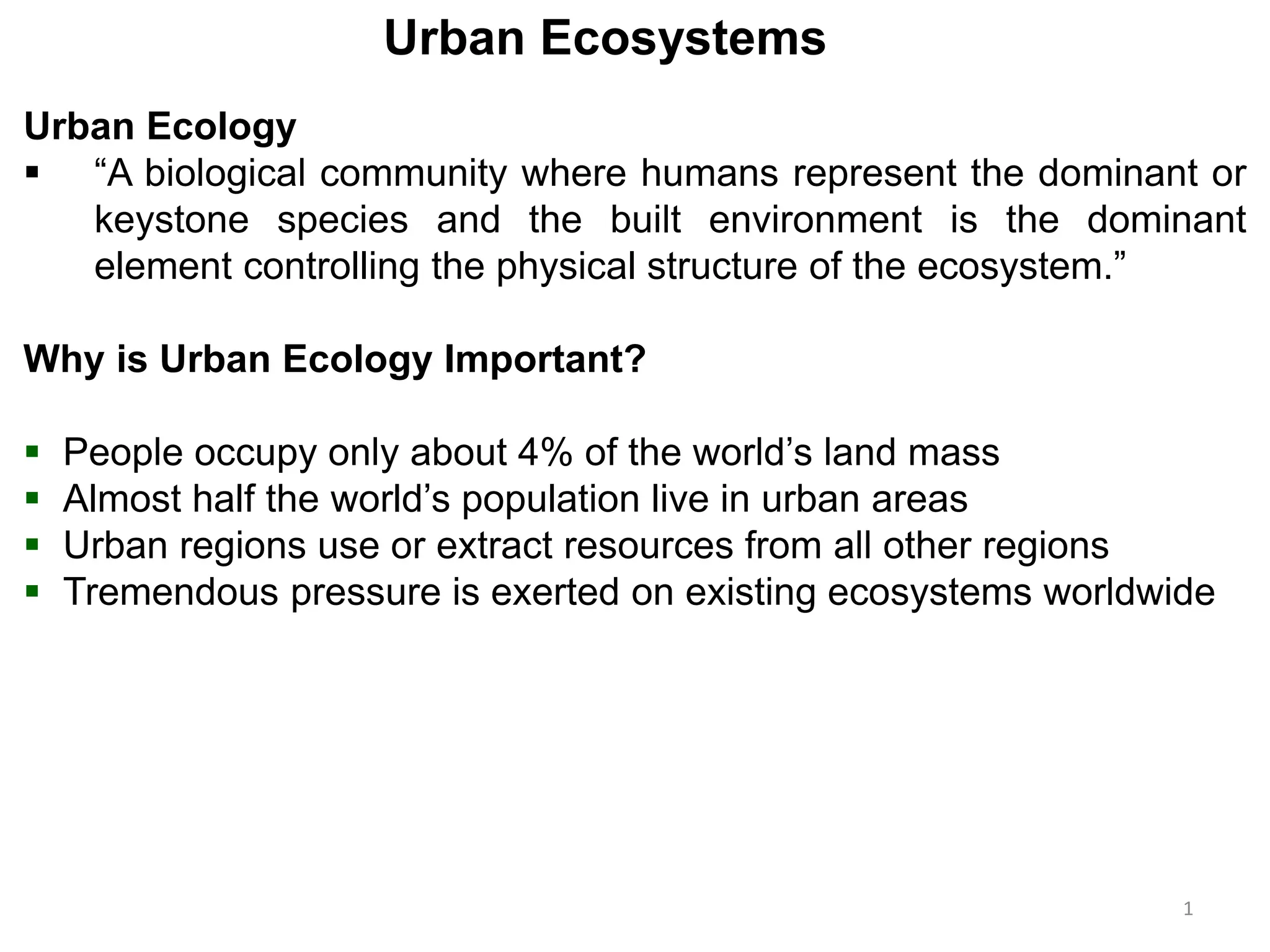
Urban Ecology
 “A biological community where humans represent the dominant or
keystone species and the built environment is the dominant
element controlling the physical structure of the ecosystem.”
Why is Urban Ecology Important?
 People occupy only about 4% of the world’s land mass
 Almost half the world’s population live in urban areas
 Urban regions use or extract resources from all other regions
 Tremendous pressure is exerted on existing ecosystems worldwide
Urban Ecosystems
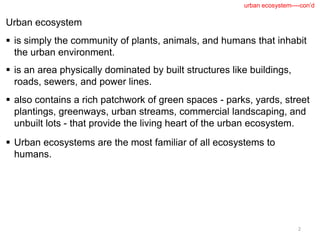
Urban ecosystem
 is simply the community of plants, animals, and humans that inhabit
the urban environment.
 is an area physically dominated by built structures like buildings,
roads, sewers, and power lines.
 also contains a rich patchwork of green spaces - parks, yards, street
plantings, greenways, urban streams, commercial landscaping, and
unbuilt lots - that provide the living heart of the urban ecosystem.
 Urban ecosystems are the most familiar of all ecosystems to
humans.
2
urban ecosystem----con’d
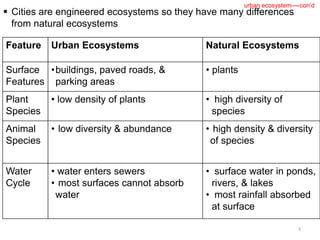
 Cities are engineered ecosystems so they have many differences
from natural ecosystems
Feature Urban Ecosystems Natural Ecosystems
Surface
Features
•buildings, paved roads, &
parking areas
• plants
Plant
Species
• low density of plants • high diversity of
species
Animal
Species
• low diversity & abundance • high density & diversity
of species
Water
Cycle
• water enters sewers
• most surfaces cannot absorb
water
• surface water in ponds,
rivers, & lakes
• most rainfall absorbed
at surface
3
urban ecosystem----con’d
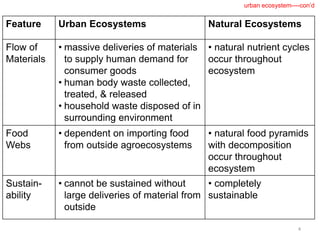
Feature Urban Ecosystems Natural Ecosystems
Flow of
Materials
• massive deliveries of materials
to supply human demand for
consumer goods
• human body waste collected,
treated, & released
• household waste disposed of in
surrounding environment
• natural nutrient cycles
occur throughout
ecosystem
Food
Webs
• dependent on importing food
from outside agroecosystems
• natural food pyramids
with decomposition
occur throughout
ecosystem
Sustain-
ability
• cannot be sustained without
large deliveries of material from
outside
• completely
sustainable
4
urban ecosystem----con’d
 also differences between urban ecosystems and natural ecosystems
(less dominated by humans).
o Urban ecosystems are generally highly disturbed systems,
• subject to rapid changes in soil and plant cover, as well as
temperature and water availability.
• The plant life in urban ecosystems is also different ,
characterized by many nonnative plants
• Even in the city's natural or seminatural areas, like parks, the
vegetation is often highly altered, with many nonnative and
invasive species.
5
urban ecosystem----con’d
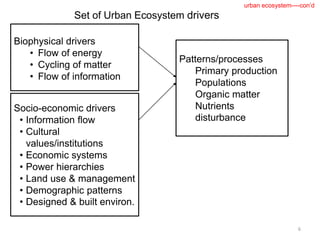
Set of Urban Ecosystem drivers
Biophysical drivers
• Flow of energy
• Cycling of matter
• Flow of information
Socio-economic drivers
• Information flow
• Cultural
values/institutions
• Economic systems
• Power hierarchies
• Land use & management
• Demographic patterns
• Designed & built environ.
Patterns/processes
Primary production
Populations
Organic matter
Nutrients
disturbance
6
urban ecosystem----con’d
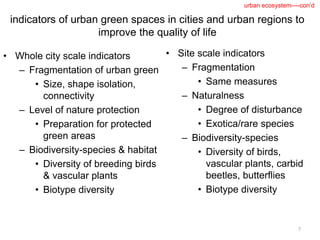
indicators of urban green spaces in cities and urban regions to
improve the quality of life
• Whole city scale indicators
– Fragmentation of urban green
• Size, shape isolation,
connectivity
– Level of nature protection
• Preparation for protected
green areas
– Biodiversity-species & habitat
• Diversity of breeding birds
& vascular plants
• Biotype diversity
• Site scale indicators
– Fragmentation
• Same measures
– Naturalness
• Degree of disturbance
• Exotica/rare species
– Biodiversity-species
• Diversity of birds,
vascular plants, carbid
beetles, butterflies
• Biotype diversity
7
urban ecosystem----con’d
Extent of Urban Ecosystems
 Urban ecosystems currently cover about 4% of the world's surface.
 they are the only major ecosystem type that is expanding with the
rapid growth of cities worldwide, .
 New urban landscapes are being generated by the building of roads,
housing, power lines, and industrial and commercial sites
8
urban ecosystem----con’d
 Cities are the heart of human commerce and industry
o the primary centers of
• employment,
• housing,
• transportation, and
• the range of social services from health care to education.
 the contribution of urban green spaces to the urban Ecosystems.
1. Shade and Temperature Control: Street trees and other green spaces help
to battle the urban heat island effect.
− Temperatures in the heart of a city are warmer than in rural areas due
to the large heat-absorbing surfaces of buildings and asphalt, as well as
high energy use.
−Trees provide shade and also transpire large amounts of water that
provide a cooling effect when evaporated.
−When combined, these effects can lower local temperatures
9
urban ecosystem----con’d
2. Air Filtering: City plants are efficient air pollution removers.
− In a park, trees can filter out as much as 85% of the ambient air
pollution - mostly particulates.
− Street trees can also be effective air purifiers, removing up to 70% of
particulates on a tree-lined street.
3. Noise reduction: Trees and shrubs can help filter out noise pollution
− A 30-meter belt of tall dense trees combined can reduce local noise
levels by 50%.
4. Storm water Control:
− Urban forests, wetlands, and streamside vegetation help to restore
some of the natural balance by buffering stormwater runoff,
absorbing pollutants, and recharging groundwater reservoirs.
5. Recreation, Aesthetic, and Spiritual Values: Parks and green spaces
provide city dwellers with invaluable recreational opportunities.
10
urban ecosystem----con’d
6. Biodiversity and Wildlife Habitat: Cities support a variety of plants and
animals.
 Urban ecosystems provide critical habitat to many migratory species.
For example, urban green spaces and parks are critical to many
migratory birds.
 In many instances, these wildlife provide us with recreational
opportunities.
7. Food Production: Although it is not so prevalent in the countries, urban
agriculture is very important on a global basis.
11
urban ecosystem----con’d
Threatening the World's Urban Ecosystems
 Intensive and rapid urban growth is the greatest pressure on urban
ecosystems.
 Urban areas will add some 2 billion new residents worldwide by
2030, growing from the current urban population of 2.9 billion to
4.9 billion.
 In today's world, nearly all population growth is urban growth.
12
urban ecosystem----con’d
 urban areas will be spread over a significantly larger area than today,
-changing natural areas like forests, grasslands, and farms into urban and
suburban environments.
-Within existing cities, more people will use parks and other green areas,
and development will gradually increase the stress on the remaining
green areas.
 Many communities still see green areas as more a luxury than
an essential component of the city's infrastructure like its roads
or sewers.
 There is a lack of planning and budgeting for the care of green
spaces.
• little attention is paid to the effects on the urban forest
13
urban ecosystem----con’d
 Like all other ecosystems, urban ecosystems are not isolated
islands, but part of a larger web of life.
 What goes on in cities affects all the ecosystems that surround them
i.e. the nearby forests, farms, and waterways.
 More than any other ecosystem, cities are permeable in their
environmental effects.
• they draw resources from other ecosystems all around them
- food, water, building materials
• often export wastes and pollution.
- They can be a tremendous burden on the surrounding natural
ecosystems.
14
urban ecosystem----con’d
 The management of urban ecosystems will remain a key challenge
for cities.
 The conflicts with urban development
• lack of knowledge and management capacity and
• too little understanding of the complex integration of the natural,
built and socio-economic systems into general urban
development.
15
urban ecosystem----con’d
 All cities are not impacting the environment in similar ways.
 Developed world cities have largely overcome their env’tal problems
 waste water removal,
 sanitation,
 water supply,
 indoor air pollution,
 etc.
 Cities in the developing world are more concerned with other issues.
• Urban env’tal challenges have been divided into two categories:
Inefficient modes of resource use, such as in the water supply,
housing, or energy, and
 limited absorptive capacity of pollution and flooding
 The key urban env’tal challenges
• water pollution;
• air pollution;
• solid waste management; and
• inappropriate land use.
16
urban ecosystem----con’d
Developed world cities Vs Developing world cities
 Urban environmental transition theory suggests that wealth can be
used to distinguish the env’tal performance of cities
 Dividing cities into three income categories,
1. The dominant env’tal problems in low-income cities are
localized health–threatening.
2. The environmental challenges in middle-income cities - threat
to both health and ecological sustainability.
3. Affluent cities must meet the challenges of global, inter–
generational, and environmental threats to ecological
sustainability.
17
urban ecosystem----con’d
 the shifting burdens of cities are described in to three categories; “brown”, “gray”,
and “green” environmental agenda issues.
 Historically, western cities have first encountered the so–called “brown agenda”,
which encompasses such environmental health agenda as
• a concern for overcrowded housing,
• a lack of basic services,
• hazardous pollutants in urban air and waterways, and
• accumulation of solid waste.
 Once cities have overcome “brown” issues they have struggled with those of the
“gray agenda”,
• Industrialization concern and
• Motorization impacts (eg. chemical pollutants).
 As cities became highly developed, activities within their borders encouraged the
emergence of “green agenda” issues,
• Increases in consumption and waste generation that disrupted ecosystems
• Resource depletion and
• Global climate change.
18
 The priority issues in the least developed cities of the developing world are:
Health, Water, and Sanitation (which we also term the “brown agenda”)
 The most important envir’tal issues in these poorer cities are:
oHousehold sanitation and
o Access to water
• a major problem - pollution of water with human excreta and
other wastes
o Indoor air pollution
19
urban ecosystem----con’d
 Understanding the city as an ecosystem began with some types of studies.
e.g.
• Urban metabolism research view - city as a consumer and digester of
resources and a creator of waste products.
- the city as an organism with its own metabolic processes.
 Cities are increasingly linked to each other through flows of goods,
services, investment, finance, people, and knowledge.
20
urban ecosystem----con’d
Cities within Regional and Global Ecosystems
 Global cities are also linked with and are increasingly impacting ecosystems
elsewhere at a larger scale.,
• “the web of connections linking one ecosystem and one country with
the next is escalating across all scales in both space and time.”.
 Cities are key to the promotion of global sustainability,
• Thus, it is important to understand the ways in which their activities
impact the local, regional, and global ecosystems
21
urban ecosystem----con’d
22
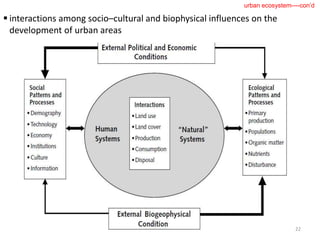
 interactions among socio–cultural and biophysical influences on the
development of urban areas
urban ecosystem----con’d
Urban ecosystems may be viewed in three ways
View 1
• As the built–up areas that are the habitat of urban people, their pets, their
garden plants, the adapted animals and organisms (birds, etc) and pests
(rats, weeds, etc).
• The survival of these areas depends on outside (external) support in the
form of energy, water, and materials inputs.
View 2
• As the immediate urban life-support system of the urban area and its
surroundings (the peri-urban area), providing ecological services such as
water supplies, areas for landfill, recreation zones, watershed protection,
greenhouse gas uptake, & biodiversity.
23
24
View 3
• As the areas affected by urban activities as a driving force, on the
provision of life-support services to urban areas, including supplies of
food, energy, water, and materials.
• as those areas affected by the emissions and waste flow from urban areas.
Ecosystem Services in Urban Ecosystems(Green spaces )
 Green spaces in cities
• modify the urban heat island,
• absorb some of the emitted greenhouse gases,
• provide recreation,
• Aesthetics and recreation
• Connecting open space & habitat
• Air and water quality maintenance
• Urban climate amelioration
• add diversity to human life,
• may be of cultural value,
• may be part of flood control systems, and
• can contribute to wildlife corridors.
- creates a series of opportunities for biodiversity
25
The traditional dev’t view pays attention to two kinds of UE function,
• Economic production &
• Social consumption,
 The production function in an urban ecosystem includes
• the production of material products,
• the application of labour and intelligence, and
• the generation of wastes.
The function of consumption in an urban ecosystem includes
• the consumption of commodities
• the utilization of infrastructure,
• the consumption of those resources and environments that have no
direct economic value like the atmosphere, watershed and hinterland
ecosystem.
26
 The function of an urban ecosystem is the ecological regulation driven by
human production and consumption;
• i.e., the systematic feedback
 It includes
• the sustainability of resource supply,
• the sustainability of environmental carrying capacity,
• the sustainability of ecological buffering, and
• the vitality of self-organization and self-regulation in human society.
 It is just this type of specific function through which the economy, the
society and the physical environment interact with one another to sustain a
harmonious human ecosystem.
27
The urban ecosystem approach raises critical needs:
1. Ecological footprints of cities needs to be identified
Ecological Footprint: a measure of the land area required to sustain a
given population of humans
i.e. understanding the dependence of urban residents on its immediate
hinterland and on far away places and resources for its everyday life
 It will assist in developing the concept of urban ecosystems i.e.
• where resources are used, and
• where wastes and pollution generated.
28
2. Global trends to develop local environment activities
 There must a clear need to link global env’tal problems to action at the
local level.
 Most global problems are a result of smaller, more local actions
e.g. increased use of cars at the local level leading to global warming.
 Thus, urban ecosystems need to be understood keeping global issues and
trends in mind.
29

Urban Ecosystem and urban manegement develope ment

  • 1.
    1 Urban Ecology  “Abiological community where humans represent the dominant or keystone species and the built environment is the dominant element controlling the physical structure of the ecosystem.” Why is Urban Ecology Important?  People occupy only about 4% of the world’s land mass  Almost half the world’s population live in urban areas  Urban regions use or extract resources from all other regions  Tremendous pressure is exerted on existing ecosystems worldwide Urban Ecosystems
  • 2.
    Urban ecosystem  issimply the community of plants, animals, and humans that inhabit the urban environment.  is an area physically dominated by built structures like buildings, roads, sewers, and power lines.  also contains a rich patchwork of green spaces - parks, yards, street plantings, greenways, urban streams, commercial landscaping, and unbuilt lots - that provide the living heart of the urban ecosystem.  Urban ecosystems are the most familiar of all ecosystems to humans. 2 urban ecosystem----con’d
  • 3.
     Cities areengineered ecosystems so they have many differences from natural ecosystems Feature Urban Ecosystems Natural Ecosystems Surface Features •buildings, paved roads, & parking areas • plants Plant Species • low density of plants • high diversity of species Animal Species • low diversity & abundance • high density & diversity of species Water Cycle • water enters sewers • most surfaces cannot absorb water • surface water in ponds, rivers, & lakes • most rainfall absorbed at surface 3 urban ecosystem----con’d
  • 4.
    Feature Urban EcosystemsNatural Ecosystems Flow of Materials • massive deliveries of materials to supply human demand for consumer goods • human body waste collected, treated, & released • household waste disposed of in surrounding environment • natural nutrient cycles occur throughout ecosystem Food Webs • dependent on importing food from outside agroecosystems • natural food pyramids with decomposition occur throughout ecosystem Sustain- ability • cannot be sustained without large deliveries of material from outside • completely sustainable 4 urban ecosystem----con’d
  • 5.
     also differencesbetween urban ecosystems and natural ecosystems (less dominated by humans). o Urban ecosystems are generally highly disturbed systems, • subject to rapid changes in soil and plant cover, as well as temperature and water availability. • The plant life in urban ecosystems is also different , characterized by many nonnative plants • Even in the city's natural or seminatural areas, like parks, the vegetation is often highly altered, with many nonnative and invasive species. 5 urban ecosystem----con’d
  • 6.
    Set of UrbanEcosystem drivers Biophysical drivers • Flow of energy • Cycling of matter • Flow of information Socio-economic drivers • Information flow • Cultural values/institutions • Economic systems • Power hierarchies • Land use & management • Demographic patterns • Designed & built environ. Patterns/processes Primary production Populations Organic matter Nutrients disturbance 6 urban ecosystem----con’d
  • 7.
    indicators of urbangreen spaces in cities and urban regions to improve the quality of life • Whole city scale indicators – Fragmentation of urban green • Size, shape isolation, connectivity – Level of nature protection • Preparation for protected green areas – Biodiversity-species & habitat • Diversity of breeding birds & vascular plants • Biotype diversity • Site scale indicators – Fragmentation • Same measures – Naturalness • Degree of disturbance • Exotica/rare species – Biodiversity-species • Diversity of birds, vascular plants, carbid beetles, butterflies • Biotype diversity 7 urban ecosystem----con’d
  • 8.
    Extent of UrbanEcosystems  Urban ecosystems currently cover about 4% of the world's surface.  they are the only major ecosystem type that is expanding with the rapid growth of cities worldwide, .  New urban landscapes are being generated by the building of roads, housing, power lines, and industrial and commercial sites 8 urban ecosystem----con’d  Cities are the heart of human commerce and industry o the primary centers of • employment, • housing, • transportation, and • the range of social services from health care to education.
  • 9.
     the contributionof urban green spaces to the urban Ecosystems. 1. Shade and Temperature Control: Street trees and other green spaces help to battle the urban heat island effect. − Temperatures in the heart of a city are warmer than in rural areas due to the large heat-absorbing surfaces of buildings and asphalt, as well as high energy use. −Trees provide shade and also transpire large amounts of water that provide a cooling effect when evaporated. −When combined, these effects can lower local temperatures 9 urban ecosystem----con’d
  • 10.
    2. Air Filtering:City plants are efficient air pollution removers. − In a park, trees can filter out as much as 85% of the ambient air pollution - mostly particulates. − Street trees can also be effective air purifiers, removing up to 70% of particulates on a tree-lined street. 3. Noise reduction: Trees and shrubs can help filter out noise pollution − A 30-meter belt of tall dense trees combined can reduce local noise levels by 50%. 4. Storm water Control: − Urban forests, wetlands, and streamside vegetation help to restore some of the natural balance by buffering stormwater runoff, absorbing pollutants, and recharging groundwater reservoirs. 5. Recreation, Aesthetic, and Spiritual Values: Parks and green spaces provide city dwellers with invaluable recreational opportunities. 10 urban ecosystem----con’d
  • 11.
    6. Biodiversity andWildlife Habitat: Cities support a variety of plants and animals.  Urban ecosystems provide critical habitat to many migratory species. For example, urban green spaces and parks are critical to many migratory birds.  In many instances, these wildlife provide us with recreational opportunities. 7. Food Production: Although it is not so prevalent in the countries, urban agriculture is very important on a global basis. 11 urban ecosystem----con’d
  • 12.
    Threatening the World'sUrban Ecosystems  Intensive and rapid urban growth is the greatest pressure on urban ecosystems.  Urban areas will add some 2 billion new residents worldwide by 2030, growing from the current urban population of 2.9 billion to 4.9 billion.  In today's world, nearly all population growth is urban growth. 12 urban ecosystem----con’d  urban areas will be spread over a significantly larger area than today, -changing natural areas like forests, grasslands, and farms into urban and suburban environments. -Within existing cities, more people will use parks and other green areas, and development will gradually increase the stress on the remaining green areas.
  • 13.
     Many communitiesstill see green areas as more a luxury than an essential component of the city's infrastructure like its roads or sewers.  There is a lack of planning and budgeting for the care of green spaces. • little attention is paid to the effects on the urban forest 13 urban ecosystem----con’d
  • 14.
     Like allother ecosystems, urban ecosystems are not isolated islands, but part of a larger web of life.  What goes on in cities affects all the ecosystems that surround them i.e. the nearby forests, farms, and waterways.  More than any other ecosystem, cities are permeable in their environmental effects. • they draw resources from other ecosystems all around them - food, water, building materials • often export wastes and pollution. - They can be a tremendous burden on the surrounding natural ecosystems. 14 urban ecosystem----con’d
  • 15.
     The managementof urban ecosystems will remain a key challenge for cities.  The conflicts with urban development • lack of knowledge and management capacity and • too little understanding of the complex integration of the natural, built and socio-economic systems into general urban development. 15 urban ecosystem----con’d
  • 16.
     All citiesare not impacting the environment in similar ways.  Developed world cities have largely overcome their env’tal problems  waste water removal,  sanitation,  water supply,  indoor air pollution,  etc.  Cities in the developing world are more concerned with other issues. • Urban env’tal challenges have been divided into two categories: Inefficient modes of resource use, such as in the water supply, housing, or energy, and  limited absorptive capacity of pollution and flooding  The key urban env’tal challenges • water pollution; • air pollution; • solid waste management; and • inappropriate land use. 16 urban ecosystem----con’d Developed world cities Vs Developing world cities
  • 17.
     Urban environmentaltransition theory suggests that wealth can be used to distinguish the env’tal performance of cities  Dividing cities into three income categories, 1. The dominant env’tal problems in low-income cities are localized health–threatening. 2. The environmental challenges in middle-income cities - threat to both health and ecological sustainability. 3. Affluent cities must meet the challenges of global, inter– generational, and environmental threats to ecological sustainability. 17 urban ecosystem----con’d
  • 18.
     the shiftingburdens of cities are described in to three categories; “brown”, “gray”, and “green” environmental agenda issues.  Historically, western cities have first encountered the so–called “brown agenda”, which encompasses such environmental health agenda as • a concern for overcrowded housing, • a lack of basic services, • hazardous pollutants in urban air and waterways, and • accumulation of solid waste.  Once cities have overcome “brown” issues they have struggled with those of the “gray agenda”, • Industrialization concern and • Motorization impacts (eg. chemical pollutants).  As cities became highly developed, activities within their borders encouraged the emergence of “green agenda” issues, • Increases in consumption and waste generation that disrupted ecosystems • Resource depletion and • Global climate change. 18
  • 19.
     The priorityissues in the least developed cities of the developing world are: Health, Water, and Sanitation (which we also term the “brown agenda”)  The most important envir’tal issues in these poorer cities are: oHousehold sanitation and o Access to water • a major problem - pollution of water with human excreta and other wastes o Indoor air pollution 19 urban ecosystem----con’d
  • 20.
     Understanding thecity as an ecosystem began with some types of studies. e.g. • Urban metabolism research view - city as a consumer and digester of resources and a creator of waste products. - the city as an organism with its own metabolic processes.  Cities are increasingly linked to each other through flows of goods, services, investment, finance, people, and knowledge. 20 urban ecosystem----con’d Cities within Regional and Global Ecosystems
  • 21.
     Global citiesare also linked with and are increasingly impacting ecosystems elsewhere at a larger scale., • “the web of connections linking one ecosystem and one country with the next is escalating across all scales in both space and time.”.  Cities are key to the promotion of global sustainability, • Thus, it is important to understand the ways in which their activities impact the local, regional, and global ecosystems 21 urban ecosystem----con’d
  • 22.
    22  interactions amongsocio–cultural and biophysical influences on the development of urban areas urban ecosystem----con’d
  • 23.
    Urban ecosystems maybe viewed in three ways View 1 • As the built–up areas that are the habitat of urban people, their pets, their garden plants, the adapted animals and organisms (birds, etc) and pests (rats, weeds, etc). • The survival of these areas depends on outside (external) support in the form of energy, water, and materials inputs. View 2 • As the immediate urban life-support system of the urban area and its surroundings (the peri-urban area), providing ecological services such as water supplies, areas for landfill, recreation zones, watershed protection, greenhouse gas uptake, & biodiversity. 23
  • 24.
    24 View 3 • Asthe areas affected by urban activities as a driving force, on the provision of life-support services to urban areas, including supplies of food, energy, water, and materials. • as those areas affected by the emissions and waste flow from urban areas.
  • 25.
    Ecosystem Services inUrban Ecosystems(Green spaces )  Green spaces in cities • modify the urban heat island, • absorb some of the emitted greenhouse gases, • provide recreation, • Aesthetics and recreation • Connecting open space & habitat • Air and water quality maintenance • Urban climate amelioration • add diversity to human life, • may be of cultural value, • may be part of flood control systems, and • can contribute to wildlife corridors. - creates a series of opportunities for biodiversity 25
  • 26.
    The traditional dev’tview pays attention to two kinds of UE function, • Economic production & • Social consumption,  The production function in an urban ecosystem includes • the production of material products, • the application of labour and intelligence, and • the generation of wastes. The function of consumption in an urban ecosystem includes • the consumption of commodities • the utilization of infrastructure, • the consumption of those resources and environments that have no direct economic value like the atmosphere, watershed and hinterland ecosystem. 26
  • 27.
     The functionof an urban ecosystem is the ecological regulation driven by human production and consumption; • i.e., the systematic feedback  It includes • the sustainability of resource supply, • the sustainability of environmental carrying capacity, • the sustainability of ecological buffering, and • the vitality of self-organization and self-regulation in human society.  It is just this type of specific function through which the economy, the society and the physical environment interact with one another to sustain a harmonious human ecosystem. 27
  • 28.
    The urban ecosystemapproach raises critical needs: 1. Ecological footprints of cities needs to be identified Ecological Footprint: a measure of the land area required to sustain a given population of humans i.e. understanding the dependence of urban residents on its immediate hinterland and on far away places and resources for its everyday life  It will assist in developing the concept of urban ecosystems i.e. • where resources are used, and • where wastes and pollution generated. 28
  • 29.
    2. Global trendsto develop local environment activities  There must a clear need to link global env’tal problems to action at the local level.  Most global problems are a result of smaller, more local actions e.g. increased use of cars at the local level leading to global warming.  Thus, urban ecosystems need to be understood keeping global issues and trends in mind. 29