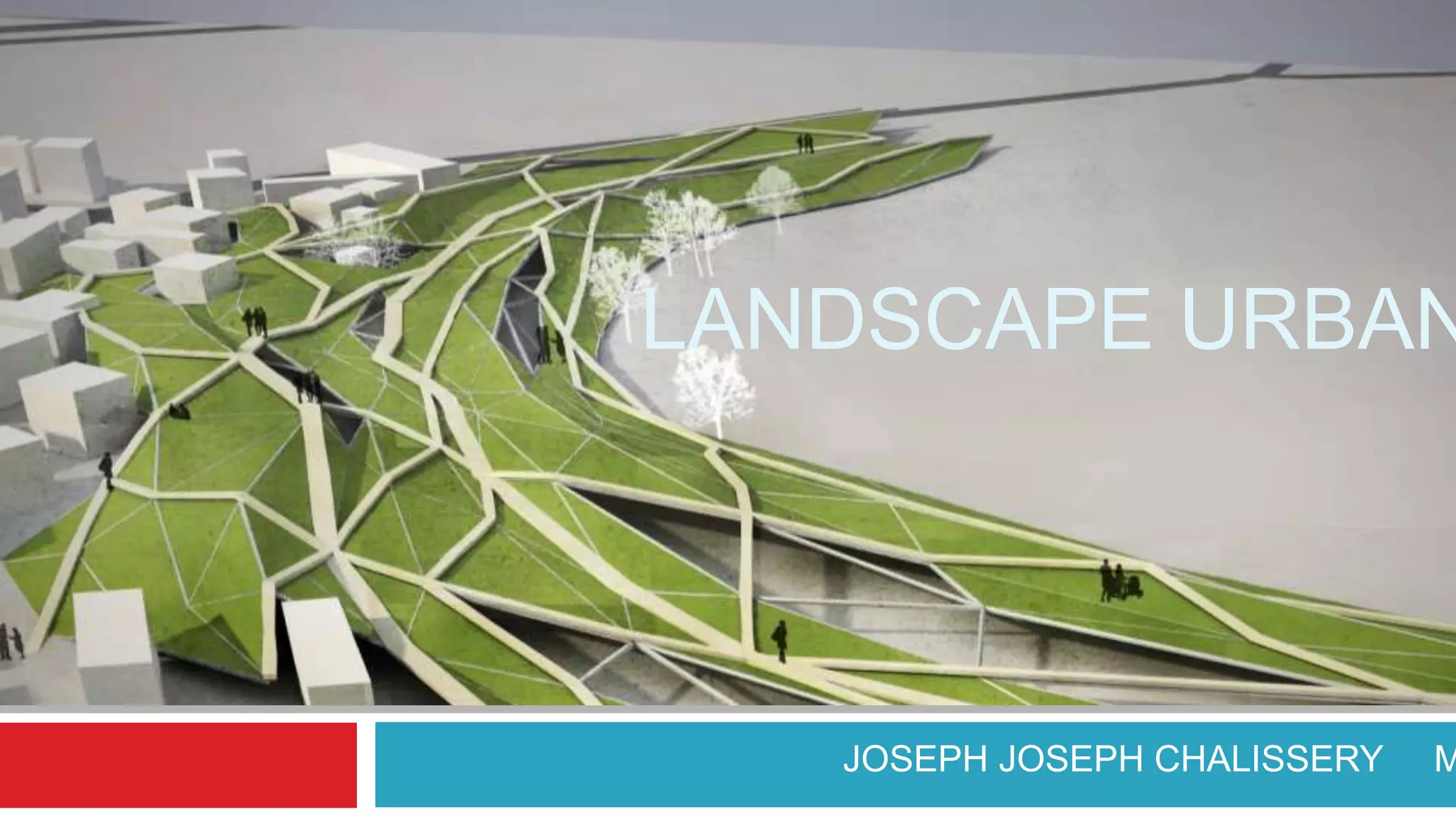
LANDSCAPE URBAN
JOSEPH JOSEPH CHALISSERY M
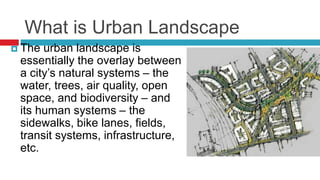
What is Urban Landscape
 The urban landscape is
essentially the overlay between
a city’s natural systems – the
water, trees, air quality, open
space, and biodiversity – and
its human systems – the
sidewalks, bike lanes, fields,
transit systems, infrastructure,
etc.
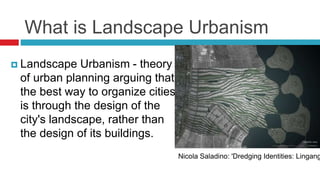
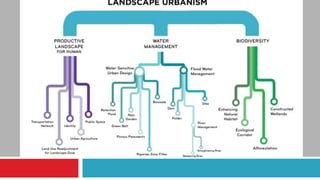
What is Landscape Urbanism
 Landscape Urbanism - theory
of urban planning arguing that
the best way to organize cities
is through the design of the
city's landscape, rather than
the design of its buildings.
Nicola Saladino: 'Dredging Identities: Lingang
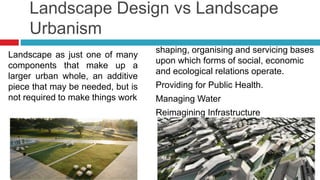
Landscape Design vs Landscape
Urbanism
Landscape as just one of many
components that make up a
larger urban whole, an additive
piece that may be needed, but is
not required to make things work
shaping, organising and servicing bases
upon which forms of social, economic
and ecological relations operate.
Providing for Public Health.
Managing Water
Reimagining Infrastructure
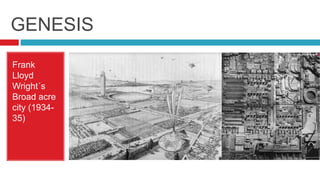
GENESIS
Frank
Lloyd
Wright´s
Broad acre
city (1934-
35)
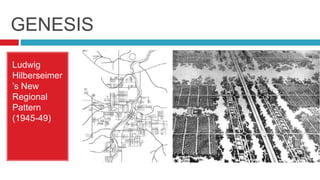
GENESIS
Ludwig
Hilberseimer
’s New
Regional
Pattern
(1945-49)
GENESIS
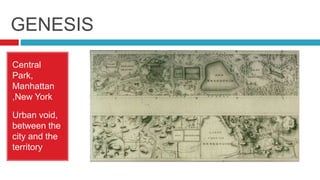
Central
Park,
Manhattan
,New York
Urban void,
between the
city and the
territory
GENESIS
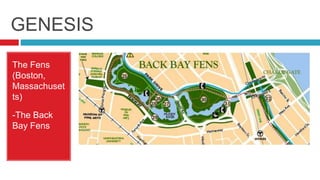
The Fens
(Boston,
Massachuset
ts)
-The Back
Bay Fens
GENESIS
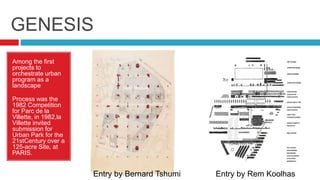
Among the first
projects to
orchestrate urban
program as a
landscape
Process was the
1982 Competition
for Parc de la
Villette, in 1982,la
Villette invited
submission for
Urban Park for the
21stCentury over a
125-acre Site, at
PARIS.
Entry by Bernard Tshumi Entry by Rem Koolhas
late 1990s
 the phrase 'landscape urbanism' was used by landscape architects in the United States
to refer to the re-organisation of declining post-industrial cities, such as Detroit.
1994
 first appeared in the work of Peter Connolly, a Masters of Urban Design student from
RMIT Melbourne.
 Connolly used the phrase in the title for his Masters of Urban Design proposal at RMIT
Melbourne.
 he suggested that 'a language of "landscape urbanism" barely exists and needs
articulating', and that 'existing urbanisms are limited in the exploration of the landscape'.
1996
 Tom Turner – “The city of the future will be an infinite series of landscapes: psychological
and physical, urban and rural, flowing apart and together. They will be mapped and
planned for special purposes, with the results recorded in geographical information
systems (GIS), which have the power to construct and retrieve innumerable plans,
images and other records. Christopher Alexander was right: a city is not a tree. It is a
landscape.
1997
 The first major event with 'landscape urbanism'
-Landscape Urbanism conference sponsored by the Graham Foundation in Chicago in
April 1997.
- Speakers included Charles Waldheim, Mohsen Mostafavi, James Corner, Adriaan
Geuze.
 exploring the artificial boundaries of Landscape Architecture, Urban Design and
Architecture, searching for better ways to deal with complex urban projects.
2000s
 it was used in Europe by architects to mean a highly flexible way of integrating large-
scale infrastructure, housing and open space. By the late 2000s, the phrase became
associated with highly commercialized, multi-phase urban parks, such as Olympic park
design.
QUOTES-James Corner- "Terra
Fluxus."
He has identified four general ideas that are important for
use in Landscape Urbanism. They are as follows:
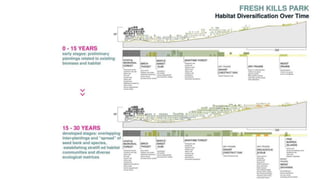
1 Process over time -. Landscape Urbanism is
concerned with a working surface over time – a type of
urbanism that anticipates change, open endedness and
negotiation.
2 Horizontality - The use of horizontal alignment in
landscaping, rather than relying on vertical structuring.
3 Working Methods /Techniques - Those who practice
the idea of landscape urbanism should be able to adapt
their techniques to the environment that they are in.
4 The imaginary - That in many ways the failing of
twentieth century planning can be attributed to the
absolute impoverishment of the imagination to extend
Landscape in Time- Christophe
Girot
“The deconstructed fragmentation of the city should be
taken as model. The situationist discourse of the last few
years has had no significant impact in the realm of
landscape except for its further degradation nor does it
necessarily mean that we always have to refer to the
traces of a given site to legitimate some form of action.”
GrahamShane- OnLandscape
“Urbanists want to continue the search for a new basis of
a performative urbanism that emerges from the bottom
up, geared to the technological and ecological realities of
the postindustrial world.”
Kenneth Frampton
“ Priority should now be accorded to landscape, rather
than freestanding built form in the making of cities” “
Priority should now be accorded to landscape, rather
than freestanding built form in the making of cities”
Stan Allen
“Increasingly, landscape is emerging as a model for
urbanism, landscape has traditionally been defined as
the art of organizing horizontal surfaces by paying close
attention to these surface conditions -not only
configuration but also materiality and performance-
designers can activate space and produce urban effects
without the weighty apparatus of traditional space
making.”
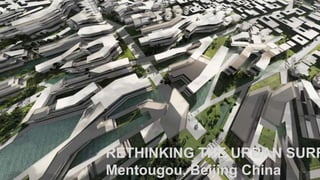
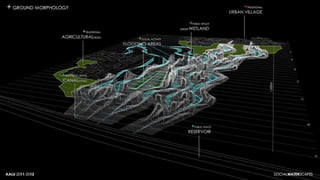
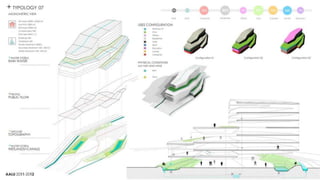
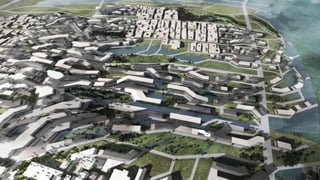
RETHINKING THE URBAN SURF
Mentougou, Beijing China
Criticism
 One opponent is New Urbanism, led by Andres Duany, which
promotes walkable communities and smart growth with its Transit
Oriented Development (TOD) and Traditional Neighborhood
Design (TND). Duany stated that “density and urbanism are not
the same.” Further, “unless there is tremendous density, human
beings will not walk.” The result is patches of green sprawl that
lose connectivity to the greater network.
 Emo Urbanism is another philosophy critical of Landscape
Urbanism. The movement contends that Landscape Urbanism
views ecology as an aesthetic element of style and not
infrastructure. The artificial ecology replaces the entropic state to
re-create a "natural" landscape that fits a particular brand or
aesthetic. The loss is a dynamic, adaptive, and certainly essential
urban system. Emo urbanism differs by making evolving "nature"
a key component of the design process. The realization of this
process is called “urbanature

Landscape urbanism

  • 1.
  • 2.
    What is UrbanLandscape  The urban landscape is essentially the overlay between a city’s natural systems – the water, trees, air quality, open space, and biodiversity – and its human systems – the sidewalks, bike lanes, fields, transit systems, infrastructure, etc.
  • 3.
    What is LandscapeUrbanism  Landscape Urbanism - theory of urban planning arguing that the best way to organize cities is through the design of the city's landscape, rather than the design of its buildings. Nicola Saladino: 'Dredging Identities: Lingang
  • 5.
    Landscape Design vsLandscape Urbanism Landscape as just one of many components that make up a larger urban whole, an additive piece that may be needed, but is not required to make things work shaping, organising and servicing bases upon which forms of social, economic and ecological relations operate. Providing for Public Health. Managing Water Reimagining Infrastructure
  • 6.
  • 7.
  • 8.
  • 9.
  • 10.
    GENESIS Among the first projectsto orchestrate urban program as a landscape Process was the 1982 Competition for Parc de la Villette, in 1982,la Villette invited submission for Urban Park for the 21stCentury over a 125-acre Site, at PARIS. Entry by Bernard Tshumi Entry by Rem Koolhas
  • 11.
    late 1990s  thephrase 'landscape urbanism' was used by landscape architects in the United States to refer to the re-organisation of declining post-industrial cities, such as Detroit. 1994  first appeared in the work of Peter Connolly, a Masters of Urban Design student from RMIT Melbourne.  Connolly used the phrase in the title for his Masters of Urban Design proposal at RMIT Melbourne.  he suggested that 'a language of "landscape urbanism" barely exists and needs articulating', and that 'existing urbanisms are limited in the exploration of the landscape'. 1996  Tom Turner – “The city of the future will be an infinite series of landscapes: psychological and physical, urban and rural, flowing apart and together. They will be mapped and planned for special purposes, with the results recorded in geographical information systems (GIS), which have the power to construct and retrieve innumerable plans, images and other records. Christopher Alexander was right: a city is not a tree. It is a landscape.
  • 12.
    1997  The firstmajor event with 'landscape urbanism' -Landscape Urbanism conference sponsored by the Graham Foundation in Chicago in April 1997. - Speakers included Charles Waldheim, Mohsen Mostafavi, James Corner, Adriaan Geuze.  exploring the artificial boundaries of Landscape Architecture, Urban Design and Architecture, searching for better ways to deal with complex urban projects. 2000s  it was used in Europe by architects to mean a highly flexible way of integrating large- scale infrastructure, housing and open space. By the late 2000s, the phrase became associated with highly commercialized, multi-phase urban parks, such as Olympic park design.
  • 13.
    QUOTES-James Corner- "Terra Fluxus." Hehas identified four general ideas that are important for use in Landscape Urbanism. They are as follows: 1 Process over time -. Landscape Urbanism is concerned with a working surface over time – a type of urbanism that anticipates change, open endedness and negotiation. 2 Horizontality - The use of horizontal alignment in landscaping, rather than relying on vertical structuring. 3 Working Methods /Techniques - Those who practice the idea of landscape urbanism should be able to adapt their techniques to the environment that they are in. 4 The imaginary - That in many ways the failing of twentieth century planning can be attributed to the absolute impoverishment of the imagination to extend
  • 17.
    Landscape in Time-Christophe Girot “The deconstructed fragmentation of the city should be taken as model. The situationist discourse of the last few years has had no significant impact in the realm of landscape except for its further degradation nor does it necessarily mean that we always have to refer to the traces of a given site to legitimate some form of action.”
  • 18.
    GrahamShane- OnLandscape “Urbanists wantto continue the search for a new basis of a performative urbanism that emerges from the bottom up, geared to the technological and ecological realities of the postindustrial world.”
  • 19.
    Kenneth Frampton “ Priorityshould now be accorded to landscape, rather than freestanding built form in the making of cities” “ Priority should now be accorded to landscape, rather than freestanding built form in the making of cities”
  • 20.
    Stan Allen “Increasingly, landscapeis emerging as a model for urbanism, landscape has traditionally been defined as the art of organizing horizontal surfaces by paying close attention to these surface conditions -not only configuration but also materiality and performance- designers can activate space and produce urban effects without the weighty apparatus of traditional space making.”
  • 21.
    RETHINKING THE URBANSURF Mentougou, Beijing China
  • 27.
    Criticism  One opponentis New Urbanism, led by Andres Duany, which promotes walkable communities and smart growth with its Transit Oriented Development (TOD) and Traditional Neighborhood Design (TND). Duany stated that “density and urbanism are not the same.” Further, “unless there is tremendous density, human beings will not walk.” The result is patches of green sprawl that lose connectivity to the greater network.  Emo Urbanism is another philosophy critical of Landscape Urbanism. The movement contends that Landscape Urbanism views ecology as an aesthetic element of style and not infrastructure. The artificial ecology replaces the entropic state to re-create a "natural" landscape that fits a particular brand or aesthetic. The loss is a dynamic, adaptive, and certainly essential urban system. Emo urbanism differs by making evolving "nature" a key component of the design process. The realization of this process is called “urbanature