Landscape Architecture
Introduction
Presented by:
Ar. Bineet Chhajer
Landscape Architecture
Landscape Architecture is the art and science of
planning and design of out door open spaces, to meet
the physical, economic and socio-behavioral needs of
the users, respecting and in harmony with the existing
contextual natural and man made environments.
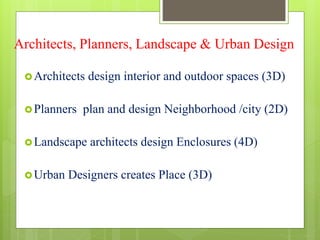
Architects, Planners, Landscape & Urban Design
ļ‚›Architects design interior and outdoor spaces (3D)
ļ‚›Planners plan and design Neighborhood /city (2D)
ļ‚›Landscape architects design Enclosures (4D)
ļ‚›Urban Designers creates Place (3D)
Landscape Architecture Profession
ļ‚›OLD Approach : Landscape Gardening
ļ‚›New Approach : Design with Nature
ļ‚›Contemporary Approaches :
i. Sustainability and Landscape
ii. Modification of micro-climate through energy
efficient enviroscaping
iii. Resource efficient landscape :TERI GRIHA
iv. Ecology and Habitat creation
Landscape Architecture Profession
ļ‚›OLD Approach : Landscape Gardening
ļ‚›New Approach : Design with Nature
ļ‚›Contemporary Approaches :
i. Sustainability and Landscape
ii. Modification of micro-climate through energy
efficient landscaping
iii. Resource efficient landscape :TERI GRIHA
iv. Ecology and Habitat creation
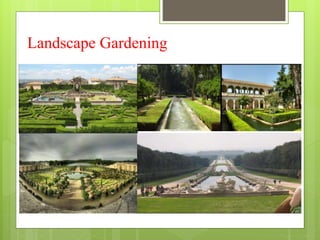
Landscape Gardening
Sustainability and Landscape
ļ‚› For centuries, theorists of architecture and landscape have vindicated, refuted, modified,and
reorganized Vitruvius’ architectural theory of the interrelationship between firmitas, utilitas, and
venustas, that is - structural stability, appropriate spatial accommodation, and attractive appearance.
ļ‚› The concept of sustainability, however, was never part of the debate, since prior to the industrial
revolution, a much smaller world population and consequentially limited land and resource
consumption meant that the earth’s resources and its ability to absorb pollution were never in
question.
ļ‚› Any discussion on the role of sustainability and landscape architecture, or architecture for that
matter, should therefore take as a starting point the now commonly known and often cited definition
in the Bruntland Commission Report of 1983 that
ā€œSustainable development is development that meets the needs of the present
without compromising the ability of future generations to meet their own needs.ā€
Sustainability and Landscape
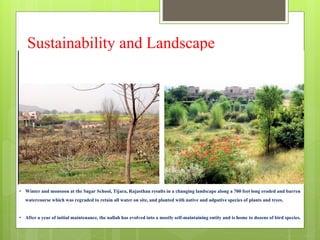
• Winter and monsoon at the Sagar School, Tijara, Rajasthan results in a changing landscape along a 700 feet long eroded and barren
watercourse which was regraded to retain all water on site, and planted with native and adpative species of plants and trees.
• After a year of initial maintenance, the nallah has evolved into a mostly self-maintaining entity and is home to dozens of bird species.
Sustainability and Landscape
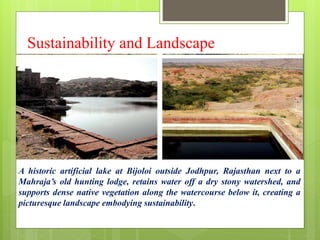
A historic artificial lake at Bijoloi outside Jodhpur, Rajasthan next to a
Mahraja’s old hunting lodge, retains water off a dry stony watershed, and
supports dense native vegetation along the watercourse below it, creating a
picturesque landscape embodying sustainability.
Resource Efficient Landscape :TERI GRIHA
• Buildings in urban areas consume enormous amount of resources
such as energy and water.
• Resource intensive materials are used to construct the building
envelope and energy consuming systems provide comfort to the
inhabitants.
• The designed landscape around the built environment adds beauty to
the outdoors, while consuming water and pesticides for its
maintenance.
• When a building gets constructed on a virgin site, the natural
ecosystem of the site may easily get damaged.
Resource Efficient Landscape :TERI GRIHA
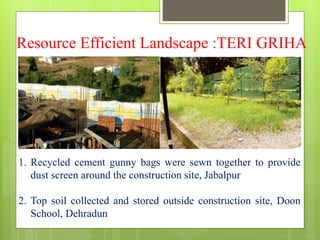
1. Recycled cement gunny bags were sewn together to provide
dust screen around the construction site, Jabalpur
2. Top soil collected and stored outside construction site, Doon
School, Dehradun
Resource Efficient Landscape :TERI GRIHA
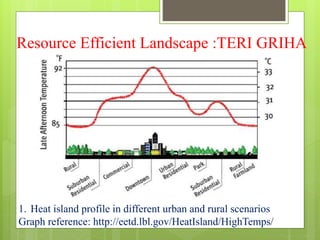
1. Heat island profile in different urban and rural scenarios
Graph reference: http://eetd.lbl.gov/HeatIsland/HighTemps/
LEED India
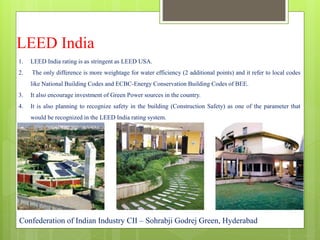
1. LEED India rating is as stringent as LEED USA.
2. The only difference is more weightage for water efficiency (2 additional points) and it refer to local codes
like National Building Codes and ECBC-Energy Conservation Building Codes of BEE.
3. It also encourage investment of Green Power sources in the country.
4. It is also planning to recognize safety in the building (Construction Safety) as one of the parameter that
would be recognized in the LEED India rating system.
Confederation of Indian Industry CII – Sohrabji Godrej Green, Hyderabad
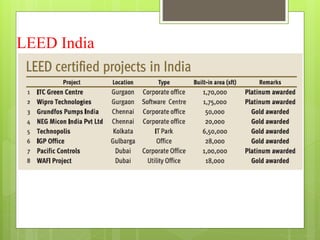
LEED India
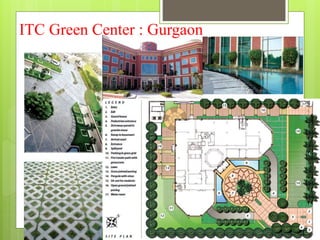
ITC Green Center : Gurgaon
Modifying micro-climate through energy
efficient landscaping
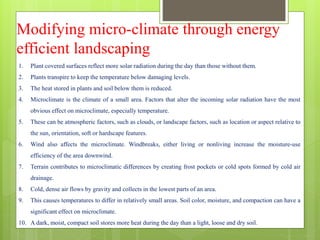
1. Plant covered surfaces reflect more solar radiation during the day than those without them.
2. Plants transpire to keep the temperature below damaging levels.
3. The heat stored in plants and soil below them is reduced.
4. Microclimate is the climate of a small area. Factors that alter the incoming solar radiation have the most
obvious effect on microclimate, especially temperature.
5. These can be atmospheric factors, such as clouds, or landscape factors, such as location or aspect relative to
the sun, orientation, soft or hardscape features.
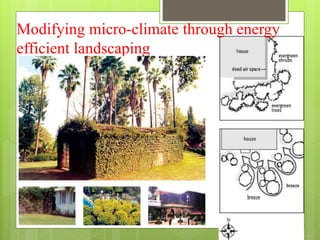
6. Wind also affects the microclimate. Windbreaks, either living or nonliving increase the moisture-use
efficiency of the area downwind.
7. Terrain contributes to microclimatic differences by creating frost pockets or cold spots formed by cold air
drainage.
8. Cold, dense air flows by gravity and collects in the lowest parts of an area.
9. This causes temperatures to differ in relatively small areas. Soil color, moisture, and compaction can have a
significant effect on microclimate.
10. A dark, moist, compact soil stores more heat during the day than a light, loose and dry soil.
Modifying micro-climate through energy
efficient landscaping
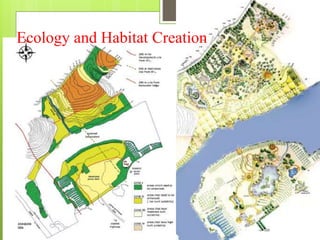
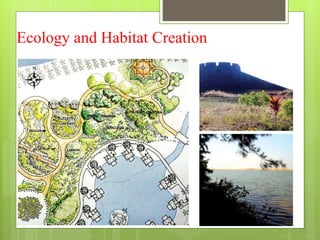
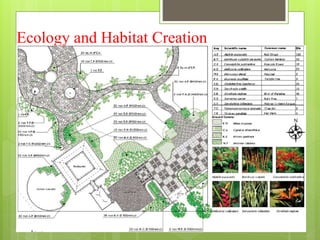
Ecology and Habitat Creation
Thank you

Landscape architecture introduction lecture 1

  • 1.
  • 2.
    Landscape Architecture Landscape Architectureis the art and science of planning and design of out door open spaces, to meet the physical, economic and socio-behavioral needs of the users, respecting and in harmony with the existing contextual natural and man made environments.
  • 3.
    Architects, Planners, Landscape& Urban Design ļ‚›Architects design interior and outdoor spaces (3D) ļ‚›Planners plan and design Neighborhood /city (2D) ļ‚›Landscape architects design Enclosures (4D) ļ‚›Urban Designers creates Place (3D)
  • 5.
    Landscape Architecture Profession ļ‚›OLDApproach : Landscape Gardening ļ‚›New Approach : Design with Nature ļ‚›Contemporary Approaches : i. Sustainability and Landscape ii. Modification of micro-climate through energy efficient enviroscaping iii. Resource efficient landscape :TERI GRIHA iv. Ecology and Habitat creation
  • 8.
    Landscape Architecture Profession ļ‚›OLDApproach : Landscape Gardening ļ‚›New Approach : Design with Nature ļ‚›Contemporary Approaches : i. Sustainability and Landscape ii. Modification of micro-climate through energy efficient landscaping iii. Resource efficient landscape :TERI GRIHA iv. Ecology and Habitat creation
  • 9.
  • 10.
    Sustainability and Landscape ļ‚›For centuries, theorists of architecture and landscape have vindicated, refuted, modified,and reorganized Vitruvius’ architectural theory of the interrelationship between firmitas, utilitas, and venustas, that is - structural stability, appropriate spatial accommodation, and attractive appearance. ļ‚› The concept of sustainability, however, was never part of the debate, since prior to the industrial revolution, a much smaller world population and consequentially limited land and resource consumption meant that the earth’s resources and its ability to absorb pollution were never in question. ļ‚› Any discussion on the role of sustainability and landscape architecture, or architecture for that matter, should therefore take as a starting point the now commonly known and often cited definition in the Bruntland Commission Report of 1983 that ā€œSustainable development is development that meets the needs of the present without compromising the ability of future generations to meet their own needs.ā€
  • 11.
    Sustainability and Landscape •Winter and monsoon at the Sagar School, Tijara, Rajasthan results in a changing landscape along a 700 feet long eroded and barren watercourse which was regraded to retain all water on site, and planted with native and adpative species of plants and trees. • After a year of initial maintenance, the nallah has evolved into a mostly self-maintaining entity and is home to dozens of bird species.
  • 12.
    Sustainability and Landscape Ahistoric artificial lake at Bijoloi outside Jodhpur, Rajasthan next to a Mahraja’s old hunting lodge, retains water off a dry stony watershed, and supports dense native vegetation along the watercourse below it, creating a picturesque landscape embodying sustainability.
  • 13.
    Resource Efficient Landscape:TERI GRIHA • Buildings in urban areas consume enormous amount of resources such as energy and water. • Resource intensive materials are used to construct the building envelope and energy consuming systems provide comfort to the inhabitants. • The designed landscape around the built environment adds beauty to the outdoors, while consuming water and pesticides for its maintenance. • When a building gets constructed on a virgin site, the natural ecosystem of the site may easily get damaged.
  • 14.
    Resource Efficient Landscape:TERI GRIHA 1. Recycled cement gunny bags were sewn together to provide dust screen around the construction site, Jabalpur 2. Top soil collected and stored outside construction site, Doon School, Dehradun
  • 15.
    Resource Efficient Landscape:TERI GRIHA 1. Heat island profile in different urban and rural scenarios Graph reference: http://eetd.lbl.gov/HeatIsland/HighTemps/
  • 16.
    LEED India 1. LEEDIndia rating is as stringent as LEED USA. 2. The only difference is more weightage for water efficiency (2 additional points) and it refer to local codes like National Building Codes and ECBC-Energy Conservation Building Codes of BEE. 3. It also encourage investment of Green Power sources in the country. 4. It is also planning to recognize safety in the building (Construction Safety) as one of the parameter that would be recognized in the LEED India rating system. Confederation of Indian Industry CII – Sohrabji Godrej Green, Hyderabad
  • 17.
  • 18.
  • 19.
    Modifying micro-climate throughenergy efficient landscaping 1. Plant covered surfaces reflect more solar radiation during the day than those without them. 2. Plants transpire to keep the temperature below damaging levels. 3. The heat stored in plants and soil below them is reduced. 4. Microclimate is the climate of a small area. Factors that alter the incoming solar radiation have the most obvious effect on microclimate, especially temperature. 5. These can be atmospheric factors, such as clouds, or landscape factors, such as location or aspect relative to the sun, orientation, soft or hardscape features. 6. Wind also affects the microclimate. Windbreaks, either living or nonliving increase the moisture-use efficiency of the area downwind. 7. Terrain contributes to microclimatic differences by creating frost pockets or cold spots formed by cold air drainage. 8. Cold, dense air flows by gravity and collects in the lowest parts of an area. 9. This causes temperatures to differ in relatively small areas. Soil color, moisture, and compaction can have a significant effect on microclimate. 10. A dark, moist, compact soil stores more heat during the day than a light, loose and dry soil.
  • 20.
    Modifying micro-climate throughenergy efficient landscaping
  • 21.
  • 22.
  • 23.
  • 24.