URBAN LANDSCAPE DESIGN
Analysis and comparison of two examples
in national and international context
Typology and Approach
• The typology of case study selected is of Urban Central
Node which incorporates Commercial-Economic and Socio
– Cultural attributes required in an Urban context
• The case studies selected shall reflect and analyse these
values [ their enhancement] with its adaptation over the
years.
• The selection is based on comparable demographic and
historic layers of the places
• The cause factor analysis of the changes are looked into
due scope limitation of the current work.
URBAN LANDSCAPE DESIGN ANALYSIS - Parvathi M, MArch,SAP 2016
2
CASE STUDY
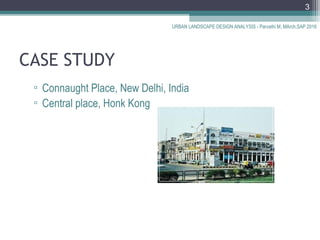
▫ Connaught Place, New Delhi, India
▫ Central place, Honk Kong
URBAN LANDSCAPE DESIGN ANALYSIS - Parvathi M, MArch,SAP 2016
3
Context and evolution of CP
How the Place came to being..
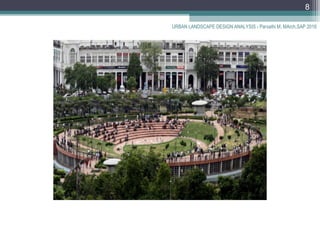
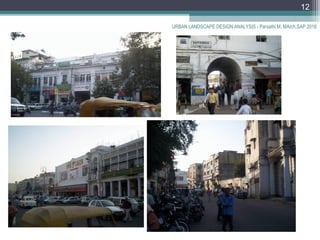
• Envisioned as a Plaza by the British Imperial, on shifting their capital
from Calcutta to New Delhi in 1911
• While planning out the residences of the British officers, need of a
separate market for the elite was realized. It was to be different from
the usual Indian markets like Chandni Chowk and Paharganj .
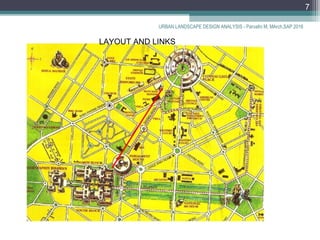
• Lutyens wanted two axes to terminate at the Viceroy’s House, that is
the present day Rashtrapati Bhawan.
• Axis 1 : To relate the British to the Muslim masses by providing a
direct axis to the Jama Masjid and the Red Fort, the capital of the
Great Mughal Empire. – Parliament Street
• Axis 2 : To relate the British to the Hindu masses by providing a direct
axis to the legendary capital of the Pandavas, Indraprastha. – Kings
Way
URBAN LANDSCAPE DESIGN ANALYSIS - Parvathi M, MArch,SAP 2016
6
URBAN LANDSCAPE DESIGN ANALYSIS - Parvathi M, MArch,SAP 2016
7
LAYOUT AND LINKS
URBAN LANDSCAPE DESIGN ANALYSIS - Parvathi M, MArch,SAP 2016
8
URBAN LANDSCAPE DESIGN ANALYSIS - Parvathi M, MArch,SAP 2016
9
Context and evolution of CP
• The Delhi Planning Commission envisioned a monumental
plaza ringed by hotels, shops and businesses dominated by a
railway tation at the intersection of Parliament Street and
Janpath This area was in close proximity to the existing village
of Madhoganj.
• This was second on the priority of the Planning Committee after
the Viceroy’s House as a expressive emblem of British progress
and power in India.
• Land of Madhoganj village was aquired to create this urban
node
• It was named after the Duke of Connaught to honour him on his
visit to Delhi.
URBAN LANDSCAPE DESIGN ANALYSIS - Parvathi M, MArch,SAP 2016
10
Context and evolution of CP
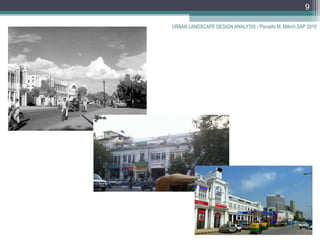
• According WH Nicholls, the architect member of the Imperial
Delhi Committee, there was a omnipresent need for uniformity
to endure a harmonious architectural effect.
• He proposed seven colonnaded facades to enclose the
circus,which was about 1100 feet in diameter.
• Robert Tor Russell was assigned to detail out the entire
structure, which he did on the lines which Nicholls had
advocated.
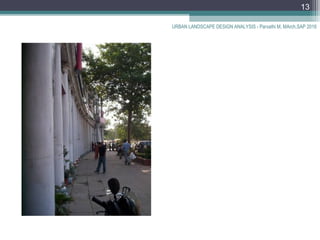
• Airy, stuccoed colonnades, punctuated by Palladian archways
to protect shoppers from rain and sun alike.
This was compared to Nash’s Regent Crescent, London and
Royal Crescent, Bath.
URBAN LANDSCAPE DESIGN ANALYSIS - Parvathi M, MArch,SAP 2016
11
URBAN LANDSCAPE DESIGN ANALYSIS - Parvathi M, MArch,SAP 2016
12
URBAN LANDSCAPE DESIGN ANALYSIS - Parvathi M, MArch,SAP 2016
13
URBAN LANDSCAPE DESIGN ANALYSIS - Parvathi M, MArch,SAP 2016
14
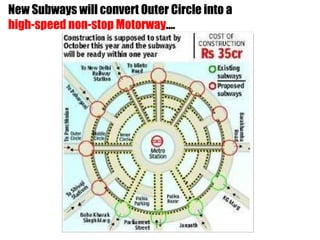
New Subways will convert Outer Circle into a
high-speed non-stop Motorway….
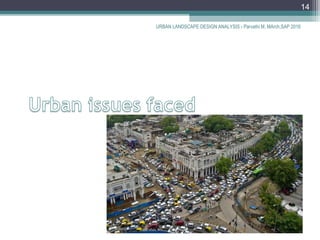
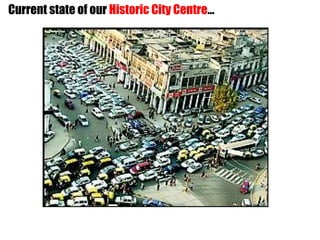
Current state of our Historic City Centre…
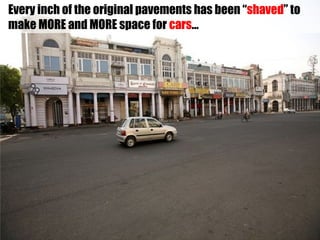
Every inch of the original pavements has been “shaved” to
make MORE and MORE space for cars…
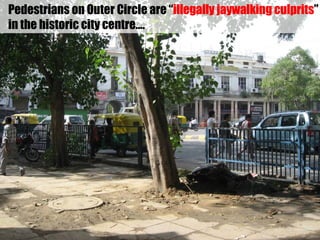
Pedestrians on Outer Circle are “illegally jaywalking culprits”
in the historic city centre….
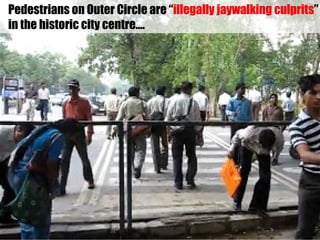
Pedestrians on Outer Circle are “illegally jaywalking culprits”
in the historic city centre….
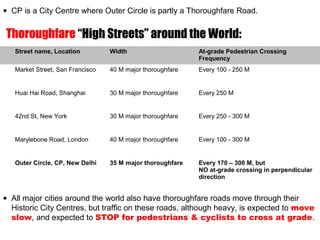
Street name, Location Width At-grade Pedestrian Crossing
Frequency
Market Street, San Francisco 40 M major thoroughfare Every 100 - 250 M
Huai Hai Road, Shanghai 30 M major thoroughfare Every 250 M
42nd St, New York 30 M major thoroughfare Every 250 - 300 M
Marylebone Road, London 40 M major thoroughfare Every 100 - 300 M
Outer Circle, CP, New Delhi 35 M major thoroughfare Every 170 – 300 M, but
NO at-grade crossing in perpendicular
direction
Thoroughfare “High Streets” around the World:
• All major cities around the world also have thoroughfare roads move through their
Historic City Centres, but traffic on these roads, although heavy, is expected to move
slow, and expected to STOP for pedestrians & cyclists to cross at grade.
• CP is a City Centre where Outer Circle is partly a Thoroughfare Road.
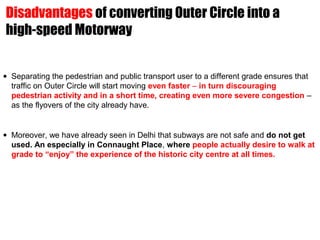
• Separating the pedestrian and public transport user to a different grade ensures that
traffic on Outer Circle will start moving even faster – in turn discouraging
pedestrian activity and in a short time, creating even more severe congestion –
as the flyovers of the city already have.
• Moreover, we have already seen in Delhi that subways are not safe and do not get
used. An especially in Connaught Place, where people actually desire to walk at
grade to “enjoy” the experience of the historic city centre at all times.
Disadvantages of converting Outer Circle into a
high-speed Motorway
Principle Goal 1: MULTI-MODAL INTEGRATION
(National Urban Transport + MPD-2021 Policy)
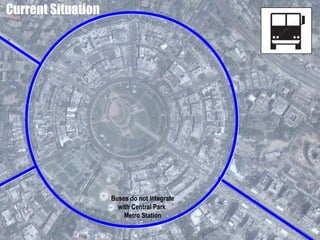
Current Situation
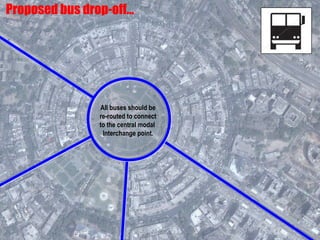
Buses do not integrate
with Central Park
Metro Station
All buses should be
re-routed to connect
to the central modal
Interchange point.
Proposed bus drop-off…
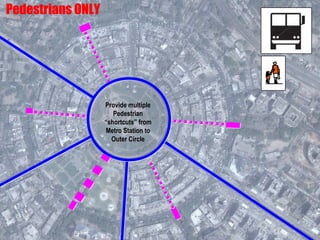
Pedestrians ONLY
Provide multiple
Pedestrian
“shortcuts” from
Metro Station to
Outer Circle
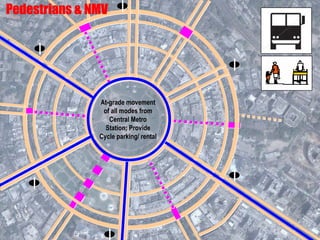
Pedestrians & NMV
At-grade movement
of all modes from
Central Metro
Station; Provide
Cycle parking/ rental
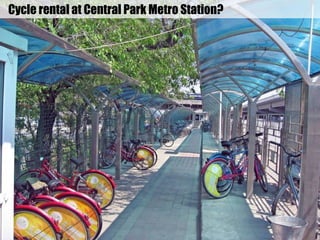
Cycle rental at Central Park Metro Station?
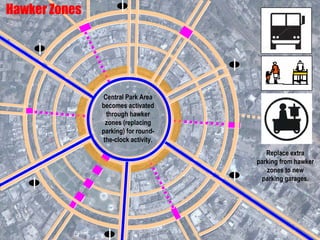
Hawker Zones
Central Park Area
becomes activated
through hawker
zones (replacing
parking) for round-
the-clock activity.
Replace extra
parking from hawker
zones to new
parking garages.
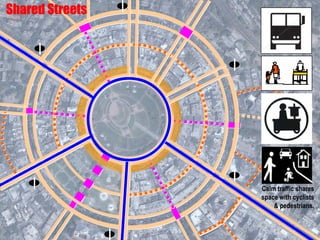
Shared Streets
Calm traffic shares
space with cyclists
& pedestrians.
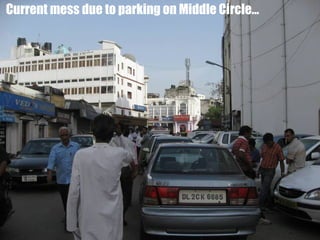
Current mess due to parking on Middle Circle…
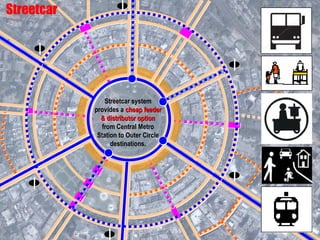
Streetcar
Streetcar system
provides a cheap feedercheap feeder
& distributor option& distributor option
from Central Metro
Station to Outer Circle
destinations.
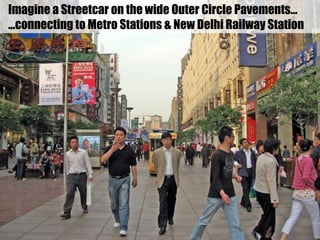
Imagine a Streetcar on the wide Outer Circle Pavements…
…connecting to Metro Stations & New Delhi Railway Station
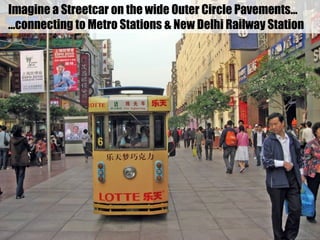
Imagine a Streetcar on the wide Outer Circle Pavements…
…connecting to Metro Stations & New Delhi Railway Station
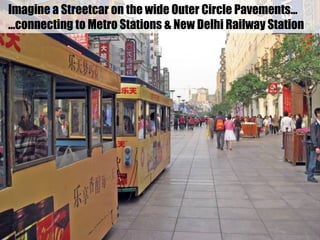
Imagine a Streetcar on the wide Outer Circle Pavements…
…connecting to Metro Stations & New Delhi Railway Station
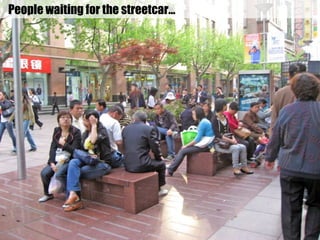
People waiting for the streetcar…
Principle Goal 2: EQUITABLE USE OF PUBLIC REALM
(National Urban Transport Policy)
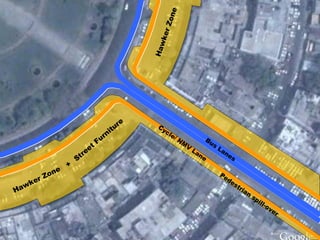
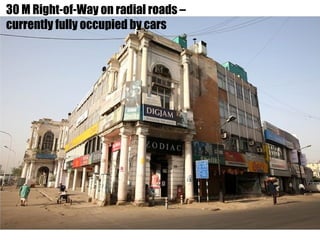
30 M Right-of-Way on radial roads –
currently fully occupied by cars
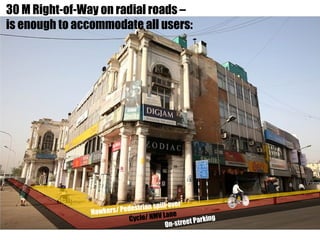
30 M Right-of-Way on radial roads –
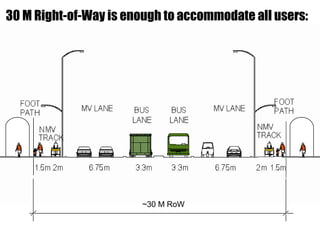
is enough to accommodate all users:
Cycle/ NMV Lane
On-street Parking
Hawkers/ Pedestrian spill-over
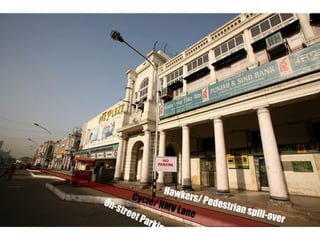
Cycle/ NMV Lane
On-street Parking
Hawkers/ Pedestrian spill-over
~30 M RoW
30 M Right-of-Way is enough to accommodate all users:
Hawker Zone
+
HawkerZone
Street
Furniture
Cycle/ NM
V
Lane
Pedestrian
spill-over
Bus
Lanes
Principle Goal 3: RESTORING STREET-LIFE
(Traditional Indian Culture)
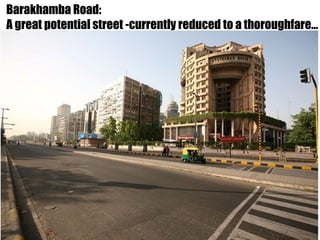
Barakhamba Road:
A great potential street -currently reduced to a thoroughfare…
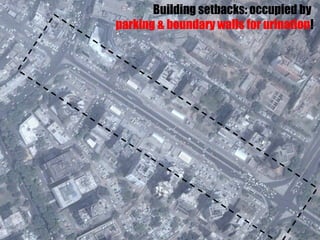
Building setbacks: occupied by
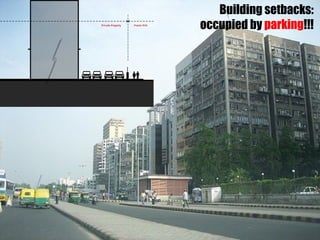
parking & boundary walls for urination!
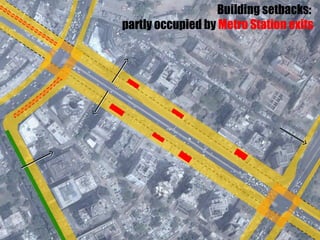
Building setbacks:
partly occupied by Metro Station exits
Building setbacks:
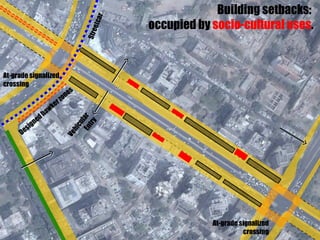
occupied by socio-cultural uses.
At-grade signalized
crossing
At-grade signalized
crossing
Designedhawkerzones Streetcar
VehicularEntry
Building setbacks:
occupied by parking!!!
Building setbacks:
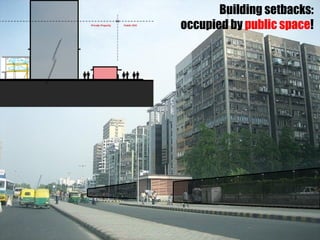
occupied by public space!
49Romi Roy
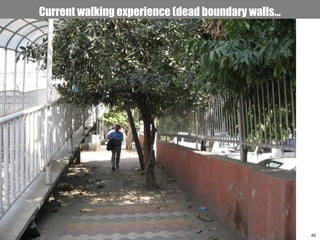
Current walking experience (dead boundary walls…
Romi Roy UTTIPEC
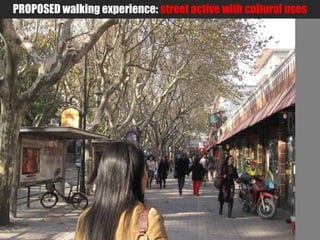
PROPOSED walking experience: street active with cultural uses
Romi Roy UTTIPEC
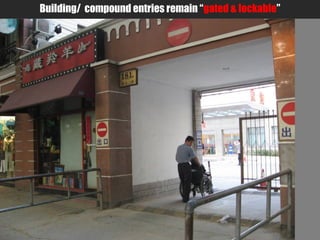
Building/ compound entries remain “gated & lockable”

Urban Landscape Design

  • 1.
    URBAN LANDSCAPE DESIGN Analysisand comparison of two examples in national and international context
  • 2.
    Typology and Approach •The typology of case study selected is of Urban Central Node which incorporates Commercial-Economic and Socio – Cultural attributes required in an Urban context • The case studies selected shall reflect and analyse these values [ their enhancement] with its adaptation over the years. • The selection is based on comparable demographic and historic layers of the places • The cause factor analysis of the changes are looked into due scope limitation of the current work. URBAN LANDSCAPE DESIGN ANALYSIS - Parvathi M, MArch,SAP 2016 2
  • 3.
    CASE STUDY ▫ ConnaughtPlace, New Delhi, India ▫ Central place, Honk Kong URBAN LANDSCAPE DESIGN ANALYSIS - Parvathi M, MArch,SAP 2016 3
  • 4.
  • 6.
    How the Placecame to being.. • Envisioned as a Plaza by the British Imperial, on shifting their capital from Calcutta to New Delhi in 1911 • While planning out the residences of the British officers, need of a separate market for the elite was realized. It was to be different from the usual Indian markets like Chandni Chowk and Paharganj . • Lutyens wanted two axes to terminate at the Viceroy’s House, that is the present day Rashtrapati Bhawan. • Axis 1 : To relate the British to the Muslim masses by providing a direct axis to the Jama Masjid and the Red Fort, the capital of the Great Mughal Empire. – Parliament Street • Axis 2 : To relate the British to the Hindu masses by providing a direct axis to the legendary capital of the Pandavas, Indraprastha. – Kings Way URBAN LANDSCAPE DESIGN ANALYSIS - Parvathi M, MArch,SAP 2016 6
  • 7.
    URBAN LANDSCAPE DESIGNANALYSIS - Parvathi M, MArch,SAP 2016 7 LAYOUT AND LINKS
  • 8.
    URBAN LANDSCAPE DESIGNANALYSIS - Parvathi M, MArch,SAP 2016 8
  • 9.
    URBAN LANDSCAPE DESIGNANALYSIS - Parvathi M, MArch,SAP 2016 9
  • 10.
    Context and evolutionof CP • The Delhi Planning Commission envisioned a monumental plaza ringed by hotels, shops and businesses dominated by a railway tation at the intersection of Parliament Street and Janpath This area was in close proximity to the existing village of Madhoganj. • This was second on the priority of the Planning Committee after the Viceroy’s House as a expressive emblem of British progress and power in India. • Land of Madhoganj village was aquired to create this urban node • It was named after the Duke of Connaught to honour him on his visit to Delhi. URBAN LANDSCAPE DESIGN ANALYSIS - Parvathi M, MArch,SAP 2016 10
  • 11.
    Context and evolutionof CP • According WH Nicholls, the architect member of the Imperial Delhi Committee, there was a omnipresent need for uniformity to endure a harmonious architectural effect. • He proposed seven colonnaded facades to enclose the circus,which was about 1100 feet in diameter. • Robert Tor Russell was assigned to detail out the entire structure, which he did on the lines which Nicholls had advocated. • Airy, stuccoed colonnades, punctuated by Palladian archways to protect shoppers from rain and sun alike. This was compared to Nash’s Regent Crescent, London and Royal Crescent, Bath. URBAN LANDSCAPE DESIGN ANALYSIS - Parvathi M, MArch,SAP 2016 11
  • 12.
    URBAN LANDSCAPE DESIGNANALYSIS - Parvathi M, MArch,SAP 2016 12
  • 13.
    URBAN LANDSCAPE DESIGNANALYSIS - Parvathi M, MArch,SAP 2016 13
  • 14.
    URBAN LANDSCAPE DESIGNANALYSIS - Parvathi M, MArch,SAP 2016 14
  • 15.
    New Subways willconvert Outer Circle into a high-speed non-stop Motorway….
  • 16.
    Current state ofour Historic City Centre…
  • 17.
    Every inch ofthe original pavements has been “shaved” to make MORE and MORE space for cars…
  • 18.
    Pedestrians on OuterCircle are “illegally jaywalking culprits” in the historic city centre….
  • 19.
    Pedestrians on OuterCircle are “illegally jaywalking culprits” in the historic city centre….
  • 20.
    Street name, LocationWidth At-grade Pedestrian Crossing Frequency Market Street, San Francisco 40 M major thoroughfare Every 100 - 250 M Huai Hai Road, Shanghai 30 M major thoroughfare Every 250 M 42nd St, New York 30 M major thoroughfare Every 250 - 300 M Marylebone Road, London 40 M major thoroughfare Every 100 - 300 M Outer Circle, CP, New Delhi 35 M major thoroughfare Every 170 – 300 M, but NO at-grade crossing in perpendicular direction Thoroughfare “High Streets” around the World: • All major cities around the world also have thoroughfare roads move through their Historic City Centres, but traffic on these roads, although heavy, is expected to move slow, and expected to STOP for pedestrians & cyclists to cross at grade. • CP is a City Centre where Outer Circle is partly a Thoroughfare Road.
  • 21.
    • Separating thepedestrian and public transport user to a different grade ensures that traffic on Outer Circle will start moving even faster – in turn discouraging pedestrian activity and in a short time, creating even more severe congestion – as the flyovers of the city already have. • Moreover, we have already seen in Delhi that subways are not safe and do not get used. An especially in Connaught Place, where people actually desire to walk at grade to “enjoy” the experience of the historic city centre at all times. Disadvantages of converting Outer Circle into a high-speed Motorway
  • 22.
    Principle Goal 1:MULTI-MODAL INTEGRATION (National Urban Transport + MPD-2021 Policy)
  • 23.
    Current Situation Buses donot integrate with Central Park Metro Station
  • 24.
    All buses shouldbe re-routed to connect to the central modal Interchange point. Proposed bus drop-off…
  • 25.
  • 26.
    Pedestrians & NMV At-grademovement of all modes from Central Metro Station; Provide Cycle parking/ rental
  • 27.
    Cycle rental atCentral Park Metro Station?
  • 28.
    Hawker Zones Central ParkArea becomes activated through hawker zones (replacing parking) for round- the-clock activity. Replace extra parking from hawker zones to new parking garages.
  • 29.
    Shared Streets Calm trafficshares space with cyclists & pedestrians.
  • 30.
    Current mess dueto parking on Middle Circle…
  • 31.
    Streetcar Streetcar system provides acheap feedercheap feeder & distributor option& distributor option from Central Metro Station to Outer Circle destinations.
  • 32.
    Imagine a Streetcaron the wide Outer Circle Pavements… …connecting to Metro Stations & New Delhi Railway Station
  • 33.
    Imagine a Streetcaron the wide Outer Circle Pavements… …connecting to Metro Stations & New Delhi Railway Station
  • 34.
    Imagine a Streetcaron the wide Outer Circle Pavements… …connecting to Metro Stations & New Delhi Railway Station
  • 35.
    People waiting forthe streetcar…
  • 36.
    Principle Goal 2:EQUITABLE USE OF PUBLIC REALM (National Urban Transport Policy)
  • 37.
    30 M Right-of-Wayon radial roads – currently fully occupied by cars
  • 38.
    30 M Right-of-Wayon radial roads – is enough to accommodate all users: Cycle/ NMV Lane On-street Parking Hawkers/ Pedestrian spill-over
  • 39.
    Cycle/ NMV Lane On-streetParking Hawkers/ Pedestrian spill-over
  • 40.
    ~30 M RoW 30M Right-of-Way is enough to accommodate all users:
  • 41.
  • 42.
    Principle Goal 3:RESTORING STREET-LIFE (Traditional Indian Culture)
  • 43.
    Barakhamba Road: A greatpotential street -currently reduced to a thoroughfare…
  • 44.
    Building setbacks: occupiedby parking & boundary walls for urination!
  • 45.
    Building setbacks: partly occupiedby Metro Station exits
  • 46.
    Building setbacks: occupied bysocio-cultural uses. At-grade signalized crossing At-grade signalized crossing Designedhawkerzones Streetcar VehicularEntry
  • 47.
  • 48.
  • 49.
    49Romi Roy Current walkingexperience (dead boundary walls…
  • 50.
    Romi Roy UTTIPEC PROPOSEDwalking experience: street active with cultural uses
  • 51.
    Romi Roy UTTIPEC Building/compound entries remain “gated & lockable”