
CASE STUDY
Yamuna Riverfront Development
Aim - “Conserve, Protect & Restore the Biodiversity of Yamuna
integrated with Public Recreation spaces that the city needs as
envisaged in the Zonal Development of Zone O”.
 Restore the riverine ecosystem
 Connect people with river
 Protect the floodplain from the adverse effect of development activities
 Share awareness among people
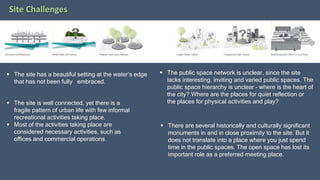
Site Challenges
 The site has a beautiful setting at the water’s edge
that has not been fully embraced.
 The site is well connected, yet there is a
fragile pattern of urban life with few informal
recreational activities taking place.
 Most of the activities taking place are
considered necessary activities, such as
offices and commercial operations.
 The public space network is unclear, since the site
lacks interesting, inviting and varied public spaces. The
public space hierarchy is unclear – where is the heart of
the city? Where are the places for quiet reflection or
the places for physical activities and play?
 There are several historically and culturally significant
monuments in and in close proximity to the site. But it
does not translate into a place where you just spend
time in the public spaces. The open space has lost its
important role as a preferred meeting place.
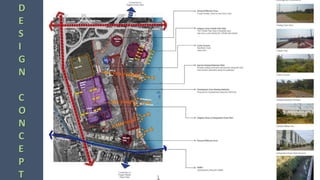
D
E
S
I
G
N
C
O
N
C
E
P
T
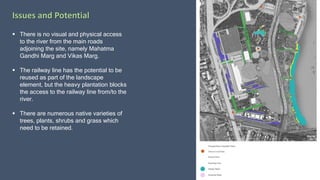
Issues and Potential
 There is no visual and physical access
to the river from the main roads
adjoining the site, namely Mahatma
Gandhi Marg and Vikas Marg.
 The railway line has the potential to be
reused as part of the landscape
element, but the heavy plantation blocks
the access to the railway line from/to the
river.
 There are numerous native varieties of
trees, plants, shrubs and grass which
need to be retained.
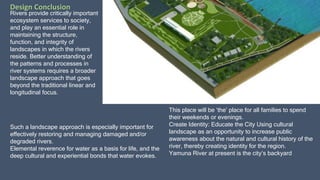
Rivers provide critically important
ecosystem services to society,
and play an essential role in
maintaining the structure,
function, and integrity of
landscapes in which the rivers
reside. Better understanding of
the patterns and processes in
river systems requires a broader
landscape approach that goes
beyond the traditional linear and
longitudinal focus.
Such a landscape approach is especially important for
effectively restoring and managing damaged and/or
degraded rivers.
Elemental reverence for water as a basis for life, and the
deep cultural and experiential bonds that water evokes.
This place will be ‘the’ place for all families to spend
their weekends or evenings.
Create Identity: Educate the City Using cultural
landscape as an opportunity to increase public
awareness about the natural and cultural history of the
river, thereby creating identity for the region.
Yamuna River at present is the city’s backyard
Design Conclusion
Principles For Riverfront Development
When planning a riverfront development, let these core principles lead the thinking:
• Feature the riverfront as the front door.
• Showcase the river’s history.
• Activate the riverfront.
• Limit obstacles and connect to the river.
• Engage with the water.
• Connect seamlessly along the riverfront and into neighbourhoods.
• Repair and enhance the environment.
• Employ high-quality architectural materials and sustainable engineering practices.
Dilli Haat
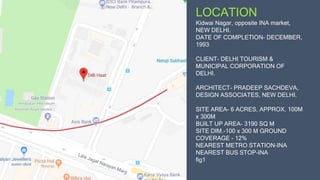
LOCATION
Kidwai Nagar, opposite INA market,
NEW DELHI.
DATE OF COMPLETION- DECEMBER,
1993
CLIENT- DELHI TOURISM &
MUNICIPAL CORPORATION OF
DELHI.
ARCHITECT- PRADEEP SACHDEVA,
DESIGN ASSOCIATES, NEW DELHI.
SITE AREA- 6 ACRES, APPROX. 100M
x 300M
BUILT UP AREA- 3190 SQ M
SITE DIM.-100 x 300 M GROUND
COVERAGE - 12%
NEAREST METRO STATION-INA
NEAREST BUS STOP-INA
fig1
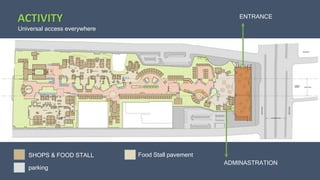
ENTRANCE
ADMINASTRATION
SHOPS & FOOD STALL
parking
Food Stall pavement
ACTIVITY
Universal access everywhere
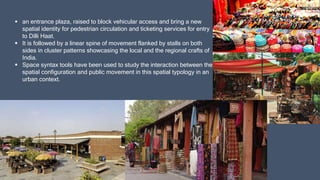
 an entrance plaza, raised to block vehicular access and bring a new
spatial identity for pedestrian circulation and ticketing services for entry
to Dilli Haat.
 It is followed by a linear spine of movement flanked by stalls on both
sides in cluster patterns showcasing the local and the regional crafts of
India.
 Space syntax tools have been used to study the interaction between the
spatial configuration and public movement in this spatial typology in an
urban context.
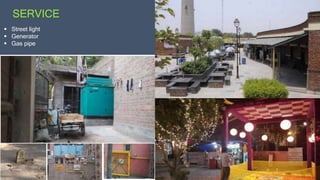
SERVICE
 Street light
 Generator
 Gas pipe
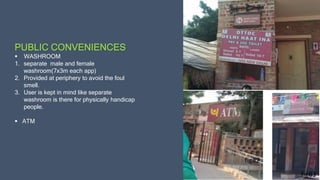
PUBLIC CONVENIENCES
 WASHROOM
1. separate male and female
washroom(7x3m each app)
2. Provided at periphery to avoid the foul
smell.
3. User is kept in mind like separate
washroom is there for physically handicap
people.
 ATM
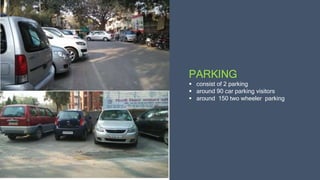
PARKING
 consist of 2 parking
 around 90 car parking visitors
 around 150 two wheeler parking
INFERENCE
 Green space is provided at relevant spaces.
 Consist of many negative spaces which are a place of dust collection.
 The spine concept is used very efficiently.
 Location of drinking water is not appropriate i.e. near to the washrooms.
 Number of ramps to reach different level are less are at far distances.
 Not all service entries are used.
 The placement system of stalls is convincing.
 the decorations enhance the beauty of the place.
 An entrance plaza, raised to block vehicular access and bring a new spatial identity for pedestrian
circulation is a very special feature.
 Every kitchen has its own gas and water supply.
 Every food stall has different style of seating and shade.
 The paved area seems monotonous which can be improved.
 Temporary stalls structure can be improvised.
 Services are not maintained properly.
 Security is compromised of the place.
THANK YOU

Riverfront Development & Haat Case Study

  • 1.
  • 2.
  • 3.
    Yamuna Riverfront Development Aim- “Conserve, Protect & Restore the Biodiversity of Yamuna integrated with Public Recreation spaces that the city needs as envisaged in the Zonal Development of Zone O”.  Restore the riverine ecosystem  Connect people with river  Protect the floodplain from the adverse effect of development activities  Share awareness among people
  • 4.
    Site Challenges  Thesite has a beautiful setting at the water’s edge that has not been fully embraced.  The site is well connected, yet there is a fragile pattern of urban life with few informal recreational activities taking place.  Most of the activities taking place are considered necessary activities, such as offices and commercial operations.  The public space network is unclear, since the site lacks interesting, inviting and varied public spaces. The public space hierarchy is unclear – where is the heart of the city? Where are the places for quiet reflection or the places for physical activities and play?  There are several historically and culturally significant monuments in and in close proximity to the site. But it does not translate into a place where you just spend time in the public spaces. The open space has lost its important role as a preferred meeting place.
  • 5.
  • 6.
    Issues and Potential There is no visual and physical access to the river from the main roads adjoining the site, namely Mahatma Gandhi Marg and Vikas Marg.  The railway line has the potential to be reused as part of the landscape element, but the heavy plantation blocks the access to the railway line from/to the river.  There are numerous native varieties of trees, plants, shrubs and grass which need to be retained.
  • 8.
    Rivers provide criticallyimportant ecosystem services to society, and play an essential role in maintaining the structure, function, and integrity of landscapes in which the rivers reside. Better understanding of the patterns and processes in river systems requires a broader landscape approach that goes beyond the traditional linear and longitudinal focus. Such a landscape approach is especially important for effectively restoring and managing damaged and/or degraded rivers. Elemental reverence for water as a basis for life, and the deep cultural and experiential bonds that water evokes. This place will be ‘the’ place for all families to spend their weekends or evenings. Create Identity: Educate the City Using cultural landscape as an opportunity to increase public awareness about the natural and cultural history of the river, thereby creating identity for the region. Yamuna River at present is the city’s backyard Design Conclusion
  • 9.
    Principles For RiverfrontDevelopment When planning a riverfront development, let these core principles lead the thinking: • Feature the riverfront as the front door. • Showcase the river’s history. • Activate the riverfront. • Limit obstacles and connect to the river. • Engage with the water. • Connect seamlessly along the riverfront and into neighbourhoods. • Repair and enhance the environment. • Employ high-quality architectural materials and sustainable engineering practices.
  • 10.
  • 11.
    LOCATION Kidwai Nagar, oppositeINA market, NEW DELHI. DATE OF COMPLETION- DECEMBER, 1993 CLIENT- DELHI TOURISM & MUNICIPAL CORPORATION OF DELHI. ARCHITECT- PRADEEP SACHDEVA, DESIGN ASSOCIATES, NEW DELHI. SITE AREA- 6 ACRES, APPROX. 100M x 300M BUILT UP AREA- 3190 SQ M SITE DIM.-100 x 300 M GROUND COVERAGE - 12% NEAREST METRO STATION-INA NEAREST BUS STOP-INA fig1
  • 12.
    ENTRANCE ADMINASTRATION SHOPS & FOODSTALL parking Food Stall pavement ACTIVITY Universal access everywhere
  • 13.
     an entranceplaza, raised to block vehicular access and bring a new spatial identity for pedestrian circulation and ticketing services for entry to Dilli Haat.  It is followed by a linear spine of movement flanked by stalls on both sides in cluster patterns showcasing the local and the regional crafts of India.  Space syntax tools have been used to study the interaction between the spatial configuration and public movement in this spatial typology in an urban context.
  • 14.
    SERVICE  Street light Generator  Gas pipe
  • 15.
    PUBLIC CONVENIENCES  WASHROOM 1.separate male and female washroom(7x3m each app) 2. Provided at periphery to avoid the foul smell. 3. User is kept in mind like separate washroom is there for physically handicap people.  ATM
  • 16.
    PARKING  consist of2 parking  around 90 car parking visitors  around 150 two wheeler parking
  • 17.
    INFERENCE  Green spaceis provided at relevant spaces.  Consist of many negative spaces which are a place of dust collection.  The spine concept is used very efficiently.  Location of drinking water is not appropriate i.e. near to the washrooms.  Number of ramps to reach different level are less are at far distances.  Not all service entries are used.  The placement system of stalls is convincing.  the decorations enhance the beauty of the place.  An entrance plaza, raised to block vehicular access and bring a new spatial identity for pedestrian circulation is a very special feature.  Every kitchen has its own gas and water supply.  Every food stall has different style of seating and shade.  The paved area seems monotonous which can be improved.  Temporary stalls structure can be improvised.  Services are not maintained properly.  Security is compromised of the place.
  • 18.