Pre industrial Europe
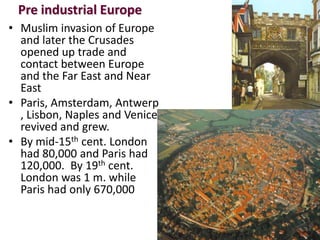
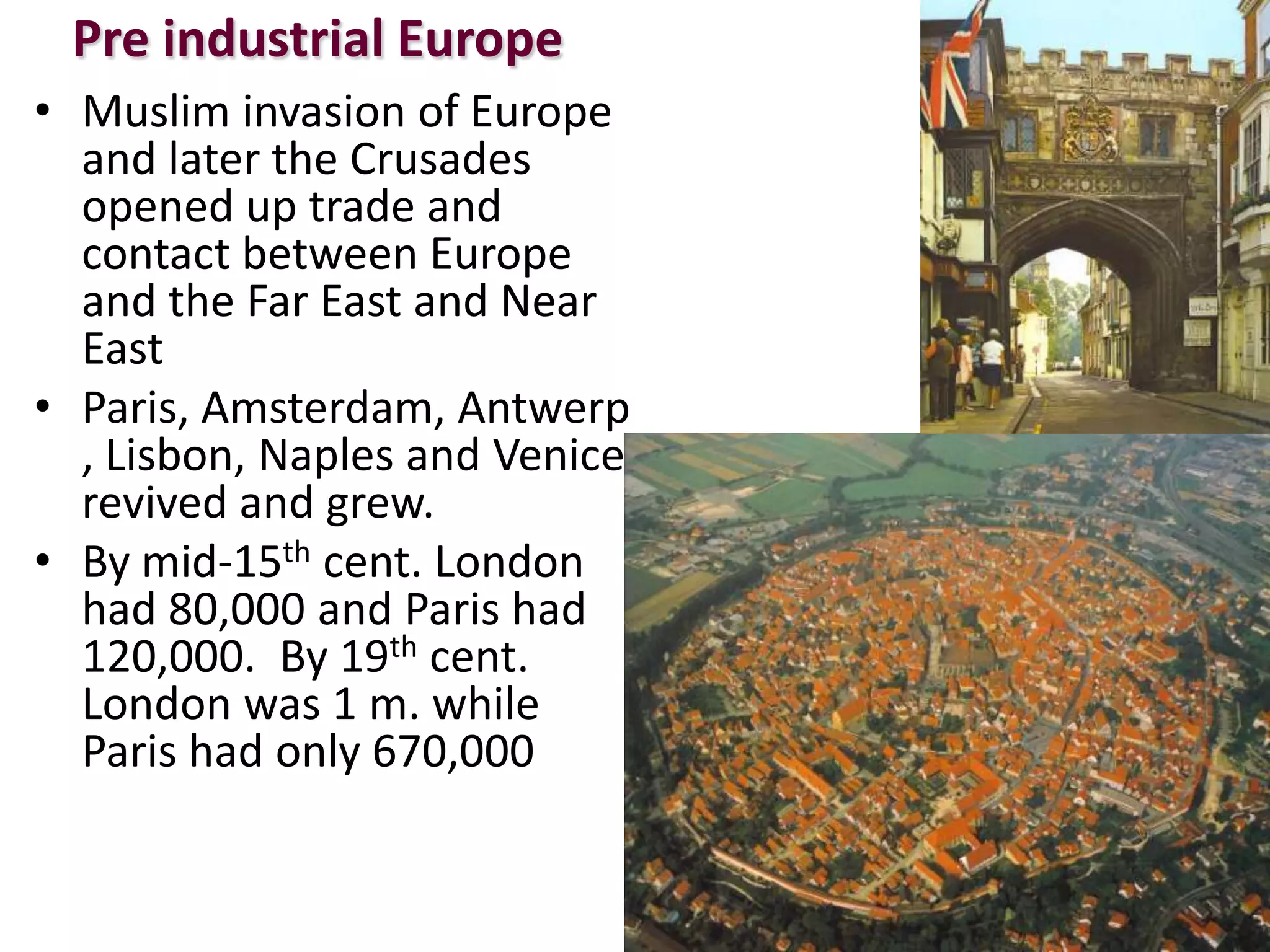
• Muslim invasion of Europe
  and later the Crusades
  opened up trade and
  contact between Europe
  and the Far East and Near
  East
• Paris, Amsterdam, Antwerp
  , Lisbon, Naples and Venice
  revived and grew.
• By mid-15th cent. London
  had 80,000 and Paris had
  120,000. By 19th cent.
  London was 1 m. while
  Paris had only 670,000
Urban Environments
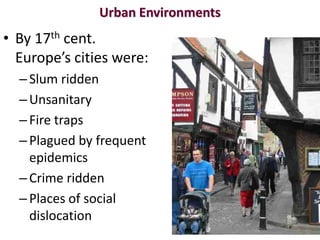
• By 17th cent.
  Europe’s cities were:
  – Slum ridden
  – Unsanitary
  – Fire traps
  – Plagued by frequent
    epidemics
  – Crime ridden
  – Places of social
    dislocation
Models of Urban Places
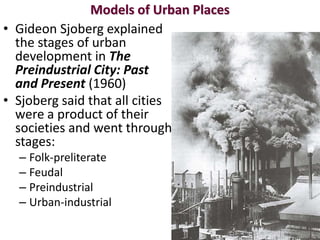
• Gideon Sjoberg explained
  the stages of urban
  development in The
  Preindustrial City: Past
  and Present (1960)
• Sjoberg said that all cities
  were a product of their
  societies and went through
  stages:
  – Folk-preliterate
  – Feudal
  – Preindustrial
  – Urban-industrial
Primate Cities
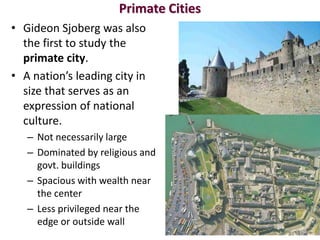
• Gideon Sjoberg was also
  the first to study the
  primate city.
• A nation’s leading city in
  size that serves as an
  expression of national
  culture.
   – Not necessarily large
   – Dominated by religious and
     govt. buildings
   – Spacious with wealth near
     the center
   – Less privileged near the
     edge or outside wall
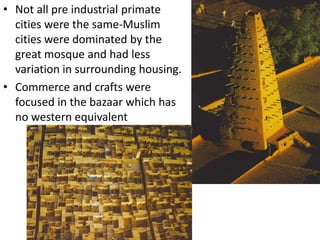
• Not all pre industrial primate
  cities were the same-Muslim
  cities were dominated by the
  great mosque and had less
  variation in surrounding housing.
• Commerce and crafts were
  focused in the bazaar which has
  no western equivalent
The Modern Western City
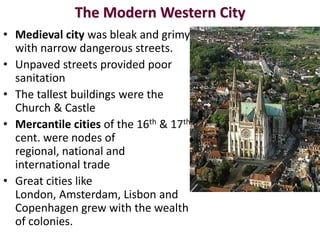
• Medieval city was bleak and grimy
  with narrow dangerous streets.
• Unpaved streets provided poor
  sanitation
• The tallest buildings were the
  Church & Castle
• Mercantile cities of the 16th & 17th
  cent. were nodes of
  regional, national and
  international trade
• Great cities like
  London, Amsterdam, Lisbon and
  Copenhagen grew with the wealth
  of colonies.
The Second Urban Revolution
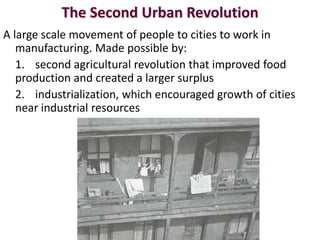
A large scale movement of people to cities to work in
   manufacturing. Made possible by:
   1. second agricultural revolution that improved food
   production and created a larger surplus
   2. industrialization, which encouraged growth of cities
   near industrial resources
The Modern Western City
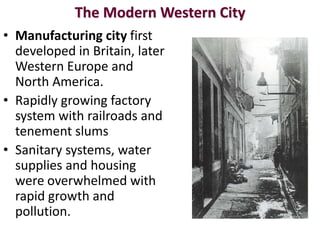
• Manufacturing city first
  developed in Britain, later
  Western Europe and
  North America.
• Rapidly growing factory
  system with railroads and
  tenement slums
• Sanitary systems, water
  supplies and housing
  were overwhelmed with
  rapid growth and
  pollution.
The Modern Western City
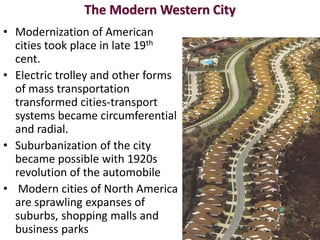
• Modernization of American
  cities took place in late 19th
  cent.
• Electric trolley and other forms
  of mass transportation
  transformed cities-transport
  systems became circumferential
  and radial.
• Suburbanization of the city
  became possible with 1920s
  revolution of the automobile
• Modern cities of North America
  are sprawling expanses of
  suburbs, shopping malls and
  business parks
• Hinterland-a German word
  that means land behind
  the city
• Spacing of cities-large cities
  lie farther apart-smaller
  settlements are closer to
  each other
• Industrial Revolution began
  in Europe-arrived in the US
  around 1870-in only 50 yrs.
  US surpassed Europe
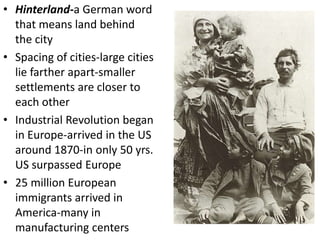
• 25 million European
  immigrants arrived in
  America-many in
  manufacturing centers
John Borchert’s “American Metropolitan Evolution”-
           4 Stage model of evolution

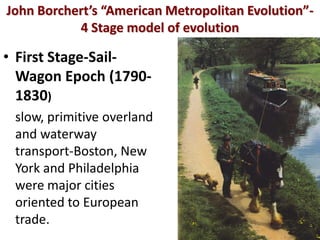
• First Stage-Sail-
  Wagon Epoch (1790-
  1830)
 slow, primitive overland
 and waterway
 transport-Boston, New
 York and Philadelphia
 were major cities
 oriented to European
 trade.
John Borchert’s “American Metropolitan Evolution-4
             Stage model of evolution
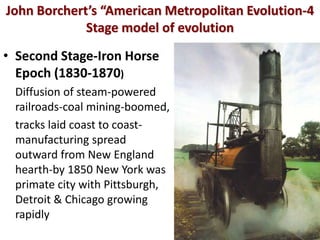
• Second Stage-Iron Horse
  Epoch (1830-1870)
 Diffusion of steam-powered
 railroads-coal mining-boomed,
 tracks laid coast to coast-
 manufacturing spread
 outward from New England
 hearth-by 1850 New York was
 primate city with Pittsburgh,
 Detroit & Chicago growing
 rapidly
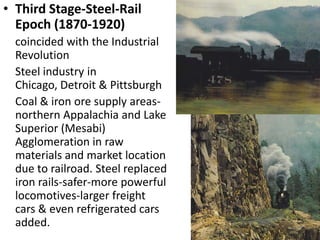
• Third Stage-Steel-Rail
  Epoch (1870-1920)
  coincided with the Industrial
  Revolution
  Steel industry in
  Chicago, Detroit & Pittsburgh
  Coal & iron ore supply areas-
  northern Appalachia and Lake
  Superior (Mesabi)
  Agglomeration in raw
  materials and market location
  due to railroad. Steel replaced
  iron rails-safer-more powerful
  locomotives-larger freight
  cars & even refrigerated cars
  added.

Urban 5

  • 1.
    Pre industrial Europe •Muslim invasion of Europe and later the Crusades opened up trade and contact between Europe and the Far East and Near East • Paris, Amsterdam, Antwerp , Lisbon, Naples and Venice revived and grew. • By mid-15th cent. London had 80,000 and Paris had 120,000. By 19th cent. London was 1 m. while Paris had only 670,000
  • 2.
    Urban Environments • By17th cent. Europe’s cities were: – Slum ridden – Unsanitary – Fire traps – Plagued by frequent epidemics – Crime ridden – Places of social dislocation
  • 3.
    Models of UrbanPlaces • Gideon Sjoberg explained the stages of urban development in The Preindustrial City: Past and Present (1960) • Sjoberg said that all cities were a product of their societies and went through stages: – Folk-preliterate – Feudal – Preindustrial – Urban-industrial
  • 4.
    Primate Cities • GideonSjoberg was also the first to study the primate city. • A nation’s leading city in size that serves as an expression of national culture. – Not necessarily large – Dominated by religious and govt. buildings – Spacious with wealth near the center – Less privileged near the edge or outside wall
  • 5.
    • Not allpre industrial primate cities were the same-Muslim cities were dominated by the great mosque and had less variation in surrounding housing. • Commerce and crafts were focused in the bazaar which has no western equivalent
  • 6.
    The Modern WesternCity • Medieval city was bleak and grimy with narrow dangerous streets. • Unpaved streets provided poor sanitation • The tallest buildings were the Church & Castle • Mercantile cities of the 16th & 17th cent. were nodes of regional, national and international trade • Great cities like London, Amsterdam, Lisbon and Copenhagen grew with the wealth of colonies.
  • 7.
    The Second UrbanRevolution A large scale movement of people to cities to work in manufacturing. Made possible by: 1. second agricultural revolution that improved food production and created a larger surplus 2. industrialization, which encouraged growth of cities near industrial resources
  • 8.
    The Modern WesternCity • Manufacturing city first developed in Britain, later Western Europe and North America. • Rapidly growing factory system with railroads and tenement slums • Sanitary systems, water supplies and housing were overwhelmed with rapid growth and pollution.
  • 9.
    The Modern WesternCity • Modernization of American cities took place in late 19th cent. • Electric trolley and other forms of mass transportation transformed cities-transport systems became circumferential and radial. • Suburbanization of the city became possible with 1920s revolution of the automobile • Modern cities of North America are sprawling expanses of suburbs, shopping malls and business parks
  • 10.
    • Hinterland-a Germanword that means land behind the city • Spacing of cities-large cities lie farther apart-smaller settlements are closer to each other • Industrial Revolution began in Europe-arrived in the US around 1870-in only 50 yrs. US surpassed Europe • 25 million European immigrants arrived in America-many in manufacturing centers
  • 11.
    John Borchert’s “AmericanMetropolitan Evolution”- 4 Stage model of evolution • First Stage-Sail- Wagon Epoch (1790- 1830) slow, primitive overland and waterway transport-Boston, New York and Philadelphia were major cities oriented to European trade.
  • 12.
    John Borchert’s “AmericanMetropolitan Evolution-4 Stage model of evolution • Second Stage-Iron Horse Epoch (1830-1870) Diffusion of steam-powered railroads-coal mining-boomed, tracks laid coast to coast- manufacturing spread outward from New England hearth-by 1850 New York was primate city with Pittsburgh, Detroit & Chicago growing rapidly
  • 13.
    • Third Stage-Steel-Rail Epoch (1870-1920) coincided with the Industrial Revolution Steel industry in Chicago, Detroit & Pittsburgh Coal & iron ore supply areas- northern Appalachia and Lake Superior (Mesabi) Agglomeration in raw materials and market location due to railroad. Steel replaced iron rails-safer-more powerful locomotives-larger freight cars & even refrigerated cars added.