Urban 4a
Urbanization and Location
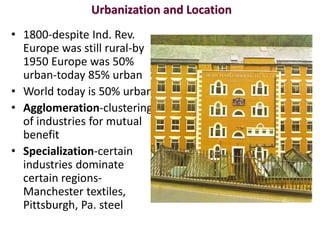
• 1800-despite Ind. Rev.
  Europe was still rural-by
  1950 Europe was 50%
  urban-today 85% urban
• World today is 50% urban
• Agglomeration-clustering
  of industries for mutual
  benefit
• Specialization-certain
  industries dominate
  certain regions-
  Manchester textiles,
  Pittsburgh, Pa. steel
• Urban Geographers look at:
  – How cities are arranged
  – What cities look like
  – Transport & communications
  – Why people move from place to place within the city
• Hinterland: the surrounding service area of
  a city that includes smaller villages and
  hamlets
• Centrality: the economic power or draw of
  a place compared to its competition
• Hamlet-small collection of houses-may have
  services.
• Village-several dozen services-stores, gas stations
  and so forth
• Town-larger than a village-higher level of
  specialization-banks, schools, libraries, specialized
  stores-furniture, appliances, hardware, etc.
• City-more functional specialization-larger
  hinterland, greater centrality, well defined CBD and
  suburbs
• Metropolis or Metropolitan area-urban area larger
  than a city
• Megalopolis-when large metropolises coalesce into
  a megacity, e.g. Boston to New York
Site and Situation
Site                     Situation
 * absolute location      * relative location
     of a city                of a city
 * a city’s static        * a city’s place in
     location, often          the region and
     chosen for trade,        the world
     defense, or              around it.
     religion.
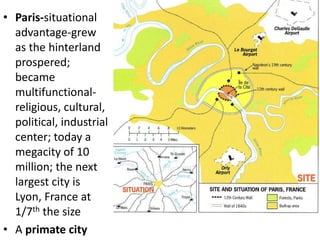
• Paris-situational
  advantage-grew
  as the hinterland
  prospered;
  became
  multifunctional-
  religious, cultural,
  political, industrial
  center; today a
  megacity of 10
  million; the next
  largest city is
  Lyon, France at
  1/7th the size
• A primate city
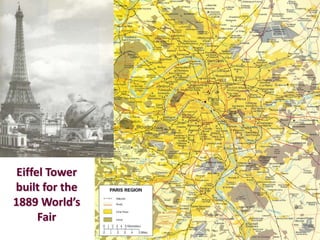
Eiffel Tower
built for the
1889 World’s
      Fair
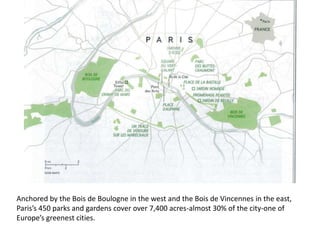
Anchored by the Bois de Boulogne in the west and the Bois de Vincennes in the east,
Paris’s 450 parks and gardens cover over 7,400 acres-almost 30% of the city-one of
Europe’s greenest cities.
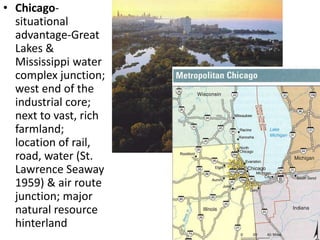
• Chicago-
  situational
  advantage-Great
  Lakes &
  Mississippi water
  complex junction;
  west end of the
  industrial core;
  next to vast, rich
  farmland;
  location of rail,
  road, water (St.
  Lawrence Seaway
  1959) & air route
  junction; major
  natural resource
  hinterland
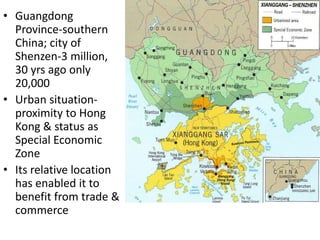
• Guangdong
  Province-southern
  China; city of
  Shenzen-3 million,
  30 yrs ago only
  20,000
• Urban situation-
  proximity to Hong
  Kong & status as
  Special Economic
  Zone
• Its relative location
  has enabled it to
  benefit from trade &
  commerce
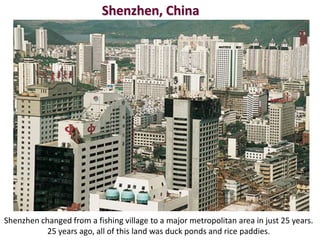
Shenzhen, China


Shenzhen changed from a fishing village to a major metropolitan area in just 25 years.
          25 years ago, all of this land was duck ponds and rice paddies.
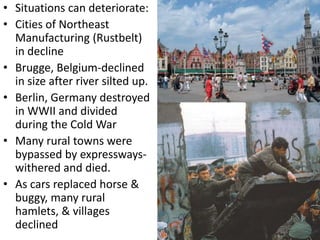
• Situations can deteriorate:
• Cities of Northeast
  Manufacturing (Rustbelt)
  in decline
• Brugge, Belgium-declined
  in size after river silted up.
• Berlin, Germany destroyed
  in WWII and divided
  during the Cold War
• Many rural towns were
  bypassed by expressways-
  withered and died.
• As cars replaced horse &
  buggy, many rural
  hamlets, & villages
  declined
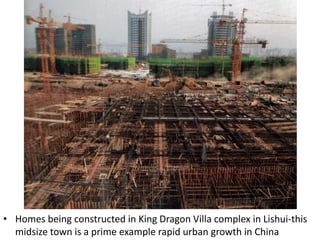
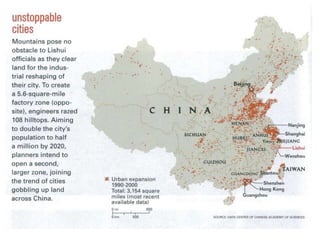
• Homes being constructed in King Dragon Villa complex in Lishui-this
  midsize town is a prime example rapid urban growth in China
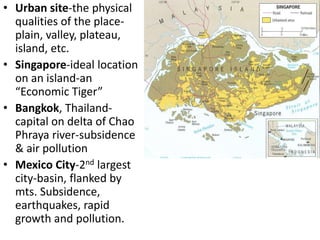
• Urban site-the physical
  qualities of the place-
  plain, valley, plateau,
  island, etc.
• Singapore-ideal location
  on an island-an
  “Economic Tiger”
• Bangkok, Thailand-
  capital on delta of Chao
  Phraya river-subsidence
  & air pollution
• Mexico City-2nd largest
  city-basin, flanked by
  mts. Subsidence,
  earthquakes, rapid
  growth and pollution.
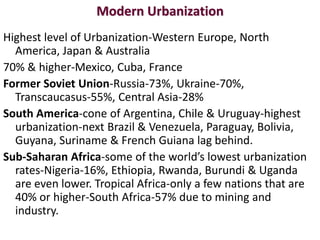
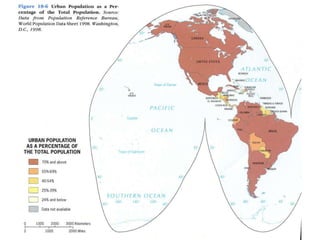
Modern Urbanization
Highest level of Urbanization-Western Europe, North
  America, Japan & Australia
70% & higher-Mexico, Cuba, France
Former Soviet Union-Russia-73%, Ukraine-70%,
  Transcaucasus-55%, Central Asia-28%
South America-cone of Argentina, Chile & Uruguay-highest
  urbanization-next Brazil & Venezuela, Paraguay, Bolivia,
  Guyana, Suriname & French Guiana lag behind.
Sub-Saharan Africa-some of the world’s lowest urbanization
  rates-Nigeria-16%, Ethiopia, Rwanda, Burundi & Uganda
  are even lower. Tropical Africa-only a few nations that are
  40% or higher-South Africa-57% due to mining and
  industry.
Urban 4

Urban 4

  • 1.
  • 2.
    Urbanization and Location •1800-despite Ind. Rev. Europe was still rural-by 1950 Europe was 50% urban-today 85% urban • World today is 50% urban • Agglomeration-clustering of industries for mutual benefit • Specialization-certain industries dominate certain regions- Manchester textiles, Pittsburgh, Pa. steel
  • 3.
    • Urban Geographerslook at: – How cities are arranged – What cities look like – Transport & communications – Why people move from place to place within the city • Hinterland: the surrounding service area of a city that includes smaller villages and hamlets • Centrality: the economic power or draw of a place compared to its competition
  • 4.
    • Hamlet-small collectionof houses-may have services. • Village-several dozen services-stores, gas stations and so forth • Town-larger than a village-higher level of specialization-banks, schools, libraries, specialized stores-furniture, appliances, hardware, etc. • City-more functional specialization-larger hinterland, greater centrality, well defined CBD and suburbs • Metropolis or Metropolitan area-urban area larger than a city • Megalopolis-when large metropolises coalesce into a megacity, e.g. Boston to New York
  • 5.
    Site and Situation Site Situation * absolute location * relative location of a city of a city * a city’s static * a city’s place in location, often the region and chosen for trade, the world defense, or around it. religion.
  • 6.
    • Paris-situational advantage-grew as the hinterland prospered; became multifunctional- religious, cultural, political, industrial center; today a megacity of 10 million; the next largest city is Lyon, France at 1/7th the size • A primate city
  • 7.
    Eiffel Tower built forthe 1889 World’s Fair
  • 8.
    Anchored by theBois de Boulogne in the west and the Bois de Vincennes in the east, Paris’s 450 parks and gardens cover over 7,400 acres-almost 30% of the city-one of Europe’s greenest cities.
  • 9.
    • Chicago- situational advantage-Great Lakes & Mississippi water complex junction; west end of the industrial core; next to vast, rich farmland; location of rail, road, water (St. Lawrence Seaway 1959) & air route junction; major natural resource hinterland
  • 10.
    • Guangdong Province-southern China; city of Shenzen-3 million, 30 yrs ago only 20,000 • Urban situation- proximity to Hong Kong & status as Special Economic Zone • Its relative location has enabled it to benefit from trade & commerce
  • 11.
    Shenzhen, China Shenzhen changedfrom a fishing village to a major metropolitan area in just 25 years. 25 years ago, all of this land was duck ponds and rice paddies.
  • 12.
    • Situations candeteriorate: • Cities of Northeast Manufacturing (Rustbelt) in decline • Brugge, Belgium-declined in size after river silted up. • Berlin, Germany destroyed in WWII and divided during the Cold War • Many rural towns were bypassed by expressways- withered and died. • As cars replaced horse & buggy, many rural hamlets, & villages declined
  • 13.
    • Homes beingconstructed in King Dragon Villa complex in Lishui-this midsize town is a prime example rapid urban growth in China
  • 15.
    • Urban site-thephysical qualities of the place- plain, valley, plateau, island, etc. • Singapore-ideal location on an island-an “Economic Tiger” • Bangkok, Thailand- capital on delta of Chao Phraya river-subsidence & air pollution • Mexico City-2nd largest city-basin, flanked by mts. Subsidence, earthquakes, rapid growth and pollution.
  • 16.
    Modern Urbanization Highest levelof Urbanization-Western Europe, North America, Japan & Australia 70% & higher-Mexico, Cuba, France Former Soviet Union-Russia-73%, Ukraine-70%, Transcaucasus-55%, Central Asia-28% South America-cone of Argentina, Chile & Uruguay-highest urbanization-next Brazil & Venezuela, Paraguay, Bolivia, Guyana, Suriname & French Guiana lag behind. Sub-Saharan Africa-some of the world’s lowest urbanization rates-Nigeria-16%, Ethiopia, Rwanda, Burundi & Uganda are even lower. Tropical Africa-only a few nations that are 40% or higher-South Africa-57% due to mining and industry.