FRONT OFFICE
UPSELLING
DEFINITION OF UP
SELLING
The use of certain words and phrases that
will make the guest feel satisfied buying
something he would not otherwise have
bought
Up selling is easy if we think of it as a way
of helping out the guest and creating a
satisfying solution to fulfill a need
CONTENTS OF THE
PROGRAMIdentify sales opportunities
Build rapport with guests
Match guests’ needs with appropriate
products
Describe the advantages of every
available room category and their
benefits to guests
Make recommendations clearly and
confidently
Track your upselling results
What should we keep in mind
when we think of UP selling?
Business Leisure
WHO ARE OUR GUESTS?
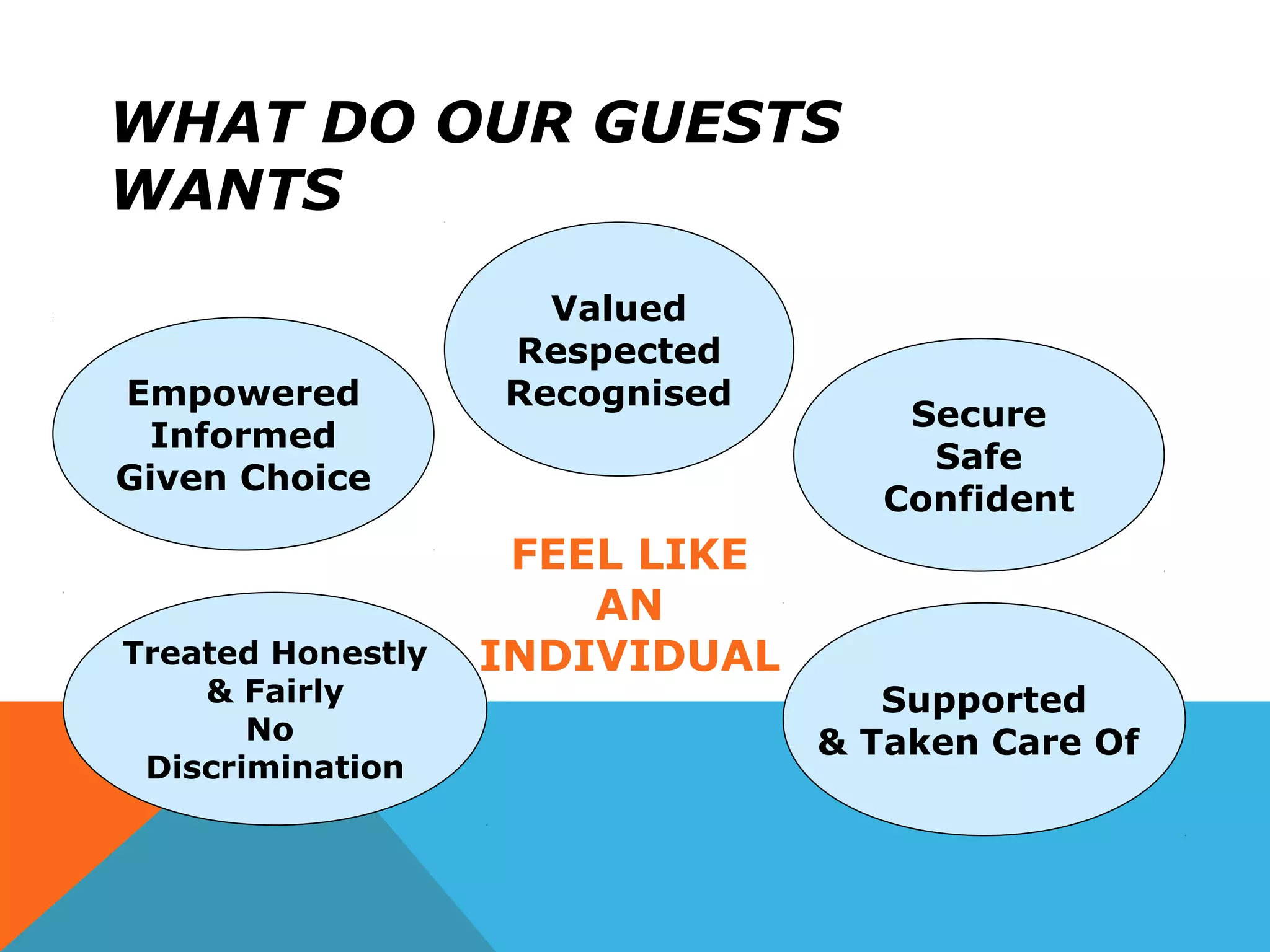
WHAT DO OUR GUESTS
WANTS
Valued
Respected
Recognised
Secure
Safe
Confident
Supported
& Taken Care Of
Treated Honestly
& Fairly
No
Discrimination
Empowered
Informed
Given Choice
FEEL LIKE
AN
INDIVIDUAL
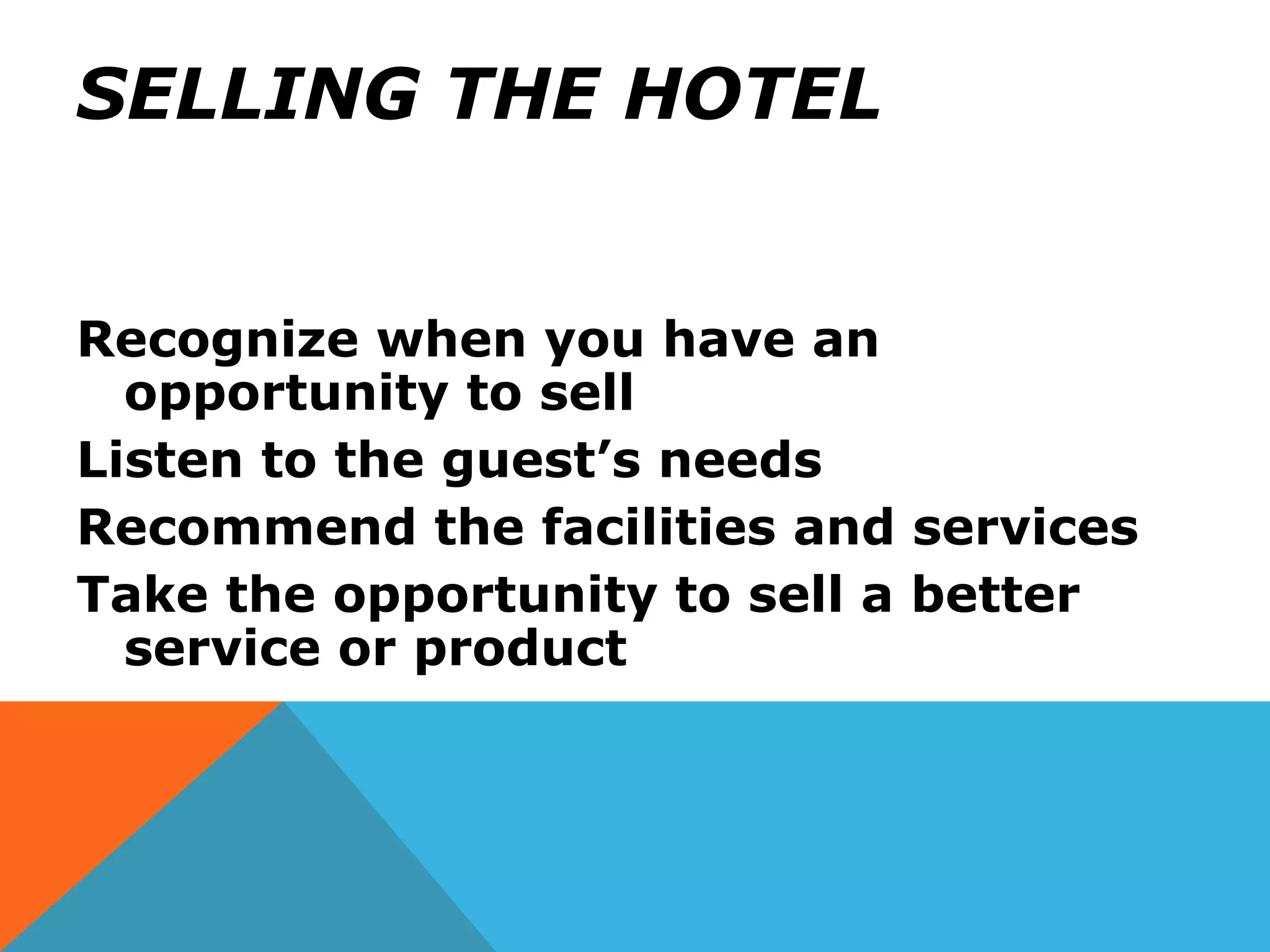
SELLING THE HOTEL
Recognize when you have an
opportunity to sell
Listen to the guest’s needs
Recommend the facilities and services
Take the opportunity to sell a better
service or product
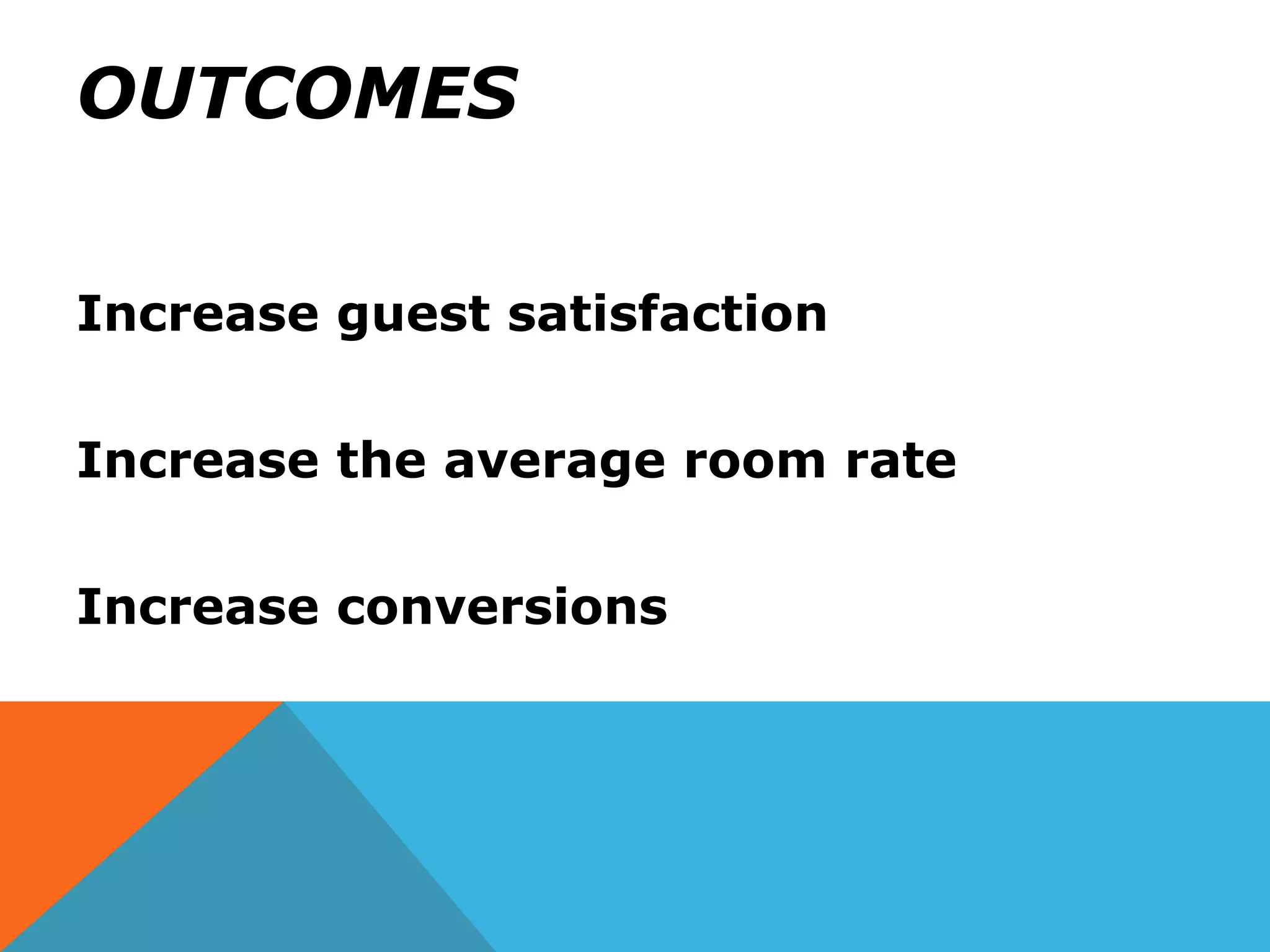
OUTCOMES
Increase guest satisfaction
Increase the average room rate
Increase conversions
UPSELLING TECHNIQUES
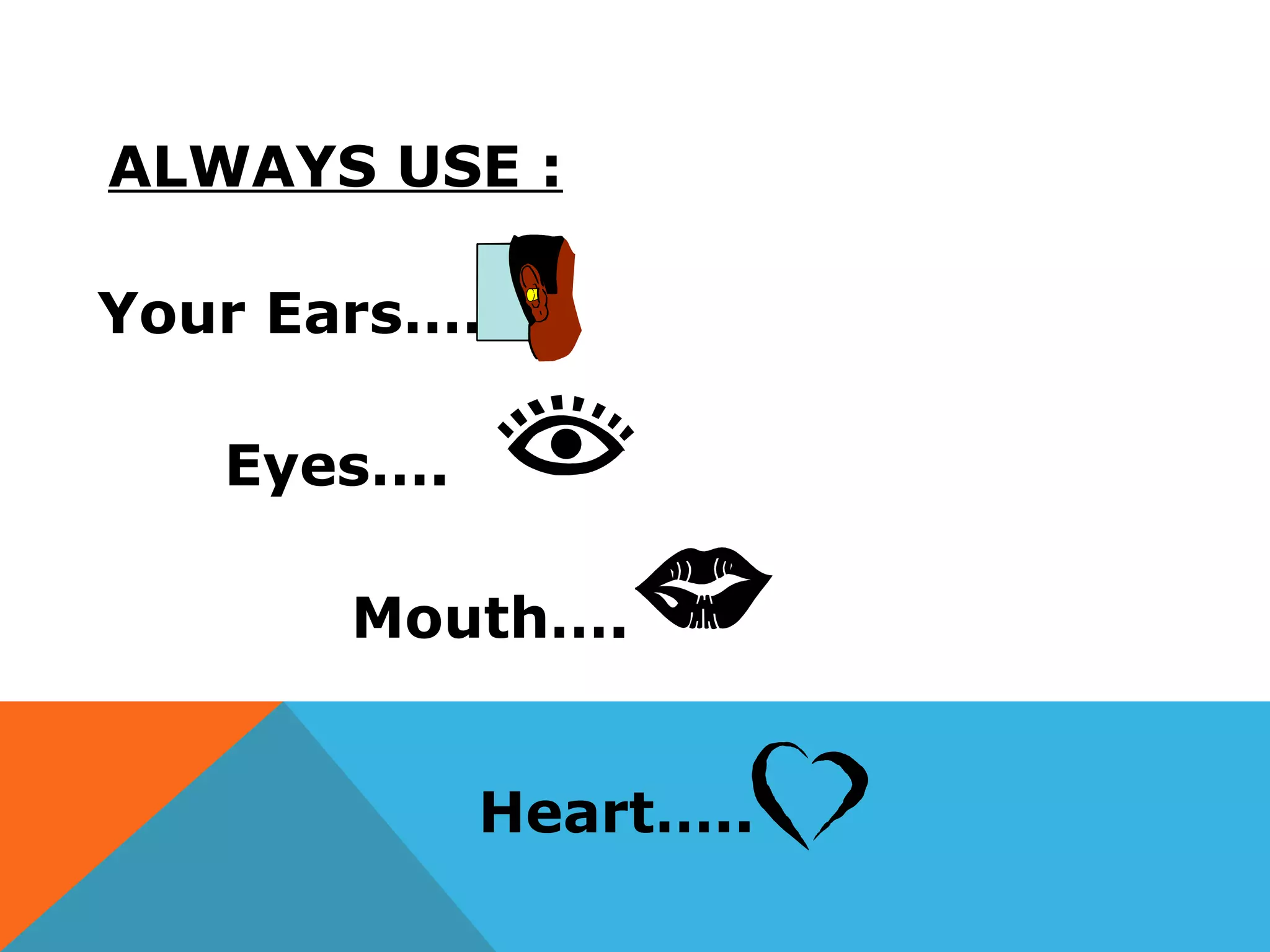
ALWAYS USE :
Your Ears….
Eyes….
Mouth….
Heart…..
WHAT DO YOU USE EYES FOR?
•Eye contact
•Read body language (identify guests
needs)
WHAT DO YOU USE YOUR EARS
FOR?
Listening to find out guests
needs
WHAT DO YOU DO WITH YOUR
MOUTH?
•Smile - establish rapport
•Speak / sell / describe / convince
WHAT DO YOU DO WITH YOUR
HEART?
• Care for the guest
HOW DO WE SELL AN
EXPERIENCE TO A GUEST?
• Show them the way to the location
• Tell them what’s available
• Describe the contents of the experience
using Power Words
POWERFUL SELLING WORDS
- Fully equipped - Elegant
- Magnificent
- Exclusive
- Beautiful View
- Superb
- Genuine
- Luxurious
- Unique
- Welcoming staff
- Tempting
- Irresistible
- Exotic
- Amazing
LEARNING HOW TO SELL
BETTER
Selling by suggesting
Handling Objections
Selling higher category room type
Describing the suggested room type
Positive buying signals/confirm the
room type
Dealing with “no”/offering
alternatives
Overcoming hesitation
Checking satisfaction
SELLING BY SUGGESTING
How does it help us if we give
suggestions rather than waiting for the
guest to make up his or her mind?
It saves time
It helps project a better image
It increases the sale
When is the best time to
make a suggestion?
When you reconfirm the reservation and
room type
When the guest asks about the facilities,
size of the room, view etc.
When you are invited to
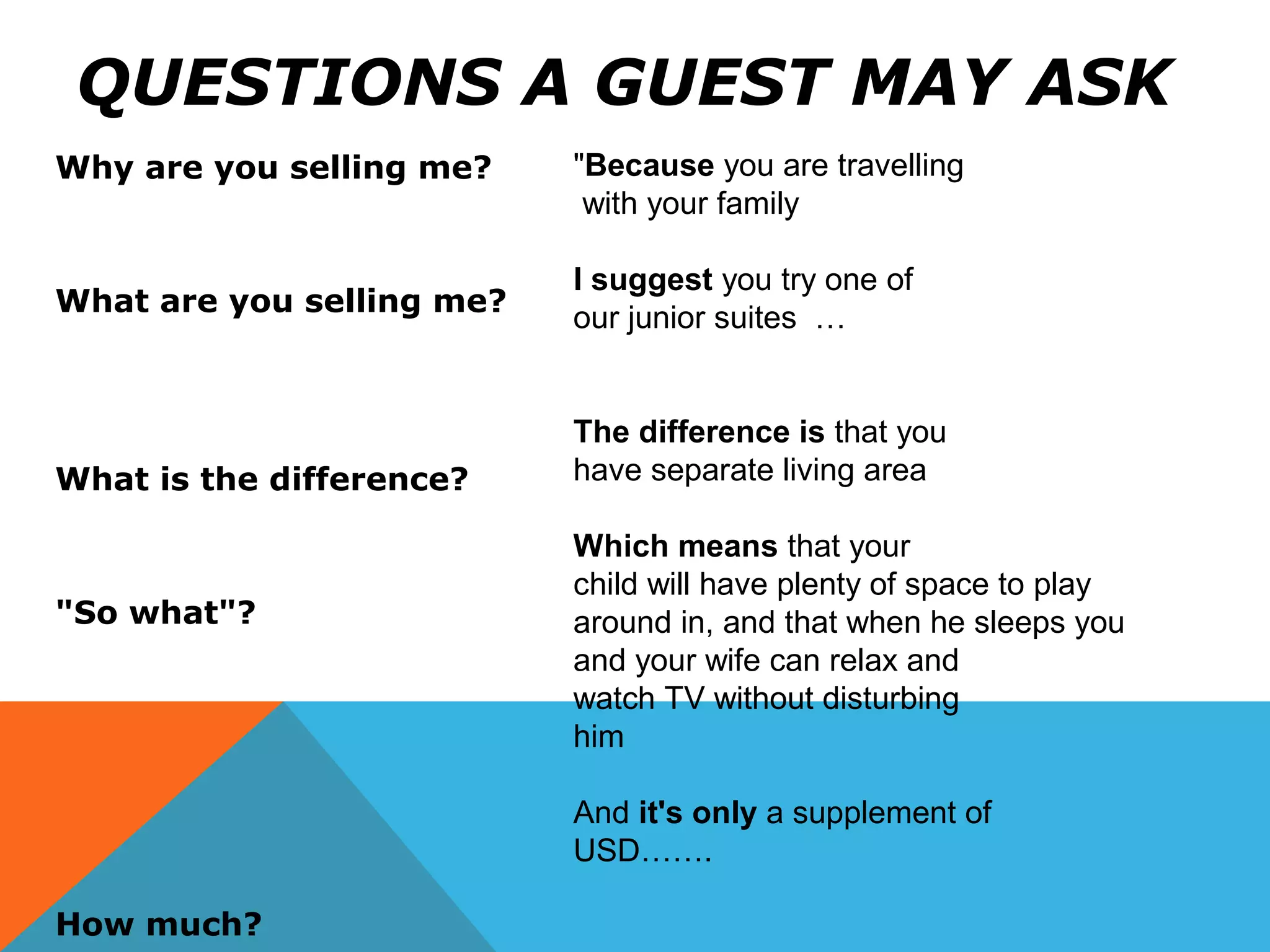
QUESTIONS A GUEST MAY ASK
Why are you selling me?
What are you selling me?
What is the difference?
"So what"?
How much?
"Because you are travelling
with your family
I suggest you try one of
our junior suites …
The difference is that you
have separate living area
Which means that your
child will have plenty of space to play
around in, and that when he sleeps you
and your wife can relax and
watch TV without disturbing
him
And it's only a supplement of
USD…….
GROUP ACTIVITY- 4
MINUTES
What is the difference between
“Advantages” and “Benefits” in
connection to “Up selling” ?
(Group 1)
Please list the advantages the guest
may have if being up sold
(Group 2)
Please list the benefits the guest will
enjoy if he takes the up sell
KEYS TO UNDERSTAND
The Difference Between Advantages
And Benefits
Identify Guest Needs
Screen The Needs
Identify The Right Room
Use The Advantages And Benefits To
Influence The Sell
Find The Selling Triggers
Introducing Upselling
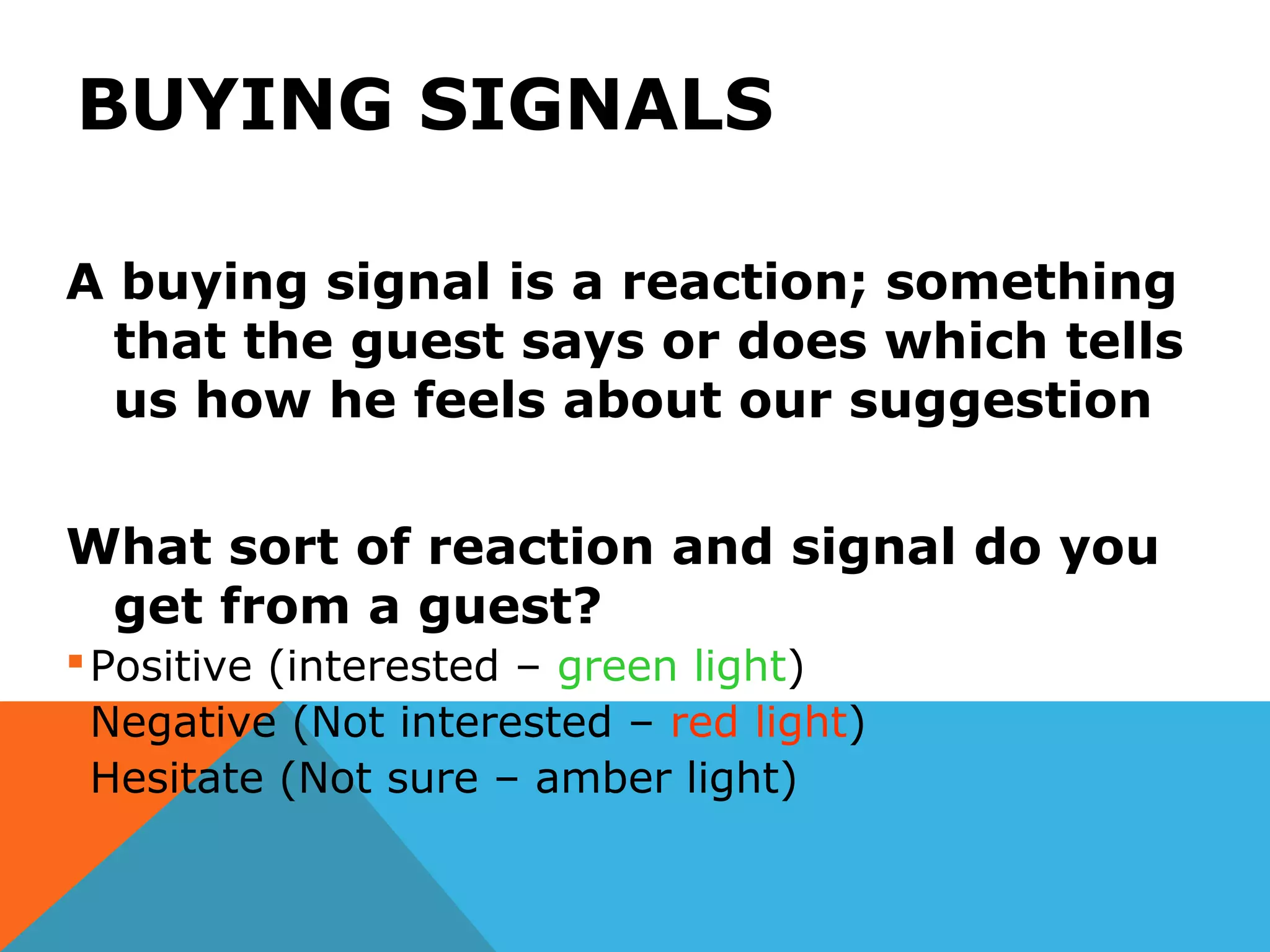
BUYING SIGNALS
A buying signal is a reaction; something
that the guest says or does which tells
us how he feels about our suggestion
What sort of reaction and signal do you
get from a guest?
Positive (interested – green light)
Negative (Not interested – red light)
Hesitate (Not sure – amber light)
POSITIVE SIGNALS
Can you think of any signals that tell us that the guest has a positive
reaction to our suggestion?
They could be Spoken Signals (things they say)
or
Silent Signals (things they do)
POSITIVE SIGNALS
Spoken Signals – What sort of things do
guests say that show a positive
reaction?
Asking a question
Saying something good about the item
Silent signals - Guests reactions are
often shown in their body language
Head & face
Hands & arms
Body & legs
NEGATIVE BUYING
SIGNALS
Body Signals like:
Shaking Of Head, looking disinterested,
turning away
In addition to silent signals guests often
simply say “no!”. There are three ways
a guest can say “no”
The unfriendly or definite “NO”
The general “NO”
The specific “NO”
UNFRIENDLY/DEFINITE NO
How should we handle this type of
guest?
Let the guest decide for himself – don’t
make any further suggestions unless
he asks for some
Give him space, move away until he is
ready; avoid doing anything that might
cause offence. Possibly advise other
associates
GENERAL NO
A general “NO” indicates a disinterest in
the whole category of room types
How should we handle a general “NO”?
Sometimes “NO” means “Persuade me”
if the clients body language is relaxed
PRICE OBJECTION
“That sounds expensive”
Empathize/agree/Explain why it is expensive
Offer alternative which will satisfy guest’s requirement in a
similar fashion
OVERCOMING HESITATION
Use powerful & enthusiastic expressions:
 It is luxurious
 It is fully equipped
 It is exclusive
As a professional salesperson, you know your product. To overcome
hesitation, show off your knowledge and your confidence
ENCOURAGE
How do we encourage a guest to buy?
Speak and act with confidence, give your personal guarantee
BODY LANGUAGE
What sort of actions might let the
guest see that we are getting
impatient?
Tapping or clicking our pens
Looking around the room
Checking our watch
Moving too close to the guest
Tapping our foot
Fidgeting
CHECKING SATISFACTION
What are some of the advantages to
checking satisfaction?
Show we care
Professional image
If something is missing we can rectify
without delay
If there is a problem we deal with it
quickly and quietly
There is a chance to sell something else
TIMING
When is the best time to check
on satisfaction?
Soon – 5 to 10 minutes after guest reaches the room
During the show around
TIMING
Why check so soon?
• If there is a problem, the longer we leave it the more upset the guest is
going to be.
WHAT NOT TO SAY
Is everything ok?
Any problems
Any Complaints
Was that good?
Is it delicious?
HANDLING GUESTS REACTIONS
What to do if the guest is happy?
•Thank the guest, smile
•Give your name and ask guest to contact you should
they need any further assistance
What to do if the guest is unhappy?
•Apologize
•Find out why
•Act to fix the problem and/or refer to the supervisor
•Possibly warn the other service staff
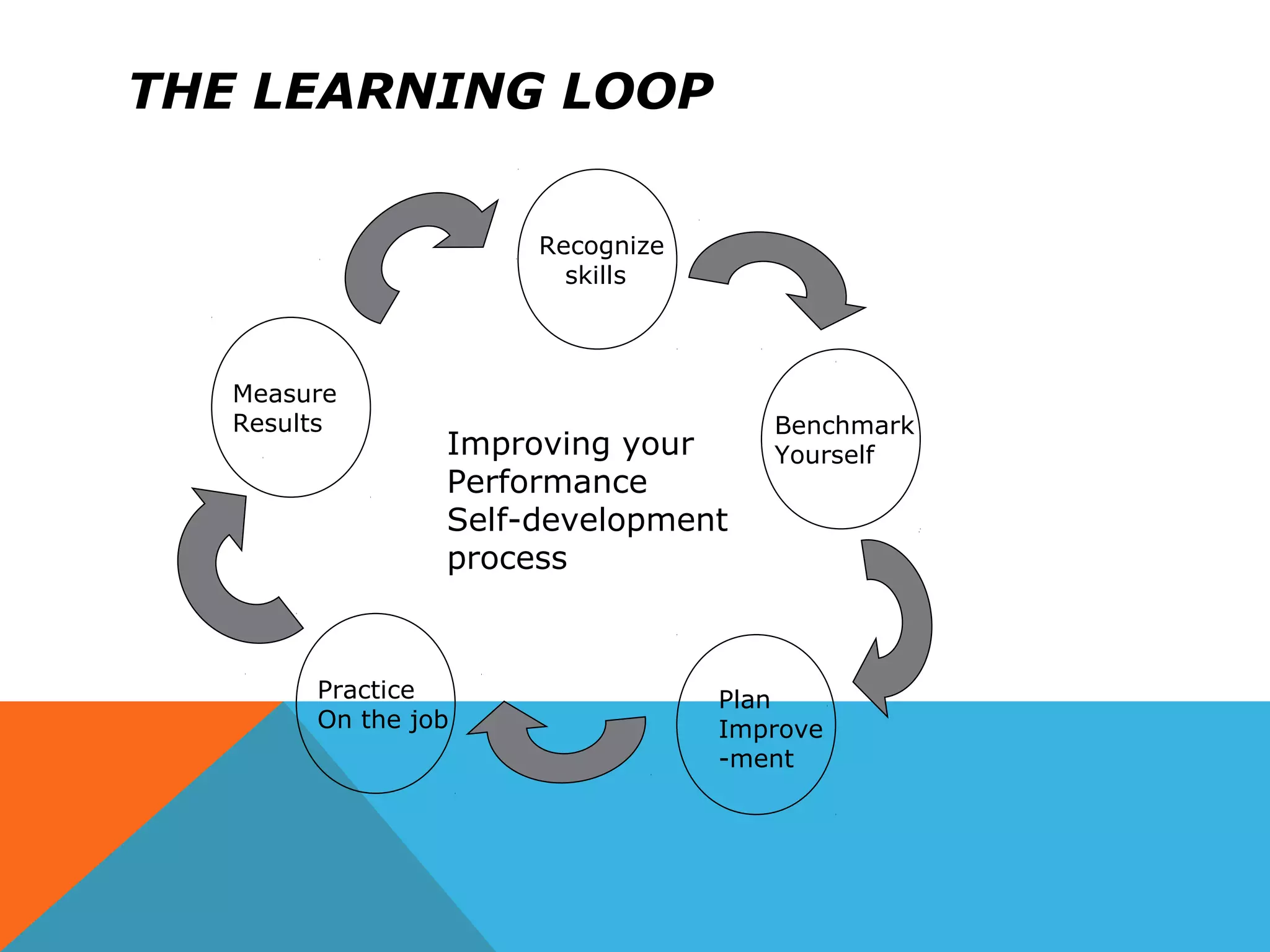
THE LEARNING LOOP
Recognize
skills
Benchmark
Yourself
Measure
Results
Practice
On the job
Plan
Improve
-ment
Improving your
Performance
Self-development
process
QUESTIONS?
SUMMARY
Don’t worry if a guest says “no” to your
suggestion
Not all your suggestions will be
accepted, and that is ok – don’t take it
personally.
Guests say “no” because they don’t
want your suggestion, not because
they don’t like you
Even guests who do say “no” will
appreciate your efforts to be helpful
and professional
SUMMARY
Don’t be scared or bothered by
objections. The main thing is to handle
the objections with confidence.
If a customer challenges your suggestion,
be ready to answer back with
confidence.
If you are selling something, be prepared
to say WHY you suggested it
Often a customer will buy our suggestion
even after giving an objection. Just like
us we sometimes say “It’s expensive
HANDLING OBJECTIONS
Don’t be scared by an objection
We will often face objections
Guests will challenge you
Some customers just say “no” to our recommendations
ALREADY DECIDED
Some guests have already
decided what they want:
when we attempt to sell
something else they say “No
I would rather have…”
Reinforce the guest’s choice
Eg. If the guest has chosen Club Room, say: Good choice Mr/Mrs
Smith, the Room has a fantastic view
REMEMBER
You first have to care for the guest, he / she must feel
that your priority is his / her comfort and delight
Repeat customers are vital to the business, sell
the product the guest wants, not what you want to
sell.
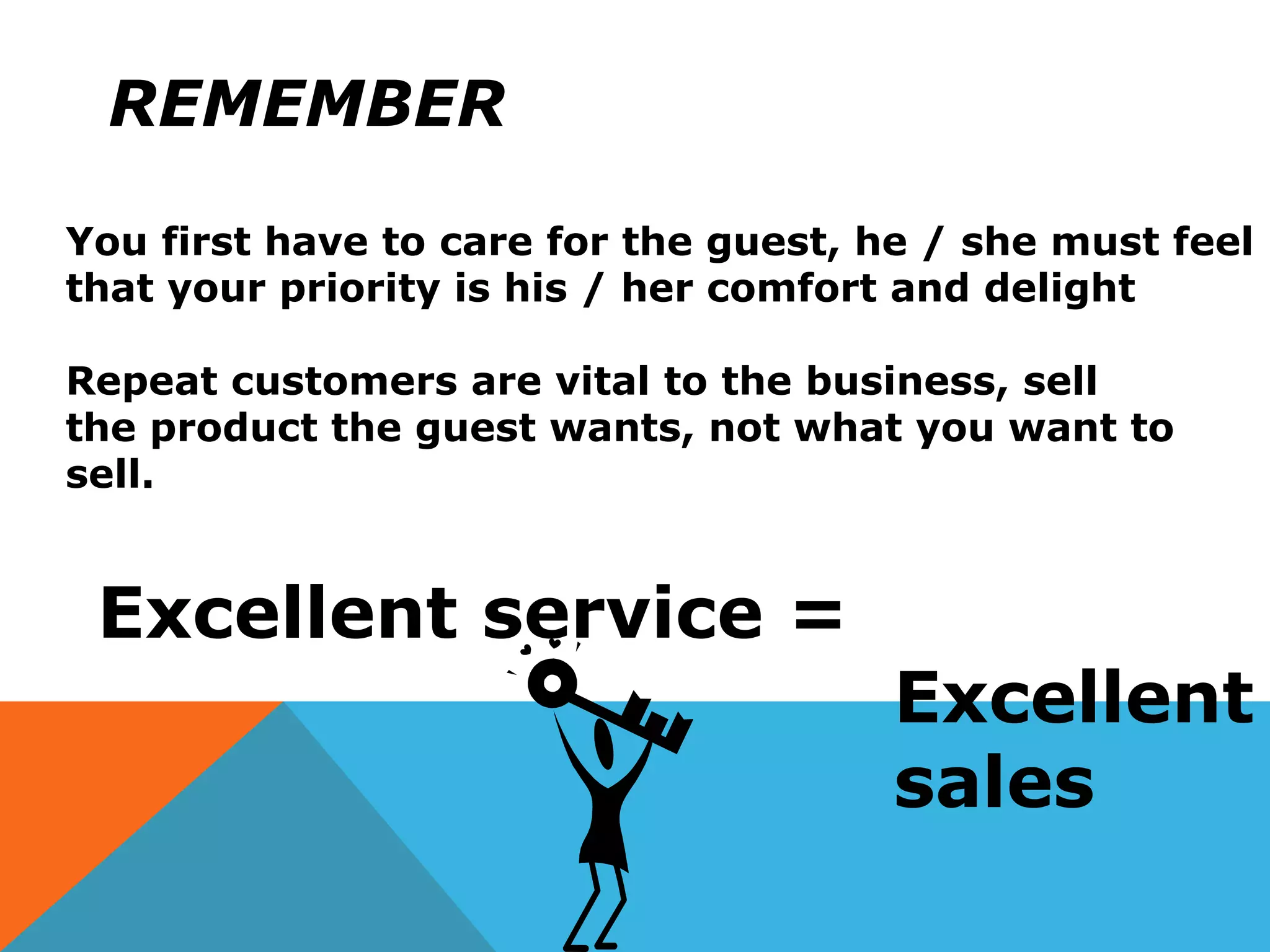
Excellent service =
Excellent
sales
THANK YOU

Upselling methods

  • 1.
  • 2.
    DEFINITION OF UP SELLING Theuse of certain words and phrases that will make the guest feel satisfied buying something he would not otherwise have bought Up selling is easy if we think of it as a way of helping out the guest and creating a satisfying solution to fulfill a need
  • 3.
    CONTENTS OF THE PROGRAMIdentifysales opportunities Build rapport with guests Match guests’ needs with appropriate products Describe the advantages of every available room category and their benefits to guests Make recommendations clearly and confidently Track your upselling results
  • 4.
    What should wekeep in mind when we think of UP selling?
  • 5.
  • 6.
    WHAT DO OURGUESTS WANTS Valued Respected Recognised Secure Safe Confident Supported & Taken Care Of Treated Honestly & Fairly No Discrimination Empowered Informed Given Choice FEEL LIKE AN INDIVIDUAL
  • 7.
    SELLING THE HOTEL Recognizewhen you have an opportunity to sell Listen to the guest’s needs Recommend the facilities and services Take the opportunity to sell a better service or product
  • 8.
    OUTCOMES Increase guest satisfaction Increasethe average room rate Increase conversions
  • 9.
  • 10.
    ALWAYS USE : YourEars…. Eyes…. Mouth…. Heart…..
  • 11.
    WHAT DO YOUUSE EYES FOR? •Eye contact •Read body language (identify guests needs)
  • 12.
    WHAT DO YOUUSE YOUR EARS FOR? Listening to find out guests needs
  • 13.
    WHAT DO YOUDO WITH YOUR MOUTH? •Smile - establish rapport •Speak / sell / describe / convince
  • 14.
    WHAT DO YOUDO WITH YOUR HEART? • Care for the guest
  • 15.
    HOW DO WESELL AN EXPERIENCE TO A GUEST? • Show them the way to the location • Tell them what’s available • Describe the contents of the experience using Power Words
  • 16.
    POWERFUL SELLING WORDS -Fully equipped - Elegant - Magnificent - Exclusive - Beautiful View - Superb - Genuine - Luxurious - Unique - Welcoming staff - Tempting - Irresistible - Exotic - Amazing
  • 17.
    LEARNING HOW TOSELL BETTER Selling by suggesting Handling Objections Selling higher category room type Describing the suggested room type Positive buying signals/confirm the room type Dealing with “no”/offering alternatives Overcoming hesitation Checking satisfaction
  • 18.
    SELLING BY SUGGESTING Howdoes it help us if we give suggestions rather than waiting for the guest to make up his or her mind? It saves time It helps project a better image It increases the sale
  • 19.
    When is thebest time to make a suggestion? When you reconfirm the reservation and room type When the guest asks about the facilities, size of the room, view etc. When you are invited to
  • 20.
    QUESTIONS A GUESTMAY ASK Why are you selling me? What are you selling me? What is the difference? "So what"? How much? "Because you are travelling with your family I suggest you try one of our junior suites … The difference is that you have separate living area Which means that your child will have plenty of space to play around in, and that when he sleeps you and your wife can relax and watch TV without disturbing him And it's only a supplement of USD…….
  • 21.
    GROUP ACTIVITY- 4 MINUTES Whatis the difference between “Advantages” and “Benefits” in connection to “Up selling” ? (Group 1) Please list the advantages the guest may have if being up sold (Group 2) Please list the benefits the guest will enjoy if he takes the up sell
  • 22.
    KEYS TO UNDERSTAND TheDifference Between Advantages And Benefits Identify Guest Needs Screen The Needs Identify The Right Room Use The Advantages And Benefits To Influence The Sell Find The Selling Triggers Introducing Upselling
  • 23.
    BUYING SIGNALS A buyingsignal is a reaction; something that the guest says or does which tells us how he feels about our suggestion What sort of reaction and signal do you get from a guest? Positive (interested – green light) Negative (Not interested – red light) Hesitate (Not sure – amber light)
  • 24.
    POSITIVE SIGNALS Can youthink of any signals that tell us that the guest has a positive reaction to our suggestion?
  • 25.
    They could beSpoken Signals (things they say) or Silent Signals (things they do)
  • 26.
    POSITIVE SIGNALS Spoken Signals– What sort of things do guests say that show a positive reaction? Asking a question Saying something good about the item Silent signals - Guests reactions are often shown in their body language Head & face Hands & arms Body & legs
  • 27.
    NEGATIVE BUYING SIGNALS Body Signalslike: Shaking Of Head, looking disinterested, turning away In addition to silent signals guests often simply say “no!”. There are three ways a guest can say “no” The unfriendly or definite “NO” The general “NO” The specific “NO”
  • 28.
    UNFRIENDLY/DEFINITE NO How shouldwe handle this type of guest? Let the guest decide for himself – don’t make any further suggestions unless he asks for some Give him space, move away until he is ready; avoid doing anything that might cause offence. Possibly advise other associates
  • 29.
    GENERAL NO A general“NO” indicates a disinterest in the whole category of room types How should we handle a general “NO”? Sometimes “NO” means “Persuade me” if the clients body language is relaxed
  • 30.
    PRICE OBJECTION “That soundsexpensive” Empathize/agree/Explain why it is expensive Offer alternative which will satisfy guest’s requirement in a similar fashion
  • 31.
    OVERCOMING HESITATION Use powerful& enthusiastic expressions:  It is luxurious  It is fully equipped  It is exclusive As a professional salesperson, you know your product. To overcome hesitation, show off your knowledge and your confidence
  • 32.
    ENCOURAGE How do weencourage a guest to buy? Speak and act with confidence, give your personal guarantee
  • 33.
    BODY LANGUAGE What sortof actions might let the guest see that we are getting impatient? Tapping or clicking our pens Looking around the room Checking our watch Moving too close to the guest Tapping our foot Fidgeting
  • 34.
    CHECKING SATISFACTION What aresome of the advantages to checking satisfaction? Show we care Professional image If something is missing we can rectify without delay If there is a problem we deal with it quickly and quietly There is a chance to sell something else
  • 35.
    TIMING When is thebest time to check on satisfaction? Soon – 5 to 10 minutes after guest reaches the room During the show around
  • 36.
    TIMING Why check sosoon? • If there is a problem, the longer we leave it the more upset the guest is going to be.
  • 37.
    WHAT NOT TOSAY Is everything ok? Any problems Any Complaints Was that good? Is it delicious?
  • 38.
    HANDLING GUESTS REACTIONS Whatto do if the guest is happy? •Thank the guest, smile •Give your name and ask guest to contact you should they need any further assistance What to do if the guest is unhappy? •Apologize •Find out why •Act to fix the problem and/or refer to the supervisor •Possibly warn the other service staff
  • 39.
    THE LEARNING LOOP Recognize skills Benchmark Yourself Measure Results Practice Onthe job Plan Improve -ment Improving your Performance Self-development process
  • 40.
  • 41.
    SUMMARY Don’t worry ifa guest says “no” to your suggestion Not all your suggestions will be accepted, and that is ok – don’t take it personally. Guests say “no” because they don’t want your suggestion, not because they don’t like you Even guests who do say “no” will appreciate your efforts to be helpful and professional
  • 42.
    SUMMARY Don’t be scaredor bothered by objections. The main thing is to handle the objections with confidence. If a customer challenges your suggestion, be ready to answer back with confidence. If you are selling something, be prepared to say WHY you suggested it Often a customer will buy our suggestion even after giving an objection. Just like us we sometimes say “It’s expensive
  • 43.
    HANDLING OBJECTIONS Don’t bescared by an objection We will often face objections Guests will challenge you Some customers just say “no” to our recommendations
  • 44.
    ALREADY DECIDED Some guestshave already decided what they want: when we attempt to sell something else they say “No I would rather have…” Reinforce the guest’s choice Eg. If the guest has chosen Club Room, say: Good choice Mr/Mrs Smith, the Room has a fantastic view
  • 45.
    REMEMBER You first haveto care for the guest, he / she must feel that your priority is his / her comfort and delight Repeat customers are vital to the business, sell the product the guest wants, not what you want to sell. Excellent service = Excellent sales
  • 46.

Editor's Notes

  • #7 What do you think each of these means? Secure, Safe and Confident – Guest wants to feel secure, safe and confident of staff have their personal welfare in mind Supported/Mothered Fathered Taken care of – Home away from Home, pampered Treated honestly and fairly no discrimination – even if they are paying a discounted rate, or coming with a gift voucher, or sales entertaining their guests etc. Empowered Informed and Given choice – Guest expects to be involved in decision making ie problem solving, would like to be kept informed and be given options Valued and Respected and Recognized – feels valued as a customer and money he is paying for services, recognition in terms of remembering names and attention to details Lastly feel like an individual and not number – Individual, personalized service and attention Once we understand the what guest wants from their overall experience now we can start breaking down the needs of the customer by each different experience during their stay And that’s where the Welcome Charter comes into picture
  • #24 For example – if you have suggested the Roast beef, and the guest nods his head that is a buying signal
  • #27 If we want to sell well we have to watch for the “silent signals”. Some of these signals are so quick that the guest may not even be aware that he or she has made them There are so many signals which are silent we will classify them into three areas – Head & face; hands & arms and body & legs
  • #28 These may be Spoken signals (things they say) or Silent Signals (things they do) There are many signs that reveal how guests are feeling – these may be spoken or silent. When we make sales suggestions the customer’s reaction is often shown by their body language. If we want to be truly professional we have to watch these silent signals closely. Some of the signals are so quick that the guest is not even aware je/she made them. There are many signals that are used in body language – head&face, hand & arm, body & legs. It takes practice to pick up and interpret the signals of body language. However, it is a skill that is worth developing as it will help you to be more sensitive to all people not just your clients
  • #29 This is a very clear signal – body language, words and tone all indicating a strong, negative reaction
  • #30 Sometimes “no” means “persuade me” if the clients body language is relaxed he or she is probably open to suggestion. Watch for the clients who say “no” with their words while their body language says “yes” or “maybe”
  • #33 The best way to overcome hesitation is to speak and act confidently. Guests will feel that you really know about the product so they will value your opinion
  • #34 Remember, we do want salesmen here but we certainly do not want to be too pushy. Above all, selling is good service – if we don’t give good service then our guests won’t come back and buy from us next time
  • #35 Checking satisfaction is important
  • #38 The second phrases sound as though you are expecting bad news. The guest will feel you are forcing him to agree
  • #44 Don’t be scared by an objection: as a professional you can handle it We will often face objections: Some customers may have tried our suggestion and didn’t like it, or they may have already made up their minds to have something else If a guest challenges your suggestion, answer confidently Some customers just say “no” to our recommendation – If the customer is unfriendly or disinterested then stop selling