Hazardous WasteHazardous Waste
Standard procedures for sample collectionStandard procedures for sample collection
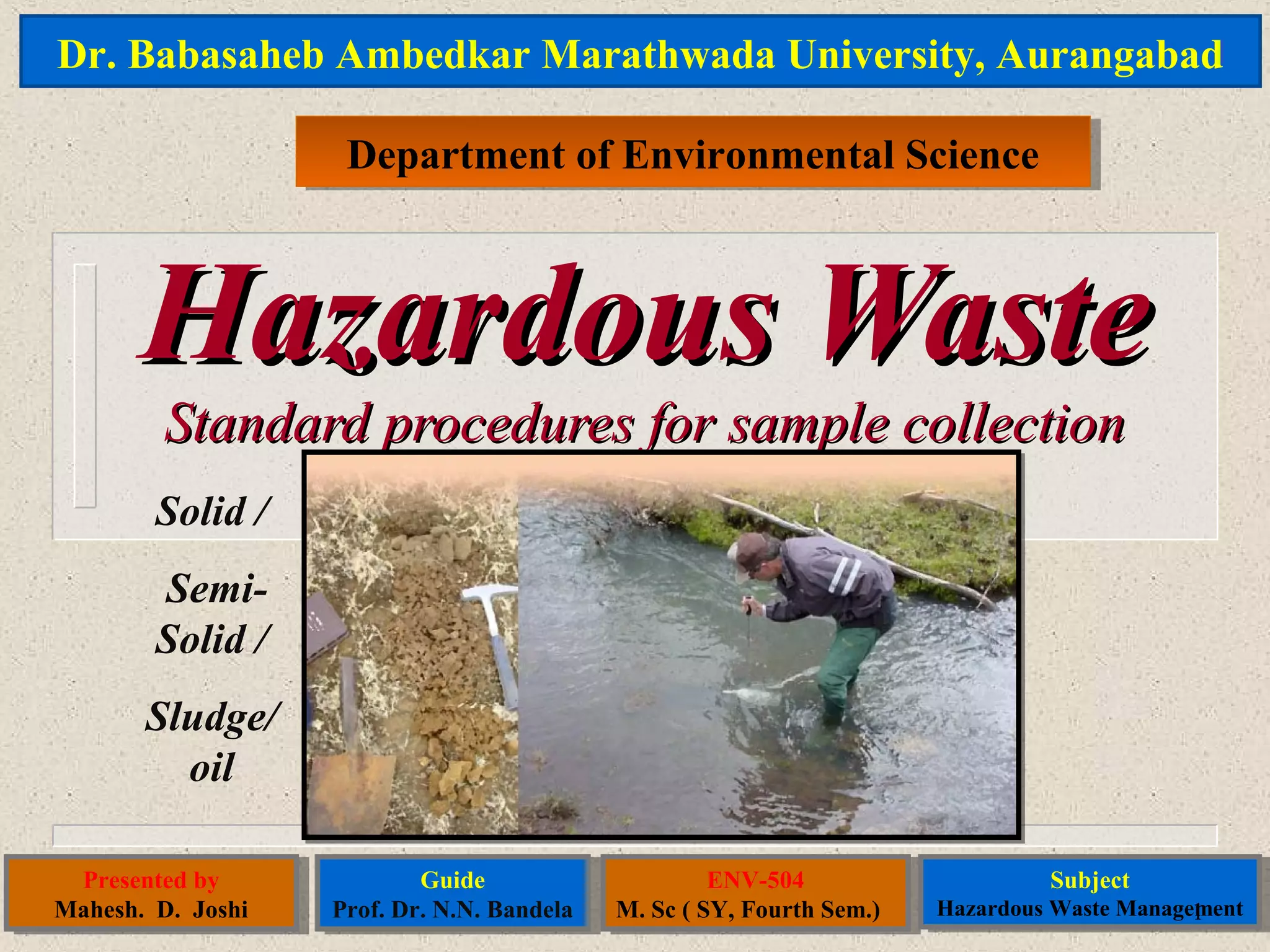
Solid /
Semi-
Solid /
Sludge/
oil
Dr. Babasaheb Ambedkar Marathwada University, Aurangabad
Department of Environmental ScienceDepartment of Environmental Science
Presented by
Mahesh. D. Joshi
Presented by
Mahesh. D. Joshi
Guide
Prof. Dr. N.N. Bandela
Guide
Prof. Dr. N.N. Bandela
ENV-504
M. Sc ( SY, Fourth Sem.)
ENV-504
M. Sc ( SY, Fourth Sem.)
Subject
Hazardous Waste Management
Subject
Hazardous Waste Management1
Topics to be covered:Topics to be covered:
Introduction
Definition
Laws
Sampling procedures
2
Hazardous waste is regulated by:Hazardous waste is regulated by:
Environmental Protection Agency (EPA)
HAZARDOUS WASTES (Management & Handling)
RULES, 1989 notified under the ENVIRONMENT
(Protection) ACT, 1986
amended in 2000
and again in 2003
Hazardous Waste (Management, Handling &Hazardous Waste (Management, Handling &
Transboundary Movement) Rules, 2008Transboundary Movement) Rules, 2008..
3
Cradle to grave statusCradle to grave status
Under Environmental Protection Agency’s
(EPA’s) hazardous waste characteristics
regulations under the authority of the Resource
Conservation and Recovery Act (RCRA)
Hazardous waste has to follow-
Cradle to grave status
Hazardous waste is regulated from the moment
it is created through the time of final disposal.
Generator is forever responsible for their waste.
4
Defination of Hazardous WasteDefination of Hazardous Waste
 Hazardous Wastes definition differs from country
to country. A generic definition says that
“ A Waste or combination of Waste that pose
a substantial present or potential Hazard to
humans or the environment, in part because
they are not readily degradable, persistent
in the environment and are dexterous to
human health or natural resources. ”
5
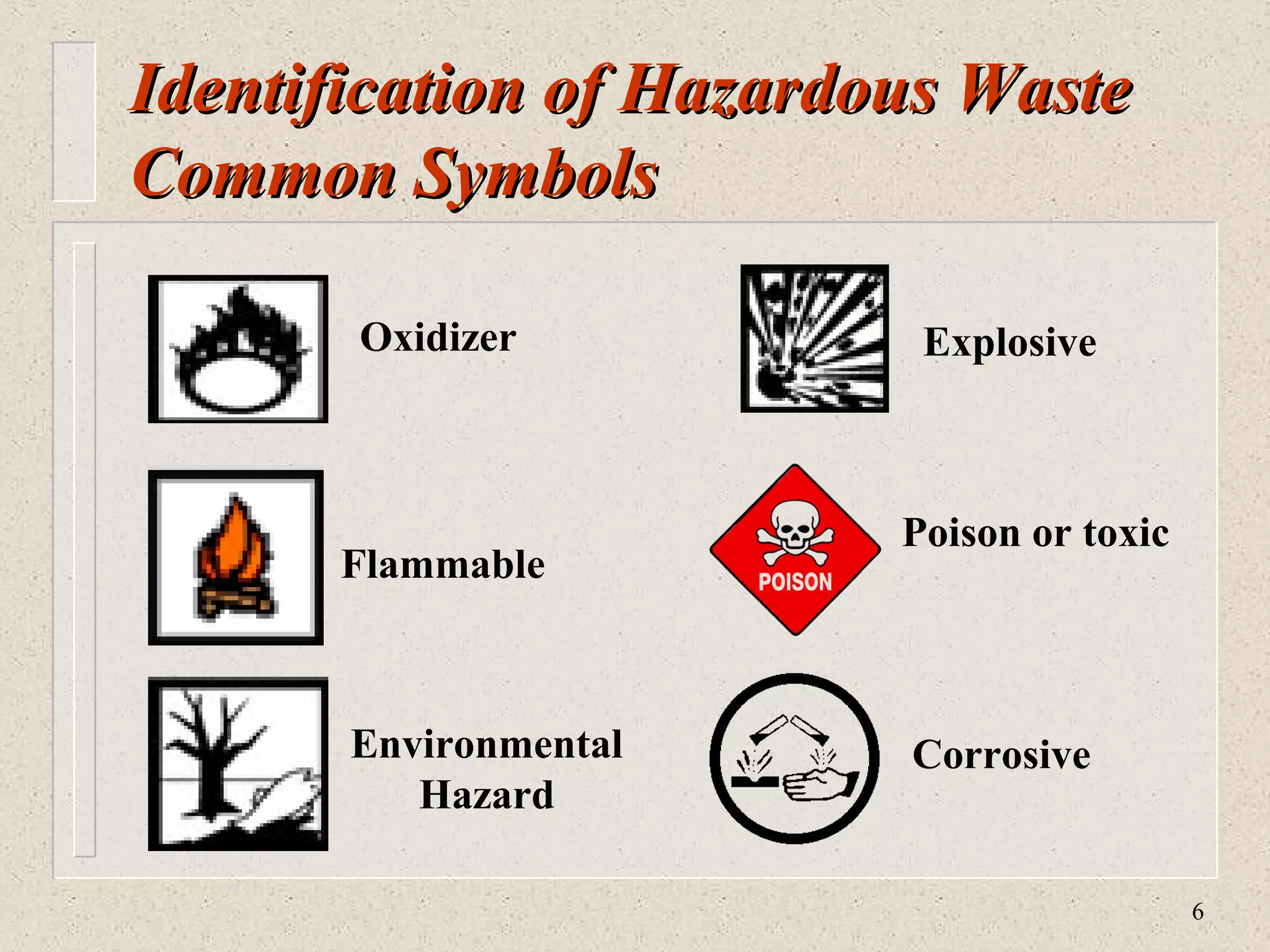
Identification of Hazardous WasteIdentification of Hazardous Waste
Common SymbolsCommon Symbols
Flammable
Environmental
Hazard
Poison or toxic
Corrosive
Oxidizer Explosive
6
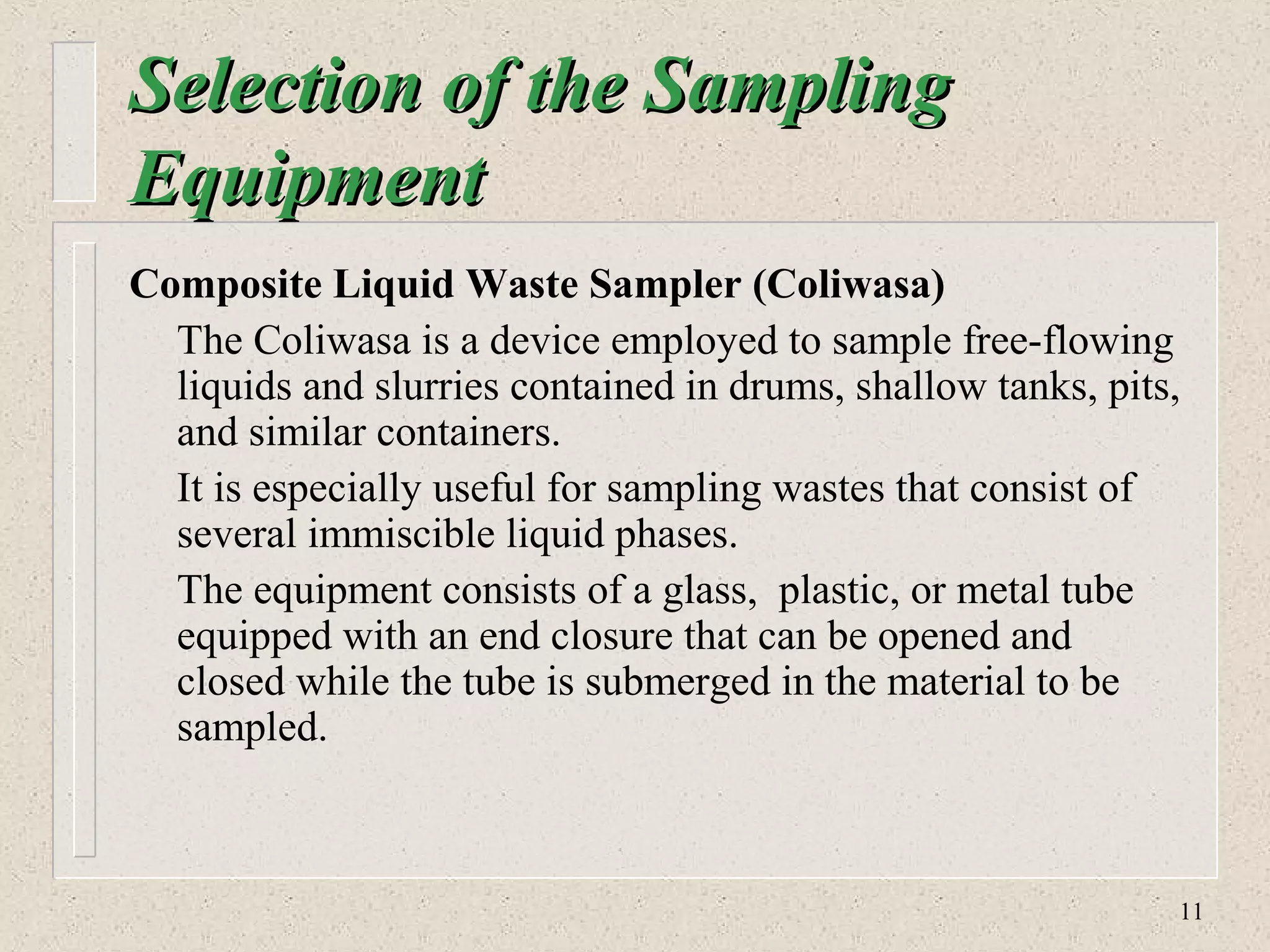
Need of SamplingNeed of Sampling
Sampling is the physical collection of a representative
portion of whole of a waste.
Sample is to ensure that the sample being collected
exhibits the average properties of the whole or the bulk of
the waste.
Sample must be collected and handled by means that will
preserve its original physical form and composition, as
well as prevent contamination or changes.
This can be achieved only by means of adopting
appropriate sampling plan, methodology, technique and
use of suitable sample collection equipment.
7
Sampling StrategiesSampling Strategies
It should address following things
Objectives of collecting the samples
Sampling approach (e.g. Authoritative or Random)
Types of samples needed (e.g. grab or composite)
Selection of sampling locations
Number of samples
Sampling frequency
Sample collection and handling techniques to be used
Physical and Chemical Properties of the wastes
8
Planning for Sampling
Samples should be collected under the supervision of a qualified
Environmental Engineer, Geologist and concerned Chemist/Scientist.
-The waste samples are usually collected from tanks, drums, ponds, piles
or form various processing or transporting equipment such as conveyor
belts.The sampling plan should be prepared depending on whether the waste
to be sampled is a liquid, solid, paste, sludge.
Number of Samples
The number of samples and the quality of the sampling procedure must be
planned to facilitate characterizing the population of interest and enhance
reliability in the final results.
9
Major Sample TypesMajor Sample Types
Grab
A sample taken from a Particular location at a distinct point in time.
Composite
A number of individually collected samples that are combined into a
single sample for subsequent analysis.
10
Selection of the SamplingSelection of the Sampling
EquipmentEquipment
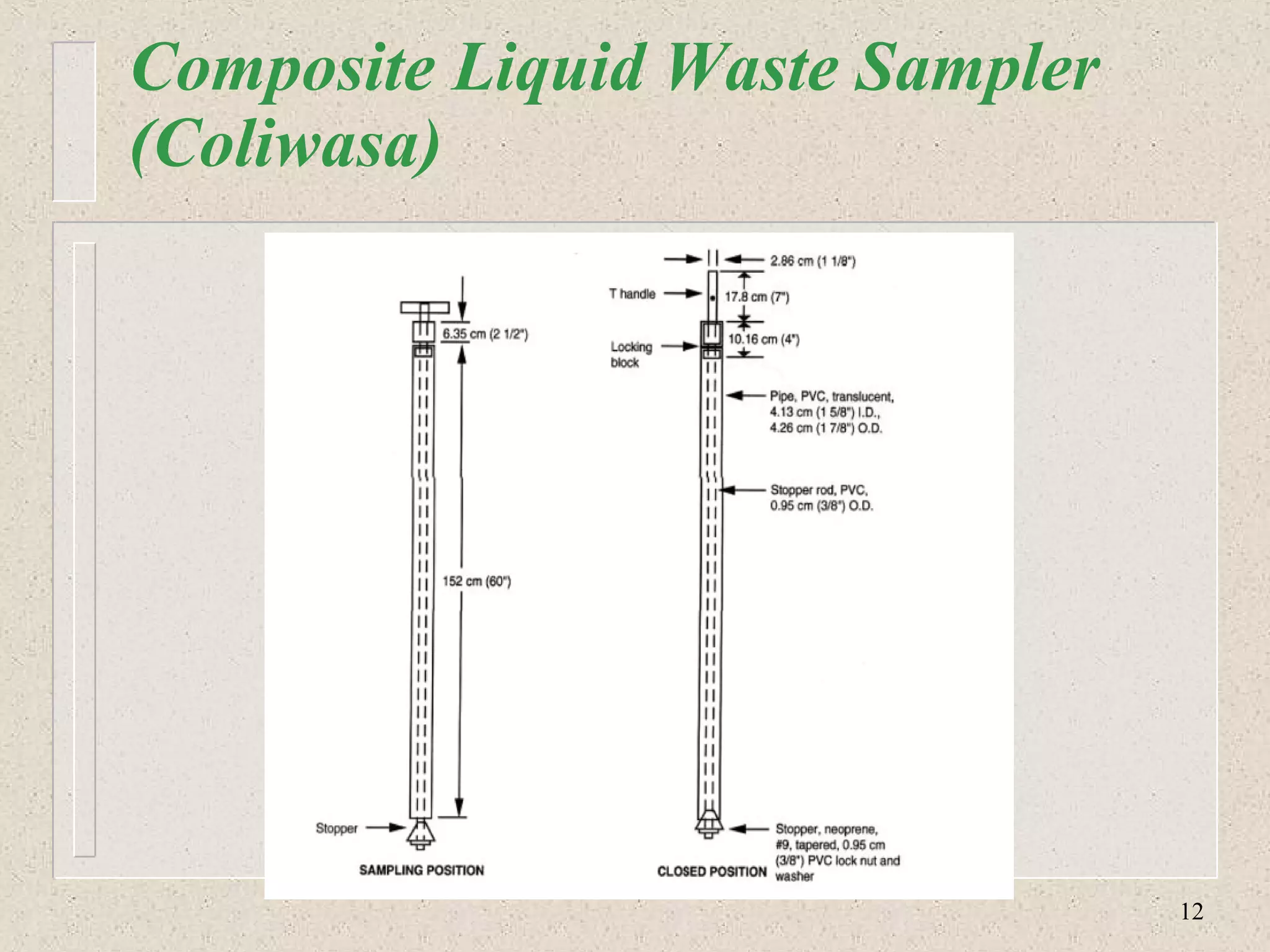
Composite Liquid Waste Sampler (Coliwasa)
The Coliwasa is a device employed to sample free-flowing
liquids and slurries contained in drums, shallow tanks, pits,
and similar containers.
It is especially useful for sampling wastes that consist of
several immiscible liquid phases.
The equipment consists of a glass, plastic, or metal tube
equipped with an end closure that can be opened and
closed while the tube is submerged in the material to be
sampled.
11
Composite Liquid Waste Sampler
(Coliwasa)
12
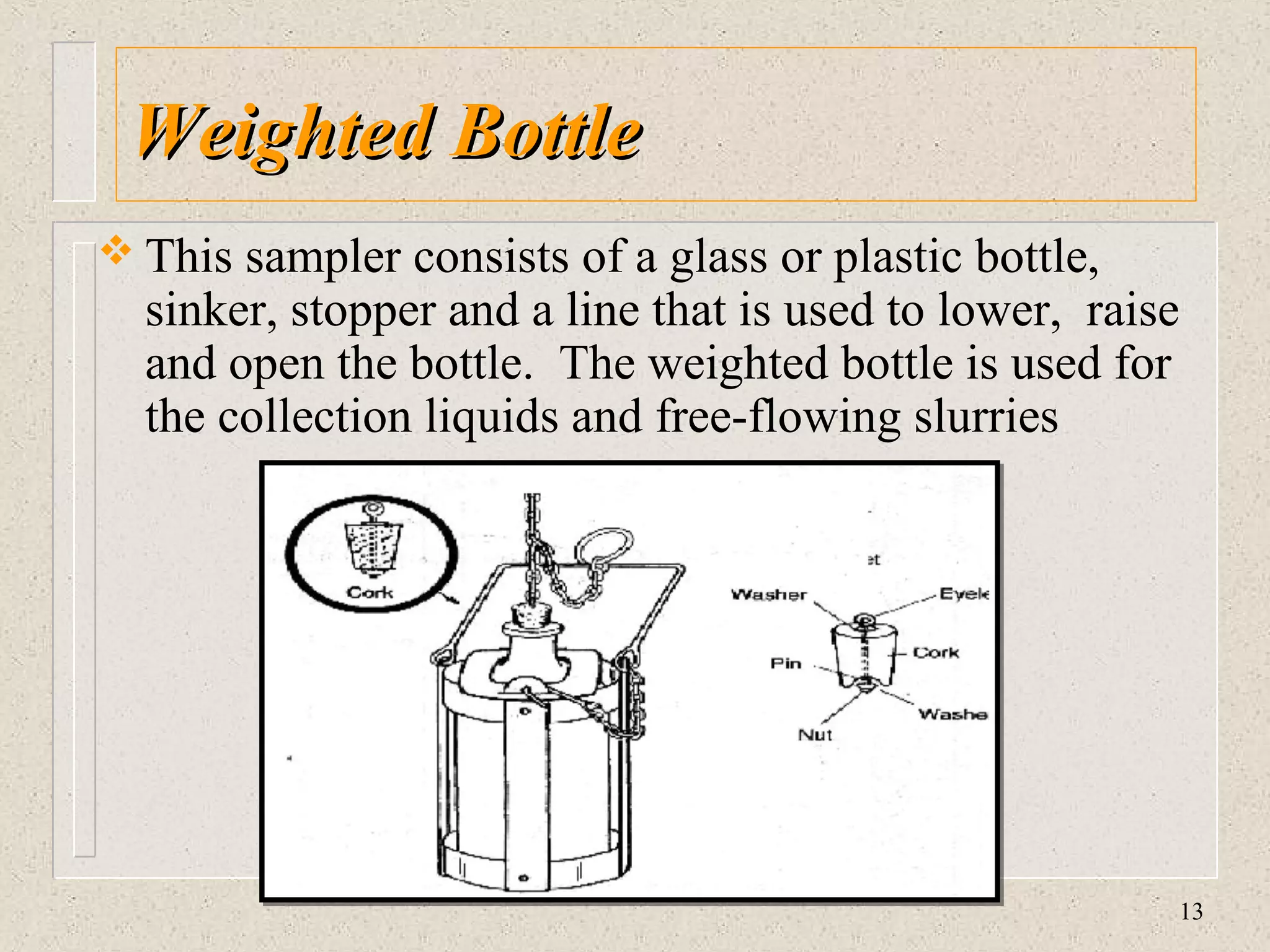
Weighted BottleWeighted Bottle
 This sampler consists of a glass or plastic bottle,
sinker, stopper and a line that is used to lower, raise
and open the bottle. The weighted bottle is used for
the collection liquids and free-flowing slurries
13
Dipper
The dipper consists of a glass or plastic beaker
clamped to the end of a two- or three-piece
telescoping aluminum or fiberglass pole that serves
as the handle. A dipper is used for the collection of
liquids and free-flowing slurries
14
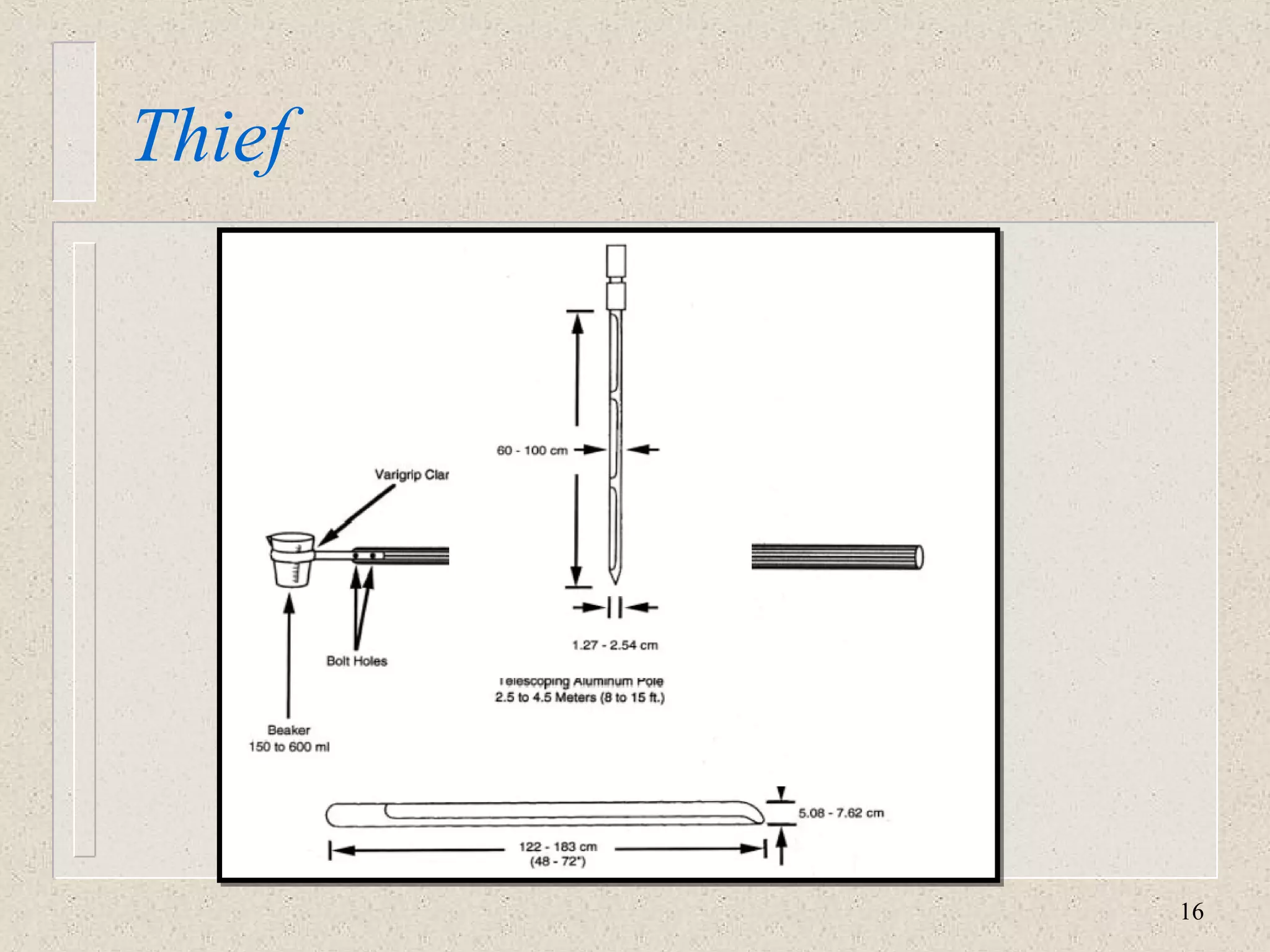
Thief
– A thief consists of two slotted concentric tubes, usually
made of stainless steel or brass. The outer tube has a
conical pointed tip that is rotated to open and close the
sampler. A thief is used to sample dry granules or
powdered wastes whose particle diameter is less than
one-third the width of the slots. This equipment can be
procured from any suppliers of laboratory items
15
Thief
16
TrierTrier
A trier consists of a tube cut in half lengthwise with a
sharpened tip that allows the sampler to cut into sticky
solids and to loosen soil. A trier is used for the collection of
moist samples or sticky solids with a particle diameter less
than one-half diameter of the trier. Some kinds of triers can
be readily procured from the suppliers of the laboratory
items and hardware shops or triers can be fabricated as per
the required dimensions
17
Auger
An auger consists of sharpened spiral blades attached to a
hard metal central shaft. An auger samples hard or packed
solid wastes or soil. Augers can be procured from
hardware shops and suppliers of the laboratory items.
18
Auger
19
Scoops and ShovelsScoops and Shovels
Scoops and shovels are used for the collection
of granular or powdered material in bins,
shallow containers and conveyor belts. Scoops
are available at hardware and suppliers of the
laboratory items.
20
Questions?
21
Thanks a lot….
22

Uploaded 9 april 2016 mahesh joshi hazardous waste sampling techniques

  • 1.
    Hazardous WasteHazardous Waste Standardprocedures for sample collectionStandard procedures for sample collection Solid / Semi- Solid / Sludge/ oil Dr. Babasaheb Ambedkar Marathwada University, Aurangabad Department of Environmental ScienceDepartment of Environmental Science Presented by Mahesh. D. Joshi Presented by Mahesh. D. Joshi Guide Prof. Dr. N.N. Bandela Guide Prof. Dr. N.N. Bandela ENV-504 M. Sc ( SY, Fourth Sem.) ENV-504 M. Sc ( SY, Fourth Sem.) Subject Hazardous Waste Management Subject Hazardous Waste Management1
  • 2.
    Topics to becovered:Topics to be covered: Introduction Definition Laws Sampling procedures 2
  • 3.
    Hazardous waste isregulated by:Hazardous waste is regulated by: Environmental Protection Agency (EPA) HAZARDOUS WASTES (Management & Handling) RULES, 1989 notified under the ENVIRONMENT (Protection) ACT, 1986 amended in 2000 and again in 2003 Hazardous Waste (Management, Handling &Hazardous Waste (Management, Handling & Transboundary Movement) Rules, 2008Transboundary Movement) Rules, 2008.. 3
  • 4.
    Cradle to gravestatusCradle to grave status Under Environmental Protection Agency’s (EPA’s) hazardous waste characteristics regulations under the authority of the Resource Conservation and Recovery Act (RCRA) Hazardous waste has to follow- Cradle to grave status Hazardous waste is regulated from the moment it is created through the time of final disposal. Generator is forever responsible for their waste. 4
  • 5.
    Defination of HazardousWasteDefination of Hazardous Waste  Hazardous Wastes definition differs from country to country. A generic definition says that “ A Waste or combination of Waste that pose a substantial present or potential Hazard to humans or the environment, in part because they are not readily degradable, persistent in the environment and are dexterous to human health or natural resources. ” 5
  • 6.
    Identification of HazardousWasteIdentification of Hazardous Waste Common SymbolsCommon Symbols Flammable Environmental Hazard Poison or toxic Corrosive Oxidizer Explosive 6
  • 7.
    Need of SamplingNeedof Sampling Sampling is the physical collection of a representative portion of whole of a waste. Sample is to ensure that the sample being collected exhibits the average properties of the whole or the bulk of the waste. Sample must be collected and handled by means that will preserve its original physical form and composition, as well as prevent contamination or changes. This can be achieved only by means of adopting appropriate sampling plan, methodology, technique and use of suitable sample collection equipment. 7
  • 8.
    Sampling StrategiesSampling Strategies Itshould address following things Objectives of collecting the samples Sampling approach (e.g. Authoritative or Random) Types of samples needed (e.g. grab or composite) Selection of sampling locations Number of samples Sampling frequency Sample collection and handling techniques to be used Physical and Chemical Properties of the wastes 8
  • 9.
    Planning for Sampling Samplesshould be collected under the supervision of a qualified Environmental Engineer, Geologist and concerned Chemist/Scientist. -The waste samples are usually collected from tanks, drums, ponds, piles or form various processing or transporting equipment such as conveyor belts.The sampling plan should be prepared depending on whether the waste to be sampled is a liquid, solid, paste, sludge. Number of Samples The number of samples and the quality of the sampling procedure must be planned to facilitate characterizing the population of interest and enhance reliability in the final results. 9
  • 10.
    Major Sample TypesMajorSample Types Grab A sample taken from a Particular location at a distinct point in time. Composite A number of individually collected samples that are combined into a single sample for subsequent analysis. 10
  • 11.
    Selection of theSamplingSelection of the Sampling EquipmentEquipment Composite Liquid Waste Sampler (Coliwasa) The Coliwasa is a device employed to sample free-flowing liquids and slurries contained in drums, shallow tanks, pits, and similar containers. It is especially useful for sampling wastes that consist of several immiscible liquid phases. The equipment consists of a glass, plastic, or metal tube equipped with an end closure that can be opened and closed while the tube is submerged in the material to be sampled. 11
  • 12.
    Composite Liquid WasteSampler (Coliwasa) 12
  • 13.
    Weighted BottleWeighted Bottle This sampler consists of a glass or plastic bottle, sinker, stopper and a line that is used to lower, raise and open the bottle. The weighted bottle is used for the collection liquids and free-flowing slurries 13
  • 14.
    Dipper The dipper consistsof a glass or plastic beaker clamped to the end of a two- or three-piece telescoping aluminum or fiberglass pole that serves as the handle. A dipper is used for the collection of liquids and free-flowing slurries 14
  • 15.
    Thief – A thiefconsists of two slotted concentric tubes, usually made of stainless steel or brass. The outer tube has a conical pointed tip that is rotated to open and close the sampler. A thief is used to sample dry granules or powdered wastes whose particle diameter is less than one-third the width of the slots. This equipment can be procured from any suppliers of laboratory items 15
  • 16.
  • 17.
    TrierTrier A trier consistsof a tube cut in half lengthwise with a sharpened tip that allows the sampler to cut into sticky solids and to loosen soil. A trier is used for the collection of moist samples or sticky solids with a particle diameter less than one-half diameter of the trier. Some kinds of triers can be readily procured from the suppliers of the laboratory items and hardware shops or triers can be fabricated as per the required dimensions 17
  • 18.
    Auger An auger consistsof sharpened spiral blades attached to a hard metal central shaft. An auger samples hard or packed solid wastes or soil. Augers can be procured from hardware shops and suppliers of the laboratory items. 18
  • 19.
  • 20.
    Scoops and ShovelsScoopsand Shovels Scoops and shovels are used for the collection of granular or powdered material in bins, shallow containers and conveyor belts. Scoops are available at hardware and suppliers of the laboratory items. 20
  • 21.
  • 22.