SUSTAINABLE PRACTICES
IN WASTE MANAGEMENT
MD SHAHNAWAZ PARVEZ 21011NB014 M.ARCH (ED)
HAZARDOUS WASTE
HAZARDOUS WASTE:
Waste is something which owner no longer wants at a given place and time and which has no
current or perceived market value for the generator.
Any waste which by any reason of its chemical or/and physico-chemical properties or its
handling is liable to cause harm to human being, other living creatures, plants, micro – organisms,
property or environment.
LEGAL DEFINITION: Hazardous Waste: Any waste which by reason of any of its physical, chemical,
reactive, toxic, flammable, explosive or corrosive characteristics causes danger or is likely to
cause danger to health or environment, whether alone or when in contact with other wastes or
substances.
What is Hazardous Waste ?
STATE POLLUTION CONTROL BOARDS
(SPCB)
Ensure the scientific management of hazardous waste, including its generation, segregation,
transportation, treatment and disposal. The strategy should also target waste minimization or
reduction as its primary focus.
Quantifying and characterizing the volume of waste generated by industries
Comprehensive environmental and social assessments of hazardous waste management
operations are needed to minimize the impacts of waste on human health and ecosystem.
Develop an adequate infrastructure for the proper treatment and disposal of Hazardous waste.
Give urgent attention to reducing the generation of solid waste at source through mandatory
standards and regulations, fee tax incentives, education and voluntary compliance.
Develop technologies for waste collection and disposal in order to ensure proper solid-waste
management.
Government standards must be set up not only for disposal of waste on land but also for cleaning
up contaminated soils and groundwater.
The Government has promulgated various rules and guidelines on the management and handling the
Hazardous waste. These rules are implemented through SPCBs in the States and Union territories.
RULES TO CONTROL HAZARDOUS WASTE
IN INDIA
◦ The Plastics(Manufacture, Usage and Waste Management) Rules,2009
◦ The Hazardous Wastes (Management, Handling and Trans boundary Movement) Rules,2009,
◦ The Hazardous Wastes (Management, Handling and Trans boundary Movement) Rules,2009
◦ The Hazardous Wastes (Management, Handling and Trans boundary Movement) Rules,2008
◦ The Batteries (Management and Handling) Rules, 2001
◦ The Municipal Solid Wastes (Management and Handling) Rules, 2000.
◦ The Recycled Plastics Manufacture and Usage Rules, 1999 
By using either or both of the following criteria, we can identify as to whether or not a waste is
hazardous:
(i) The list provided by government agencies declaring that substance as hazardous.
(ii) Characteristics such as ignitibility, corrosivity, reactivity and toxicity of the substance.
According to Hazardous and Other Wastes (Management and Transboundary Movement) Rules,
2016, Hazardous wastes include:
(i) waste specified under column (3) of Schedule I;
(ii) waste having equal to or more than the concentration limits specified for the constituents in class
A and class B of Schedule II or any of the characteristics as specified in class C of Schedule II.
IDENTIFICATION OF HAZARDOUS WASTE
1.Flammable: A waste is an ignitable/flammable hazardous waste, if it has a flash point of less than
60°C; readily catches fire and burns so vigorously as to create a hazard.
• A simple method of determining the flash point of a waste is to review the material safety data
sheet, which can be obtained from the manufacturer or distributor of the material.
• Naphtha, lacquer thinner, epoxy resins, adhesives and oil based paints are all examples of
ignitable hazardous wastes.
2. Toxicity: Wastes that are hazardous due to the toxicity characteristic are harmful when ingested or
absorbed.
• Toxic wastes present a concern as they may be able to leach from waste and pollute groundwater.
• The toxicity of a waste is determined by the Toxicity Characteristic Leaching Procedure (TCLP).
CHARACTERISTICS OF HAZARDOUS
SOLID WASTE
3. Reactivity: Wastes that are hazardous due to the reactivity characteristic may be unstable under
normal conditions, may react with water, may give off toxic gases and may be capable of
detonation or explosion under normal conditions or when heated.
4. Infectiousness: Substances or wastes containing viable micro-organisms or their toxins which are
known or suspected to cause disease in animals or humans.
5. Radioactivity: Substances that emit ionising radiation are radioactive. Such substances are
hazardous because prolonged exposure to radiation often results in damage to living organisms.
Radioactive substances are of special concern because they persist for a long period. The period in
which radiation occurs is commonly measured and expressed as half-life, i.e., the time required for
the radioactivity of a given amount of the substance to decay to half its initial value. Examples:
Biomedical research facilities, nuclear power plant.
6. Corrosiveness: A liquid waste which has a pH of less than or equal to 2 or greater than or equal to
12.5 is considered to be a corrosive hazardous waste. Example is caustic solution and hydrochloric
acid which is used in many industries to clean or degrease metal parts.
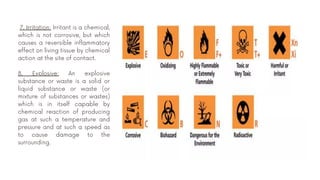
7. Irritation: Irritant is a chemical,
which is not corrosive, but which
causes a reversible inflammatory
effect on living tissue by chemical
action at the site of contact.
8. Explosive: An explosive
substance or waste is a solid or
liquid substance or waste (or
mixture of substances or wastes)
which is in itself capable by
chemical reaction of producing
gas at such a temperature and
pressure and at such a speed as
to cause damage to the
surrounding.
Waste Exchange is where the waste product of one process becomes the raw materials for a second
process. This is similar to using pre-consumer recycling material in a product. This represents a way of
reducing waste disposal through reuse for that which cannot be eliminated.
One of the best example of waste exchange in industrial sector and it's called industrial symbiosis.
Industrial symbiosis is an association between two or more industrial facilities or companies in which
the wastes or byproducts of one become the raw materials for another.
• Industrial symbiosis can helps in:
• -Reduce raw material and waste disposal costs
• -Earn new revenue from residues and byproducts
• -Divert waste from landfill and reduce carbon emissions
• -Open up new business opportunities
WASTE EXCHANGE
• Waste minimization or reduction at source means to reduce the amount of waste generated at
the source, the most practical and promising methods appear to be;
1.The adoption of industry standards for product manufacturing and packaging that use less
material, 2.The passing of laws that minimise the use of virgin materials in consumer products,
3.The levying (by communities) of cess/fees for waste management services that penalise
generators in case of increase in waste quantities.
• Modifications in product packaging standards can result in reduction of waste packaging
material or use of recyclable materials.
• Minimization of use of virgin raw materials by the manufacturing industry promotes substitution by
recycled materials.
WASTE MINIMIZATION
RESOURCE RECOVERY THROUGH MATERIAL RECYCLING
• 1. Sorting at Source
(a) Dry recyclable materials e.g. glass, paper, plastics, cans etc.,
(b) Bio-waste and garden waste,
(c) Bulky waste,
(d) Hazardous material in household waste,
(e) Construction and Demolition waste, and
(f) Commingled MSW (mixed waste).
• 2. Centralized Sorting
• 3. Sorting Prior to Waste Processing or Landfilling
WASTE MINIMIZATION
THANKYOU

Hazardous waste.pdf

  • 1.
    SUSTAINABLE PRACTICES IN WASTEMANAGEMENT MD SHAHNAWAZ PARVEZ 21011NB014 M.ARCH (ED) HAZARDOUS WASTE
  • 2.
    HAZARDOUS WASTE: Waste issomething which owner no longer wants at a given place and time and which has no current or perceived market value for the generator. Any waste which by any reason of its chemical or/and physico-chemical properties or its handling is liable to cause harm to human being, other living creatures, plants, micro – organisms, property or environment. LEGAL DEFINITION: Hazardous Waste: Any waste which by reason of any of its physical, chemical, reactive, toxic, flammable, explosive or corrosive characteristics causes danger or is likely to cause danger to health or environment, whether alone or when in contact with other wastes or substances. What is Hazardous Waste ?
  • 3.
    STATE POLLUTION CONTROLBOARDS (SPCB) Ensure the scientific management of hazardous waste, including its generation, segregation, transportation, treatment and disposal. The strategy should also target waste minimization or reduction as its primary focus. Quantifying and characterizing the volume of waste generated by industries Comprehensive environmental and social assessments of hazardous waste management operations are needed to minimize the impacts of waste on human health and ecosystem. Develop an adequate infrastructure for the proper treatment and disposal of Hazardous waste. Give urgent attention to reducing the generation of solid waste at source through mandatory standards and regulations, fee tax incentives, education and voluntary compliance. Develop technologies for waste collection and disposal in order to ensure proper solid-waste management. Government standards must be set up not only for disposal of waste on land but also for cleaning up contaminated soils and groundwater. The Government has promulgated various rules and guidelines on the management and handling the Hazardous waste. These rules are implemented through SPCBs in the States and Union territories.
  • 4.
    RULES TO CONTROLHAZARDOUS WASTE IN INDIA ◦ The Plastics(Manufacture, Usage and Waste Management) Rules,2009 ◦ The Hazardous Wastes (Management, Handling and Trans boundary Movement) Rules,2009, ◦ The Hazardous Wastes (Management, Handling and Trans boundary Movement) Rules,2009 ◦ The Hazardous Wastes (Management, Handling and Trans boundary Movement) Rules,2008 ◦ The Batteries (Management and Handling) Rules, 2001 ◦ The Municipal Solid Wastes (Management and Handling) Rules, 2000. ◦ The Recycled Plastics Manufacture and Usage Rules, 1999 
  • 5.
    By using eitheror both of the following criteria, we can identify as to whether or not a waste is hazardous: (i) The list provided by government agencies declaring that substance as hazardous. (ii) Characteristics such as ignitibility, corrosivity, reactivity and toxicity of the substance. According to Hazardous and Other Wastes (Management and Transboundary Movement) Rules, 2016, Hazardous wastes include: (i) waste specified under column (3) of Schedule I; (ii) waste having equal to or more than the concentration limits specified for the constituents in class A and class B of Schedule II or any of the characteristics as specified in class C of Schedule II. IDENTIFICATION OF HAZARDOUS WASTE
  • 6.
    1.Flammable: A wasteis an ignitable/flammable hazardous waste, if it has a flash point of less than 60°C; readily catches fire and burns so vigorously as to create a hazard. • A simple method of determining the flash point of a waste is to review the material safety data sheet, which can be obtained from the manufacturer or distributor of the material. • Naphtha, lacquer thinner, epoxy resins, adhesives and oil based paints are all examples of ignitable hazardous wastes. 2. Toxicity: Wastes that are hazardous due to the toxicity characteristic are harmful when ingested or absorbed. • Toxic wastes present a concern as they may be able to leach from waste and pollute groundwater. • The toxicity of a waste is determined by the Toxicity Characteristic Leaching Procedure (TCLP). CHARACTERISTICS OF HAZARDOUS SOLID WASTE
  • 7.
    3. Reactivity: Wastesthat are hazardous due to the reactivity characteristic may be unstable under normal conditions, may react with water, may give off toxic gases and may be capable of detonation or explosion under normal conditions or when heated. 4. Infectiousness: Substances or wastes containing viable micro-organisms or their toxins which are known or suspected to cause disease in animals or humans. 5. Radioactivity: Substances that emit ionising radiation are radioactive. Such substances are hazardous because prolonged exposure to radiation often results in damage to living organisms. Radioactive substances are of special concern because they persist for a long period. The period in which radiation occurs is commonly measured and expressed as half-life, i.e., the time required for the radioactivity of a given amount of the substance to decay to half its initial value. Examples: Biomedical research facilities, nuclear power plant. 6. Corrosiveness: A liquid waste which has a pH of less than or equal to 2 or greater than or equal to 12.5 is considered to be a corrosive hazardous waste. Example is caustic solution and hydrochloric acid which is used in many industries to clean or degrease metal parts.
  • 8.
    7. Irritation: Irritantis a chemical, which is not corrosive, but which causes a reversible inflammatory effect on living tissue by chemical action at the site of contact. 8. Explosive: An explosive substance or waste is a solid or liquid substance or waste (or mixture of substances or wastes) which is in itself capable by chemical reaction of producing gas at such a temperature and pressure and at such a speed as to cause damage to the surrounding.
  • 9.
    Waste Exchange iswhere the waste product of one process becomes the raw materials for a second process. This is similar to using pre-consumer recycling material in a product. This represents a way of reducing waste disposal through reuse for that which cannot be eliminated. One of the best example of waste exchange in industrial sector and it's called industrial symbiosis. Industrial symbiosis is an association between two or more industrial facilities or companies in which the wastes or byproducts of one become the raw materials for another. • Industrial symbiosis can helps in: • -Reduce raw material and waste disposal costs • -Earn new revenue from residues and byproducts • -Divert waste from landfill and reduce carbon emissions • -Open up new business opportunities WASTE EXCHANGE
  • 10.
    • Waste minimizationor reduction at source means to reduce the amount of waste generated at the source, the most practical and promising methods appear to be; 1.The adoption of industry standards for product manufacturing and packaging that use less material, 2.The passing of laws that minimise the use of virgin materials in consumer products, 3.The levying (by communities) of cess/fees for waste management services that penalise generators in case of increase in waste quantities. • Modifications in product packaging standards can result in reduction of waste packaging material or use of recyclable materials. • Minimization of use of virgin raw materials by the manufacturing industry promotes substitution by recycled materials. WASTE MINIMIZATION
  • 11.
    RESOURCE RECOVERY THROUGHMATERIAL RECYCLING • 1. Sorting at Source (a) Dry recyclable materials e.g. glass, paper, plastics, cans etc., (b) Bio-waste and garden waste, (c) Bulky waste, (d) Hazardous material in household waste, (e) Construction and Demolition waste, and (f) Commingled MSW (mixed waste). • 2. Centralized Sorting • 3. Sorting Prior to Waste Processing or Landfilling WASTE MINIMIZATION
  • 12.