
UPLIFTING SCIENCE, TECHNOLOGY,
         AND RESEARCH
    College of Law, Bulacan State University,
            City of Malolos, Bulacan
             May 4,, 2005, 8:00 a.m


                       ERLINDA P. VILLAMORAN, Ph. D
                       Director, Research Services Office
                       Professor, Graduate School and
                       College of Education
                       Bulacan State University
                       Malolos, Bulacan 3000
Focus of Discussion
    1 Overview of Basic Concepts

       Scientific Method
       Steps in the Research Process
        –   Identification of Problem
        –   Theoretical Framework
        –   Research Designs and Methods
        –   Presentation, Analyses, and Interpretation of
            Data
        –   Summary, Conclusions, and Recommendations
       Rules to Follow in Research Writing
2                      Erlinda P. Villamoran
2 Workshop Topics

     1. Problem Identification
     2. Definition of the General and Specific Problems
     3. Preparation of the Conceptual Framework Based on
        the Identified Problems
        3.1 Paradigm of the Study
        3.2 Hypothesis of the Study
        3.3 Definition of Terms
     4. Presentation, Analysis and Interpretation of Mock
        Data
     III Presentation of Outputs [(4.1), (4.2), (4.3), (4.4),
         (4.5)]
     IV Critiquing of Outputs
3                       Erlinda P. Villamoran
Scientific Research


       Scientific research is a systematic, controlled,
        empirical, and critical investigation of natural
        phenomena guided by theory and hypotheses
        about the presumed relations among such
        phenomena.


4                     Erlinda P. Villamoran
Paradigm of Inquiry in Scientific Approach

    1.   Problem-Obstacle-Idea – involves getting the idea out in
         the open and expressing the problem in some reasonably
         manageable form
    2.   Hypothesis - a conjectural statement, a tentative
         proposition about the relation between two or more
         phenomena or variables
    3.   Reasoning-Deduction - the scientist deduces the
         consequences of the hypothesis he has formulated
    4.   Observation-Test-Experiment - is only part of the
         scientific enterprise. If the problem has been well stated,
         the hypothesis or hypotheses adequately formulated, and
         the implications of the hypotheses carefully deduced, this
         step is almost automatic assuming that the investigator is
         technically competent.
5                        Erlinda P. Villamoran
General Order of the Scientific Methods


       Identification of a problem
       Definition of the problem
       Formulation of hypotheses
       Projection of consequences
       Testing of hypotheses


6                    Erlinda P. Villamoran
Steps in the Research Process

       Identifying a Problem
       Theoretical Framework
           2.1 Theory Building
           2.2 Review of Related Studies
           2.3 Review of Related Literature
           2.4 Conceptual Framework
           2.5 Constructing Hypotheses
           2.6 Identifying, Labeling and Controlling
                  Variables
           2.7 Definition of Terms
7                    Erlinda P. Villamoran
Steps in the Research Process

       Research Designs and Methods
           3.1 Basic Research Designs
           3.2 Sampling Procedure
           3.3 The Collection of Data
           3.4 Selecting Appropriate Statistical
                 Technique
       Presentation, Analysis and Interpretation of
        Data
       Summary, Conclusions and
        Recommendations
8                     Erlinda P. Villamoran
Classification of Research

       Research as a formal, systematic and intensive
        process of scientific investigation is always
        directed toward the solution of a problem

        Basic Research - it develops or enhances theories

        Applied research - it tests theories and evaluate
        their usefulness in solving actual problem
        situations in order to improve a product or
        process.

        Action Research - Applied research which is
        focused on immediate application.
9                       Erlinda P. Villamoran
Sources of a Research Problem


        Experience and observations.
        The vast amount of literature in your own field.
        Courses that you have taken.
        Journals, books, magazines, or abstracts.
        Theses and Dissertation.
        Your Professor and Your Classmates.


10                     Erlinda P. Villamoran
Elements of a Research Problem

        Aim or purpose of the problem for
         investigation.
        The subject matter or topic to be investigated.
        The place or locale where the research is to be
         conducted.
        The period or time of study during which data
         are to be gathered.
        Population or universe from whom data are to
         be collected.
11                     Erlinda P. Villamoran
Criteria in the Selection of a Research
     Problem
        Novelty and avoidance of unnecessary
         duplication.
        Significance for the field represented and
         implementation.
        Interest, intellectual, curiosity, and drive.
        Sponsorship and administrative cooperation.
        Cost and returns.
        Time factor.
        Training and personal qualification.
        Availability of data or method.
        Special equipment and working conditions.
12                     Erlinda P. Villamoran
Guidelines in the Selection of a Research
     Problem

        The research problem or topic must be chosen
         by the researcher himself.
        It must be within the interest of the researcher.
        It must be within the specification of the
         researcher.
        It must be within the competence of the
         researcher to tackle.
        It must be within the ability of the researcher to
         finance.
        It is researchable and manageable.
13                     Erlinda P. Villamoran
Selecting a Research Problem


        Analyzing the research problem.
        Identifying the variable.
        Stating the problem.
        Evaluating the problem.
        Setting up of a sub-problem.
        Presentation of the problem.


14                    Erlinda P. Villamoran
Criteria of Problems and Problem
     Statement
     1.   The problem should express a relation between
          two or more variables. It asks, in effect, questions
          like is A related to B? How are A and B related to
          C? How is A related to B under conditions C and
          D?

     2.   The problem should be stated clearly and
          unambiguously in question form. Instead of saying
          for instance, “The problem is . . . ,” or “The
          purpose of this study is …,” ask a question.

     3.   The problem and the problem statement should be
          such as to imply possibilities of empirical testing
15                        Erlinda P. Villamoran
Significance of the Study

        Rational, timeliness and/or relevance of the
         study should be clearly stated;
        Contribution to the accumulation of
         knowledge, or to filling up a knowledge or gap;
        Contribution to building, validating or refining
         prevailing theories;
        Contribution to meeting a pressing need of a
         specific group like solving a problem or
         improving certain conditions; possible
         implications and;
        Contribution to refining concepts, improving
         research instrumentation and methodologies.
16                     Erlinda P. Villamoran
Scope/Limitations of the Study
        Scope defines the coverage or boundary of the
         study in terms of the area or locality and
         subjects or population covered, the duration
         or period of the study and the research issues
         are focused.

        Limitations are statements which alert the
         reader of the research report to certain
         constraints over which the researcher has no
         control. It also defines the conditions beyond
         the control of the researcher that may place
         restrictions on the conclusions of the study
         and their application or other situations.
17                     Erlinda P. Villamoran
Theoretical Framework
     Relevant Theory

        A theory is a set of interrelated constructs
         (concepts), definitions and propositions that present
         a systematic view of phenomena by specifying
         relations among variables, with the purpose of
         explaining and predicting the phenomena

        Sources of theories:
          – Research literature and the conceptual writings in
            a discipline
          – If a theory did exist or was not well developed,
            one could conceptualize a theory based on a
            logical analysis of prior research applied to the
            phenomenon under study.
18                       Erlinda P. Villamoran
Theoretical Framework
     Role of Theory in Research

     1.   Provides a framework by serving as the point
          departure for the pursuit of a research
          problem
     2.   The theory identifies the crucial factors
     3.   It provides a guide for systematizing and
          interrelating the various facets of the
          research.
     4.   It helps identify gaps and weak points
     5.   Theory may light the way for continued
          research on the phenomena under study

19                    Erlinda P. Villamoran
Theoretical Framework
     Related Literature and Studies
        Involves the systematic identification, location
         and analysis of documents containing
         information on the research problem
        Literature refers to the writings of a country or
         books dealing with a special subject valued as
         works of arts like drama, fiction, essays, ..
         etc.”, therefore all written material or article
         can be called as literature.
        Related studies are investigations that are
         usually published materials like manuscript,
         theses, and dissertations which are conducted
         previously to which the present study had
         similarity and relatedness.
20                     Erlinda P. Villamoran
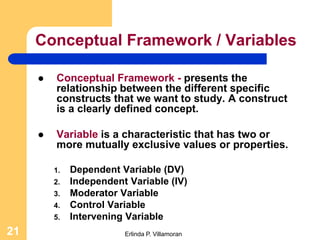
Conceptual Framework / Variables

        Conceptual Framework - presents the
         relationship between the different specific
         constructs that we want to study. A construct
         is a clearly defined concept.

        Variable is a characteristic that has two or
         more mutually exclusive values or properties.

         1.   Dependent Variable (DV)
         2.   Independent Variable (IV)
         3.   Moderator Variable
         4.   Control Variable
         5.   Intervening Variable
21                       Erlinda P. Villamoran
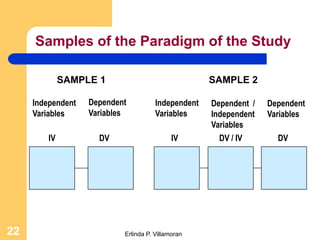
Samples of the Paradigm of the Study

              SAMPLE 1                              SAMPLE 2

     Independent   Dependent          Independent   Dependent /   Dependent
     Variables     Variables          Variables     Independent   Variables
                                                    Variables
         IV          DV                     IV        DV / IV       DV


22                         Erlinda P. Villamoran
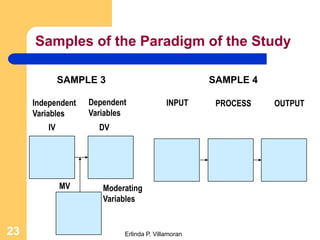
Samples of the Paradigm of the Study

              SAMPLE 3                             SAMPLE 4

     Independent   Dependent              INPUT     PROCESS   OUTPUT
     Variables     Variables
         IV          DV


              MV      Moderating
                      Variables


23                         Erlinda P. Villamoran
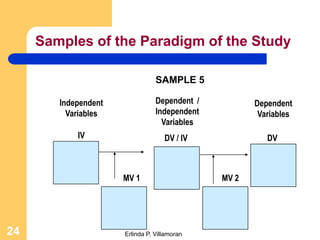
Samples of the Paradigm of the Study

                                 SAMPLE 5

        Independent              Dependent /          Dependent
          Variables              Independent           Variables
                                   Variables
            IV                      DV / IV              DV


                      MV 1                     MV 2


24                    Erlinda P. Villamoran
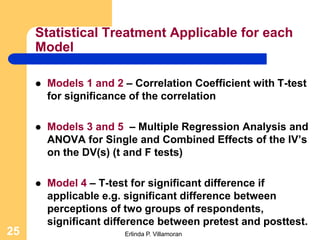
Statistical Treatment Applicable for each
     Model

        Models 1 and 2 – Correlation Coefficient with T-test
         for significance of the correlation

        Models 3 and 5 – Multiple Regression Analysis and
         ANOVA for Single and Combined Effects of the IV’s
         on the DV(s) (t and F tests)

        Model 4 – T-test for significant difference if
         applicable e.g. significant difference between
         perceptions of two groups of respondents,
         significant difference between pretest and posttest.
25                      Erlinda P. Villamoran
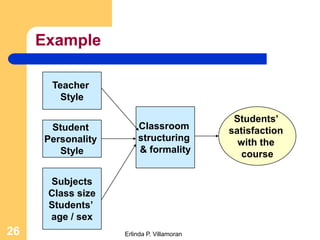
Example

      Teacher
        Style

                                            Students’
      Student          Classroom           satisfaction
     Personality       structuring           with the
        Style          & formality            course

      Subjects
      Class size
      Students’
      age / sex
26                 Erlinda P. Villamoran
Hypothesis
        Hypothesis comes from the Greek prefix “Hypo”
         meaning beneath or underlying, and the Greek word
         “thesis” meaning a proportion or statement that can
         be supported by argument or evidence.

        It is a conjectural statement of the significant
         relationship between two or more variables. It is still
         doubtful and needs to be tested.

         Two types of hypothesis:
         1. Null hypothesis
         2. The alternative or experimental or research
            hypothesis
            a. Non-directional Hypothesis
            b. Directional Hypothesis
27                       Erlinda P. Villamoran
Functions of Hypothesis

     1.   Helps the researcher determine what kind of
          research is to be done and what methodology
          may be used;
     2.   Means of stating assumptions and presenting or
          providing explanations;
     3.   Serves as determinations of the relevancy of
          facts;
     4.   Aids the researcher present the conclusions of
          the study; and
     5.   Provides format for the presentation, analysis and
          interpretation of research data.
     6.   Sources for the formulation of new hypothesis.
     7.   Provides the link between theory and
          observation;
28                     Erlinda P. Villamoran
Research Methodology

        Research Designs
        Methods and Procedures
        Sources of Data
        Data Gathering Instruments
        Procedure
        Statistical Treatment Used
        Collection of Data
         – Primary
         – Secondary


29                   Erlinda P. Villamoran
Sources of Primary Data

     1.   Interview
          a.   Personal Interview
          b.   Telephone Interview
          c.   Interviewing by Mail
     2.   Observation
          a.   Non-Behavioral Observation
               i. Record Analysis
               ii. Physical Condition Analysis
               iii. Physical Process Analysis
          b.   Behavioral Observation
               i.     Non – Verbal Analysis
               ii.    Linguistic Analysis
               iii.   Extra – Linguistic Analysis
               iv.    Spatial Analysis
30                               Erlinda P. Villamoran
Data Processing

         Is a means of converting information either manually or by
          machine. This involves the following phases:

     1.   Data Coding . It is a process of grouping the response to a
          question into categories and assigning numbers, characters,
          and/or other symbols called codes.

     2.   Selecting Appropriate Statistical Method

          Factors to be considered:
          a. Variables – a noun that stands for variation within a class of
             objects.
          b. Relationship of Variables – a statement about variables; two or
             more groups are compared or relationships among variables
             are studied within one group
          c. Measurement of Scales
          d. Sample Size
31                           Erlinda P. Villamoran
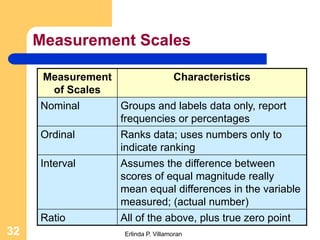
Measurement Scales

      Measurement                    Characteristics
       of Scales
     Nominal        Groups and labels data only, report
                    frequencies or percentages
     Ordinal        Ranks data; uses numbers only to
                    indicate ranking
     Interval       Assumes the difference between
                    scores of equal magnitude really
                    mean equal differences in the variable
                    measured; (actual number)
     Ratio          All of the above, plus true zero point
32                  Erlinda P. Villamoran
Commonly Used Statistical Analyses
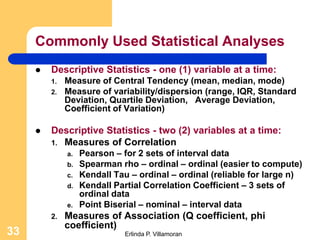
        Descriptive Statistics - one (1) variable at a time:
         1.   Measure of Central Tendency (mean, median, mode)
         2.   Measure of variability/dispersion (range, IQR, Standard
              Deviation, Quartile Deviation, Average Deviation,
              Coefficient of Variation)

        Descriptive Statistics - two (2) variables at a time:
         1. Measures of Correlation
              a.   Pearson – for 2 sets of interval data
              b.   Spearman rho – ordinal – ordinal (easier to compute)
              c.   Kendall Tau – ordinal – ordinal (reliable for large n)
              d.   Kendall Partial Correlation Coefficient – 3 sets of
                   ordinal data
              e.   Point Biserial – nominal – interval data
         2.   Measures of Association (Q coefficient, phi
              coefficient)
33                            Erlinda P. Villamoran
Commonly Used Statistical Analyses

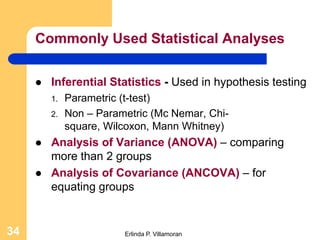
        Inferential Statistics - Used in hypothesis testing
         1.   Parametric (t-test)
         2.   Non – Parametric (Mc Nemar, Chi-
              square, Wilcoxon, Mann Whitney)
        Analysis of Variance (ANOVA) – comparing
         more than 2 groups
        Analysis of Covariance (ANCOVA) – for
         equating groups


34                       Erlinda P. Villamoran
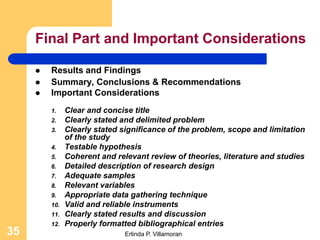
Final Part and Important Considerations

        Results and Findings
        Summary, Conclusions & Recommendations
        Important Considerations
         1.    Clear and concise title
         2.    Clearly stated and delimited problem
         3.    Clearly stated significance of the problem, scope and limitation
               of the study
         4.    Testable hypothesis
         5.    Coherent and relevant review of theories, literature and studies
         6.    Detailed description of research design
         7.    Adequate samples
         8.    Relevant variables
         9.    Appropriate data gathering technique
         10.   Valid and reliable instruments
         11.   Clearly stated results and discussion
         12.   Properly formatted bibliographical entries
35                             Erlinda P. Villamoran
Designing Research Instruments


     A. Observation Checklist Guidelines

     1.  Enumerate (list down) the dimensions (factors) to be observed
     2.  Define them very clearly. (What they are exactly)
     3.  Eliminate those that are vague or repetitive.
     4.  Arrange them on a sheet of paper in a manner most convenient
         for observing and recording.
     5. Include space for identifying data.
     6. Try out form. (This is called a dry run)
     7. Revise the form on the basis of the try out and your experience.
     8. Write the checklist in its final form.


36                        Erlinda P. Villamoran
B. Guidelines in the Formulation of questions
        for a Questionnaire
     1. Make all directions clear and unequivocal
     2. Use correct grammar
     3. Make all questions unequivocal
     4. Avoid asking biases questions
     5. Objective responses
     6. Relate all questions to the topic under study
     7. Create categories or classes for approximate
     8. Group the questions in logical
     9. Create sufficient number of response categories
     10. Word carefully or avoid questions that deal with confidential or
         embarrassing information
     11. Explain and illustrate difficult questions
     12. State all questions affirmatively
     13. Makes as many questions as would supply adequate information
         for the study
     14. Add a catch-all word or phrase to options of multiple response questions
     15. Place all spaces for relies at the left side
     16. Make the respondents anonymous
37                          Erlinda P. Villamoran
Sample of Bibliographical Entries
                    BIBLIOGRAPHY

                         A. BOOKS
     Alano, Patricio, Management of Human Behavior in
      Organizations, Manila, National Bookstore, 1992.

       Baldwin, R. G., Incentives for Faculty Vitality, San
          Francisco Publishing House: London, 1985

               B.JOURNAL AND PERIODICALS
      Putman, J.J. “Quicksilver and Slow Death” National
                      Geographic, 1972.
       Waldichuck, M. “Lead in the Environment” Marine
                    Pollution Bulletin, 1980

                  C. UNPUBLISHED MATERIALS
       Alcala, D., “Personality Dimensions and Status of
     Elementary School Principals as Related to their level
        Of Job Satisfaction in the Division of Quezon”.
          (Unpublished Masteral Thesis, PNC, 1988.)
38                     Erlinda P. Villamoran

(THESIS) Uplifting Science & research2

  • 1.
    UPLIFTING SCIENCE, TECHNOLOGY, AND RESEARCH College of Law, Bulacan State University, City of Malolos, Bulacan May 4,, 2005, 8:00 a.m ERLINDA P. VILLAMORAN, Ph. D Director, Research Services Office Professor, Graduate School and College of Education Bulacan State University Malolos, Bulacan 3000
  • 2.
    Focus of Discussion 1 Overview of Basic Concepts  Scientific Method  Steps in the Research Process – Identification of Problem – Theoretical Framework – Research Designs and Methods – Presentation, Analyses, and Interpretation of Data – Summary, Conclusions, and Recommendations  Rules to Follow in Research Writing 2 Erlinda P. Villamoran
  • 3.
    2 Workshop Topics 1. Problem Identification 2. Definition of the General and Specific Problems 3. Preparation of the Conceptual Framework Based on the Identified Problems 3.1 Paradigm of the Study 3.2 Hypothesis of the Study 3.3 Definition of Terms 4. Presentation, Analysis and Interpretation of Mock Data III Presentation of Outputs [(4.1), (4.2), (4.3), (4.4), (4.5)] IV Critiquing of Outputs 3 Erlinda P. Villamoran
  • 4.
    Scientific Research  Scientific research is a systematic, controlled, empirical, and critical investigation of natural phenomena guided by theory and hypotheses about the presumed relations among such phenomena. 4 Erlinda P. Villamoran
  • 5.
    Paradigm of Inquiryin Scientific Approach 1. Problem-Obstacle-Idea – involves getting the idea out in the open and expressing the problem in some reasonably manageable form 2. Hypothesis - a conjectural statement, a tentative proposition about the relation between two or more phenomena or variables 3. Reasoning-Deduction - the scientist deduces the consequences of the hypothesis he has formulated 4. Observation-Test-Experiment - is only part of the scientific enterprise. If the problem has been well stated, the hypothesis or hypotheses adequately formulated, and the implications of the hypotheses carefully deduced, this step is almost automatic assuming that the investigator is technically competent. 5 Erlinda P. Villamoran
  • 6.
    General Order ofthe Scientific Methods  Identification of a problem  Definition of the problem  Formulation of hypotheses  Projection of consequences  Testing of hypotheses 6 Erlinda P. Villamoran
  • 7.
    Steps in theResearch Process  Identifying a Problem  Theoretical Framework 2.1 Theory Building 2.2 Review of Related Studies 2.3 Review of Related Literature 2.4 Conceptual Framework 2.5 Constructing Hypotheses 2.6 Identifying, Labeling and Controlling Variables 2.7 Definition of Terms 7 Erlinda P. Villamoran
  • 8.
    Steps in theResearch Process  Research Designs and Methods 3.1 Basic Research Designs 3.2 Sampling Procedure 3.3 The Collection of Data 3.4 Selecting Appropriate Statistical Technique  Presentation, Analysis and Interpretation of Data  Summary, Conclusions and Recommendations 8 Erlinda P. Villamoran
  • 9.
    Classification of Research  Research as a formal, systematic and intensive process of scientific investigation is always directed toward the solution of a problem Basic Research - it develops or enhances theories Applied research - it tests theories and evaluate their usefulness in solving actual problem situations in order to improve a product or process. Action Research - Applied research which is focused on immediate application. 9 Erlinda P. Villamoran
  • 10.
    Sources of aResearch Problem  Experience and observations.  The vast amount of literature in your own field.  Courses that you have taken.  Journals, books, magazines, or abstracts.  Theses and Dissertation.  Your Professor and Your Classmates. 10 Erlinda P. Villamoran
  • 11.
    Elements of aResearch Problem  Aim or purpose of the problem for investigation.  The subject matter or topic to be investigated.  The place or locale where the research is to be conducted.  The period or time of study during which data are to be gathered.  Population or universe from whom data are to be collected. 11 Erlinda P. Villamoran
  • 12.
    Criteria in theSelection of a Research Problem  Novelty and avoidance of unnecessary duplication.  Significance for the field represented and implementation.  Interest, intellectual, curiosity, and drive.  Sponsorship and administrative cooperation.  Cost and returns.  Time factor.  Training and personal qualification.  Availability of data or method.  Special equipment and working conditions. 12 Erlinda P. Villamoran
  • 13.
    Guidelines in theSelection of a Research Problem  The research problem or topic must be chosen by the researcher himself.  It must be within the interest of the researcher.  It must be within the specification of the researcher.  It must be within the competence of the researcher to tackle.  It must be within the ability of the researcher to finance.  It is researchable and manageable. 13 Erlinda P. Villamoran
  • 14.
    Selecting a ResearchProblem  Analyzing the research problem.  Identifying the variable.  Stating the problem.  Evaluating the problem.  Setting up of a sub-problem.  Presentation of the problem. 14 Erlinda P. Villamoran
  • 15.
    Criteria of Problemsand Problem Statement 1. The problem should express a relation between two or more variables. It asks, in effect, questions like is A related to B? How are A and B related to C? How is A related to B under conditions C and D? 2. The problem should be stated clearly and unambiguously in question form. Instead of saying for instance, “The problem is . . . ,” or “The purpose of this study is …,” ask a question. 3. The problem and the problem statement should be such as to imply possibilities of empirical testing 15 Erlinda P. Villamoran
  • 16.
    Significance of theStudy  Rational, timeliness and/or relevance of the study should be clearly stated;  Contribution to the accumulation of knowledge, or to filling up a knowledge or gap;  Contribution to building, validating or refining prevailing theories;  Contribution to meeting a pressing need of a specific group like solving a problem or improving certain conditions; possible implications and;  Contribution to refining concepts, improving research instrumentation and methodologies. 16 Erlinda P. Villamoran
  • 17.
    Scope/Limitations of theStudy  Scope defines the coverage or boundary of the study in terms of the area or locality and subjects or population covered, the duration or period of the study and the research issues are focused.  Limitations are statements which alert the reader of the research report to certain constraints over which the researcher has no control. It also defines the conditions beyond the control of the researcher that may place restrictions on the conclusions of the study and their application or other situations. 17 Erlinda P. Villamoran
  • 18.
    Theoretical Framework Relevant Theory  A theory is a set of interrelated constructs (concepts), definitions and propositions that present a systematic view of phenomena by specifying relations among variables, with the purpose of explaining and predicting the phenomena  Sources of theories: – Research literature and the conceptual writings in a discipline – If a theory did exist or was not well developed, one could conceptualize a theory based on a logical analysis of prior research applied to the phenomenon under study. 18 Erlinda P. Villamoran
  • 19.
    Theoretical Framework Role of Theory in Research 1. Provides a framework by serving as the point departure for the pursuit of a research problem 2. The theory identifies the crucial factors 3. It provides a guide for systematizing and interrelating the various facets of the research. 4. It helps identify gaps and weak points 5. Theory may light the way for continued research on the phenomena under study 19 Erlinda P. Villamoran
  • 20.
    Theoretical Framework Related Literature and Studies  Involves the systematic identification, location and analysis of documents containing information on the research problem  Literature refers to the writings of a country or books dealing with a special subject valued as works of arts like drama, fiction, essays, .. etc.”, therefore all written material or article can be called as literature.  Related studies are investigations that are usually published materials like manuscript, theses, and dissertations which are conducted previously to which the present study had similarity and relatedness. 20 Erlinda P. Villamoran
  • 21.
    Conceptual Framework /Variables  Conceptual Framework - presents the relationship between the different specific constructs that we want to study. A construct is a clearly defined concept.  Variable is a characteristic that has two or more mutually exclusive values or properties. 1. Dependent Variable (DV) 2. Independent Variable (IV) 3. Moderator Variable 4. Control Variable 5. Intervening Variable 21 Erlinda P. Villamoran
  • 22.
    Samples of theParadigm of the Study SAMPLE 1 SAMPLE 2 Independent Dependent Independent Dependent / Dependent Variables Variables Variables Independent Variables Variables IV DV IV DV / IV DV 22 Erlinda P. Villamoran
  • 23.
    Samples of theParadigm of the Study SAMPLE 3 SAMPLE 4 Independent Dependent INPUT PROCESS OUTPUT Variables Variables IV DV MV Moderating Variables 23 Erlinda P. Villamoran
  • 24.
    Samples of theParadigm of the Study SAMPLE 5 Independent Dependent / Dependent Variables Independent Variables Variables IV DV / IV DV MV 1 MV 2 24 Erlinda P. Villamoran
  • 25.
    Statistical Treatment Applicablefor each Model  Models 1 and 2 – Correlation Coefficient with T-test for significance of the correlation  Models 3 and 5 – Multiple Regression Analysis and ANOVA for Single and Combined Effects of the IV’s on the DV(s) (t and F tests)  Model 4 – T-test for significant difference if applicable e.g. significant difference between perceptions of two groups of respondents, significant difference between pretest and posttest. 25 Erlinda P. Villamoran
  • 26.
    Example Teacher Style Students’ Student Classroom satisfaction Personality structuring with the Style & formality course Subjects Class size Students’ age / sex 26 Erlinda P. Villamoran
  • 27.
    Hypothesis  Hypothesis comes from the Greek prefix “Hypo” meaning beneath or underlying, and the Greek word “thesis” meaning a proportion or statement that can be supported by argument or evidence.  It is a conjectural statement of the significant relationship between two or more variables. It is still doubtful and needs to be tested.  Two types of hypothesis: 1. Null hypothesis 2. The alternative or experimental or research hypothesis a. Non-directional Hypothesis b. Directional Hypothesis 27 Erlinda P. Villamoran
  • 28.
    Functions of Hypothesis 1. Helps the researcher determine what kind of research is to be done and what methodology may be used; 2. Means of stating assumptions and presenting or providing explanations; 3. Serves as determinations of the relevancy of facts; 4. Aids the researcher present the conclusions of the study; and 5. Provides format for the presentation, analysis and interpretation of research data. 6. Sources for the formulation of new hypothesis. 7. Provides the link between theory and observation; 28 Erlinda P. Villamoran
  • 29.
    Research Methodology  Research Designs  Methods and Procedures  Sources of Data  Data Gathering Instruments  Procedure  Statistical Treatment Used  Collection of Data – Primary – Secondary 29 Erlinda P. Villamoran
  • 30.
    Sources of PrimaryData 1. Interview a. Personal Interview b. Telephone Interview c. Interviewing by Mail 2. Observation a. Non-Behavioral Observation i. Record Analysis ii. Physical Condition Analysis iii. Physical Process Analysis b. Behavioral Observation i. Non – Verbal Analysis ii. Linguistic Analysis iii. Extra – Linguistic Analysis iv. Spatial Analysis 30 Erlinda P. Villamoran
  • 31.
    Data Processing  Is a means of converting information either manually or by machine. This involves the following phases: 1. Data Coding . It is a process of grouping the response to a question into categories and assigning numbers, characters, and/or other symbols called codes. 2. Selecting Appropriate Statistical Method Factors to be considered: a. Variables – a noun that stands for variation within a class of objects. b. Relationship of Variables – a statement about variables; two or more groups are compared or relationships among variables are studied within one group c. Measurement of Scales d. Sample Size 31 Erlinda P. Villamoran
  • 32.
    Measurement Scales Measurement Characteristics of Scales Nominal Groups and labels data only, report frequencies or percentages Ordinal Ranks data; uses numbers only to indicate ranking Interval Assumes the difference between scores of equal magnitude really mean equal differences in the variable measured; (actual number) Ratio All of the above, plus true zero point 32 Erlinda P. Villamoran
  • 33.
    Commonly Used StatisticalAnalyses  Descriptive Statistics - one (1) variable at a time: 1. Measure of Central Tendency (mean, median, mode) 2. Measure of variability/dispersion (range, IQR, Standard Deviation, Quartile Deviation, Average Deviation, Coefficient of Variation)  Descriptive Statistics - two (2) variables at a time: 1. Measures of Correlation a. Pearson – for 2 sets of interval data b. Spearman rho – ordinal – ordinal (easier to compute) c. Kendall Tau – ordinal – ordinal (reliable for large n) d. Kendall Partial Correlation Coefficient – 3 sets of ordinal data e. Point Biserial – nominal – interval data 2. Measures of Association (Q coefficient, phi coefficient) 33 Erlinda P. Villamoran
  • 34.
    Commonly Used StatisticalAnalyses  Inferential Statistics - Used in hypothesis testing 1. Parametric (t-test) 2. Non – Parametric (Mc Nemar, Chi- square, Wilcoxon, Mann Whitney)  Analysis of Variance (ANOVA) – comparing more than 2 groups  Analysis of Covariance (ANCOVA) – for equating groups 34 Erlinda P. Villamoran
  • 35.
    Final Part andImportant Considerations  Results and Findings  Summary, Conclusions & Recommendations  Important Considerations 1. Clear and concise title 2. Clearly stated and delimited problem 3. Clearly stated significance of the problem, scope and limitation of the study 4. Testable hypothesis 5. Coherent and relevant review of theories, literature and studies 6. Detailed description of research design 7. Adequate samples 8. Relevant variables 9. Appropriate data gathering technique 10. Valid and reliable instruments 11. Clearly stated results and discussion 12. Properly formatted bibliographical entries 35 Erlinda P. Villamoran
  • 36.
    Designing Research Instruments A. Observation Checklist Guidelines 1. Enumerate (list down) the dimensions (factors) to be observed 2. Define them very clearly. (What they are exactly) 3. Eliminate those that are vague or repetitive. 4. Arrange them on a sheet of paper in a manner most convenient for observing and recording. 5. Include space for identifying data. 6. Try out form. (This is called a dry run) 7. Revise the form on the basis of the try out and your experience. 8. Write the checklist in its final form. 36 Erlinda P. Villamoran
  • 37.
    B. Guidelines inthe Formulation of questions for a Questionnaire 1. Make all directions clear and unequivocal 2. Use correct grammar 3. Make all questions unequivocal 4. Avoid asking biases questions 5. Objective responses 6. Relate all questions to the topic under study 7. Create categories or classes for approximate 8. Group the questions in logical 9. Create sufficient number of response categories 10. Word carefully or avoid questions that deal with confidential or embarrassing information 11. Explain and illustrate difficult questions 12. State all questions affirmatively 13. Makes as many questions as would supply adequate information for the study 14. Add a catch-all word or phrase to options of multiple response questions 15. Place all spaces for relies at the left side 16. Make the respondents anonymous 37 Erlinda P. Villamoran
  • 38.
    Sample of BibliographicalEntries BIBLIOGRAPHY A. BOOKS Alano, Patricio, Management of Human Behavior in Organizations, Manila, National Bookstore, 1992. Baldwin, R. G., Incentives for Faculty Vitality, San Francisco Publishing House: London, 1985 B.JOURNAL AND PERIODICALS Putman, J.J. “Quicksilver and Slow Death” National Geographic, 1972. Waldichuck, M. “Lead in the Environment” Marine Pollution Bulletin, 1980 C. UNPUBLISHED MATERIALS Alcala, D., “Personality Dimensions and Status of Elementary School Principals as Related to their level Of Job Satisfaction in the Division of Quezon”. (Unpublished Masteral Thesis, PNC, 1988.) 38 Erlinda P. Villamoran