
Writing an Effective
Research Proposal
Submitted By
Prajakta Naxane (15)
Ruchi Agrawal(16)
Ujwala Ninawe(17)
Sonal Pannase(20)
Preliminary Remarks
 Status of Current Research
 Quantity
 Quality
 Reasons – Research Skills
 Language
 Analytical Skills
− Philosophy
− Logic
 Statistics
 Communication skills
 Research Teams
 Research Support Lab
Familiarity with Statistics
Basic Rules
1. Always consult a qualified statistician – Very early
2. Know enough about statistics to be able to view the advice
critically
3. Understand the process of analysis
Essential Characteristic of a Researcher
?
Some Basic Ideas
Question
Doubt
Confidence
Four Questions
What data / evidence do I need?
What will be the source of that data / evidence?
How will I collect that data / evidence?
How will I analyze that data / evidence?
Terms Used
Proposal
Synopsis
Prospectus
Research Proposal – Definitions - 1
“… the meaning of proposal … suggests looking forward, to what the
researcher plans to do in the future. … The proposal lays out the
problem for research, describes exactly how the research will be
conducted, and outlines in precise detail the resources – both factual and
instrumental – the researcher will use to achieve the desired results.”
Research Proposal – Definitions - 2
“A research proposal is a document that describes the essential features
of a study to be conducted in the future, as well as the strategy whereby
the inquiry may be logically and successfully accomplished.”
Research Proposal - Definitions - 3
“The academic research proposal is a structured presentation of what
you plan to do in research and how you plan to do it.”
Research Proposal – Main Elements
• An outline of the research problem
• A statement of the significance of the problem
• A review of related studies
• A discussion of the procedures
• Methods for data collection and analysis
• A note about the study’s limitations
Components of a Research Proposal
• Title of the proposal
• Background of the problem
• Statement of the problem
• Research objectives, questions, hypotheses
• Significance of the study
• Review of related literature
• Definition of terms
• Delimitations and limitations
• Research methods and procedures
• Expected results
• Preliminary working bibliography
Writing an introduction or background
The deficiencies model of an ‘introduction’ is a general template for
writing a good introduction that consists of five parts.
• The research Problem
• Studies that have addressed the problem
• Deficiencies in the studies
• The significance of the study for particular audiences
• The purpose statement
Potential Sources of Research Problems - 1
• Scanning and reading published and unpublished research
• Disagreeing with some previous research and developing a new study to
test its findings
• Gaps in explanations or in accepted principles
• Questioning the validity of a generally accepted procedure
• Replication – Redoing the same thing with an expectation of the same
result
Potential Sources of Research Problems - 2
• Designing and developing of new research tools and techniques
• Developing new models
• Studying areas where knowledge or information is scarce, out-of-date,
or indefinite
• Attempting to deal with actual problems
• Networking or sharing ideas and information with colleagues
• Interdisciplinary research – Cross fertilization
Functions of the Statement of the Problem
• Establishes the existence of a unique problem
• Relates the problem to its general antecedents
• Suggests the benefits to be derived from the study
• Justifies the utility, significance, or interest inherent in the pursuit of the
problems
Attributes Associated with the Statement of the Problem –
Top Nine
• Clarity and precision
• Identification of what to study
• Identification of an overarching question
• Definition of key concepts / terms
• Articulation of study’s boundaries / parameters
• Some generalizability
• Conveyance of study’s importance, benefits, and justification
• No use of unnecessary jargon
• Conveyance of more than descriptive data providing a “snapshot”
Components of the Problem Statement
Any problem statement should contain four elements:
• A lead-in [narrative hook]
• Declaration of originality (mentioning a knowledge void which would be
supported by the literature review
• Indication of the central focus of the study (purpose statement); and
• Explanation of study significance or benefits to be derived from an
investigation of the problem (Rationale or justification of the study)
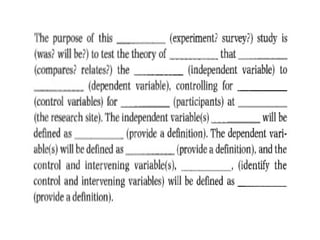
Writing a Purpose statement - Guidelines
• Begin with signaling words such as “the purpose or intent of”
• Indicate the overall intent of the study such as “the intent is to examine the
role of school teacher in promoting reading habit”
• Indicate the research design and strategy such as survey, experiment, etc.
• Identify the independent and / or dependent variables. Use words that
connect the variables such as “the relationship between” or “the
comparison of” two or more variables
• Position or order the variables from left to right in purpose statement with
independent variable followed by the dependent variable
• Make reference to the participant (unit of analysis) and mention the
research site
Research Objectives, Questions, Hypotheses
• Emerge from the Statement of the Problem
• How the research problem is to be prepared to be approached
methodologically
• A precise and formal statement
• Wording of considerable importance
Significance of the Study
• Why this study is significant?
• Why do it now?
• What will it contribute to the existing research literature?
• What implications your findings may have?
• Who will benefit from it?
Review of Related Literature – Important Information
• Information concerning theory – findings
• Information concerning methods
• Information concerning data analysis
• Strengths and weaknesses
Purposes of Literature Review - 1
• Familiarity with the field of inquiry
• Provides a context for the proposed study
• Generation of research questions or hypotheses for further
studies
• Knowledge of the methodologies common to the field can reveal
sources of data that you may not have known existed
• Demonstrates why it is important and timely
• To avoid or solve problems others have encountered in their research
(Limitations)
• Increase your confidence in your topic because others have invested
considerable time, effort, and resources in studying it
Steps in Conducting Literature Review - 1
1. Identify a research topic
2. Identify keywords/descriptors that are useful in locating relevant
information material
3. Develop an overall search strategy for the literature review
4. Search preliminary sources
5. Select relevant primary and secondary sources
6. Search the library for identified primary and secondary sources. Establish
a computer and paper trail including research summaries in your own
words that will be used in the literature review
Steps in Conducting Literature Review - 2
8. Repeat step 4–7 as needed to refine search
9. Develop themes/concepts that synthesize the literature
10. Relate the themes/concepts to one another through an outline of the
literature review, or a literature map
11. Produce a final literature review that structures or organizes the literature
thematically or by important concepts
12. Use the literature review to develop or refine the research objectives,
questions, and hypothesis
Definition of Terms
• Variety and location
• Operational definition of all the major concepts to be employed in the
study
• Should cover all the essential terms in the Statement of the Problem and
the Research Objectives, Questions, Hypotheses
• These definitions will establish the basis for the objective tests for the
outcomes of the proposed study
Delimitations and Limitations
• Establish the boundaries, exceptions, qualifications, and reservations
• Delimitations - Before
 How the study will be narrowed in scope
 Controlled by the researcher
• Limitations – Before and After
 Factors that will affect the study
 Not controlled by the researcher
• Should appear when imposed by the nature of the problem
Research Methods and Procedures – Main Decisions
• Method
• Population / Sample to be studied
• Instrumentation
• Data collection procedures
• Data analysis
Selecting the Research Design
• True experimental design
• Quasi-experimental design
• Non-experimental design
• Historical design
Preliminary Working Bibliography
• Materials cited in the proposal
• Quality, not quantity
• Full bibliographical details
• Style of citation
Thank You

Research proposal

  • 1.
    Writing an Effective ResearchProposal Submitted By Prajakta Naxane (15) Ruchi Agrawal(16) Ujwala Ninawe(17) Sonal Pannase(20)
  • 2.
    Preliminary Remarks  Statusof Current Research  Quantity  Quality  Reasons – Research Skills  Language  Analytical Skills − Philosophy − Logic  Statistics  Communication skills  Research Teams  Research Support Lab
  • 3.
    Familiarity with Statistics BasicRules 1. Always consult a qualified statistician – Very early 2. Know enough about statistics to be able to view the advice critically 3. Understand the process of analysis
  • 4.
  • 5.
    Some Basic Ideas Question Doubt Confidence FourQuestions What data / evidence do I need? What will be the source of that data / evidence? How will I collect that data / evidence? How will I analyze that data / evidence?
  • 6.
  • 7.
    Research Proposal –Definitions - 1 “… the meaning of proposal … suggests looking forward, to what the researcher plans to do in the future. … The proposal lays out the problem for research, describes exactly how the research will be conducted, and outlines in precise detail the resources – both factual and instrumental – the researcher will use to achieve the desired results.”
  • 8.
    Research Proposal –Definitions - 2 “A research proposal is a document that describes the essential features of a study to be conducted in the future, as well as the strategy whereby the inquiry may be logically and successfully accomplished.”
  • 9.
    Research Proposal -Definitions - 3 “The academic research proposal is a structured presentation of what you plan to do in research and how you plan to do it.”
  • 10.
    Research Proposal –Main Elements • An outline of the research problem • A statement of the significance of the problem • A review of related studies • A discussion of the procedures • Methods for data collection and analysis • A note about the study’s limitations
  • 11.
    Components of aResearch Proposal • Title of the proposal • Background of the problem • Statement of the problem • Research objectives, questions, hypotheses • Significance of the study • Review of related literature • Definition of terms • Delimitations and limitations • Research methods and procedures • Expected results • Preliminary working bibliography
  • 13.
    Writing an introductionor background The deficiencies model of an ‘introduction’ is a general template for writing a good introduction that consists of five parts. • The research Problem • Studies that have addressed the problem • Deficiencies in the studies • The significance of the study for particular audiences • The purpose statement
  • 14.
    Potential Sources ofResearch Problems - 1 • Scanning and reading published and unpublished research • Disagreeing with some previous research and developing a new study to test its findings • Gaps in explanations or in accepted principles • Questioning the validity of a generally accepted procedure • Replication – Redoing the same thing with an expectation of the same result
  • 15.
    Potential Sources ofResearch Problems - 2 • Designing and developing of new research tools and techniques • Developing new models • Studying areas where knowledge or information is scarce, out-of-date, or indefinite • Attempting to deal with actual problems • Networking or sharing ideas and information with colleagues • Interdisciplinary research – Cross fertilization
  • 16.
    Functions of theStatement of the Problem • Establishes the existence of a unique problem • Relates the problem to its general antecedents • Suggests the benefits to be derived from the study • Justifies the utility, significance, or interest inherent in the pursuit of the problems
  • 17.
    Attributes Associated withthe Statement of the Problem – Top Nine • Clarity and precision • Identification of what to study • Identification of an overarching question • Definition of key concepts / terms • Articulation of study’s boundaries / parameters • Some generalizability • Conveyance of study’s importance, benefits, and justification • No use of unnecessary jargon • Conveyance of more than descriptive data providing a “snapshot”
  • 18.
    Components of theProblem Statement Any problem statement should contain four elements: • A lead-in [narrative hook] • Declaration of originality (mentioning a knowledge void which would be supported by the literature review • Indication of the central focus of the study (purpose statement); and • Explanation of study significance or benefits to be derived from an investigation of the problem (Rationale or justification of the study)
  • 19.
    Writing a Purposestatement - Guidelines • Begin with signaling words such as “the purpose or intent of” • Indicate the overall intent of the study such as “the intent is to examine the role of school teacher in promoting reading habit” • Indicate the research design and strategy such as survey, experiment, etc. • Identify the independent and / or dependent variables. Use words that connect the variables such as “the relationship between” or “the comparison of” two or more variables • Position or order the variables from left to right in purpose statement with independent variable followed by the dependent variable • Make reference to the participant (unit of analysis) and mention the research site
  • 21.
    Research Objectives, Questions,Hypotheses • Emerge from the Statement of the Problem • How the research problem is to be prepared to be approached methodologically • A precise and formal statement • Wording of considerable importance
  • 22.
    Significance of theStudy • Why this study is significant? • Why do it now? • What will it contribute to the existing research literature? • What implications your findings may have? • Who will benefit from it?
  • 23.
    Review of RelatedLiterature – Important Information • Information concerning theory – findings • Information concerning methods • Information concerning data analysis • Strengths and weaknesses
  • 24.
    Purposes of LiteratureReview - 1 • Familiarity with the field of inquiry • Provides a context for the proposed study • Generation of research questions or hypotheses for further studies • Knowledge of the methodologies common to the field can reveal sources of data that you may not have known existed • Demonstrates why it is important and timely • To avoid or solve problems others have encountered in their research (Limitations) • Increase your confidence in your topic because others have invested considerable time, effort, and resources in studying it
  • 25.
    Steps in ConductingLiterature Review - 1 1. Identify a research topic 2. Identify keywords/descriptors that are useful in locating relevant information material 3. Develop an overall search strategy for the literature review 4. Search preliminary sources 5. Select relevant primary and secondary sources 6. Search the library for identified primary and secondary sources. Establish a computer and paper trail including research summaries in your own words that will be used in the literature review
  • 26.
    Steps in ConductingLiterature Review - 2 8. Repeat step 4–7 as needed to refine search 9. Develop themes/concepts that synthesize the literature 10. Relate the themes/concepts to one another through an outline of the literature review, or a literature map 11. Produce a final literature review that structures or organizes the literature thematically or by important concepts 12. Use the literature review to develop or refine the research objectives, questions, and hypothesis
  • 27.
    Definition of Terms •Variety and location • Operational definition of all the major concepts to be employed in the study • Should cover all the essential terms in the Statement of the Problem and the Research Objectives, Questions, Hypotheses • These definitions will establish the basis for the objective tests for the outcomes of the proposed study
  • 28.
    Delimitations and Limitations •Establish the boundaries, exceptions, qualifications, and reservations • Delimitations - Before  How the study will be narrowed in scope  Controlled by the researcher • Limitations – Before and After  Factors that will affect the study  Not controlled by the researcher • Should appear when imposed by the nature of the problem
  • 29.
    Research Methods andProcedures – Main Decisions • Method • Population / Sample to be studied • Instrumentation • Data collection procedures • Data analysis
  • 30.
    Selecting the ResearchDesign • True experimental design • Quasi-experimental design • Non-experimental design • Historical design
  • 31.
    Preliminary Working Bibliography •Materials cited in the proposal • Quality, not quantity • Full bibliographical details • Style of citation
  • 32.