
ML Fundamentals: Session 3
Unsupervised Learning with scikit-learn
Alia Hamwi
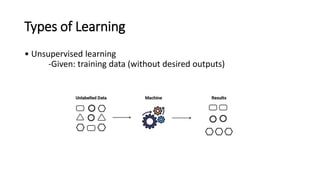
Types of Learning
• Unsupervised learning
-Given: training data (without desired outputs)
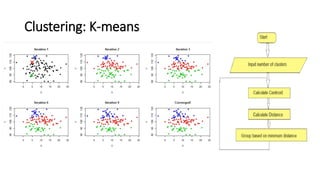
Clustering: K-means
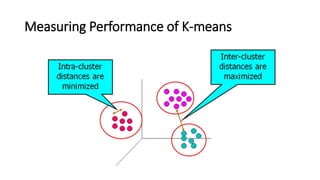
Measuring Performance of K-means
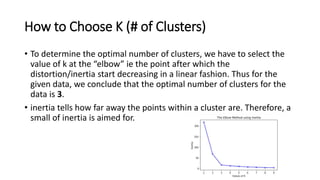
How to Choose K (# of Clusters)
• To determine the optimal number of clusters, we have to select the
value of k at the “elbow” ie the point after which the
distortion/inertia start decreasing in a linear fashion. Thus for the
given data, we conclude that the optimal number of clusters for the
data is 3.
• inertia tells how far away the points within a cluster are. Therefore, a
small of inertia is aimed for.
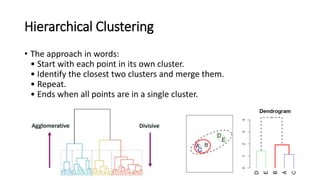
Hierarchical Clustering
• The approach in words:
• Start with each point in its own cluster.
• Identify the closest two clusters and merge them.
• Repeat.
• Ends when all points are in a single cluster.
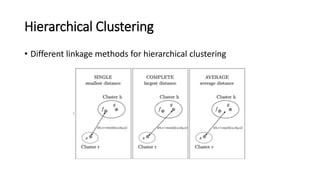
Hierarchical Clustering
• Different linkage methods for hierarchical clustering
Principal component analysis (PCA)
• PCA produces a low-dimensional representation of a
dataset. It finds a sequence of linear combinations of the
variables that have maximal variance, and are mutually
uncorrelated
• Apart from producing derived variables for use in
supervised learning problems, PCA also serves as a tool for
data visualization.
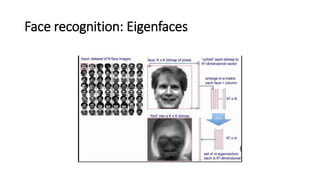
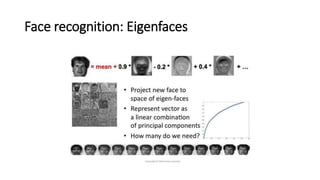
Face recognition: Eigenfaces
Non-negative Matrix-Factorization
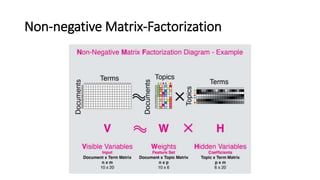
• In the example above, the Topics (p) are set to 6. Each column of the W
matrix represents a probability that the topic is in the document. Each
row of the W matrix represents a distribution of topic frequencies in
each Document. Each row of the H matrix represent the distribution of
term frequencies in each topic, and can be seen as the degree to which
each term is activated in each topic.
References
• https://towardsdatascience.com/nmf-a-visual-explainer-and-python-implemen
tation-7ecdd73491f8
• https://www.pyimagesearch.com/2021/05/10/opencv-eigenfaces-for-face-
recognition/
Thank You

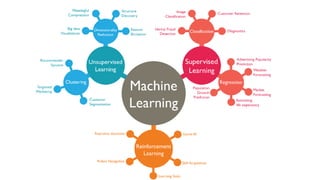
Unsupervised Learning