COMPONENTS OF MULTI COPTER DRONE
 FLIGHT CONTROLLER
 BATTERY
 BLDC MOTOR
 ELECTRONIC SPEED CONTROLLER
 POWER MODULE
 PROPELLERS
 POWER DISTRIBUTION BOARD
 GPS
 LANDING GEAR
 TRANSMITTER AND RECEIVER
 TELEMETRY
 PUMP MOTOR
 NOZZLE
 TANK
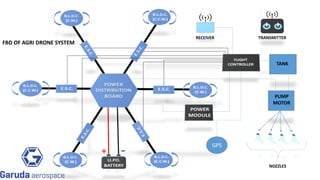
 BLOCK DIAGRAM
TRANSMITTER
RECEIVER
NOZZLES
TANK
PUMP
MOTOR
GPS
FBD OF AGRI DRONE SYSTEM
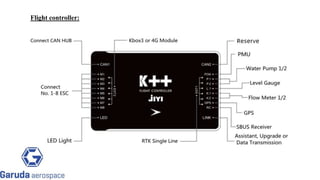
Flight controller:
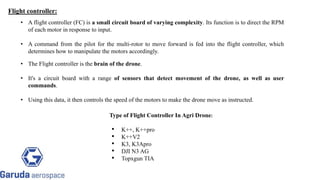
• A flight controller (FC) is a small circuit board of varying complexity. Its function is to direct the RPM
of each motor in response to input.
• A command from the pilot for the multi-rotor to move forward is fed into the flight controller, which
determines how to manipulate the motors accordingly.
• The Flight controller is the brain of the drone.
• It's a circuit board with a range of sensors that detect movement of the drone, as well as user
commands.
• Using this data, it then controls the speed of the motors to make the drone move as instructed.
Type of Flight Controller In Agri Drone:
• K++, K++pro
• K++V2
• K3, K3Apro
• DJI N3 AG
• Topxgun TIA
Flight controller:
Above mentioned types, We use the K++ type Flight Controller because:
K++ flight control is specially designed for Agricultural sprayer drones. It has a variety of modes and exclusive
functions for Agriculture spraying drones.
It supports manual, semi-autonomous (A-B) and autonomous flight. It can monitor drug flow in real time and
intelligently match the spray volume to achieve precise
Diverse Operating Mode for a variety of operating environments
K++ built-in fixed height mode, GPS - speed mode and other operating modes, easy to operate, flexible
switching, free to change operating modes according to different operating environments, to meet the needs of
agriculture spraying requirement.
Return to block
diagram
Return to block
diagram
Flight controller:
Battery:
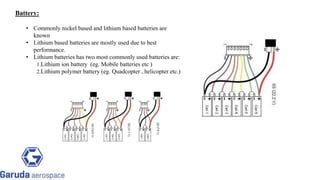
• Commonly nickel based and lithium based batteries are
known
• Lithium based batteries are mostly used due to best
performance.
• Lithium batteries has two most commonly used batteries are:
1.Lithium ion battery (eg. Mobile batteries etc )
2.Lithium polymer battery (eg. Quadcopter , helicopter etc.)
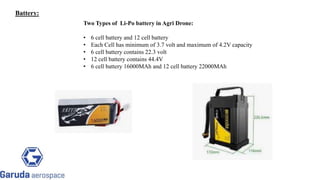
Two Types of Li-Po battery in Agri Drone:
• 6 cell battery and 12 cell battery
• Each Cell has minimum of 3.7 volt and maximum of 4.2V capacity
• 6 cell battery contains 22.3 volt
• 12 cell battery contains 44.4V
• 6 cell battery 16000MAh and 12 cell battery 22000MAh
Battery:
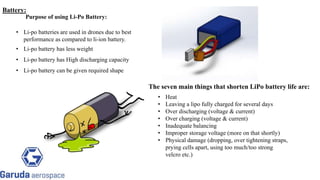
The seven main things that shorten LiPo battery life are:
• Li-po batteries are used in drones due to best
performance as compared to li-ion battery.
• Li-po battery has less weight
• Li-po battery has High discharging capacity
• Li-po battery can be given required shape
Purpose of using Li-Po Battery:
Return to block
diagram
• Heat
• Leaving a lipo fully charged for several days
• Over discharging (voltage & current)
• Over charging (voltage & current)
• Inadequate balancing
• Improper storage voltage (more on that shortly)
• Physical damage (dropping, over tightening straps,
prying cells apart, using too much/too strong
velcro etc.)
Return to block
diagram
Battery:
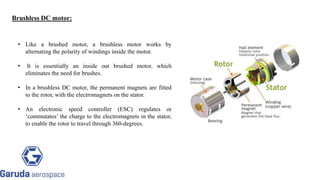
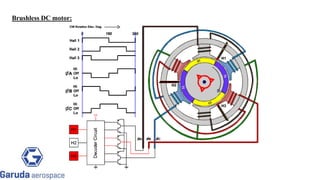
Brushless DC motor:
• Like a brushed motor, a brushless motor works by
alternating the polarity of windings inside the motor.
• It is essentially an inside out brushed motor, which
eliminates the need for brushes.
• In a brushless DC motor, the permanent magnets are fitted
to the rotor, with the electromagnets on the stator.
• An electronic speed controller (ESC) regulates or
‘commutates’ the charge to the electromagnets in the stator,
to enable the rotor to travel through 360-degrees.
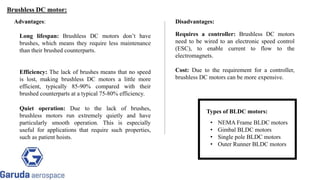
Brushless DC motor:
Advantages:
Long lifespan: Brushless DC motors don’t have
brushes, which means they require less maintenance
than their brushed counterparts.
Efficiency: The lack of brushes means that no speed
is lost, making brushless DC motors a little more
efficient, typically 85-90% compared with their
brushed counterparts at a typical 75-80% efficiency.
Quiet operation: Due to the lack of brushes,
brushless motors run extremely quietly and have
particularly smooth operation. This is especially
useful for applications that require such properties,
such as patient hoists.
Requires a controller: Brushless DC motors
need to be wired to an electronic speed control
(ESC), to enable current to flow to the
electromagnets.
Cost: Due to the requirement for a controller,
brushless DC motors can be more expensive.
Disadvantages:
Types of BLDC motors:
• NEMA Frame BLDC motors
• Gimbal BLDC motors
• Single pole BLDC motors
• Outer Runner BLDC motors
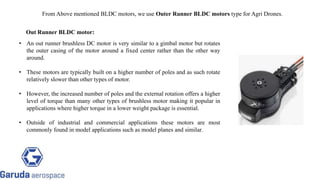
Brushless DC motor:
• An out runner brushless DC motor is very similar to a gimbal motor but rotates
the outer casing of the motor around a fixed center rather than the other way
around.
• These motors are typically built on a higher number of poles and as such rotate
relatively slower than other types of motor.
• However, the increased number of poles and the external rotation offers a higher
level of torque than many other types of brushless motor making it popular in
applications where higher torque in a lower weight package is essential.
• Outside of industrial and commercial applications these motors are most
commonly found in model applications such as model planes and similar.
Out Runner BLDC motor:
From Above mentioned BLDC motors, we use Outer Runner BLDC motors type for Agri Drones.
Return to block
diagram
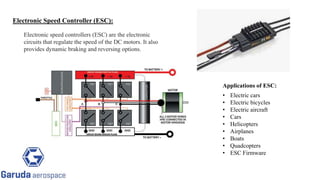
Electronic Speed Controller (ESC):
Electronic speed controllers (ESC) are the electronic
circuits that regulate the speed of the DC motors. It also
provides dynamic braking and reversing options.
• Electric cars
• Electric bicycles
• Electric aircraft
• Cars
• Helicopters
• Airplanes
• Boats
• Quadcopters
• ESC Firmware
Applications of ESC:
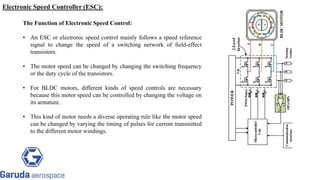
The Function of Electronic Speed Control:
• An ESC or electronic speed control mainly follows a speed reference
signal to change the speed of a switching network of field-effect
transistors.
• The motor speed can be changed by changing the switching frequency
or the duty cycle of the transistors.
• For BLDC motors, different kinds of speed controls are necessary
because this motor speed can be controlled by changing the voltage on
its armature.
• This kind of motor needs a diverse operating rule like the motor speed
can be changed by varying the timing of pulses for current transmitted
to the different motor windings.
Return to block
diagram
Electronic Speed Controller (ESC):
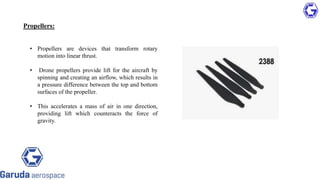
Propellers:
• Propellers are devices that transform rotary
motion into linear thrust.
• Drone propellers provide lift for the aircraft by
spinning and creating an airflow, which results in
a pressure difference between the top and bottom
surfaces of the propeller.
• This accelerates a mass of air in one direction,
providing lift which counteracts the force of
gravity.
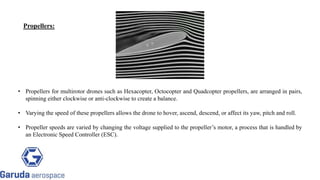
• Propellers for multirotor drones such as Hexacopter, Octocopter and Quadcopter propellers, are arranged in pairs,
spinning either clockwise or anti-clockwise to create a balance.
• Varying the speed of these propellers allows the drone to hover, ascend, descend, or affect its yaw, pitch and roll.
• Propeller speeds are varied by changing the voltage supplied to the propeller’s motor, a process that is handled by
an Electronic Speed Controller (ESC).
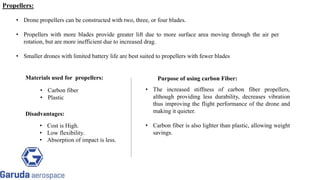
Propellers:
• Drone propellers can be constructed with two, three, or four blades.
• Propellers with more blades provide greater lift due to more surface area moving through the air per
rotation, but are more inefficient due to increased drag.
• Smaller drones with limited battery life are best suited to propellers with fewer blades
Materials used for propellers:
• Carbon fiber
• Plastic
Purpose of using carbon Fiber:
• The increased stiffness of carbon fiber propellers,
although providing less durability, decreases vibration
thus improving the flight performance of the drone and
making it quieter.
• Carbon fiber is also lighter than plastic, allowing weight
savings.
Disadvantages:
• Cost is High.
• Low flexibility.
• Absorption of impact is less.
Return to block
diagram
Propellers:
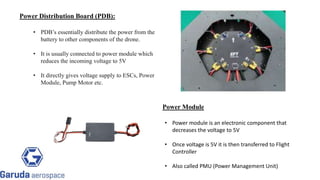
Power Distribution Board (PDB):
• PDB’s essentially distribute the power from the
battery to other components of the drone.
• It is usually connected to power module which
reduces the incoming voltage to 5V
• It directly gives voltage supply to ESCs, Power
Module, Pump Motor etc.
Return to block
diagram
Power Module
• Power module is an electronic component that
decreases the voltage to 5V
• Once voltage is 5V it is then transferred to Flight
Controller
• Also called PMU (Power Management Unit)
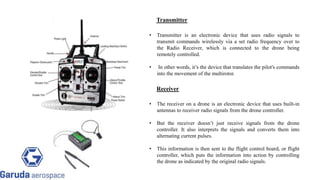
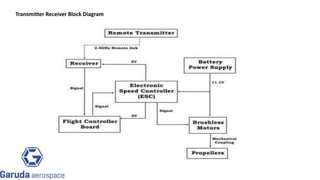
• Transmitter is an electronic device that uses radio signals to
transmit commands wirelessly via a set radio frequency over to
the Radio Receiver, which is connected to the drone being
remotely controlled.
• In other words, it’s the device that translates the pilot's commands
into the movement of the multirotor.
• The receiver on a drone is an electronic device that uses built-in
antennas to receiver radio signals from the drone controller.
• But the receiver doesn’t just receive signals from the drone
controller. It also interprets the signals and converts them into
alternating current pulses.
• This information is then sent to the flight control board, or flight
controller, which puts the information into action by controlling
the drone as indicated by the original radio signals.
Receiver
Transmitter
Transmitter Receiver Block Diagram
Return to block
diagram
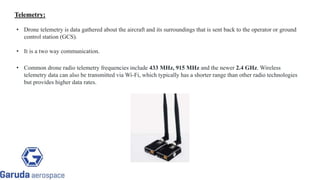
Telemetry:
• Drone telemetry is data gathered about the aircraft and its surroundings that is sent back to the operator or ground
control station (GCS).
• It is a two way communication.
• Common drone radio telemetry frequencies include 433 MHz, 915 MHz and the newer 2.4 GHz. Wireless
telemetry data can also be transmitted via Wi-Fi, which typically has a shorter range than other radio technologies
but provides higher data rates.
Return to block
diagram
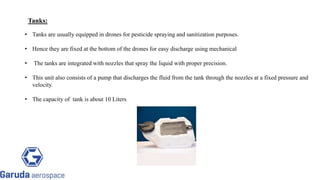
Tanks:
• Tanks are usually equipped in drones for pesticide spraying and sanitization purposes.
• Hence they are fixed at the bottom of the drones for easy discharge using mechanical
• The tanks are integrated with nozzles that spray the liquid with proper precision.
• This unit also consists of a pump that discharges the fluid from the tank through the nozzles at a fixed pressure and
velocity.
• The capacity of tank is about 10 Liters
Return to block
diagram
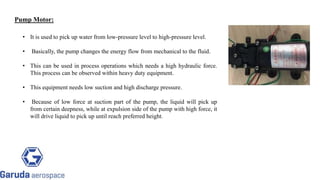
Pump Motor:
• It is used to pick up water from low-pressure level to high-pressure level.
• Basically, the pump changes the energy flow from mechanical to the fluid.
• This can be used in process operations which needs a high hydraulic force.
This process can be observed within heavy duty equipment.
• This equipment needs low suction and high discharge pressure.
• Because of low force at suction part of the pump, the liquid will pick up
from certain deepness, while at expulsion side of the pump with high force, it
will drive liquid to pick up until reach preferred height.
Return to block
diagram
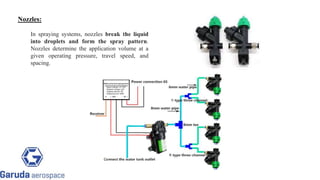
In spraying systems, nozzles break the liquid
into droplets and form the spray pattern.
Nozzles determine the application volume at a
given operating pressure, travel speed, and
spacing.
Nozzles:
Return to block
diagram
Return to block
diagram
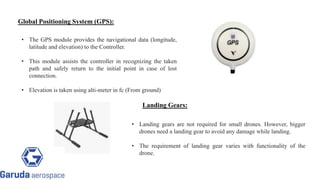
• The GPS module provides the navigational data (longitude,
latitude and elevation) to the Controller.
• This module assists the controller in recognizing the taken
path and safely return to the initial point in case of lost
connection.
• Elevation is taken using alti-meter in fc (From ground)
Global Positioning System (GPS):
Landing Gears:
Return to block
diagram
• Landing gears are not required for small drones. However, bigger
drones need a landing gear to avoid any damage while landing.
• The requirement of landing gear varies with functionality of the
drone.
 TRUE / FALSE. Function of flight controller is to direct the RPM of each motor in
response to input
 --------------------- flight controller is used in Garuda’s Agri drone
A) K++ B) K3, K3Apro C) DJI N3 AG D) Topxgun TIA
 ----------------- battery has less weight and high discharging capacity
A) Li-ion B) Li-polymer C) Lead Acid D) Nickel-Cadmium
RECAP OF THE SESSION
 TRUE / FALSE. Brushless motors run extremely quiet and with smooth operation
 ----------- BLDC motor is used when higher torque in a lower weight package is essential
A) NEMA Frame B) Gimbal C) Single pole D) Outer Runner
 ESC stands for ------------------
 ESC regulates the speed by changing the ------------- of the transistors
 Propellers transform ---------- motion into ----------- thrust.
A) rotary, linear B) linear, rotary
RECAP OF THE SESSION
 TRUE / FALSE. Varying the speed of these propellers allows the drone to hover, ascend,
descend, or affect its yaw, pitch and roll
 ----------- is the output of power distribution board
A) 5V DC B) 5V AC C) 12V DC D) 12V AC
 The GPS module provides the -------------- to the controller
A) longitude B) latitude C) elevation D) all the THREE
RECAP OF THE SESSION
ANY QUESTIONS ??
THANK YOU

Drone Components.pptx

  • 1.
    COMPONENTS OF MULTICOPTER DRONE  FLIGHT CONTROLLER  BATTERY  BLDC MOTOR  ELECTRONIC SPEED CONTROLLER  POWER MODULE  PROPELLERS  POWER DISTRIBUTION BOARD  GPS  LANDING GEAR  TRANSMITTER AND RECEIVER  TELEMETRY  PUMP MOTOR  NOZZLE  TANK  BLOCK DIAGRAM
  • 2.
  • 3.
  • 4.
    • A flightcontroller (FC) is a small circuit board of varying complexity. Its function is to direct the RPM of each motor in response to input. • A command from the pilot for the multi-rotor to move forward is fed into the flight controller, which determines how to manipulate the motors accordingly. • The Flight controller is the brain of the drone. • It's a circuit board with a range of sensors that detect movement of the drone, as well as user commands. • Using this data, it then controls the speed of the motors to make the drone move as instructed. Type of Flight Controller In Agri Drone: • K++, K++pro • K++V2 • K3, K3Apro • DJI N3 AG • Topxgun TIA Flight controller:
  • 5.
    Above mentioned types,We use the K++ type Flight Controller because: K++ flight control is specially designed for Agricultural sprayer drones. It has a variety of modes and exclusive functions for Agriculture spraying drones. It supports manual, semi-autonomous (A-B) and autonomous flight. It can monitor drug flow in real time and intelligently match the spray volume to achieve precise Diverse Operating Mode for a variety of operating environments K++ built-in fixed height mode, GPS - speed mode and other operating modes, easy to operate, flexible switching, free to change operating modes according to different operating environments, to meet the needs of agriculture spraying requirement. Return to block diagram Return to block diagram Flight controller:
  • 6.
    Battery: • Commonly nickelbased and lithium based batteries are known • Lithium based batteries are mostly used due to best performance. • Lithium batteries has two most commonly used batteries are: 1.Lithium ion battery (eg. Mobile batteries etc ) 2.Lithium polymer battery (eg. Quadcopter , helicopter etc.)
  • 7.
    Two Types ofLi-Po battery in Agri Drone: • 6 cell battery and 12 cell battery • Each Cell has minimum of 3.7 volt and maximum of 4.2V capacity • 6 cell battery contains 22.3 volt • 12 cell battery contains 44.4V • 6 cell battery 16000MAh and 12 cell battery 22000MAh Battery:
  • 8.
    The seven mainthings that shorten LiPo battery life are: • Li-po batteries are used in drones due to best performance as compared to li-ion battery. • Li-po battery has less weight • Li-po battery has High discharging capacity • Li-po battery can be given required shape Purpose of using Li-Po Battery: Return to block diagram • Heat • Leaving a lipo fully charged for several days • Over discharging (voltage & current) • Over charging (voltage & current) • Inadequate balancing • Improper storage voltage (more on that shortly) • Physical damage (dropping, over tightening straps, prying cells apart, using too much/too strong velcro etc.) Return to block diagram Battery:
  • 9.
    Brushless DC motor: •Like a brushed motor, a brushless motor works by alternating the polarity of windings inside the motor. • It is essentially an inside out brushed motor, which eliminates the need for brushes. • In a brushless DC motor, the permanent magnets are fitted to the rotor, with the electromagnets on the stator. • An electronic speed controller (ESC) regulates or ‘commutates’ the charge to the electromagnets in the stator, to enable the rotor to travel through 360-degrees.
  • 10.
  • 11.
    Advantages: Long lifespan: BrushlessDC motors don’t have brushes, which means they require less maintenance than their brushed counterparts. Efficiency: The lack of brushes means that no speed is lost, making brushless DC motors a little more efficient, typically 85-90% compared with their brushed counterparts at a typical 75-80% efficiency. Quiet operation: Due to the lack of brushes, brushless motors run extremely quietly and have particularly smooth operation. This is especially useful for applications that require such properties, such as patient hoists. Requires a controller: Brushless DC motors need to be wired to an electronic speed control (ESC), to enable current to flow to the electromagnets. Cost: Due to the requirement for a controller, brushless DC motors can be more expensive. Disadvantages: Types of BLDC motors: • NEMA Frame BLDC motors • Gimbal BLDC motors • Single pole BLDC motors • Outer Runner BLDC motors Brushless DC motor:
  • 12.
    • An outrunner brushless DC motor is very similar to a gimbal motor but rotates the outer casing of the motor around a fixed center rather than the other way around. • These motors are typically built on a higher number of poles and as such rotate relatively slower than other types of motor. • However, the increased number of poles and the external rotation offers a higher level of torque than many other types of brushless motor making it popular in applications where higher torque in a lower weight package is essential. • Outside of industrial and commercial applications these motors are most commonly found in model applications such as model planes and similar. Out Runner BLDC motor: From Above mentioned BLDC motors, we use Outer Runner BLDC motors type for Agri Drones. Return to block diagram
  • 13.
    Electronic Speed Controller(ESC): Electronic speed controllers (ESC) are the electronic circuits that regulate the speed of the DC motors. It also provides dynamic braking and reversing options. • Electric cars • Electric bicycles • Electric aircraft • Cars • Helicopters • Airplanes • Boats • Quadcopters • ESC Firmware Applications of ESC:
  • 14.
    The Function ofElectronic Speed Control: • An ESC or electronic speed control mainly follows a speed reference signal to change the speed of a switching network of field-effect transistors. • The motor speed can be changed by changing the switching frequency or the duty cycle of the transistors. • For BLDC motors, different kinds of speed controls are necessary because this motor speed can be controlled by changing the voltage on its armature. • This kind of motor needs a diverse operating rule like the motor speed can be changed by varying the timing of pulses for current transmitted to the different motor windings. Return to block diagram Electronic Speed Controller (ESC):
  • 15.
    Propellers: • Propellers aredevices that transform rotary motion into linear thrust. • Drone propellers provide lift for the aircraft by spinning and creating an airflow, which results in a pressure difference between the top and bottom surfaces of the propeller. • This accelerates a mass of air in one direction, providing lift which counteracts the force of gravity.
  • 16.
    • Propellers formultirotor drones such as Hexacopter, Octocopter and Quadcopter propellers, are arranged in pairs, spinning either clockwise or anti-clockwise to create a balance. • Varying the speed of these propellers allows the drone to hover, ascend, descend, or affect its yaw, pitch and roll. • Propeller speeds are varied by changing the voltage supplied to the propeller’s motor, a process that is handled by an Electronic Speed Controller (ESC). Propellers:
  • 17.
    • Drone propellerscan be constructed with two, three, or four blades. • Propellers with more blades provide greater lift due to more surface area moving through the air per rotation, but are more inefficient due to increased drag. • Smaller drones with limited battery life are best suited to propellers with fewer blades Materials used for propellers: • Carbon fiber • Plastic Purpose of using carbon Fiber: • The increased stiffness of carbon fiber propellers, although providing less durability, decreases vibration thus improving the flight performance of the drone and making it quieter. • Carbon fiber is also lighter than plastic, allowing weight savings. Disadvantages: • Cost is High. • Low flexibility. • Absorption of impact is less. Return to block diagram Propellers:
  • 18.
    Power Distribution Board(PDB): • PDB’s essentially distribute the power from the battery to other components of the drone. • It is usually connected to power module which reduces the incoming voltage to 5V • It directly gives voltage supply to ESCs, Power Module, Pump Motor etc. Return to block diagram Power Module • Power module is an electronic component that decreases the voltage to 5V • Once voltage is 5V it is then transferred to Flight Controller • Also called PMU (Power Management Unit)
  • 19.
    • Transmitter isan electronic device that uses radio signals to transmit commands wirelessly via a set radio frequency over to the Radio Receiver, which is connected to the drone being remotely controlled. • In other words, it’s the device that translates the pilot's commands into the movement of the multirotor. • The receiver on a drone is an electronic device that uses built-in antennas to receiver radio signals from the drone controller. • But the receiver doesn’t just receive signals from the drone controller. It also interprets the signals and converts them into alternating current pulses. • This information is then sent to the flight control board, or flight controller, which puts the information into action by controlling the drone as indicated by the original radio signals. Receiver Transmitter
  • 20.
    Transmitter Receiver BlockDiagram Return to block diagram
  • 21.
    Telemetry: • Drone telemetryis data gathered about the aircraft and its surroundings that is sent back to the operator or ground control station (GCS). • It is a two way communication. • Common drone radio telemetry frequencies include 433 MHz, 915 MHz and the newer 2.4 GHz. Wireless telemetry data can also be transmitted via Wi-Fi, which typically has a shorter range than other radio technologies but provides higher data rates. Return to block diagram
  • 22.
    Tanks: • Tanks areusually equipped in drones for pesticide spraying and sanitization purposes. • Hence they are fixed at the bottom of the drones for easy discharge using mechanical • The tanks are integrated with nozzles that spray the liquid with proper precision. • This unit also consists of a pump that discharges the fluid from the tank through the nozzles at a fixed pressure and velocity. • The capacity of tank is about 10 Liters Return to block diagram
  • 23.
    Pump Motor: • Itis used to pick up water from low-pressure level to high-pressure level. • Basically, the pump changes the energy flow from mechanical to the fluid. • This can be used in process operations which needs a high hydraulic force. This process can be observed within heavy duty equipment. • This equipment needs low suction and high discharge pressure. • Because of low force at suction part of the pump, the liquid will pick up from certain deepness, while at expulsion side of the pump with high force, it will drive liquid to pick up until reach preferred height. Return to block diagram
  • 24.
    In spraying systems,nozzles break the liquid into droplets and form the spray pattern. Nozzles determine the application volume at a given operating pressure, travel speed, and spacing. Nozzles: Return to block diagram
  • 25.
    Return to block diagram •The GPS module provides the navigational data (longitude, latitude and elevation) to the Controller. • This module assists the controller in recognizing the taken path and safely return to the initial point in case of lost connection. • Elevation is taken using alti-meter in fc (From ground) Global Positioning System (GPS): Landing Gears: Return to block diagram • Landing gears are not required for small drones. However, bigger drones need a landing gear to avoid any damage while landing. • The requirement of landing gear varies with functionality of the drone.
  • 26.
     TRUE /FALSE. Function of flight controller is to direct the RPM of each motor in response to input  --------------------- flight controller is used in Garuda’s Agri drone A) K++ B) K3, K3Apro C) DJI N3 AG D) Topxgun TIA  ----------------- battery has less weight and high discharging capacity A) Li-ion B) Li-polymer C) Lead Acid D) Nickel-Cadmium RECAP OF THE SESSION
  • 27.
     TRUE /FALSE. Brushless motors run extremely quiet and with smooth operation  ----------- BLDC motor is used when higher torque in a lower weight package is essential A) NEMA Frame B) Gimbal C) Single pole D) Outer Runner  ESC stands for ------------------  ESC regulates the speed by changing the ------------- of the transistors  Propellers transform ---------- motion into ----------- thrust. A) rotary, linear B) linear, rotary RECAP OF THE SESSION
  • 28.
     TRUE /FALSE. Varying the speed of these propellers allows the drone to hover, ascend, descend, or affect its yaw, pitch and roll  ----------- is the output of power distribution board A) 5V DC B) 5V AC C) 12V DC D) 12V AC  The GPS module provides the -------------- to the controller A) longitude B) latitude C) elevation D) all the THREE RECAP OF THE SESSION
  • 29.