Universal Design for Learning
Alexandra Fair
From the National Center for Universal
Design in Learning….
• The following link describes the basic
principles of Universal Design in architecture
and education.
• The video includes images, audio and subtitles
to be universally accessible to users.
• http://www.udlcenter.org/resource_library/vi
deos/udlcenter/udl
Universal design at school
• Universal design is a conscious design of
instruction, places and products “to be usable
by all people, to the greatest extent possible,
without the need for adaptation or specialized
design"
• For teachers this means making education as
accessible as possible for students with
diverse learning needs
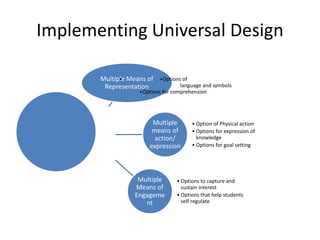
Implementing Universal Design
Multiple Means of
Representation
• +Options of
language and symbols
+Options for comprehension
Multiple
means of
action/
expression
• Option of Physical action
• Options for expression of
knowledge
• Options for goal setting
Multiple
Means of
Engageme
nt
• Options to capture and
sustain interest
• Options that help students
self regulate
Universal Design in Post Secondary
Education
• Its important for all materials used in class to
be accessible for students
• This could mean permitting audio devices in
lectures and showing videos with captions
• The class building itself should be accessible
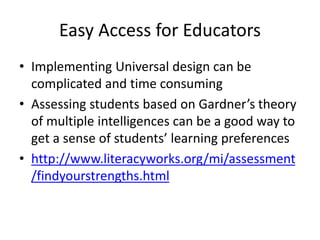
Easy Access for Educators
• Implementing Universal design can be
complicated and time consuming
• Assessing students based on Gardner’s theory
of multiple intelligences can be a good way to
get a sense of students’ learning preferences
• http://www.literacyworks.org/mi/assessment
/findyourstrengths.html
Goal of Universal Design
• American Curriculum is structured in a very
specific way, and if students are less successful
they are categorized as disabled or
“struggling” Universal Instruction allows ALL
students to be more actively involved in their
learning

Universal design for learning 2.3

  • 1.
    Universal Design forLearning Alexandra Fair
  • 2.
    From the NationalCenter for Universal Design in Learning…. • The following link describes the basic principles of Universal Design in architecture and education. • The video includes images, audio and subtitles to be universally accessible to users. • http://www.udlcenter.org/resource_library/vi deos/udlcenter/udl
  • 3.
    Universal design atschool • Universal design is a conscious design of instruction, places and products “to be usable by all people, to the greatest extent possible, without the need for adaptation or specialized design" • For teachers this means making education as accessible as possible for students with diverse learning needs
  • 4.
    Implementing Universal Design MultipleMeans of Representation • +Options of language and symbols +Options for comprehension Multiple means of action/ expression • Option of Physical action • Options for expression of knowledge • Options for goal setting Multiple Means of Engageme nt • Options to capture and sustain interest • Options that help students self regulate
  • 5.
    Universal Design inPost Secondary Education • Its important for all materials used in class to be accessible for students • This could mean permitting audio devices in lectures and showing videos with captions • The class building itself should be accessible
  • 6.
    Easy Access forEducators • Implementing Universal design can be complicated and time consuming • Assessing students based on Gardner’s theory of multiple intelligences can be a good way to get a sense of students’ learning preferences • http://www.literacyworks.org/mi/assessment /findyourstrengths.html
  • 7.
    Goal of UniversalDesign • American Curriculum is structured in a very specific way, and if students are less successful they are categorized as disabled or “struggling” Universal Instruction allows ALL students to be more actively involved in their learning