Universal Design for
     Learning:
   What is the inspiration for UDL?
Think of architecture:
•   “First articulated by CAST in the early
    1990s, UDL mirrors the universal design
    movement in architecture and product
    development, which calls for designs that from
    the outset consider the needs of the greatest
    number of possible users, eliminating the need
    for costly, inconvenient, and unattractive
    adaptations later.”

•   (http://www.cast.org/research/index.html)
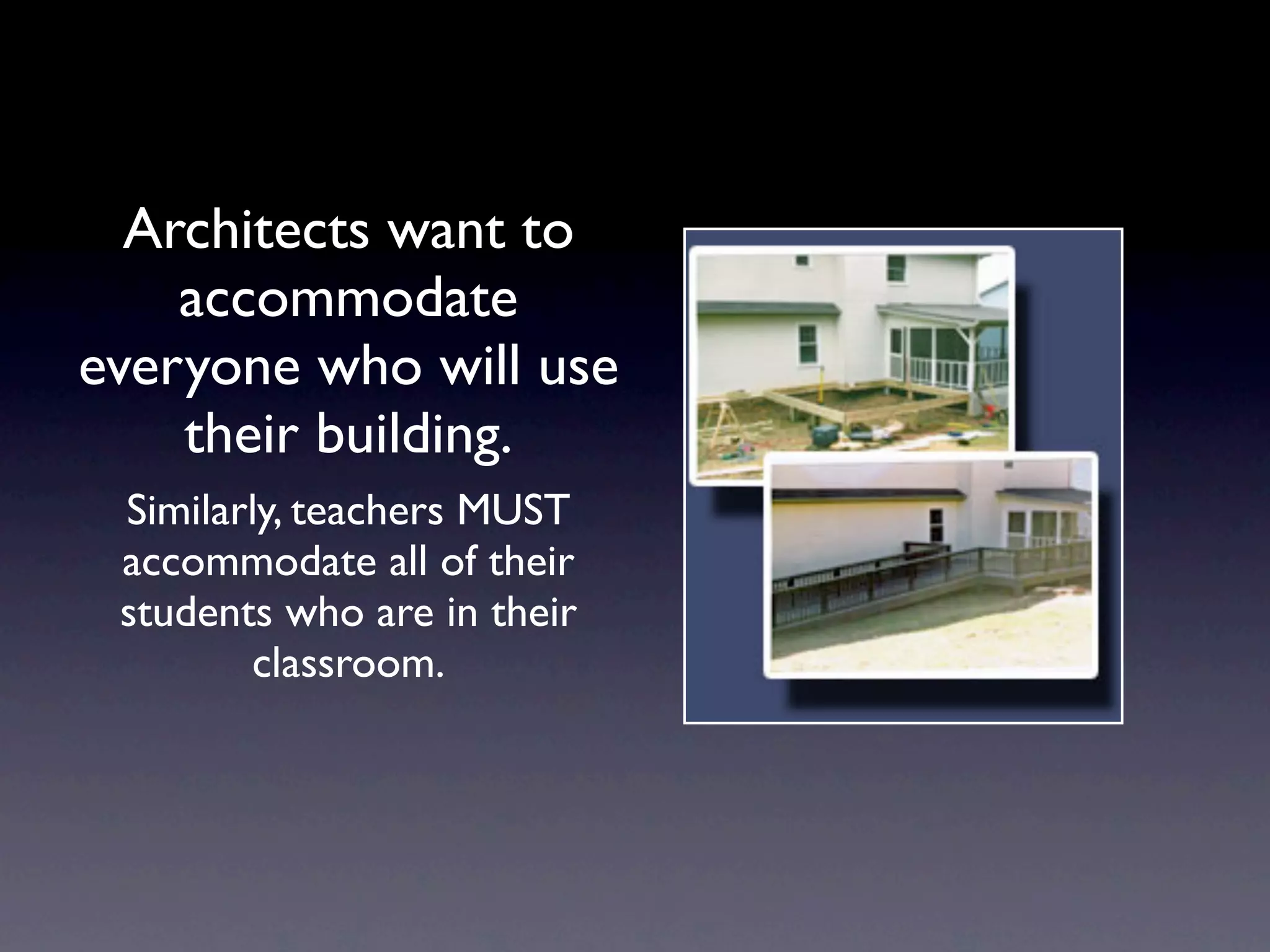
Architects want to
    accommodate
everyone who will use
    their building.
 Similarly, teachers MUST
 accommodate all of their
 students who are in their
        classroom.
Think of education:

• “Universal Design for Learning
  is a set of principles for curriculum
  development that give all individuals equal
  opportunities to learn.”
• (http://www.cast.org/udl/index.html)
UDL’s Three Principles

• Presentation
• Expression
• Engagement
Neuroscience tells us that the variety of
 skills, needs, and interests that students
bring into the classroom are as unique as
                 fingerprints.

  (http://www.cast.org/udl/index.html)
What are the
          implications?
Our curriculum has to be the dough and not
              the cookie cutter.
  UDL makes this possible through the following:
      -Information is presented in varied ways
 -Students express their knowledge in varied ways
     -Students interest is constantly stimulated
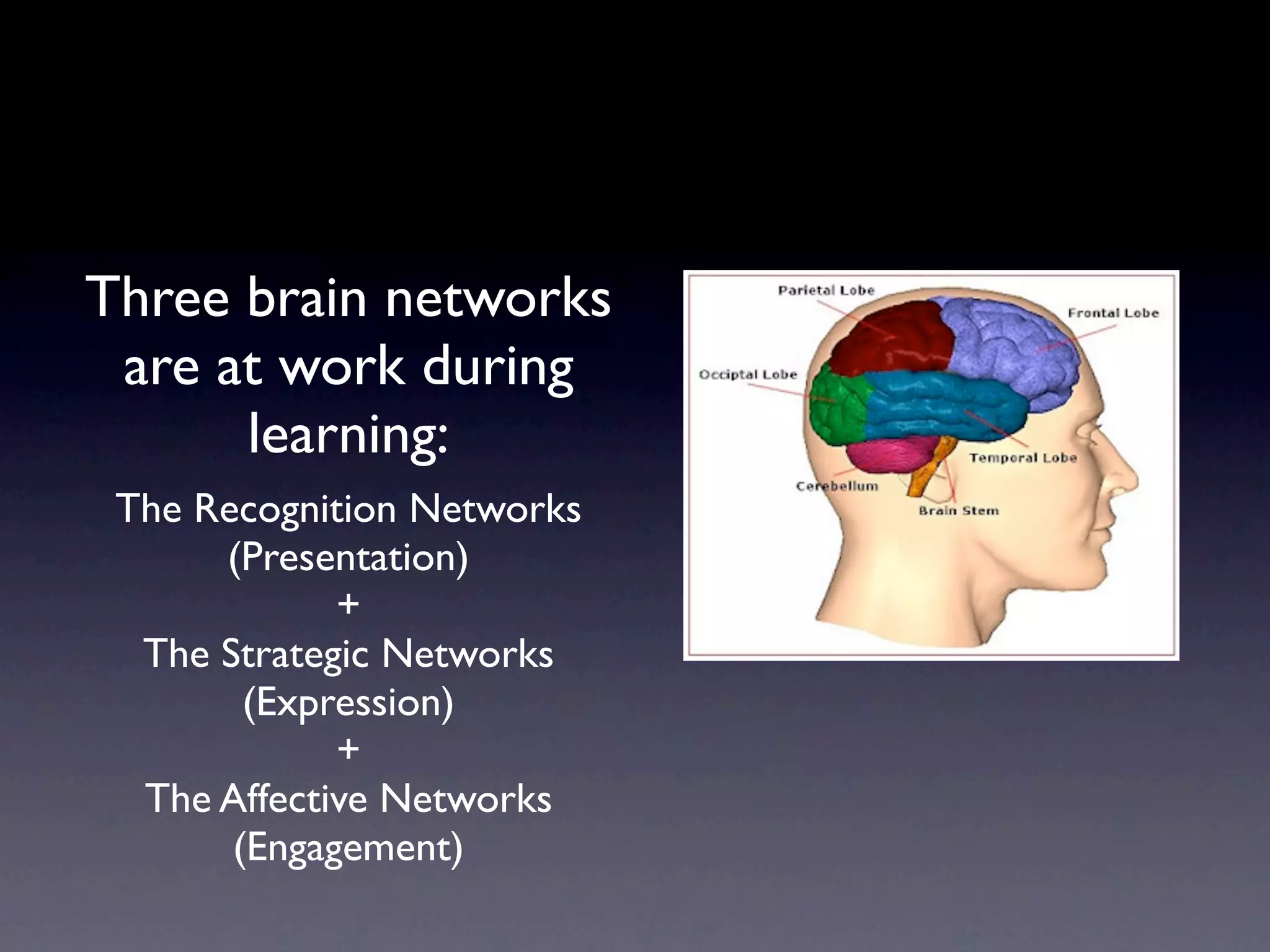
Three brain networks
 are at work during
      learning:
 The Recognition Networks
      (Presentation)
             +
  The Strategic Networks
        (Expression)
             +
  The Affective Networks
       (Engagement)
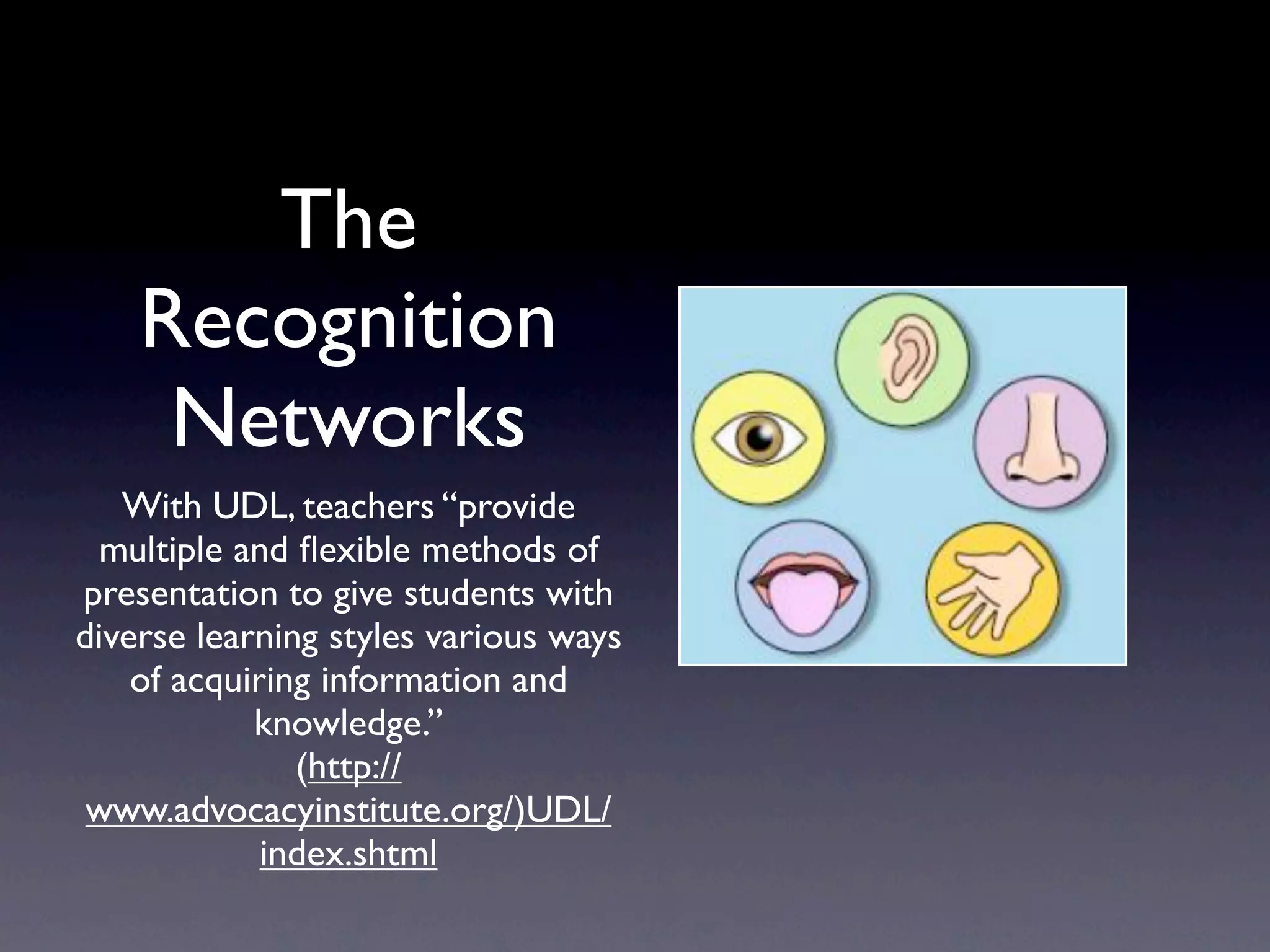
The
    Recognition
     Networks
   With UDL, teachers “provide
  multiple and flexible methods of
presentation to give students with
diverse learning styles various ways
    of acquiring information and
            knowledge.”
               (http://
 www.advocacyinstitute.org/)UDL/
             index.shtml
The Recognition Networks

•   Student handouts

•   Powerpoint
    presentations

•   Podcasts

•   Texts with vocabulary
    defined in footnotes
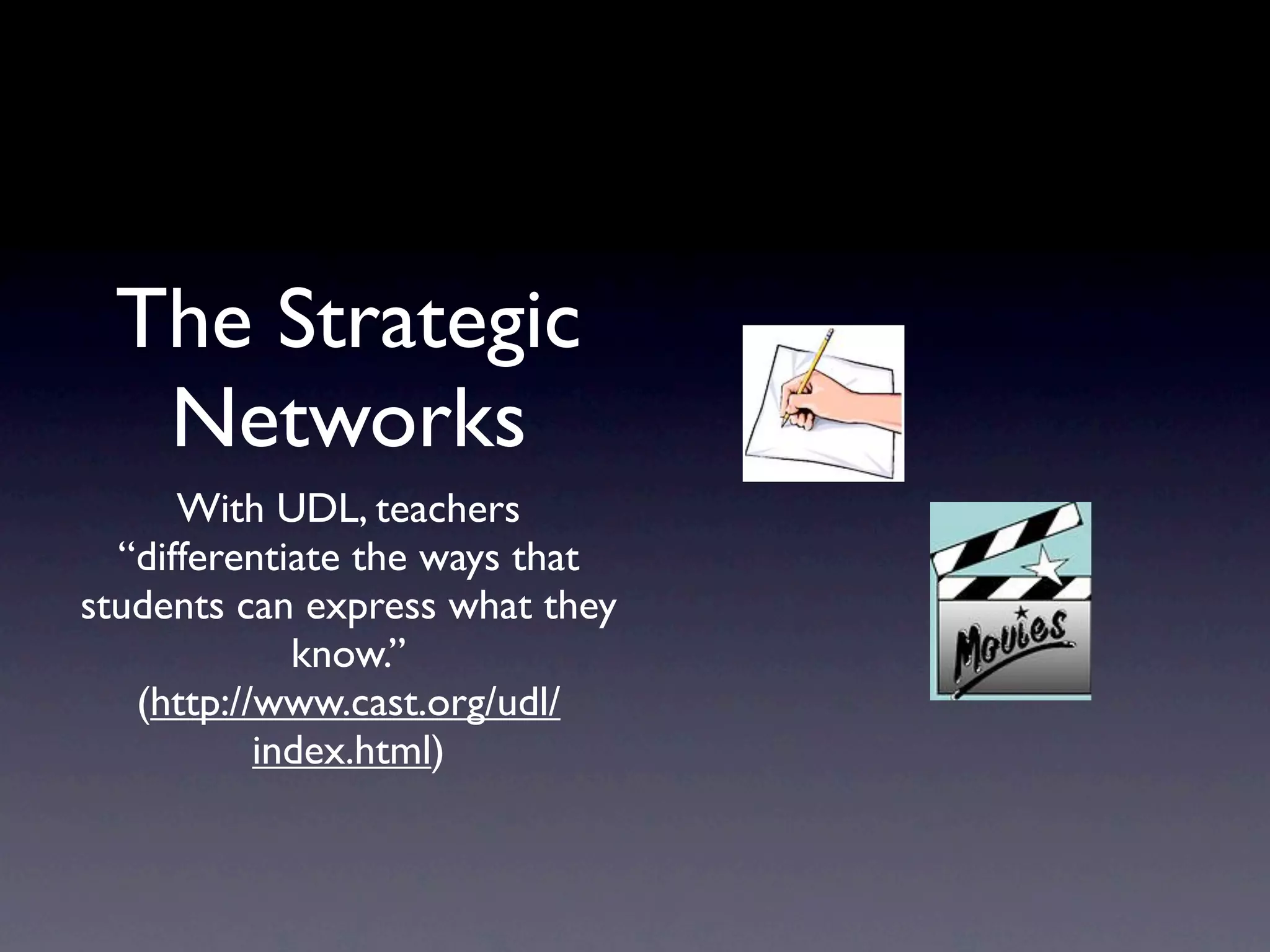
The Strategic
  Networks
      With UDL, teachers
  “differentiate the ways that
students can express what they
             know.”
   (http://www.cast.org/udl/
           index.html)
The Strategic
          Networks
• Essays
• Digital Stories
• Songs
• Paintings
• Blogs
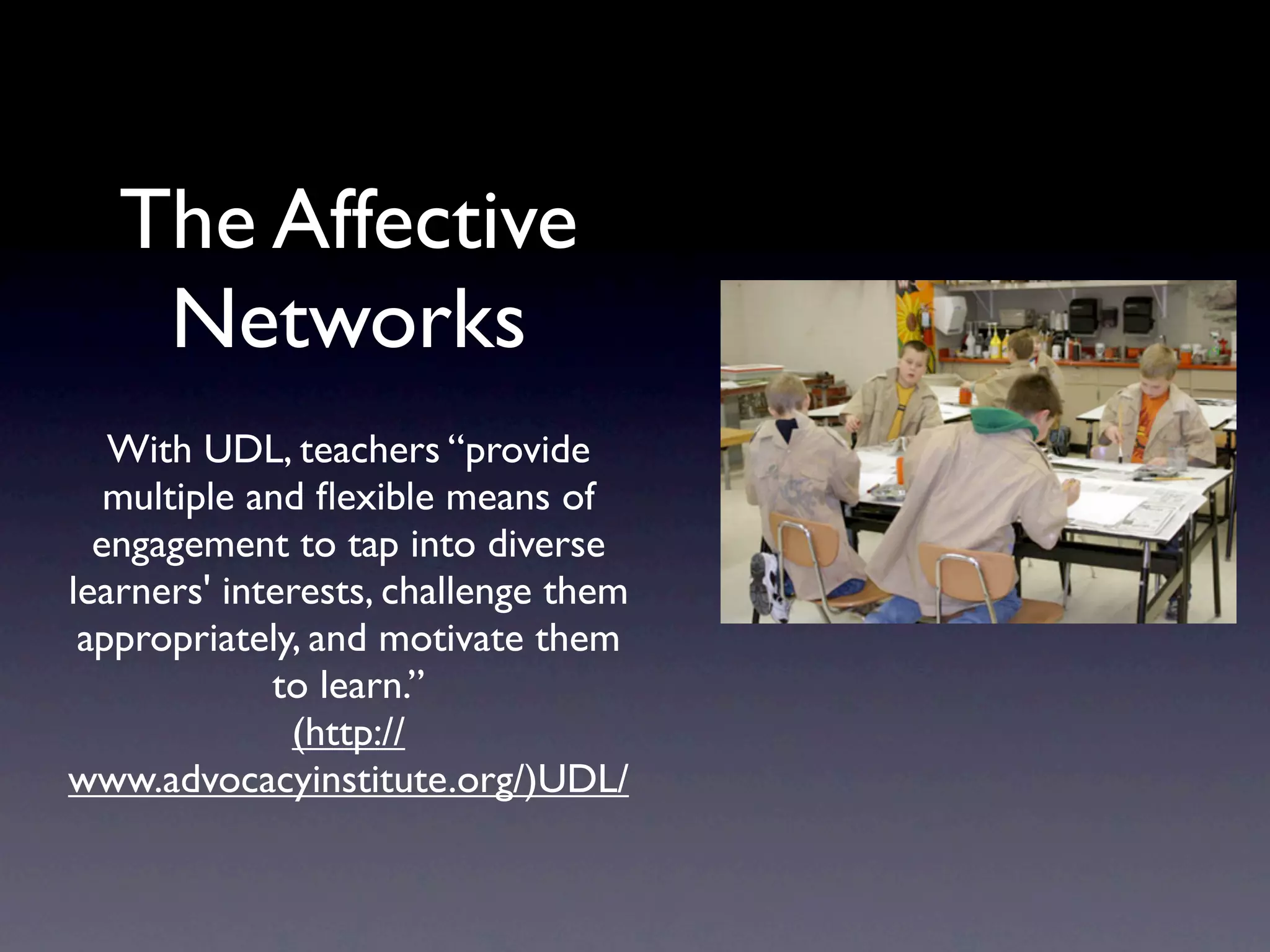
The Affective
    Networks
   With UDL, teachers “provide
   multiple and flexible means of
  engagement to tap into diverse
learners' interests, challenge them
 appropriately, and motivate them
             to learn.”
              (http://
www.advocacyinstitute.org/)UDL/
The Affective Networks

• Provide student choice (choice novel unit)
• Provide relevance (This I Believe essay)
• Provide a distraction free environment
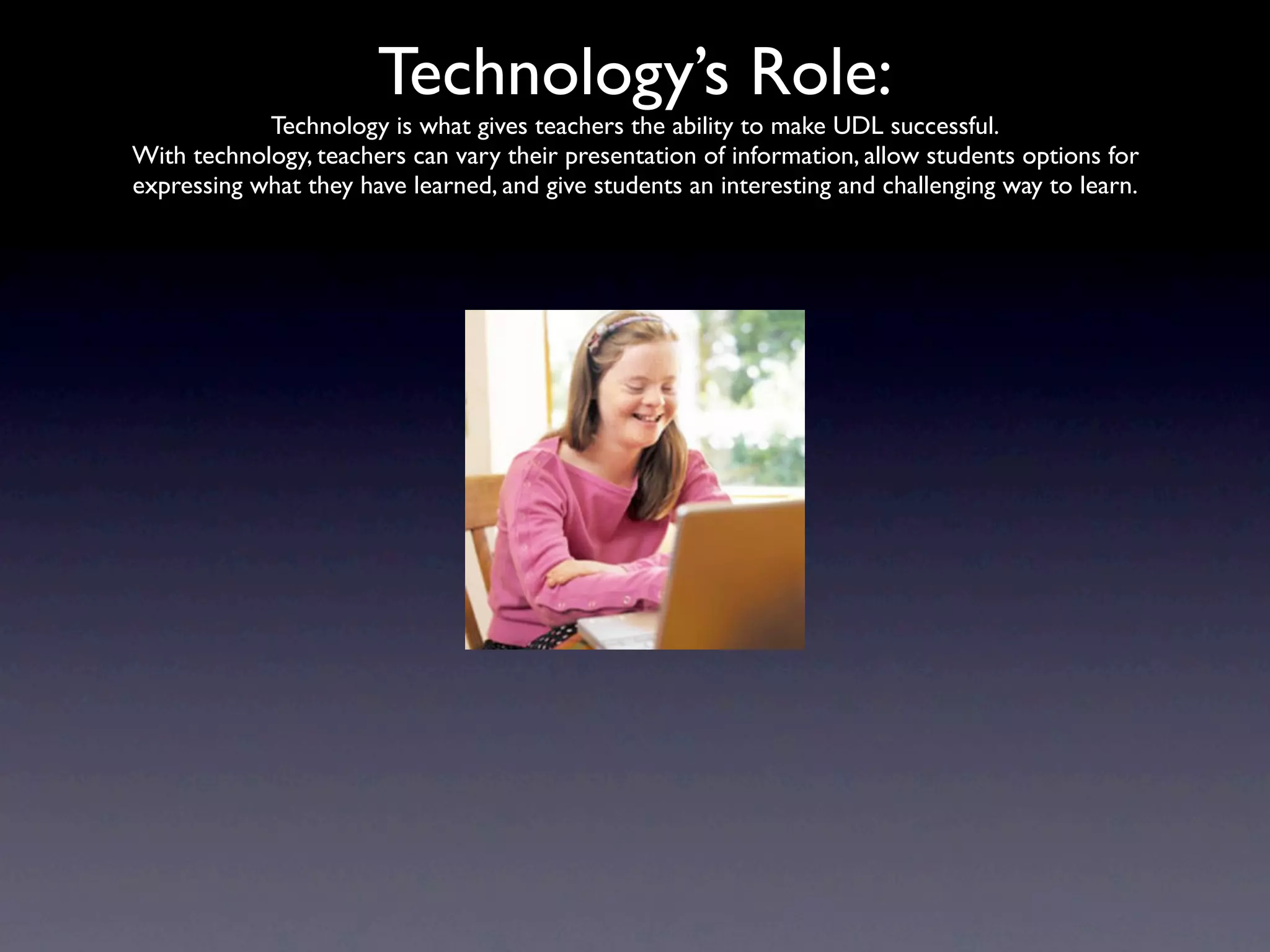
Technology’s Role:
            Technology is what gives teachers the ability to make UDL successful.
With technology, teachers can vary their presentation of information, allow students options for
expressing what they have learned, and give students an interesting and challenging way to learn.
UDL’s Impact?
   UDL isn’t for the brightest student. It
isn’t for the struggling student. It isn’t for
  the student with special needs. UDL is
             for EVERY student.
       UDL will help every student be
                  successful.
More Technology
to help teachers with
        UDL...
UDL Book Builder
a different way to read the same text...


• Text-to-speech
• Translations from English to Spanish
• Pictures to accompany words
• Glossary definitions of difficult words
Digital Content in the
      Classroom
• Learn to find digital texts online and
  download
• Learn to create your own digital content
• See model lessons that incorporate digital
  content
Internet Inquiry Toolkit

• Internet Inquiry is now an everyday
  occurrence for students
• Learn to teach Internet Inquiry
• See sample lessons
References:


• (http://www.advocacyinstitute.org/)UDL/
• (http://www.cast.org/udl/index.html)

Universal Design for Learning

  • 1.
    Universal Design for Learning: What is the inspiration for UDL?
  • 2.
    Think of architecture: • “First articulated by CAST in the early 1990s, UDL mirrors the universal design movement in architecture and product development, which calls for designs that from the outset consider the needs of the greatest number of possible users, eliminating the need for costly, inconvenient, and unattractive adaptations later.” • (http://www.cast.org/research/index.html)
  • 3.
    Architects want to accommodate everyone who will use their building. Similarly, teachers MUST accommodate all of their students who are in their classroom.
  • 4.
    Think of education: •“Universal Design for Learning is a set of principles for curriculum development that give all individuals equal opportunities to learn.” • (http://www.cast.org/udl/index.html)
  • 5.
    UDL’s Three Principles •Presentation • Expression • Engagement
  • 6.
    Neuroscience tells usthat the variety of skills, needs, and interests that students bring into the classroom are as unique as fingerprints. (http://www.cast.org/udl/index.html)
  • 7.
    What are the implications? Our curriculum has to be the dough and not the cookie cutter. UDL makes this possible through the following: -Information is presented in varied ways -Students express their knowledge in varied ways -Students interest is constantly stimulated
  • 8.
    Three brain networks are at work during learning: The Recognition Networks (Presentation) + The Strategic Networks (Expression) + The Affective Networks (Engagement)
  • 9.
    The Recognition Networks With UDL, teachers “provide multiple and flexible methods of presentation to give students with diverse learning styles various ways of acquiring information and knowledge.” (http:// www.advocacyinstitute.org/)UDL/ index.shtml
  • 10.
    The Recognition Networks • Student handouts • Powerpoint presentations • Podcasts • Texts with vocabulary defined in footnotes
  • 11.
    The Strategic Networks With UDL, teachers “differentiate the ways that students can express what they know.” (http://www.cast.org/udl/ index.html)
  • 12.
    The Strategic Networks • Essays • Digital Stories • Songs • Paintings • Blogs
  • 13.
    The Affective Networks With UDL, teachers “provide multiple and flexible means of engagement to tap into diverse learners' interests, challenge them appropriately, and motivate them to learn.” (http:// www.advocacyinstitute.org/)UDL/
  • 14.
    The Affective Networks •Provide student choice (choice novel unit) • Provide relevance (This I Believe essay) • Provide a distraction free environment
  • 15.
    Technology’s Role: Technology is what gives teachers the ability to make UDL successful. With technology, teachers can vary their presentation of information, allow students options for expressing what they have learned, and give students an interesting and challenging way to learn.
  • 16.
    UDL’s Impact? UDL isn’t for the brightest student. It isn’t for the struggling student. It isn’t for the student with special needs. UDL is for EVERY student. UDL will help every student be successful.
  • 17.
    More Technology to helpteachers with UDL...
  • 18.
    UDL Book Builder adifferent way to read the same text... • Text-to-speech • Translations from English to Spanish • Pictures to accompany words • Glossary definitions of difficult words
  • 19.
    Digital Content inthe Classroom • Learn to find digital texts online and download • Learn to create your own digital content • See model lessons that incorporate digital content
  • 20.
    Internet Inquiry Toolkit •Internet Inquiry is now an everyday occurrence for students • Learn to teach Internet Inquiry • See sample lessons
  • 21.