t-test
Dr. Hamza Aduraidi
Review 6 Steps for
Significance Testing
1. Set alpha (p
level).
2. State hypotheses,
Null and
Alternative.
3. Calculate the test
statistic (sample
value).
4. Find the critical
value of the
statistic.
5. State the decision
rule.
6. State the
conclusion.
t-test
• t –test is about means: distribution and
evaluation for group distribution
• Withdrawn form the normal distribution
• The shape of distribution depend on
sample size and, the sum of all
distributions is a normal distribution
• t- distribution is based on sample size and
vary according to the degrees of freedom
What is the t -test
• t test is a useful technique for comparing
mean values of two sets of numbers.
• The comparison will provide you with a
statistic for evaluating whether the difference
between two means is statistically significant.
• t test is named after its inventor, William
Gosset, who published under the pseudonym
of student.
• t test can be used either :
1.to compare two independent groups (independent-
samples t test)
2.to compare observations from two measurement
occasions for the same group (paired-samples t
test).
What is the t -test
• The null hypothesis states that any
difference between the two means is a
result to difference in distribution.
• Remember, both samples drawn randomly
form the same population.
• Comparing the chance of having difference
is one group due to difference in
distribution.
• Assuming that both distributions
came from the same population, both
distribution has to be equal.
What is the t -test
• Then, what we intend:
“To find the difference due to chance”
• Logically, The larger the difference in means, the
more likely to find a significant t test.
• But, recall:
1.Variability
More variability = less overlap = larger difference
2. Sample size
Larger sample size = less variability (pop) = larger difference
Types
1. The independent-sample t test is used to compare two
groups' scores on the same variable. For example, it
could be used to compare the salaries of dentists and
physicians to evaluate whether there is a difference in
their salaries.
2. The paired-sample t test is used to compare the means
of two variables within a single group. For example, it
could be used to see if there is a statistically significant
difference between starting salaries and current salaries
among the general physicians in an organization.
Assumption
1. Dependent variable should be
continuous (I/R)
2. The groups should be randomly
drawn from normally distributed
and independent populations
e.g. Male X Female
Dentist X Physician
Manager X Staff
NO OVER LAP
Assumption
3. the independent variable is categorical with two
levels
4. Distribution for the two independent variables
is normal
5. Equal variance (homogeneity of variance)
6. large variation = less likely to have sig t test =
accepting null hypothesis (fail to reject) = Type
II error = a threat to power
Sending an innocent to jail for no significant reason
Independent Samples t-test
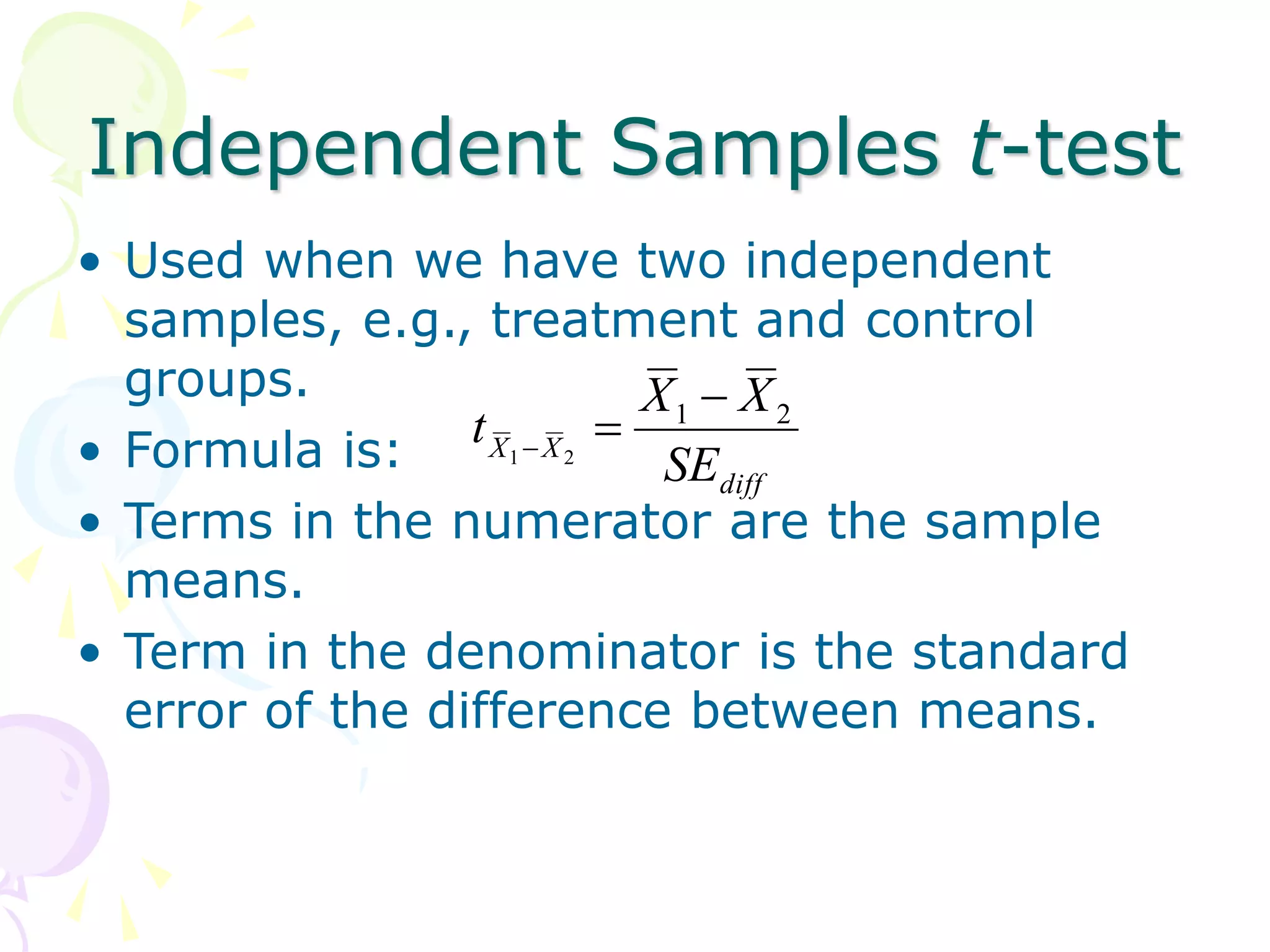
• Used when we have two independent
samples, e.g., treatment and control
groups.
• Formula is:
• Terms in the numerator are the sample
means.
• Term in the denominator is the standard
error of the difference between means.
diff
X
X
SE
X
X
t 2
1
2
1



Independent samples t-test
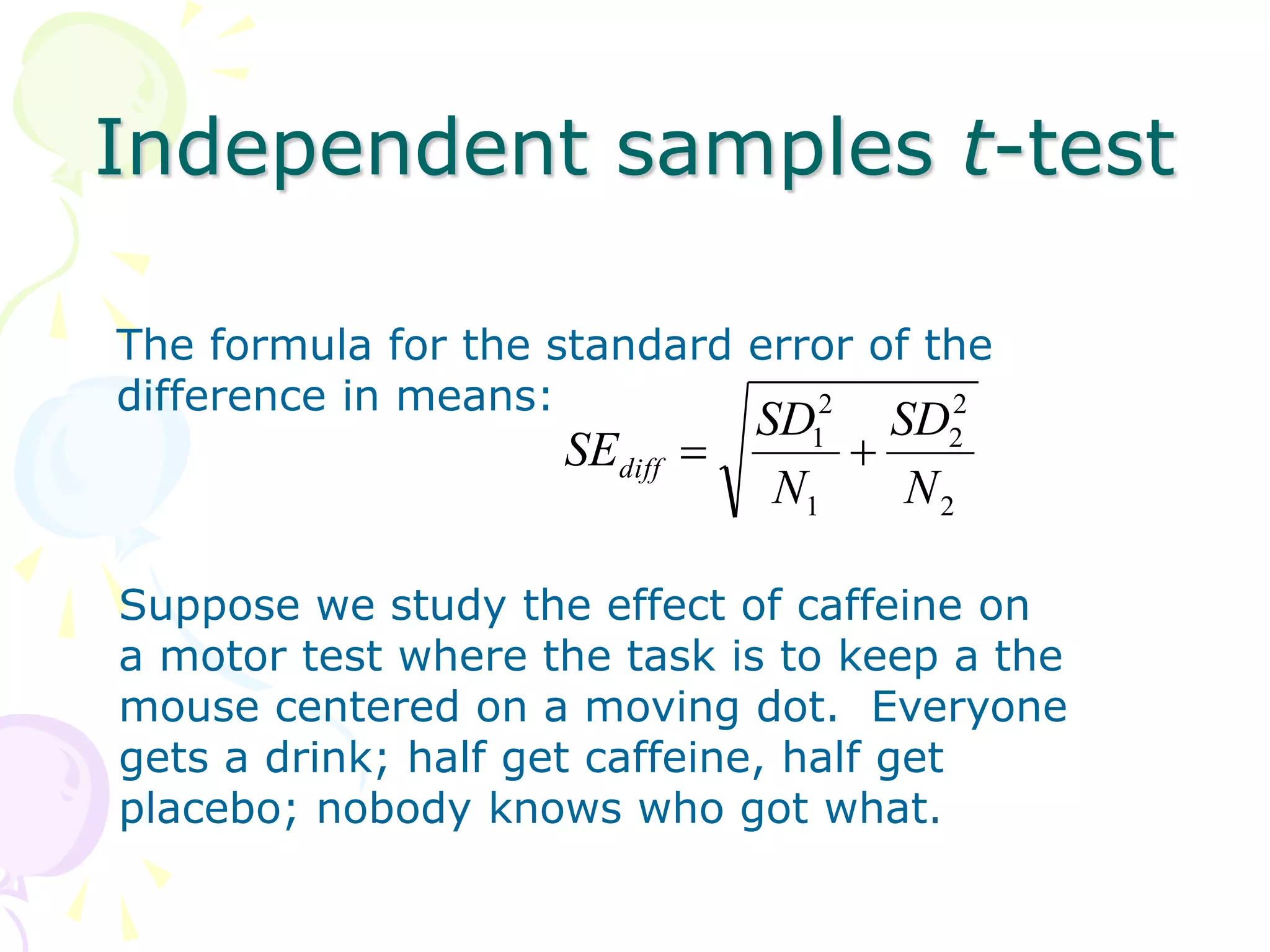
The formula for the standard error of the
difference in means:
2
2
2
1
2
1
N
SD
N
SD
SEdiff 

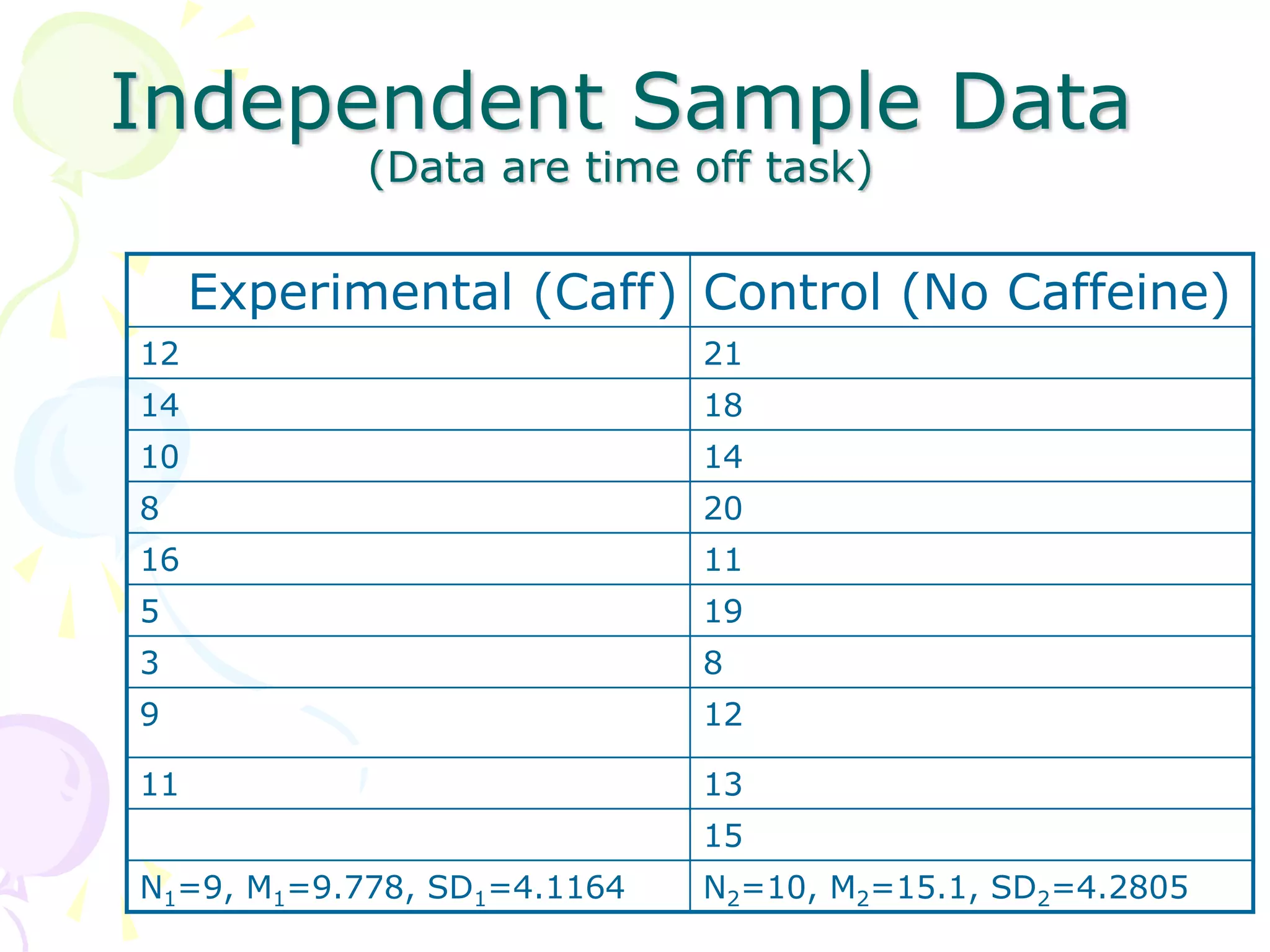
Suppose we study the effect of caffeine on
a motor test where the task is to keep a the
mouse centered on a moving dot. Everyone
gets a drink; half get caffeine, half get
placebo; nobody knows who got what.
Independent Sample Data
(Data are time off task)
Experimental (Caff) Control (No Caffeine)
12 21
14 18
10 14
8 20
16 11
5 19
3 8
9 12
11 13
15
N1=9, M1=9.778, SD1=4.1164 N2=10, M2=15.1, SD2=4.2805
Independent Sample
Steps(1)
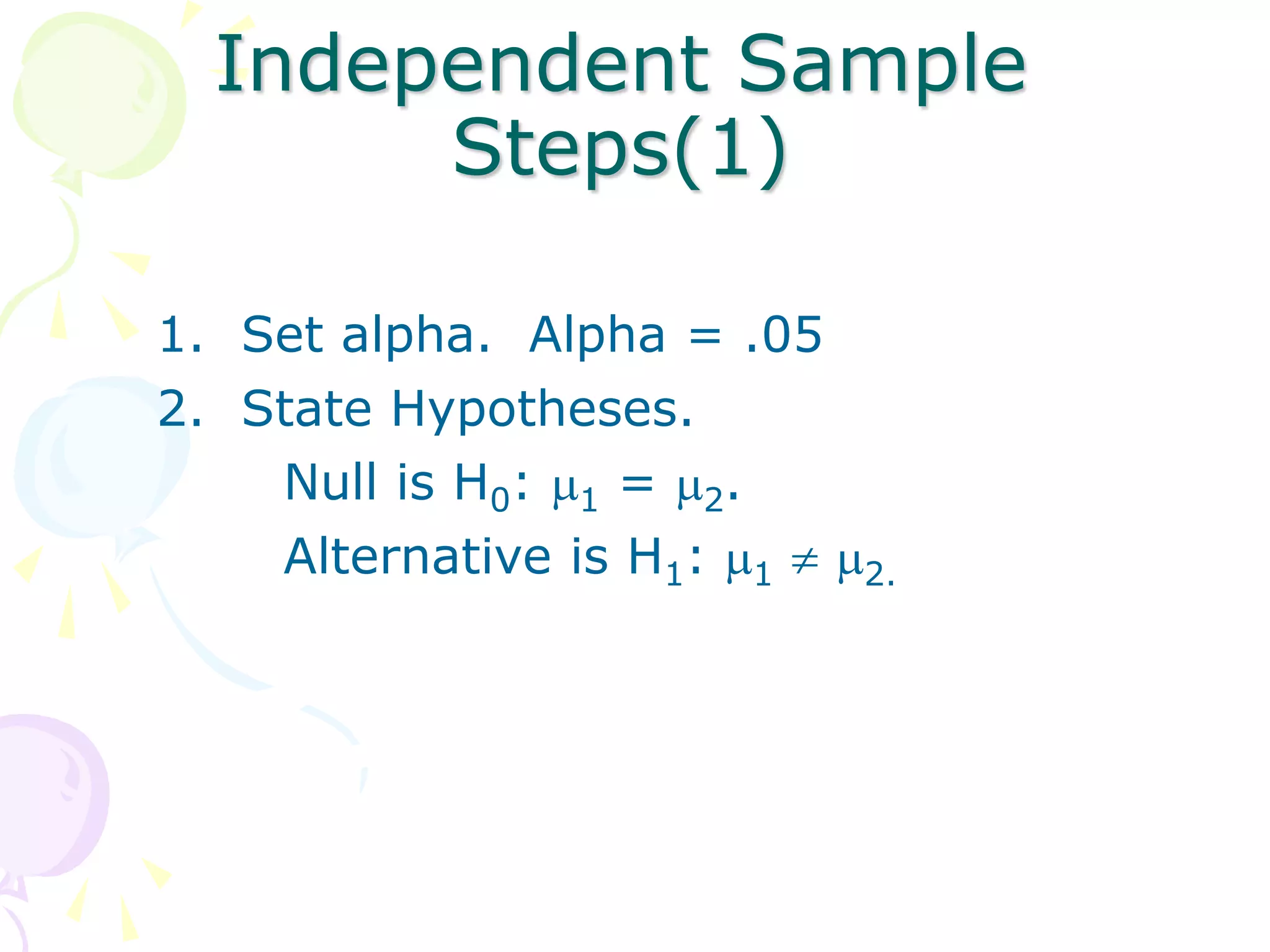
1. Set alpha. Alpha = .05
2. State Hypotheses.
Null is H0: 1 = 2.
Alternative is H1: 1  2.
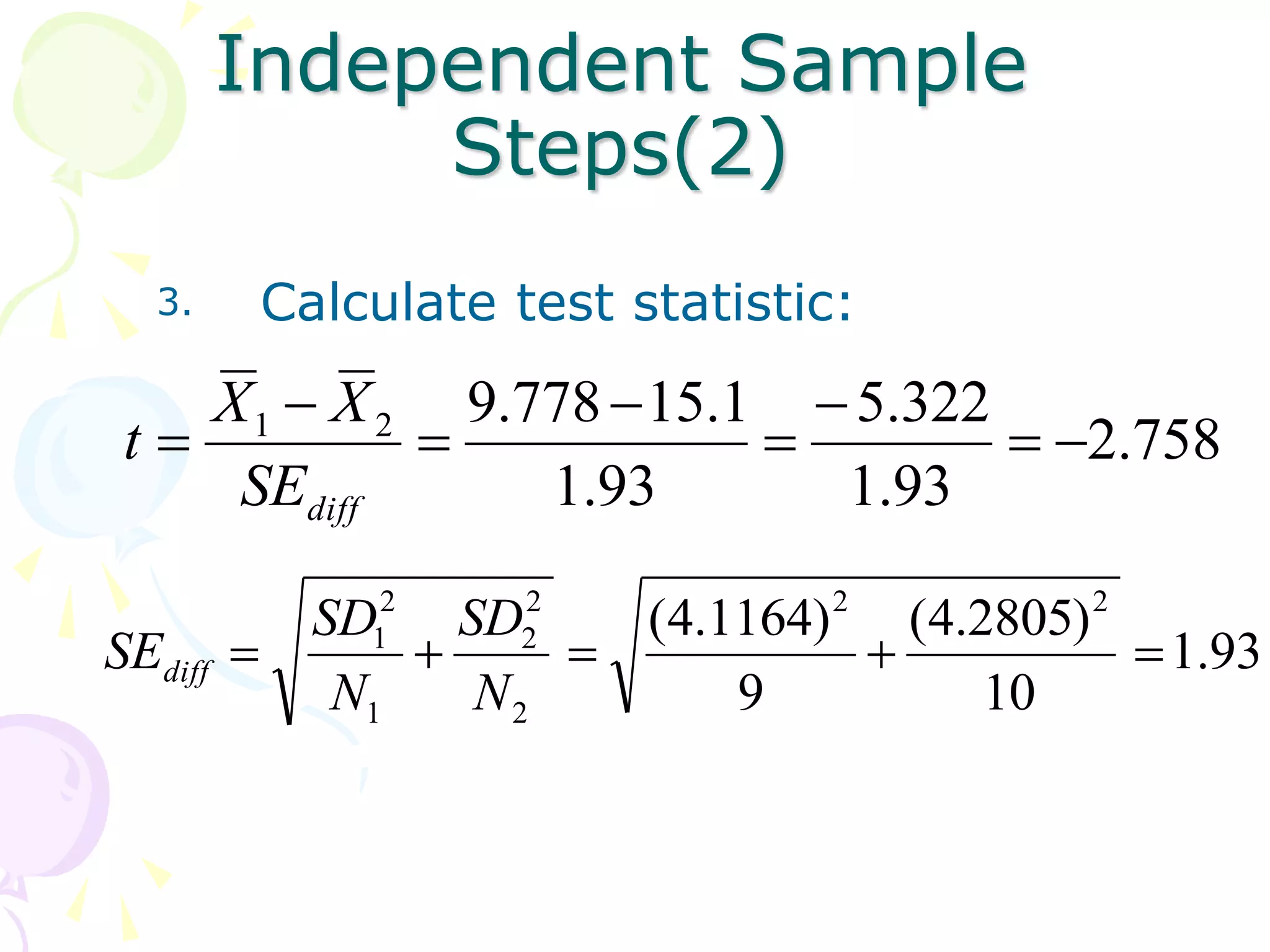
Independent Sample
Steps(2)
3. Calculate test statistic:
93
.
1
10
)
2805
.
4
(
9
)
1164
.
4
( 2
2
2
2
2
1
2
1





N
SD
N
SD
SEdiff
758
.
2
93
.
1
322
.
5
93
.
1
1
.
15
778
.
9
2
1








diff
SE
X
X
t
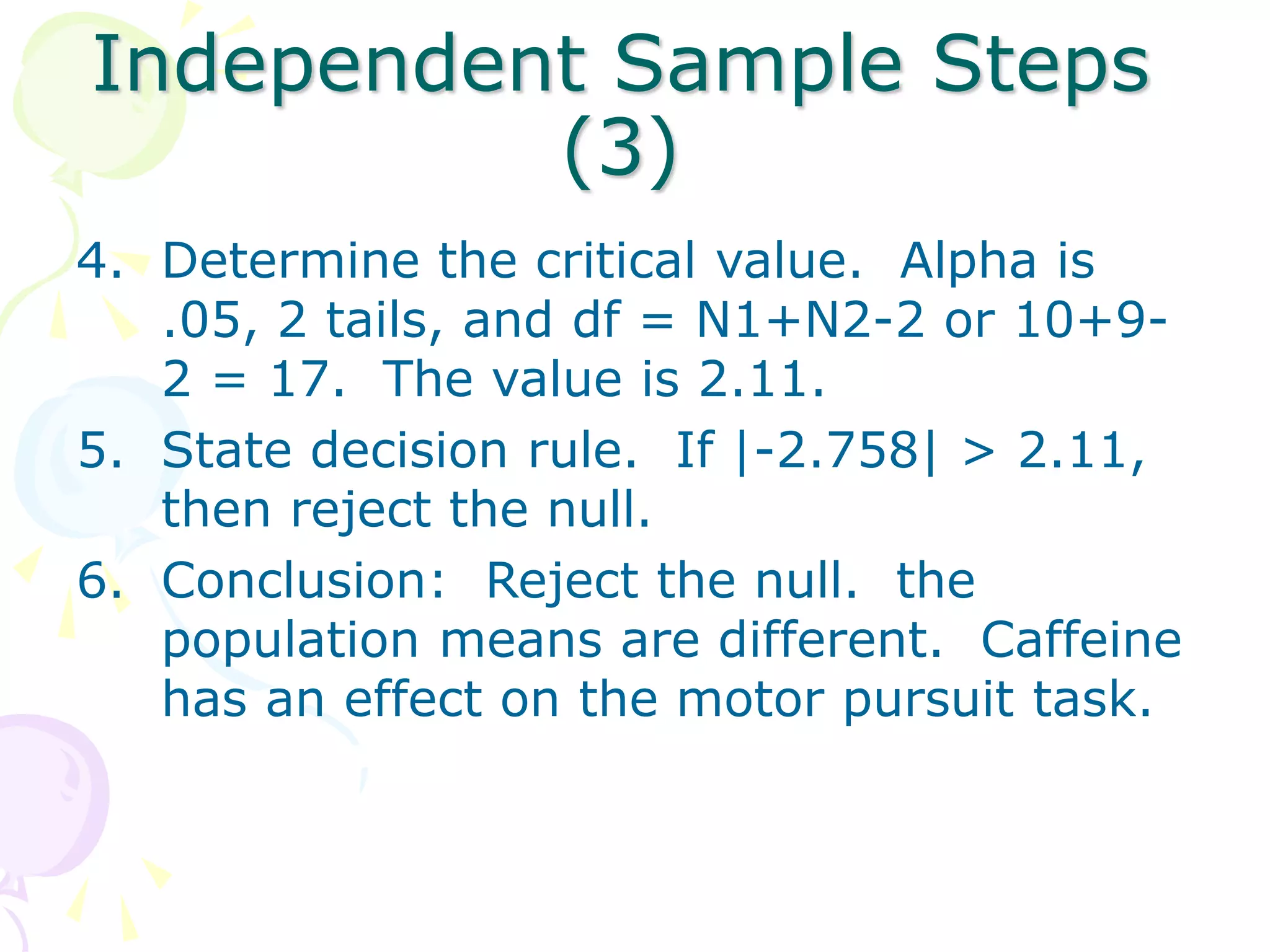
Independent Sample Steps
(3)
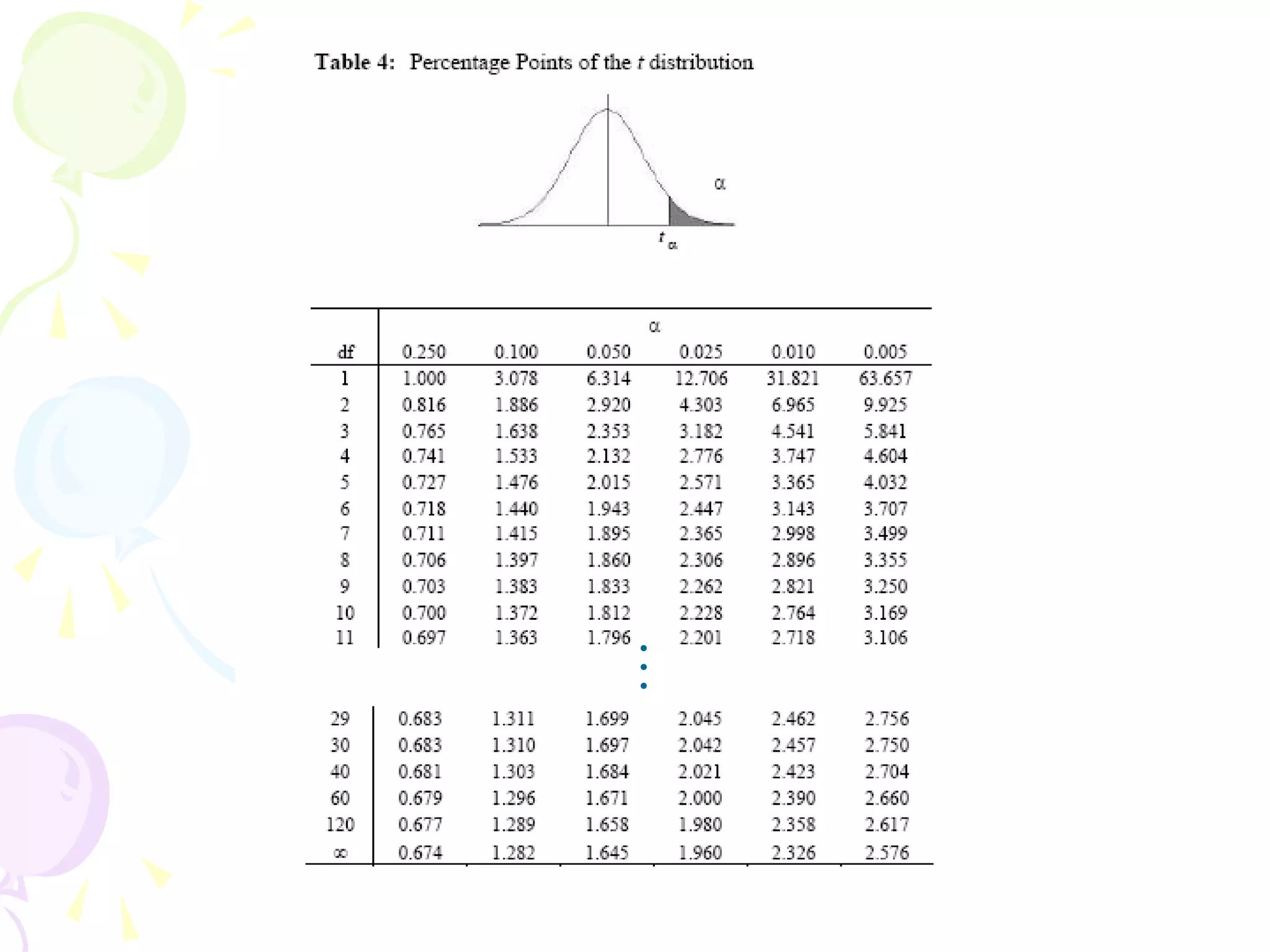
4. Determine the critical value. Alpha is
.05, 2 tails, and df = N1+N2-2 or 10+9-
2 = 17. The value is 2.11.
5. State decision rule. If |-2.758| > 2.11,
then reject the null.
6. Conclusion: Reject the null. the
population means are different. Caffeine
has an effect on the motor pursuit task.
…
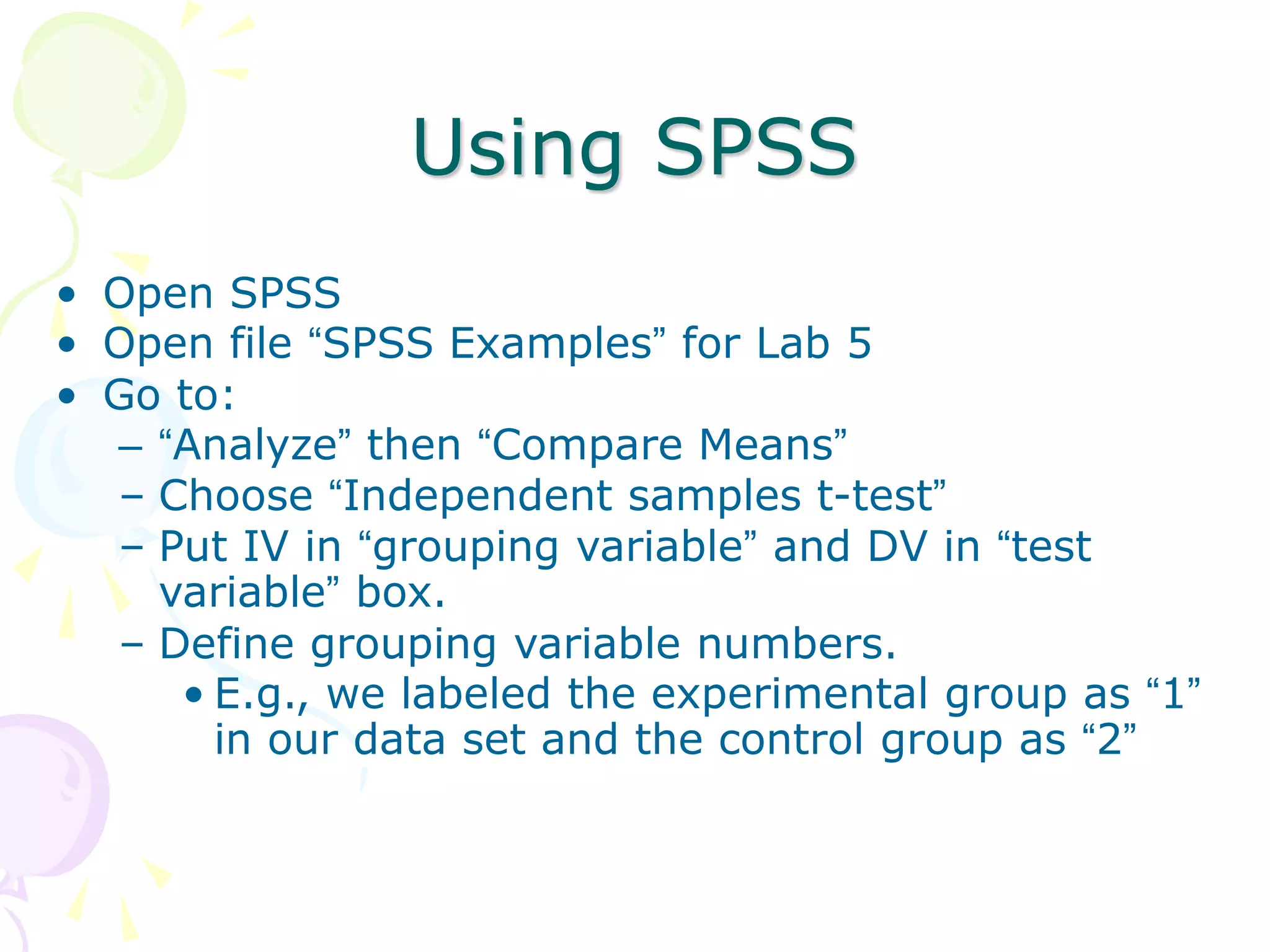
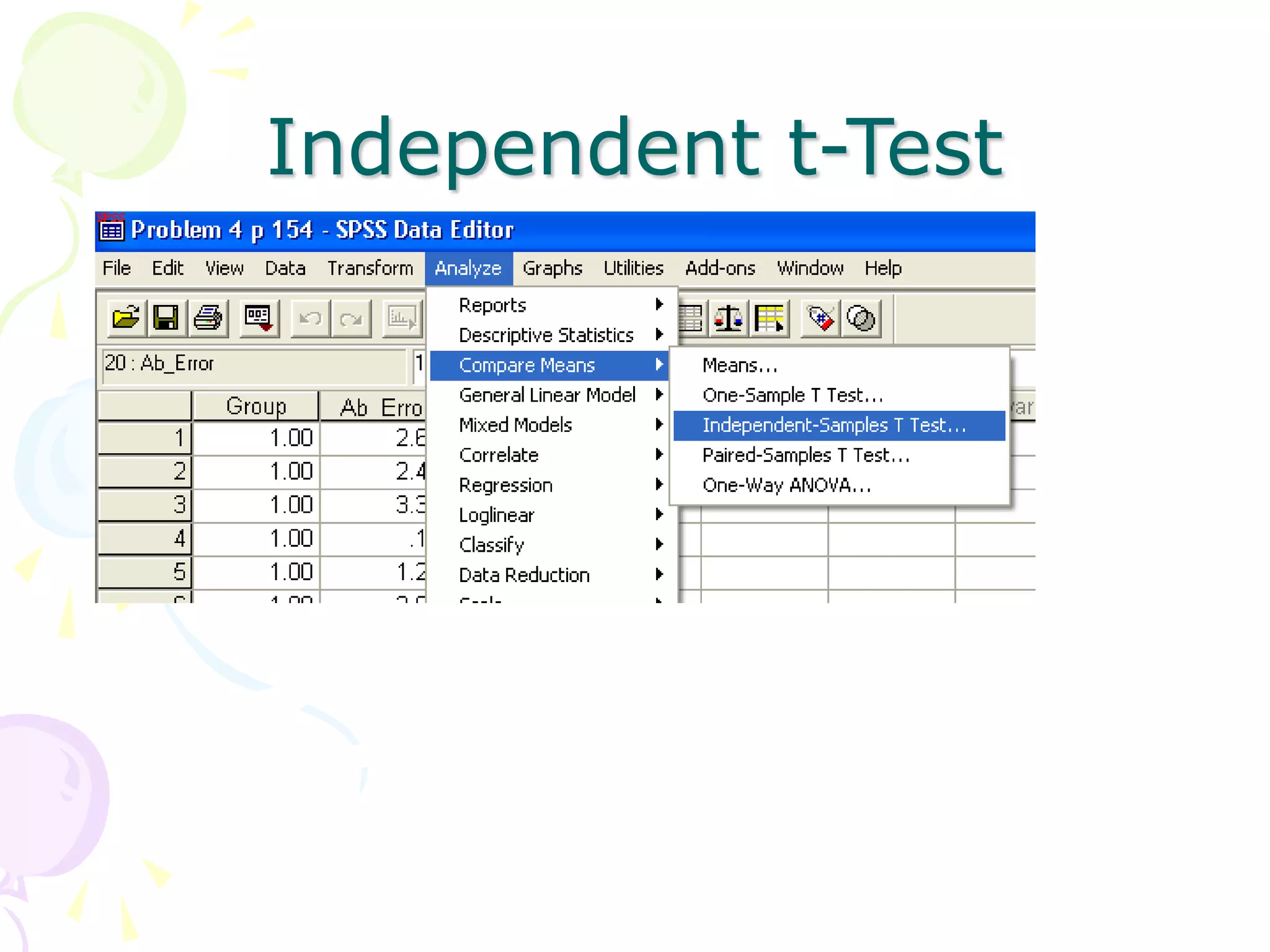
Using SPSS
• Open SPSS
• Open file “SPSS Examples” for Lab 5
• Go to:
– “Analyze” then “Compare Means”
– Choose “Independent samples t-test”
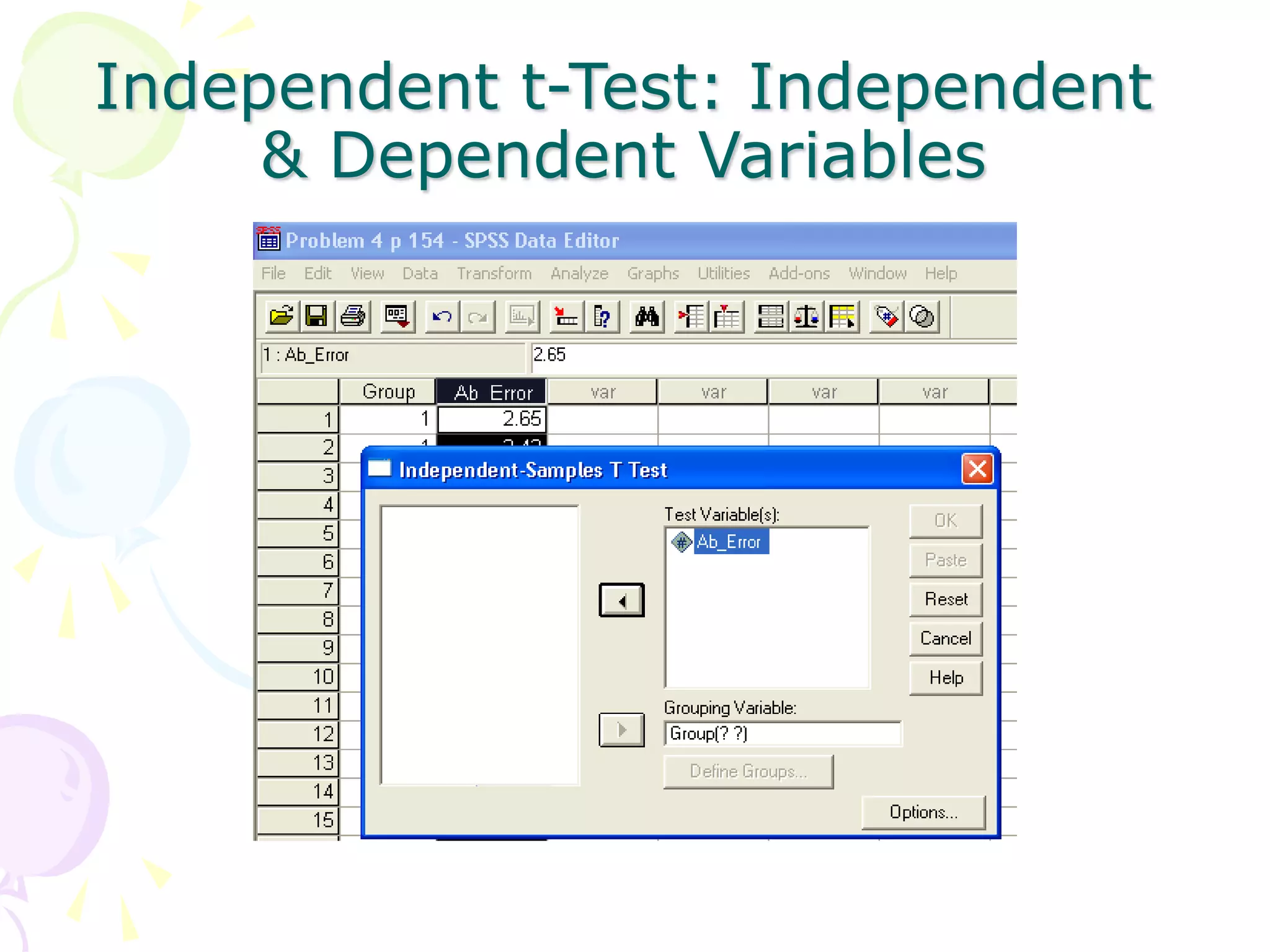
– Put IV in “grouping variable” and DV in “test
variable” box.
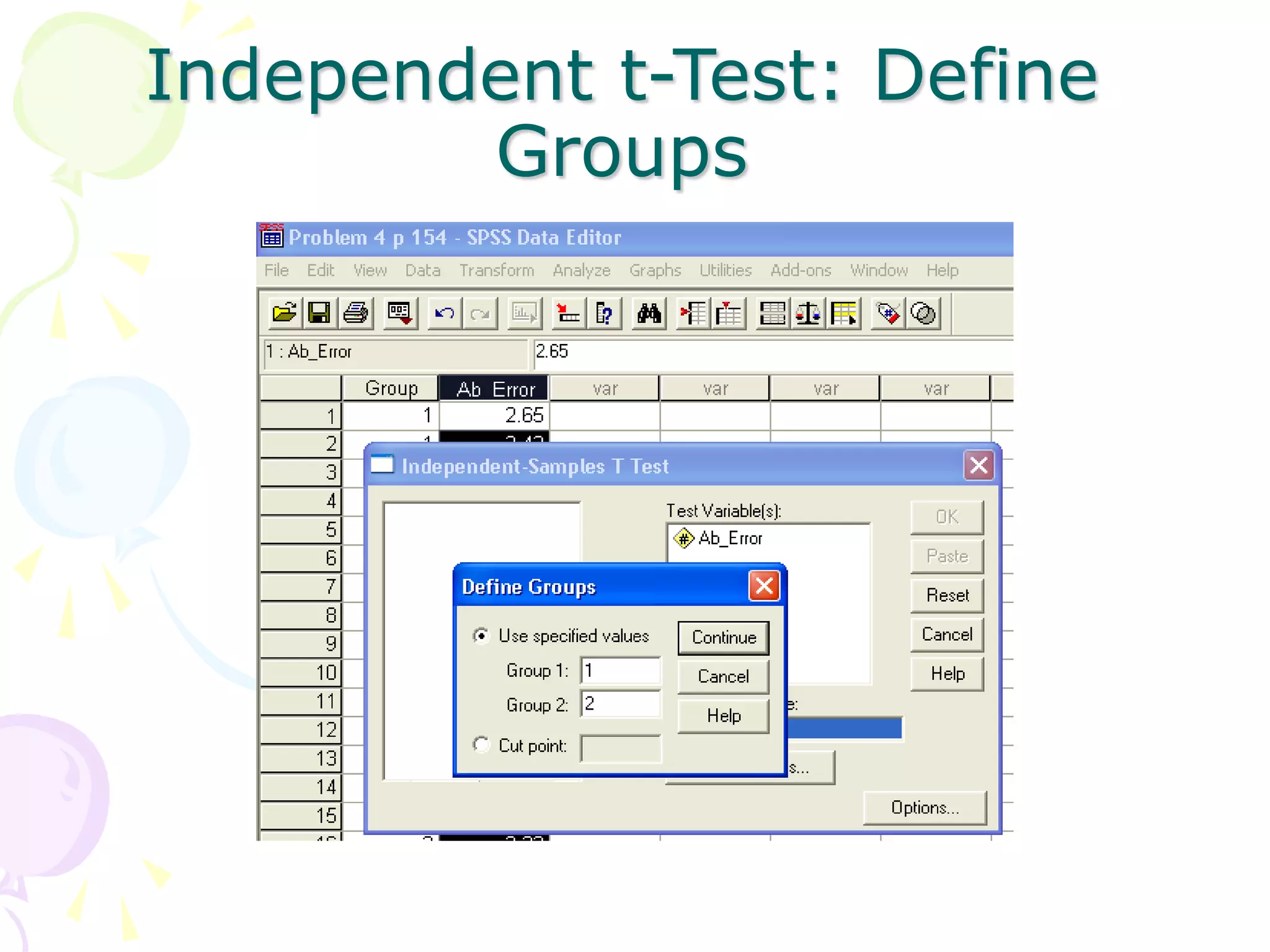
– Define grouping variable numbers.
• E.g., we labeled the experimental group as “1”
in our data set and the control group as “2”
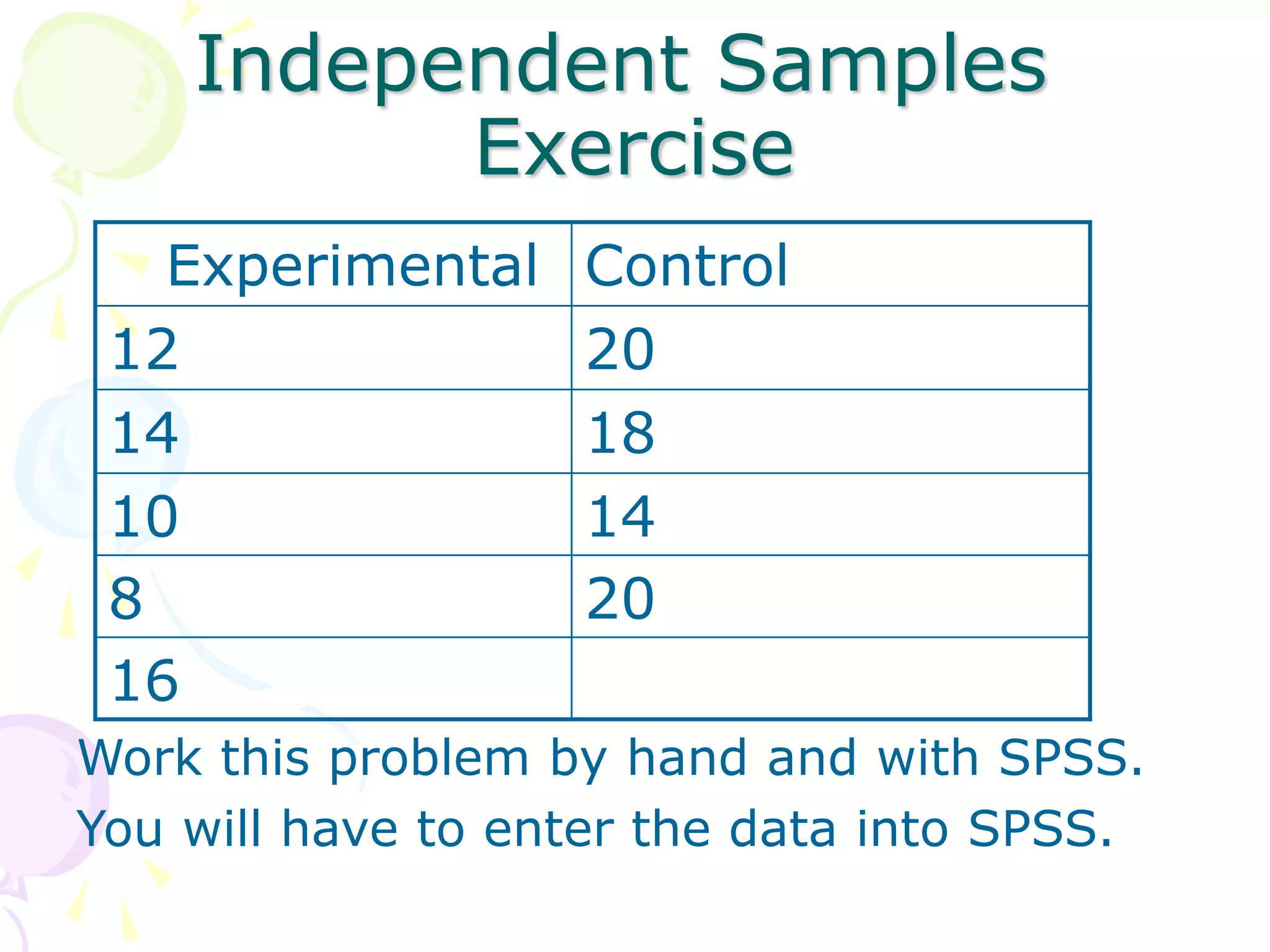
Independent Samples
Exercise
Experimental Control
12 20
14 18
10 14
8 20
16
Work this problem by hand and with SPSS.
You will have to enter the data into SPSS.
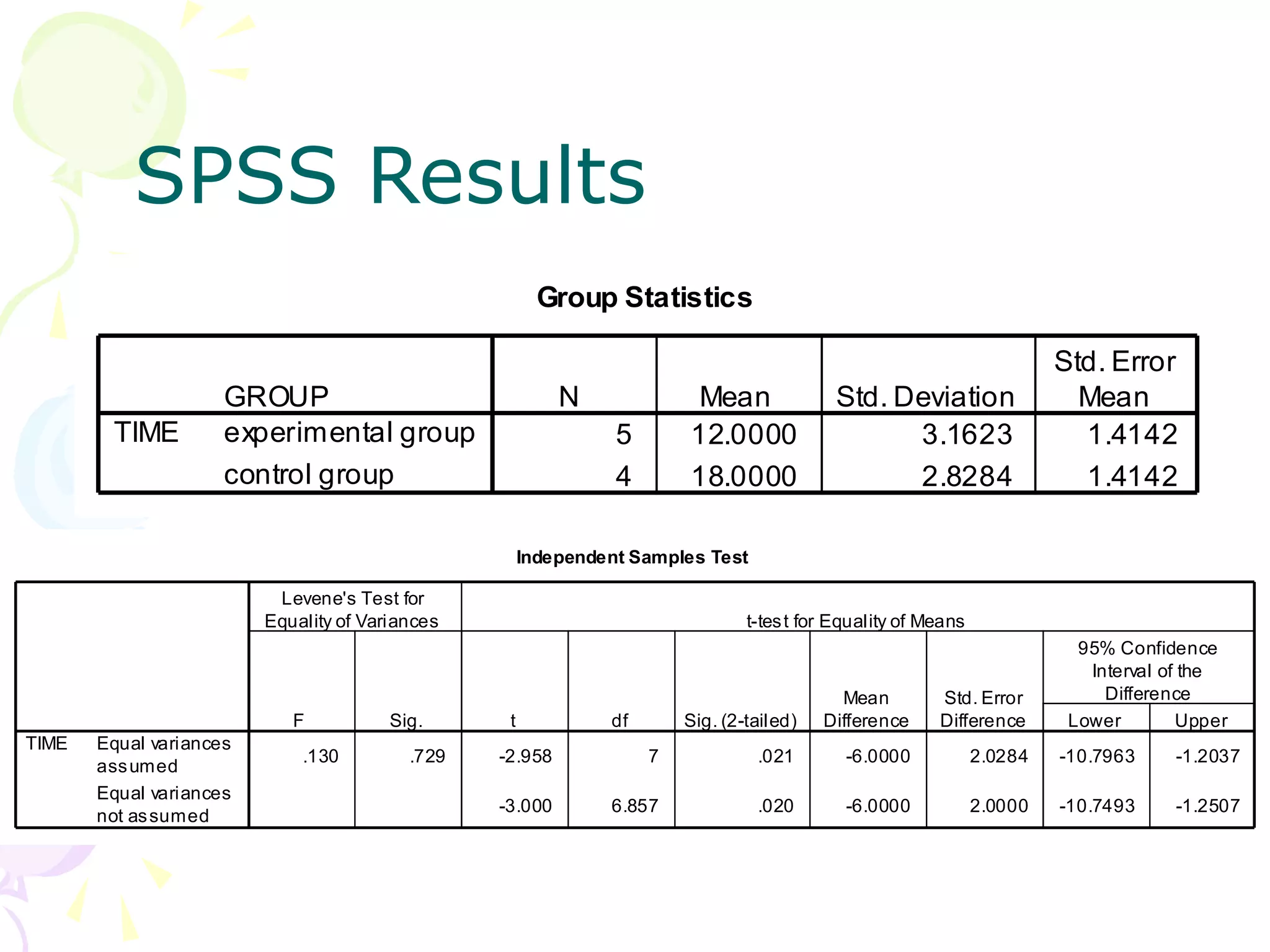
Group Statistics
5 12.0000 3.1623 1.4142
4 18.0000 2.8284 1.4142
GROUP
experimental group
control group
TIME
N Mean Std. Deviation
Std. Error
Mean
Independent Samples Test
.130 .729 -2.958 7 .021 -6.0000 2.0284 -10.7963 -1.2037
-3.000 6.857 .020 -6.0000 2.0000 -10.7493 -1.2507
Equal variances
assumed
Equal variances
not assumed
TIME
F Sig.
Levene's Test for
Equality of Variances
t df Sig. (2-tailed)
Mean
Difference
Std. Error
Difference Lower Upper
95% Confidence
Interval of the
Difference
t-test for Equality of Means
SPSS Results
Dependent
Samples
t-tests
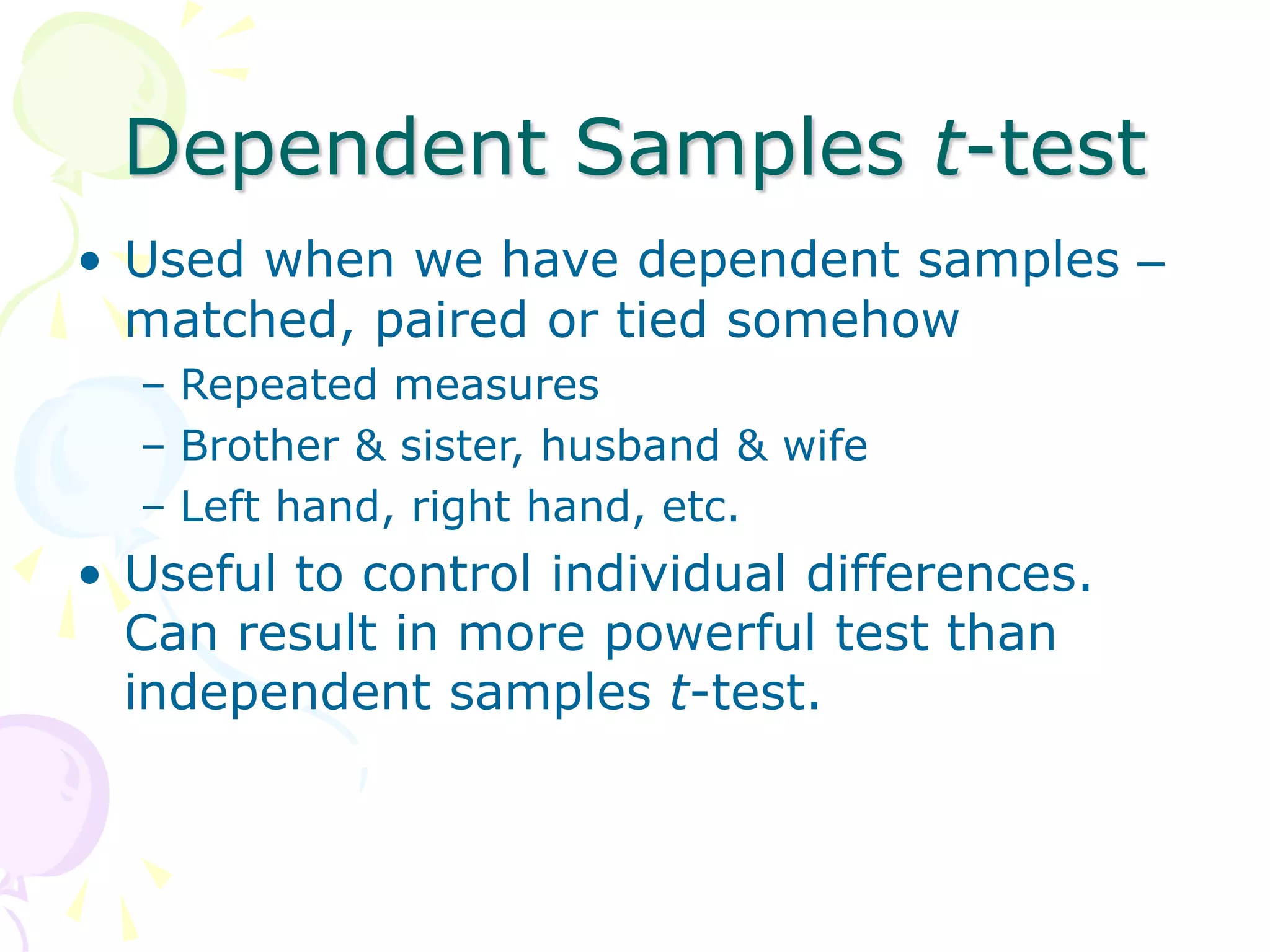
Dependent Samples t-test
• Used when we have dependent samples –
matched, paired or tied somehow
– Repeated measures
– Brother & sister, husband & wife
– Left hand, right hand, etc.
• Useful to control individual differences.
Can result in more powerful test than
independent samples t-test.
Dependent Samples t
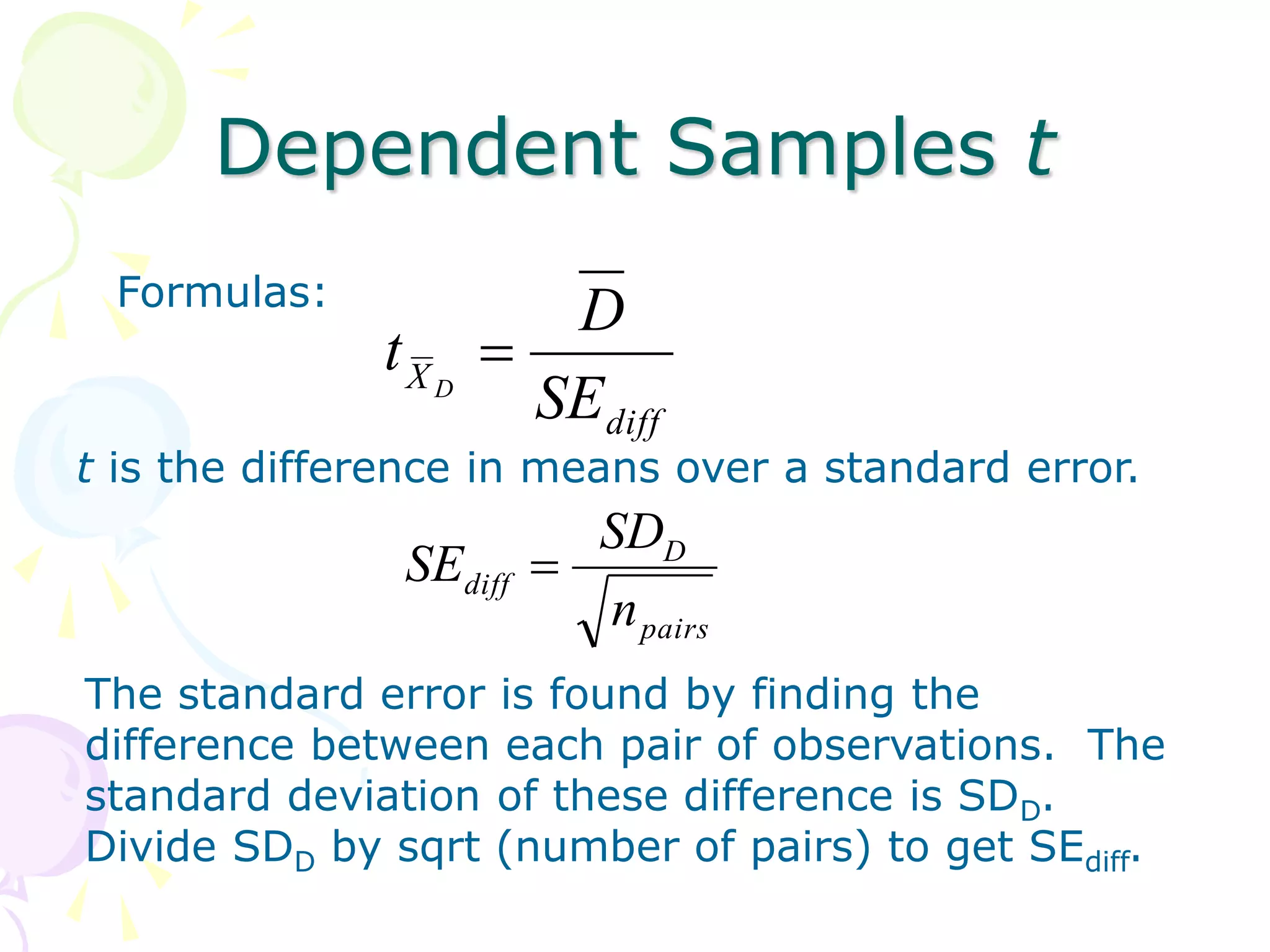
Formulas:
diff
X
SE
D
t D

t is the difference in means over a standard error.
pairs
D
diff
n
SD
SE 
The standard error is found by finding the
difference between each pair of observations. The
standard deviation of these difference is SDD.
Divide SDD by sqrt (number of pairs) to get SEdiff.
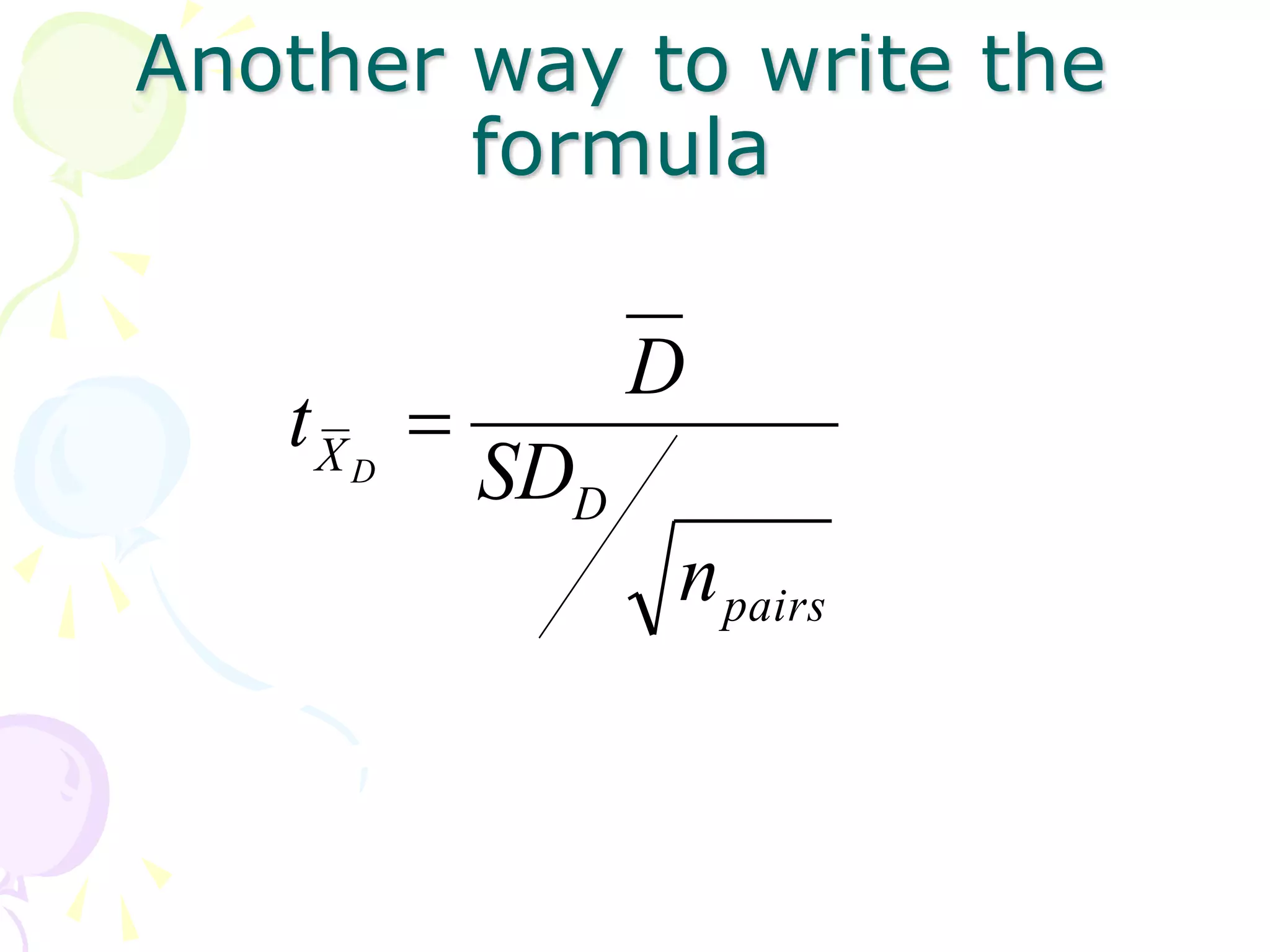
Another way to write the
formula
pairs
D
X
n
SD
D
t D

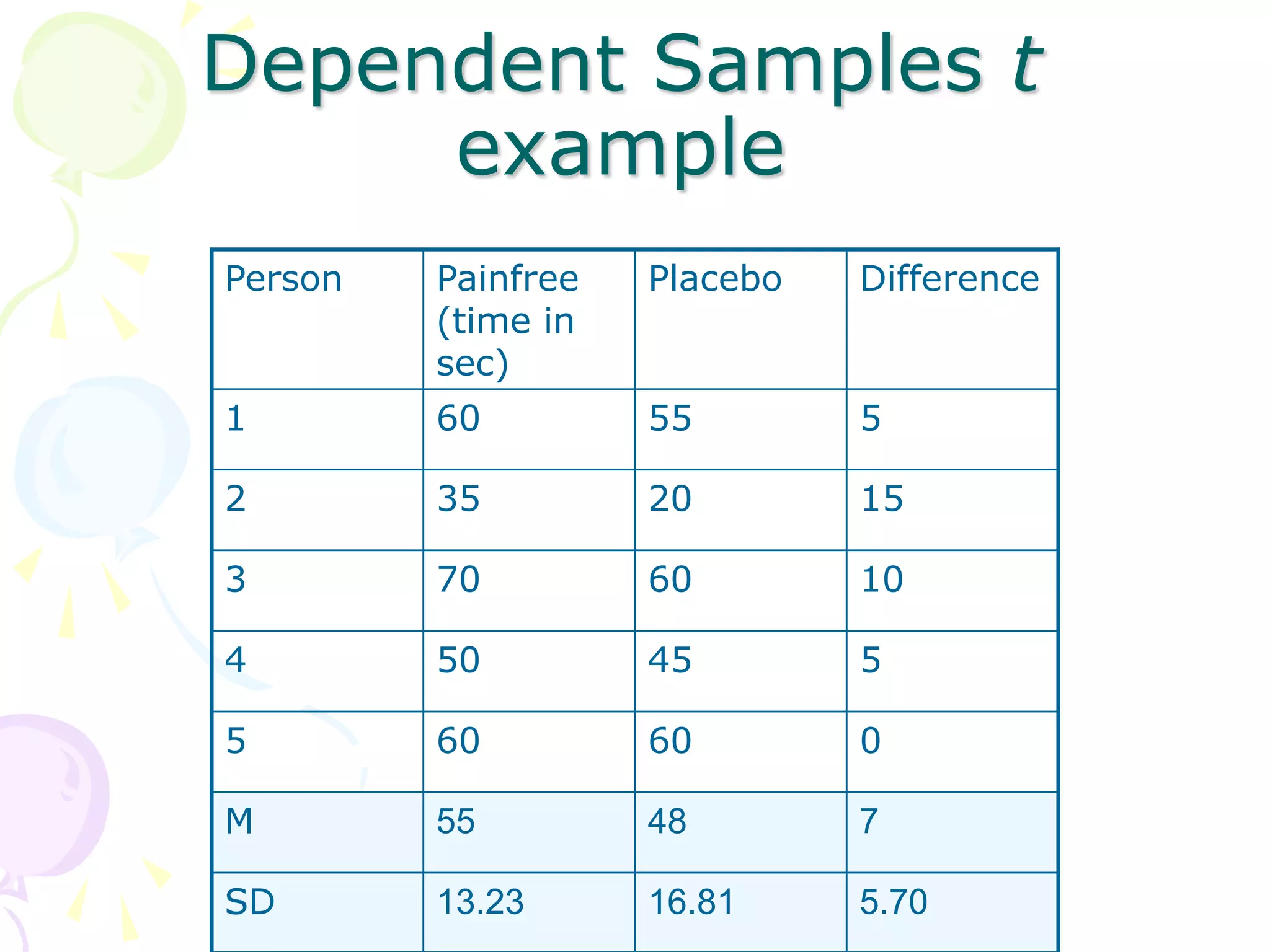
Dependent Samples t
example
Person Painfree
(time in
sec)
Placebo Difference
1 60 55 5
2 35 20 15
3 70 60 10
4 50 45 5
5 60 60 0
M 55 48 7
SD 13.23 16.81 5.70
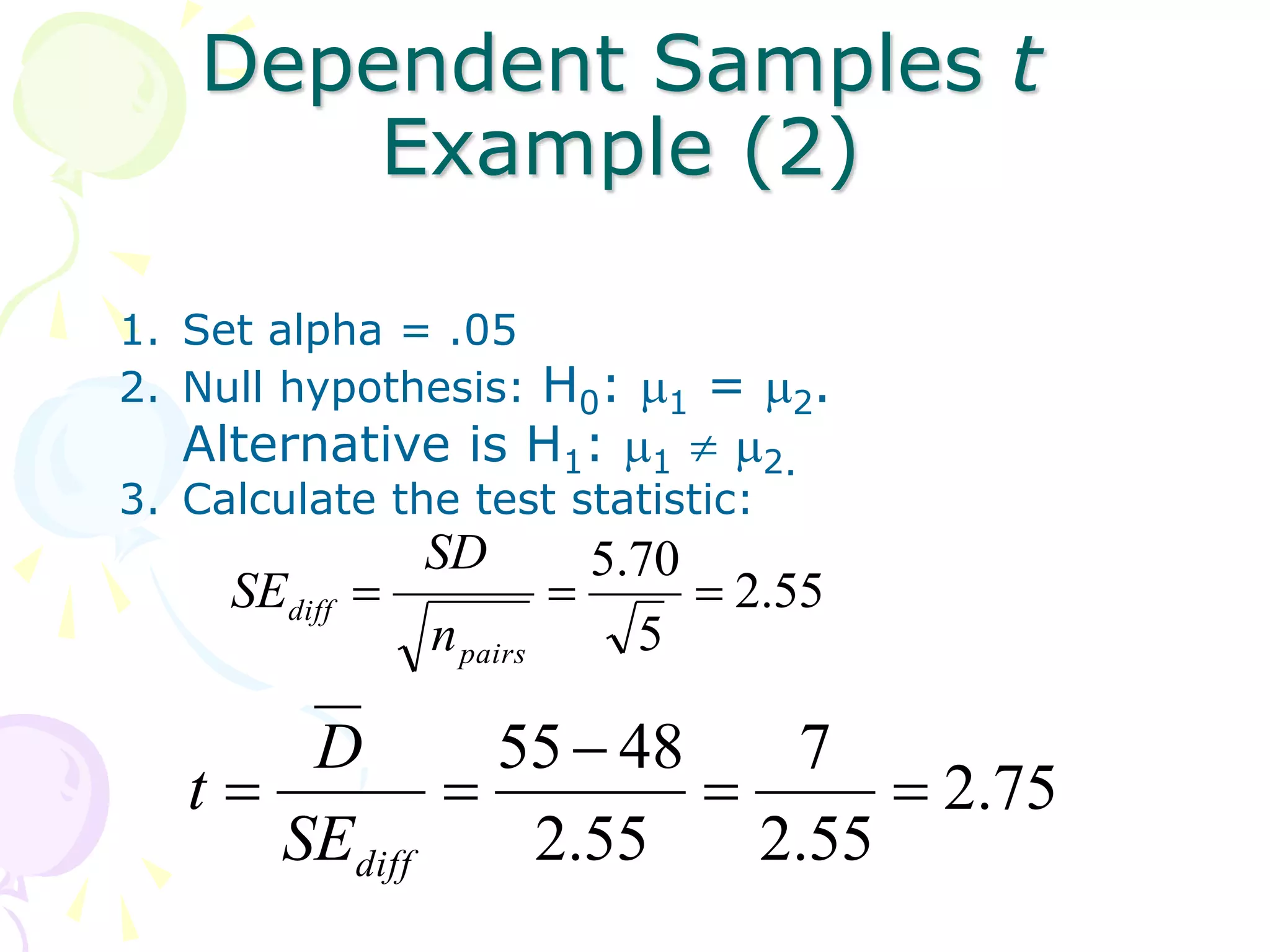
Dependent Samples t
Example (2)
55
.
2
5
70
.
5



pairs
diff
n
SD
SE
75
.
2
55
.
2
7
55
.
2
48
55





diff
SE
D
t
1. Set alpha = .05
2. Null hypothesis: H0: 1 = 2.
Alternative is H1: 1  2.
3. Calculate the test statistic:
Dependent Samples t
Example (3)
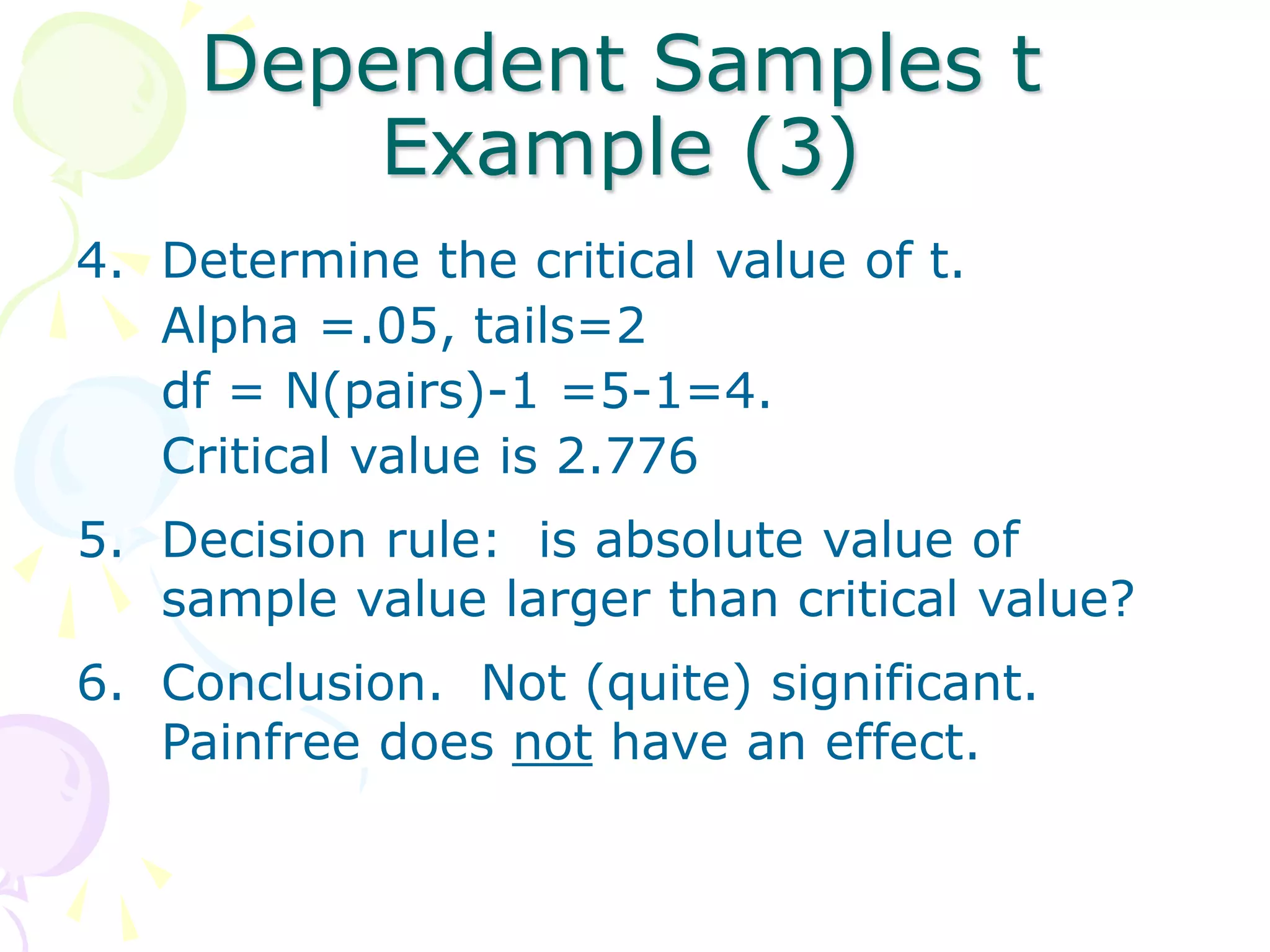
4. Determine the critical value of t.
Alpha =.05, tails=2
df = N(pairs)-1 =5-1=4.
Critical value is 2.776
5. Decision rule: is absolute value of
sample value larger than critical value?
6. Conclusion. Not (quite) significant.
Painfree does not have an effect.
Using SPSS for dependent t-
test
• Open SPSS
• Open file “SPSS Examples” (same as
before)
• Go to:
– “Analyze” then “Compare Means”
– Choose “Paired samples t-test”
– Choose the two IV conditions you are
comparing. Put in “paired variables box.”
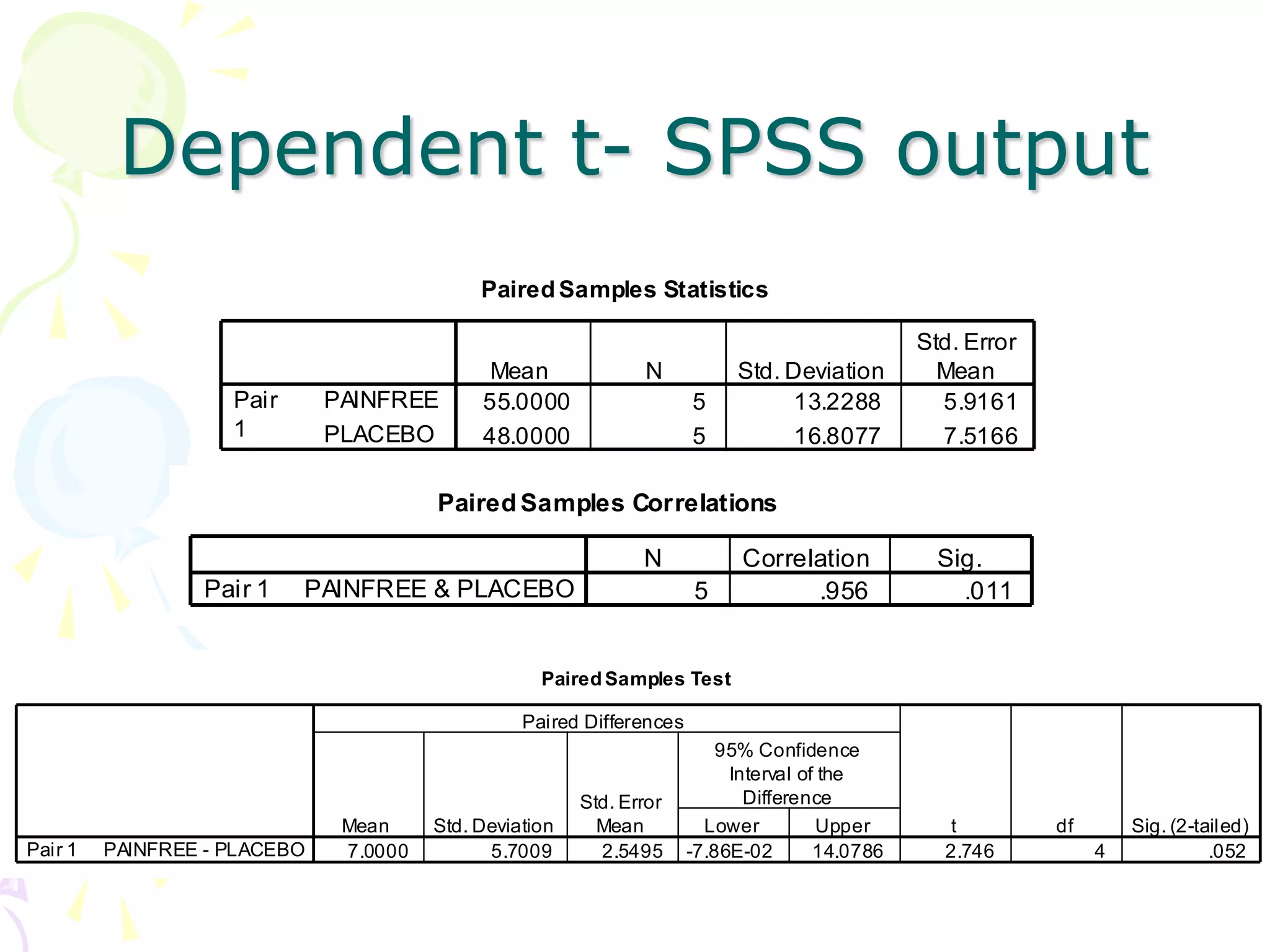
Dependent t- SPSS output
Paired Samples Statistics
55.0000 5 13.2288 5.9161
48.0000 5 16.8077 7.5166
PAINFREE
PLACEBO
Pair
1
Mean N Std. Deviation
Std. Error
Mean
Paired Samples Correlations
5 .956 .011
PAINFREE & PLACEBO
Pair 1
N Correlation Sig.
Paired Samples Test
7.0000 5.7009 2.5495 -7.86E-02 14.0786 2.746 4 .052
PAINFREE - PLACEBO
Pair 1
Mean Std. Deviation
Std. Error
Mean Lower Upper
95% Confidence
Interval of the
Difference
Paired Differences
t df Sig. (2-tailed)
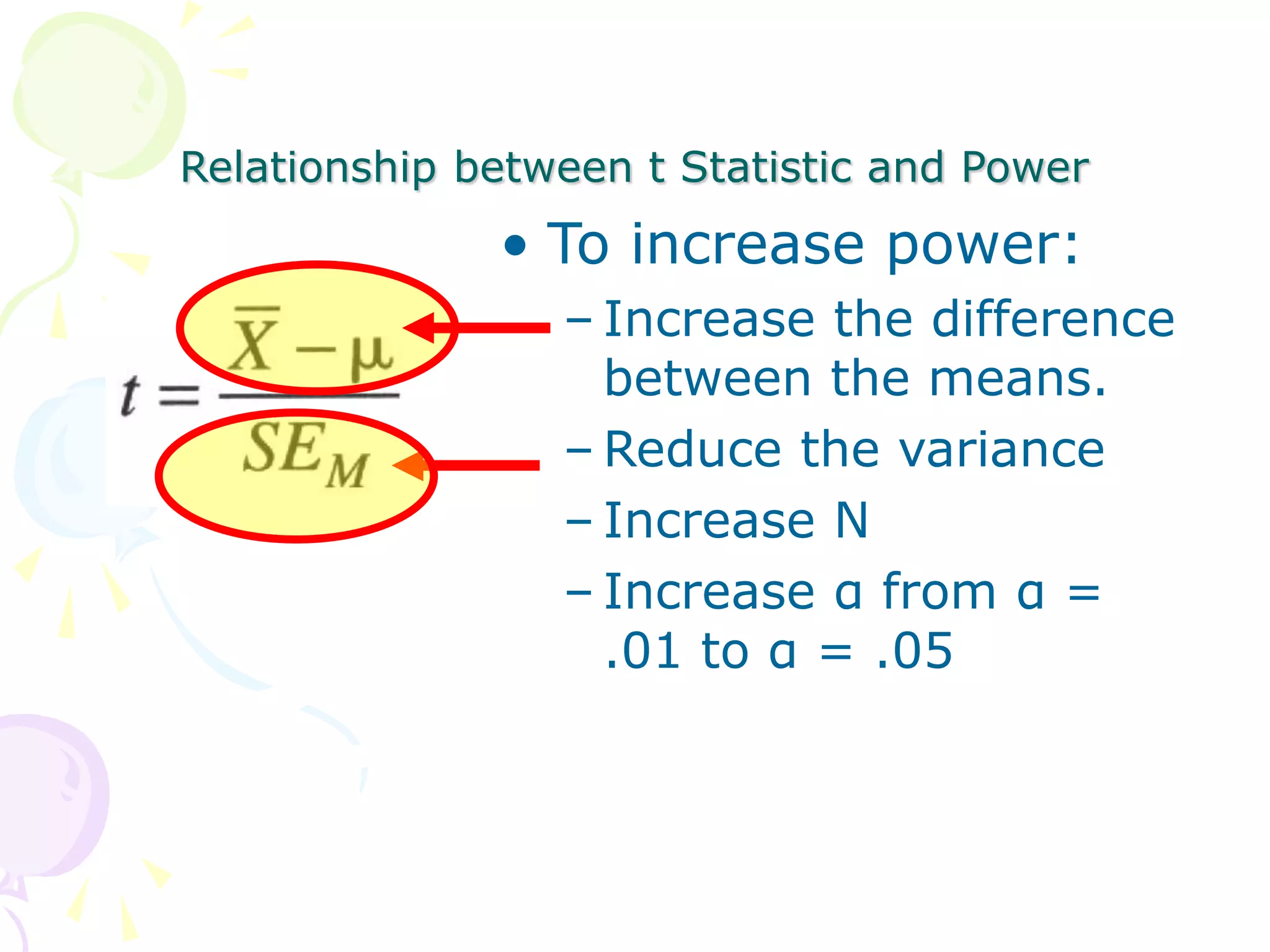
Relationship between t Statistic and Power
• To increase power:
– Increase the difference
between the means.
– Reduce the variance
– Increase N
– Increase α from α =
.01 to α = .05
To Increase Power
• Increase alpha, Power for α = .10 is
greater than power for α = .05
• Increase the difference between
means.
• Decrease the sd’s of the groups.
• Increase N.
Independent t-Test
Independent t-Test: Independent
& Dependent Variables
Independent t-Test: Define
Groups
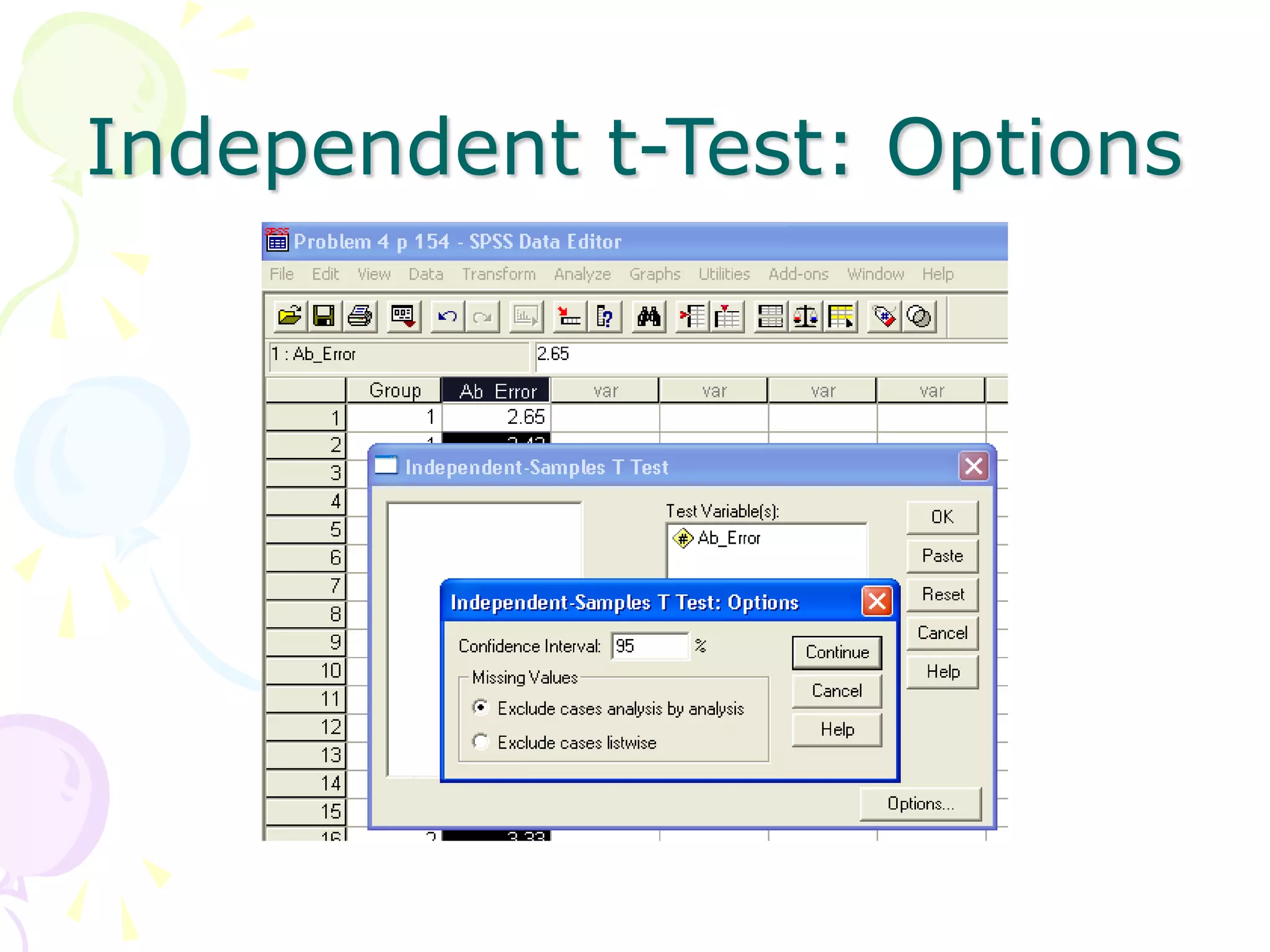
Independent t-Test: Options
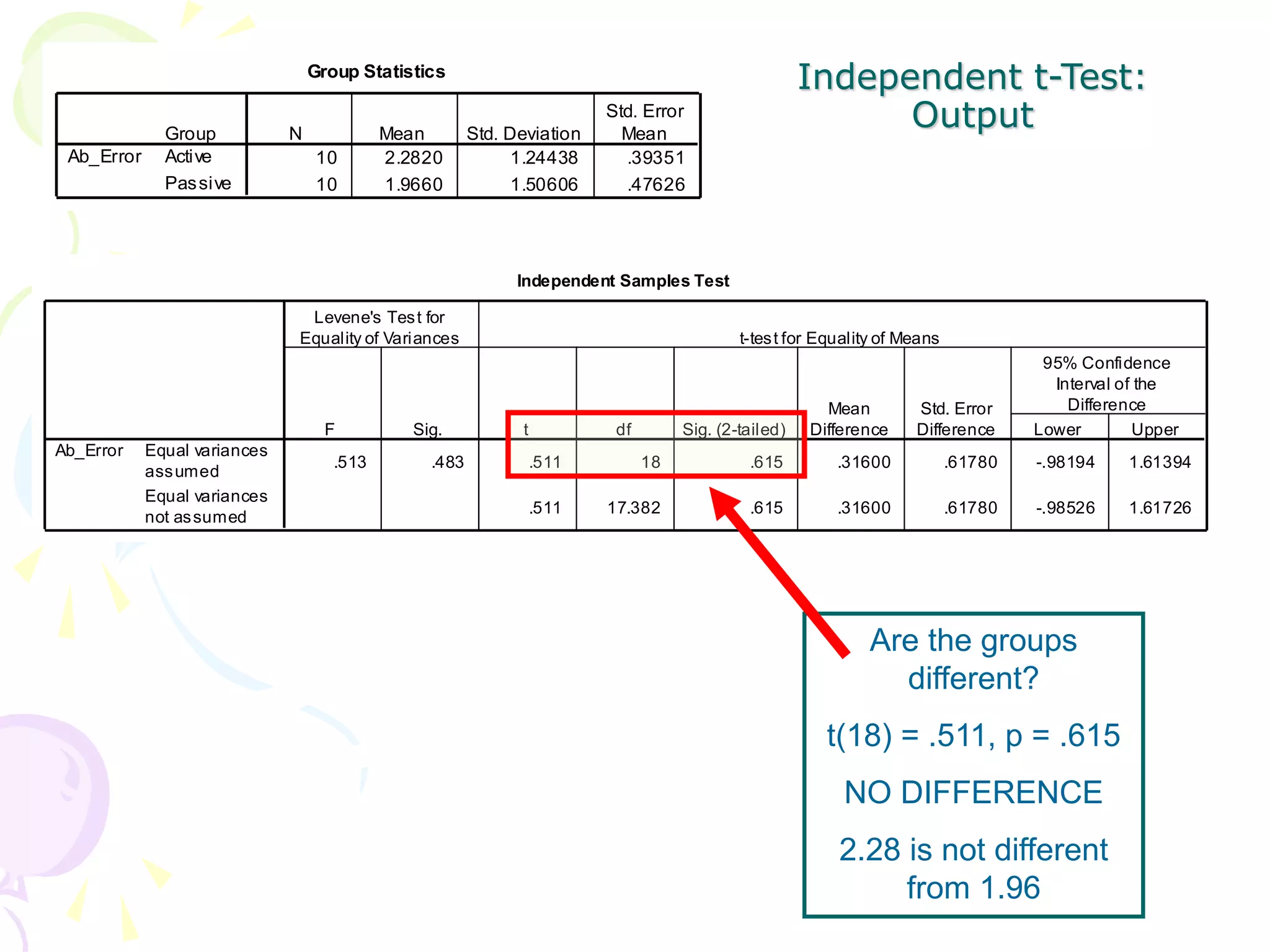
Independent t-Test:
Output
Group Statistics
10 2.2820 1.24438 .39351
10 1.9660 1.50606 .47626
Group
Active
Passive
Ab_Error
N Mean Std. Deviation
Std. Error
Mean
Independent Samples Test
.513 .483 .511 18 .615 .31600 .61780 -.98194 1.61394
.511 17.382 .615 .31600 .61780 -.98526 1.61726
Equal variances
assumed
Equal variances
not assumed
Ab_Error
F Sig.
Levene's Test for
Equality of Variances
t df Sig. (2-tailed)
Mean
Difference
Std. Error
Difference Lower Upper
95% Confidence
Interval of the
Difference
t-test for Equality of Means
Are the groups
different?
t(18) = .511, p = .615
NO DIFFERENCE
2.28 is not different
from 1.96
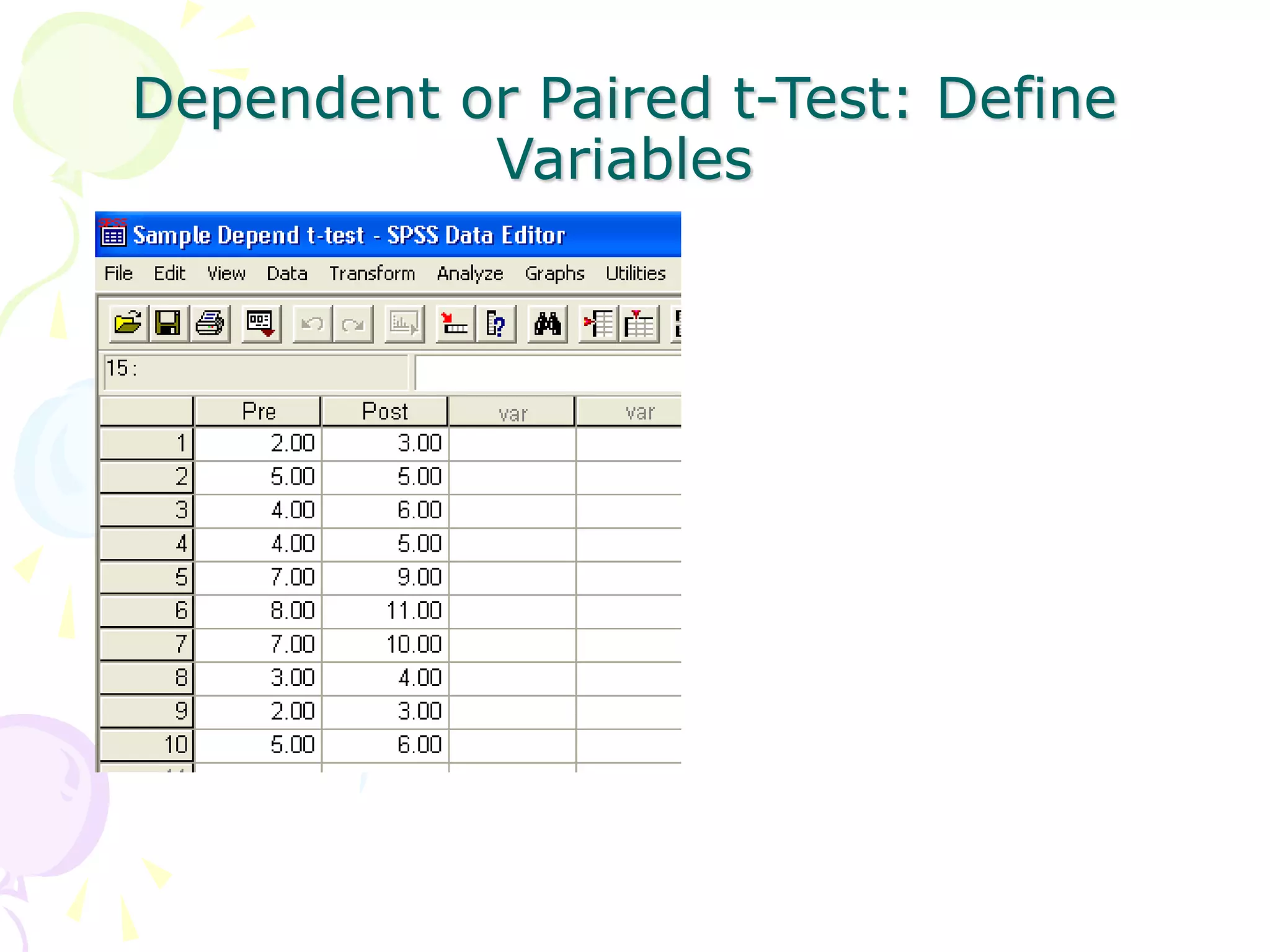
Dependent or Paired t-Test: Define
Variables
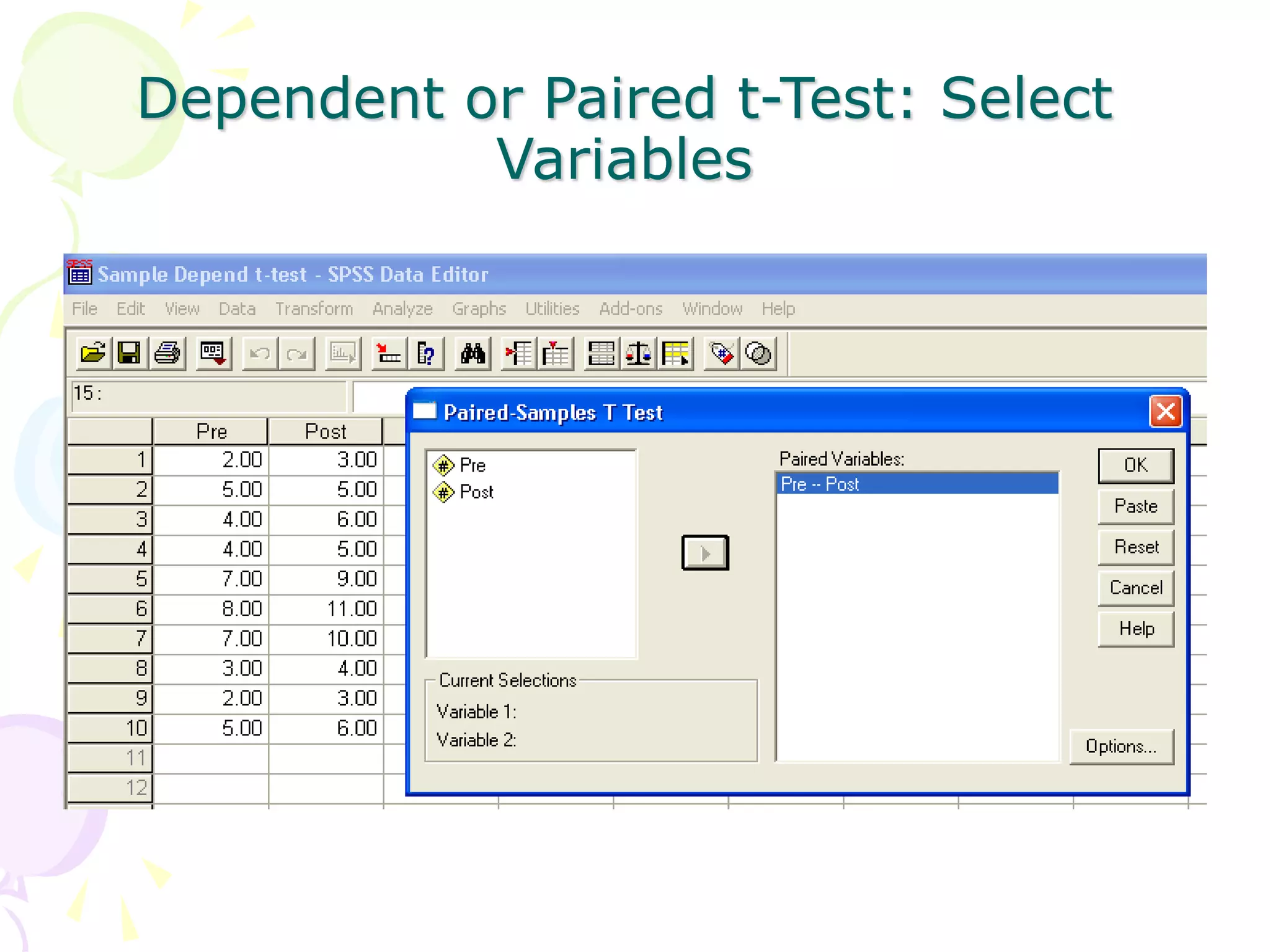
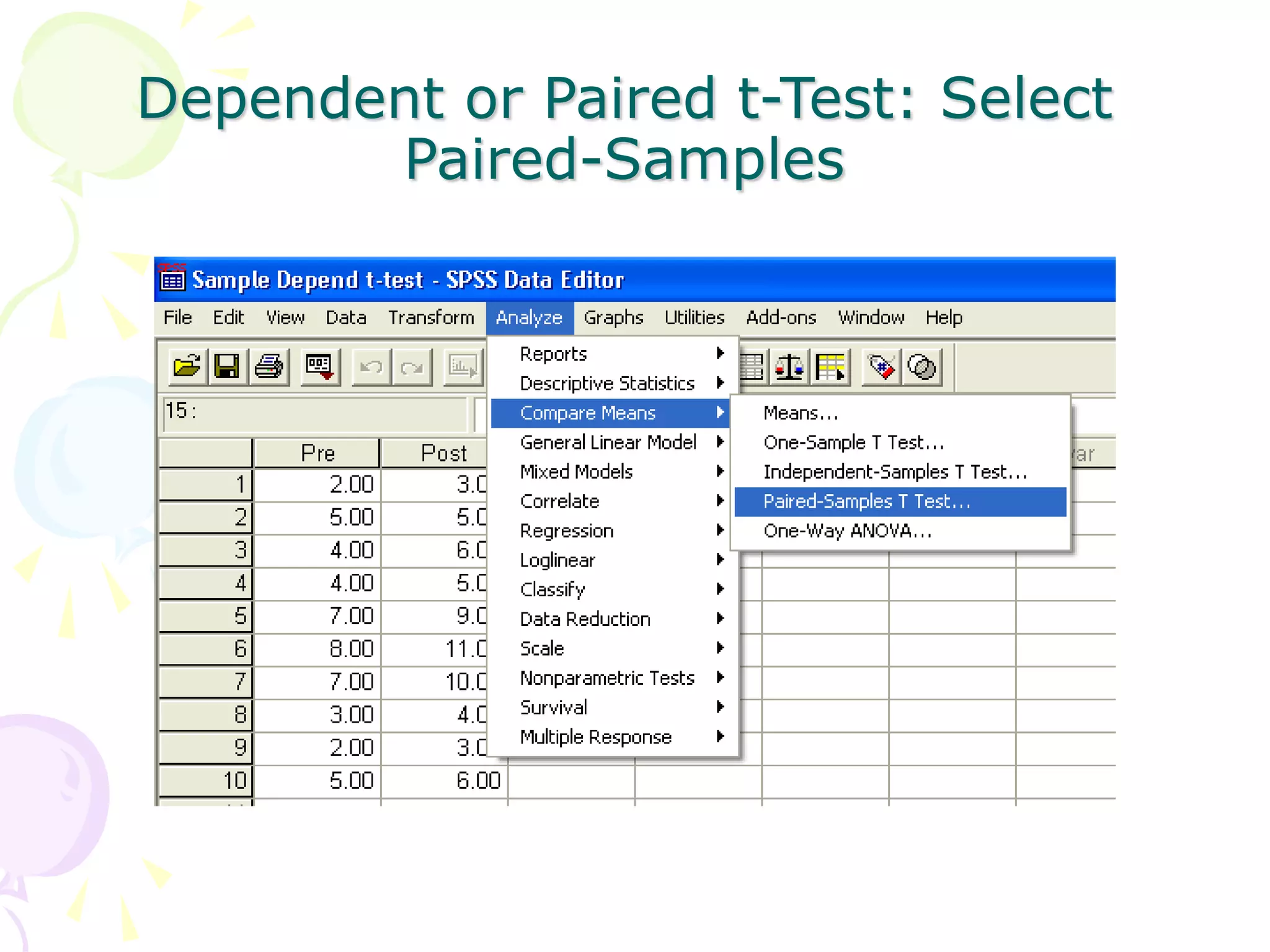
Dependent or Paired t-Test: Select
Paired-Samples
Dependent or Paired t-Test: Select
Variables
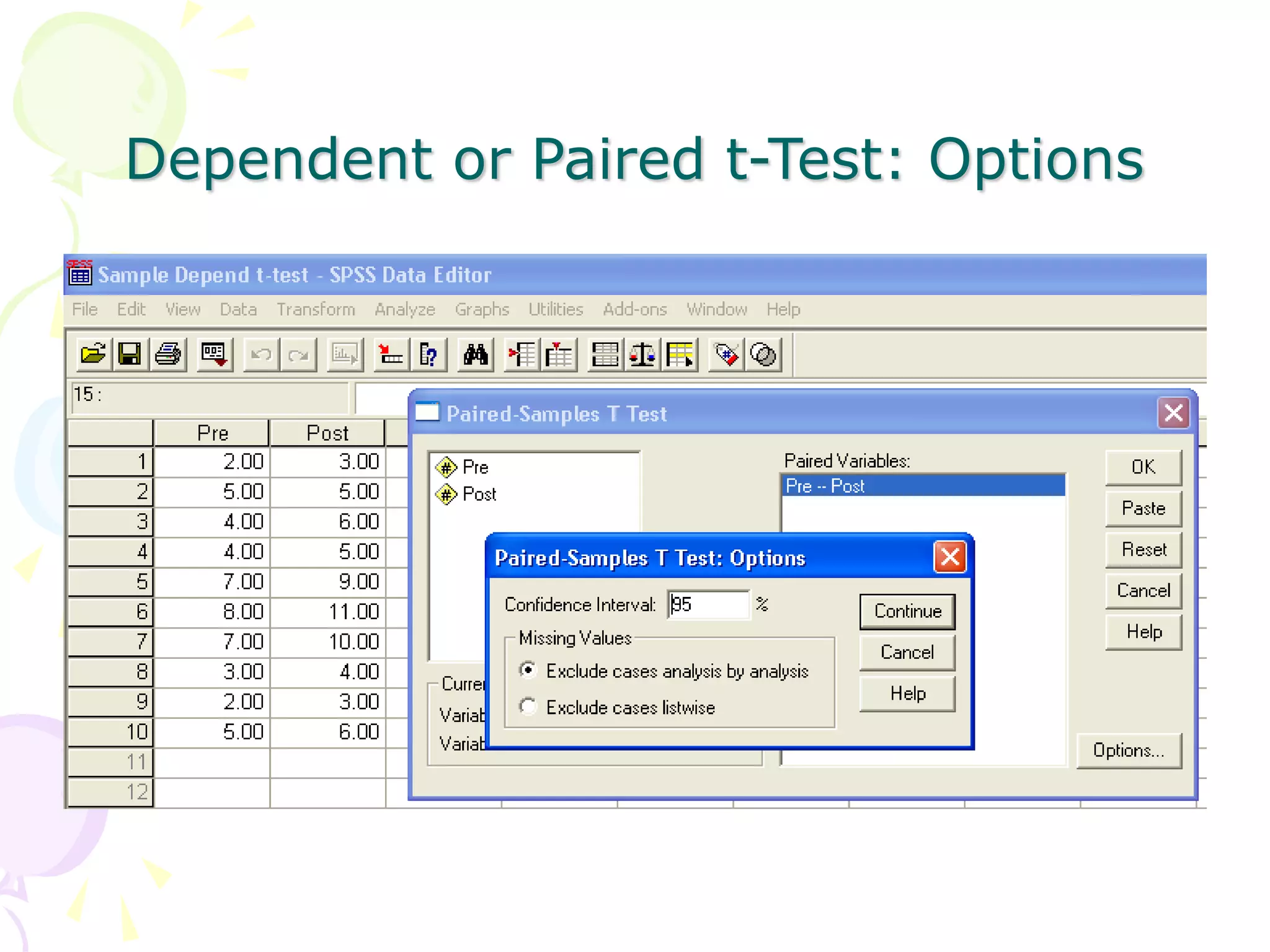
Dependent or Paired t-Test: Options
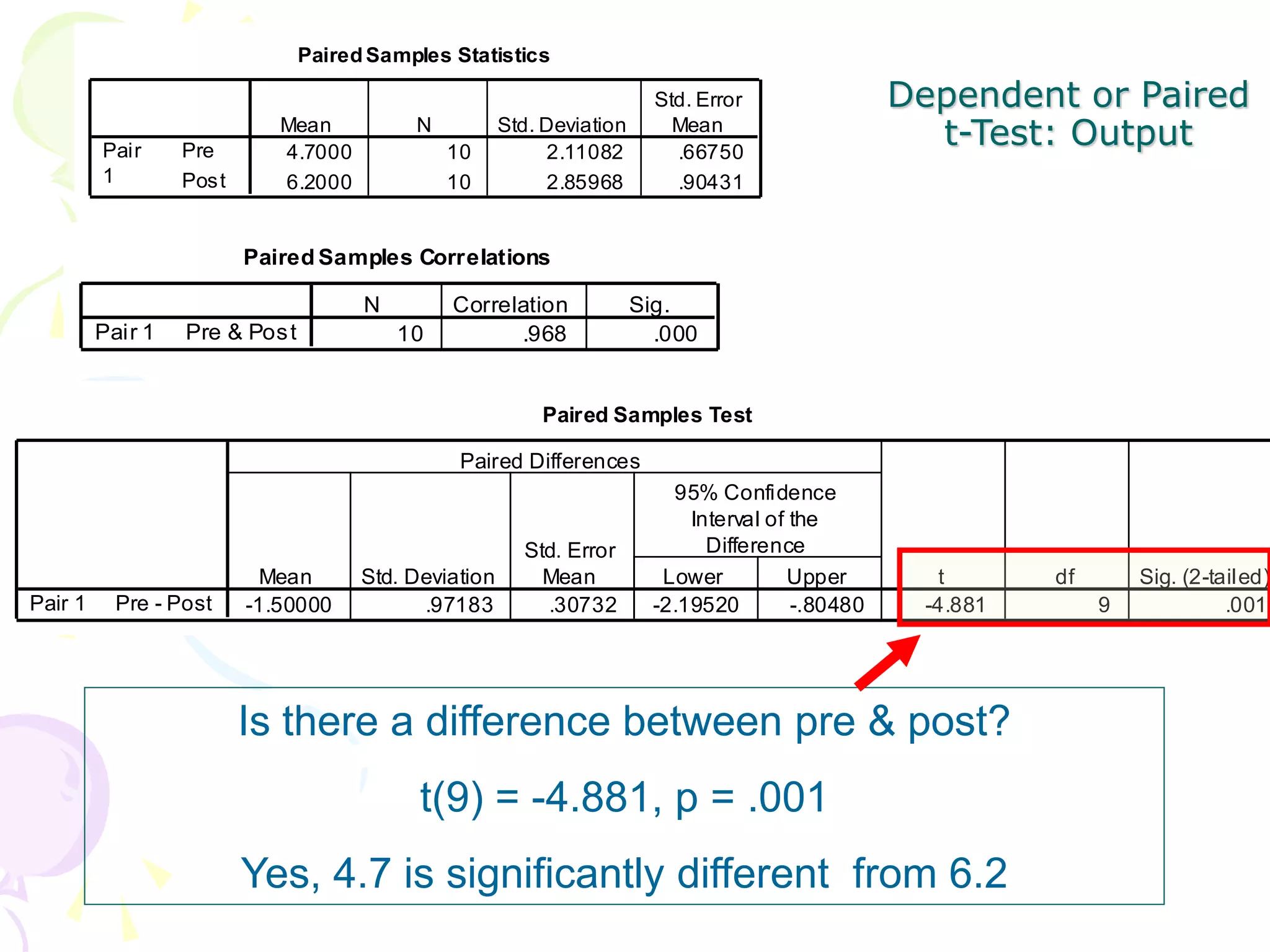
Dependent or Paired
t-Test: Output
PairedSamples Statistics
4.7000 10 2.11082 .66750
6.2000 10 2.85968 .90431
Pre
Post
Pair
1
Mean N Std. Deviation
Std. Error
Mean
Paired Samples Correlations
10 .968 .000
Pre & Post
Pair 1
N Correlation Sig.
Paired Samples Test
-1.50000 .97183 .30732 -2.19520 -.80480 -4.881 9 .001
Pre - Post
Pair 1
Mean Std. Deviation
Std. Error
Mean Lower Upper
95% Confidence
Interval of the
Difference
Paired Differences
t df Sig. (2-tailed)
Is there a difference between pre & post?
t(9) = -4.881, p = .001
Yes, 4.7 is significantly different from 6.2

Unit-5.-t-test.ppt

  • 1.
  • 2.
    Review 6 Stepsfor Significance Testing 1. Set alpha (p level). 2. State hypotheses, Null and Alternative. 3. Calculate the test statistic (sample value). 4. Find the critical value of the statistic. 5. State the decision rule. 6. State the conclusion.
  • 3.
    t-test • t –testis about means: distribution and evaluation for group distribution • Withdrawn form the normal distribution • The shape of distribution depend on sample size and, the sum of all distributions is a normal distribution • t- distribution is based on sample size and vary according to the degrees of freedom
  • 4.
    What is thet -test • t test is a useful technique for comparing mean values of two sets of numbers. • The comparison will provide you with a statistic for evaluating whether the difference between two means is statistically significant. • t test is named after its inventor, William Gosset, who published under the pseudonym of student. • t test can be used either : 1.to compare two independent groups (independent- samples t test) 2.to compare observations from two measurement occasions for the same group (paired-samples t test).
  • 5.
    What is thet -test • The null hypothesis states that any difference between the two means is a result to difference in distribution. • Remember, both samples drawn randomly form the same population. • Comparing the chance of having difference is one group due to difference in distribution. • Assuming that both distributions came from the same population, both distribution has to be equal.
  • 6.
    What is thet -test • Then, what we intend: “To find the difference due to chance” • Logically, The larger the difference in means, the more likely to find a significant t test. • But, recall: 1.Variability More variability = less overlap = larger difference 2. Sample size Larger sample size = less variability (pop) = larger difference
  • 7.
    Types 1. The independent-samplet test is used to compare two groups' scores on the same variable. For example, it could be used to compare the salaries of dentists and physicians to evaluate whether there is a difference in their salaries. 2. The paired-sample t test is used to compare the means of two variables within a single group. For example, it could be used to see if there is a statistically significant difference between starting salaries and current salaries among the general physicians in an organization.
  • 8.
    Assumption 1. Dependent variableshould be continuous (I/R) 2. The groups should be randomly drawn from normally distributed and independent populations e.g. Male X Female Dentist X Physician Manager X Staff NO OVER LAP
  • 9.
    Assumption 3. the independentvariable is categorical with two levels 4. Distribution for the two independent variables is normal 5. Equal variance (homogeneity of variance) 6. large variation = less likely to have sig t test = accepting null hypothesis (fail to reject) = Type II error = a threat to power Sending an innocent to jail for no significant reason
  • 10.
    Independent Samples t-test •Used when we have two independent samples, e.g., treatment and control groups. • Formula is: • Terms in the numerator are the sample means. • Term in the denominator is the standard error of the difference between means. diff X X SE X X t 2 1 2 1   
  • 11.
    Independent samples t-test Theformula for the standard error of the difference in means: 2 2 2 1 2 1 N SD N SD SEdiff   Suppose we study the effect of caffeine on a motor test where the task is to keep a the mouse centered on a moving dot. Everyone gets a drink; half get caffeine, half get placebo; nobody knows who got what.
  • 12.
    Independent Sample Data (Dataare time off task) Experimental (Caff) Control (No Caffeine) 12 21 14 18 10 14 8 20 16 11 5 19 3 8 9 12 11 13 15 N1=9, M1=9.778, SD1=4.1164 N2=10, M2=15.1, SD2=4.2805
  • 13.
    Independent Sample Steps(1) 1. Setalpha. Alpha = .05 2. State Hypotheses. Null is H0: 1 = 2. Alternative is H1: 1  2.
  • 14.
    Independent Sample Steps(2) 3. Calculatetest statistic: 93 . 1 10 ) 2805 . 4 ( 9 ) 1164 . 4 ( 2 2 2 2 2 1 2 1      N SD N SD SEdiff 758 . 2 93 . 1 322 . 5 93 . 1 1 . 15 778 . 9 2 1         diff SE X X t
  • 15.
    Independent Sample Steps (3) 4.Determine the critical value. Alpha is .05, 2 tails, and df = N1+N2-2 or 10+9- 2 = 17. The value is 2.11. 5. State decision rule. If |-2.758| > 2.11, then reject the null. 6. Conclusion: Reject the null. the population means are different. Caffeine has an effect on the motor pursuit task.
  • 16.
  • 17.
    Using SPSS • OpenSPSS • Open file “SPSS Examples” for Lab 5 • Go to: – “Analyze” then “Compare Means” – Choose “Independent samples t-test” – Put IV in “grouping variable” and DV in “test variable” box. – Define grouping variable numbers. • E.g., we labeled the experimental group as “1” in our data set and the control group as “2”
  • 18.
    Independent Samples Exercise Experimental Control 1220 14 18 10 14 8 20 16 Work this problem by hand and with SPSS. You will have to enter the data into SPSS.
  • 19.
    Group Statistics 5 12.00003.1623 1.4142 4 18.0000 2.8284 1.4142 GROUP experimental group control group TIME N Mean Std. Deviation Std. Error Mean Independent Samples Test .130 .729 -2.958 7 .021 -6.0000 2.0284 -10.7963 -1.2037 -3.000 6.857 .020 -6.0000 2.0000 -10.7493 -1.2507 Equal variances assumed Equal variances not assumed TIME F Sig. Levene's Test for Equality of Variances t df Sig. (2-tailed) Mean Difference Std. Error Difference Lower Upper 95% Confidence Interval of the Difference t-test for Equality of Means SPSS Results
  • 20.
  • 21.
    Dependent Samples t-test •Used when we have dependent samples – matched, paired or tied somehow – Repeated measures – Brother & sister, husband & wife – Left hand, right hand, etc. • Useful to control individual differences. Can result in more powerful test than independent samples t-test.
  • 22.
    Dependent Samples t Formulas: diff X SE D tD  t is the difference in means over a standard error. pairs D diff n SD SE  The standard error is found by finding the difference between each pair of observations. The standard deviation of these difference is SDD. Divide SDD by sqrt (number of pairs) to get SEdiff.
  • 23.
    Another way towrite the formula pairs D X n SD D t D 
  • 24.
    Dependent Samples t example PersonPainfree (time in sec) Placebo Difference 1 60 55 5 2 35 20 15 3 70 60 10 4 50 45 5 5 60 60 0 M 55 48 7 SD 13.23 16.81 5.70
  • 25.
    Dependent Samples t Example(2) 55 . 2 5 70 . 5    pairs diff n SD SE 75 . 2 55 . 2 7 55 . 2 48 55      diff SE D t 1. Set alpha = .05 2. Null hypothesis: H0: 1 = 2. Alternative is H1: 1  2. 3. Calculate the test statistic:
  • 26.
    Dependent Samples t Example(3) 4. Determine the critical value of t. Alpha =.05, tails=2 df = N(pairs)-1 =5-1=4. Critical value is 2.776 5. Decision rule: is absolute value of sample value larger than critical value? 6. Conclusion. Not (quite) significant. Painfree does not have an effect.
  • 27.
    Using SPSS fordependent t- test • Open SPSS • Open file “SPSS Examples” (same as before) • Go to: – “Analyze” then “Compare Means” – Choose “Paired samples t-test” – Choose the two IV conditions you are comparing. Put in “paired variables box.”
  • 28.
    Dependent t- SPSSoutput Paired Samples Statistics 55.0000 5 13.2288 5.9161 48.0000 5 16.8077 7.5166 PAINFREE PLACEBO Pair 1 Mean N Std. Deviation Std. Error Mean Paired Samples Correlations 5 .956 .011 PAINFREE & PLACEBO Pair 1 N Correlation Sig. Paired Samples Test 7.0000 5.7009 2.5495 -7.86E-02 14.0786 2.746 4 .052 PAINFREE - PLACEBO Pair 1 Mean Std. Deviation Std. Error Mean Lower Upper 95% Confidence Interval of the Difference Paired Differences t df Sig. (2-tailed)
  • 29.
    Relationship between tStatistic and Power • To increase power: – Increase the difference between the means. – Reduce the variance – Increase N – Increase α from α = .01 to α = .05
  • 30.
    To Increase Power •Increase alpha, Power for α = .10 is greater than power for α = .05 • Increase the difference between means. • Decrease the sd’s of the groups. • Increase N.
  • 31.
  • 32.
  • 33.
  • 34.
  • 35.
    Independent t-Test: Output Group Statistics 102.2820 1.24438 .39351 10 1.9660 1.50606 .47626 Group Active Passive Ab_Error N Mean Std. Deviation Std. Error Mean Independent Samples Test .513 .483 .511 18 .615 .31600 .61780 -.98194 1.61394 .511 17.382 .615 .31600 .61780 -.98526 1.61726 Equal variances assumed Equal variances not assumed Ab_Error F Sig. Levene's Test for Equality of Variances t df Sig. (2-tailed) Mean Difference Std. Error Difference Lower Upper 95% Confidence Interval of the Difference t-test for Equality of Means Are the groups different? t(18) = .511, p = .615 NO DIFFERENCE 2.28 is not different from 1.96
  • 36.
    Dependent or Pairedt-Test: Define Variables
  • 37.
    Dependent or Pairedt-Test: Select Paired-Samples
  • 38.
    Dependent or Pairedt-Test: Select Variables
  • 39.
    Dependent or Pairedt-Test: Options
  • 40.
    Dependent or Paired t-Test:Output PairedSamples Statistics 4.7000 10 2.11082 .66750 6.2000 10 2.85968 .90431 Pre Post Pair 1 Mean N Std. Deviation Std. Error Mean Paired Samples Correlations 10 .968 .000 Pre & Post Pair 1 N Correlation Sig. Paired Samples Test -1.50000 .97183 .30732 -2.19520 -.80480 -4.881 9 .001 Pre - Post Pair 1 Mean Std. Deviation Std. Error Mean Lower Upper 95% Confidence Interval of the Difference Paired Differences t df Sig. (2-tailed) Is there a difference between pre & post? t(9) = -4.881, p = .001 Yes, 4.7 is significantly different from 6.2