ROLE OF TEXTBOOKS IN
CHALLENGING GENDER
INEQUALITIES
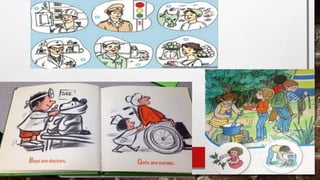
HOW TEXTBOOKS CREATE GENDER ISSUES
•Male chauvinist ideas are reflected in many textbooks.
•Deterioration of status of women can be seen in many
textbooks.
•Emphasis given to certain religious issues and rituals lead to
gender disparity.
•Emphasis given to the writings of male writers lead to
gender disparity.
SOLUTIONS
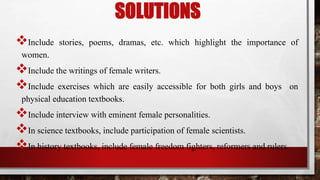
Include stories, poems, dramas, etc. which highlight the importance of
women.
Include the writings of female writers.
Include exercises which are easily accessible for both girls and boys on
physical education textbooks.
Include interview with eminent female personalities.
In science textbooks, include participation of female scientists.
In history textbooks, include female freedom fighters, reformers and rulers.
Avoid the highlighting of certain religious issues.
Include incidents related with women empowerment.
Include current affairs related with persons like Irom Sharmila, Malala,
Mary Kom, etc.
Highlight the right to equality and articles related with that in the
beginning of the textbooks.
In the beginning of the textbooks, include some attractive quotes or
proverbs, which highlight the importance of women.
Ensuring gender equality in syllabus.
Including activities that promote gender equality.
Cite examples giving equal importance to all genders.
Home assignments with gender participation.
Gender fair pictures in textbooks.
Follow up activities on gender equality.
ROLE OF TEACHERS
IN CHALLENGING
GENDER INEQUALITY
ISSUES
Domination of boys in leadership.
Most of the responsible works are given to boys.
Most of the cleaning works are given to girls.
Teacher forms groups on the basis of gender.
School authority orders different consideration for boys and girls.
Most of the school provide different seating arrangement for boys
and girls.
SOLUTIONS
•Teachers must provide equal opportunities for boys and girls.
•Must provide equal responsible work for both boys and girls.
•Must ensure both girls and boys are engaging in cleaning works.
•Must allow students to mingle with each other and teach them to respect each
other.
•Can provide awareness classes among students about equality before law.
•Can provide equal chances to play and perform together.
•Must arrange the class in mixed order.
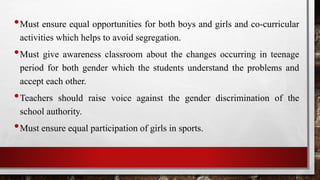
•Must ensure equal opportunities for both boys and girls and co-curricular
activities which helps to avoid segregation.
•Must give awareness classroom about the changes occurring in teenage
period for both gender which the students understand the problems and
accept each other.
•Teachers should raise voice against the gender discrimination of the
school authority.
•Must ensure equal participation of girls in sports.
GENDER IN CONTEXT
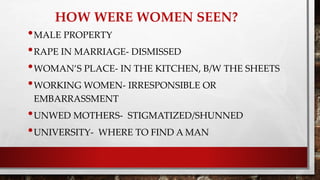
HOW WERE WOMEN SEEN?
•MALE PROPERTY
•RAPE IN MARRIAGE- DISMISSED
•WOMAN’S PLACE- IN THE KITCHEN, B/W THE SHEETS
•WORKING WOMEN- IRRESPONSIBLE OR
EMBARRASSMENT
•UNWED MOTHERS- STIGMATIZED/SHUNNED
•UNIVERSITY- WHERE TO FIND A MAN
Gender in text and context

Gender in text and context

  • 2.
    ROLE OF TEXTBOOKSIN CHALLENGING GENDER INEQUALITIES
  • 4.
    HOW TEXTBOOKS CREATEGENDER ISSUES •Male chauvinist ideas are reflected in many textbooks. •Deterioration of status of women can be seen in many textbooks. •Emphasis given to certain religious issues and rituals lead to gender disparity. •Emphasis given to the writings of male writers lead to gender disparity.
  • 6.
    SOLUTIONS Include stories, poems,dramas, etc. which highlight the importance of women. Include the writings of female writers. Include exercises which are easily accessible for both girls and boys on physical education textbooks. Include interview with eminent female personalities. In science textbooks, include participation of female scientists. In history textbooks, include female freedom fighters, reformers and rulers.
  • 7.
    Avoid the highlightingof certain religious issues. Include incidents related with women empowerment. Include current affairs related with persons like Irom Sharmila, Malala, Mary Kom, etc. Highlight the right to equality and articles related with that in the beginning of the textbooks. In the beginning of the textbooks, include some attractive quotes or proverbs, which highlight the importance of women.
  • 8.
    Ensuring gender equalityin syllabus. Including activities that promote gender equality. Cite examples giving equal importance to all genders. Home assignments with gender participation. Gender fair pictures in textbooks. Follow up activities on gender equality.
  • 20.
    ROLE OF TEACHERS INCHALLENGING GENDER INEQUALITY
  • 21.
    ISSUES Domination of boysin leadership. Most of the responsible works are given to boys. Most of the cleaning works are given to girls. Teacher forms groups on the basis of gender. School authority orders different consideration for boys and girls. Most of the school provide different seating arrangement for boys and girls.
  • 22.
    SOLUTIONS •Teachers must provideequal opportunities for boys and girls. •Must provide equal responsible work for both boys and girls. •Must ensure both girls and boys are engaging in cleaning works. •Must allow students to mingle with each other and teach them to respect each other. •Can provide awareness classes among students about equality before law. •Can provide equal chances to play and perform together. •Must arrange the class in mixed order.
  • 23.
    •Must ensure equalopportunities for both boys and girls and co-curricular activities which helps to avoid segregation. •Must give awareness classroom about the changes occurring in teenage period for both gender which the students understand the problems and accept each other. •Teachers should raise voice against the gender discrimination of the school authority. •Must ensure equal participation of girls in sports.
  • 24.
  • 25.
    HOW WERE WOMENSEEN? •MALE PROPERTY •RAPE IN MARRIAGE- DISMISSED •WOMAN’S PLACE- IN THE KITCHEN, B/W THE SHEETS •WORKING WOMEN- IRRESPONSIBLE OR EMBARRASSMENT •UNWED MOTHERS- STIGMATIZED/SHUNNED •UNIVERSITY- WHERE TO FIND A MAN