Welcome to Our
Presentation
NAME ID
Ashraful Islam- 5505
Sabiha Sultana 5502
Md. Hafizur Rahman 5447
Md. Kauser Ahamed 5513
Nusrat Jahan 5497
Shamira Sultana 4204
GROUP MEMBERS
Grouping Jobs
Introduction:
Grouping jobs is the second building block of
organization Structure. The process of grouping
jobs is also called departmentalization.
Grouping Jobs: Departmentalization
Departmentalization: is the process of grouping
jobs according to some logical arrangement.
In smaller organizations, the owner-
manager/partner may be able to personally
oversee everyone who works there.
As an organization grows, new managerial
positions are created to supervise work of others
grouped according to some plan which leads to the
creation of departments.
Types of Departmentalization:
There are four types of Departmentalization.
 Functional Departmentalization
 Product Departmentalization.
 Customer Departmentalization.
 Location Departmentalization.
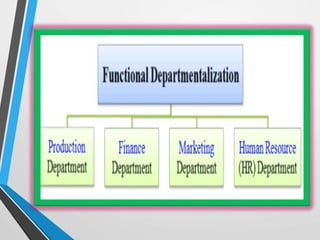
Functional departmentalization:
Grouping activities by functions performed. Activities
can be grouped according to function (work being done)
to pursue economies of scale by placing employees with
shared skills and knowledge into departments for
example human resources, IT, accounting,
manufacturing, logistics, and engineering. Functional
departmentalization can be used in all types of
organizations.
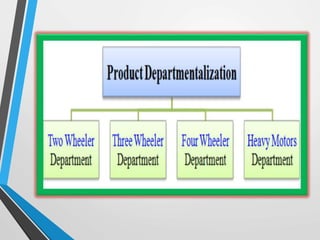
Product Departmentalization
Grouping activities by product line. Tasks can
also be grouped according to a specific product
or service, thus placing all activities related to the
product or the service under one manager. Each
major product area in the corporation is under the
authority of a senior manager who is specialist
in, and is responsible for, everything related to
the product line. LA Gear is an example of
company that uses product departmentalization.
Its structure is based on its varied product lines
which include women’s footwear etc.
Customer Departmentalization:
Grouping activities on the basis of common customers
or types of customers. Jobs may be grouped according
to the type of customer served by the organization. The
assumption is that customers in each department have a
common set of problems and needs that can best be met
by specialists. The sales activities in an office supply
firm can be broken down into three departments that
serve retail, wholesale and government accounts
Location Departmentalization:
Grouping activities on the basis of territory. If an
organization's customers are geographically dispersed,
it can group jobs based on geography. For example,
the organization structure of Coca-Cola has reflected
the company’s operation in two broad location areas –
the North American sector and the international sector,
which includes the Pacific Rim, the European
Community, Northeast Europe, Africa and Latin
America groups.
Other Forms of Departmentalization may
include:
Departmentalization by Time: grouping
certain activities by time – shift system in which
each shift has its own superintendent, who
reports to the plant manager, and functional
departments.
Hospitals and airlines use time as well to
departmentalize.
Departmentalization by Sequence:
university registration by senior, junior, etc;
credit checks by employees according to
customer name; insurance company claim
division by policy number.
 Other Considerations for Departmentalization:
 In some large organization, departments may be referred to
as Divisions, Units, Sections and Bureaus.
 Regardless of the label used, they represent groups of jobs
that have been tied together according to some unifying
principle.
Almost all organizations are likely to use multiple bases of
departmentalization, depending on level.
 It is quite common that organizations use a variety of bases
of departmentalization for different levels and different sets of
activities.
Conclusion:
Manager need to understand throughly the
strengths and implications weaknesses of each
common method to approach to
departmentalization for their own unique
circumstances
Grouping Jobs

Grouping Jobs

  • 1.
  • 2.
    NAME ID Ashraful Islam-5505 Sabiha Sultana 5502 Md. Hafizur Rahman 5447 Md. Kauser Ahamed 5513 Nusrat Jahan 5497 Shamira Sultana 4204 GROUP MEMBERS
  • 3.
  • 4.
    Introduction: Grouping jobs isthe second building block of organization Structure. The process of grouping jobs is also called departmentalization.
  • 5.
    Grouping Jobs: Departmentalization Departmentalization:is the process of grouping jobs according to some logical arrangement. In smaller organizations, the owner- manager/partner may be able to personally oversee everyone who works there. As an organization grows, new managerial positions are created to supervise work of others grouped according to some plan which leads to the creation of departments.
  • 6.
    Types of Departmentalization: Thereare four types of Departmentalization.  Functional Departmentalization  Product Departmentalization.  Customer Departmentalization.  Location Departmentalization.
  • 7.
    Functional departmentalization: Grouping activitiesby functions performed. Activities can be grouped according to function (work being done) to pursue economies of scale by placing employees with shared skills and knowledge into departments for example human resources, IT, accounting, manufacturing, logistics, and engineering. Functional departmentalization can be used in all types of organizations.
  • 9.
    Product Departmentalization Grouping activitiesby product line. Tasks can also be grouped according to a specific product or service, thus placing all activities related to the product or the service under one manager. Each major product area in the corporation is under the authority of a senior manager who is specialist in, and is responsible for, everything related to the product line. LA Gear is an example of company that uses product departmentalization. Its structure is based on its varied product lines which include women’s footwear etc.
  • 11.
    Customer Departmentalization: Grouping activitieson the basis of common customers or types of customers. Jobs may be grouped according to the type of customer served by the organization. The assumption is that customers in each department have a common set of problems and needs that can best be met by specialists. The sales activities in an office supply firm can be broken down into three departments that serve retail, wholesale and government accounts
  • 13.
    Location Departmentalization: Grouping activitieson the basis of territory. If an organization's customers are geographically dispersed, it can group jobs based on geography. For example, the organization structure of Coca-Cola has reflected the company’s operation in two broad location areas – the North American sector and the international sector, which includes the Pacific Rim, the European Community, Northeast Europe, Africa and Latin America groups.
  • 15.
    Other Forms ofDepartmentalization may include: Departmentalization by Time: grouping certain activities by time – shift system in which each shift has its own superintendent, who reports to the plant manager, and functional departments. Hospitals and airlines use time as well to departmentalize. Departmentalization by Sequence: university registration by senior, junior, etc; credit checks by employees according to customer name; insurance company claim division by policy number.
  • 16.
     Other Considerationsfor Departmentalization:  In some large organization, departments may be referred to as Divisions, Units, Sections and Bureaus.  Regardless of the label used, they represent groups of jobs that have been tied together according to some unifying principle. Almost all organizations are likely to use multiple bases of departmentalization, depending on level.  It is quite common that organizations use a variety of bases of departmentalization for different levels and different sets of activities.
  • 17.
    Conclusion: Manager need tounderstand throughly the strengths and implications weaknesses of each common method to approach to departmentalization for their own unique circumstances